(Lyndon Johnson)向国会提交了《向贫困宣战》特别咨文,重述丰裕的美国社会存在的严重贫困现象。注意:他是美国民主党人。
眨眼之间,半个世纪过去了。今天,2015年5月12日,现任美国第44任总统的贝拉克·奥巴马(Barack Obama) 出席了在乔治城大学(Georgetown University)举行的一个以脱贫为主题的研讨会,发表《向贫困宣战》特别演讲,再次重述丰裕的美国社会存在的严重贫困现象。注意:他也是美国民主党人。
一个美国总统在4年的任期内,如果没有建树、治国无能的话,就是江郎才尽,等待被美国的选民们抛弃。那么,美国的民主党在长达半个世纪漫长的期间,无能力落实自己政党的政纲,实现《向贫困宣战》的理想,这个政党是不是应该解甲归田,立即解散呢?
显然,奥巴马总统在讲话中,借口美国全社会一直没有“下定决心”在降低贫困方面做出一些成绩;并怀疑目前美国全社会上下,在降低贫困问题上,很大程度上未怀有真诚的意愿,为自己和美国民主党在《向贫困宣战》政纲方面失职和无能开脱责任。
Joseph Toomey所著《An Unworthy Future——The Grim Reality of Obama’s Green Energy Delusions》一书中指出,奥巴马的“绿色能源”政策,强调其对农业的益处,无视负面影响,不但达不到“降低温室气体排放”的目的, 该政策甚至有可能导致一场生态灾难。没能解决全球环境危机,还会使穷人更穷。作者在该书第428页写到:“And yet politicians like Obama, who pretend to be on the side of the poor, support them."
美国总统奥巴马《向贫困宣战》的讲话,只是作秀而已(用奥巴马自己的话讲,就是“空谈”),听众不必当真!
----------------------------------------------------------------------------------------
来源:美国之音 2015-05-12
向贫困宣战 奥巴马促美国上下动真格的

美国总统奥巴马在乔治城大学举行的一个以脱贫为主题的研讨会上讲话(2015年5月12日)
奥巴马总统星期二表示希望美国全社会做出更多努力,减少美国国内的贫困现象,缩小美国富裕阶层和中产阶层以及贫困人口之间不断扩大的收入不平等。
奥巴马总统星期二出席了在乔治城大学(Georgetown University)举行的一个以脱贫为主题的研讨会。在一个多小时的时间里,奥巴马总统坐在主席台上,同出席会议的各界人士一道,就颇为广泛的议题,展开了对话。
奥巴马总统说,世界上最为繁荣富有的国家不能做出更多努力、以建立一个更加平等的社会,这是说不过去的。
会议期间,奥巴马总统和一位报纸专栏作家、来自哈佛大学的一位公共政策课题教授、以及美国最主要的商业游说团体之一的主席交换了意见。
奥巴马总统表示,从过去的经验来看,只要美国全社会“下定决心”,就能够在降低贫困方面做出一些成绩。
不过奥巴马总统也表示,目前面临的一个基本问题是:美国全社会上下,在降低贫困问题上,到底在多大程度上怀有真诚的意愿。
奥巴马总统说,没有人愿意生活在贫穷之中,但是很多人一生下来,就处于贫困状态、或者幼年的时候就面临艰难的生活环境;这其中的原因有很多,或者是父母缺少就业机会、或者是当地学校条件差、或者像奥巴马总统幼年时期一样,被亲生父亲遗弃。
奥巴马总统说,“贫穷让人备受煎熬。人们不会喜欢受穷。贫穷本身耗费人一生的宝贵年华,让人备受压力,度日艰难。”
奥巴马总统说,解决贫困问题,一需要政治意愿,二需要政府开支。
奥巴马总统表示,“向贫困宣战的最好的方式就是就业机会。”但是美国联邦、州一级和地方各级政府往往对一些曾经出资经营的扶贫项目、改善教育质量的项目,在项目进行的中途,就停止提供资金。
奥巴马总统强调指出,美国的公司高管和普通工人之间的收入鸿沟急剧扩大。他同时指责共和党人控制的国会拒绝针对让富有的对冲基金高管获益的减税优惠,进行任何的改动。
他说:“假如不能让美国社会中那些‘赢了彩票的人’为大家做出点贡献的话,其余的都是空谈。”
----------------------------------------------------------------------------
来源:《环球财经》 2014-03-02
美国治贫五十年
《环球财经》记者 刘洋
“或者因为贫困,或者因为肤色,更多则是兼而有之,很多美国人正不幸地生活在希望的边缘。我们希望可以通过努力为他们创造机会,让他们告别绝望。自今天开始,政府将向美国的贫困无条件宣战,我希望国会和美国的民众都能为这项伟大的事业贡献自己的力量。”
1964年1月8日,时任美国总统的林登?约翰逊(Lyndon Johnson)在其著名演讲《向贫困宣战》(War on Poverty)中宣布,美国政府将从那时开始竭尽全力地为贫困阶层提升教育医疗水平,提高工作技能并增加工作机会,以求通过资源和政策的倾斜最大限度消灭贫困。
约翰逊总统的呼吁看起来就像对美国民间延续多年的某些声音的回应。在那之前两年,迈克尔·哈灵顿(Michael Harrington)就在其极富影响力的畅销书《另一个美国》中表达了对贫困的认识和态度。当时,他将贫困描述为“一块很少被大多数美国同胞关注到的土地”。
寻找穷人
【统计指标的调整对于医治贫困非常重要。因为贫困是一个主观概念,美国实际上不可能像预想的那样完全消除贫困,充分利用现有资源解决急迫的现实问题才是治贫思想的核心。】
在研究美国南部废除学校种族歧视问题时,哈瑞尔?罗杰斯(Harrell Rodgers)教授很快发现美国的贫困问题竟然如此严峻。在佐治亚州、亚拉巴马州、密西西比州的农场中,工人们看起来似乎还生活在17世纪,那里的房间没有自来水也没有门窗。在应邀去华盛顿作一个有关民权影响的报告时,他又在自己居住的旅店旁边见到了他一生见过最肮脏的房子。
对战胜贫困怀有坚定信念的人们相信,邮政编码和肤色种族不能决定人的一生,只要提供合适的阶梯,每个人都可以获得成功。但要实现这样的理想,人们要面对的挑战实在太多。人们对于贫困——这块“土地”的了解太少:很多时候,贫穷就像一个难以量化的主观词汇,人们其实很难分辨只能租住狭窄公寓的银行家和依靠耕种自家土地生活的农民谁更贫困。
这反映出发展经济学中一个重要的问题,尽管人们知道贫困指“收入无法满足最基本的需求”,但人们不知道怎样定义需求,也不知道如何衡量收入。需求又与经济发展密切相关:约翰逊宣布向贫困开战时,很多美国中产家庭都没有冷热水供应;但现在,这已经成为美国家庭的“标配”,但少有指标体系会反应这种变迁。所有基于收入的指标体系还都会低估居民收益,持续的低估会在统计层面拉升贫困人口比率,从而令人们对能否战胜贫困产生怀疑。
宣战贫困的战略提出后,美国意识到贫困问题的解决绝非朝夕之功,贫困的衡量也没有普适标准。为改进衡量体系,美国人口调查统计局(Census Bureau)提出了改进型贫困测度法(Supplemental Poverty Measure,SPM),该方法针对第33支出百分位区间上家庭的实际消费情况得出必要消费后,还上浮20%以允许这些家庭进行其他消费,并根据家庭规模、结构及所在地区进行了修正。在此基础上,SPM对自有住房和租房家庭分别设置了贫困线。
与之前的指标体系相比,SPM做了很多细微却重要的改进。它不再是一个基于收入的评估体系,而是通过计入非货币福利更综合地反应家庭的贫困状况;它也排除了税收和运费对居民福利的影响,从而使评价适用不同地区;它还排除了政府承担部分的医疗支出,因为这些费用并不能被居民应用于其他用途;最重要的是,SPM会随时修改必需品的构成,而之前的指标体系只是在货币层面上对通货膨胀做出反应,实物层面上的反馈一直都相当有限。
统计指标的这些调整对于医治贫困非常重要。因为贫困是一个主观概念,美国实际上不可能像预想的那样完全消除贫困,充分利用现有资源解决急迫的现实问题才是治贫思想的核心。况且,美国的贫困也只是相对的贫困:在美国,40%的贫困家庭有房产,70%的贫困家庭有车,97%的贫困家庭有彩色电视机——看电视是最便宜的娱乐方式,美国最贫穷的5%仍然是全世界最富裕10%人群中的一员,这些事实几乎很难让人将其与贫困联系在一起。
成绩为何褪色
【最大的挑战其实是制度本身,无限制的福利补贴鼓励更多人变成穷人,以市场为导向成为后来美国政府解决贫困问题的根本出发点。】
“对这代人而言,消灭贫穷是个非常有意义的想法,我们应该努力在1980年前实现这个目标。”1971年,解释约翰逊总统的决策时,总统经济顾问罗伯特?拉普曼(Robert Lampman)说,“因为届时,我们的下一代将制定新的社会目标,其中也许就包括他们自己的分配计划。”但仅仅两年之后,美国贫困率的下降就似乎进入了瓶颈,至今美国也没能真正告别贫困。
脱贫进程减速的一个重要原因在于,约翰逊扩大社保网络的努力太过成功,以至于老年贫困人口比率在上世纪60年代下降过快。1959年时,美国65岁以上老年人中有36.9%处在贫困线以下;到1974年,这一数字已降低到14.6;再经过随后38年的努力,这一数字才进一步降低到9.1%。因此,尽管非老龄群体的脱贫一直在加速,但统计数据再也难见辉煌。
脱贫进程减速的另一个重要原因在于经济发展没能惠及中下阶层。尽管美国自1975年开始的35年间始终维持着大约2%的真实经济增长,但经济增长成果大多被社会中上阶层获得:全美最富裕5%人群的真实收入在此期间上升了57%,最贫穷20%人群的真实收入在此期间却只上涨了3.7%。这与从1947年到1975年间的情形形成了鲜明的对比:在这一区间,全美最富裕5%人群的真实收入上涨了86%,但最贫穷20%人群的真实收入上涨了90%。
约翰逊担任总统时大幅提升了美国最低真实工资被使其在1968年达到顶峰。随后,美国最低真实工资水平或者下降或者上升,但再也没能超过这一水平,今天的最低工资——7.25美元每小时的真实价值只与1950年时相当。按照这一标准,一个拥有两个孩子的单亲即便全职工作也只能保证家庭生活徘徊在贫困线附近,而单亲家庭在美国正变得越来越多。
社会变迁是脱贫进程减速的又一个重要原因。上世纪60年代的“伟大社会运动”导致公众对单亲父母和离婚的态度更加宽容,人们因此更容易选择离婚和非婚生育,女性经济独立进一步强化了这种趋势。单亲女性家庭数量剧增是20世纪美国最重大的社会变化之一,但这类家庭其实非常脆弱。1960年,单亲女性家庭只占0.9%,但这一数字到1985年已经提升到22%,其中大约34%的单亲女性家庭都生活在贫困中,1/5的美国儿童因此处境艰难。
造成收入差距扩大的另一个重要原因在于工会势力的衰退。1983年时,美国还有23.5%的工人加入了各种工会组织;而到2012年,这一比例已经降至12.5%。在传统美国社会,工会是提升中低收入工人收入的重要力量,工会力量的弱化必然影响到收入分配的公平。
最大的挑战其实是制度本身,无限制的福利补贴鼓励更多人变成穷人,改革福利制度的呼声因此在美国社会日渐高涨。克林顿上台后发誓要“终结我们熟知的福利制度”,国会因此在1996年通过了《个人责任和工作机会协调法案》,以期把单纯的救济和普遍的福利改革为工作福利和有限救助,以市场为导向成为随后美国历届政府解决贫困问题的根本出发点。
真正的挑战
【结构性失业一直是经济演进过程中最痛苦的现象,针对这一现象的公共政策正在变成一个全球性问题。】
奥巴马堪称约翰逊社保思想遗产的最大受益者。如果没有后者发起建设的健全社会保障网络,美国的贫困率在金融危机期间至少会上升4.8个百分点,奥巴马的执政能力将因此遭受严重质疑。看看上世纪80年代的情况,就知道奥巴马有多幸运:在那次尚不及此次严重的经济危机中,由于社保网络尚未建成,美国的贫困率从1979年的17.4%迅速上升至22.1%。
这个巨大的网络在美国社会中扮演着重要的角色。如果没有这个网络,美国曾经高速的阶层流动将失去最重要的基础,美国以至引以为傲的美国梦也将真正不再属于穷人。从某种意义上讲,美国其实并不在意贫困,这个国家更在意的是人们是否还拥有改变命运的机会。
长久以来,流行文化喜欢通过各种感人的故事来演绎美国梦,但这可能与美国的现实并不相符。如果用子女收入与父母收入的相关度作为指标,人们很容易就会发现美国社会的成绩单并不出众:在欧洲,美国的成绩单仅与英国和意大利相当,而落后于其他欧洲发达国家。
在美国,社会阶层的固化已经开始影响美国的核心价值观——美国梦。现在,贫民家庭孩子比富裕家庭孩子的平均收入要少20%到40%,前者中40%的男孩和25%的女孩都会深陷贫困。同时,一个地区的收入相差越悬殊,穷人孩子完成学业的比例就越低但未婚怀孕的比例就越高,而这些都有可能衍生出其他更加严重的社会问题,从而令贫困变得更难解决。
收入不平等又强化了贫困的代际传递。“美国梦”层出不穷并不能代表成功中的家庭因素在减弱。由于高知阶层倾向于相互结合,他们的孩子很小就会显示出家庭背景带来的优势。到四岁时,收入最高家庭孩子的文学和数学成绩均值已在第69百分位数区间,收入最低家庭孩子的两项成绩均值只分别位于第34和32百分位数区间,而文学和数学被认为与成功关系颇最深。一旦处在社会底层的人看不到成功的希望,贫困就会固化下来并不断传承下去。
奥巴马因此其实面临着新的挑战。约翰逊的呼吁发起之初,一份工作就能让一个家庭摆脱贫困;而今天,哪怕一个家庭只有一个孩子,一份全职工作如果只能获得最低薪水也不足以让这个家庭摆脱贫困。只是依靠勤奋,当今美国的任何人也不能保证可以摆脱贫困的困扰。
问题的根源在经济本身。伴随经济结构的变化,美国社会对高知职位和低技能职位的需求在增加,对中等职位的需求却在减弱。由于传统中产阶级向上竞争的空间有限,向下竞争的他们最终将那些受教育较少的工人挤出了劳动市场,失业于是开始刺激贫困的种子蔓延。
其实,这种工作机会的极化现象并非只存在于美国,欧洲劳动力市场也在经历这种重构。结构性失业一直是经济演进过程中最痛苦的现象,针对这一现象的公共政策正在变成一个全球性问题。作为一个鼓励自由竞争而抵制政府干预国家的领袖,奥巴马必须给出自己的答案。
奥巴马的方案
【奥巴马提出美国要在2020年时再度成为全球高等教育的领导者。今天,教育在战胜贫困和缩小贫富差距中所扮演的角色愈发重要。让民众对未来重拾信心的最好办法就是教育。】
奥巴马决定师从约翰逊,后者很早就指出必须激励人们投身工作才能消除贫困。颁布《经济机会法案》(Economic Opportunity Act)时,他曾这样描述其思路,“我们不是要通过保护让贫民更安全地蜷缩在角落里,而是希望通过鼓励让他们跳出角落为希望和未来不懈奋斗”。
让民众对未来重拾信心的最好办法就是教育。今天,教育在战胜贫困和缩小贫富差距中所扮演的角色愈发重要了:1959年时,高中辍学生陷入贫困的几率“只”是大学毕业生的3.8倍;而现在,这一数字已经提升至6.1。对全社会最贫穷的20%的人而言,如果他们的孩子没能获得大学学位,这些孩子将有45%的可能继续忍受贫困;但如果他们获得了大学甚至更高一级的学位,那么他们就将只有16%的可能性继续忍受贫穷——教育的价值显而易见。
让儿童接受教育进而摆脱贫穷的关键是早期儿童教育。向贫困宣战开始后不久,美国发起了“头脑出发(Head Start)”计划,该计划被认为是“过去50年中最伟大的治贫措施”。研究表明,这项计划通过帮助孩子接受早期教育至少弥补了家庭背景带来收入差距的三成。
对早期教育的关注和投资之所以能在治贫领域有如此突出的表现,是因为它可以显著减少政府随后在其他社会保障领域的支出。同时,对早期教育的投资有助于孩子接受更多的教育,从而为经济发展提供合适且足够的智力资本,而经济发展是最终消除贫困的终极办法。
奥巴马上台后提出美国要在2020年时再度成为全球高等教育的领导者,美国联邦和各州政府为此制定了内容更复杂也更具体的教育系统改革方案以保证美国学生可以在大学和工作中获得成功。改革举措包括雇佣和培养大量符合未来要求的教师,尽快消除不同种族、肤色、民族和性别学生正在遭受的教育歧视,保证数字手段在教学中的广泛使用以及提升全美最差学校的竞争力。仅最后一项,全美就将有1500所学校获得政府的50亿美元资金。
由于大学毕业工人的平均收入几乎是只有高中毕生证书工人的两倍,更高的教育几乎是穷人通往中产阶级最直接也最简单的路径。但现在,美国在高中教育和大学教育直接却有一条鸿沟:在结束高中教育之后,那些出生在最富裕家庭的孩子几乎必然可以进入最好的大学,但那些出生在最贫穷家庭的孩子就只有一半的机会从高中顺利升入大学以继续接受教育。
为了让更多美国人进入大学、负担学费和完成学业,奥巴马政府通过各种手段为超过1000万低收入家庭提供了财政支持,并通过大规模改革学生助学贷款方案令贷款学生在未来十年节省超过680亿美元的支出。这可以使很多学生在进入工作岗位后不会因繁重的助学贷款而无法买房安家,贷款负担的降低可以进一步提升美国学生进入大学的动力和收益。
这也许是奥巴马政府带给美国经济的最大财富。
(本文所涉文件材料由国务院发展研究中心国际技术经济研究所研究员张保明提供;关于治贫方面的相关阅读,可参考《环球财经》2013年9月刊“环球访谈录”《以证据为基础的贫困治理之路》、《让发展中国家政府接受以证据为基础的发展理念》)
-------------------------------------------------------------------------------
来源:http://www.americanrhetoric.com/speeches/lbj1964stateoftheunion.htm
Lyndon Baines Johnson
First State of the Union Address
delivered 8 January 1964
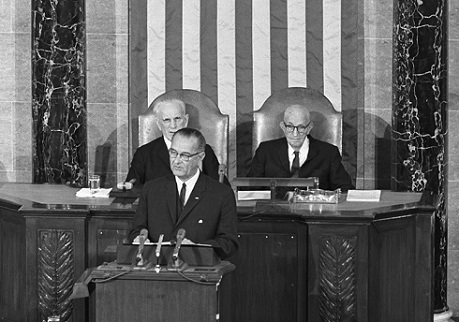
Mr. Speaker, Mr. President, Members of the House and Senate, my fellow Americans:
I will be brief, for our time is necessarily short and our agenda is already long.
Last year's congressional session was the longest in peacetime history. With that foundation, let us work together to make this year's session the best in the Nation's history.
Let this session of Congress be known as the session which did more for civil rights than the last hundred sessions combined; as the session which enacted the most far-reaching tax cut of our time; as the session which declared all-out war on human poverty and unemployment in these United States; as the session which finally recognized the health needs of all our older citizens; as the session which reformed our tangled transportation and transit policies; as the session which achieved the most effective, efficient foreign aid program ever; and as the session which helped to build more homes, more schools, more libraries, and more hospitals than any single session of Congress in the history of our Republic.
All this and more can and must be done. It can be done by this summer, and it can be done without any increase in spending. In fact, under the budget that I shall shortly submit, it can be done with an actual reduction in Federal expenditures and Federal employment.
We have in 1964 a unique opportunity and obligation -- to prove the success of our system; to disprove those cynics and critics at home and abroad who question our purpose and our competence.
If we fail, if we fritter and fumble away our opportunity in needless, senseless quarrels between Democrats and Republicans, or between the House and the Senate, or between the South and North, or between the Congress and the administration, then history will rightfully judge us harshly. But if we succeed, if we can achieve these goals by forging in this country a greater sense of union, then, and only then, can we take full satisfaction in the State of the Union.
Here in the Congress you can demonstrate effective legislative leadership by discharging the public business with clarity and dispatch, voting each important proposal up, or voting it down, but at least bringing it to a fair and a final vote.
Let us carry forward the plans and programs of John Fitzgerald Kennedy -- not because of our sorrow or sympathy, but because they are right.
In his memory today, I especially ask all members of my own political faith, in this election year, to put your country ahead of your party, and to always debate principles; never debate personalities.
For my part, I pledge a progressive administration which is efficient, and honest and frugal. The budget to be submitted to the Congress shortly is in full accord with this pledge.
It will cut our deficit in half -- from $10 billion to $4,900 million. It will be, in proportion to our national output, the smallest budget since 1951.
It will call for a substantial reduction in Federal employment, a feat accomplished only once before in the last 10 years. While maintaining the full strength of our combat defenses, it will call for the lowest number of civilian personnel in the Department of Defense since 1950.
It will call for total expenditures of $97,900 million -- compared to $98,400 million for the current year, a reduction of more than $500 million. It will call for new obligational authority of $103,800 million -- a reduction of more than $4 billion below last year's request of $107,900 million.
But it is not a standstill budget, for America cannot afford to stand still. Our population is growing. Our economy is more complex. Our people's needs are expanding.
But by closing down obsolete installations, by curtailing less urgent programs, by cutting back where cutting back seems to be wise, by insisting on a dollar's worth for a dollar spent, I am able to recommend in this reduced budget the most Federal support in history for education, for health, for retraining the unemployed, and for helping the economically and the physically handicapped.
This budget, and this year's legislative program, are designed to help each and every American citizen fulfill his basic hopes -- his hopes for a fair chance to make good; his hopes for fair play from the law; his hopes for a full-time job on full-time pay; his hopes for a decent home for his family in a decent community; his hopes for a good school for his children with good teachers; and his hopes for security when faced with sickness or unemployment or old age.
Unfortunately, many Americans live on the outskirts of hope -- some because of their poverty, and some because of theft color, and all too many because of both. Our task is to help replace their despair with opportunity.
This administration today, here and now, declares unconditional war on poverty in America. I urge this Congress and all Americans to join with me in that effort.
It will not be a short or easy struggle, no single weapon or strategy will suffice, but we shall not rest until that war is won. The richest Nation on earth can afford to win it. We cannot afford to lose it. One thousand dollars invested in salvaging an unemployable youth today can return $40,000 or more in his lifetime.
Poverty is a national problem, requiring improved national organization and support. But this attack, to be effective, must also be organized at the State and the local level and must be supported and directed by State and local efforts.
For the war against poverty will not be won here in Washington. It must be won in the field, in every private home, in every public office, from the courthouse to the White House.
The program I shall propose will emphasize this cooperative approach to help that one-fifth of all American families with incomes too small to even meet their basic needs.
Our chief weapons in a more pinpointed attack will be better schools, and better health, and better homes, and better training, and better job opportunities to help more Americans, especially young Americans, escape from squalor and misery and unemployment rolls where other citizens help to carry them.
Very often a lack of jobs and money is not the cause of poverty, but the symptom. The cause may lie deeper in our failure to give our fellow citizens a fair chance to develop their own capacities, in a lack of education and training, in a lack of medical care and housing, in a lack of decent communities in which to live and bring up their children.
But whatever the cause, our joint Federal-local effort must pursue poverty, pursue it wherever it exists -- in city slums and small towns, in sharecropper shacks or in migrant worker camps, on Indian Reservations, among whites as well as Negroes, among the young as well as the aged, in the boom towns and in the depressed areas.
Our aim is not only to relieve the symptom of poverty, but to cure it and, above all, to prevent it. No single piece of legislation, however, is going to suffice.
We will launch a special effort in the chronically distressed areas of Appalachia.
We must expand our small but our successful area redevelopment program.
We must enact youth employment legislation to put jobless, aimless, hopeless youngsters to work on useful projects.
We must distribute more food to the needy through a broader food stamp program.
We must create a National Service Corps to help the economically handicapped of our own country as the Peace Corps now helps those abroad.
We must modernize our unemployment insurance and establish a high-level commission on automation. If we have the brain power to invent these machines, we have the brain power to make certain that they are a boon and not a bane to humanity.
We must extend the coverage of our minimum wage laws to more than 2 million workers now lacking this basic protection of purchasing power.
We must, by including special school aid funds as part of our education program, improve the quality of teaching, training, and counseling in our hardest hit areas.
We must build more libraries in every area and more hospitals and nursing homes under the Hill-Burton Act, and train more nurses to staff them.
We must provide hospital insurance for our older citizens financed by every worker and his employer under Social Security, contributing no more than $1 a month during the employee's working career to protect him in his old age in a dignified manner without cost to the Treasury, against the devastating hardship of prolonged or repeated illness.
We must, as a part of a revised housing and urban renewal program, give more help to those displaced by slum clearance, provide more housing for our poor and our elderly, and seek as our ultimate goal in our free enterprise system a decent home for every American family.
We must help obtain more modern mass transit within our communities as well as low-cost transportation between them.
Above all, we must release $11 billion of tax reduction into the private spending stream to create new jobs and new markets in every area of this land.
These programs are obviously not for the poor or the underprivileged alone. Every American will benefit by the extension of social security to cover the hospital costs of their aged parents. Every American community will benefit from the construction or modernization of schools, libraries, hospitals, and nursing homes, from the training of more nurses and from the improvement of urban renewal in public transit. And every individual American taxpayer and every corporate taxpayer will benefit from the earliest possible passage of the pending tax bill from both the new investment it will bring and the new jobs that it will create.
That tax bill has been thoroughly discussed for a year. Now we need action. The new budget clearly allows it. Our taxpayers surely deserve it. Our economy strongly demands it. And every month of delay dilutes its benefits in 1964 for consumption, for investment, and for employment.
For until the bill is signed, its investment incentives cannot be deemed certain, and the withholding rate cannot be reduced-and the most damaging and devastating thing you can do to any businessman in America is to keep him in doubt and to keep him guessing on what our tax policy is. And I say that we should now reduce to 14 percent instead of 15 percent our withholding rate.
I therefore urge the Congress to take final action on this bill by the first of February, if at all possible. For however proud we may be of the unprecedented progress of our free enterprise economy over the last 3 years, we should not and we cannot permit it to pause.
In 1963, for the first time in history, we crossed the 70 million job mark, but we will soon need more than 75 million jobs. In 1963 our gross national product reached the $600 billion level -- $100 billion higher than when we took office. But it easily could and it should be still $30 billion higher today than it is.
Wages and profits and family income are also at their highest levels in history -- but I would remind you that 4 million workers and 13 percent of our industrial capacity are still idle today.
We need a tax cut now to keep this country moving.
For our goal is not merely to spread the work. Our goal is to create more jobs. I believe the enactment of a 35-hour week would sharply increase costs, would invite inflation, would impair our ability to compete, and merely share instead of creating employment. But I am equally opposed to the 45- or 50-hour week in those industries where consistently excessive use of overtime causes increased unemployment.
So, therefore, I recommend legislation authorizing the creation of a tripartite industry committee to determine on an industry-by-industry basis as to where a higher penalty rate for overtime would increase job openings without unduly increasing costs, and authorizing the establishment of such higher rates.
Let me make one principle of this administration abundantly clear: All of these increased opportunities -- in employment, in education, in housing, and in every field-must be open to Americans of every color. As far as the writ of Federal law will run, we must abolish not some, but all racial discrimination. For this is not merely an economic issue, or a social, political, or international issue. It is a moral issue, and it must be met by the passage this session of the bill now pending in the House.
All members of the public should have equal access to facilities open to the public. All members of the public should be equally eligible for Federal benefits that are financed by the public. All members of the public should have an equal chance to vote for public officials and to send their children to good public schools and to contribute their talents to the public good.
Today, Americans of all races stand side by side in Berlin and in Viet Nam. They died side by side in Korea. Surely they can work and eat and travel side by side in their own country.
We must also lift by legislation the bars of discrimination against those who seek entry into our country, particularly those who have much needed skills and those joining their families.
In establishing preferences, a nation that was built by the immigrants of all lands can ask those who now seek admission: "What can you do for our country?" But we should not be asking: "In what country were you born?"
For our ultimate goal is a world without war, a world made safe for diversity, in which all men, goods, and ideas can freely move across every border and every boundary.
We must advance toward this goal in 1964 in at least 10 different ways, not as partisans, but as patriots.
First, we must maintain -- and our reduced defense budget will maintain -- that margin of military safety and superiority obtained through 3 years of steadily increasing both the quality and the quantity of our strategic, our conventional, and our anti-guerilla forces. In 1964 we will be better prepared than ever before to defend the cause of freedom, whether it is threatened by outright aggression or by the infiltration practiced by those in Hanoi and Havana, who ship arms and men across international borders to foment insurrection. And we must continue to use that strength as John Kennedy used it in the Cuban crisis and for the test ban treaty -- to demonstrate both the futility of nuclear war and the possibilities of lasting peace.
Second, we must take new steps -- and we shall make new proposals at Geneva -- toward the control and the eventual abolition of arms. Even in the absence of agreement, we must not stockpile arms beyond our needs or seek an excess of military power that could be provocative as well as wasteful.
It is in this spirit that in this fiscal year we are cutting back our production of enriched uranium by 25 percent. We are shutting down four plutonium piles. We are closing many nonessential military installations. And it is in this spirit that we today call on our adversaries to do the same.
Third, we must make increased use of our food as an instrument of peace -- making it available by sale or trade or loan or donation-to hungry people in all nations which tell us of their needs and accept proper conditions of distribution.
Fourth, we must assure our pre-eminence in the peaceful exploration of outer space, focusing on an expedition to the moon in this decade -- in cooperation with other powers if possible, alone if necessary.
Fifth, we must expand world trade. Having recognized in the Act of 1962 that we must buy as well as sell, we now expect our trading partners to recognize that we must sell as well as buy. We are willing to give them competitive access to our market, asking only that they do the same for us.
Sixth, we must continue, through such measures as the interest equalization tax, as well as the cooperation of other nations, our recent progress toward balancing our international accounts.
This administration must and will preserve the present gold value of the dollar.
Seventh, we must become better neighbors with the free states of the Americas, working with the councils of the OAS, with a stronger Alliance for Progress, and with all the men and women of this hemisphere who really believe in liberty and justice for all.
Eighth, we must strengthen the ability of free nations everywhere to develop their independence and raise their standard of living, and thereby frustrate those who prey on poverty and chaos. To do this, the rich must help the poor -- and we must do our part. We must achieve a more rigorous administration of our development assistance, with larger roles for private investors, for other industrialized nations, and for international agencies and for the recipient nations themselves.
Ninth, we must strengthen our Atlantic and Pacific partnerships, maintain our alliances and make the United Nations a more effective instrument for national independence and international order.
Tenth, and finally, we must develop with our allies new means of bridging the gap between the East and the West, facing danger boldly wherever danger exists, but being equally bold in our search for new agreements which can enlarge the hopes of all, while violating the interests of none.
In short, I would say to the Congress that we must be constantly prepared for the worst, and constantly acting for the best. We must be strong enough to win any war, and we must be wise enough to prevent one.
We shall neither act as aggressors nor tolerate acts of aggression. We intend to bury no one, and we do not intend to be buried.
We can fight, if we must, as we have fought before, but we pray that we will never have to fight again.
My good friends and my fellow Americans: In these last 7 sorrowful weeks, we have learned anew that nothing is so enduring as faith, and nothing is so degrading as hate.
John Kennedy was a victim of hate, but he was also a great builder of faith -- faith in our fellow Americans, whatever their creed or their color or their station in life; faith in the future of man, whatever his divisions and differences.
This faith was echoed in all parts of the world. On every continent and in every land to which Mrs. Johnson and I traveled, we found faith and hope and love toward this land of America and toward our people.
So I ask you now in the Congress and in the country to join with me in expressing and fulfilling that faith in working for a nation, a nation that is free from want and a world that is free from hate -- a world of peace and justice, and freedom and abundance, for our time and for all time to come.