紐約時報英文版8月5日發文《Buddhist Sect Leader Detained During Raid》。
原文鏈接:
http://sinosphere.blogs.nytimes.com/2014/08/05/buddhist-sect-leader-detained-during-raid/?_php=true&_type=blogs&module=Search&mabReward=relbias%3Ar%2C%7B"2"%3A"RI%3A18"%7D&_r=0
原文如下:
Buddhist Sect Leader Detained During Raid
By BECKY DAVIS AUGUST 5, 2014 4:13 AM
The authorities in the southern province of Guangdong have moved against a Buddhist sect whose spiritual leader has cultivated a growing cadre of followers both inside China and abroad.

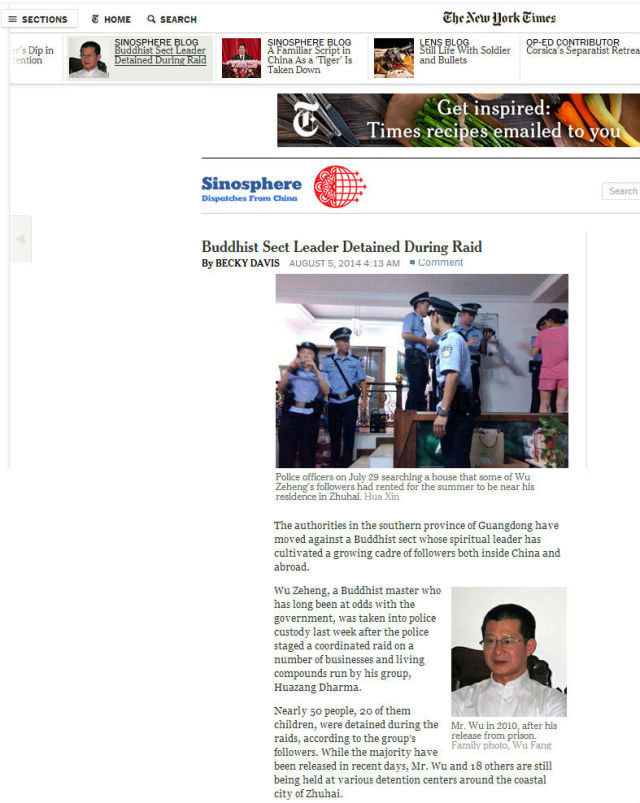
Wu Zeheng, a Buddhist master who has long been at odds with the government, was taken into police custody last week after the police staged a coordinated raid on a number of businesses and living compounds run by his group, Huazang Dharma.
Nearly 50 people, 20 of them children, were detained during the raids, according to the group’s followers. While the majority have been released in recent days, Mr. Wu and 18 others are still being held at various detention centers around the coastal city of Zhuhai.
The crackdown on Huazang Dharma comes at a time of increasing pressure on organized religious activity outside the government bodies that regulate much of the nation’s religious life. Buddhism is one of the five officially sanctioned religions of China — the others being Taoism, Islam, Protestantism and Catholicism — but the Communist Party requires spiritual leaders to operate under the auspices of its “patriotic” Buddhist association.
Last week, the American State Department, as it has since 1999, listed China as a “Country of Particular Concern” in itsannual report on international religious freedom.
The current detention of Mr. Wu is not his first run-in with the Chinese authorities. In 2000, he was convicted of financial crimes, including “illegally operating a business,” and sentenced to 11 years in jail, according to the Huazang Center website. His followers say the arrest was retribution for an open letter he wrote to Chinese leaders calling for democracy and greater government transparency.
Although Mr. Wu has largely refrained from advocating political change since his release in 2010, his disciples say the Chinese government has taken notice of his growing popularity. In the last four years, Mr. Wu had drawn thousands of followers within China and across the world, largely through videos and writings he and his aides post online. Although the authorities have blocked his blog and microblog platforms in China, Huazang says that events organized by the group in recent years have drawn more than 8,400 participants worldwide.
It was not immediately clear what prompted the raid on the group. The government has not issued any public statements about Huazang Dharma, and those questioned by the police say the authorities did not suggest they thought the group was an illicit cult.
According to its website, the group calls on followers to perform a good deed each day and to fast several days a month and then to donate to charity the money they would have spent on food. The website also speaks of the group’s “commitment to the prosperity of the Chinese nation and world peace.”
Mr. Wu, who is also addressed by followers as His Holiness Vairocana Xing Wu, founded Huazang Dharma in the late 1980s and traces its teachings back to the earliest days of Buddhism. A number of followers believe he possesses healing powers and say the traditional Chinese medicine he prescribes can cure cancer and other diseases.
Nicole Ho, who lives in the United States and who credits Mr. Wu with saving the life of her ailing father, has been a devout follower since 1995. “His ability and level of wisdom is simply different from anyone else,” she said. “With Master Wu, you listen and feel good from head to toe.”
Mr. Wu had been briefly detained twice by the police in recent years, but his followers said the current detentions of him and his followers suggested the authorities were determined to crush the group.
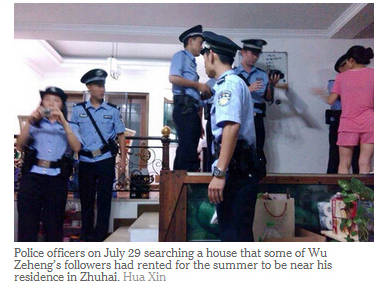
According to several witnesses, the police entered Mr. Wu’s home in Zhuhai on July 29 saying they wanted to examine his residency registration papers and then took him away. A number of followers living in apartments in the same complex were also detained at the same time, including children who were studying meditation and martial arts. Meanwhile, the police in the nearby city of Shenzhen raided two businesses affiliated with Huazang Dharma and the homes of people working there.
One follower who gave her name as Cissy said she was stunned by the way the police handled the incident. She said the police took six children from an apartment in Zhuhai around 11 p.m. and held them at the station house until dawn. The youngest child, she said, was 11. “They asked about personal things, our families, when and why we’d come here,” she said in a telephone interview. “Whatever they ask, you must answer.”
Ms. Ho, who was recently in Beijing to lobby American Embassy officials on Mr. Wu’s behalf, expressed concern for her teacher and those still held in custody. “They won’t physically hurt you, but they’ll try to break you down, change your mind, and make your heart timid, like that of a slave.”
Reached by phone on Monday, officials in the Zhuhai Gongbei Municipal Public Security Bureau declined to comment.
Those who were detained and released said they remained convinced that their group had done nothing wrong.
“Honestly, what I’m most concerned about right now is the state of our society,” Cissy said. “As I was leaving the police station, I asked the policeman, ‘Is it so hard to be a good person in today’s society?’ He didn’t respond.”
譯文如下:
佛教教派領袖被查抄拘留
(紐約時報英文版8月5日早4’13’’)
中國南部廣東省的政府當局對一個佛教教派及其精神領袖採取了鎮壓行動,該教派的精神領袖培養了越來越多的遍布海內外的法脈追隨者。
吳澤恆,這位佛教大師曾經多年與政府的意見相左,他在上周被警方拘留。在此前,警方對與華藏法門相關人士的企業和住所進行了一次聯合性的突然查抄。
根據其追隨者的講述,在查抄行動中拘留了近50人,其中20個是孩子。雖然大部分人已在近日被釋放,吳先生連同其他18人仍然被關押在這個海濱城市---珠海---的各個看守所中。
針對華藏法門的鎮壓發生在一個特定的時期:政府機構管控國家的絕大部分宗教生活,同時,官方系統之外有組織的宗教活動受到的壓制越來越大。雖然佛教是中國官方認可的五個宗教之一 ---其餘為道教,伊斯蘭教,基督新教和天主教 ---但是共產黨要求精神領袖們在“愛國的”佛教協會的主持下進行運作。
上周,美國國務院在其關於國際宗教自由的年度報告中,把中國列為自1999年以來“特別關注的國家”。
目前對吳先生的拘留並不是他與中國當局發生的第一次爭執。根據華藏中心網站,在2000年,他被以經濟罪定罪,包括“非法經營罪”,並判處11年徒刑。他的追隨者說,逮捕他是當局報復他寫了一封公開信給中國領導人,呼籲民主和加強政府透明度。
自2010年出獄以來,儘管吳先生在很大程度上不再敦促政治改革,他的弟子們說中國政府已經注意到他的人氣越來越旺。在過去的四年裡,主要通過在互聯網上發布的視頻和著作,吳先生吸引了中國和世界各地成千上萬的追隨者。雖然當局封殺了他在中國的博客和微博平台,華藏最近幾年組織的活動已經吸引了全世界超過8,400人的參與。
目前尚不清楚是什麼原因造成此次的查抄。政府也沒有出台有關華藏法門的任何公開聲明。那些被警方調查過的人員說,當局並沒有表明他們認為該團體是一個非法的邪教組織。
根據華藏的網站,該團體號召追隨者們用“日行一善”和每月辟穀幾日,把辟穀省下的食物花費用於捐助(“辟穀濟善”)。 其網站同時聲明,該團體“致力於中華民族的繁榮昌盛和世界和平。”
吳先生,追隨者們用法名稱之毗盧行武,在20世紀80年代末創辦華藏法門,它的教義追溯到最早期的佛教。許多信徒們相信他具備治癒能力,並說他提供的傳統中藥藥方可以治癒癌症和其他疾病。
住在美國的何妮可,提起了吳先生挽救她生病父親生命的過程,她是自1995年皈依的虔誠信徒。“他的能力和智慧是非同一般人,”她說。“跟隨師父,聽其法會感到身心的統攝。”
雖然近年來吳先生已被警方短暫拘留過兩次,但是他的追隨者們說,當前這次的拘留行動表明目前當局下決心要鎮壓這個團體。
據一些目擊者說,7月29日警察進入吳先生在珠海的家,說他們想檢查他的戶籍文件,然後帶走了他。住在同一小區其他公寓的一些追隨者們也同時被拘留,包括那些來學習禪坐和武術的孩子們。同時,附近深圳市的警察查抄了華藏法門相關人士的兩個公司及其公司員工的住家。
一名叫西茜的追隨者說,她被警方處理事件的方式驚呆了。她說,晚上11點左右警方將六個孩子從珠海的公寓帶走,並把他們關在派出所一直到天亮。其中最小的孩子,是11歲。。她說:“他們訊問關於個人私事,我們的家庭,何時以及為什麼我們會來這裡,”她在電話採訪中說。“不管他們問什麼,你都必須回答。”
何女士,最近代表吳先生到北京會見美國使館的官員,對於她的老師及那些被關押的朋友表示關注。 “他們一般不會傷害你身體,但他們會摧垮你,改變你的思想,並讓你的內心膽怯,最後如同奴隸般。”
周一電話撥通了珠海市拱北公安局,接電話的官員拒絕對此發表評論。
這些被拘留後釋放的人說,他們仍然相信,他們的團體沒有做錯任何事情。
“說實話,我目前最關心的,是我們社會的現狀,”西茜說。“當我離開了派出所,我問那個警察,‘在當今社會,做一個好人很難嗎?’他沒有回應。”
原文截圖如下:
|