对外提高关税促谈判,对内轻徭薄赋激活力 ——我对川普政府关税政策的现实担忧与积极展望 By Archer Hong Qian (Intersubjective Symbiosism Foundation) 我对美国第47任总统川普的关税政策的现实担忧与积极展望,源自我将川普政府与历史上的麦金莱(第25任总统)和胡佛(第31任总统)的关税政策的比较,以及全球共生新时代的哲学思考。 一、川普对麦金莱的赞美与关税政策 在2025年1月20日的就职演说中,川普总统对第25任美国总统威廉·麦金莱表示了高度赞赏,甚至提议将德纳里山重新命名为麦金莱山,以纪念这位前总统。麦金莱总统以推行高关税政策闻名,他认为高关税有助于保护美国工业,促进经济繁荣。川普对麦金莱的推崇,可能正如人们所说的,反映了他对保护主义政策的认同,特别是在关税方面。 不过,川普的关税政策旨在通过提高关税,减少贸易逆差,迫使贸易伙伴重新谈判贸易协议,以实现更公平的贸易环境。他希望通过这种方式,促进经济合作,取代制裁对抗,使美国及其盟友回到互利共赢的轨道上。 然而,历史上也有高关税政策导致灾难性后果的案例。这就是1930年的《斯穆特-霍利关税法案》大幅提高关税,引发了世界强国(欧美)间贸易战,加剧了经济大萧条。川普的关税政策是否会重蹈覆辙,取决于全球经济环境、各国的反应以及内外整套政策的具体实施情况。 总的来说,川普对麦金莱总统的赞誉,反映了他对高关税政策的支持,希望通过这种方式实现美国的再次伟大。然而,政策的实际效果需要谨慎评估和适时调整,以结出积极成果。 二、川普 vs. 麦金莱 vs. 胡佛 在美国历史上,关税一直是重要的经济和政治工具。威廉·麦金莱(第25任总统)、赫伯特·胡佛(第31任总统)和唐纳德·川普(第45、47任总统)都曾推行高关税政策,但它们的背景、目标、策略和结果却大不相同。 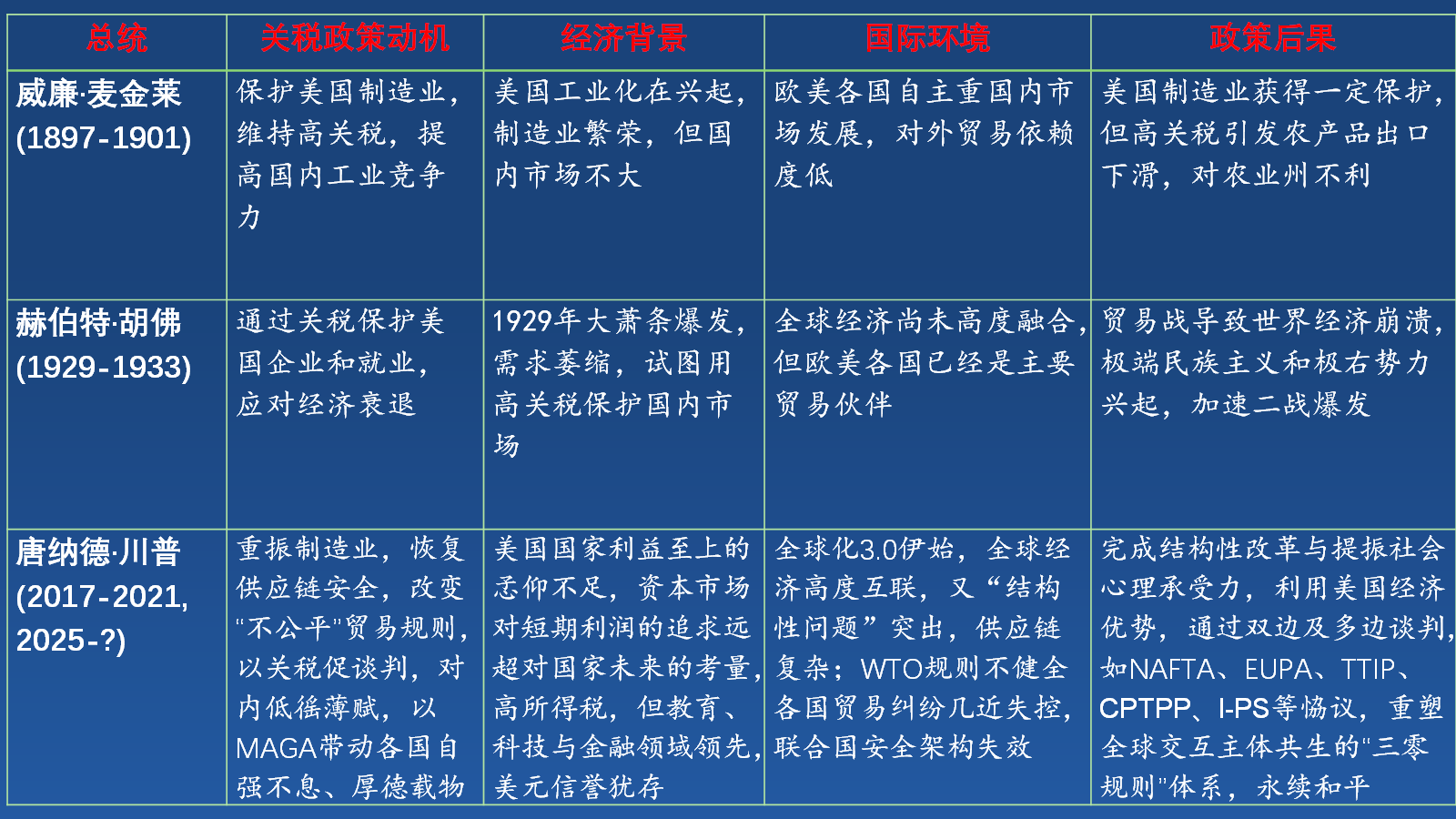
三、川普 vs. 麦金莱:相似之处 川普的关税政策与麦金莱最相似的地方在于: 1、目的相似:都是为了保护美国制造业 麦金莱在19世纪末推行关税保护美国制造业,确保美国制造业崛起。川普则在21世纪初试图通过高关税让制造业回流,减少对外依赖,并推动美国在全球经济中的竞争力,迎来了美国镀金时代的进步主义辉煌。 2、政策手段相似:通过“关税+谈判” 麦金莱在1897年推行《丁利关税法案》(Dingley Tariff Act),大幅提高进口商品税率,同时鼓励与其他国家商讨关税减让协议。川普通过提高关税,然后用关税作为谈判筹码,迫使其他国家接受更公平的贸易规则(特别是与政治盟友和相关区域,如美加墨自由贸易协定)。 3、结果可能相似:激活社会活力,促进美国工业复兴 麦金莱的高关税政策确实帮助美国成为世界工业强国,美国经济增长强劲,制造业竞争力提升。川普希望借助关税迫使制造业回流,同时免收15万美元收入的美国家庭所得税,使美国城乡社区生活受益,最终形成新的“一对一”全球贸易体系。 四、川普 vs. 胡佛:关键区别 虽然川普和胡佛都采取了高关税政策,但它们的背景和策略完全不同。 1、胡佛:被动应对大萧条,误判形势 1929年经济危机爆发,胡佛政府认为高关税可以保护国内市场,挽救美国经济。结果适得其反,全球报复性关税导致美国出口暴跌(从1929年的54亿美元跌至1932年的7.8亿美元),世界贸易总量减少70%,经济进一步恶化。 2、川普:主动调整全球贸易规则,试图减少贸易逆差 川普政府认为全球贸易体系不公平,某些国家(如中国、德国、日本)长期对美贸易顺差,通过补贴、汇率操控、窃取知识产权等手段损害美国企业。川普的加关税是主动出击,以高关税迫使其他国家重新谈判贸易协议(如重新谈判北美自由贸易协定),短期增加政府收入,减免国民所得税和消费税。 3、关键区别:胡佛的关税政策是在世界经济衰退中“闭关锁国”,导致世界贸易战,而川普的关税政策是,对内“进行结构性改革与提振社会承受力”,实施“轻徭薄赋”激活低层人民的生命活力,对外利用美国的经济优势,重塑全球交互主体共生的“三零贸易规则”体系。 五、川普的关税政策:真正目标 川普的关税政策不仅仅是为了减少贸易逆差,更是为了推动新的全球贸易模式,即通过“一对一”的谈判艺术,逐步实现交互主体共生(Intersubjective Symbiosism)的“三链趋势 + 三零规则”的全球化体系: 1、三链趋势(The Three-Chain Trend) ✅ 产业链(Production Chain): 确保制造业合理回流,增强美国本土生产能力,同时与盟友形成更紧密的工业合作。 ✅ 供应链(Supply Chain): 重新布局全球供应网络,减少对特定国家的单一依赖,使关键物资供应更具韧性。 ✅ 价值链(Value Chain): 通过技术创新、数字经济、知识产权保护,提高全球价值链的合理分配,让市场竞争更加公平。 2、三零规则(The Three-Zero Rule) ✅ 零关税(Zero Tariffs): 以双边或多边谈判换取更多贸易伙伴同意降低关税,实现更自由的全球贸易。 ✅ 零壁垒(Zero Barriers): 打破隐形贸易壁垒,减少不公平的市场准入限制,特别是针对美国产品的限制。 ✅ 零歧视(Zero Discrimination): 反对某些国家利用补贴、操纵汇率等手段进行贸易不公平竞争,确保所有市场参与者在公平竞争环境中获利。 ⏩ 最终,川普加关税的目的是为了逼迫全球主要经济体进入自由竞争的“零关税、零壁垒、零歧视”的新型全球化模式,而非真的长期维持高关税。 结论:川普能否避免胡佛的教训,复制麦金莱的成功? ✅ 川普的关税政策更像麦金莱,因为它是主动策略,对外以关税促谈判,对内轻徭薄赋激励活力,目标是重塑全球贸易规则,而非保护衰退中的经济。 ✅ 但如果川普无法成功谈判并建立新的全球贸易规则,那么它可能会带来类似于胡佛关税政策的负面后果,导致全球经济放缓,贸易冲突升级。 ⏩ 最终,川普的成功与否,取决于他是否能对内既不迁就屈服于内部惰性压力,又要避免美国社会走向现实分裂的无序化;对外将高关税政策转换为全球各种经济体交互主体共生的“三零规则”的贸易体系,以MAGA带动全球生命体自强不息、厚德载物——自组织外连接动態平衡! 2025.3.11于Vancouver My Concerns and Optimistic Outlook on President Trump’s Tariff Policy Historical Comparison: Trump vs. McKinley vs. Hoover By Archer Hong Qian (Intersubjective Symbiosism Foundation) My concerns and optimistic outlook on President Trump’s tariff policy stem from my comparison of Trump's administration with the historical tariff policies of President William McKinley (25th President) and President Herbert Hoover (31st President), along with philosophical reflections on the era of global symbiosis. Trump’s Praise for McKinley and His Tariff Policy
During his inaugural address on January 20, 2025, President Trump expressed high praise for the 25th U.S. President, William McKinley, even suggesting renaming Denali Mountain back to Mount McKinley in his honor. President McKinley was known for implementing high tariff policies, believing that high tariffs would protect American industries and promote economic prosperity. Trump’s admiration for McKinley likely reflects his endorsement of protectionist policies, especially in the area of tariffs. However, Trump’s tariff policy is aimed at increasing tariffs to reduce trade deficits and pressure trade partners into renegotiating agreements to create a fairer trade environment. His ultimate goal is to replace confrontation with economic cooperation and bring the U.S. and its allies back to a path of mutual benefit and win-win cooperation. Nevertheless, history has also shown disastrous consequences of high tariffs. In 1930, the Smoot-Hawley Tariff Act significantly increased tariffs, triggering retaliatory trade wars among world powers (Europe and the U.S.), exacerbating the Great Depression. Whether Trump’s tariff policy will follow a similar trajectory depends on the global economic landscape, how other countries respond, and the broader implementation of his domestic and international policies. Overall, Trump’s admiration for President McKinley reflects his support for high tariffs, hoping that this approach will contribute to making America great again. However, the actual effects of this policy require careful assessment and timely adjustments to achieve positive results. Trump vs. McKinley vs. Hoover: A Historical Comparison
Tariffs have always been a crucial economic and political tool in U.S. history. Presidents William McKinley (25th), Herbert Hoover (31st), and Donald Trump (45th and 47th) all implemented high tariff policies, yet their contexts, objectives, strategies, and outcomes varied significantly. Comparison of the Tariff Policies of Trump, McKinley, and Hoover | President | Tariff Policy Motivation | Economic Background | International Context | Policy Outcomes | | William McKinley (1897-1901) | Protect U.S. manufacturing, maintain high tariffs, enhance domestic industrial competitiveness | The U.S. was experiencing industrialization, manufacturing was thriving, but the domestic market was relatively small | European and American nations were focused on developing their domestic markets, with low dependence on foreign trade | U.S. manufacturing received significant protection, but high tariffs led to a decline in agricultural exports, negatively impacting farm states | | Herbert Hoover (1929-1933) | Protect U.S. businesses and jobs through tariffs, respond to economic recession | The 1929 stock market crash led to economic downturn, with shrinking demand; attempted to use high tariffs to protect the domestic market | Global economic integration was not yet deep, but European nations had become major trade partners | The trade war led to global economic collapse, fueled the rise of extreme nationalism and far-right forces, accelerating the outbreak of World War II | | Donald Trump (2017-2021, 2025-?) | Revitalize manufacturing, restore supply chain security, reform "unfair" trade rules, low taxes and light burdens to boost vitality,reduce trade deficits, promote the "Three-Zero Rules" globalization | U.S. national interests faced a credibility crisis, short-term volatility in capital markets deterred long-term investment, but education, technology, and finance remained dominant, with the U.S. holding a technological and market advantage | In the Globalization 3.0 era, the world economy was highly interconnected, but "structural issues" surfaced, disrupting supply chains; WTO rules were ineffective in restraining unfair trade practices, leading to the necessity for bilateral or multilateral negotiations to rebuild trade security frameworks | Successfully implemented structural reform while enhancing public psychological resilience, leveraging U.S. economic advantages to reshape global trade rules through bilateral and multilateral negotiations, laying the foundation for the “Three-Zero Rules” system (Zero Tariffs, Zero Barriers, Zero Discrimination) |
III. Trump vs. McKinley: Similarities Similar Goals: Protecting U.S. Manufacturing
McKinley introduced tariffs in the late 19th century to protect U.S. manufacturing and ensure its rise. Similarly, Trump’s goal in the early 21st century was to use high tariffs to encourage reshoring of manufacturing, reduce external dependence, and strengthen the U.S. position in global economic competition. Similar Policy Approach: Tariffs + Negotiation
In 1897, McKinley implemented the Dingley Tariff Act, significantly increasing import taxes while encouraging negotiations with other nations to reduce tariffs selectively. Likewise, Trump used tariffs as a bargaining chip, pressuring countries into renegotiating trade agreements (e.g., the USMCA replacing NAFTA). 3. The outcome could be similar: revitalizing societal dynamism and promoting American industrial resurgence. McKinley’s high-tariff policy did help the U.S. become a global industrial powerhouse, driving strong economic growth and enhancing manufacturing competitiveness. Trump aims to leverage tariffs to force manufacturing reshoring, while exempting American households earning up to $150,000 from income tax—benefiting urban and rural communities alike and ultimately paving the way for a new global trade system.
IV.Trump vs. Hoover: Key Differences While both Hoover and Trump implemented high tariffs, their backgrounds and strategies were completely different. Hoover: Reacting Passively to the Great Depression, Misjudging the Situation
When the 1929 economic crisis erupted, Hoover believed high tariffs would protect the domestic market and revive the U.S. economy. However, the result was disastrous—global retaliatory tariffs led to U.S. exports plunging from $5.4 billion in 1929 to $780 million in 1932, and world trade declined by 70%, deepening the economic downturn. Trump: Proactively Reshaping Global Trade Rules to Reduce Trade Deficits
Trump’s administration argued that the global trade system was unfair, with countries like China, Germany, and Japan maintaining trade surpluses with the U.S. by subsidizing industries, manipulating exchange rates, and stealing intellectual property. Trump’s tariff policy was an offensive strategy—raising tariffs to force other nations to renegotiate trade deals. Key Difference: Hoover’s tariffs isolated the U.S., leading to a global trade war, while Trump’s tariffs were part of a broader strategy to reform trade relationships. Trump’s Real Trade Agenda: The Three-Chain Trend & Three-Zero Rules
Trump’s tariff policy goes beyond trade deficits—it seeks to establish a new global trade model, based on Intersubjective Symbiosism and the Three-Chain Trend + Three-Zero Rules framework: The Three-Chain Trend (产业链, 供应链, 价值链)
✅ Production Chain: Ensuring U.S. manufacturing remains competitive while strengthening industrial partnerships with allies.
✅ Supply Chain: Redesigning global supply networks to reduce dependence on single markets and increase resilience.
✅ Value Chain: Promoting technological innovation and fair value distribution in global markets. The Three-Zero Rules (三零规则)
✅ Zero Tariffs: Using bilateral/multilateral negotiations to lower tariffs globally.
✅ Zero Barriers: Eliminating hidden trade barriers that limit market access.
✅ Zero Discrimination: Preventing unfair trade practices like subsidies, currency manipulation, and monopolistic policies. Ultimately, Trump’s goal is to use tariffs as a tool to push the global economy toward a freer, fairer, and more balanced system, rather than sustaining high tariffs indefinitely. Conclusion: Can Trump Avoid Hoover’s Mistakes and Replicate McKinley’s Success? ✅ Trump’s tariff policy is more akin to McKinley’s, as it represents a proactive strategy: using tariffs externally to drive negotiations, while internally adopting light taxation to stimulate vitality. The goal is to reshape global trade rules, not to protect a declining economy. ✅ However, if Trump fails to establish new trade rules, his policies could lead to Hoover-like economic disruption, sparking global recession and trade conflicts. The Final Challenge: Will Trump’s tariff policies create a new global trade order based on "Zero Tariffs, Zero Barriers, and Zero Discrimination," or will they lead to economic retaliation and isolation?
His legacy will be defined by how well he navigates these challenges. 📍 March 11, 2025 | Vancouver
|