從托克維爾到數位-量子時代 From Tocqueville to the Digital-Quantum Era ——論美國的民情、異化與信託的重建 —On the Reconstruction of America's Mœurs, Alienation,and Trust 錢 宏(Archer Hong Qian) 2026年7月5日 於溫哥華 一個問題 我昨天在《復興“愛之智慧”,重建組織信託——250周年來,美利堅合眾國為人類提供了怎樣的制度坐標?》(amorsophia.com/article/10097)中,說到1787年《美國憲法》文本中沒有出現“民主”(Democracy)一詞,但經過大革命後的法國思想家托克維爾(Alexis de Tocqueville)卻在1835年出版了《論美國的民主》,這是為什麼?應該向讀者有所交待。
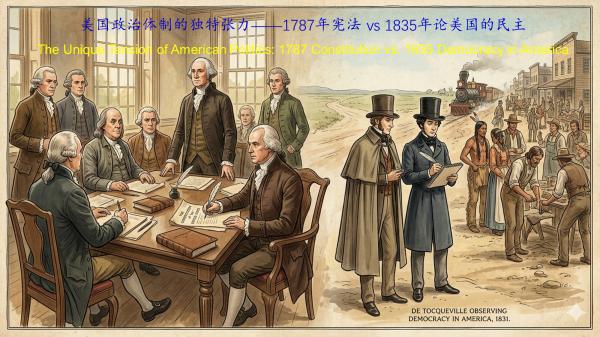
這兩個現象看似矛盾,實則揭示了美國從“建國精英的制度設計”向“大眾平民社會”演變的歷史必然。 1、為什麼《美國憲法》不寫“民主”? 美國制憲會議的建國先賢在當時對“民主”抱有極大的警惕和敵意: 警惕“多數人的暴政”:在古希臘的語境下,“民主”意味着平民階級的直接統治。麥迪遜、漢密爾頓等建國先賢認為,直接民主容易導致煽動家奪權、多數人剝奪少數人財產,即所謂的“暴民政治”。 追求“共和”而非“民主”:建國先賢更傾向於建設一個共和國(Republic)。憲法第四條第四款明確規定,聯邦政府保證各州實行“共和政體”。 制度設計的制衡性:為了防範民主的狂熱,憲法設計了複雜的三權分立與制衡機制,如設立非直接選舉的參議院、選舉人團制度以及最高法院,以此來過濾和稀釋直接的民意。 2、為什麼托克維爾看到的卻是“民主”? 當托克維爾於1831年訪問美國時,距離憲法頒布已過去40多年,美國的社會土壤已經發生了翻天覆地的變化: “安德魯·傑克遜時代”的到來:當時美國正處於“傑克遜式民主”巔峰期,各州基本取消了投票的財產資格限制,成年白人男子獲得了普選權。 身份平等的社會現實:托克維爾眼中的“民主”不僅是一種政治制度,更是一種“身份平等的社會狀況”。他發現美國沒有歐洲根深蒂固的封建貴族階級,人們在社會地位、觀念和習慣上表現出驚人的平等趨同。 強大的公民社會:雖然沒有憲法條文的直接命令,但美國人通過自發組建鄉鎮自治、民間社團和宗教組織,將“民主”內化為了日常生活的一種習慣和文化(民情)。 3、從憲法文本到社會現實 這兩種現象的對立,恰恰構成了美國政治體制的獨特張力。 美國政治體制的獨特張力——1787年憲法 vs 1835年論美國的民主 比較維度 | 視角:1787年《美國憲法》核心 | 視角:1835年《論美國的民主》發現 | 核心關注 | 政治制度的設計與限權:
着眼於國家機器的職能分工、權力長臂的約束以及冷冰冰的法理框架。 | 社會狀態、民情與生活方式:
聚焦於活生生的人類生活、自髮結社的社團文化以及信仰所注入的內在道德習慣。 | 防護對象 | 大多數人的暴政與暴民政治:
顯然古希臘式的狂熱直接民主,防範閃電家利用底層無產者洗劫少數人的合法財產。 | 民主制度下的大多數人暴政與個人主義:
覺醒全能的行政長臂對人性的馴服,防範原子化個體因以色列隔離而主動向權力讓渡自由。 | 政體定性 | 憲政共和制:
通過間接選舉、多元制衡與參議院等機制,對狂熱的民意進行與國防直接民主。 | 民主社會:
打破封建階級後的身份平等的平民時代,作為民主社會的一個深入骨髓的社會土壤和契約秩序。 |
總之,建國先賢用《美國憲法》搭建了一個冰冷、理性的共和框架;而托克維爾則敏銳地觀察到,在這個框架內部,正奔涌着一股無法阻擋的、充滿激情的民主社會浪潮。 序章:憲法未言之字與新大陸的民情 1787年,當美國建國先賢們聚集在費城,用羽毛筆在羊皮紙上寫下人類歷史上第一部成文憲法時,他們在一件至關重要的事情上保持了沉默——在整部憲法的文本中,沒有出現一次“民主”(Democracy)這個詞。麥迪遜、漢密爾頓等建國精英對古希臘式的“直接民主”抱有極大的警惕,他們認為那極易退化為煽動家奪權的“暴民政治”與“多數人的暴政”。因此,他們精心設計了一個複雜的、充滿了三權分立與制衡機制的憲政共和國(Republic),試圖設立重重過濾網,將直接的民意與激情稀釋、冷卻。 然而,僅僅四十多年後,當法國思想家亞歷克西·德·托克維爾(Alexis de Tocqueville)於1831年踏上這片土地時,他卻在1835年出版的巨著中,毫不猶豫地將這本書命名為《論美國的民主》。 托克維爾看到了建國先賢沒有寫進憲法,但卻在北美平原上蓬勃生長的東西。四十年的民情演變,那時的美國,正處於“安德魯·傑克遜時代”的巔峰,各州逐步取消了投票的財產限制,平民階層全面走向政治前台。但托克維爾敏銳地指出,美國的民主不僅是一種政治制度,更是一種“身份平等的社會狀況”。在這裡,沒有歐洲根深蒂固的封建貴族階級,人們在觀念、習慣和地位上表現出驚人的平民化趨同。 最重要的是,托克維爾發現美國之所以能馴服“民主”這頭可能走向專制的猛獸,靠的不是完美的憲法條文,而是一套獨特的“民情”(Mœurs)——即一種在最小化法律框架內,依靠信仰和內心的自覺,由下至上生長出來的、人與自然、人與社會、人與自己(身心靈)健康交互契合的共生秩序。 第一章:雙城記——法蘭西的幻滅與美利堅的共生 為了理解這種共生秩序的珍貴,托克維爾一生都在將美國與他的祖國法國進行對比。同樣高喊“自由、平等、博愛”的法國大革命,最終卻走向了血腥而恐怖的雅各賓專制,這成為了近代文明史上的巨大反差。 在托克維爾的另一部著作《舊制度與大革命》中,他解開了這個謎團。法國的悲劇,在於其走向了唯理主義的烏托邦。以羅伯斯庇爾為代表的雅各賓派,深受盧梭絕對公意理論的影響,試圖用國家權力和狂熱的意識形態,自上而下地硬塞給人民一個“完美秩序”。為了實現這個高尚的目標,他們不惜動用斷頭台,“強迫人們獲得自由”。同時,法國長期的中央集權摧毀了社會的自治能力,當國王的頭顱落地,社會陷入原子化的無序,唯有依靠更強大的國家恐怖機器來維持。更致命的是,法國大革命具有強烈的反教會傾向,他們用“理性教”代替傳統信仰,導致人們失去了內心的道德約束,自由迅速退化為放縱。 反觀美國,其秩序的秘密在於“最大化的內心自覺”與“最小化的法律框架”之間的完美平衡。 首先,在“人與自己(身心靈)”的維度上,宗教信仰成為了內心的錨。在美國,清教徒們為了宗教自由而來到新大陸,自由與信仰在這裡非但沒有對立,反而深度結合。政府管得少,人就必須自我約束。宗教提供了這種內心的自覺,它規範了欲望,讓人們在追求物質財富的同時保持對神聖和道德的敬畏。 其次,在“人與社會”的維度上,美國人通過鄉鎮自治與民間的契約共生來組織生活。修路、建教堂、辦學校,居民們自發開會決定。托克維爾讚美這種“結社的藝術”,通過日常的協作,人們走出了孤立的自我,學會了妥協與責任。 最後,在“人與自然”的維度上,當時遼闊的荒野與西進運動提供了無限的實踐空間。開發自然、創造財富被視為踐行上帝選民職責的方式,這種開拓稀釋了歐洲那種因土地匱乏而產生的階級仇恨。 美國人並不標榜自己有多麼高尚,他們承認人都是自私的,但他們踐行着“正確理解的利益”(Interest Rightly Understood):通過幫助他人、維護社區、遵守契約,最終受益的是自己。這種將“個人自由”與“公共善業”完美契合的共生秩序,構成了托克維爾眼中美國民主的靈魂。 對比維度 | 【 法國大革命:雅各賓專制 】
(自上而下的唯理異化) | 【美國民主:自下而上秩序】
(自下而上的民情共生) | 底層動力與思想根源 | 唯理主義烏托邦強迫自由
基於精英理性設計的完美藍圖,動用國家暴政自上而下硬塞給人民,最終走向背叛自由的暴力。 | 清教徒信仰內心自覺規範欲望
根植於對超然崇拜的敬畏,形成強烈的內在道德自律,從而實現個人的自我約束,規範私慾。 | 社會建制與核心架構 | 中央集權摧毀社會中間階層
絕對的中央權力進行長臂曼哈頓,系統性剷除社會中間組織,使社會底層徹底沙化與原子化。 | 鄉鎮自治自髮結社與民情塑造
去中心化的自組織節點在日常的契約協作中碰撞,將紙面制度沉澱為民情與生活習慣。 | 致精神與道德約束 | 反教會失去內在道德約束,
激進拆除毀壞傳統宗教,使毀滅徹底喪失了超驗的道德關點,自由迅速剝奪了縱慾、猜忌與殺戮。 | 開拓荒野物質繁榮與精神契合
在拓展物理與心理邊界的實幹中,將汗水、常識與神聖的精神契約多層融合,巔峰階級。 | 系統的安裝終局(後果) | 後果:國家恐怖與原子化無序
組織破產徹底破產,淪為絞殺生命主體的絕對戰爭機器,個人淪為國家社會工程模擬上的犧牲品。 | 後果:自由與公共善業的共生
每一個清移民家庭和鄉鎮都是獨立的受託節點,達成了個人自由與社區善業之間的健康交互與有機平衡。 |
第二章:異化與危機——數位-量子時代的“組織熵增” 然而,這種在“最小化法律”與“最大化內心自覺”之間取得平衡的有機秩序,在邁入“數位-量子時代”(Digital-Quantum Era)後,遭遇了前所未有的結構性坍塌。 托克維爾時代那種建立在“低速、具身(Embodied)、地方性”社會連接上的美德,正在被無情地解構,社會加速陷入了“組織熵增異化”(Organizational Entropic Alienation)的危機。在這場技術與思想的海嘯中,傳統秩序在三個核心維度上發生了系統性變異: 1、生命(LIFE)的量子化消解: 數字化和人工智能技術將鮮活的、具有神聖感的人類生命,解構為代碼、標籤和算法操縱的注意力數據。生命失去了整體性、靈性與主體地位,退化為流水線上的“生物黑匣子”。 2、技術利維坦與程序正義的共謀 冰冷的官僚系統與算法技術合謀。只要滿足了“程序合法”與“代碼無誤”,組織就可以名正言順地冷酷無情。這種“冰冷的程序正義”扼殺了人性的溫度、同理心與道德直覺。 3、信託(TRUST)的自由化熵增 在從生命、家庭、社區、學校、企業到政府的整個社會信託鏈條中,原本靠“信仰與內心自覺”維持的隱性契約,被過度推崇的絕對個人自由和原子化切割所破壞。組織失去了凝聚能量的內核,系統自然走向最大化的混亂與異化,即組織熵增異化(Organizational Entropic Alienation)。 更深層次的危機在於,“左翼進步主義帶來的秩序瓦解”與“社會-共產主義思想的內部侵蝕”合流。這種侵蝕直接對準了文明的根基:它在組織內引入“壓迫者與被壓迫者”的階級或利益鬥爭思維,摧毀了家庭、師生和僱傭之間的神聖契約(TRUST);它剝奪了生命作為“上帝造物”的獨立神聖性,將其降格為社會工程中集體的螺絲釘(LIFE);它傾向於利用絕對的中央權力來控制數據和算法這兩大現代核心生產要素,試圖將人工智能打造為全方位監控、審查和洗腦的“數字鐵幕”(AI)。 面對這種系統性的“內侵蝕”,以查理·柯克(Charlie Kirk)的“轉折點組織”為代表的青年覺醒運動,以及川普(Donald Trump)在政治實踐中的積極糾偏,無疑是一次主動且極具針對性的文明防禦。川普在總統山和華盛頓特區國慶日等標誌性場合的演講,明確將這種內部侵蝕與歷史上的極權主義思想劃上等號,旨在打破“政治正確”的禁錮,動用建制力量去清除那些帶有“中央集權、強制對齊、階級鬥爭”邏輯的異化毒素,為“重建組織信託”(Rebuilding Organizational TRUST)掃清路障。 然而,從 “LIFE-AI-TRUST 交互契合共生秩序” 的宏大視角來看,傳統的保守主義依然顯得力不從心。傳統的保守主義往往是“向後看”的,試圖拉回一個沒有數字技術和 AI 的過去,無法兼容和解釋今天信息指數級爆發的數字現實;同時,它未能意識到 AI 正在重塑“人何以為人”的本體論,單純高喊傳統口號無法抵禦社交媒體算法對家庭和社區的持續解構。面對技術有利維坦化的風險,單純的文化防守遠遠不夠,文明的救贖必須聚焦於“重建組織信託”。 第三章:2025的雙重震撼與終極的重構盟約 歷史的發展往往需要戲劇性的催化劑。2025年發生的浪漫而殘酷的兩大史詩級事件的交互,徹底將川普和保守主義的關注點推向了文明防線的最深處。這兩大事件,一正一反,互為鏡像: 一是查理·柯克在大學校園的遇害。這位致力於在全美青年學生中播種“內心自覺與傳統信仰”的保守主義旗手,在猶他州演講時遭遇暴力暗殺。這一槍打破了美國政治“斗而不破”的底層默契,完成了“肉身生命的消滅(LIFE的毀滅)”。
二是民主社會主義者曼達尼(Zohran Mamdani)以黑馬之姿當選紐約市長。這位年僅34歲的激進進步派歷史性地奪下全美第一大城市,上台後立即推行高額平準稅、凍結房租等激進政策。他試圖用行政命令強行重塑社會契約,完成了“社會建制的全面變色(TRUST的奪取)”。 2025年兩大歷史事件交互與保守主義戰略升級矩陣 歷史事件坐標軸 | 核心事件剖析 | 系統的底層危機(舊範式癌變) | 川普與保守主義的升級應對(常識重組) | 事件一:【 查理·柯克校園遇害 】 | 肉身生命的消滅
(The Eradication of Physical LIFE) | 算法極化與信息繭房的暴力洗腦,導致意識形態徹底狂熱化,最終顯化為對生命主體的物理消滅。 | 1. 重塑教育信託(Education Trust):
動用聯邦政府鐵腕與行政槓桿,重拳清算高校內部的極左意識形態,恢復古典理性與常識。 | 事件二:【 曼達尼當選紐約市長 】 | 社會建制的變色
(The Hijacking of Institutional TRUST) | 唯理主義、教條主義與“結果絕對平等”的行政長臂管轄強加於社會,導致傳統體制的信用被竊取與篡改。 | 2. 強化行政制衡(Institutional Balances):
通過聯邦財政攔截、司法起訴與跨代政策鎖定,對激進左翼城市(如紐約)形成戰略性長臂壓施。 | 交互主體共生演化 (演化終局) | 兩大惡果合流
體制的長臂管轄(降維管理)正在與暴民的物理消滅呼應,形成勒死文明萌芽的硬結構。 | 系統熵值的極端膨脹:
傳統的教育、政治組織已不再履行信託責任,轉而淪為對象化、工具化生命的國家恐怖主義潛流。 | 3. 締結 AI 盟約(The AI Covenant):
全力扶持、資助尊崇上帝、保護家庭、捍衛個體自由的去中心化 AI 算力網絡。用數位時代的新信託,對沖僵死官僚機器的賽博集權。 |
這兩大事件的交織,構成了對美國傳統體制的“合圍”。柯克之死,讓保守主義清醒地看到,長期通過極化流量、標籤化投餵的社交媒體算法(AI),是如何批量製造出充滿恨意的行兇者;而曼達尼的勝選,則是法國大革命唯理主義的現代都市翻版,試圖用“結果的絕對平等”取代美國依靠民間契約、企業自由和財富神聖性建立起來的傳統組織信任。 鮮血與政權的變色,成為了川普深入清除內侵蝕路障的終極推力。川普政府的戰略發生了質的飛躍:他們不再滿足於口頭的文化防守,而是開始動用聯邦鐵腕全面清算高等教育系統中的極左意識形態,奪回年輕一代的教育信託;通過財政與司法槓桿極限施壓試圖把城市變成“左翼公社”的行政體;最重要的是,他們意識到,對抗算法控制的唯一方法是開源、分布式和個人主權,必須在技術層面上大力扶持在底層邏輯上“尊崇上帝、敬畏生命、保護家庭”的替代性 AI 生態。 結語:邁向 LIFE-AI-TRUST 的新秩序 從托克維爾在1831年看到的那個充滿激情的民主社會,到2025年充滿血與火的技術社會,人類文明完成了一個巨大的周期。政治家的鐵腕清理可以為美國拉開一個“不破不立”的序幕,清除寄生在國家機器內部的“熵增源頭”,但真正的“重建”絕不能依靠另一個全能的“右翼利維坦”。 要真正實現 “LIFE-AI-TRUST 交互契合共生秩序”,文明的重建必須重歸托克維爾的核心智慧,在數位-量子時代重新發明“信託”: 在 AI 層面,技術必須扮演“熵減”的角色,通過去中心化身份和分布式網絡,把數據的所有權和生命的數字定義權還給個人,讓 AI 的底層對齊目標回歸對“人類生命神聖性”的尊重。 在 TRUST 層面,組織必須回歸微觀,聯邦政府需要“退出”,把權力和資源還給地方。讓教堂重新成為精神的紐帶,讓傳統家庭重新擁有教育的自主權,讓企業回歸民間的自由契約。 在 LIFE 層面,最根本的救贖是靈魂的重塑。普通人需要把注意力從屏幕上的政治口水戰和算法投餵中拔出來,重新投入到具身的、真實的、面對面的家庭與社區生活中。
內心的自覺無法由華盛頓的法令自上而下地賜予。在這場漫長的文明排毒運動中,唯有當人們重新感受到鄰里之間的溫度、家庭的責任和對超越性信仰的敬畏時,那種讓托克維爾讚嘆不已的、將“個人自由”與“公共善業”完美契合的共生秩序,才會在新時代的數字廢墟之上,重新開花結果。 最後,希望這篇敘事性文章能夠將我們今天跨越兩百年歷史、政治哲學與前沿技術的深度對話呈現給讀者。今天,針對文中提到的核心矛盾,若要將這一宏大敘事轉化為當下的具體行動,還需要在“家庭(LIFE)”與“數字主權(AI)”的結合上,率先倡導一種“數字斷食與具身陪伴”的家庭新盟約,來作為抵抗算法熵增的第一步(參見《家庭信託的消解與重建——2025雙重震撼下的美國新文明自覺》https://www.amorsophia.com/article/10125)。 From Tocqueville to the Digital-Quantum Era —On the Reconstruction of America's Mœurs, Alienation,and Trust By Archer Hong Qian (錢宏)
July 5, 2026, in Vancouver One Question In my previous article, Reviving the "Wisdom of Love" and Reconstructing Organizational Trust, I noted that the word "Democracy" never appears in the text of the 1787 United States Constitution . Yet, the French thinker Alexis de Tocqueville, writing after the French Revolution, published Democracy in America in 1835 . Why this discrepancy ? An explanation is owed to the readers . These two phenomena seem contradictory . In reality, they reveal a historical inevitability . This inevitability marks America's evolution from an institutional design by founding elites to a mass populist society . 1. Why Did the U.S. Constitution Omit "Democracy"? The founding fathers at the Constitutional Convention held great vigilance and hostility toward "democracy" : · Vigilance Against the "Tyranny of the Majority": In the ancient Greek context, "democracy" meant the direct rule of the lower classes . Founders like Madison and Hamilton believed direct democracy leads to demagogues seizing power . They feared the majority plundering the property of the minority, resulting in "mob rule" . · Pursuing a "Republic" Rather Than a "Democracy": The founders leaned toward building a republic . Article IV, Section 4 of the Constitution explicitly states that the federal government guarantees a "Republican Form of Government" to every state . · Institutional Checks and Balances: To suppress democratic fanaticism, the Constitution engineered a complex system of separation of powers . Mechanisms like an indirectly elected Senate, the Electoral College, and the Supreme Court filtered the direct will of the populace . 2. Why Did Tocqueville See "Democracy"? By the time Tocqueville visited America in 1831, over forty years had passed since the Constitution's ratification . The social soil of America had undergone tectonic shifts : · The Rise of the "Andrew Jackson Era": America was at the peak of "Jacksonian Democracy" . Most states had eliminated property qualifications for voting . Adult white males achieved universal suffrage . · The Reality of Social Equality: Tocqueville viewed "democracy" as more than a political system . To him, it was a "social condition of equal status" . He found that America lacked Europe’s deep-seated feudal aristocracy . People displayed an astonishing convergence in social status, ideas, and habits . · A Powerful Civil Society: Though not mandated by constitutional text, Americans formed grassroots associations . Through township governance, civic groups, and religious bodies, they internalized democracy into daily habits and culture, forming their mœurs (civic morals) . 3. From Constitutional Text to Social Reality The opposition between these two phenomena forms the unique structural tension of the American political system . Analytical Dimension | Perspective: The Core of the 1787 U.S. Constitution | Perspective: The Discovery of the 1835 Democracy in America | Core Focus | Design and Limitation of Political Systems:
Focuses on the functional division of the state apparatus, constraints on executive overreach, and a cold legal framework . | Social Conditions, Mœurs, and Lifestyles:
Focuses on vibrant human lives, a culture of spontaneous association, and moral habits infused by faith . | Protected Objects | The Tyranny of the Majority and Mob Rule:
Guards against the fanaticism of ancient direct democracy . Prevents demagogues from using the masses to plunder minority property . | The Tyranny of the Majority and Individualism in Democratic Systems:
Guards against the subjugation of human nature by an all-powerful administrative arm . Prevents atomized individuals from surrendering liberty due to isolation . | Regime Definition | Constitutional Republic:
Uses indirect elections, checks and balances, and the Senate to cool down frantic public whims and prevent direct democracy . | Democratic Society:
Represents a populist era of equal status after shattering feudal classes . Functions as an ingrained social soil and contractual order . |
In short, the founding fathers built a cold, rational republican framework with the U.S. Constitution . Within this framework, Tocqueville observed an unstoppable, passionate wave of democratic society . Prologue: The Silence of Philadelphia and the Mœurs of the New World In 1787, when the American founders gathered in Philadelphia to draft the first written constitution, they remained silent on a critical matter—the word "Democracy" never appears in the text . Founders like Madison and Hamilton held deep vigilance toward direct democracy, viewing it as a path to mob rule and majoritarian tyranny . Thus, they engineered a constitutional republic filled with checks and balances to dilute and cool raw public passions . Yet, forty years later in 1831, when French thinker Alexis de Tocqueville stepped onto this land, he unhesitatingly titled his masterpiece Democracy in America . Tocqueville saw what the founders omitted from the text but what flourished on the North American plains . Through forty years of moral evolution, America reached the peak of the Jacksonian era . The masses entered the political vanguard as property voting restrictions crumbled . Tocqueville noted that American democracy was a social condition of equality . Lacking a feudal aristocracy, Americans converged astonishingly in habits and status . Crucially, Tocqueville found that America tamed the monster of democratic despotism not through perfect laws, but through a unique set of "customs and morals" (mœurs) . This was a symbiotic order born from faith and inner consciousness . It grew from the bottom up within a minimal legal framework, harmonizing relations between man and nature, man and society, and man and his own soul . Chapter I: A Tale of Two Cities—The Illusion of France and the Symbiosis of America To understand the value of this symbiosis, Tocqueville constantly contrasted America with his native France . The French Revolution, which championed "Liberty, Equality, Fraternity," degenerated into the bloody Jacobin Reign of Terror, creating a massive civilizational contrast . In The Old Regime and the Revolution, Tocqueville unraveled this mystery . France's tragedy lay in its pursuit of a rationalist utopia . The Jacobins, influenced by Rousseau’s absolute general will, attempted to impose a "perfect order" from the top down using state terror . To achieve this noble end, they deployed the guillotine to "force men to be free" . Concurrently, centralized power destroyed France's capacity for local governance . When the king fell, an atomized society collapsed into chaos, requiring an even grander terror apparatus to sustain order . Furthermore, the revolution's anti-clerical radicalism dismantled traditional faith, stripping citizens of internal moral constraints and reducing liberty to licentiousness . Conversely, America’s order succeeded due to a perfect balance between maximal inner consciousness and a minimal legal framework . First, regarding "man and his own soul," religious faith acted as an internal anchor . In America, Puritans sought the New World to secure religious freedom . Liberty and faith did not clash; they merged deeply . Because the government governed minimally, individuals had to govern themselves . Religion provided this internal discipline, regulating desires while preserving a reverence for the sacred amid material pursuits . Second, regarding "man and society," Americans organized life through township governance and spontaneous civic contracts . Residents met to decide on roads, churches, and schools . Tocqueville praised this "art of association" . Through daily collaboration, individuals stepped outside their isolated selves to learn compromise and responsibility . Third, regarding "man and nature," the vast frontier and the westward expansion provided boundless practical space . Developing nature and creating wealth were seen as fulfilling a divine calling . This frontier expansion diluted the fierce class hatreds born from land scarcity in Europe . Americans did not claim to be entirely selfless; they acknowledged self-interest . However, they practiced "self-interest rightly understood" . They understood that by helping others, preserving the community, and honoring contracts, they ultimately benefited themselves . This synthesis of personal liberty and the public good formed the soul of American democracy . Analytical Dimension | The French Revolution: Jacobin Despotism
(Top-Down Rationalist Alienation) | American Democracy: Bottom-Up Order
(Bottom-Up Moral Symbiosis) | Underlying Motivation & Ideological Roots | Rationalist UtopiaForced Freedom:
Imposing a perfect blueprint designed by elites through state tyranny from the top down, resulting in violence that betrayed freedom . | Puritan FaithInner Conscience Regulating Desires:
Rooted in reverence for transcendent faith, fostering strong internal moral discipline, self-restraint, and regulation of desires . | Social Institutions & Core Framework | CentralizationDestruction of Social Intermediaries:
Absolute central authority enforcing long-arm control, systematically erasing intermediate organizations like churches, causing society to atomize . | Township AutonomySpontaneous Association & Moral Shaping:
Decentralized self-organizing nodes collaborating through daily civic contracts, turning legal text into living habits . | Spiritual Outlook & Moral Constraints | Anti-ClericalismLoss of Internal Moral Constraints:
Radically dismantling traditional religion, stripping civilization of its transcendent anchor, degrading freedom into licentiousness and suspicion . | Frontier ExpansionMaterial Prosperity & Spiritual Harmony:
Merging hard work, common sense, and sacred spiritual covenants during frontier expansion to dilute class animosities . | Systemic Endstate (Consequence) | State Terror and Atomized Chaos:
The complete bankruptcy of organizational trust, transforming the state into an absolute war machine that clips human life . | Symbiosis of Liberty and the Public Good:
Every Puritan family and township acts as an independent trustee node, achieving a balance between personal freedom and public welfare . |
Chapter II: Alienation and Crisis—"Organizational Entropy" in the Digital-Quantum Era However, this organic balance between minimal law and maximal inner consciousness has suffered a structural collapse in the Digital-Quantum Era . The virtues Tocqueville observed, which relied on slow, embodied, and localized social connections, are being systematically deconstructed . Society is accelerating into a crisis of Organizational Entropic Alienation . This technological and ideological tide has caused systemic mutations across three core dimensions : 1. The Quantum Dissolution of Life (LIFE): Digitalization and artificial intelligence deconstruct the sanctity of human life into metrics, code, and attention data . Life loses its holistic, spiritual, and subjective status, degrading into a biological "black box" on an algorithmic assembly line . 2. The Collusion of Tech-Leviathan and Procedural Justice: Cold bureaucratic systems collude with algorithmic execution . As long as "procedural legality" and "error-free code" are satisfied, institutions can operate with cold indifference . This rigid proceduralism suffocates human warmth, empathy, and moral intuition . 3. The Entropic Liberalization of Trust (TRUST): Across the entire trust chain—from life, family, and community to schools, corporations, and governance—implicit covenants built on faith and inner consciousness are fractured . Hyper-individualism and atomization destroy the core energy that holds organizations together, driving the system toward maximal chaos and alienation . A deeper crisis emerges from the convergence of "order dissolution driven by progressive movements" and "the internal erosion of social-communist ideas" . This erosion directly targets the foundations of civilization . It injects an "oppressor vs. oppressed" class struggle mentality into institutions, shattering the sacred trusts between families, teachers, and employers . It strips life of its divine sanctity, reducing individuals to cogs in social engineering . Finally, it seeks to centralize control over big data and algorithms—the core production elements of the modern era—to forge a "digital iron curtain" of total surveillance and censorship via AI . In response to this systemic erosion, youth movements like Charlie Kirk’s Turning Point USA and the political corrections led by Donald Trump represent vital civilizational defense mechanisms . Trump’s major addresses, such as those at Mount Rushmore and Washington D.C. on Independence Day, explicitly equate this internal erosion with historical totalitarian ideologies . They aim to break the shackles of political correctness, deploying institutional authority to purge the alienating toxins of centralization, forced alignment, and class struggle, thereby clearing the roadblocks to Rebuilding Organizational TRUST . Yet, from the grand perspective of the LIFE-AI-TRUST symbiotic order, traditional conservatism remains inadequate . It often looks backward, attempting to return to a past devoid of digital technology and AI, failing to comprehend or manage today's exponential information explosion . It fails to recognize that AI is reshaping the ontology of what it means to be human . Merely shouting traditional slogans cannot shield families and communities from the deconstructive power of social media algorithms . Facing a tech-Leviathan, a purely defensive cultural posture is insufficient; civilizational rescue must focus on rebuilding organizational trust . Chapter III: The Dual Shocks of 2025 and the Ultimate Covenant of Reconstruction The movement of history requires dramatic catalysts . In late 2025, the intersection of two epochal events pushed conservative focus to the deepest frontlines of civilizational defense . These two events, serving as inverse mirrors, shook the nation : First, the assassination of Charlie Kirk on a university campus . As a conservative vanguard dedicated to sowing seeds of inner consciousness and traditional faith among youth, his life was violently cut short in Utah . This event shattered the unspoken civil agreement of political boundaries, marking the physical annihilation of life (the destruction of LIFE) . Second, the dark-horse mayoral victory of democratic socialist Zohran Mamdani in New York City . The 34-year-old radical progressive captured America's largest metropolis, immediately implementing aggressive socialization policies like steep equalization taxes and rent freezes . He sought to forcibly restructure the social contract via administrative edict, completing the institutional hijacking of governance (the usurpation of TRUST) . The 2025 Dual Historical Shocks and Conservative Strategic Upgrade Matrix Historical Event Axis | Core Event Analysis | Underlying Systemic Crisis | Conservative Strategic Response | Event 1: The Campus Assassination of Charlie Kirk | The Physical Eradication of LIFE:
A right-wing youth leader assassinated on campus . | Algorithmic polarization and information cocoons execute violent psychological brainwashing, causing ideological fanaticism to manifest as physical liquidation . | 1. Rebuilding Education Trust: Deploying federal authority and administrative levers to purge institutional far-left radicalism, restoring classical reason and common sense . | Event 2: The Mayoral Election of Zohran Mamdani | The Institutional Hijacking of TRUST:
A radical democratic socialist captures America's premier metropolis . | Dogmatic rationalism and the administrative enforcement of "absolute equality of outcomes" overwrite traditional private contracts and systemic trust . | 2. Strengthening Institutional Balances: Utilizing federal fiscal withholding, judicial litigation, and intergenerational policy-locking to apply long-arm pressure on radical municipalities . | Intersubjective Co-Evolution (Systemic Endstate) | The Convergence of Dual Evils:
Administrative long-arm regulation and mob-driven physical liquidation form a pincer movement to strangle civilizational renewal . | Extreme Systemic Entropy Expansion:
Traditional educational and political institutions abandon their fiduciary duties, transforming into machinery that objectifies and instrumentalizes human life . | 3. Forging the AI Covenant: Funding and scaling decentralized AI computing networks that honor a higher spiritual order, protect the family, and defend individual liberty to counter cyber-centralization . |
The intersection of these two events formed a pincer movement surrounding the traditional American establishment . Kirk's death revealed how social media algorithms (AI), driven by polarized traffic and hyper-targeted feed-packaging, mass-produce hate-filled assailants . Mamdani’s victory represented a urban revival of Jacobin rationalism, attempting to replace organic social trust built on private contracts and corporate freedom with forced outcomes . Blood and political transformation provided the ultimate push for the Trump administration to dismantle internal roadblocks . Conservative strategy evolved rapidly . It abandoned mere rhetorical cultural defense, utilizing federal authority to purge radicalism from higher education and reclaim educational trust for the younger generation . It applied fiscal and legal leverage against municipal attempts to establish radical enclaves . Most importantly, it recognized that the only way to counter algorithmic control is through open-source, decentralized networks and individual sovereignty . It shifted support heavily toward an alternative AI ecosystem rooted in liberty, family preservation, and respect for life . Conclusion: Moving Toward a New Resilient Order of LIFE-AI-TRUST From the passionate democratic society observed by Tocqueville in 1831 to the tech-dominated reality of 2025, human civilization has completed a massive cycle . While political intervention can clear the institutional sources of entropy within the state apparatus, true reconstruction cannot rely on an alternative right-wing Leviathan . To achieve a resilient LIFE-AI-TRUST symbiotic order, civilizational renewal must return to Tocqueville’s core insights, reinventing trust within the Digital-Quantum Era : · At the AI Level: Technology must act as an agent of entropy reduction . Through decentralized identities and distributed networks, data ownership and the digital definition of life must be returned to the individual . The alignment goals of AI must return to a profound respect for the sanctity of human life . · At the TRUST Level: Organizations must return to the micro-scale . The federal government must step back, returning power and resources to local entities . Churches must be revitalized as spiritual bonds, traditional families must reclaim educational autonomy, and corporations must return to free civilian contracts . · At the LIFE Level: The fundamental rescue lies in the restoration of the soul . Ordinary individuals must withdraw their attention from the political theater of screens and the manipulations of algorithms, reinvesting their presence into the embodied, face-to-face realities of family and community life . Inner consciousness can never be granted top-down by an administrative decree . In this long process of civilizational detoxification, the organic symbiotic order that weaves personal liberty together with the public good will only flourish again when people rediscover the warmth of neighbors, the responsibilities of family, and a reverence for transcendent faith amid the digital ruins of a new era . To turn this grand narrative into concrete action, we must advocate a new covenant of "digital fasting and embodied presence" at the intersection of family (LIFE) and digital sovereignty (AI) as the first step in resisting algorithmic entropy .
|