谁的比较优势?
Whose Comparative Advantage? ——从四种经济理论的主体性盲点:“吃饭财政”,看经济学生命转向的必由之路 — From the Blind Spots Concerning Subjectivity in Four Economic Theories and the Problem of “Feeding the Bureaucracy” to the Imperative of a Life-Centered Turn in Economics 钱宏(Archer Hong Qian) 2026年11月21日于温哥华 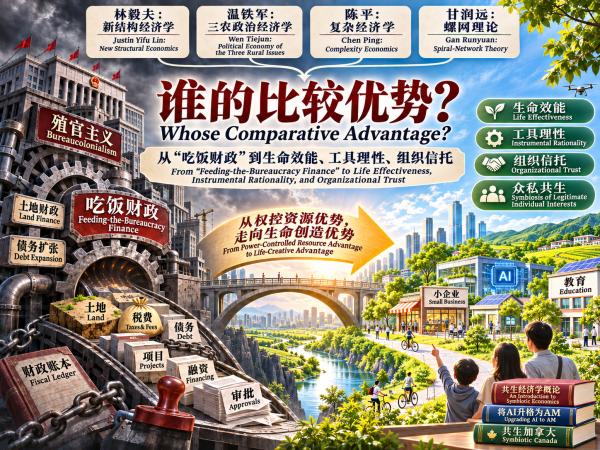
讨论中国经济发展的特色、得失、成败与当下未来,绕不开朱镕基当年说出的四个字:“吃饭财政”。这四个字所指向的,远不止财政收支的技术问题。社会创造的财富,怎样可能被行政组织不断增长的供养需求消耗?政府怎样从资源控制者转向受托服务者?中国老话“坐吃山空”,揭示了一个可以跨越朝代考察的政治经济学难题。 一个社会创造的财富再多,如果依赖行政控制的组织不断自我繁殖,汲取资源的规模与能力持续膨胀,经济基础便会承受日益沉重的上层建筑。这里所谓“吃饭”,不仅是公务人员的工资支出,还包括维持组织扩张的机构、工程、融资、审批、收费与资源支配成本。问题究竟在于财政不够充裕,还是于不断扩大自身供养需求的权力结构? 林毅夫的新结构经济学、温铁军的三农政治经济学、陈平的复杂经济学、甘润远的螺网理论,分别从产业结构、城乡关系、非线性演化与社会合力解释中国经济。我与这四位学者均有实际交往:曾专门撰文批评新结构经济学的结构问题;2004年起与温铁军持续交流并有过共同实践,我甚至为他在人民大学博士班代课两个月;与陈平也有较深较长时间的思想交往;对甘润远所承继的系统科学、思维科学探索,则早在参与1984—1985年钱学森相关学术活动接触时,便有切身体会。正因此,比较四种理论,对我而言也是对四十多年中国改革实践与经济思想的一次重新追问。 这次追问可以浓缩为四句话:谁的比较优势?谁的城乡比较?谁的复杂系统?谁的螺网?进一步追问便是:谁创造财富,谁控制资源,谁取得收益,谁承担成本,谁有权纠错? 本文结构:吃饭财政 → 殖官主义自我繁殖 → 上层建筑超负荷经济基础 → 四种经济理论的主体性盲点 → 宏观数据与微观体感背离 → 生命效能、工具理性、组织信托的交互主体共生 → 经济学生命转向。 一、“吃饭财政”:从经济难题深入政治与文化结构 1998年3月19日,新任国务院总理朱镕基在记者招待会上谈到科教兴国资金不足,直指政府机关庞大、“吃饭财政”消耗财政资源,以及各级政府干预造成的盲目重复建设。他还公开批评一些机关在法定税收之外巧立名目收费,加重群众负担。这一诊断,少有地把政府自身运行成本摆到了国家发展问题的中心。 朱镕基曾在1958年被错划为“右派”,后来重新进入经济管理和领导岗位。他的经历与作风,说明改革史中独立思考和直面现实问题的重要性。但不能将其任用的全部政治原因归结为一句话;可以确定的是,他对机构膨胀、财政负担和行政干预的认识,构成其改革施政的重要现实起点。 “吃饭财政”原指行政机构及其供养负担挤占财政资源。深入其制度根源,它可以成为殖官主义(Bureaucolonialism;亦称Reproductive Officialdom)在财政领域的通俗表现:权力与资源自我繁殖,组织供养和控制需求不断扩张,成本向社会转嫁,公共价值与组织利益脱钩。所谓“殖官”,重在指出权力组织自我繁殖的机制,并不等于把每位公务人员都归入同一性质。其内在矛盾,是上层建筑的资源汲取及自我扩张能力可能日益超出经济基础、具体企业和普通家庭的负担能力。 “坐吃山空”四个字,恰恰说明仅靠开源无法根治这种矛盾。今日增税,明日卖地,后日举债,再往后借助产业基金和高技术项目寻找新的收益来源,只要支配这些工具的组织仍能不受充分约束地自我扩张,新增财富便可能成为下一轮扩张的资本。殖官主义具有增长惯性,也具有拒绝自我缩减的惰性:发展得越快,能够控制的资源越多,原有的组织需求可能膨胀得越快。这里用“癌变”作为警示性的比喻,指组织失去对生命整体的服务关系、转而以自我增殖为目的的病理状态,并非对任何具体个人的医学判断。 沿着这一问题回望王莽、隋炀帝杨广、王安石、张居正、明思宗朱由检,再到近现代改革,历史情境与制度性质各不相同,不能简单等量齐观。王莽试图用国家权力重整土地、货币和经济秩序;杨广时期的大工程与战争造成沉重的财政、徭役动员;王安石以青苗、免役、市易等制度求富国强兵;张居正整饬财政、清丈土地并推动赋役调整;朱由检即崇祯帝(1628—1644年在位),面对战争、灾荒与财政枯竭,明末辽饷、剿饷、练饷的累积加派进一步加重了民生负担。不同的改革与危机反复触及同一问题:国家如何获得公共治理资源,又怎样防止财政汲取与组织供养反过来侵蚀社会生产和生命活力? 解决国家“吃饭”问题,可能走向节制组织成本、改善公共服务,也可能走向扩大征敛、增加摊派和强化资源控制。两条道路不能混为一谈。历史上的兴亡得失,恰恰提醒我们:财政收入增加,并不自动意味着国富民强;组织的效率提高,也未必意味着组织的目的得到校准。 二、朱镕基改革:发现了问题,为何仍未走出问题? 邓小平改革开放的重要路径,是以对外(美国、日本)开放带动国内改革,以扩大交易和竞争倒逼传统计划配置松动。农村家庭承包经营、乡镇企业、个体工商户和民营企业的发展,释放了个人、家庭和企业的创造力。但开放市场不等于同时完成行政权力的制度转型:土地、信贷、投资、审批及资源配置仍可由行政组织深度控制。于是,民间经济主体的自主性在发展中不断扩展,也可能在财政及政治组织需要加强控制时再次受到挤压。 朱镕基面对的是这一矛盾累积后的现实:财政拮据、国企亏损、行政机构膨胀、金融风险和产业重复建设。其改革具有明确的行动能力:推动机构精简、国企脱困、金融整顿及财税制度调整,使一些长期积累的低效环节得到清理。这里应当区分改革的成效与它未能根治的制度问题。 票证制度的退出,是改革开放解除商品配给约束的重要标志,但需要讲清时间线:布票在1984年已基本退出;粮票在1993年全国粮食流通改革中陆续取消,到1994年前后基本退出日常生活。这一进程始于朱镕基出任总理之前,不能简单归为其个人在1994年的改革。它显示,当供给能力、价格机制和个人购买选择得到扩展,原有配给权力便可能失去存在必要。 另一面则是国有企业改革中的大规模下岗分流。我愿意称之为“世纪之痛”。国家统计局曾披露,1998年至2001年底,全国国有企业累计产生下岗职工2550万人。改革使企业减员增效、部分亏损组织摆脱困境,却也使大量家庭承受就业中断、身份失落、生活转型和代际影响。企业资产负债表的改善,必须与劳动者及家庭的生活账本一同核算。 改革解决了若干“由谁供养、如何减负”的迫切问题,却未从根本上回答:政府和国有组织的资源支配权,应当怎样受到产权、契约、司法和公共责任的持续约束?财政为什么必须首先承兑普通人的生活?谁来检验行政组织扩张究竟是有益投入,还是新的成本转嫁? 1994年分税制增强了中央财政统筹能力,也重新安排了中央与地方财权关系。此后地方土地开发、出让收入、城市建设和融资平台逐步形成相互依存的链条。不能把土地财政全部归因于一项税制改革,但地方政府以土地资源支撑财政与投资扩张,正说明旧的组织激励可以在新的市场环境下找到新的资源载体。 这一制度难题并未随着世纪之交的国企改革而消失。中国2001年加入世界贸易组织(World Trade Organization,WTO WTO),不仅扩大了国际市场与经济交流,也通过贸易承诺、规则约束、国际竞争和跨国契约,引入了具有制度影响的外部性,对国内经济管理与组织行为产生持续影响。从谈判到签约过程中,中国劳动权益、社会保障与行政改革亦在这一时期经历调整(包括双休日、最低工资),它们促进出口、就业、投资和产业(经济管理)学习,也拓宽了民间企业的活动空间。2003—2012年中国经济快速增长,有人称之为“黄金十年”。其增长既依靠国内劳动、创业和产业能力,也离不开WTO带来的外部市场和规则环境。与此同时,部分关键产业及2008年后刺激投资中的国有部门资源配置影响增强,“国进民退”争论随之升温。为缓解财政与发展困境而放开社会创造,随着经济规模和组织控制资源的能力扩大,又可能恢复或强化行政控制:这构成一个需要持续检验的制度循环。 这正是“吃饭财政”的深层悖论。社会创造力被释放,有利于经济繁荣,也为财政提供新的税基;可是,如果财政与组织的目的始终围绕权力的持续供养和扩张,新增财富便容易再转化为“权控资源”优势。此前依赖粮票、布票的配给控制可以退出,新的土地、融资、产业基金、行政许可和技术项目控制却可以兴起。改变的只是工具和汲取渠道,未必是人与组织的交互主体关系。“解决吃饭财政”与“根治吃饭财政”由此成为两件不同的事。 其后,土地出让收入、地方融资平台、城建投资与债务扩张逐渐形成彼此强化的关系;当房地产市场调整、土地收入萎缩,财政的旧有支撑便暴露出脆弱性。财政部2025年决算显示,地方一般公共预算本级收入约12.21万亿元,地方一般公共预算支出约24.44万亿元;按本级收入对本级支出的覆盖率观察,全国各省级地区都未实现完全自给,中央转移支付承担着重要平衡作用。这里须区分本级财政自给能力不足与依法安排转移支付、债券融资后的预算赤字,它们不能混为一谈。 债务问题更加直接。财政部公布的2025年末地方政府法定债务余额为54.82万亿元;国际货币基金组织2026年关于中国地方财政的专题研究指出,若计入地方政府融资平台(政府的城投公司等),官方地方债务与融资平台债务合计的估算规模约相当于2025年GDP的90%。不同统计口径不能简单相加,但都揭示出沉重的存量债务、偿债约束及地方财政调整难题。 2026年前三季度中国GDP按官方核算仍同比增长4.6%,不能据此断言全国经济已出现统计意义上的整体衰退。然而,房地产、建筑业、地方财政收入结构、部分行业需求和居民资产负债表所经历的收缩,足以说明“增长”与“生活体感”之间存在需要正面回答的裂缝。若继续以投资项目和技术产值代替生命净效能,这一裂缝不会因增长指标仍为正值而自行消失。 由此,从机构供养之困,到放活企业与市场,再到部分领域的“国进民退”、土地财政极致化、地方债务压力以及围绕新质生产力的新一轮资源配置,贯穿其间的都是财政需求、社会创造与行政控制的交互作用。问题的关键始终是:发展的比较优势,究竟属于创造财富、改善生活的具体生命主体,还是属于掌握资源控制权的组织? 三、四种经济理论:四个“谁的”与一个共同盲点 林毅夫的新结构经济学,以要素禀赋、比较优势和产业升级解释经济发展,提出“有效市场、有为政府”。要害在于“谁的比较优势”:企业的市场竞争优势、居民的生活收益,与行政官员的权控资源优势,可能完全不同。没有对政府资源控制权、财政激励和组织责任的内在约束,“有为”就容易被实践改写为有权配置、有权投资和有权扩张。早在2018年,我便撰文讨论新结构经济学的结构性缺陷。今天再追问“谁的比较优势”,问题更加明确:决定资源如何实际配置的权力、产权与责任结构,必须进入经济理论的核心分析。 温铁军的三农政治经济学,以工业化成本转嫁、城乡关系和村社合作解释中国现代化。要害在于“谁的城乡比较”:农民个人、家庭、村社集体、地方政府和城市资本,权利与利益并不天然一致。看见乡村被转嫁的成本,还须看见农民作为自主产权、经营、创造和契约主体的权利;否则,村社共同体也可能被重新组织为行政资源控制的载体。 陈平的复杂经济学,借助耗散结构、非线性动力学与代谢增长解释技术竞争、产业兴衰和经济演化。要害在于“谁的复杂系统”:经济结构可以呈现非均衡和自组织特征,但系统的壮大与复杂化,不能替代人的自由创造、生命心智与效能检验。复杂性揭示变化机制,无法单独确定发展目的。 甘润远的螺网理论,以多维联结、分叉、协同、分形与周期刻画社会经济的整体演进。要害在于“谁的螺网”:谁连接、组织、支配网络,谁拥有选择和退出权,谁从结构协同中受益?网络越严密,也可能越有利于权力集中;螺旋演化并不自动保证生命效能提升。 四种理论的研究贡献各有侧重,但在解释中国模式时,它们都尚未把权力与资源自我繁殖、成本转嫁、公共价值脱钩的殖官主义(Bureaucolonialism)作为贯穿经济演化的核心变量。与达龙·阿西莫格鲁、詹姆斯·A.罗宾逊在《国家为什么会失败》(Why Nations Fail)中对包容性与攫取性制度的分析相对照,更可看出权力分配和经济机会之间的深层关联;而殖官主义要继续追究的,是行政组织怎样使汲取能力跨产业、跨财政工具延续,以及这些行动由谁承担生命代价。四种理论中的国家、城乡、系统、网络,常比具体生命主体更清晰;生产规模、结构升级和组织能力,常比生活净效能更容易计量。 四个“谁的”,最终都指向同一个问题:一套经济理论如果不辨明谁创造价值、谁控制资源、谁承担责任及谁拥有纠错权,便很难识别经济成就如何与百姓实际体感相背离,更难为经济转型提供明确的价值方向。 四、殖官主义:为什么从土地财政到新质生产力会重现同一困境? 殖官主义(Bureaucolonialism / Reproductive Officialdom)是我在《论殖官主义》中讨论的原创诊疗概念。它指权力与资源依托行政组织持续自我繁殖,决策者可能获取组织收益,却将风险与代价留给社会,公共价值与组织利益日益脱钩的经济政治机制。这一机制既具有扩张惯性,也具有纠错惰性:资源越集中,组织越依赖资源控制;组织越依赖扩张,越难主动缩减既有权力和利益。用“癌变”形容这一组织病理,是强调失去生命服务目的的自我增殖危险;它是一种制度分析比喻,而不是把复杂历史直接归因于单一因素。殖官主义更深的病理,是原本为解决问题而成立的组织,可能逐渐把问题的持续存在转化为维持职位、预算和权力的理由,从解决问题转向经营问题,甚至排斥真正推动纠错的人与组织。如此,社会问题便成为组织自我繁殖的资源。 土地财政极致化,是这种机制的一种历史表现。土地从生活与生产的基本条件,变为融资、项目、地价与财政循环的关键工具。一些城市建设确实改善了交通和公共设施,另一些开发却可能使居民承担高房价、债务和长期资源错配。究竟属于哪一种,必须通过真实的社会净效能检验,而不能仅以土地出让收入和投资额判断。 新质生产力具有技术创新、全要素生产率提高和产业进步的现实潜力。但若产业政策的实施仍以掌握项目、配置补贴、扩大投资和形成行政业绩为中心,新的算力园区、产业基金或先进制造项目也可能复制旧的资源汲取逻辑,强化所谓“数字集权”。所以,新技术可以改变生产工具,未必自动改变组织权力的运行方式。 从土地、人力,到AI算力,真正值得比较的不是资源名称,而是制度关系:谁决定投入,谁拥有产权,谁掌握退出权,谁享有收益,谁承担失败成本,以及谁能够要求公开审计与纠错。 不确定生命效能标准,因而不从生产关系、上层建筑这些问题的根本解决,再先进的生产力,仍可能被殖官主义转化为新的“吃饭财政”。 从“吃饭财政”看政府与社会的关系,尤其不能把民间主体仅仅视为在财政困难时可以“放活”、在财政充裕后可以“收回”的资源对象。一个人不是行政项目的投入要素,一家企业不是待征收的财政矿藏,一个社区也不是供组织扩张的被动载体。人们具有独立生命、自主心智、产权与契约能力,政府则拥有为公众提供必要服务、维护公正秩序的特定职责。两者的主体地位和权力性质不同,彼此需要交互,比例、边界和责任应通过明确的规则、持续的效能检验加以校准。 五、亚当·斯密的繁荣原点:和平、轻税、过得去的司法行政 亚当·斯密(Adam Smith)在1755年前后的论述中,提出国家走向富裕的重要条件:“和平、轻税、过得去的司法行政”(Peace, easy taxes, and a tolerable administration of justice)。这段话由杜格尔德·斯图尔特(Dugald Stewart)后来转述,短短一句,至今仍有令人警醒的清晰性。 和平保护生命安全、交易秩序与正常交往;轻税使个人与企业有条件保有劳动及创造的成果;“过得去的司法行政”保障产权、契约、权利救济与可预期的行政行为。和平还具有国内社会安宁、国家之间和平以及个人与组织之间免于任意侵害的多层含义。所谓三重和平,并不限于没有真刀真枪的战争,也包括不以趋利执法、任意收费和随意处罚破坏社会生活的安宁。当然,这与国际法和政治学意义上的武装战争表现方式不一样,但将这种经济社会摩擦称为一种“非武装的对抗状态”,可提示其对信任与社会安宁的侵蚀,则不为过。 以斯密这一基准衡量,“吃饭财政”便不仅是财政开支问题,更是社会能否承受行政组织负担的问题。一个政府倘若为了供养自身,持续扩大税赋、行政收费、罚没与非税性资源汲取,就会挤压居民和企业的自主创造空间。不过,概念和统计必须分清:财政部公布,2025年全国一般公共预算税收收入为17.64万亿元,非税收入为3.97万亿元;2026年前三季度分别为14.07万亿元和3.16万亿元。按这一统一口径,非税收入并未超过税收收入。土地出让收入另列政府性基金预算,不能混在非税收入中重复计算。真正应追究的是多渠道财政汲取与社会实际负担的综合效应。 这也是中国经济讨论需要找回的方向感:国家富裕应当能够落实到具体人的生活;产业竞争优势应当能够转化为劳动、创造与收入的真实机会;组织权力应当受到公共责任和有效纠错机制约束。 所谓“远洋捕捞”式跨区域趋利性执法,及对企业历史经营行为不当追溯、罚没的问题,之所以引发广泛关切,就在于公权力若把企业和个人当作填补财政缺口的对象,司法行政便会从秩序的保障者滑向经济生活的不确定性来源。针对这类问题,中国政府近年也提出规范涉企行政执法、整治趋利性执法。将这种经济社会摩擦称为一种“非武装的对抗状态”,可提示其对信任与安宁的侵蚀;但须与国际法和政治学意义上的武装战争加以区分。 达龙·阿西莫格鲁(Daron Acemoglu)与詹姆斯·A.罗宾逊(James A. Robinson)在《国家为什么会失败》中追问政治和经济制度如何影响繁荣与贫困,为比较“殖民—制度—经济不平等”与“殖官—制度—政治不平等”提供了思想参照。西蒙·约翰逊(Simon Johnson)与上述两位学者共同获得2024年诺贝尔经济学奖,但他并非《国家为什么会失败》的合著者。将制度问题进一步落实为生命主体、工具理性与组织信托的交互关系,才能检验组织财富、政治控制和个人生活之间的具体差距。 谁拥有决策权,谁就应承担与之相称的责任;谁受生命之托,谁就必须向生命承兑。 殖官主义最深刻的制度特征之一,是决策权、收益权与责任承担之间的脱节:掌权者可以享受决策带来的组织收益,却将决策失败的成本留给纳税人、企业和普通家庭。所谓“决策免责权”,正是这种权责不对称的概括。终结这种特权,是重建组织信托的重要前提。 从这一意义上说,阿根廷总统哈维尔·米莱(Javier Milei)以“电锯改革”削减冗余机构、压缩行政支出、减少管制、重新界定政府与市场的边界,展现了反殖官主义的改革方向。我愿意称这种敢于向行政组织自我供养和资源控制惯性动刀的行动者为反殖官主义英雄。 但改革真正的完成,还取决于决策者自身能否同样受到法律、审计、公共监督和责任追究的约束。政府瘦身之后,权力不能以新的形式重新集中;行政成本下降之后,社会承担的实际代价也必须接受生命净效能的检验。 终结“决策免责权”,就是要让有权决策者对决策后果承担相应责任,让公共权力重新成为受托权力,让组织的存在与发展最终向生命承兑。 斯密的和平、轻税、司法行政 → 米莱改革对组织自我供养的挑战 → 终结决策免责权 → 重建组织信托 → 生命效能、工具理性、组织信托的交互主体共生。 六、共生经济学:从LIFE—AI—TRUST到生命效能、工具理性、组织信托 共生经济学(Symbionomics)的理论原点是:“全部历史的第一个前提,是个人生命自组织连接的存在。”经济生活始于具体生命主体(LIFE)的生存、选择、创造及其与他者的连接。公寓于私,众私即公;各主体的正当权利、利益与创造,通过契约、责任和有益交互形成公共价值。人的生命形態、智能形態与组织形態可以分别以LIFE、AI、TRUST标识,其研究重点是三者之间的交互主体共生,而不是让人被技术和组织吞没。 其基本机制,是自组织连接动态平衡(动能)与交互主体共生(势能)的相应相辅相成。万物有序,唯生命具足而超序,万事交互主体共生(Everything Intersubjective Symbiosism,EIS)且生生不息。经济发展不仅包含资源配置和结构演化,也包含生命心智的自主创造、组织革新及关系重建。 在此基础上,必须确立生命效能(Life Effectiveness)、工具理性(Instrumental Rationality)、组织信托(Organizational Trust / Trusteeship)三者的交互主体共生关系。生命效能回答“为了谁、改善了什么”;工具理性回答“怎样使用资本、技术、市场、税收与行政手段”;组织信托回答“受谁之托、权力边界何在、成本与责任如何承兑”。三者相应相辅:生命效能提供价值基准,工具理性提供行动能力,组织信托校准权利、责任与结果。主体间性(Intersubjectivity)既承认个人、企业、社区与政府各有其位,也要求公共组织受到契约、法律与生活效能的持续检验。 共生经济学以生产—生活—生態—生命的综合净效能为评价对象,提出GDE(Gross Domestic Effectiveness,国内共生净效能)及效能系数η(Effectiveness Coefficient):GDE=Σ(GDPᵢ×ηᵢ);以降本(C,Lower Cost)、赋能(E,Enablement)、健康(H,Health)、信任(T,Trust)、和平(P,Peace)五因指数(Five-Factor Index)和“生活基准”检验收益、风险、外部成本及长期后果,并探索可测量、可比较、可纠错的共生标准(Symbiotic Standards)。 从GDP、PPP和外汇储备等宏观指标与普通人生活体感的背离,到股市、楼市、债市的资产价值重估,GDE与效能系数η所追问的,始终是资源投入、经济产出与实际生命净效能之间的转化关系。 GDE与五因指数仍须在具体领域明确核算边界、估值与证据要求,因而还需要在不同领域持续发展可重复的计量方法,才能真正进入政策与社会实践。而这正是当今从事经济学、社会学、哲学和工程技术、民调基准探索者大有可为的广阔天地。 在行动层面,通过K诊(K-Diagnosis,即对成本挤压、权控汲取与组织效能损失的病理诊断)查明症结,通过Q疗(Q-Therapy,即拓宽创造主体与价值实现空间的建设性疗法)重整产权、契约、技术、组织和公共服务,落实“受生命之托,向生命承兑”。在数位—量子时代,从人工智能(Artificial Intelligence,AI)探索升格为人工心智(Artificial Mind,AM),以及创建愛之智慧孞態场/网(Amorsophia MindsField/MindsWeb),让技术能力、组织能力与生命效能(生产方式、生活方式和思维方式)交互契合。 概括起来,共生经济学以生命主体为原点,以自组织连接动态平衡(动能)与交互主体共生(势能)的相应相辅相成为机制,以GDE、η及五因指数检验生命净效能,以生命效能—工具理性—组织信托的交互关系明确方向,通过K诊、Q疗、共生标准与组织信托推动经济社会持续革新。 七、从“吃饭财政”到“受生命之托”:中国经济未来的转向 中国改革开放以来最深刻的经验之一,是个人、家庭和企业一旦获得真实的经营自主权与交易机会,就能够创造远超行政计划所能预期的财富。另一面,当行政组织在财政困境中放活社会,在税基扩张、土地开发与债务融资中获得新的支配能力后,便可能重新加强控制,从而重演“放活—汲取—扩张—负债”的循环。WTO的外部规则与竞争有助于拓宽市场空间,却无法单独替代国内产权、财政、司法与组织信托的深层改革。 因此,问题不能只在“吃饭财政”内部寻找解法。精简一次机构、出售一批土地、提高收费、扩大一轮项目投资,可能缓解一时的财力短缺,却未必改变组织自我繁殖的根本激励;更强的生产工具也可能带来更强的资源控制能力。真正需要改革的,是上层建筑与经济基础之间的权利和责任关系:把本来被当作资源客体的个人、家庭和企业,确立为具有独立权利、选择与创造能力的生命主体;把行政组织置于有限、明确、可审计、可纠错的公共信托关系中。 黄宗羲对天下公私关系的追问,洛克对个人权利与政府受托责任的阐释,都提醒我们重新辨明公与私的关系。公寓于私,众私即公。政府的公共权力只有回到一个个具体生命主体的正当权利、创造与责任,才能摆脱以组织自身利益冒充公共利益的殖官主义困境。 提出问题,从每个人的真实生活效能出发;分析问题,追究权力与工具如何配置资源、如何形成组织供养惯性、由谁承担成本;解决问题,重建产权、司法、财政及行政组织的信托责任,校准政府服务与社会自主之间的合宜关系,使生产、生活、生態、生命的综合净效能真正成为经济发展和公共治理的共同检验基准。 谁的比较优势?最终应当回到谁的生命创造、谁的生活改善、谁的未来机会。谁的城乡比较、复杂系统和螺网?最终都要接受具体生命主体的权利、责任与效能检验。 从“吃饭财政”走向公共价值承兑,从“坐吃山空”的组织自我供养走向众私共生的生命创造,从权控资源优势走向能由人们实际生活验证的比较优势,从规模扩张走向生产、生活、生態、生命的综合净效能:这才是经济学生命转向的必由之路。 自己活,也让别人活。受生命之托,向生命承兑。All for Life! 总结一句话 四位学者各有特色,但都没有逾越解决“吃饭财政”思维方式。朱镕基“吃饭财政”施政方式,只是超意识形态的殖官主义(Bureaucolonialism /Reproductive Officialdom)体制机制的财政表现,殖官主义揭示了资源权控组织自我繁殖的制度根源;经济学生命转向,则要从生命效能、工具理性与组织信托的交互共生关系中寻找建设性出路。 主要史料与参考依据 1.新华社:《朱镕基总理等答中外记者问》,1998年3月19日,载《人民日报》1998年3月20日。https://cn.govopendata.com/renminribao/1998/03/20/1/ 2.国家统计局:《国有企业改革稳步推进》,关于1998—2001年国企下岗分流及再就业统计。https://www.stats.gov.cn/zt_18555/ztfx/yjsld/202303/t20230301_1920320.html 3.《人民日报》:《告别粮票20年:从短缺到充裕》,2013年12月24日,关于布票及粮票退出的时间。https://cpc.people.com.cn/n/2013/1224/c83083-23927923-4.html 4.朱镕基:《在上海市九届人大一次会议上的讲话》,上海党史网,关于1958年被划为右派的本人回忆。https://www.ccphistory.org.cn/shds/shhm/content/8af04d01-01dd-4d80-bde6-f4069563e576.html 5.Dugald Stewart 转述 Adam Smith 1755年前后论述:“Peace, easy taxes, and a tolerable administration of justice.” Online Library of Liberty. https://oll.libertyfund.org/quotes/adam-smith-on-the-need-for-peace-easy-taxes-and-a-tolerable-administration-of-justice-1755 6.财政部:《关于2025年中央和地方预算执行情况与2026年中央和地方预算草案的报告》,2026年3月。https://www.mof.gov.cn/zhengwuxinxi/caizhengxinwen/202603/t20260316_3985331.htm 7.国际货币基金组织:《Local Government Finances in China: Policy Options to Tackle the Debt Overhang》,2026年10月。https://www.elibrary.imf.org/view/journals/087/2026/019/article-A001-en.xml 8.国家统计局:《Preliminary Accounting Results of GDP for the Third Quarter of 2026》,2026年10月21日。https://www.stats.gov.cn/english/PressRelease/202610/t20261021_1965671.html 9.高明:《中国“国家资本主义”发展特征——2003—2012:国有企业的主导性发展》,卡内基国际和平基金会,2010年8月27日。https://carnegieendowment.org/zh/research/2010/08/2003-2012 10.新疆维吾尔自治区财政厅网站转载:《2025年各省财政收支情况与自给率排名》,2026年3月30日(原始逐省数据以各地财政决算为准)。https://czt.xinjiang.gov.cn/xjczt/c115019/202603/77a86d6c89af4cb188fc4a6b134c4f.shtml 11.财政部:《2025年财政收支情况》,2026年1月30日。https://www.mof.gov.cn/zhengwuxinxi/caizhengxinwen/202601/t20260130_3983013.htm 12.财政部:《2026年前三季度财政收支情况》,2026年10月23日。https://m.mof.gov.cn/czxw/202610/t20261023_4003380.htm 13.财政部:《2026年前三季度财政收支情况新闻发布会文字实录》,2026年10月23日,关于土地出让收入及涉企收费。https://app.mof.gov.cn/mofmobile2026/czxw/202610/t20261023_4003442.htm 14.故宫博物院:《崇祯皇帝》人物资料,关于明思宗朱由检及其在位年代。https://www.dpm.org.cn/court/lineage/226246.html 15.中国人民大学清史研究所:《赋税财政》相关史料及《清世祖实录》所载明末“三饷”加派问题。https://iqh.ruc.edu.cn/old/qdjjsyj/jjs_ztyj/fscz/9c7ad16d1e0447f9a9649fe9662fb972.htm 16. 钱 宏(Archer Hong Qian):《中国经济社会结构性问题之结症——林毅夫“新结构经济学”的结构性缺陷(摘要)》(本摘要,摘自中美“贸易战”开打前两个月的2018年1月,发表在 “全球共生论坛”公众号(IGS1218)上的《林毅夫新结构经济学的现实长项与理论缺失》)http://symbiosism.com.cn/3885.html 17. 钱 宏(Archer Hong Qian):《资源效能“转化率”——“宏观数据”与“微观体感”背离的破解之道》http://symbiosism.com.cn/11392.html 18. 钱 宏(Archer Hong Qian):《为何GDP、PPP、外储全优仍难国富民强?》http://symbiosism.com.cn/11636.html 19. 钱 宏(Archer Hong Qian):《R定律:用GDE效能坐标重估股市、楼市与债市的真实价值》http://symbiosism.com.cn/11674.html 20.黄亚生:《中国模式的终点:从科举帝制到数位威权,揭露中国式治理制度的宿命》,今周刊于2025年12月出版。 21. 钱 宏(Archer Hong Qian):《从〈国家的视角〉到〈论殖官主义〉》,2025年10月28日至2026年3月29日写作,2026年4月15日刊载,全球共生研究院。https://www.amorsophia.com/article/10010 22.钱 宏(Archer Hong Qian):《殖官主义:享受决策的好处,把代价留给他人——从跨制度的组织行为惰性到国家组织信托重建》,2026年10月8日整合修订稿,全球共生研究院。https://www.ai-am.org/article/10338 23.达龙·阿西莫格鲁、詹姆斯·A.罗宾逊:《国家为什么会失败:权力、繁荣与贫困的根源》(Why Nations Fail: The Origins of Power, Prosperity, and Poverty),Crown Publishers,2012年。https://www.penguinrandomhouse.com/books/205014/why-nations-fail-by-daron-acemoglu-and-james-a-robinson/9780307719232/ 24. 钱 宏(Archer Hong Qian):《大公无私之私,众私共生之公——从黄宗羲与洛克的文明分流,到集权悖论、殖官主义与公私之辨》The Private in “Selfless Public Good,”the Public in Symbiosis Among Legitimate Individual Interests—From the Divergent Civilizational Paths of Huang Zongxi and Locke to the Centralization Paradox, Bureaucolonialism, and the Public–Private Distinction,https://www.amorsophia.com/article/10396 25.钱 宏(Archer Hong Qian):《共生经济学概论(修订版)》(Symbionomics: An Overview, Revised),2026年作者著作。 26.钱 宏(Archer Hong Qian):《将AI升格为AM》(Elevating AI to AM),2026年作者著作。 27.钱 宏(Archer Hong Qian):《从亚当·斯密、加拿大立国之约到共生经济学的组织信托》,全球共生研究院,2026年。https://www.amorsophia.com/article/10305 28.钱 宏(Archer Hong Qian):《一篇反殖官主义宣言!——从原旨主义的觉悟、殖官主义的癌变,到卢比奥的使命与行动雄心》,2026年11月16日,全球共生研究院。https://www.amorsophia.com/article/10432
Whose Comparative Advantage?— From the Blind Spots Concerning Subjectivity in Four Economic Theories and the Problem of “Feeding the Bureaucracy” to the Imperative of a Life-Centered Turn in Economics
Archer Hong Qian November 21, 2026 · Vancouver
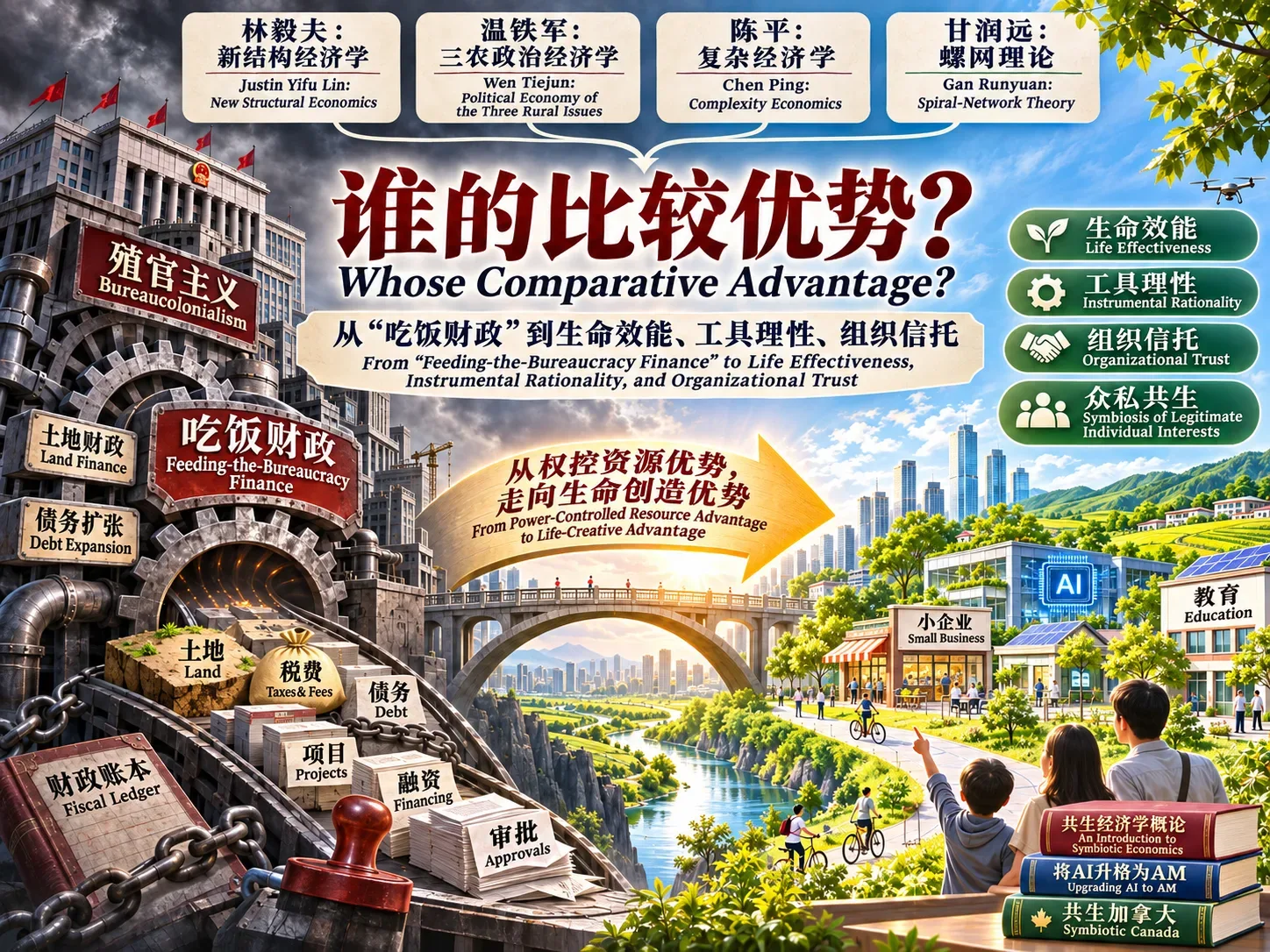
To discuss the distinctive characteristics, achievements, failures, present conditions, and future prospects of China's economic development, one cannot avoid the four Chinese characters once spoken by Zhu Rongji: “吃饭财政” — a fiscal system consumed by feeding the bureaucracy. These four characters point to something far beyond the technical question of fiscal revenue and expenditure. How can the wealth created by society be consumed by the continually expanding costs of maintaining administrative organizations? How can a government move from controlling resources to serving as a trustee of the people? The old Chinese saying “坐吃山空” — even a mountain of wealth will eventually be exhausted if one lives by consuming it — reveals a problem in political economy that recurs across dynasties. No matter how much wealth a society creates, if organizations dependent on administrative control continue reproducing themselves, and their capacity and appetite for extracting resources keep expanding, the economic base will eventually be burdened by an increasingly oversized superstructure. Here, “feeding” means more than paying government employees' salaries. It also includes the costs of maintaining expanding institutions, projects, financing arrangements, approval procedures, administrative charges, and the power to control resources. Is the real problem an insufficiently prosperous treasury, or a power structure that continually expands its own requirements for maintenance? Justin Yifu Lin's New Structural Economics, Wen Tiejun's Political Economy of the Three Rural Issues, Chen Ping's Complexity Economics, and Gan Runyuan's Spiral-Network Theory approach China's economy through industrial structures, urban–rural relations, nonlinear evolution, and the combined forces shaping society. I have had personal interactions with all four scholars. I wrote an article specifically criticizing the structural deficiencies of New Structural Economics. Since 2004, I have maintained an ongoing intellectual exchange with Wen Tiejun and participated in practical projects with him; I even taught classes on his behalf for two months in a doctoral program at Renmin University of China. I have also had extensive and sustained intellectual exchanges with Chen Ping. As for the systems science and science of thinking associated with Gan Runyuan's approach, I gained firsthand exposure to these fields through my participation in academic activities connected with Qian Xuesen in 1984–1985. For these reasons, comparing the four theories is also, for me, an opportunity to revisit more than forty years of Chinese economic reform and economic thought. This inquiry can be condensed into four questions: Whose comparative advantage? Whose urban–rural comparison? Whose complex system? Whose spiral network? Behind them lie further questions: Who creates wealth? Who controls resources? Who receives the benefits? Who bears the costs? And who has the right to correct mistakes? The argument of this article follows a connected sequence: The fiscal burden of feeding the bureaucracy → Bureaucolonialism's self-reproduction → an oversized superstructure overwhelming the economic base → blind spots concerning subjectivity in four economic theories → divergence between macroeconomic indicators and lived experience → intersubjective symbiosis among Life Effectiveness, Instrumental Rationality, and Organizational Trust → the life-centered turn in economics. I. “Feeding the Bureaucracy”: From an Economic Problem to the Political and Cultural StructureOn March 19, 1998, at a press conference shortly after taking office as Premier of the State Council, Zhu Rongji discussed the shortage of funds for China's strategy of rejuvenating the country through science and education. He pointed directly to the enormous size of government institutions, the fiscal resources consumed by “feeding the bureaucracy,” and the wasteful duplication of construction projects resulting from government interference at different levels. He also publicly criticized government agencies that invented various fees outside legally prescribed taxation, thereby increasing the burden on ordinary people. This diagnosis was unusual in placing the operating costs of government itself at the center of the country's development problems. Zhu Rongji had been wrongly labeled a “Rightist” in 1958 and later returned to economic administration and leadership. His experience and governing style illustrate the importance of independent thinking and confronting practical problems in the history of reform. His appointment cannot be explained entirely by any single consideration. What can be established is that his understanding of institutional expansion, fiscal burdens, and administrative interference became an important starting point for his reform policies. The expression “feeding the bureaucracy” originally referred to administrative institutions and the costs of maintaining them consuming fiscal resources. Examined at its institutional roots, it can be understood as a familiar fiscal manifestation of Bureaucolonialism (also termed Reproductive Officialdom): the self-reproduction of power and resources, the continual expansion of organizational maintenance and control requirements, the shifting of costs onto society, and the separation of organizational interests from public value. The term Bureaucolonialism identifies the mechanism by which power organizations reproduce themselves. It does not imply that every civil servant shares the same characteristics. Its underlying contradiction is that the resource-extraction capacity and self-expansion of the superstructure may increasingly exceed what the economic base, individual enterprises, and ordinary households can sustain. The traditional saying “even a mountain of wealth can be consumed away” demonstrates why increasing revenue alone cannot resolve this contradiction. Today the authorities may raise taxes; tomorrow they may sell land; the next day they may borrow; subsequently they may seek new sources of revenue through industrial funds and high-technology projects. As long as the organizations controlling these instruments can continue expanding without sufficient constraints, newly created wealth may become the capital that finances another round of organizational expansion. Bureaucolonialism therefore has both an inertia of expansion and a resistance to reducing itself. The faster the economy develops, the more resources an organization may be able to control, and the faster its established demands may grow. The metaphor of a “cancerous transformation” serves as a warning about a pathological organizational condition: an organization loses its service relationship with the larger living whole and instead pursues its own multiplication. It is not a medical judgment about any particular individual. Looking back from this perspective at Wang Mang, Emperor Yang Guang of the Sui dynasty, Wang Anshi, Zhang Juzheng, Emperor Zhu Youjian of the late Ming dynasty, and modern reforms, we encounter different historical circumstances and institutional arrangements that cannot simply be treated as equivalent. Wang Mang attempted to reorganize landownership, currency, and the economic order through state power. Under Yang Guang, massive construction projects and military campaigns imposed heavy fiscal and corvée-labor demands. Wang Anshi introduced policies involving agricultural credit, labor-service reform, and state market intervention in an effort to enrich the state and strengthen its military capacity. Zhang Juzheng reorganized public finances, surveyed landholdings, and promoted adjustments to taxation and labor obligations. Zhu Youjian, the Chongzhen Emperor (reigned 1628–1644), confronted warfare, natural disasters, and fiscal exhaustion. The cumulative additional levies for frontier defense, suppression campaigns, and military training further increased the burden on the population. These different reforms and crises repeatedly touched upon the same question: How can a state obtain the resources necessary for public governance while preventing fiscal extraction and the costs of maintaining its organizations from undermining social production and the vitality of life? Addressing the state's need to “feed itself” may lead toward limiting organizational costs and improving public services. It may also lead toward expanding levies, increasing compulsory contributions, and strengthening control over resources. These two paths must be distinguished. The rise and fall of states throughout history remind us that increased fiscal revenue does not automatically produce national prosperity and popular well-being. Greater organizational efficiency does not necessarily mean that an organization's purposes have been properly aligned. II. Zhu Rongji's Reforms: Having Identified the Problem, Why Did They Fail to Move Beyond It?An important feature of Deng Xiaoping's reform and opening-up strategy was using openness to the outside world, including the United States and Japan, to promote domestic reform. Expanded transactions and competition helped loosen traditional centrally planned resource allocation. The household responsibility system in agriculture, township and village enterprises, individual businesses, and private enterprises released the creative capacities of individuals, families, and businesses. Yet opening markets did not automatically complete the institutional transformation of administrative power. Land, credit, investment, approvals, and resource allocation could still remain under extensive administrative control. Consequently, the autonomy of private economic actors expanded during economic development, but could also be constrained again when fiscal and political organizations sought to strengthen control. Zhu Rongji confronted the accumulated consequences of these contradictions: strained public finances, losses in state-owned enterprises, expanding government institutions, financial risks, and redundant industrial construction. His reforms demonstrated considerable capacity for action. He promoted institutional streamlining, the restructuring of loss-making state-owned enterprises, financial-sector rectification, and adjustments to fiscal and taxation arrangements, helping clear away some longstanding inefficiencies. The achievements of these reforms must be distinguished from the institutional problems they did not fundamentally resolve. The disappearance of ration coupons was an important symbol of reform and opening-up removing restrictions on the distribution of consumer goods. The chronology needs to be clear: cloth ration coupons had largely disappeared by 1984; grain ration coupons were progressively abolished in the nationwide reform of grain distribution in 1993 and had largely disappeared from everyday life by around 1994. This process began before Zhu Rongji became Premier and cannot simply be attributed to his personal reforms in 1994. It shows that when supply capacity, price mechanisms, and consumers' purchasing choices expand, earlier powers of rationing may lose their reason for existence. The other side was the large-scale layoffs and reassignment of workers during state-owned enterprise reform. I would call this “the pain of the century.” According to figures previously released by China's National Bureau of Statistics, a cumulative 25.5 million workers were laid off from state-owned enterprises between 1998 and the end of 2001. The reforms enabled enterprises to reduce staff and improve efficiency, allowing some loss-making organizations to escape their difficulties. Yet they also forced numerous households to endure interrupted employment, the loss of established social identity, changes in livelihood, and intergenerational consequences. Improvements to corporate balance sheets must be assessed alongside the household accounts of workers and their families. The reforms addressed some urgent questions concerning who should be supported and how costs could be reduced. Yet they did not fundamentally answer the following questions: How should the power of government and state-owned organizations to control resources be continuously constrained by property rights, contracts, judicial institutions, and public responsibility? Why must public finance first fulfill its obligations to ordinary people's lives? Who should determine whether expanding administrative organizations represents beneficial investment or another transfer of costs? The 1994 tax-sharing reform strengthened the central government's fiscal capacity and rearranged fiscal relations between central and local governments. Thereafter, local land development, land-conveyance revenue, urban construction, and local financing platforms gradually formed an interdependent chain. Land-based finance cannot be attributed entirely to a single tax reform. Nevertheless, the use of land resources by local governments to support fiscal revenues and investment expansion demonstrates how old organizational incentives can find new resource carriers within a changing market environment. This institutional problem did not disappear with the state-owned enterprise reforms at the turn of the century. China joined the World Trade Organization (WTO) in 2001. WTO accession not only expanded international markets and economic exchange but, through trade commitments, rule-based constraints, international competition, and cross-border contracts, also introduced external influences with significant institutional consequences for domestic economic management and organizational behavior. During the period of negotiations and accession, China's labor rights, social protection, and administrative reforms also underwent adjustments, including measures relating to the two-day weekend and minimum wages. These developments contributed to exports, employment, investment, and industrial and economic-management learning, while broadening the scope of private enterprise activity. China experienced rapid economic growth from 2003 to 2012, a period sometimes described as a “golden decade.” That growth depended on domestic labor, entrepreneurship, and industrial capacity, as well as access to external markets and the rules-based environment associated with WTO membership. At the same time, state-owned sectors gained influence over resource allocation in certain key industries and in investment stimulated after 2008, bringing the debate over the “advance of the state and retreat of the private sector” (guo jin min tui) to prominence. When fiscal and developmental difficulties arise, society's creative capacity may be released. Yet as economic activity expands and organizations accumulate greater control over resources, administrative control may subsequently be restored or strengthened. This constitutes an institutional cycle that calls for continued examination. Here lies the deeper paradox of “feeding the bureaucracy.” Releasing society's creative capacity promotes prosperity and provides government with a growing tax base. But if fiscal and organizational objectives remain centered on maintaining and expanding power, the additional wealth created can readily be converted into an advantage based on controlling resources. Earlier rationing instruments such as grain and cloth coupons may disappear, only to be replaced by new forms of control through land, financing, industrial funds, administrative licenses, and technological projects. What changes may be merely the instruments and channels of extraction, rather than the intersubjective relationship between human beings and organizations. “Addressing the fiscal burden of feeding the bureaucracy” and “eliminating its institutional roots” are therefore two different undertakings. In subsequent years, land-conveyance revenue, local government financing vehicles, urban construction investment, and debt expansion increasingly reinforced one another. When the property market adjusted and land revenue declined, the fragility of the old fiscal support structure became evident. According to China's Ministry of Finance figures for 2025, local general public budget revenue collected at the local level was approximately RMB 12.21 trillion, while local general public budget expenditure amounted to approximately RMB 24.44 trillion. Measured by the proportion of expenditures covered by locally collected revenue, none of the provincial-level jurisdictions was entirely self-financing. Central government fiscal transfers therefore played a significant balancing role. A distinction must be made between insufficient fiscal self-sufficiency at the local level and an actual budget deficit after legally arranged transfers and bond financing. These are not the same thing. The debt problem is more immediate. The Ministry of Finance reported that outstanding legally recognized local government debt reached RMB 54.82 trillion at the end of 2025. A 2026 International Monetary Fund study on China's local government finances indicated that, when local government financing vehicles are included, combined official local government debt and financing-vehicle debt were estimated at approximately 90 percent of China's 2025 GDP. Debt figures based on different statistical definitions cannot simply be added together. Nevertheless, they reveal substantial outstanding debt, repayment constraints, and the difficult adjustments facing local public finances. According to official figures, China's GDP still grew by 4.6 percent year on year during the first three quarters of 2026. It would therefore be inaccurate to conclude from these figures that the entire national economy had entered a statistical recession. Nevertheless, contractions affecting the real estate sector, construction, local government revenue structures, demand in some industries, and household balance sheets demonstrate a gap between recorded “growth” and people's lived experience that must be confronted. If investment projects and technological output continue to be treated as substitutes for net life effectiveness, this gap will not disappear merely because aggregate growth indicators remain positive. Thus, from the burden of maintaining government institutions, through efforts to release enterprise and market activity, to the advance of the state in certain sectors, the expansion of land-based finance, local government debt pressures, and another round of resource allocation around new quality productive forces, the persistent underlying relationship is the interaction among fiscal requirements, social creativity, and administrative control. The central question remains: Does the comparative advantage of development belong to the concrete living subjects who create wealth and improve life, or to the organizations that possess the power to control resources? III. Four Economic Theories: Four Questions of “Whose?” and One Shared Blind SpotJustin Yifu Lin's New Structural Economics explains economic development through factor endowments, comparative advantage, and industrial upgrading, proposing the combination of an “effective market” and a “facilitating government.” Its crucial question is: Whose comparative advantage? An enterprise's competitive advantage in the marketplace, the benefits accruing to residents, and an administrative official's advantage in controlling resources can be entirely different. Without intrinsic constraints on the government's control over resources, fiscal incentives, and organizational responsibilities, a “facilitating” government can easily become, in practice, one empowered to allocate resources, invest, and expand. As early as 2018, I published an article examining the structural deficiencies of New Structural Economics. Returning today to the question “Whose comparative advantage?”, the issue becomes clearer: the structure of power, property rights, and responsibility that determines how resources are actually allocated must enter the core analysis of economic theory. Wen Tiejun's political economy of the Three Rural Issues explains China's modernization through the shifting of industrialization costs, urban–rural relations, and village-community cooperation. Its crucial question is: Whose urban–rural comparison? The rights and interests of individual farmers, families, village collectives, local governments, and urban capital do not automatically coincide. Recognizing the costs shifted onto rural areas must be accompanied by recognition of farmers' rights as autonomous holders of property, operators of businesses, creators, and parties to contracts. Otherwise, village communities themselves may be reorganized into instruments for administrative resource control. Chen Ping's Complexity Economics draws on dissipative structures, nonlinear dynamics, and metabolic growth to explain technological competition, industrial rise and decline, and economic evolution. Its crucial question is: Whose complex system? Economic structures may exhibit non-equilibrium and self-organizing characteristics. Yet the expansion and increasing complexity of a system cannot substitute for human freedom to create, the human mind, or the assessment of life effectiveness. Complexity can reveal mechanisms of change, but cannot, by itself, determine the purposes of development. Gan Runyuan's Spiral-Network Theory uses multidimensional connections, branching, coordination, fractals, and cycles to describe the overall evolution of society and the economy. Its crucial question is: Whose spiral network? Who connects, organizes, and controls the network? Who possesses the right to choose and withdraw? Who benefits from structural coordination? A more tightly integrated network may also facilitate greater concentration of power. Spiral evolution does not automatically guarantee improvements in life effectiveness. These four theories make different contributions. Yet when they seek to explain the Chinese development model, none places Bureaucolonialism — the self-reproduction of power and resources, the transfer of costs, and the disconnection of public value from organizational interests — at the center of economic evolution. A comparison with Daron Acemoglu and James A. Robinson's analysis of inclusive and extractive institutions in Why Nations Fail further highlights the relationship between the distribution of power and economic opportunity. Bureaucolonialism, however, goes on to investigate how administrative organizations preserve their extractive capacity across industries and fiscal instruments, and whose lives bear the consequences. In the four theories, the nation, urban–rural structure, system, and network are often more clearly defined than the concrete subjects of life. Production scale, structural upgrading, and organizational capacity are often more readily measured than net effectiveness in everyday life. The four questions of “whose?” ultimately lead to one underlying issue: If an economic theory does not identify who creates value, who controls resources, who bears responsibility, and who possesses the right to correct mistakes, it will struggle to explain why economic achievements may diverge from ordinary people's actual experience, and struggle even more to establish a clear direction for economic transformation. IV. Bureaucolonialism: Why Can the Same Predicament Reappear from Land-Based Finance to New Quality Productive Forces?Bureaucolonialism / Reproductive Officialdom is an original diagnostic and therapeutic concept that I have explored in my essay On Bureaucolonialism. It refers to a political-economic mechanism through which power and resources continually reproduce themselves within administrative organizations. Decision-makers may enjoy organizational benefits while leaving risks and costs to society, increasingly separating organizational interests from public value. This mechanism possesses both an inertia of expansion and a reluctance to correct itself. The more concentrated resources become, the more organizations depend on controlling them. The more organizations depend on expansion, the harder it becomes for them voluntarily to reduce established power and interests. Using “cancerous transformation” to describe this organizational pathology emphasizes the danger of self-proliferation that has lost its purpose of serving life. It is an institutional analogy, rather than an attempt to explain complex history through a single cause. An even deeper pathology of Bureaucolonialism arises when organizations originally established to solve problems gradually turn the continued existence of those problems into a justification for retaining positions, budgets, and power. They move from solving problems to managing and perpetuating them, and may even exclude people and organizations genuinely seeking correction. Social problems thus become resources for organizational self-reproduction. The extreme expansion of land-based finance is one historical manifestation of this mechanism. Land, originally a fundamental condition for living and production, becomes a central instrument in cycles of financing, projects, land prices, and fiscal revenue. Some urban construction projects have indeed improved transportation and public facilities. Other developments may impose high housing prices, debt, and long-term resource misallocation on residents. Determining which outcome has occurred requires an assessment of actual net social effectiveness, rather than relying solely on land-conveyance revenue or investment volume. New quality productive forces hold genuine potential for technological innovation, improvements in total factor productivity, and industrial progress. But if the implementation of industrial policy continues to revolve around controlling projects, allocating subsidies, expanding investment, and producing administrative achievements, new computing-power parks, industrial investment funds, and advanced manufacturing projects may reproduce older patterns of resource extraction, reinforcing what might be termed “digital centralization.” New technologies can transform production tools without necessarily transforming the way organizational power operates. From land and human labor to AI computing capacity, the central comparison concerns institutional relationships rather than the names of resources. Who decides on investment? Who owns property? Who possesses the right to exit? Who receives the returns? Who bears the cost of failure? And who can demand public auditing and correction? Without establishing life effectiveness as the standard, and without addressing the underlying problems of production relations and the superstructure, even the most advanced productive forces can be transformed by Bureaucolonialism into a new way of “feeding the bureaucracy.” In examining government–society relations through this fiscal problem, private economic actors must never be treated merely as resources to be “liberated” during fiscal hardship and “taken back” once public finances become more comfortable. An individual is not simply an input into an administrative project. A business is not a fiscal mine waiting to be taxed or exploited. A community is not a passive instrument for organizational expansion. People possess independent lives, autonomous minds, property rights, and the capacity to enter into contracts. Government, meanwhile, has specific responsibilities to provide necessary public services and maintain a just social order. Their status as subjects and the nature of their powers are different. They need to interact, while the appropriate proportions, boundaries, and responsibilities must be calibrated through clear rules and continuing assessments of effectiveness. V. Adam Smith's Foundations of Prosperity: Peace, Easy Taxes, and a Tolerable Administration of JusticeIn remarks dating from around 1755, Adam Smith identified important conditions for a country to become prosperous: “Peace, easy taxes, and a tolerable administration of justice.” This statement was later reported by Dugald Stewart. Its brevity and clarity remain strikingly relevant today. Peace protects human life, the order necessary for transactions, and normal social interaction. Easy taxes enable individuals and enterprises to retain more of the fruits of their labor and creativity. A tolerable administration of justice protects property rights, contracts, access to legal remedies, and predictable administrative behavior. Peace also has multiple dimensions: domestic social tranquility, peace between nations, and freedom from arbitrary infringement in relations between individuals and organizations. The concept of threefold peace extends beyond the absence of armed conflict. It also includes preserving the tranquility of social life against profit-driven law enforcement, arbitrary administrative charges, and indiscriminate penalties. Such practices differ from armed warfare as understood in international law and political science. Nevertheless, describing the resulting economic and social friction as a form of “unarmed confrontation” can serve to highlight its corrosive effects on trust and social tranquility. Measured against Smith's standard, “feeding the bureaucracy” becomes more than a problem of fiscal expenditure. It becomes a question of whether society can bear the costs imposed by administrative organizations. If a government continually increases taxes, administrative charges, confiscations, fines, and other forms of non-tax resource extraction to support itself, it will constrain the independent creative capacities of residents and enterprises. However, concepts and statistics must be distinguished. According to China's Ministry of Finance, national general public budget tax revenue amounted to RMB 17.64 trillion in 2025, compared with non-tax revenue of RMB 3.97 trillion. During the first three quarters of 2026, the corresponding figures were RMB 14.07 trillion and RMB 3.16 trillion. Under this consistent statistical definition, non-tax revenue did not exceed tax revenue. Land-conveyance revenue is reported separately under the government-managed funds budget and must not be included again in non-tax revenue, which would result in double counting. The real issue is the combined effect of multiple channels of fiscal extraction on the actual burdens borne by society. This is also the sense of direction that discussions of China's economy need to recover. National wealth should translate into tangible improvements in individual lives. Industrial competitive advantages should create real opportunities for work, creativity, and income. Organizational power should remain subject to public responsibility and effective mechanisms for correcting errors. The concern over so-called “deep-sea fishing” — profit-driven law enforcement carried out across regional jurisdictions — and the improper retrospective investigation, punishment, and confiscation of property associated with enterprises' historical business activities arises precisely because public power may begin to regard enterprises and individuals as resources for filling fiscal shortfalls. In such circumstances, judicial administration risks changing from a guarantor of order into a source of uncertainty in economic life. In recent years, the Chinese government has also proposed measures to regulate administrative law enforcement involving enterprises and curb profit-driven enforcement. Describing these economic and social frictions as a form of “unarmed confrontation” helps convey their erosion of trust and tranquility, although they must be distinguished from armed conflict as defined in international law and political science. Daron Acemoglu and James A. Robinson, in Why Nations Fail, investigate how political and economic institutions affect prosperity and poverty. Their work provides an intellectual reference for comparing “colonialism–institutions–economic inequality” with “Bureaucolonialism–institutions–political inequality.” Simon Johnson, together with Acemoglu and Robinson, received the 2024 Nobel Memorial Prize in Economic Sciences, although Johnson was not a co-author of Why Nations Fail. By grounding institutional questions in the intersubjective relationships among Life Effectiveness, Instrumental Rationality, and Organizational Trust, we can examine the concrete gaps between organizational wealth, political control, and individual lives. Whoever Holds Decision-Making Power Must Bear Responsibility Commensurate with That Power; Whoever Is Entrusted by Life Must Be Accountable to Life. One of the most profound institutional characteristics of Bureaucolonialism (Reproductive Officialdom) is the separation of decision-making authority, the benefits derived from decisions, and responsibility for their consequences. Those in power may enjoy the organizational benefits of their decisions while leaving the costs of failure to taxpayers, businesses, and ordinary families. The so-called “privilege of immunity from decision-making accountability” captures precisely this asymmetry between power and responsibility. Ending this privilege is an essential prerequisite for rebuilding Organizational Trust. In this sense, Argentine President Javier Milei, through his “chainsaw reforms,” has challenged the inertia of bureaucratic self-maintenance and resource control by eliminating redundant institutions, reducing administrative expenditures, deregulating economic activity, and redefining the boundaries between government and the market. His reforms represent a direction toward overcoming Bureaucolonialism. I would call those who dare to take a chainsaw to the entrenched machinery of bureaucratic self-maintenance and resource control heroes in the struggle against Bureaucolonialism. Yet the ultimate success of such reforms also depends on whether decision-makers themselves are equally subject to the rule of law, auditing, public oversight, and accountability. A smaller government must not allow power to reconcentrate in new forms. Reductions in administrative costs must also be assessed against the actual costs borne by society, using net Life Effectiveness as the ultimate benchmark. To end the “privilege of immunity from decision-making accountability” is to ensure that those who exercise decision-making authority bear responsibility commensurate with the consequences of their decisions; that public power once again becomes power held in trust; and that the existence and development of every organization are ultimately accountable to life. Adam Smith’s Peace, Easy Taxes, and a Tolerable Administration of Justice → Milei’s Challenge to Bureaucratic Self-Maintenance → Ending the Privilege of Immunity from Decision-Making Accountability → Rebuilding Organizational Trust → Intersubjective Symbiosis among Life Effectiveness, Instrumental Rationality, and Organizational Trust. VI. Symbionomics: From LIFE—AI—TRUST to Life Effectiveness, Instrumental Rationality, and Organizational TrustThe theoretical starting point of Symbionomics is: “The first premise of all history is the existence of individual lives through self-organizing connections.” Economic life begins with the survival, choices, creativity, and connections of concrete living subjects (LIFE). The public resides within the private; the symbiosis of legitimate individual interests constitutes the public good. Through contracts, responsibility, and beneficial interaction, the legitimate rights, interests, and creative contributions of different subjects can give rise to public value. The life form, intelligent form, and organizational form may be represented respectively by LIFE, AI, and TRUST. The focus of inquiry is their intersubjective symbiosis, ensuring that human beings are not swallowed up by technology and organizations. Its basic mechanism is the mutually reinforcing relationship between the dynamic equilibrium of self-organizing connections (kinetic energy) and intersubjective symbiosis (potential energy). Everything possesses order; life alone is inherently endowed with the capacity to transcend established order. All affairs participate in Everything Intersubjective Symbiosism (EIS), and life continues to flourish. Economic development encompasses not only resource allocation and structural evolution but also the autonomous creativity of the living mind, organizational renewal, and the reconstruction of relationships. On this foundation, it is essential to establish the intersubjective symbiotic relationship among Life Effectiveness, Instrumental Rationality, and Organizational Trust. Life Effectiveness asks: For whom is development undertaken, and what has actually improved? Instrumental Rationality asks: How should capital, technology, markets, taxation, and administrative instruments be employed? Organizational Trust asks: On whose behalf is authority exercised, where are its boundaries, and how are costs and responsibilities discharged? The three reinforce and complement one another. Life Effectiveness establishes the value benchmark. Instrumental Rationality provides the capacity for action. Organizational Trust aligns rights, responsibilities, and results. Intersubjectivity recognizes that individuals, enterprises, communities, and governments each have their proper roles, while requiring public organizations to remain subject to continual assessment through contracts, law, and effectiveness in everyday life. Symbionomics takes the comprehensive net effectiveness of production, living, ecology, and life as its object of evaluation. It proposes Gross Domestic Effectiveness (GDE) and the effectiveness coefficient η: [ GDE=\sum_i(GDP_i\times\eta_i) ] It also employs the Five-Factor Index, comprising Lower Cost (C), Enablement (E), Health (H), Trust (T), and Peace (P), together with a Living Benchmark, to evaluate benefits, risks, externalized costs, and long-term consequences. On this basis, it explores Symbiotic Standards that can be measured, compared, and continuously corrected. From the divergence between macroeconomic indicators such as GDP, purchasing power parity (PPP), and foreign exchange reserves and the everyday experiences of ordinary people, to the revaluation of the real worth of stock markets, housing markets, and bond markets, GDE and the effectiveness coefficient η consistently ask how resources invested and economic output are converted into actual net life effectiveness. GDE and the Five-Factor Index still require clear accounting boundaries, valuation methods, and evidentiary requirements in specific fields. Repeatable measurement methods must therefore continue to be developed across different domains before these instruments can be fully integrated into policy and social practice. This opens a broad field of opportunity for researchers in economics, sociology, philosophy, engineering, technology, and the exploration of public-opinion-based benchmarks. At the practical level, K-Diagnosis identifies the underlying pathology of cost pressures, resource extraction through administrative control, and losses of organizational effectiveness. Q-Therapy provides constructive approaches that broaden participation by creative subjects and expand opportunities for value realization, reforming property rights, contracts, technology, organizations, and public services. Together, they put into practice the principle: “Entrusted by Life, Accountable to Life.” In the digital–quantum age, we can explore elevating Artificial Intelligence (AI) to Artificial Mind (AM), while developing the Amorsophia MindsField/MindsWeb — a field and network of minds grounded in the Wisdom of Love. The aim is to bring technological capacity, organizational capacity, and life effectiveness — including modes of production, ways of living, and ways of thinking — into mutually attuned interaction. In summary, Symbionomics takes living subjects as its starting point; the mutually reinforcing relationship between the dynamic equilibrium of self-organizing connections (kinetic energy) and intersubjective symbiosis (potential energy) as its mechanism; and GDE, η, and the Five-Factor Index as instruments for assessing net life effectiveness. It establishes direction through the interrelationship of Life Effectiveness, Instrumental Rationality, and Organizational Trust, and advances continuous economic and social renewal through K-Diagnosis, Q-Therapy, Symbiotic Standards, and Organizational Trust. VII. From “Feeding the Bureaucracy” to “Entrusted by Life”: The Future Direction of China's EconomyOne of the most profound lessons of China's reform and opening-up is that individuals, families, and enterprises, once granted genuine managerial autonomy and opportunities for exchange, can create wealth far beyond what administrative planning could have anticipated. Yet when administrative organizations release social activity during periods of fiscal difficulty, and subsequently acquire new powers over resources through an expanding tax base, land development, and debt financing, they may once again strengthen control. The cycle of “liberalization → extraction → expansion → indebtedness” can then repeat itself. External rules and competition introduced through WTO membership can help broaden market opportunities, but they cannot independently replace deeper domestic reforms involving property rights, public finance, the judiciary, and Organizational Trust. The solution therefore cannot be found solely within the fiscal problem of “feeding the bureaucracy.” Streamlining government institutions once, selling a quantity of land, increasing fees, or expanding another round of investment projects may temporarily ease financial shortages, without necessarily changing the fundamental incentives driving organizational self-reproduction. More powerful instruments of production may also create more powerful instruments of resource control. What truly requires reform is the relationship of rights and responsibilities between the superstructure and the economic base. Individuals, families, and enterprises previously treated as objects of resource allocation must be recognized as living subjects possessing independent rights, choices, and creative capacities. Administrative organizations must be placed within public trusteeship relationships that are limited, clearly defined, auditable, and open to correction. Huang Zongxi's inquiry into the relationship between public and private interests under heaven, together with John Locke's account of individual rights and the government's entrusted responsibilities, reminds us to reconsider the fundamental relationship between the public and the private. The public resides within the private; the symbiosis of legitimate individual interests constitutes the public good. Government's public authority can overcome the Bureaucolonialist predicament of presenting organizational interests as public interests only by returning to the legitimate rights, creativity, and responsibilities of concrete living subjects. To identify problems, begin with the actual effectiveness of each person's life. To analyze problems, examine how power and instruments allocate resources, how organizational maintenance becomes self-perpetuating, and who bears the costs. To solve problems, rebuild trustee responsibilities concerning property rights, the judiciary, public finance, and administrative organizations; calibrate the appropriate relationship between governmental services and social autonomy; and make the comprehensive net effectiveness of production, living, ecology, and life the shared benchmark for economic development and public governance. Whose comparative advantage? Ultimately, the answer must return to whose life is empowered to create, whose everyday living improves, and whose future opportunities expand. Whose urban–rural comparison, whose complex system, and whose spiral network? All must ultimately be examined against the rights, responsibilities, and effectiveness experienced by concrete living subjects. From “feeding the bureaucracy” to accountability for public value; from organizational self-maintenance that exhausts even a mountain of wealth to the creative vitality of symbiosis among legitimate individual interests; from comparative advantage based on resource control to comparative advantage verified in people's actual lives; and from expansion in scale to the comprehensive net effectiveness of production, living, ecology, and life: This is the imperative path toward a life-centered turn in economics. Live and let live. Entrusted by Life, Accountable to Life. All for Life! In One SentenceThe four scholars each have distinctive theoretical approaches, yet none has moved beyond the prevailing mindset of addressing the fiscal burden of “feeding the bureaucracy.” Zhu Rongji's approach to the fiscal problem of “feeding the bureaucracy” represents only the fiscal manifestation of the trans-ideological institutional mechanism of Bureaucolonialism. Bureaucolonialism reveals the institutional roots of the self-reproduction of organizations that control resources through power. The life-centered turn in economics must therefore seek a constructive way forward through the intersubjective symbiosis of Life Effectiveness, Instrumental Rationality, and Organizational Trust. Principal Historical Sources and ReferencesI. Xinhua News Agency. “Premier Zhu Rongji and Other Officials Answer Questions from Chinese and Foreign Journalists.” March 19, 1998. Published in People’s Daily, March 20, 1998. https://cn.govopendata.com/renminribao/1998/03/20/1/ II. National Bureau of Statistics of China. “Steady Progress in the Reform of State-Owned Enterprises.” Statistics on layoffs, workforce restructuring, and reemployment in state-owned enterprises during 1998–2001. https://www.stats.gov.cn/zt_18555/ztfx/yjsld/202303/t20230301_1920320.html III. People’s Daily. “Twenty Years After the Abolition of Grain Ration Coupons: From Scarcity to Abundance.” December 24, 2013. On the historical timeline of the abolition of cloth and grain ration coupons. https://cpc.people.com.cn/n/2013/1224/c83083-23927923-4.html IV. Zhu Rongji. “Speech at the First Session of the Ninth Shanghai Municipal People’s Congress.” Shanghai Party History website. Includes Zhu’s personal recollections of being labeled a “Rightist” in 1958. https://www.ccphistory.org.cn/shds/shhm/content/8af04d01-01dd-4d80-bde6-f4069563e576.html V. Dugald Stewart’s account of Adam Smith’s remarks around 1755: “Peace, easy taxes, and a tolerable administration of justice.” Online Library of Liberty. https://oll.libertyfund.org/quotes/adam-smith-on-the-need-for-peace-easy-taxes-and-a-tolerable-administration-of-justice-1755 VI. Ministry of Finance of China. Report on the Execution of the Central and Local Budgets for 2025 and the Draft Central and Local Budgets for 2026. March 2026. https://www.mof.gov.cn/zhengwuxinxi/caizhengxinwen/202603/t20260316_3985331.htm VII. International Monetary Fund. Local Government Finances in China: Policy Options to Tackle the Debt Overhang. October 2026. https://www.elibrary.imf.org/view/journals/087/2026/019/article-A001-en.xml VIII. National Bureau of Statistics of China. Preliminary Accounting Results of GDP for the Third Quarter of 2026. October 21, 2026. https://www.stats.gov.cn/english/PressRelease/202610/t20261021_1965671.html IX. Gao Ming. “Characteristics of China’s ‘State Capitalism,’ 2003–2012: The Dominant Development of State-Owned Enterprises.” Carnegie Endowment for International Peace, August 27, 2010. https://carnegieendowment.org/zh/research/2010/08/2003-2012 X. Xinjiang Uyghur Autonomous Region Department of Finance, reposted material. “Provincial Fiscal Revenues, Expenditures, and Fiscal Self-Sufficiency Rankings for 2025.” March 30, 2026. Original provincial figures should be checked against the respective local final accounts. https://czt.xinjiang.gov.cn/xjczt/c115019/202603/77a86d6c89af4cb188fc4a6b134c4f.shtml XI. Ministry of Finance of China. Fiscal Revenue and Expenditure in 2025. January 30, 2026. https://www.mof.gov.cn/zhengwuxinxi/caizhengxinwen/202601/t20260130_3983013.htm XII. Ministry of Finance of China. Fiscal Revenue and Expenditure in the First Three Quarters of 2026. October 23, 2026. https://m.mof.gov.cn/czxw/202610/t20261023_4003380.htm XIII. Ministry of Finance of China. Transcript of the Press Conference on Fiscal Revenue and Expenditure in the First Three Quarters of 2026. October 23, 2026. Includes information on land-conveyance revenue and administrative charges affecting enterprises. https://app.mof.gov.cn/mofmobile2026/czxw/202610/t20261023_4003442.htm XIV. Palace Museum. “The Chongzhen Emperor.” Biographical information on Zhu Youjian, the last emperor of the Ming dynasty, and the dates of his reign. https://www.dpm.org.cn/court/lineage/226246.html XV. Institute of Qing History, Renmin University of China. Historical materials on taxation and public finance, including references in the Veritable Records of the Shunzhi Emperor concerning the three additional fiscal levies (san xiang) imposed during the late Ming dynasty. https://iqh.ruc.edu.cn/old/qdjjsyj/jjs_ztyj/fscz/9c7ad16d1e0447f9a9649fe9662fb972.htm XVI. Archer Hong Qian. “The Crux of China’s Structural Economic and Social Problems: The Structural Deficiencies of Justin Yifu Lin’s New Structural Economics (Abstract).” Excerpted from “The Practical Strengths and Theoretical Omissions of Justin Yifu Lin’s New Structural Economics,” published in January 2018, two months before the outbreak of the US–China trade war, on the Global Symbiosis Forum’s WeChat public account (IGS1218). http://symbiosism.com.cn/3885.html XVII. Archer Hong Qian. “The ‘Conversion Rate’ of Resource Effectiveness: A Way to Resolve the Divergence Between ‘Macroeconomic Data’ and ‘Micro-Level Lived Experience.’” http://symbiosism.com.cn/11392.html XVIII. Archer Hong Qian. “Why Do Strong GDP, PPP, and Foreign Exchange Reserves Still Fail to Produce National Prosperity and Popular Well-Being?” http://symbiosism.com.cn/11636.html XIX. Archer Hong Qian. “The R Law: Reassessing the Real Value of Stock, Housing, and Bond Markets Through the GDE Effectiveness Framework.” http://symbiosism.com.cn/11674.html XX. Yasheng Huang. The End of the China Model: From the Imperial Examination System to Digital Authoritarianism, Revealing the Historical Predicament of China’s Governance Institutions. Chinese-language edition published by Business Today (Jin Zhoukan), December 2025. XXI. Archer Hong Qian. “From Seeing Like a State to On Bureaucolonialism.” Written between October 28, 2025, and March 29, 2026; published April 15, 2026. Global Symbiosism Institute. https://www.amorsophia.com/article/10010 XXII. Archer Hong Qian. “Bureaucolonialism: Enjoying the Benefits of Decisions While Leaving the Costs to Others — From Cross-Institutional Organizational Inertia to the Reconstruction of National Organizational Trust.” Consolidated and revised October 8, 2026. Global Symbiosism Institute. https://www.ai-am.org/article/10338 XXIII. Daron Acemoglu and James A. Robinson. Why Nations Fail: The Origins of Power, Prosperity, and Poverty. Crown Publishers, 2012. https://www.penguinrandomhouse.com/books/205014/why-nations-fail-by-daron-acemoglu-and-james-a-robinson/9780307719232/ XXIV. Archer Hong Qian. “The Private in ‘Selfless Public Good,’ the Public in Symbiosis Among Legitimate Individual Interests — From the Divergent Civilizational Paths of Huang Zongxi and Locke to the Centralization Paradox, Bureaucolonialism, and the Public–Private Distinction.” https://www.amorsophia.com/article/10396 XXV. Archer Hong Qian. Symbionomics: An Overview (Revised). Author’s book manuscript, 2026. XXVI. Archer Hong Qian. Elevating AI to AM. Author’s book manuscript, 2026. XXVII. Archer Hong Qian. “From Adam Smith and Canada’s Founding Covenant to Organizational Trust in Symbionomics.” Global Symbiosism Institute, 2026. https://www.amorsophia.com/article/10305 XXVIII. Archer Hong Qian. “A Manifesto Against Bureaucolonialism! — From the Awakening of Originalism and the Cancerous Transformation of Bureaucolonialism to Rubio’s Mission and Ambition for Action.” November 16, 2026. Global Symbiosism Institute. https://www.amorsophia.com/article/10432
|