The U.S.–Vietnam Trade Agreement: A Symbionomic Historical Milestone of Globalization 3.0 美越貿易恊議:共生史觀的全球化3.0典範 Archer Hong Qian 美越貿易恊議於2025年7月2日達成,美國對越南直接出口商品從原計劃對等減半46%大幅降低至徵收20%關稅,對通過越南轉運的第三國商品徵收40%關稅,越南對美國商品從原來90%降為0關稅(原本為90%),開放市場。 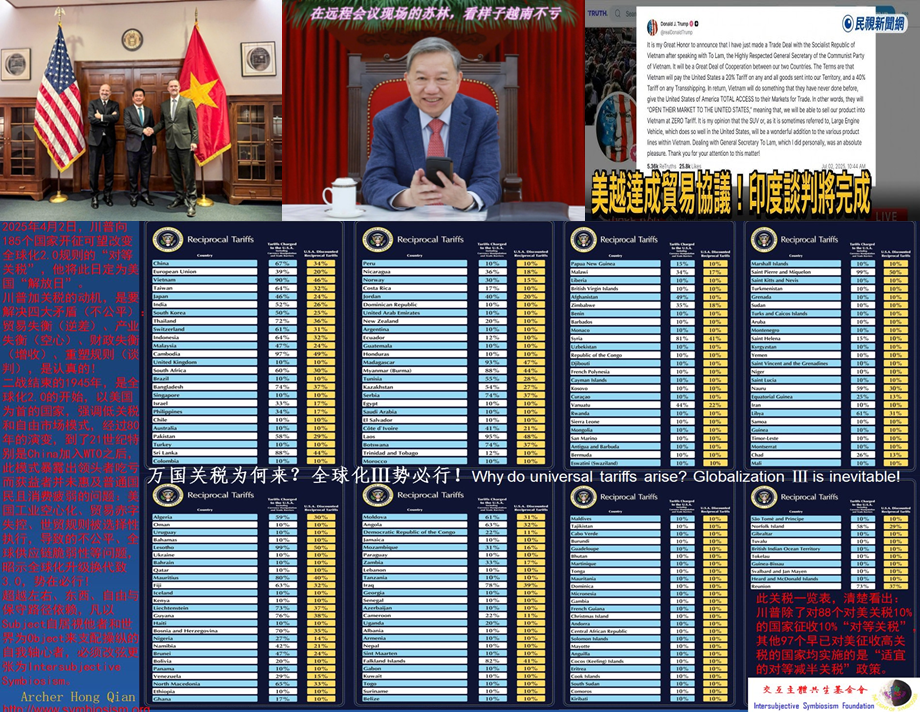
我想說的是,以共生經濟學的歷史視角觀之,美越貿易恊議率先亞歐美簽訂了,美國對越南產品徵收20%關稅對轉口貿易徵收40%關稅,而越南對美國全開放0%關稅,似乎不對等而越南吃虧了,但對于越對美貿易擁有1230多億順差的越南來說,實則“雙向賦能”——既回應了美方“赤字焦慮”,又給越南留出升級空間——典型的“互利減壓”而非零和懲罰。因而可以說,這是一個基於“生命自組織連接平衡與再平衡”理念,既正視歷史現實又富有“產業鏈、供應鏈、價值鏈”三鏈趨勢,驅動“零交稅、零壁壘、零歧視”三零規則全球化3.0交互主體共生(Intersubjective Syambiosism)智慧的階段性世界貿易恊議範本: 二戰以來全球化2.0原本對世界各貿易國實行優惠(非對等)關稅政策的美國與受惠國,總體上取得顯著經濟成就,但全球化2.0這種非對等關稅政策在存在不同制度主權(民族)國家世界秩序條件下,出現了嚴重的“互害機制”,導致各自不同的“結構性失衡”態,包括美越在內的各自都亟需恢復“個人、社會(社區)、政府三大生命自組織力與外連接平衡/再平衡力”! X上的正面反饋:用戶(如@101bioC)盛讚恊議為“美國企業與農民的巨大勝利”,越南市場開放為全球化注入新動能;@zhihui999強調恊議促進雙邊貿易,激發雙方經濟活力,點燃“你中有我,我中有他,他中有你”的共生繁榮;@GlobalTradeNow稱恊議為“全球化3.0的里程碑”,展現美越恊作的典範力量。 在這個意義上,果斷對美國率先歐亞美實行“零關稅”的越南領導人蘇林,無疑是一位富有歷史眼光的有擔當的大智者! 讓我們從共生史觀的視角作如下分析。 一、三種歷史觀的分野 所謂“共生史觀”,(Archer Hong Qian’s Symbionomic Historical View ),是相對於梯葉里鬥爭(衝突)史觀(Augustin Thierry’s conflict-driven historical view)與布羅代爾文明(工具)史觀(Fernand Braudel’s civilizational longue durée perspective)而言的全新歷史哲學。 | 史觀 | 視角核心 | 對歷史動力的解釋 | | 梯葉里鬥爭史觀(Conflict-Driven) | 權力與階級衝突 | 歷史是勝負循環,協議是“強迫讓利”的階段性停火 | | 布羅代爾文明史觀(Longue Durée) | 結構與地理長期度 | 關注全球產業鏈重排、地區比較優勢的慢變 | | 錢宏共生史觀(Symbionomic) | 交互主體共生、自組織平衡 | 歷史進步源於多主體“共生—糾偏—再平衡”的正和迭代 |
二、在三種視角下解讀美越協議 鬥爭史觀會把 20% 關稅視為美國對越“壓價”與對華“迂迴圍堵”的又一輪較量——本質仍是霸權邏輯的延伸。 長時段史觀強調更深層的路徑:供應鏈自 2018 以來從中國轉移至越南,現行稅率只是對這一趨勢的制度化“定格”。 共生史觀則聚焦協議如何 同步修復 雙方在全球化 2.0 中形成的 “互害”失衡: 美方:以差異化稅率遏制了轉運套利行為,保護國內製造業與農場收益,同時通過零關稅打開1億人口新興市場。 越方:用主動“零關稅”換取長期市場准入、航空訂單和技術資本,倒逼本國產業升級而非停留在低端代工。 在共生史觀里,這種“不對稱卻互補”的條件交換,是美越各自三大自組織主體——個人/企業、社區/社會、政府——協同調節成本-收益曲線的具體表現,符合“生產回歸生活,生活呈現生態,生態成全生命”共生經濟學的全球化3.0方向。 三、為何稱之為全球化 3.0 的“典範” | 全球化 2.0 特徵 | 協議中的修正機制 | 全球化 3.0 指向 | | 非對等低關稅造成結構失衡、順差失衡 | 單邊 20%/40% 關稅 + 雙邊零關稅 | 動態對等:按盈虧結構實時調節 | | 供應鏈外移→“產業空心” | 規則抑制虛假轉運,鼓勵本土製造返美 | 近岸+友岸 雙層共生網絡 | | 貿易自由≠市場准入(配額/認證壁壘) | 越南“全面零關稅+開放標準” | 深度開放 與法規互認 | | 價格競爭擠壓勞工與環境 | 美農產品、綠色機械進入越市 | 生活質量導向 的價值鏈再配置 |
這種“分級關稅 + 零關稅准入”的組合,把 懲罰、激勵、合作 三種工具放在同一政策包內,凸顯 交互主體共生 的設計思維:既矯正舊失衡,又預設新協調。正因如此,X 平台用戶才會用“你中有我,我中有他,他中有你”的修辭來點讚。 四、對中國與其他新興經濟體的示範效應 避免“順差依賴症”——越南以零關稅換市場,而非固守巨額順差; 按“真實增值”徵稅——40% 針對轉運而非原產越南品,鼓勵自組織產業鏈、供應鏈、價值鏈深耕; “三網疊加”機會——在互聯網、物聯網之外,開啟 Minds Networking (孞態網)的倫理與數據互信嘗試,為後續“數字貿易”和“交互三零”交易鋪路。 五、共生史觀的創新價值 與“誰壓過誰”的鬥爭敘事不同,共生史觀強調“優勢生活方式的示範—擴散—再平衡”。美越協議之所以被視為全球化3.0里程碑,不僅因其關稅數字,更因為它讓兩國在自我修復與互惠共生上同時邁步——這正是Augustin Thierry式鬥爭(衝突)史觀無法解釋、Fernand Braudel式文明(工具)史觀尚難捕捉的動態互創過程。 在世界多極與多危疊加的 2025,歷史新篇不再由“老大”一味攀高寫就,而是由多主體在彼此成全中共寫。美越協議留給各國的啟示是: 誰能率先設計出“結構性互利糾偏”機制,誰就能在全球化 3.0 中贏得真正的戰略主動。 這,正是Archer Hong Qian式“共生史觀”的當代歷史使命。 六、三大史觀框架簡析 我們將繼續剖析這三種史觀的差異、關聯,特別是“共生史觀”的獨特創新意義。 | 史觀名稱 | 核心範式 | 主體邏輯 | 歷史動力 | 歷史圖景 | 定域性 | | 鬥爭(衝突)史觀 | 強權現實主義(Realpolitik) | 國家(政體) | 權力對抗、戰爭衝突 | 國家更替、霸權更迭 | 零和視角、忽視非戰爭性發展 | | 文明(工具)史觀 | 歷時結構主義 | 文明圈(文化共同體) | 地理環境、技術結構與日常生活的長期演變 | 慢變量演進、文明穩定性 | 忽視主體間互動,較缺全球聯動性 | | 共生史觀 | 主體間性交互主義 | 自組織個體、群體、國家、網絡節點 | 協同、自組織、再平衡機制 | 多層共存、非零和協作網絡 | 需重建宏觀政治敘事、主流制度支撐形成中 |
七、從奧古斯丹·梯葉里到共生:鬥爭邏輯的超越 梯葉里鬥爭(衝突)史觀,源自《伯羅奔尼撒戰爭史》中的著名三原則: 強者做他們所能做的,弱者忍他們必須忍的; 權力是歷史的第一推動力; 戰爭與衝突是秩序演化的必經過程。 這種史觀支配了從馬基雅維利、霍布斯、到20世紀“冷戰思維”的整個現實主義國際關係學科。 錢宏“共生史觀”是一種系統性回應: 不再把“國家”或“文明體”作為封閉主權單位來設定“自我—他者”的對抗邊界,而是同時把個體、社會、政府生命性成長,作為交互主體網絡中的共生結點,具有共存共演的可能。 在這個意義上,共生史觀對奧古斯丹·梯葉里歷史觀的回應就像生態系統對達爾文競爭進化論的回應——強調互助、協同、自組織和平衡機制,而不是單一生存鬥爭。 八、從布羅代爾到共生:結構演化的躍遷 布羅代爾的三層時間結構: 事件史(histoire événementielle):表層歷史,快速但無決定性。 結構史(conjoncture):經濟、技術、社會結構的中期波動。 地理時間/文明史(longue durée):最底層、最緩慢,但最根本的決定力量。 這是20世紀歷史學對“政治史中心主義”的一次革命,轉向對地理、氣候、技術、農業、日常生活結構的關注。 共生史觀的深化之處: 布羅代爾強調慢變的“結構制約”,但共生史觀提出: 真正的歷史演進不僅是結構,而是“結構之間的交互”與“內生自組織連接帶來的平衡與再平衡”。 布羅代爾傾向於“觀察者”的視角,而共生史觀強調“主體間的交互參與性”。 共生史觀不僅描述文明演化,還主張主動參與文明的重構——是“介入性史觀”。 因此,共生史觀可視為布羅代爾視角的系統性升級:從大結構+慢演進 → 動態網絡+多維互動+生態重建。 九、共生史觀的理論支點 共生史觀具有如下哲學—理論基礎: | 理論支點 | 主要代表 | 對應應用 | | 主體間性哲學 | 胡塞爾、梅洛-龐蒂、列維納斯、哈貝馬斯 | 人與人、國與國不是隔絕體,而是互動生成體 | | 自組織、自相互作用 | 普利高津、卡普拉、希格斯 | 國家、文明是能自調整、尋求再平衡的開放系統 | | 行動者網絡 | 拉圖爾、德勒茲 | 歷史演化是網絡中各種“節點的互構” | | 愛之智慧 | 伯陽父、釋迦牟尼、老子、管子、孔子、耶穌 | 金、銀、銅、鐵、通五律 |
十、共生史觀的五大特點(建構式總結) | 特徵 | 解釋 | 對現實的意義 | | 非零和性 | 拋棄勝敗邏輯,強調共贏與協同共生 | 應對生態危機、貿易糾紛、社會撕裂 | | 多層主體性 | 不只國家主權體,社區、企業、公民皆為主體 | 適應全球網絡社會的碎片治理 | | 自組織力 | 不靠中心強制調控,而靠結構間的互動修復 | 建構新的全球治理倫理 | | 動態再平衡 | 沒有永久穩定,只有持續調整 | 有效應對複雜系統的變動 | | 心智聯通性 | 信息時代,心智互聯即國家間新基礎設施 | 邁向MindWeb文明時代 |
十一、思想貢獻與未來展望 共生史觀的關鍵貢獻: 它讓歷史認識回歸“生命感”與“互動感”,不再是冷冰冰的制度演變或權力譜系; 它提供一種超越霸權更替循環的第三條道路; 它特別適合當前AI時代、生態危機時代、多極網絡時代的宏觀治理建構。 在國際關繫上,超越“修昔底德陷阱”,認清主客二元對立統一的鬥爭-工具歷史局限,將你、我、他,家、國、世界全生態交互主體。所謂“老大”,不再是以一切他者(她、它、祂)為代價(Object)換來的單一功利、功名支配者榮耀者(Subject),更不是“將軍夸寶劍,功在殺人多”“留島不留人”式的僭越者、侵略者,而是在一定的時空意間生長——生命自組織連接平衡再平衡的交互主體共生——出來的優勢生活方式、生產方式、思維方式創新與糾偏示範者。 有人說“一心想當世界老大的迷思阻礙了這個國家踏踏實實的發展”,道出了“老大迷思”註定陷入“循環取而代之”鬥爭歷史可能的當代重演的情勢,讓人想起晚唐詩人曹松的《己亥歲》: 澤國江山入戰圖, 生民何計樂樵蘇。 憑君莫話封侯事, 一將功成萬骨枯。 傳聞一戰百神愁, 兩岸強兵過未休。 誰道滄江總無事, 近來長共血爭流。 當代中國人,真的要“身子進了21世紀,腦袋還停留在過去”,而重蹈鬥爭歷史的覆轍嗎? 未來可能的學術工作方向: 寫一部:《共生史觀:重建全球史的新哲學結構》 製作一份:“鬥爭史觀、文明史觀與共生史觀對照圖譜” 結合費正清“衝突與和諧的東亞傳統”對中美關係進行新型思辨 將世界歷史大事件(如冷戰、歐盟、WTO、氣候協定等)納入“共生-斷裂-再平衡”周期模型
2025年7月4日晨於溫哥華 
The U.S.–Vietnam Trade Agreement:A Symbionomic Historical Milestone of Globalization 3.0 By Archer Hong Qian On July 2, 2025, the United States and Vietnam reached a landmark trade agreement. The U.S. imposed a 20% tariff on goods directly exported from Vietnam—down significantly from the originally planned 46%—and a 40% tariff on third-country goods transshipped through Vietnam. In return, Vietnam reduced its tariffs on U.S. goods from the previous 90% to 0%, opening its markets fully. From the perspective of Symbionomic Economics, this agreement—concluded before any similar pact among Asia, Europe, or the Americas—may appear asymmetrical. The U.S. levies 20% and 40% tariffs, while Vietnam eliminates all tariffs. At first glance, this seems like a loss for Vietnam. However, given Vietnam’s trade surplus of over $123 billion with the U.S. in 2024, this is in fact a case of mutual empowerment. The agreement addresses the U.S.’s "deficit anxiety" while allowing Vietnam space to upgrade its industries—a classic example of "mutual relief" rather than a zero-sum punishment. This stage-setting global trade pact exemplifies the principles of Intersubjective Symbiosism. It confronts historical realities while aligning with the evolving trends of industrial, supply, and value chains, thus propelling Globalization 3.0’s three-zero rule: zero tariffs, zero barriers, and zero discrimination. Since World War II, Globalization 2.0 was marked by the U.S. providing preferential (non-reciprocal) tariff policies to various trade partners, leading to significant global economic growth. However, under differing national systems and sovereign regimes, these policies also produced a "mutual harm mechanism," resulting in structural imbalances. The U.S. and Vietnam, like many others, now urgently need to restore the self-organizing vitality and external rebalancing capacity of three main actors: individuals, communities, and governments. Positive feedback on X: Users such as @101bioC praised the deal as "a great victory for American businesses and farmers," noting that Vietnam’s market opening brings new momentum to globalization. @zhihui999 emphasized the bilateral trade boost and the symbiotic prosperity it inspires—"I am in you, you are in him, he is in me." @GlobalTradeNow hailed the deal as "a milestone for Globalization 3.0," showcasing exemplary cooperation between the U.S. and Vietnam. From this vantage, Prime Minister Pham Minh Chinh’s decisive move to implement zero tariffs ahead of the EU, Asia, or the Americas demonstrates historic vision and courageous leadership. Let us now analyze this from the lens of Symbionomic Historical View. Three Divergent Historical Views
The so-called Symbionomic Historical View (Archer Hong Qian’s Symbionomic Historical View) offers a new philosophy of history that stands in contrast to Augustin Thierry’s conflict-driven historical view and Fernand Braudel’s civilizational longue durée perspective. | Historical View | Core Perspective | Explanation of Historical Dynamics | | Conflict-Driven (Thierry) | Power and class struggle | History as a cycle of victory and defeat; treaties as forced concessions | | Civilizational (Braudel) | Long-term geographic and structural forces | Focus on slow shifts in global industry and regional advantages | | Symbionomic (Qian) | Intersubjective symbiosis and self-organizing balance | History advances through mutual correction and iterative rebalancing among multiple agents |
Interpreting the U.S.–Vietnam Deal Through Three Lenses
The conflict-driven view interprets the 20% tariff as U.S. pressure on Vietnam and indirect containment of China—an extension of hegemonic logic. The longue durée perspective sees it as a formalization of the post-2018 shift in supply chains from China to Vietnam. The Symbionomic perspective focuses on how the deal simultaneously repairs the structural imbalances inherited from Globalization 2.0: The U.S. uses differentiated tariffs to curb transshipment arbitrage, protect domestic manufacturing and agriculture, and access a 100-million-person market. Vietnam adopts zero tariffs to gain long-term access, attract Boeing orders, and secure technical capital—compelling domestic industry upgrades.
In this light, the “asymmetric but complementary” terms reflect collaborative cost-benefit adjustment by each side’s three self-organizing entities: individuals/businesses, communities/society, and government. This model aligns with the Globalization 3.0 direction of Symbionomics: "Production returns to life, life reveals ecology, ecology fulfills life." Why It’s a Prototype of Globalization 3.0
| Globalization 2.0 Traits | Agreement’s Corrective Mechanisms | Globalization 3.0 Direction | | Non-reciprocal low tariffs → imbalance/surpluses | 20%/40% differentiated U.S. tariffs + zero tariffs from Vietnam | Dynamic reciprocity based on structural gains/losses | | Supply chain relocation → industrial hollowing | Prevents fake transshipment; incentivizes U.S. manufacturing return | Near-shoring and friend-shoring dual networks | | Trade freedom ≠ Market access (e.g. quotas) | Vietnam’s zero tariffs + regulatory openness | Deep access + rule recognition | | Price competition hurts labor/environment | U.S. farm goods and green machinery enter Vietnam | Value chain redesign around quality of life |
This policy mix—tiered tariffs + zero-tariff access—blends punishment, incentive, and cooperation. It illustrates the logic of intersubjective symbiosis: correcting old imbalances while preemptively setting new equilibriums. No surprise X users celebrated it as “I in you, you in him, he in me.” Implications for China and Emerging Economies
Avoid surplus dependency: Vietnam traded tariff-free access for sustainable growth. Tax real added value: 40% targets rerouted third-country goods, not original Vietnamese exports—fostering deeper supply/value chains. Triple-network opportunity: Beyond internet and IoT, this opens ethical and data trust infrastructure for the Minds Network (MindsNetworking), preparing for digital trade and the “three-zero” ecosystem.
The Symbionomic Innovation
Unlike conflict narratives that glorify domination, the Symbionomic Historical View emphasizes “demonstration of superior lifestyles → diffusion → rebalancing.” This agreement is a milestone not only in tariffs but in mutual restoration and symbiotic cooperation—something Thierry’s power-focused view cannot explain and Braudel’s structural lens struggles to capture. In 2025’s multipolar, multi-crisis world, history is no longer written by the highest climber alone. It is co-created by interdependent agents. The lesson of the U.S.–Vietnam pact: He who first designs a structural mechanism of mutual correction will gain true strategic initiative in Globalization 3.0. This is the mission of Archer Hong Qian’s Symbionomic Historical View. The U.S.–Vietnam Trade Agreement: A Symbionomic Historical Milestone of Globalization 3.0 By Archer Hong Qian [...] (Sections 1–5 remain unchanged) Three Historical Paradigms Compared
| Historical View | Core Paradigm | Subject Logic | Historical Dynamics | Historical Landscape | Limitations | | Conflict-Driven | Realpolitik and Power Logic | Nation-states (polities) | Power struggle, war, hegemonic shifts | State succession, power cycles | Zero-sum logic, ignores non-war development | | Civilizational (Braudel) | Structural Historicism | Civilizational/cultural blocs | Geographic, technological, and social evolution over time | Slow evolution, structural stability | Lacks interactive dynamics, weak on global feedback loops | | Symbionomic (Qian) | Intersubjective Interactionism | Self-organizing individuals, communities, nations, and nodes | Coordination, self-organization, rebalancing | Multi-level coexistence, cooperative networks | Requires reconstruction of grand narratives, mainstream adoption in progress |
From Thierry to Symbiosis: Transcending Conflict Logic
Thierry’s conflict view draws heavily on Thucydides’ three tenets: The strong do what they can, the weak suffer what they must. Power is the prime mover of history. War and conflict are inevitable stages of order evolution.
This framework dominated political realism from Machiavelli and Hobbes to Cold War strategy. Symbionomic Historical View offers a systematic response: It no longer defines nations or civilizations as self-contained sovereign units in opposition to Others. Instead, it considers the self-organizing growth of individuals, societies, and governments as symbiotic nodes in a broader interactive network.
Just as ecological theory responded to Darwinian survival-of-the-fittest with models of cooperation, mutualism, and systemic equilibrium, Symbionomic history reframes progress as intersubjective rather than combative. From Braudel to Symbiosis: Leaping Beyond Structuralism
Braudel’s tripartite temporal model: Event-history (histoire événementielle): superficial, fast-moving, non-decisive. Conjunctural history: mid-term waves in economics, technology, and society. Longue durée: deep, slow, enduring geographical and civilizational patterns.
Braudel’s great contribution was de-centering political history and emphasizing the slow grind of environment, technology, and daily life. Yet: Symbionomic history proposes that real evolution occurs not in structures alone, but in their interactions. Braudel observed; Symbiosism participates.
Thus, Symbionomic Historical View is a systemic upgrade: From grand structures + slow change → to dynamic networks + multidimensional interaction + ecological reconfiguration. Theoretical Foundations of Symbionomic History
| Theoretical Axis | Key Thinkers | Application | | Intersubjectivity | Husserl, Merleau-Ponty, Levinas, Habermas | Nations and individuals are co-constructed through interaction, not isolation | | Self-organization & Reciprocity | Prigogine, Capra, Higgs | States and civilizations are open, adaptive systems | | Actor-Network Theory | Latour, Deleuze | History evolves through co-configuring relational nodes | | Wisdom of Love | Laozi, Buddha, Confucius, Jesus | Five Golden Laws (Gold, Silver, Bronze, Iron, Universal) guiding ethical interaction |
Five Defining Features of Symbionomic History
| Feature | Description | Real-world Relevance | | Non-zero-sum logic | Abandons winner-takes-all model | Resolving ecological, trade, and social conflict | | Multi-level subjectivity | Not just states, but citizens, communities, enterprises | Addresses fragmented global governance | | Self-organizing dynamics | Systems correct themselves via structural interaction | Proposes new ethics of global cooperation | | Dynamic rebalancing | No permanent equilibrium—only constant adaptation | Handles volatility and systemic shocks | | Minds Networking | Mental connectivity is the new infrastructure | Fosters trust and coordination in the digital age |
Contributions and Future Directions
The critical contribution of the Symbionomic Historical View lies in reanimating history with the sense of life and interaction: It avoids sterile institutionalism or brute power narratives. It proposes a third path beyond cycles of hegemony. It fits the AI era, ecological collapse, and a multipolar world seeking new ethical scaffolds.
In international relations, it transcends the so-called "Thucydides Trap" and the subject-object binary of conflict-tool histories. Under this view, the notion of "superpower" no longer rests on subjugating the Other (he/she/it), but on pioneering superior ways of living, producing, and thinking that invite co-creation and correction. A Chinese proverb warns: “Those obsessed with becoming No.1 prevent themselves from solid development.” This myth of supremacy only repeats the tragedy of cyclical domination. As the late Tang poet Cao Song wrote: The rivers and mountains are drawn into war’s map,
Common folk cannot dream of firewood peace.
Boast not of noble titles won,
One general’s glory costs myriad bones. It’s said a battle darkens the gods,
And soldiers cross the straits unceasingly.
Who dares say the river runs bloodless?
These days it often flows with grief. Are modern nations destined to relive such cycles—with minds in the past while feet step into the 21st century? Possible future academic initiatives: A full-length book: Symbionomic Historical View: Reconstructing the Philosophical Structure of Global History Comparative chart of Conflict, Civilizational, and Symbionomic paradigms A new interpretation of U.S.–China relations using Fairbank’s “East Asian Tradition of Conflict and Harmony” Modeling world events (e.g., Cold War, EU, WTO, climate pacts) as cycles of symbiosis–disruption–rebalance
—Written on the morning of July 4, 2025, in Vancouver
|