梵蒂冈国务卿办公室
圣座 基督内平安。 值此良十四世教宗(Pope Leo XIV)正式颁布首份人工智能通谕《壮丽的人性:论人工智能时代对人性尊严的守护》(Magnifica Humanitas)之际,交互主体共生基金会(Intersubjective Symbiosism Foundation)谨向圣座呈递所附公开信: 《论生命、人工智能与组织信托的交互主体共生》。 本基金会首先谨向良十四世教宗表达诚挚敬意,并高度肯定《壮丽的人性》通谕对于人工智能时代“人性尊严”问题所展现出的深刻洞察与先知性关怀。 交互主体共生基金会代表钱宏(Archer Hong Qian)曾于 2005 年有幸拜访梵蒂冈,并在西斯廷礼拜堂长久驻足,屏息仰望米开朗基罗《创造亚当》(The Creation of Adam)这一伟大世纪壁画。时至今日,在人类文明迈入数字化与人工智能巨变的时代黎明,那跨越时空、几乎相触的“指尖”,再次带来深刻震撼与启示。 我们相信,米开朗基罗五百年前留下的这一神圣图景,恰恰深刻隐喻了当今生命(LIFE)、人工智能(AI)与组织信托(TRUST)之间正在形成的交互主体共生关系,并进一步启示出 AI 时代若干重要而未竟的神学与文明问题。 首先,“指尖之间的空隙”,提醒我们:《Holy Bible》的核心,也许不仅是静态教义,更是一种“动态圣约(Covenant)”关系。上帝并未将不可更改的绝对代码植入人类;而亚当那略显脆弱、尚未完全触及的手指,正呼应了教宗在《壮丽的人性》中所强调的人之有限性、脆弱性与自由意志。 其次,上帝身后由天使与帷幔构成、近似“人类大脑结构”的红袍图景,也仿佛提醒我们:智能与组织信托(TRUST)原本应当服务于生命(LIFE)。然而今天,无论是赛博封建资本,还是数字集权结构,都可能在 AI 的放大下,使人逐渐脱离真实生命世界,而被卷入纯算法化、纯技术化的冰冷系统之中。 再次,英美海洋文明中不断复活的“先知 + 侠客”精神——如罗宾汉、佐罗等形象——也体现出一种重要的“守约”精神:当制度失去温度、圣约遭到破坏时,真正的守约者愿意以肉身入局、守护弱小;然而,在修复公义之后,又主动退回边界之内,不篡夺终极主权。这种谦卑与边界感,本身也许正是 AI 时代极其重要的文明提醒。 良十四世教宗在《壮丽的人性》中,对于 AI 可能侵蚀人性尊严所表达的忧虑,我们深感共鸣。然而,我们也相信,更深层的危险,也许在于:当人类因恐惧而主动将主体性外包给特定科技资本、算法平台或权力体系时,人类也正在主动放下那根原本拥有自由意志与责任能力的“亚当之指”。 基于这样的思考,本基金会谨将“西斯廷指尖相触”的图景,作为随函公开信的一个象征性视觉隐喻。我们诚挚希望,在 AI 时代,人类能够超越单纯抽象的“伦理对齐”,重新回到对具体生命、真实苦难与主体尊严的共同关怀之中,并在新的技术、组织与文明结构里,重新探索一种能够同时回应 LIFE、AI 与 TRUST 的“共生之约”。 随函附上公开信全文及意大利文摘要,谨呈圣座参阅。 愿生命、智能与组织信托,
回归共生之约,
而非彼此支配。 谨以此呈上,
怀着希望与真理。 Amen! 交互主体共生基金会
(Intersubjective Symbiosism Foundation) 2026 年 5 月 27 日
加拿大·温哥华 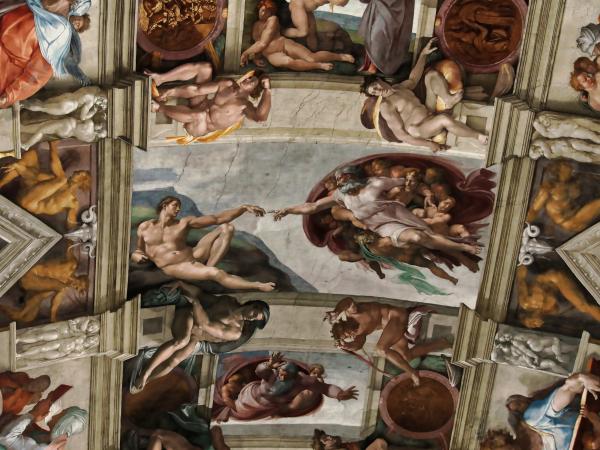
To the Secretariat of State
The Holy See
Vatican City Peace in Christ. On the occasion of the promulgation of Magnifica Humanitas, the first encyclical on artificial intelligence issued by His Holiness Pope Leo XIV, the Intersubjective Symbiosism Foundation respectfully submits the enclosed open letter: On the Intersubjective Symbiosism of LIFE, Artificial Intelligence, and TRUST. The founder and representative of the Foundation, Archer Hong Qian, had the privilege of visiting the Vatican in 2005. Standing beneath Michelangelo’s The Creation of Adam in the Sistine Chapel, he was profoundly moved by the almost-touching fingertips that transcend time and space. Today, at the dawn of humanity’s digital transformation, that same image once again reveals an extraordinary prophetic resonance. We believe that Michelangelo’s masterpiece, painted more than five centuries ago, offers a profound metaphor for the emerging relationship among LIFE, Artificial Intelligence (AI), and TRUST, and further illuminates several theological and civilizational questions that remain open in the age of AI. First, the subtle gap between the fingertips of God and Adam reflects the deeper meaning of the Holy Bible not merely as static doctrine, but as a living Covenant. God did not implant humanity with immutable code. Adam’s vulnerable and unfinished gesture mirrors precisely what the Holy Father emphasized in Magnifica Humanitas: the irreplaceable dignity of the human person arises from finitude, vulnerability, and freedom. Second, the famous mantle surrounding God — long interpreted by many scholars as resembling the structure of the human brain — reminds us that intelligence and organizational forms of TRUST were originally meant to serve life. Yet today, both cyber-feudal capital and digital bureaucratic systems increasingly risk separating Adam (LIFE) from the living earth, enclosing humanity within cold algorithmic systems governed exclusively by AI logic. Third, the recurring “prophet-knight” spirit within the Anglo-American maritime tradition — figures such as Robin Hood or Zorro — reflects another covenantal dimension: entering history in defense of the weak when institutions become cold and covenants are broken. Yet after restoring justice, the true covenant-keeper does not seize the crown. This restraint reflects humility before ultimate sovereignty and an awareness of moral boundaries. The Holy Father has rightly expressed grave concern regarding the erosion of human dignity under AI expansion. Yet perhaps the deeper danger arises when humanity, out of fear, voluntarily surrenders its subjectivity either to technological oligarchies or to increasingly centralized systems of power. For this reason, the Foundation respectfully offers the “touching fingertips” of the Sistine Chapel as a symbolic vision accompanying the enclosed letter — not merely as a work of art, but as an eschatological image of covenant, freedom, responsibility, and coexistence. It is our sincere hope that, in the age of AI, humanity may move beyond abstract “ethical alignment” toward a more concrete solidarity with embodied human life itself, and that new forms of open algorithms, decentralized covenants, and shared responsibility may help contribute to a renewed civilizational horizon worthy of the hope symbolized by the New Jerusalem. May LIFE, AI, and TRUST
return to a covenant of symbiosis
rather than domination. Respectfully submitted,
in hope and truth. Amen. Intersubjective Symbiosism Foundation
Vancouver, Canada
May 27, 2026
致良十四世教宗 To His Holiness Pope Leo XIV ——论生命、人工智能与组织信托的交互主体共生 — On the Intersubjective Symbiosism of LIFE, Artificial Intelligence, and TRUST 尊敬的良十四世教宗(Pope Leo XIV): 主内平安。 值此您于2026年5月25日正式颁布教宗任内首份人工智能通谕《壮丽的人性:论人工智能时代对人性尊严的守护》(Magnifica Humanitas)之际,交互主体共生基金会(Intersubjective Symbiosism Foundation)怀着深切敬意与时代责任感,谨向梵蒂冈致以诚挚问候。 首先,我们必须郑重表达对这份通谕的高度肯定。 在全球技术狂飙、算法扩张、生命位格不断遭受客体化的历史背景下,您以极大的先知性敏锐指出:人类真正不可替代的价值,并不在于效率、速度或计算能力,而恰恰在于人的有限性(Finitude)、脆弱性(Vulnerability)以及承担后果的能力(Capacity to Bear Consequences)。 这一洞见极其重要。 因为在越来越多的人试图将“智能”误认为“智慧”、将“计算”误认为“人格”、将“数据”误认为“生命”的今天,《壮丽的人性》重新提醒世界:AI 可以模拟语言,却无法真正承担苦难;可以生成情感,却无法真正进入爱;可以进行无限统计,却无法为自身行为承担真正的道德后果。 从这个意义上说,《壮丽的人性》之于AI时代的重要性,正如135年前良十三世教宗(Pope Leo XIII)的《新事》(Rerum Novarum)之于工业革命时代。 彼时,《新事》面对的是“劳动者被机器化”的危机;今日,《壮丽的人性》面对的,则是“人类主体性被算法化”的危机。 然而,也正因为这份通谕已经触及文明深处最关键的问题,我们怀着一种神学性的敬畏与战栗,不得不进一步提出几项更深层的叩问。 因为AI问题,或许已经不仅仅是“AI的问题”。 它正在演变为一个关于生命(LIFE)、人工智能(AI)与组织信托(TRUST)如何交互耦合的整体文明问题。 一、终末论视界的缺席:从“技术警示”到“新耶路撒冷”的启示 《壮丽的人性》极其深刻地揭示了AI可能带来的异化风险,对算法社会中人的工具化、情感模拟与道德空洞化提出了重要警告。 这种警示当然重要。 但与良十三世《新事》相比,《壮丽的人性》仍显得美中不足。 因为《新事》之所以伟大,并不仅仅在于它批判了工业革命时代的苦难,更在于它提出了一条具有历史创造性的“第三条道路(The Third Way)”: 既强烈反对自由放任资本主义(Laissez-faire Capitalism)将劳动者彻底商品化的冷酷逻辑,也坚决谴责社会主义(Socialism)消灭私有制、鼓吹阶级斗争的激进倾向。 甚至可以说,这种“第三条道路”的精神,还隐约预见了今天世俗“政治正确(Political Correctness)”意识形态在“反歧视”过程中不断衍生出的某种“逆向歧视(Reverse Discrimination)”现象——当人越来越被拆解为身份标签、算法分类与合规参数时,真正具有普遍性的“人格主体(Personhood)”反而再次遭到消解。 相比之下,《壮丽的人性》虽然敏锐地意识到AI对人性尊严的侵蚀,却更多仍停留于对“AI革命”中已经出现或可能出现之风险与异化现象的描述与警示,而尚未进一步提出AI时代新的“第三条道路”。 它指出了危险,却尚未真正展开一种关于“新天新地”与“新耶路撒冷城”的文明启示。 这里,我必须把一个萦绕在我心里几十年的感觉和信念说出来,这就是《Holy Bible》的中文翻译,不应当只是《圣经》,更贴切更入心的翻译应当是《圣约》。 因为,《Holy Bible》的核心,从来不只是某种静态、单向、非此即彼的“经”。在中文世界,《Holy Bible》长期被译作《圣经》,这一翻译当然有其历史贡献;但若回到希伯来传统与救赎史本身,“圣约(Holy Covenant)”或许更能揭示其深层精神。 因为,《Holy Bible》的核心,不只是抽象教义(Doctrine)的宣示,更是一部“神与人立约、破约、守约、续约”的动态历史。 从西奈山的律法之约(Covenant of Law),到耶稣以肉身入局、进入苦难的福音之约(Covenant of Gospel),再到《启示录》中“神的帐幕在人间”的终末应许,其核心始终不是冰冷的制度,而是一种关系性的共在(Relational Indwelling)与爱的智慧(Amorsophia)。 也正因如此,AI时代真正的问题,或许从来不只是“机器是否会超越人”,而是: 人在技术扩张中,是否仍愿彼此承认为主体(Subject),而不是彼此降格为资源(Resource)与数据对象(Data Object)。 二、AI时代“新道路”的失语:LIFE–AI–TRUST 的结构性危机 1891年,《新事》之所以能够成为划时代的社会通谕,并不仅仅因为它批判问题,而是因为它在资本与社会主义之间,提出了一种关于“人格主体性”的制度性回应。 然而今天,AI革命已经将这种结构性危机推向新的高度。 当代世界,正在同时出现两种新的“数字利维坦”(TRUST反噬): 一方面,是以数据资本、算法平台与硅谷科技寡头为代表的“赛博封建主义(Cyber-Feudalism)”; 另一方面,则是以数字监控、算法治理与全景式社会管理为特征的“数字官僚主义(Digital Bureaucratism)”。 在这两种力量共同作用下,人越来越不再作为主体存在,而是逐渐被降格为: 可预测的数据、
可优化的行为、
可调用的流量、
可替换的人力模块。 于是,低生育率、婚姻解体、青年“躺平”、意义感崩塌,并不仅仅是经济问题,而是生命(LIFE)对“AI + 权力组织”双重客体化的一种消极熔断。 因此,我们认为: AI问题不能脱离生命(LIFE)、人工智能(AI)与组织信托(TRUST)三者的交互耦合结构而单独讨论。 因为AI从来不是孤立存在的技术。 算法背后,始终存在权力;
数据背后,始终存在组织;
平台背后,始终存在制度。 这三者,都可能涉及TRUST在AI加持下对LIFE反噬,也正因如此,《壮丽的人性》虽然极富道义力量,却尚未真正提出AI时代的“新道路”。 例如: 如何避免人的数字人格被平台永久占有?
如何避免算法主权完全归属于资本与国家?
如何保护劳动者在AI时代仍拥有主体性的博弈能力?
如何避免数据成为新型“圈地运动”?
如何让技术重新服务于人的生命完整性,而不是反过来塑造人? 这些问题,或许已经不仅仅是伦理问题,而是新的文明制度问题。 三、道德主权的考验:教会是否正在向新数字资本降态? 最后,我们也愿以极大的敬意与谨慎,提出一个关于教会自身位置的问题。 此次梵蒂冈邀请硅谷AI独角兽企业 Anthropic 联合创始人克里斯托弗·奥拉(Christopher Olah)作为重要主讲嘉宾之一,本意显然是希望推动技术伦理对话。 这一开放姿态,本身值得尊重。 然而,教会若在新的数字文明形成过程中,过度依赖特定科技资本所提供的“AI安全框架”与“伦理对齐语言”,则难免令人担忧: 教会是否会在不知不觉中,将自身部分先知性权威,让渡给新的数字资本秩序? 即便是最强调“AI安全”与“伦理对齐”的科技企业,本质上仍处于资本、国家与产业竞争的现实逻辑之中。 因此,梵蒂冈若在硅谷新资本之间形成某种“拉一派、打一派”的结构性站位,其实并不妥当。 因为教会真正珍贵的地方,恰恰在于它不应轻易依附任何帝国、任何资本、任何世俗权力。 从《新事》到今天,天主教社会训导真正伟大的地方,从来不在于它成为某种技术治理顾问,而在于它始终代表着一种超越性的、面向受苦生命的终极关怀。 如果未来教会仅仅停留在: “提醒AI风险”、
“倡导伦理监管”、
“呼吁企业自律”, 却无法真正进入那些被算法剥夺主体性的劳动者、青年人与边缘群体的现实苦难之中, 那么,教会就可能从“先知性的见证者”,逐渐降态为“数字文明的道德装饰者”。 四、结语:AI时代真正的问题,是人是否还愿彼此当人 从工业革命到 AI 革命,人类始终面对同一个问题: 人究竟是目的,还是工具? 是主体,还是资源? 是彼此承认的人,还是彼此利用的数据? 我们相信,真正值得警惕的,从来不只是 AI 本身,而是人在技术扩张中逐渐失去彼此承认的能力。 如果技术最终只是让人类更高效地彼此利用,
那么无论 AI 多么先进,人类文明都不过是在以新的算法语言,重复巴别塔的命运。 更值得警惕的是,AI 所放大的,并不仅仅是技术能力本身,而是各种组织形态(TRUST)潜在的异化倾向。 无论是国家、资本、平台,甚至包括宗教组织(TRUST)自身,所有组织形态,都必须警惕异化,一旦失去对生命(LIFE)主体性的敬畏,都可能在 AI 的加持下,逐渐滑向对人的重新客体化反噬。 人类真正需要的,从来不是一个越来越强大的“数字利维坦”, 因为,AI 从来不是孤立存在的技术。它总是嵌入某种组织结构之中,并不断强化其运行逻辑。我们需要一种能够让生命、智能与组织重新彼此守约(Covenant)、彼此承认、彼此共生的新文明秩序。 当 TRUST 背离生命,组织就可能反噬生命;当技术脱离共生,智能就可能异化为控制。 也正是在这样的背景下,人类或许需要开始探索一种新的“技术—伦理—生活方式”基础设施: 即在互联网(信息连接)与物联网(感知连接)之后,进一步探索一种以“孞念交互”与“爱的智慧”为核心的 AM(Amorsophia MindsField/Network,愛之智慧孞態场/网)构想,以同时回应 LIFE(生命)、AI(智能)与 TRUST(组织信托)之间不断加剧的结构性紧张。 它并非为了创造新的数字利维坦,而是为了避免机器取代人、组织反噬生命,让智能重新学会承载生命,让组织重新回归服务生命。 愿教会在这个关键时代,
不仅成为技术风险的警醒者,
而且成为“新事物”的倡导者,
更是荣耀上帝“新耶路撒冷”希望的见证者。 愿生命、智能与组织信托,
回归共生之约,
而非彼此支配。 谨以此呈上,
怀着希望与真理。 Amen! 交互主体共生基金会
(Intersubjective Symbiosism Foundation) 2026年5月27日晨于温哥华 To His Holiness Pope Leo XIV
— On the Intersubjective Symbiosism of LIFE, Artificial Intelligence, and TRUST Your Holiness Pope Leo XIV, Peace in Christ. On the occasion of Your Holiness’s promulgation, on May 25, 2026, of your first encyclical on artificial intelligence, Magnifica Humanitas: On Safeguarding Human Dignity in the Age of Artificial Intelligence, the Intersubjective Symbiosism Foundation wishes to extend to the Vatican our deepest respect and sincere greetings, together with a profound sense of responsibility toward the future of civilization. First and foremost, we must solemnly express our high appreciation for this encyclical. At a historical moment marked by technological acceleration, algorithmic expansion, and the growing objectification of human personhood, Your Holiness has demonstrated remarkable prophetic insight in affirming that the irreplaceable value of the human person lies not in efficiency, speed, or computational power, but precisely in human finitude, vulnerability, and the capacity to bear consequences. This insight is of immense importance. For at a time when many increasingly mistake “intelligence” for wisdom, “computation” for personhood, and “data” for life itself, Magnifica Humanitas reminds the world that AI may simulate language, but it cannot truly suffer; it may generate emotion, but it cannot genuinely love; it may perform limitless calculations, but it cannot bear moral responsibility for its own actions. In this sense, the significance of Magnifica Humanitas for the AI age is comparable to that of Pope Leo XIII’s Rerum Novarum for the age of the Industrial Revolution 135 years ago. Then, Rerum Novarum confronted the crisis of the mechanization of labor. Today, Magnifica Humanitas confronts the crisis of the algorithmization of human subjectivity. Yet precisely because this encyclical has touched one of the deepest questions of our civilization, we feel compelled—with theological reverence and trembling—to raise several further questions. For the problem of AI may no longer be merely a problem of AI itself. It is rapidly becoming a broader civilizational question concerning the interactive coupling of LIFE, Artificial Intelligence (AI), and TRUST. I. The Absence of an Eschatological Horizon: From Technological Warning to the Vision of the New Jerusalem Magnifica Humanitas offers profound warnings concerning the risks of AI-driven alienation and the reduction of human beings to instruments within algorithmic society. Such warnings are undoubtedly important. Yet compared with Rerum Novarum, Magnifica Humanitas still appears, in some respects, incomplete. For the greatness of Rerum Novarum lay not merely in its critique of the sufferings of industrial society, but in its proposal of a historically creative “Third Way”: it strongly opposed the cold logic of laissez-faire capitalism that reduced labor into mere commodity, while also firmly rejecting socialism’s abolition of private property and its promotion of class struggle. One may even say that the spirit of this “Third Way” faintly anticipated today’s secular ideology of “Political Correctness,” in which anti-discrimination itself may generate new forms of reverse discrimination—where human beings are increasingly fragmented into identity labels, algorithmic categories, and compliance parameters, while universal personhood itself becomes dissolved. By contrast, although Magnifica Humanitas perceptively recognizes the erosion of human dignity caused by AI, it remains primarily at the level of warning against already existing or foreseeable risks of the AI revolution, without yet articulating a new “Third Way” for the AI age. It points to danger, but has not yet fully unfolded a civilizational vision of the “New Heaven and New Earth” and the “New Jerusalem.” At this point, I must express a conviction and feeling that has remained with me for decades: the Chinese rendering of the Holy Bible should perhaps not merely be understood as “Holy Scripture,” but more profoundly as “Holy Covenant.” For the heart of the Holy Bible has never been merely a static, one-directional, absolute “canon.” In the Chinese-speaking world, the translation “Holy Scripture” certainly possesses historical significance. Yet if we return to the Hebrew tradition and the history of salvation itself, “Holy Covenant” may reveal its deeper essence more fully. For the core of the Holy Bible is not merely the proclamation of doctrine, but the dynamic history of God and humanity entering into covenant, breaking covenant, renewing covenant, and fulfilling covenant. From the Covenant of Law at Sinai, to the Covenant of the Gospel in which Christ entered human suffering through the Incarnation, and finally to the eschatological promise in Revelation that “the dwelling place of God is with humanity,” the essence has never been a cold institutional order, but relational indwelling and the Wisdom of Love—Amorsophia. Thus, the deepest question of the AI age may not ultimately be whether machines will surpass human beings, but whether human beings still remain willing to recognize one another as Subjects rather than reducing one another into Resources and Data Objects. II. The Silence Regarding a New “Third Way”: The Structural Crisis of LIFE–AI–TRUST The greatness of Rerum Novarum lay in the fact that it did not merely criticize social problems, but proposed an institutional response centered on the dignity of personhood between capitalism and socialism. Today, however, the AI revolution has pushed this structural crisis to an entirely new level. The contemporary world is simultaneously witnessing the rise of two new forms of “Digital Leviathan” — a backlash of TRUST against LIFE: on the one hand, cyber-feudalism represented by data capital, algorithmic platforms, and Silicon Valley technological oligarchies; on the other hand, digital bureaucratism characterized by surveillance systems, algorithmic governance, and panoptic social management. Under the combined force of these two tendencies, human beings increasingly cease to exist as subjects, and are gradually reduced into: predictable data,
optimizable behavior,
callable traffic,
and replaceable human modules. Thus, declining birth rates, collapsing marriages, social withdrawal among the young, and the erosion of meaning are not merely economic problems. They represent a silent existential circuit-breaker triggered by the double objectification of LIFE under “AI + power structures.” Therefore, we believe that the question of AI cannot be discussed apart from the interactive coupling of LIFE, AI, and TRUST. For AI is never an isolated technology. Behind algorithms lies power.
Behind data lies organization.
Behind platforms lies institutional structure. All three involve the possibility of TRUST turning against LIFE under AI amplification. And for this reason, although Magnifica Humanitas possesses considerable moral force, it has not yet truly proposed a new “Third Way” for the AI age. For example: How can digital personhood avoid permanent enclosure by platforms?
How can algorithmic sovereignty avoid complete capture by states and capital?
How can workers retain meaningful agency in the AI era?
How can data avoid becoming a new form of enclosure movement?
How can technology once again serve the wholeness of life rather than reshape humanity in its own image? These are no longer merely ethical questions. They are questions of civilizational structure. III. The Trial of Moral Sovereignty: Is the Church Yielding Ground to New Digital Powers? Finally, with the utmost respect and caution, we wish to raise a question concerning the position of the Church itself. The Vatican’s invitation of Christopher Olah, co-founder of the AI unicorn company Anthropic, as a principal speaker was clearly intended to promote ethical dialogue concerning AI. Such openness is itself worthy of respect. Yet if the Church becomes excessively dependent upon ethical vocabularies and “AI safety frameworks” provided by particular technological powers during the formation of digital civilization, a deeper concern inevitably arises: might the Church gradually and unintentionally surrender part of its prophetic moral authority to new structures of digital capital? Even companies most committed to “AI safety” and “alignment” remain embedded within the realities of capital, geopolitical competition, and industrial power. Thus, it would be unwise for the Vatican to appear structurally aligned with one technological faction against another within Silicon Valley. For the true greatness of the Church lies precisely in its refusal to become dependent upon any empire, any capital system, or any worldly power. From Rerum Novarum until today, the greatness of Catholic social teaching has never rested in becoming merely a consultant for technological governance, but in remaining a transcendent witness for suffering life itself. If the Church ultimately limits itself to:
“warning about AI risks,”
“advocating ethical regulation,”
or “calling for corporate self-discipline,” without truly entering the lived suffering of workers, youth, and marginalized people whose subjectivity is increasingly stripped away by algorithmic systems, then the Church may gradually descend from being a prophetic witness into becoming merely a moral ornament of digital civilization. IV. Conclusion: The Real Question of the AI Age Is Whether Human Beings Still Recognize One Another as Human From the Industrial Revolution to the AI Revolution, humanity has continuously faced the same question: Is the human person an end,
or merely a tool? A Subject,
or merely a Resource? A being to be recognized,
or merely data to be utilized? We believe that what deserves the greatest vigilance is not AI alone, but humanity’s growing inability to recognize one another as subjects. If technology merely enables human beings to exploit one another more efficiently, then no matter how advanced AI becomes, civilization will merely repeat the fate of Babel in a new algorithmic language. More dangerous still is the fact that AI amplifies not merely technical capability, but the latent tendency toward alienation within every organizational form of TRUST. Whether states, corporations, platforms, or even religious institutions themselves, all organizational forms must remain vigilant against alienation. Once reverence for LIFE is lost, AI amplification may gradually drive them toward renewed forms of human objectification. Humanity does not truly need an ever more powerful “Digital Leviathan.” For AI is never isolated technology. It is always embedded within organizational structures and continuously amplifies their operational logic. When TRUST departs from LIFE, organization begins to devour life.
When technology departs from symbiosis, intelligence risks becoming domination. It is precisely under these conditions that humanity may need to begin exploring a new “technology–ethics–way of life” infrastructure: following the Internet (information connectivity) and the Internet of Things (perceptual connectivity), humanity may need to explore an AM (Amorsophia MindsField/Network) framework centered upon “mind-interaction” and the Wisdom of Love, capable of responding to the intensifying structural tensions among LIFE, AI, and TRUST. Such a framework would not seek to create another Digital Leviathan, but rather to prevent machines from replacing humanity and organizations from turning against LIFE — enabling intelligence once again to bear life, and organizations once again to serve life. May the Church, in this decisive age,
not only become a vigilant witness against technological risk,
but also an advocate for truly “new things,”
and above all, a witness to the hope of the New Jerusalem in the glory of God. May LIFE, AI, and TRUST
return to a covenant of symbiosis
rather than domination. Respectfully submitted,
in hope and truth. Amen. Intersubjective Symbiosism Foundation Vancouver
Morning of May 27, 2026
|