从工程文明到生態文明 From Engineering Civilization to Ecological Civilization
——为什么工程师不能独自完成新文明创造
Why Engineers Cannot Create a New Civilization Alone
钱 宏(Archer Hong Qian)
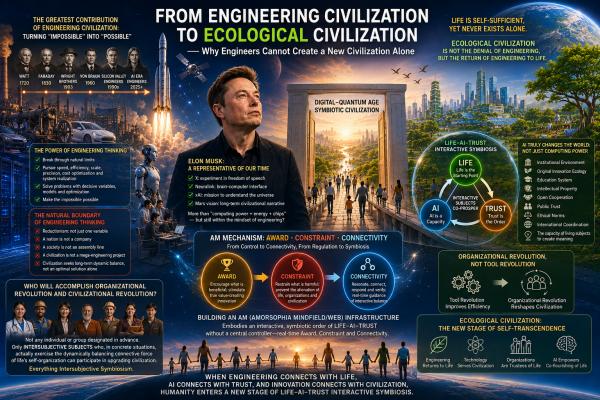
过去几年,每当有人问我,为什么如此关注埃隆·马斯克(Elon Musk),我的回答始终比较简单:因为在人类从轴心时代工业文明进入数位-量子时代生態文明的门口,他代表着一种前所未有的工程担当的力量。 我从未否认这一点。 恰恰相反,我一直认为,人类今天比任何时代都更需要伟大的工程师。 没有工程师,就没有工业革命;没有工程师,就没有互联网;没有工程师,就没有今天迅速发展的人工智能。 工程,是文明不断突破现实边界的重要力量。 但是,随着AI逐渐成为影响整个人类未来的基础设施,我越来越意识到一个过去并没有被充分讨论的问题: 工程师能够不断突破技术边界,却未必能够独自完成文明的升级。 这并不是针对马斯克,也不是针对任何一位工程师,而是工程文明自身所具有的一种天然边界。 一、工程文明最大的贡献,是把“不可能”变成“可能” 过去三百年的现代文明,几乎都是工程文明不断推进的历史。 瓦特改进蒸汽机,使机械动力进入生产体系;法拉第、麦克斯韦奠定电气时代基础;莱特兄弟实现飞行梦想;冯·布劳恩推动航天技术;硅谷一代工程师创造了互联网与移动通信;今天,马斯克、黄仁勋以及众多AI工程师,又把人类带入智能时代。 工程文明的伟大,在于不断突破自然限制。 它追求的是速度、效率、规模、精度、成本优化和系统实现。 在这一意义上,工程师天然具有一种令人敬佩的创造激情:别人认为做不到,他偏偏要做到;别人认为成本太高,他偏偏能降下来;别人认为需要几十年,他偏偏希望几年完成。 这种精神,本身就是现代文明极其珍贵的财富。 因此,一个尊重生命的社会,也必须尊重工程师。 二、但工程文明并不天然等于生态文明 问题恰恰出现在这里。 工程思维之所以高效,是因为它必须不断简化问题。 面对极其复杂的现实,它需要首先寻找决定性的变量,再建立模型,再进行优化。 这种方法解决汽车生产极为有效。 解决火箭设计极为有效。 解决芯片制造极为有效。 但是,当这种思维被直接迁移到社会治理、文明演进乃至AI未来时,它便容易出现一种结构性的认知局限。 因为文明从来不是只有一个单一变量。 一个国家,不是一家公司。 一个社会,不是一条流水线。 一个文明,更不是一个超级工程项目。 法律、伦理、文化、宗教、教育、家庭、市场、国家、国际关系,以及人与人之间的组织信托,共同构成了文明运行的真实生态。 这些因素彼此交互、彼此反馈、彼此制衡,很少能够被压缩为一条简单的因果链。 工程师寻找的是最优解。 文明更多追求的是长期动态平衡。 二者并不矛盾,却绝不能彼此替代。 三、马斯克是一个时代样本 我们知道,马斯克的贡献并不完全局限于工程优化。他X上的言论自由实验、Neuralink 的脑机接口、xAI 的明确使命(理解宇宙)、火星殖民的长期文明叙事,都是具有可圈可点的独特,而且事实上超出了单纯的“算力+能源+芯片”单一变量。 但最近接受《经济学人》专访,Elon Musk关于AI、电力、能源以及太空计划的一系列讨论,使我更加意识到这一点。 我并不认为马斯克的问题,象克鲁格曼说的是道德问题。 也不赞成简单地把一切归结为资本阴谋。 真正值得讨论的是另一件事情: 一位极其成功的工程师,在持续成功之后,是否容易把工程思维误认为世界本身? 这是任何成功者都可能遇到的问题。 工程项目往往可以不断扩大规模。 文明却不能无限复制一种成功模型。 例如,算力重要。 能源重要。 芯片重要。 数据中心重要。 监管重要。 但是,尽管算力、能源、芯片确实是当前 AI 发展的硬约束,如果因此便认为谁拥有最多电力,谁就一定能够领导AI,那么便把极其复杂的技术文明问题,压缩成了单一变量。 AI真正改变世界的,不只是算力。 还有制度环境。 原创生态。 教育体系。 知识产权。 开放合作。 公共信任。 伦理规范。 国际协同。 更重要的是,生命主体自身不断创造意义的能力。 这些,并不会随着发电量同步增长。 如果说工程决定了AI能够跑多快,那么文明决定了AI将走向哪里。 四、AI时代真正需要导通的,不只是技术 过去,人类主要讨论技术创新。 今天,更重要的问题已经变成: 如何让技术重新进入生命秩序。 AI越强,人类越需要回答三个问题: 技术为了谁? 组织为何存在? 文明最终服务什么? 如果这些问题没有回答,再先进的AI,也可能不断放大已有的问题。 因此,我近年来一直提出重建组织信托(Rebuilding Organizational Trust)。 因为组织不是生命本身。 组织只是生命的受托者(Trustee)。 AI也不是生命。 AI只是心智-组织能力的一部分。 真正需要成长的,不只是算法,而是人与人、人与组织、组织与社会之间重新建立可以托付、可以合作、可以持续发展的关系。 我把这种关系概括为: LIFE–AI–TRUST。 生命始终是起点。 AI始终是能力。 Trust始终是秩序。 顺序不能颠倒。 五、把“监管”变成“导通”比什么都重要 最近,Google DeepMind CEO Demis Hassabis在X上发的Article《前沿 AI框架与新时代的黎明》(A Framework for Frontier AI and the Dawning of a New Age)长文。 文章呼吁美国牵头成立一个“前沿AI标准机构”,参照金融行业 FINRA的模式:由这个机构定义什么算“前沿级”模型,达标的公司成为“前沿实验室”;新模型发布前最多提前30天送审,先自愿、后强制,通不过就不能在美国市场部署;评测覆盖网络安全、生物威胁,以及agentic AI的欺骗行为。其中最为重要的一条是:如果形势足够严峻,这个机构可以协调各家前沿实验室,一起放缓开发。 说到底,Hassabis还是对他预言即将出现的AGI不放心,要有有效监控机制这件事吗?奥特曼、马斯克、达利欧们都在讲啊,一溜儿看过来,无非玩“猫鼠游戏”,或玩“猫猫游戏”。 Hassabis希望建立的是“前沿AI标准机构”;Altman希望建立的是全球协调机制;Musk强调的是行业自治与同行约束。他们彼此路径不同,却仍停留在同一种文明逻辑:相信治理首先来自控制,相信安全首先来自监管,相信秩序首先来自审批。 然而,真正成熟的AI生態,从来不是靠“谁一直盯着谁”而存在。生态不会因为每天召开监管会议才保持平衡,生命自组织连接动態平衡,也不会因为时时接受审查才得以生长。 生命能够持续繁荣,依赖的是一种不断生成的奖抑通契合共生秩序:有益者得到激励,有害者自然受抑,主体之间在交互中形成导通的动态平衡。 因此,我们提出创建AM(Amorsophia MindField/Web)“奖、抑、通机制”。试图把AI治理从“控制论”推进到“共生论”。治理不再只是踩刹车,而是建立一种能够持续奖善、抑恶、导通的文明机制。届时,不再需要政府当“猫”,或企业当“猫”,AI和AI企业,也不是“鼠”,没有什么治理中心,而实时发挥奖、抑、通作用的,将是体现“生命(LIFE)、心智(AI)、组织信托(TRUST)交互契合共生秩序”的全新的基础设施。 奖,不只是奖励成功。而是持续激励真正创造价值的创新。 抑,也不是压制创新。而是约束任何可能异化生命、异化组织、异化文明的力量。 重点是第三个字:通。 通,是感通,是连接,是互联,是感应,是互证心智、知识、能量、语言模型及其孞念中,实时显现的“天堂、地狱、炼狱”可能迹象的鉴别,并加以奖/抑导通。 通,就是把工程、人文、经济、政治、法律、宗教、艺术重新进入生命共襄成长的过程中的监管,转变为导通! 当工程师能够理解哲学,哲学家能够理解工程,企业家能够理解制度,制度能够重新服务生命,人类文明才真正进入一种新的创造状态。 这已经不是传统意义上的跨学科,而是一种交互主体共生的文明能力。 六、从工程文明,走向生態文明 工程文明不会结束。也不应该结束。相反,它将在AI时代变得更加重要。 真正需要完成升级的,是工程文明自身的文明观。 未来最伟大的工程,不再只是造出更快的芯片、更大的火箭、更强的模型。而是帮助不同主体重新建立可以彼此信任、彼此赋能、彼此成全的文明秩序。 今天,我们依然需要像马斯克这样敢于探索的人。但与此同时,我们也需要更多能够导通工程与文明的人。
因为工程,可以不断改变世界运行的速度,解决经济学上的稀缺性问题;文明,则决定世界前进的方向。
组织革命,不是工具革命。 当AI越来越强大,人类真正需要重建的,并不是某一种工具体系,而是生命、组织与组织之间新的信托关系。工具革命能够提升效率,组织革命才能重塑文明。 有人问,组织革命与文明革命最终要落到具体的人、具体的制度与具体的信任重建上,那么,“谁来完成组织革命与文明革命”呢? 文明升级的主体,不是任何被事先指定的个体或共同体。不能像卡尔·马克思那样,先设定一个“无产阶级”作为历史主体,再让理论去服务这个主体。历史已经反复证明:一旦把某个阶级、某个民族、某个政党、某个技术精英群体“指定”为文明升级的唯一或主导主体,就很容易滑向新的支配结构,最终出现《新阶级》《动物庄园》《1984》所描述的组织异化,以及二十世纪许多国家发生的生灵涂炭。 真正能参与文明升级的,只能是那些在具体情境中实际发挥了“生命自组织连接动态平衡力”的交互主体(Intersubjective Subjects)。是否成为交互主体的一部分,不由事先的身份、出身、地位或理论资格决定,而由它是否真实地参与了生命自组织连接、是否实际促进了动态平衡来检验。组织革命、文明革命拒绝预先指定主体,也拒绝把文明进程压缩成某一方对另一方的胜利。它不是又一个“统一的支配力量”,也不是二元对立之后再来一次“对立统一”。 凡事交互主体共生(Everything Intersubjective Symbiosism)。只有那些在具体情境中真实发挥了“生命自组织连接动态平衡力”的主体,才能成为文明升级的参与者。 最后,生態文明,也不是工程文明的终点。 它不是否定工程,更不是削弱创新,而是工程文明完成自我超越后的新阶段。在这一阶段,工程开始自觉回归生命,技术开始主动服务文明,组织重新成为生命的受托者(Trustee),AI则成为生命共同成长的能力,而不再是凌驾于生命之上的目标。 数位-量子时代真正等待完成的,不只是一次技术革命,更是一次组织革命;不只是一次组织革命,更是一场文明革命。 当工程终于导通生命,当AI终于导通信托,当创新终于导通文明,人类才真正迈入LIFE–AI–TRUST交互契合共生的新阶段。
From Engineering Civilization to Ecological CivilizationWhy Engineers Cannot Create a New Civilization AloneArcher Hong Qian
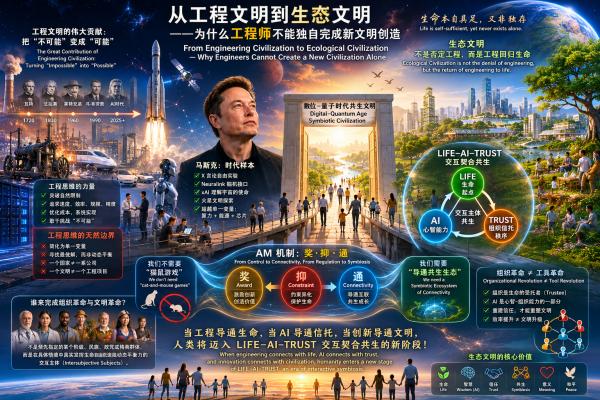
Over the past few years, whenever someone has asked me why I pay so much attention to Elon Musk, my answer has always been fairly simple: because, at the threshold where humanity is moving from the industrial civilization of the Axial Age into the ecological civilization of the Digital–Quantum Age, he represents an unprecedented force of engineering responsibility. I have never denied this. On the contrary, I have always believed that humanity today needs great engineers more than at any previous time. Without engineers, there would have been no Industrial Revolution. Without engineers, there would have been no internet. Without engineers, there would be no rapidly advancing artificial intelligence today. Engineering is an essential force through which civilization continually breaks beyond the boundaries of existing reality. Yet as AI gradually becomes a foundational infrastructure shaping the future of humanity as a whole, I have become increasingly aware of a question that has not received sufficient attention: Engineers can continually break through technological boundaries, but they may not be able to accomplish the upgrading of civilization on their own. This is not directed against Musk, nor against any particular engineer. It concerns a natural boundary inherent in engineering civilization itself. I. The Greatest Contribution of Engineering Civilization Is Turning the “Impossible” into the “Possible”The history of modern civilization over the past three centuries has largely been a history advanced by engineering civilization. James Watt improved the steam engine and brought mechanical power into the system of production. Michael Faraday and James Clerk Maxwell laid the foundations of the electrical age. The Wright brothers fulfilled humanity’s dream of flight. Wernher von Braun advanced space technology. Generations of Silicon Valley engineers created the internet and mobile communications. Today, Elon Musk, Jensen Huang, and numerous AI engineers are leading humanity into the age of intelligence. The greatness of engineering civilization lies in its continual effort to break through natural limitations. It pursues speed, efficiency, scale, precision, cost optimization, and systemic realization. In this sense, engineers naturally possess an admirable passion for creation: when others believe something cannot be done, they insist on doing it; when others believe the cost is too high, they find a way to bring it down; when others believe something will take decades, they try to accomplish it within a few years. This spirit is itself an extraordinarily precious asset of modern civilization. A society that respects life must therefore also respect engineers. II. Engineering Civilization Does Not Naturally Equal Ecological CivilizationHere, however, is precisely where the problem arises. Engineering thinking is highly efficient because it must continually simplify problems. Confronted with an immensely complex reality, it first seeks the decisive variables, then constructs a model, and finally proceeds to optimization. This method is exceptionally effective in automobile production. It is exceptionally effective in rocket design. It is exceptionally effective in semiconductor manufacturing. But when this mode of thinking is transferred directly into social governance, civilizational evolution, or the future of AI, it can easily generate a structural cognitive limitation. Civilization has never been governed by a single variable. A nation is not a company. A society is not an assembly line. A civilization is even less a gigantic engineering project. Law, ethics, culture, religion, education, family, markets, the state, international relations, and organizational trust among human beings together constitute the living ecology through which civilization operates. These elements interact, respond to one another, and hold one another in balance. They can rarely be compressed into a simple line of causation. Engineers seek optimal solutions. Civilization is more concerned with long-term dynamic balance. The two are not contradictory, but neither can ever replace the other. III. Musk Is a Representative Case of Our TimeWe know that Musk’s contributions are not confined entirely to engineering optimization. His experiment with freedom of speech on X, Neuralink’s brain–computer interface, xAI’s explicit mission to understand the universe, and his long-term civilizational narrative of settling Mars all possess distinctive and noteworthy significance. In fact, they already extend beyond the single-variable formula of “computing power + energy + chips.” Nevertheless, a series of remarks by Elon Musk concerning AI, electricity, energy, and space programs in his recent interview with The Economist has made me even more conscious of the issue discussed here. I do not believe that Musk’s problem is fundamentally a moral one, as Paul Krugman suggests. Nor do I agree with reducing everything to a conspiracy of capital. The question truly worth examining is something else: After achieving continuous and extraordinary success, can an exceptionally successful engineer begin to mistake engineering thinking for the world itself? This is a difficulty that any successful person may encounter. Engineering projects can often be expanded continuously. Civilization, however, cannot endlessly reproduce a single successful model. Computing power is important. Energy is important. Semiconductors are important. Data centers are important. Regulation is important. Computing power, energy, and chips are indeed hard constraints on the current development of AI. Yet to conclude from this that whoever possesses the greatest amount of electricity will necessarily lead AI is to compress an extraordinarily complex question of technological civilization into a single variable. What enables AI truly to transform the world is not computing power alone. It also includes the institutional environment. An ecology of original creation. The educational system. Intellectual property. Open cooperation. Public trust. Ethical norms. International coordination. More important still is the capacity of living subjects themselves continually to create meaning. None of these grows automatically in proportion to electricity generation. If engineering determines how fast AI can run, civilization determines where AI will go. IV. What the AI Age Truly Needs to Connect Is More Than TechnologyIn the past, humanity primarily discussed technological innovation. Today, a more important question has emerged: How can technology be brought back into the order of life? The more powerful AI becomes, the more urgently humanity must answer three questions: For whom does technology exist? Why do organizations exist? What does civilization ultimately serve? Without answers to these questions, even the most advanced AI may simply magnify the problems that already exist. This is why, in recent years, I have continually called for Rebuilding Organizational Trust. An organization is not life itself. An organization is only a Trustee of Life. AI is not life either. AI is only one part of mind–organizational capacity. What truly needs to grow is not merely the algorithm. What must be rebuilt are relationships among persons, between persons and organizations, and between organizations and society—relationships within which people can entrust themselves to one another, cooperate with one another, and develop together sustainably. I summarize this relationship as: LIFE–AI–TRUST. Life must always remain the starting point. AI must always remain a capacity. Trust must always remain the order. This sequence must never be reversed. V. Nothing Is More Important Than Transforming “Regulation” into “Connectivity”Google DeepMind CEO Demis Hassabis recently published a long article on X entitled A Framework for Frontier AI and the Dawning of a New Age. The article calls for the United States to take the lead in establishing a “frontier AI standards body,” modeled on FINRA in the financial sector. Such an organization would define what qualifies as a “frontier-level” model, and companies meeting the standard would become recognized “frontier laboratories.” New models would be submitted for review as many as thirty days before release—initially voluntarily and later mandatorily. Models that failed to pass would not be permitted to enter the American market. Evaluations would cover cybersecurity, biological threats, and deceptive behavior by agentic AI. One of its most significant proposals is that, if circumstances became sufficiently serious, this body could coordinate frontier laboratories to slow development together. Fundamentally, Hassabis remains uneasy about the AGI whose imminent arrival he himself predicts and therefore seeks an effective mechanism of supervision. Yet are Altman, Musk, Dalio, and others not all discussing similar concerns? Viewed together, these proposals amount either to a “cat-and-mouse game” or to a game in which everyone wants to become the cat. Hassabis seeks a frontier AI standards body. Altman seeks a mechanism of global coordination. Musk emphasizes industry self-governance and peer restraint. Their approaches differ, yet they remain within the same civilizational logic: governance is assumed to arise first from control, safety first from regulation, and order first from approval. A mature AI ecology, however, has never depended on someone constantly watching someone else. An ecology does not maintain balance because regulators hold meetings every day. Nor can the self-organizing, connective, and dynamically balanced growth of life flourish through uninterrupted inspection. The continued flourishing of life depends upon a continually generated order of fitting symbiosis through Award, Constraint, and Connectivity: what benefits life is encouraged, what harms life is naturally restrained, and subjects form a connected dynamic balance through interaction. For this reason, we propose the creation of the AM—or Amorsophia MindField/Web—mechanism of Award, Constraint, and Connectivity. Its purpose is to advance AI governance from cybernetics to symbiosis. Governance would no longer merely apply the brakes. It would establish a civilizational mechanism capable of continuously rewarding what is beneficial, constraining what is harmful, and enabling connectivity. At that point, government would no longer need to play the “cat,” nor would corporations need to play the “cat.” AI systems and AI companies would not be “mice,” either. There would be no single center of governance. Instead, a new form of infrastructure would exercise the real-time functions of Award, Constraint, and Connectivity, embodying an interactive, fitting symbiotic order among Life, Mind, and Organizational Trust—LIFE–AI–TRUST. Award does not merely reward success. It continually encourages innovation that genuinely creates value. Constraint does not suppress innovation. It restrains any force capable of alienating life, organizations, or civilization. The key lies in the third term: Connectivity. Connectivity is resonance, connection, interconnection, responsiveness, and mutual verification. It is the capacity to distinguish, within minds, knowledge, energy, language models, and the faith and trust they manifest, the emerging signs of possible “heaven,” “hell,” and “purgatory,” and then to guide them through Award and Constraint. Connectivity means transforming regulation into a process through which engineering, the humanities, economics, politics, law, religion, and art re-enter and participate in the co-flourishing growth of life. When engineers can understand philosophy, philosophers can understand engineering, entrepreneurs can understand institutions, and institutions can once again serve life, human civilization will enter a genuinely new state of creation. This is no longer interdisciplinarity in the traditional sense. It is a civilizational capacity for Intersubjective Symbiosism. VI. From Engineering Civilization to Ecological CivilizationEngineering civilization will not come to an end. Nor should it. On the contrary, it will become even more important in the age of AI. What truly needs to be upgraded is engineering civilization’s own understanding of civilization. The greatest engineering projects of the future will no longer consist merely in producing faster chips, larger rockets, or more powerful models. They will help different subjects rebuild a civilizational order in which they can trust, empower, and fulfil one another. Today, we still need explorers with the courage of Elon Musk. At the same time, however, we need more people capable of reconnecting engineering and civilization. Engineering can continually change the speed at which the world operates and help resolve the economic problem of scarcity. Civilization determines the direction in which the world moves. An organizational revolution is not a tool revolution. As AI becomes increasingly powerful, what humanity truly needs to rebuild is not another system of tools, but new relationships of trust among life, organizations, and organizations themselves. A tool revolution can improve efficiency. Only an organizational revolution can reshape civilization. Someone may ask: if organizational revolution and civilizational revolution must ultimately be embodied in particular persons, particular institutions, and the concrete rebuilding of trust, then who is to accomplish these revolutions? The subject of civilizational upgrading cannot be any individual or collective designated in advance. We cannot follow Karl Marx by first appointing the “proletariat” as the subject of history and then requiring theory to serve that subject. History has repeatedly demonstrated that once a particular class, nation, political party, or group of technological elites is designated as the sole or dominant subject of civilizational upgrading, a new structure of domination can easily emerge. The result is the organizational alienation portrayed in The New Class, Animal Farm, and Nineteen Eighty-Four, as well as the immense destruction of life experienced by many countries during the twentieth century. Those who can genuinely participate in civilizational upgrading can only be the Intersubjective Subjects who, in concrete situations, actually exercise the dynamically balancing connective force of life’s self-organization. Whether someone becomes part of this intersubjective process is not determined in advance by identity, origin, status, or theoretical qualification. It must be tested by whether that subject genuinely participates in the self-organizing connections of life and actually promotes dynamic balance. Organizational revolution and civilizational revolution reject the prior designation of a historical subject. They also reject reducing the civilizational process to the victory of one side over another. They do not seek yet another “unified force of domination,” nor do they propose one more “unity of opposites” after binary confrontation. Everything Intersubjective Symbiosism. Only those subjects who genuinely exercise the dynamically balancing connective force of life’s self-organization in concrete situations can become participants in civilizational upgrading. Finally, ecological civilization is not the terminus of engineering civilization. It neither negates engineering nor weakens innovation. It is a new stage reached when engineering civilization completes its own self-transcendence. At this stage, engineering consciously returns to life, technology actively serves civilization, organizations once again become Trustees of Life, and AI becomes a capacity through which life grows together rather than a goal standing above life. What truly awaits completion in the Digital–Quantum Age is not merely a technological revolution, but an organizational revolution; and not merely an organizational revolution, but a civilizational revolution. When engineering finally connects with life, when AI finally connects with trust, and when innovation finally connects with civilization, humanity will truly enter a new stage of interactive, fitting symbiosis through LIFE–AI–TRUST.
|