重建,还是崩塌? Rebuild or Collapse? ——政治危机的组织孞托诊断学 — A Diagnostic Theory of Political Crisis Through Organizational Entrustment 钱宏(Archer Hong Qian) 一切政治危机、经济危机、文化危机、未来危机,说到底,都是组织孞托危机。 危机发生的时候,人们看到的往往是政权更替、财政赤字、货币贬值、失业增长、社会撕裂、街头抗议、犬儒逐利、戾气冲天、躺平摆烂、文化冲突。政治家忙着灭火,经济学家寻找周期,社会学家分析阶层,历史学家追溯制度。 这些当然都有意义。 然而,如果我们继续往生命与组织关系的深处追问:一个社会为什么会走到危机这一步?为什么曾经有效的制度突然失灵?为什么曾经接受的权威不再被接受?为什么经济数字仍在增长,人们却越来越愤怒?为什么政府说得越来越正确,人民却越来越不相信? 最后都会碰到同一个问题: 组织承诺的价值,无法继续得到承兑了。 生命把一部分权利、财富、时间、劳动乃至自由托付给组织,是因为组织能够降低彼此交往的成本,保护生命,维持秩序,协调冲突,创造个人独自生活无法获得的公共价值。 这是一种托付,也是一种承兑关系。 组织一旦长期消耗这种托付,却不能提供与之相称的价值,危机便开始发生。 所以,政治诊断学真正需要测量的,不只是GDP、债务率、通胀率、支持率,也不只是左翼还是右翼、民主还是威权、市场还是政府。 更值得追问的是: 这个组织还值得生命托付吗? 这就是组织孞托。
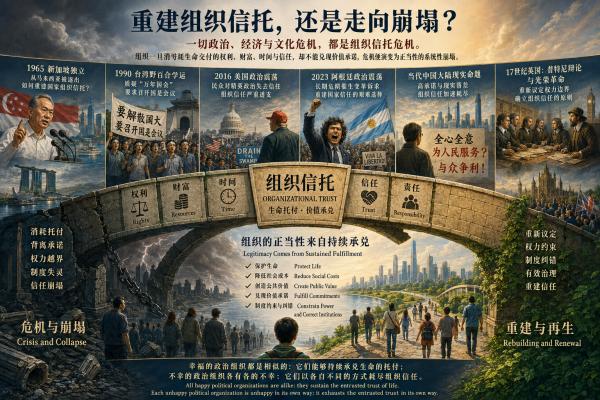
一、1965:一个被逐出联邦的小岛 1965年8月9日,新加坡脱离马来西亚。 准确地说,这是长期政治、族群和经济矛盾累积之后,马来西亚国会通过修宪,将新加坡逐出联邦。 李光耀在宣布新加坡独立的记者会上落泪。 那不是一个胜利者的眼泪。 一个资源匮乏、面积狭小、族群复杂,连淡水供应都高度依赖外部的小岛,突然必须作为一个独立国家生存。 摆在李光耀面前的问题,当然包括住房、就业、工业、教育、国防、外交。 可是把这些问题放在一起看,会发现还有一个更加根本的问题: 谁相信新加坡? 居民是否相信这个刚刚诞生的国家? 不同族群是否相信彼此能够生活在一起? 企业是否愿意投资? 国际资本是否相信这里的契约? 公务员是否能够成为公共责任的承担者,而不是权力与利益的寻租者? 世界是否相信这个小岛明天还存在? 因此,新加坡真正稀缺的资源,甚至不只是土地、淡水、资本和技术。 还有组织孞托。 国家首先必须让自己值得托付。 政府必须证明税收不会无休止地被浪费,行政能够有效运行,法律可以稳定执行,公共住房能够兑现,教育能够改变下一代人的生活,港口可以正常运转,投资者的财产与契约能够得到保护。 于是,一个几乎没有自然资源的小岛,开始积累一种看不见的资源: 人们愿意把自己的未来托付给这个组织。 新加坡后来创造的经济奇迹,可以用资本积累解释,可以用全球贸易解释,可以用产业政策解释,可以用华人文化解释,也可以用英国制度解释。 这些解释都触及了真实的一部分。 但在这些因素能够发挥作用之前,还必须存在一个条件: 组织能够承兑。 这才是1965年以后新加坡最值得研究的政治经济学遗产之一。 二、1990:广场上的青年与总统府里的选择 1990年3月,台湾青年学生聚集在中正纪念堂广场。 后来,这场运动被称为“野百合学运”。 学生面对的是一个非常具体、也非常荒诞的问题:1940年代在大陆选出的部分“中央民意代表”,迁台以后长期没有全面改选,以至于出现所谓“万年国会”。 一个声称“主权在民”的共和国,如果人民不能通过正常制度重新授权自己的代表,“主权在民”究竟由谁承兑? 所以,野百合学生提出解散长期未全面改选的国民大会、废除《动员戡乱时期临时条款》、召开国是会议、推动民主改革等要求。 这时候,真正接受考验的并不只是街头学生。 还有李登辉。 镇压,还是对话? 把青年视为秩序的破坏者,还是把他们提出的问题看作共和国自身必须回答的问题? 这是一个政治判断,也是一种政治格局。 更深处,则是一次组织孞托选择: 继续消耗共和国的名义,还是让共和国重新承兑“主权在民”? 李登辉选择接见学生代表,随后推动召开国是会议。台湾此后的政治改革当然复杂得多,也绝非一个人、一场运动所能完成,但这个历史瞬间依然具有象征意义。 因为政治组织面对挑战的时候,最容易发生一种危险的错觉: 把保护组织等同于保护既得权力结构。 其实,一个组织真正需要保护的,是生命为什么愿意把权利托付给它的那个理由。 当这个理由已经受到损害,继续保护旧结构,恰恰可能加速组织自身的孞托耗损。 因此,1990年的问题表面上是“万年国会”,深处却是: 共和国还能不能让共和国名副其实? 三、2016与2023:为什么选民突然要掀桌子? 2016年的美国与2023年的阿根廷,相距数千公里,国家历史、经济结构、政治文化差异巨大。 川普与米莱的个人风格也完全不同。 然而,两场政治震荡背后,都存在一个不能忽略的现象: 相当数量的选民已经不再相信原有政治组织能够依靠自身惯性解决问题。 当普通人的生活成本不断提高,政府债务不断累积,行政体系越来越庞大,规则越来越复杂,政治语言越来越精致,学校教育也越来越偏蔽,而人们对未来的确定感越来越低,一种奇怪的裂缝便出现了: 组织越来越强,组织孞托却越来越弱。 一个组织最危险的时候,未必是GDP下降的时候,而可能是GDP仍在增长,生命却开始退出的时候。 这正是共生经济学(Symbionomics)对“无效GDP”分析能够进入政治诊断的地方。GDP记录发生了多少交易、投资和支出,却不会自动辨别这些活动究竟降低了多少生活成本、创造了多少公共价值,又制造了多少新的组织成本。污染后的治理、拥堵后的扩建、高房价推动的土地金融、不断膨胀的行政维持成本,都可能形成GDP;如果生命为此付出的时间、债务、健康和未来选择越来越多,增长就可能与真实生活所得发生背离。 更值得警惕的是无效GDP的代际化:收益在当期确认,成本向未来递延;增长记在今天,账单寄给明天。那些以GDP增长作为政绩考评、升官发财圭臬的殖官主义(Bureaucolonialism)者,还可能在任期、调任和晋升中,把自己的组织责任一并转嫁出去。 这一代人在GDP账面上留下了“增长”,下一代人在生活账本上收到的却是成本。 因此,共生经济学提出GDE(Gross Domestic Energy / Efficiency),并不是再造一个数字崇拜,而是要求把经济活动重新放回生命来衡量:有没有降本、赋能、增进健康、生成孞托与和平?当GDP仍然增长而GDE意义上的生命效能持续下降,政治危机可能已经在经济繁荣的表象之下发生。 这恰恰是现代政治最容易误诊的地方。 政府规模扩大,不等于治理能力增强。 财政支出增加,不等于公共价值增加。 法律法规越来越多,不等于秩序越来越好。 专家越来越多,也不意味着人民越来越相信组织。 当组织为了维持自身运行不断增加社会成本,而它所承兑的公共价值却没有同步增长,组织就可能从生命的受托者,逐渐变成生命必须供养的对象。 政治危机由此孕育。 所以,2016年的美国选举与2023年的阿根廷选举,无论人们如何评价川普与米莱,都提出了一个比左右之争更加持久的问题: 现代国家怎样重新证明自己值得人民托付? 选举可以更换总统。 真正困难的是重建组织孞托。 四、人民共和国怎样名副其实? 同样的问题,也摆在PRC大陆面前。 今天,一个值得高度注意的文化现象,是部分知识分子和公共表达越来越迅速地向权力叙事靠拢。 胡鞍钢、金灿荣、张维为也好,林毅夫、李稻葵、张丹丹也罢,个人并不是这里真正值得讨论的重点。 值得观察的是一种社会症候: 为什么知识越来越容易成为权力的解释工具?为什么公共语言与普通人的生活体验之间正在形成越来越明显的裂缝? 一个组织可以拥有强大的宣传能力,可以不断生产宏大的国家叙事,可以反复表达自己的善意。 但是,孞托无法靠语言单方面制造。 中华人民共和国曾经作出一个极高的政治价值承诺: 全心全意为人民服务。 “人民共和国”四个字本身,也是一张极高价值的政治承兑凭证。 人民不是修辞。 共和国也不是装饰。 如果组织一方面宣称全心全意为人民服务,另一方面却在资源配置——土地、住房、教育、医疗、金融、行政垄断和各种经营活动中不断扩张自身利益;如果公共权力越来越深入地参与货殖,又拥有普通市场主体无法拥有的权力优势,那么一个古老的问题便重新出现: 与民争利。 我更愿意采用司马迁《货殖列传》中讲的“最下者与之争”,《史记正义》表述的: 与众争利。 这里真正危险的,甚至不只是某一项政策是否正确。 危险发生在价值承诺与生活体验持续分离的时候。 一个组织宣称的价值越高,它承担的承兑责任也越高。 “人民共和国”因此不是一份永久获得的政治资产。 它需要每天承兑。 怎样知道这种承兑正在发生,还是正在落空?不能只听组织怎样描述自己,还要看生命怎样用生活作出选择。普通家庭敢不敢消费和承担长期负债,年轻人愿不愿意留下、结婚、生育并进入长期保障,企业家愿不愿意投资,人才愿不愿意把自己的创造力放在这里,人们遇到不公时是否相信制度能够纠正——这些都不是抽象的情绪,而是生命用时间、财富与未来对组织进行的现实计价。 当越来越多人减少长期投入、回避长期契约,甚至以“躺平”“不卷”“不生”回应不断上升的生活成本时,首先需要诊断的未必是年轻人的道德,而是组织承兑是否出现了裂缝。生命的退出,本身就可能成为组织孞托耗损最安静、也最难伪装的信号。 人民愿不愿意相信,年轻人愿不愿意留下,企业家愿不愿意投资,普通家庭敢不敢消费,人们遇到不公时相不相信制度能够纠正,知识分子能不能诚实表达自己的判断——这些看似分散的现象,都在不断给组织孞托计价。 所以,大陆今天面对的问题最终仍然绕不开: 怎样让“人民共和国”名副其实? 换句话说: 怎样重建组织孞托? 五、“重建人民共和国”:一个四十年前的问题 “重建人民共和国”,并不是我今天才提出的命题。 1986年,一场车祸以后,我开始写作《公民个人权利优先引论——作为整体主义的共和国公民学与作为个体主义的共和国组织学》。 那时候我三十出头。 它的导论题为《一个精神裂变患者的自述》,后来全文刊载于《华人世界》1989年第一期。 回头看,那个时候真正困扰我的,其实已经是同一个问题: 个人与组织究竟是什么关系? 如果共和国以人民的名义存在,公民个人为什么反而可能被抽象的“整体”吞没? 如果个人权利优先,共和国又如何形成超越个人的公共秩序? 整体与个体之间,难道只能彼此争夺? 四十年过去,我越来越清楚地意识到,这个问题如果一直停留在“个人主义—整体主义”的二元框架中,很难真正打开。 生命本自具足,又非独存。 人需要连接,需要交互,需要组织。 组织因此发生。 然而组织一旦发生,又可能逐渐忘记自己为什么发生。 它从生命的受托者,变成自己的目的;从降低生活成本,变成制造组织成本;从帮助生命彼此连接,变成控制生命;从承兑价值,变成索取价值。 这也是我今天重新理解“重建人民共和国”的关键: 问题不再停留在国家与个人谁优先,而在于组织是否持续履行受托责任。组织一旦把自身扩张当成目的,把维持组织的成本转嫁给生命,再用增长、秩序或宏大叙事证明这种转嫁的合理性,个人主义与整体主义的旧争论便遮蔽了更基础的事实——生命为什么还要继续托付? 于是,1986年的“重建人民共和国”,经过四十年的思想生长,最终抵达了今天这个更加基础的问题: 重建组织孞托。 这也使“共和国”重新获得了一个可以超越意识形态争论的尺度: 国家叫什么并非最重要。 写着什么主义也并非最重要。 真正重要的是: 生命托付给组织的权利、资源和责任,组织有没有好好承兑? 六、从普特尼到光荣革命:政治文明的另一条线索 1647年,英国内战尚未真正结束,一群军官、士兵与政治思想者在伦敦附近的普特尼展开了一场后来影响深远的辩论。 Putney Debates。 他们争论选举权,争论财产权,争论议会,争论一个普通英国人究竟凭什么服从政治权力。 争论异常激烈。 英国也没有因此立即获得一个完美制度。 随后仍有王政复辟,仍有政治冲突,仍有权力斗争。但是,现代政治文明的思想萌芽,已经有了。 直到1688年的The Glorious Revolution,再到1689年的Bill of Rights,英国才逐渐形成一种新的政治安排: 权力必须受到约束; 征税需要授权; 议会具有不可轻易取消的地位; 统治本身必须拥有可以被承认的正当来源; 少数人的权利必须得到保障。 如果只用“君主制走向君主立宪制”来概括这一段历史,当然没有错。 可是从组织孞托的角度看,还可以看到另一条历史线索: 托付—背离—冲突—重新议定—重新承兑。 这可能才是现代政治文明最值得珍惜的能力之一。 一个社会不可能永远没有危机。 一个组织也不可能永远不犯错误。 真正决定文明能否持续生长的,是组织有没有自我修复能力。 当承诺无法兑现,能不能重新议定? 当权力越界,能不能把它拉回来? 当制度失灵,能不能修改制度? 当人民不再相信,组织能不能通过真实行动重新获得托付? Putney Debates与The Glorious Revolution的意义,由此超出了英国历史。 它们让世界第一次较为清楚地看到: 政治秩序可以通过重新议定组织与生命之间的托付关系获得再生。 七、政治危机怎样诊断?——从宏观数字回到生命选择 如果“组织孞托”只是一个漂亮的解释概念,它还不足以成为政治诊断学。诊断必须能够观察:孞托在哪里生成,在哪里耗损,又怎样从日常生活中显现出来。 传统政治经济分析习惯观察GDP、通胀、债务、失业、财政收支、支持率和选举结果。这些指标当然重要,但它们主要告诉我们组织发生了什么,却不一定告诉我们生命怎样感受并回应这些变化。 组织孞托诊断学因此需要增加一组“生命指标”:人们是否愿意作长期投资,是否愿意创业,家庭是否敢于消费和负债,年轻人是否愿意结婚生育,劳动者是否愿意持续进入长期社会保障关系,人才和资本是进入还是退出,人们面对不公时是否相信制度能够纠正,知识分子能否诚实表达判断。 这些现象不能被机械地归结为单一政治原因,也不能把任何一次下降都直接解释成孞托崩塌。它们真正的意义在于:当多个生活选择长期、同向地发生变化,而宏观数字仍然显示繁荣时,我们必须警惕组织价值承诺与生命真实所得之间已经出现裂缝。 由此,政治危机可以沿着一条更完整的链条被观察:生命托付,组织承兑;承兑形成公共价值,孞托生成;组织成本超过生命所得,无效GDP增加;成本向他人和下一代转嫁,承兑开始失衡;生命减少投入、回避长期契约乃至退出;组织孞托持续耗损;最后,原本可以修复的治理问题才演变成政治危机。 生命托付 → 组织承兑 → 孞托生成 → 承兑失衡 → 成本转嫁 → 生命退出 → 孞托危机。 诊断的目的并不是等待最后一环发生,而是在组织仍有修复能力的时候,看见前面的信号。 诊断维度 | 需要追问的问题 | 可能观察到的生活信号 | 生命成本 | 组织是在降低还是增加生活成本? | 住房、教育、医疗、育儿、养老、通勤与时间成本 | 价值承兑 | 公共承诺是否转化为可体验的公共价值? | 对制度、公平与长期承诺的可信度 | 组织效能 | GDP增长是否伴随GDE意义上的降本、赋能、健康、孞托与和平? | 增长与生活感受是否持续背离 | 代际责任 | 当期收益是否把成本递延给未来? | 债务、生养、养老压力、环境与住房负担的代际转移 | 生命投入 | 人们还愿不愿把时间、财富和未来托付出去? | 消费、投资、创业、婚育、长期保障参与 | 纠错能力 | 承兑失灵后能否重新议定并修复? | 制度纠错、权力约束、公开表达与真实反馈 |
这张表并不试图把复杂社会压缩成一套机械评分。它提供的是一种圭臬:所有宏观指标最终都要回到生命,观察组织究竟创造了多少值得托付的现实。 八、幸福的政治组织都是相似的 托尔斯泰在《安娜·卡列尼娜》开篇写下了一句流传至今的话: “幸福的家庭都是相似的,不幸的家庭各有各的不幸。”(All happy families are alike; each unhappy family is unhappy in its own way.) 政治世界何尝不是如此? 新加坡有新加坡的问题,台湾有台湾的问题,美国有美国的问题,阿根廷有阿根廷的问题,中国大陆当然也有中国大陆自己的历史、制度和现实处境。 它们不能简单类比。 更不能拿一种制度模式去裁剪所有国家。 但是政治诊断仍然可以拥有一种圭臬。 我们可以问: 组织为什么发生? 生命为什么把权利、财富、时间和部分自由托付给它? 组织获得这些托付以后创造了什么? 它降低了生活成本,还是不断增加生活成本? 它保护生命,还是消耗生命? 它促进人与人的连接,还是制造彼此敌视? 它让社会更有创造力,还是让每个人越来越害怕? 它有没有履行自己的价值承诺? 它还有没有纠错能力? 它是否仍然值得托付? 于是,我们也可以套用托尔斯泰的话: 幸福的政治组织都是相似的:它们能够持续承兑生命的托付。 不幸的政治组织各有各的不幸:它们以各自不同的方式耗尽组织孞托。 这或许就是政治诊断学最简单的一把圭臬。 因此,幸福的政治组织并不意味着没有冲突、没有错误、没有危机。它们真正相似的地方,是能够把危机转化为反馈,把反馈转化为纠错,把纠错重新转化为承兑。孞托不是一次授予的许可证,而是在生命与组织持续交互中生成的关系。 九、To be or not to be 莎士比亚让哈姆雷特问: To be or not to be, that is the question. 今天,每一个陷入政治、经济与文化危机的组织,其实也面对着自己的“To be or not to be”。 重建,还是崩塌? 这里的重建,不等于推倒一切重新开始。 真正有生命力的重建,是让组织恢复自身的生命来源,让失去的托付重新发生,让已经无法承兑的承诺重新获得现实内容。 新加坡曾经回答过这个问题。 台湾曾经回答过这个问题。 英国在漫长而痛苦的历史中回答过这个问题。 美国仍在回答。 阿根廷仍在回答。 PRC大陆也必须回答。 没有任何组织能够凭借过去的功绩永久获得未来的孞托。 也没有任何权力可以仅仅依靠自己的强力,证明自己的正当。 因为组织从来不是生命的主人。 组织是生命的受托者(Trustee)。 生命托付,组织承兑。 承兑发生,孞托生成。 承兑不断发生,组织获得生命。 承兑长期落空,组织孞托便开始耗尽。 而当组织仍然能够听见生命的退出、纠正成本转嫁、重新议定责任并恢复价值承兑,危机就可能成为孞托再生的入口。重建的核心因此不是恢复旧有权威,而是恢复组织值得托付的现实理由。 政治危机、经济危机、文化危机、未来危机,由此获得了一条彼此贯通的解释线索。 而一个文明真正的成熟,也许就在于它终于明白: 危机并不可怕。 真正危险的是组织已经失去孞托,却仍然把维护自己当作维护秩序;已经无法承兑,却仍然不断提高承诺;已经远离生命,却仍然要求生命继续无条件托付。 历史一次又一次把同一个问题放到人类面前。 今天,它再次来到我们面前: 重建,还是崩塌? To be or not to be, that is the question. Rebuild or Collapse? — A Diagnostic Theory of Political Crisis Through Organizational Entrustment Archer Hong Qian All political crises, economic crises, cultural crises, and crises of the future are, in the final analysis, crises of organizational entrustment. When crisis erupts, what people usually see are changes of government, fiscal deficits, currency depreciation, rising unemployment, social fragmentation, street protests, cynical rent-seeking, mounting hostility, lying flat and giving up, and cultural conflict. Politicians rush to put out fires; economists look for cycles; sociologists analyze classes; historians trace institutions. All of this matters. But if we continue to probe deeper into the relationship between life and organization, we encounter a more fundamental set of questions: Why does a society arrive at crisis? Why do institutions that once worked suddenly fail? Why is authority that was once accepted no longer accepted? Why can economic indicators keep rising while people grow angrier? Why can governments sound increasingly correct while the people believe them less and less? In the end, all these questions converge on one problem: The value promised by an organization can no longer be fulfilled. Life entrusts part of its rights, wealth, time, labor, and even freedom to organizations because organizations can reduce the costs of human interaction, protect life, maintain order, coordinate conflict, and create public value that individuals living alone could not obtain. This is a relationship of entrustment and fulfillment. When an organization continuously consumes that entrustment but can no longer provide value commensurate with what it has received, crisis begins. Political diagnosis therefore needs to measure more than GDP, debt ratios, inflation, approval ratings, or whether a system is left or right, democratic or authoritarian, market-oriented or state-led. The more fundamental question is: Is this organization still worthy of life’s entrustment? That is organizational entrustment. I. 1965: An Island Expelled from the FederationOn August 9, 1965, Singapore separated from Malaysia. More precisely, after prolonged political, ethnic, and economic tensions, the Malaysian Parliament amended the Constitution and expelled Singapore from the Federation. Lee Kuan Yew wept at the press conference announcing Singapore’s independence. Those were not the tears of a victor. A small island with few natural resources, limited land, a complex ethnic composition, and even a heavy dependence on external sources for fresh water suddenly had to survive as an independent state. Lee Kuan Yew certainly faced problems of housing, employment, industry, education, national defense, and diplomacy. Yet taken together, these problems pointed to an even more fundamental question: Who believed in Singapore? Would its residents believe in this newborn state? Would different ethnic groups believe they could live together? Would businesses invest? Would international capital trust contracts made there? Could civil servants become bearers of public responsibility rather than seekers of power and rents? Would the world believe that this island would still exist tomorrow? Singapore’s truly scarce resources, therefore, were not only land, water, capital, and technology. It also lacked organizational entrustment. The state first had to make itself worthy of entrustment. The government had to demonstrate that taxes would not be endlessly wasted, administration could function effectively, law could be applied consistently, public housing commitments could be fulfilled, education could change the lives of the next generation, the port could operate reliably, and investors’ property and contracts could be protected. Thus an island with almost no natural resources began to accumulate an invisible resource: People became willing to entrust their future to the organization. Singapore’s later economic miracle can be explained through capital accumulation, global trade, industrial policy, Chinese cultural traditions, or British institutional legacies. Each explanation captures part of the truth. But before any of these factors could work, one condition had to exist: The organization had to be capable of fulfillment. That is one of Singapore’s most important political-economic legacies after 1965. II. 1990: Young People in the Square and a Choice in the Presidential OfficeIn March 1990, young Taiwanese students gathered at Chiang Kai-shek Memorial Hall. The movement later became known as the Wild Lily Student Movement. The students confronted a concrete and extraordinary problem: some members of the central representative bodies elected on the Chinese mainland in the 1940s had remained in office for decades after relocating to Taiwan without comprehensive reelection, producing what came to be called the “Ten-Thousand-Year Parliament.” If a republic claimed that sovereignty resided in the people, yet the people could not reauthorize their representatives through normal institutional procedures, who was fulfilling the promise of popular sovereignty? The Wild Lily students therefore demanded the dissolution of the long-unreelected National Assembly, the abolition of the Temporary Provisions Effective During the Period of National Mobilization for Suppression of the Communist Rebellion, the convening of a National Affairs Conference, and democratic reform. At that moment, it was not only the students in the square who were being tested. Lee Teng-hui was being tested as well. Repression, or dialogue? Should the young people be treated as destroyers of order, or should the questions they raised be treated as questions the republic itself had to answer? This was a political judgment and a test of political vision. At a deeper level, it was a choice about organizational entrustment: Continue consuming the name of the republic, or enable the republic once again to fulfill the promise that sovereignty resides in the people? Lee Teng-hui chose to meet student representatives and subsequently promoted the convening of a National Affairs Conference. Taiwan’s later political reforms were of course far more complex and cannot be attributed to one person or one movement. Yet that historical moment retains symbolic significance. Political organizations under challenge are especially prone to a dangerous illusion: they confuse protecting the organization with protecting the existing structure of power. What an organization truly needs to protect is the reason life was willing to entrust rights to it in the first place. When that reason has already been damaged, continuing to defend the old structure may accelerate the depletion of organizational entrustment. Thus the surface issue in 1990 was the “Ten-Thousand-Year Parliament.” The deeper question was: Could the republic once again make its name correspond to reality? III. 2016 and 2023: Why Did Voters Suddenly Want to Overturn the Table?The United States in 2016 and Argentina in 2023 were separated by thousands of kilometers and differed profoundly in history, economic structure, and political culture. Donald Trump and Javier Milei also had very different personal styles. Yet behind both political shocks lay a phenomenon that cannot be ignored: substantial numbers of voters no longer believed that established political organizations could solve problems through their own institutional inertia. As ordinary people’s living costs rise, government debt accumulates, administrative systems grow larger, rules become more complex, political language becomes more refined, school education grows increasingly biased, and people’s sense of certainty about the future declines, a strange fissure appears: Organizations grow stronger while organizational entrustment grows weaker. An organization may be in greatest danger not when GDP is falling, but when GDP is still growing while life begins to withdraw. This is where Symbionomics and its analysis of “ineffective GDP” enter political diagnosis. GDP records how much transaction, investment, and expenditure has occurred, but it does not automatically distinguish how much those activities have reduced living costs, how much public value they have created, or how much new organizational cost they have generated. Cleaning up pollution, expanding infrastructure after congestion, land finance driven by high housing prices, and the growing administrative costs required to sustain expanding organizations can all add to GDP. If life must pay ever more in time, debt, health, and future choices, growth may diverge from real gains in living. More alarming still is the intergenerationalization of ineffective GDP: benefits are recognized in the present while costs are deferred into the future; growth is recorded today while the bill is sent to tomorrow. Practitioners of Bureaucolonialism who use GDP growth as a criterion for performance evaluation, promotion, and personal advancement may also transfer away their organizational responsibility through successive terms, transfers, and promotions. One generation leaves “growth” on the GDP ledger; the next generation receives the costs on its ledger of life. Symbionomics therefore proposes GDE (Gross Domestic Energy / Efficiency), not to create another form of numerical worship, but to return economic activity to life as the measure: Does it reduce costs? Does it empower? Does it improve health? Does it generate entrustment and peace? When GDP continues to rise while life effectiveness in the GDE sense keeps declining, political crisis may already be developing beneath the appearance of economic prosperity. This is precisely where modern politics is most easily misdiagnosed. An expanding government does not necessarily mean stronger governance. Higher fiscal expenditure does not necessarily mean greater public value. More laws and regulations do not necessarily mean better order. More experts do not mean that people trust organizations more. When organizations continuously increase social costs merely to sustain themselves, while the public value they fulfill does not grow accordingly, they may gradually cease to be trustees of life and become objects that life is required to support. Political crisis is born in this way. Thus, whatever one thinks of Trump or Milei, the U.S. election of 2016 and Argentina’s election of 2023 raised a question more enduring than the conflict between left and right: How can the modern state once again prove itself worthy of the people’s entrustment? Elections can replace presidents. Rebuilding organizational entrustment is far more difficult. IV. How Can a “People’s Republic” Live Up to Its Name?The same question confronts mainland China under the PRC. One cultural phenomenon today deserves particular attention: some intellectuals and public discourse are moving ever more rapidly toward narratives of power. Whether Hu Angang, Jin Canrong, Zhang Weiwei, Lin Yifu, Li Daokui, or Zhang Dandan, the individuals themselves are not the central issue here. What deserves observation is a social symptom: Why does knowledge increasingly become an explanatory instrument of power? Why is a widening gap emerging between public language and ordinary people’s lived experience? An organization may possess formidable propaganda capacity. It may continuously produce grand national narratives and repeatedly proclaim its benevolent intentions. But entrustment cannot be manufactured unilaterally through language. The People’s Republic of China once made an extraordinarily high-value political commitment: Serve the people wholeheartedly. The words “People’s Republic” themselves constitute a political certificate carrying an exceptionally high value commitment. The people are not rhetoric. A republic is not decoration. If an organization proclaims that it serves the people wholeheartedly while continuously expanding its own interests through the allocation of land, housing, education, healthcare, finance, administrative monopolies, and commercial activities; if public power becomes increasingly involved in wealth multiplication while enjoying advantages unavailable to ordinary market participants, an ancient problem reappears: Competing with the people for gain. I prefer the formulation associated with Sima Qian’s “Biographies of Merchants” in the Records of the Grand Historian, and the later wording in Shiji Zhengyi: “competing with the multitude for gain.” The deeper danger is not merely whether a particular policy is correct. Danger emerges when value commitments and lived experience continuously separate. The higher the value an organization proclaims, the greater its responsibility for fulfillment. “People’s Republic” is therefore not a political asset permanently acquired. It must be fulfilled every day. How do we know whether that fulfillment is taking place or failing? We cannot listen only to how the organization describes itself; we must observe how life chooses to live. Do ordinary families dare to consume and assume long-term debt? Are young people willing to stay, marry, have children, and enter long-term systems of protection? Are entrepreneurs willing to invest? Are talented people willing to place their creativity there? When people encounter injustice, do they believe the system can correct it? These are not abstract emotions. They are the real pricing of organizations by life through time, wealth, and the future. When growing numbers of people reduce long-term investment, avoid long-term commitments, or respond to rising living costs by “lying flat,” refusing endless competition, or choosing not to have children, the first object of diagnosis may not be the morality of the young, but whether cracks have appeared in organizational fulfillment. Life’s withdrawal may itself be the quietest and hardest-to-disguise signal of depleted organizational entrustment. Whether people are willing to believe, whether young people are willing to stay, whether entrepreneurs are willing to invest, whether ordinary households dare to consume, whether people believe institutions can correct injustice, and whether intellectuals can express their judgments honestly—these seemingly separate phenomena are continuously pricing organizational entrustment. Mainland China therefore cannot evade the ultimate question: How can the “People’s Republic” live up to its name? In other words: How can organizational entrustment be rebuilt? V. “Rebuilding the People’s Republic”: A Question from Forty Years Ago“Rebuilding the People’s Republic” is not a proposition I invented today. After a car accident in 1986, I began writing An Introduction to the Priority of Individual Civil Rights — Republican Civics as Holism and Republican Organization Theory as Individualism. I was in my early thirties. Its introduction, “Confessions of a Patient of Spiritual Fission,” was later published in full in the first 1989 issue of Chinese World. Looking back, I can see that what troubled me then was already the same question: What is the relationship between the individual and organization? If a republic exists in the name of the people, why can individual citizens be swallowed by an abstract “whole”? If individual rights take priority, how can a republic form a public order that transcends the individual? Must the whole and the individual always compete with one another? Forty years later, I see more clearly that this question cannot truly open as long as it remains trapped within the binary framework of individualism versus holism. Life is self-sufficient in itself, yet never exists alone. Human beings need connection, interaction, and organization. Organization therefore arises. Yet once organization arises, it may gradually forget why it arose. It can move from being the trustee of life to making itself the end; from reducing living costs to manufacturing organizational costs; from helping lives connect to controlling life; from fulfilling value to extracting value. This is also the key to how I now understand “rebuilding the People’s Republic.” The question no longer stops at whether the state or the individual comes first. It is whether organization continuously fulfills its fiduciary responsibility. Once organization treats its own expansion as an end, transfers the costs of maintaining itself onto life, and then uses growth, order, or grand narratives to justify that transfer, the old dispute between individualism and holism conceals a more fundamental fact: Why should life continue to entrust itself? Thus, after forty years of intellectual growth, the 1986 proposition of “rebuilding the People’s Republic” has arrived at a more fundamental question: Rebuild organizational entrustment. This also gives the “republic” a measure that can transcend ideological disputes. What a state is called is not the most important thing. What “ism” is written on its banner is not the most important thing. What matters is this: Has the organization properly fulfilled the rights, resources, and responsibilities that life entrusted to it? VI. From Putney to the Glorious Revolution: Another Thread of Political CivilizationIn 1647, while the English Civil War had not yet truly ended, a group of officers, soldiers, and political thinkers gathered near London for a debate that would later become historically influential: the Putney Debates. They argued about suffrage, property rights, Parliament, and the basis on which an ordinary Englishman should obey political power. The debate was fierce. England did not immediately acquire a perfect system. The Restoration followed, along with further political conflict and struggles for power. Yet the intellectual germ of modern political civilization had appeared. Only with the Glorious Revolution of 1688 and the Bill of Rights of 1689 did England gradually form a new political arrangement: power had to be constrained; taxation required authorization; Parliament possessed a status that could not easily be abolished; rule itself required a recognizable source of legitimacy; and minority rights required protection. To summarize this history simply as a transition from monarchy to constitutional monarchy is not wrong. But from the perspective of organizational entrustment, another historical sequence becomes visible: Entrustment → betrayal → conflict → renegotiation → renewed fulfillment. This may be one of the most valuable capacities of modern political civilization. No society can remain forever free of crisis. No organization can remain forever free of error. What determines whether a civilization can continue to grow is whether its organizations possess the capacity for self-repair. When commitments can no longer be fulfilled, can they be renegotiated? When power crosses its boundaries, can it be brought back? When institutions fail, can they be changed? When people no longer believe, can organizations regain entrustment through real action? The significance of the Putney Debates and the Glorious Revolution therefore extends beyond British history. They allowed the world to see, with unusual clarity, that political order can regenerate itself by renegotiating the relationship of entrustment between organization and life. VII. How Can Political Crisis Be Diagnosed? — From Macroeconomic Numbers Back to Life ChoicesIf “organizational entrustment” is merely an elegant explanatory concept, it is not yet sufficient to constitute a political diagnostic theory. Diagnosis must make it possible to observe where entrustment is generated, where it is depleted, and how those changes appear in everyday life. Traditional political-economic analysis observes GDP, inflation, debt, unemployment, fiscal balances, approval ratings, and election results. These indicators matter, but they mainly tell us what is happening to organizations; they do not necessarily tell us how life experiences and responds to those changes. A diagnostic theory of organizational entrustment therefore needs an additional set of “life indicators”: Are people willing to make long-term investments? Are they willing to start businesses? Do households dare to consume and borrow? Are young people willing to marry and have children? Are workers willing to remain in long-term social-protection relationships? Are talent and capital entering or exiting? When people encounter injustice, do they believe institutions can correct it? Can intellectuals express their judgments honestly? These phenomena cannot be mechanically reduced to a single political cause, nor should every decline be interpreted directly as a collapse of entrustment. Their significance lies elsewhere: when multiple life choices move persistently in the same direction while macroeconomic indicators still display prosperity, we must ask whether a fissure has opened between organizational value commitments and life’s real gains. Political crisis can therefore be observed through a more complete chain: Life entrusts → organization fulfills → entrustment is generated → fulfillment becomes imbalanced → costs are transferred → life withdraws → entrustment enters crisis. The purpose of diagnosis is not to wait until the final link appears, but to recognize earlier signals while the organization still retains the capacity for repair. Diagnostic Dimension | Question to Ask | Possible Life Signals | Life costs | Is the organization reducing or increasing the cost of living? | Housing, education, healthcare, childcare, eldercare, commuting, and time costs | Value fulfillment | Are public commitments becoming public value that people can actually experience? | Credibility of institutions, fairness, and long-term commitments | Organizational effectiveness | Is GDP growth accompanied by cost reduction, empowerment, health, entrustment, and peace in the GDE sense? | Persistent divergence between growth and lived experience | Intergenerational responsibility | Are current benefits deferring costs into the future? | Intergenerational transfer of debt, child-rearing and pension pressures, environmental costs, and housing burdens | Life investment | Are people still willing to entrust time, wealth, and their future? | Consumption, investment, entrepreneurship, marriage and childbearing, long-term protection participation | Corrective capacity | Can failed fulfillment be renegotiated and repaired? | Institutional correction, constraints on power, open expression, and genuine feedback |
This table does not attempt to compress complex societies into a mechanical scoring system. It offers a criterion: all macro indicators must ultimately return to life and ask how much reality worthy of entrustment an organization has actually created. VIII. Happy Political Organizations Are AlikeTolstoy opened Anna Karenina with a line that has traveled around the world: “All happy families are alike; each unhappy family is unhappy in its own way.” Is the political world so different? Singapore has Singapore’s problems; Taiwan has Taiwan’s; the United States has its own; Argentina has its own; mainland China has its own historical, institutional, and contemporary circumstances. They cannot be mechanically compared. Still less should one institutional model be used to cut every country to the same pattern. But political diagnosis can still possess a criterion. We can ask: Why does organization arise? Why does life entrust rights, wealth, time, and part of its freedom to it? What does the organization create after receiving that entrustment? Does it reduce living costs or continually increase them? Does it protect life or consume it? Does it promote connection among people or manufacture hostility? Does it make society more creative or make everyone more afraid? Does it fulfill its value commitments? Does it retain corrective capacity? Is it still worthy of entrustment? We may therefore adapt Tolstoy: Happy political organizations are alike: they continuously fulfill the entrustment of life. Unhappy political organizations are unhappy in their own ways: each exhausts organizational entrustment differently. This may be the simplest criterion of political diagnosis. A happy political organization does not mean one without conflict, error, or crisis. What such organizations share is the capacity to turn crisis into feedback, feedback into correction, and correction back into fulfillment. Entrustment is not a license granted once and for all. It is a relationship continuously generated through interaction between life and organization. IX. To Be or Not to BeShakespeare has Hamlet ask: To be or not to be, that is the question. Today, every organization caught in political, economic, or cultural crisis faces its own “to be or not to be.” Rebuild or collapse? Rebuilding here does not mean demolishing everything and beginning again. Rebuilding with genuine vitality means restoring the organization to its source in life, allowing lost entrustment to occur again, and giving real content once more to commitments that can no longer be fulfilled. Singapore once answered this question. Taiwan once answered it. Britain answered it through a long and painful history. The United States is still answering. Argentina is still answering. Mainland China under the PRC must answer it as well. No organization can permanently secure future entrustment through past achievements. Nor can any power prove its legitimacy merely through force. Because organization is never the master of life. Organization is the trustee of life. Life entrusts; organization fulfills. Through fulfillment, entrustment is generated. Through continuous fulfillment, organization gains life. When fulfillment persistently fails, organizational entrustment begins to be exhausted. When an organization can still hear life’s withdrawal, correct the transfer of costs, renegotiate responsibility, and restore value fulfillment, crisis can become an opening for the regeneration of entrustment. The core of rebuilding is therefore not the restoration of old authority, but the restoration of the real reasons an organization deserves to be entrusted. Political crisis, economic crisis, cultural crisis, and future crisis thereby acquire a common explanatory thread. A civilization may truly mature when it finally understands that crisis itself is not the greatest danger. The real danger comes when an organization has already lost entrustment but still equates maintaining itself with maintaining order; when it can no longer fulfill its commitments yet continues to raise them; when it has moved away from life yet still demands unconditional entrustment from life. History places the same question before humanity again and again. Today, it is before us once more: Rebuild or collapse? To be or not to be, that is the question. AbstractThis essay develops a diagnostic theory of organizational entrustment, arguing that beneath political, economic, cultural, and future crises lies a breakdown in the relationship between what life entrusts and what organizations fulfill. From Singapore in 1965 and Taiwan’s Wild Lily Student Movement in 1990 to the United States in 2016, Argentina in 2023, the contemporary challenge facing mainland China, and Britain’s Putney Debates and Glorious Revolution, it examines how organizational entrustment is generated, exhausted, repaired, and rebuilt. Drawing on Symbionomics, the essay brings ineffective GDP, GDE, and organizational costs into political diagnosis: GDP may continue to rise even as life begins to withdraw under mounting living costs, debt, and intergenerational burdens. One generation leaves “growth” on the GDP ledger; the next receives the costs on its ledger of life. The essay therefore proposes six diagnostic dimensions: life costs, value fulfillment, organizational effectiveness, intergenerational responsibility, life investment, and capacity for correction. Political legitimacy cannot be permanently conferred by names, ideologies, historical achievements, or coercive power. Organizations are trustees of life: life entrusts, organizations fulfill; through fulfillment, entrustment is generated. Rebuilding or collapse ultimately depends on whether an organization can once again prove itself worthy of life’s entrustment.
|