北美自由贸易区,先把“边界”讲清楚 North American Free Trade: Define the “Boundary” First ——美加墨USMCA审议、贸易争端与一个最基本的自由贸易常识 —The 2026 USMCA Review, U.S.–Canada–Mexico Trade Disputes, and a Basic Principle of Free Trade 钱 宏(Archer Hong Qian) 内容精要(约250字) 本文从2026年美加贸易谈判受挫切入,追问一个常被情绪遮蔽的自由贸易常识:自由必须发生在可辨认的契约边界之内。USMCA首先是美国、加拿大、墨西哥三方共同承担权利与责任的制度安排,原产地规则、防止转运与“洗产地”,本质上是在维护这一边界;但美国也不能把“北美含量”偷换成“美国含量”。文章以加拿大美国酒下架、对美贸易依存及民族情绪动员为生活案例,提出“主权挟持”(Sovereignty Capture):政治组织若把党派利益、选举收益和政治形象包装成国家利益,便可能阻断生命与市场已经形成的自组织连接。共生经济学由此把自由贸易重新理解为降低生命连接成本的制度安排,并提出“生命自组织连接权”(Right of Life to Self-Organizing Connectivity)。真正可持续的北美自由贸易,应当做到边界明确、主体自主、责任对称、契约清楚、连接自由。 2026年的美加贸易谈判再次谈崩了。8月21日,美国开始对约200亿美元加拿大商品征收50%的新关税。此前几天,双方一度声称协议已经非常接近,美国还把原定实施关税的时间宽限了三天;最终,汽车、钢铝、软木、酒类、乳制品以及若干最后阶段的条件没有谈拢,加拿大暂停谈判并宣布反制。美国说加拿大没有解决长期存在的贸易问题,加拿大说美国最后时刻改变条件。站在双方新闻发布会前,很容易各信一边。 我倒觉得,不妨先离开一点情绪,问一个再简单不过的问题:我们谈的究竟是什么?谈的是美加墨自由贸易。这里有两个词,一个是“自由”,另一个是“北美”。许多人强调第一个词,却把第二个词忘了。 没有“北美”这个边界,“自由贸易”根本无从发生。
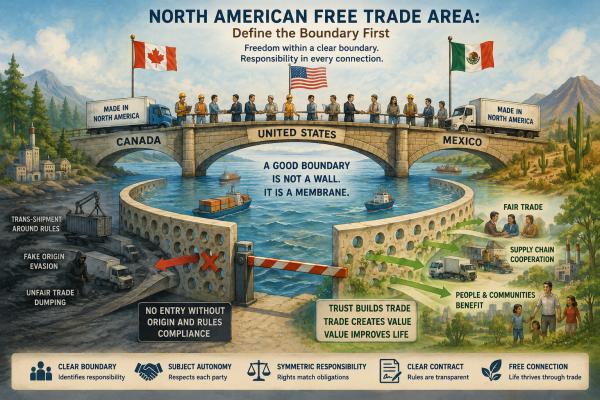
一、“北美”首先是一个契约边界 今天所谓USMCA,即《美国—墨西哥—加拿大协定》(United States–Mexico–Canada Agreement),是1994年NAFTA的继承者。严格说,它是一项三方自由贸易协定;我们日常说“北美自由贸易区”,指的就是由美、加、墨三方缔约关系形成的制度性自由贸易边界。这里的“北美”不是一个无限扩展的地理修辞,而是三个缔约方:美国、加拿大、墨西哥。 所谓北美自由贸易区,说到底是一份三方契约:我们三家降低彼此交易成本,符合规则的本区域产品享受优惠待遇,成员承担相应义务;非成员仍然可以与我们贸易,但不能自动享受只有成员才有的优惠。你我三个人开一家会员俱乐部,约定会员之间免门票;第四个人当然可以来,但如果第四个人说“既然你们三个人自由进出,我为什么不能从后门进来,也不买票”,那就不是自由,而是在取消契约。 自由从来不等于没有边界。真正能够长期存在的自由,恰恰需要清楚边界。 二、原产地规则,就是自由贸易区的“细胞膜” 这也是为什么USMCA谈判中“原产地规则”(Rules of Origin)如此重要。现有汽车规则已经要求相当比例的汽车价值来自北美,目的之一,就是保证优惠待遇主要给予真正使用北美零部件和材料的生产者。2026年美国与墨西哥的USMCA审议谈判也反复讨论加强北美供应链、强化原产地规则,以及如何处理来自非缔约方(non-Parties)的搭便车(free-riding)。 钢铁“熔炼与浇筑”(melted and poured / melted and cast)规则也应放在这个背景中理解。北美钢铁产业确实公开要求把“必须在北美熔炼和浇筑”写进更严格的USMCA原产地规则;但就目前公开资料而言,不能简单说墨西哥已经无条件接受了一条覆盖所有钢铁产品的最终统一规则。能够确认的是,美墨双方愿意继续强化原产地规则、北美制造和经济安全,并明确提出堵住非成员搭便车的漏洞。这个区别很重要,因为谈贸易,第一件事就是把事实与立场分开。 三、为什么“洗产地”不能睁一只眼闭一只眼? 假设一吨来自自由贸易区以外的钢进入加拿大,只做一点简单加工,变成螺丝、构件或某种汽车部件,然后一转身说“我是加拿大产品了”,再利用美加墨自由贸易优惠进入美国。如果任何产品都可以这样操作,墨西哥企业为什么还要按照北美规则投资?加拿大真正炼钢的企业为什么还要承担更高成本?美国企业为什么还要遵守原产地要求?更根本的是:为什么还要有北美自由贸易区? 如果谁都可以借一个成员国完成最简单的最后加工,就自动获得成员待遇,那么所谓“北美自由贸易区”实际上变成了“全球自由贸易区,却只让美、加、墨承担会员责任”。这显然说不通。防止转运、洗产地和规避原产地规则,原则上不是反自由贸易,恰恰是在保护自由贸易。 好的边界不是墙,是膜。 生命细胞有膜。膜不是为了拒绝一切交换,而是让有益的东西进入,让废物出去,辨认自己与外界,同时维持交换。贸易边界也一样:它不该成为阻断正常交易的墙,却必须能够辨认成员、来源、责任和欺诈。我越来越觉得,这比抽象争论“开放还是保护”更接近贸易问题的实相。 四、加拿大当然有理由坚持自己的利益 讲清边界,并不能顺手得出另一个过于简单的结论:美国提出什么,加拿大都应该接受。当然不是。自由贸易区有三个主体,主体之所以能够交互,首先因为主体有边界。加拿大有权保护自己的产业,墨西哥有权保护自己的就业,美国同样有权要求改善它认为导致产业流失的制度安排。真正的问题从来不是“谁应该服从谁”,而是哪条规则真正与三方共同建立的自由贸易区相契合。 美国提出越来越高的美国本土含量要求,也可能走过头。目前USMCA汽车规则强调北美区域价值,而如果进一步把“北美含量”简单变成“美国含量”,不仅墨西哥会反对,美国汽车企业本身也会担心规则过度复杂、成本上升。 “堵住第三国搭便车”与“把三国自由贸易区变成美国制造附属区”是两件不同的事情。前者维护三方边界,后者可能破坏三方主体的权责对称。美国也必须接受同一把尺子。 五、一瓶美国酒,为什么让我重新想这场贸易战? 8月17日,我正好想买一瓶美国白酒泡药,去了Richmond一家很大的酒类专卖店。货架上转了一圈,没有;店员陪我找了一圈,也没有。我去问收银员:“美国酒是不是恢复上架了?”她说:“我们没有收到通知。”我问:“下架大半年了吧?”她回答:“哪止半年,一年多了。” 这当然只是我在Richmond遇到的一个生活片段,不能拿一家商店证明整个加拿大的政策执行情况。加拿大酒类销售又有很强的省级权限,即使联邦层面释放恢复销售的信号,是否以及何时真正回到货架,也不完全由总理一句话决定。 但是,那一排没有美国酒的货架还是让我觉得很有意思,因为它把“国际贸易”从电视里的总统、总理和谈判代表,重新变回了生活。贸易最终是什么?是一瓶酒、一袋牛奶、一个汽车零件、一吨钢、一个农场的订单、一个工人的岗位、一家小公司的现金流。最后都是人的生活。 六、加拿大更需要算账,而不是只讲姿态 加拿大尤其应该算这笔账。按2025年的加拿大官方统计口径,美国仍吸收加拿大七成以上的商品出口;加拿大对美贸易保持显著顺差,而对美国以外市场总体上仍存在较大商品贸易逆差。具体比例随统计口径会有差异,但基本事实没有变化:美国不是加拿大一个普通客户,而是加拿大压倒性最大的出口市场。 这当然不意味着加拿大不能贸易多元化。应该多元化,也应该增加对欧洲、亚洲和其他地区的贸易。但多元化是一种新增连接,不应该被变成切断最大既有连接的政治口号。一个企业不会因为希望开发第二大客户,就主动得罪占自己七成营业额的第一大客户。国家比企业复杂得多,但基本算术不会因为升格为国家政治就失效。 七、民族情绪什么时候开始伤害国家利益? 贸易谈判当然会有冲突。谈判本来就是你开价、我还价,你保护这里、我要求那里,今天谈崩、明天再谈。真正危险的是把交易争议重新包装成民族忠诚。一旦社会开始流行“让步就是下跪”“坚持就是爱国”“妥协就是软弱”“对方就是狼”,一个非常现实的贸易谈判就会进入另一个世界:酒不再是酒,牛奶不再是牛奶,钢不再是钢,它们开始代表尊严。 这时政治领导人反而最难转弯,因为昨天亲手点燃的民族情绪,今天会反过来绑住谈判者。我把这种现象称为“主权挟持”(Sovereignty Capture):政治组织的操纵者借助国家、民族、尊严和外部威胁,把自己的党派收益、选举收益和政治形象包装成国家利益。 问题还会进一步恶化。普通消费者本来愿意买美国酒,加拿大企业本来愿意卖产品到美国,美国公司本来需要加拿大原材料,他们之间已经形成生活和市场的自组织连接。政治组织制造摩擦以后,却要求这些人为了“国家尊严”承担成本,于是,生命开始为组织制造的敌意买单。 八、自由贸易最怕的不是“边界”,而是没有责任的边界 所以,美加墨接下来到底应该怎样谈?并没有那么玄。先恢复三个常识:北美自由贸易区有边界,边界之内有自由,自由之中有责任。美国不能要求所有好处归美国;加拿大不能一边享受北美自由贸易区的成员优惠,一边对明显的第三国借道、转运和原产地漏洞长期睁一只眼闭一只眼;墨西哥也一样。 非成员当然可以进入北美市场。中国、日本、德国、韩国,全世界都可以。但北美自由贸易区不是“北美—中国自由贸易区”,也不是“北美—日本自由贸易区”。中国商品进入加拿大,按加中贸易规则来;日本商品进入墨西哥,按墨日规则来;如果要享受USMCA成员优惠,就必须达到USMCA约定的北美原产地条件。否则,“会员”这个概念本身就失去了意义。 这不是排外,这是契约。 九、2026年真正要审议的,不只是USMCA 严格地说,2026年发生的并不是简单“USMCA到期续约”。按协定的联合审议机制,三国可以在六年审议时共同确认延长协定期限;如果没有共同确认,USMCA并不会立即消失,而会进入后续年度审议和持续修改压力之中。因此,把它通俗地说成“续约谈判”可以理解,但制度上更准确的说法是“联合审议(Joint Review)及延长期限的确认”。 从这个角度看,美国的基本态度并不难理解:原来的价格不接受了,要重新算账。我2月写给卡尼总理的信中曾说,战后几十年形成的很多安排逐渐产生一种不必真实面对成本的制度幻觉;今天的问题不是简单破坏秩序,而是旧秩序已经无法按原来的价格继续运行。 但是,“重新定价”也绝不是美国单方面开价。真正可持续的重新定价只能是三方把账摊开:谁得到什么,谁承担什么,哪些规则已经过时,哪些漏洞必须堵,哪些美国要求越过了边界,哪些加拿大保护形成了歧视,哪些墨西哥安排需要改变。然后重新承兑。这才是契约。 十、从自由贸易回到共生 从共生经济学(Symbionomics)的角度看,自由贸易最终并不是把关税降到零这么简单,它的价值在于降低生命连接成本。一个加拿大农场、一家墨西哥工厂、一间美国零售店,本来彼此不知道;贸易把他们连接起来,价格传递信息,契约分配责任,原产地辨认边界,法律处理违约,基础设施降低摩擦。这才是贸易秩序真正发生的地方。 因此,我愿意把自由贸易放回一个更大的概念中理解:生命自组织连接权(Right of Life to Self-Organizing Connectivity)。生命主体应该能够自由寻找有价值的连接,国家组织则承担受托责任:保护这种连接、辨认欺诈、维护边界、降低成本、处理外部性。国家不应该为了自己的政治利益无端阻断健康连接,同样,所谓自由也不能要求国家对欺诈、倾销、洗产地和搭便车视而不见。 共生秩序真正需要的不是“无边界”,而是:边界明确,主体自主,责任对称,契约清楚,连接自由。 这也正是交互主体共生(Intersubjective Symbiosism)的常识基础。主体没有了,共生便无从发生;边界没有了,责任便无从辨认;只有边界,没有连接,则只剩孤立和敌意。好的边界像细胞膜:它保护生命,也帮助生命交换。 北美自由贸易区当然应该继续,但它应该继续得更真实。美国不必把加拿大变成美国,加拿大也不必靠反美证明自己是加拿大,墨西哥无需在两者之间选边。三国真正需要回答的只有一个问题:怎样让美国人、加拿大人和墨西哥人的正常连接,比政治组织制造摩擦的能力更强?如果这一点能够做到,USMCA叫什么、条款改多少,都还只是技术问题;如果这一点做不到,再漂亮的自由贸易协定,也只是另一只漏水的篮子。 North American Free Trade: Define the “Boundary” First —The 2026 USMCA Review, U.S.–Canada–Mexico Trade Disputes, and a Basic Principle of Free Trade Archer Hong Qian Abstract (about 200 words) This essay begins with the breakdown of the 2026 U.S.–Canada trade talks and returns to a basic principle often obscured by political emotion: freedom can endure only within a recognizable contractual boundary. The USMCA is first of all an institutional arrangement among the United States, Canada, and Mexico, in which rights and responsibilities are shared. Rules of origin and safeguards against transshipment and origin laundering therefore protect the boundary of free trade; yet Washington must not quietly turn “North American content” into “U.S. content.” Drawing on the disappearance of American liquor from Canadian shelves, Canada’s dependence on the U.S. market, and nationalist political mobilization, the essay introduces “Sovereignty Capture”: the process by which political operators package partisan interests, electoral gains, or political image as the national interest, thereby obstructing self-organizing connections already formed by people and markets. From the perspective of Symbionomics, free trade is ultimately an institutional means of reducing the cost of human and economic connection. The essay therefore advances the Right of Life to Self-Organizing Connectivity. A sustainable North American free-trade order requires clear boundaries, autonomous participants, reciprocal responsibilities, explicit contracts, and freedom to connect. The 2026 U.S.–Canada trade talks have broken down again. On August 21, the United States began imposing a new 50 percent tariff on roughly US$20 billion worth of Canadian goods. Only days earlier, both sides had said an agreement was close, and Washington had extended the tariff deadline by three days. In the end, automobiles, steel and aluminum, softwood lumber, alcoholic beverages, dairy products, and several last-stage conditions remained unresolved. Canada suspended the talks and announced countermeasures. The United States said Canada had failed to address longstanding trade problems; Canada said the United States changed its conditions at the last moment. Listening to the two press conferences, it is easy to believe whichever side one happens to hear. I would rather step away from the emotion for a moment and ask a simpler question: What exactly are we negotiating? We are talking about free trade among the United States, Canada, and Mexico. There are two key words here: “free” and “North American.” Many people emphasize the first and forget the second. Without the boundary called “North America,” free trade itself has nowhere to occur. 1. “North America” Is First a Contractual Boundary What we now call the USMCA—the United States–Mexico–Canada Agreement—is the successor to the 1994 NAFTA. Strictly speaking, it is a trilateral free-trade agreement. What we commonly call the “North American free-trade area” is the institutional boundary of free trade created by the contractual relationship among the United States, Canada, and Mexico. “North America” here is not an indefinitely expandable geographical expression. It identifies three contracting parties: the United States, Canada, and Mexico. At bottom, the North American free-trade area is a three-party contract: the three parties lower transaction costs among themselves; qualifying regional products receive preferential treatment; and members assume corresponding obligations. Non-members remain free to trade with us, but they do not automatically receive benefits reserved for members. Imagine three people forming a club and agreeing that members enter without paying admission. A fourth person is certainly welcome to come. But if that fourth person says, “Since the three of you can enter freely, why can’t I come in through the back door without buying a ticket?” that is no longer freedom. It is the cancellation of the contract. Freedom has never meant the absence of boundaries. Freedom that can endure requires clear boundaries. 2. Rules of Origin Are the “Cell Membrane” of a Free-Trade Area This is why Rules of Origin matter so much in the USMCA. Existing automotive rules already require a substantial share of vehicle value to originate in North America. One purpose is to ensure that preferential treatment primarily benefits producers genuinely using North American parts and materials. The 2026 U.S.–Mexico USMCA review discussions have likewise repeatedly addressed stronger North American supply chains, tighter rules of origin, and ways to deal with free-riding by non-Parties. The proposed steel requirement that products be “melted and poured” or “melted and cast” in North America should be understood in this context. North American steel producers have indeed publicly called for stricter USMCA rules requiring steel to be melted and poured in North America. Yet, on the public record presently available, it would be too simple to say that Mexico has unconditionally accepted one final, uniform rule covering all steel products. What can be said is that the United States and Mexico have shown willingness to strengthen rules of origin, North American production, and economic security, while explicitly addressing loopholes that permit non-members to free-ride. The distinction matters. In trade, facts must be separated from positions before anything else. 3. Why Can’t We Turn a Blind Eye to “Origin Laundering”? Suppose a ton of steel from outside the free-trade area enters Canada, undergoes only minor processing into screws, structural components, or an automotive part, and then declares, “Now I am a Canadian product,” before entering the United States under North American trade preferences. If any product could obtain member treatment in this way, why should Mexican firms invest under North American rules? Why should Canadian steelmakers that actually produce steel bear higher costs? Why should U.S. firms comply with origin requirements? More fundamentally, why have a North American free-trade area at all? If a product can pass through one member country, receive the simplest final processing, and automatically obtain member treatment, the “North American free-trade area” effectively becomes a global free-trade area in which only the United States, Canada, and Mexico bear membership responsibilities. That makes no sense. Preventing transshipment, origin laundering, and circumvention of origin rules is not, in principle, anti-free-trade. It protects free trade. A good boundary is not a wall. It is a membrane. Living cells have membranes. A membrane does not reject all exchange. It lets beneficial things enter, allows waste to leave, distinguishes self from environment, and sustains exchange at the same time. Trade boundaries should work in much the same way. They should not become walls blocking normal exchange, but they must be capable of identifying membership, origin, responsibility, and fraud. Increasingly, I find this closer to the reality of trade than the abstract opposition between “openness” and “protection.” 4. Canada Certainly Has Reasons to Defend Its Own Interests Clarifying the boundary does not lead to another simplistic conclusion: that Canada should accept whatever the United States proposes. Of course not. A free-trade area has three subjects. Subjects can interact precisely because each has boundaries. Canada has the right to protect its industries. Mexico has the right to protect its employment. The United States likewise has the right to seek changes to arrangements it believes have contributed to industrial losses. The real question has never been “Who should submit to whom?” It is: Which rules genuinely fit the free-trade area the three parties established together? U.S. demands for ever-higher domestic U.S. content can also go too far. Current USMCA automotive rules emphasize North American regional value. If “North American content” is further converted into “U.S. content,” Mexico will object, and U.S. automakers themselves may worry that excessive complexity will raise costs. “Closing the door on third-country free-riding” and “turning a three-country free-trade area into an appendage of U.S. manufacturing” are two different things. The former protects the trilateral boundary; the latter may undermine reciprocity among the three participants. The United States must be measured by the same standard. 5. Why Did a Bottle of American Liquor Make Me Rethink This Trade War? On August 17, I happened to want a bottle of American liquor to make a medicinal infusion, so I went to a large liquor store in Richmond. I walked around the shelves—nothing. An employee helped me look—still nothing. I asked the cashier, “Has American liquor been put back on the shelves?” She replied, “We haven’t received any notice.” I asked, “It’s been off the shelves for more than half a year, right?” She answered, “More than half a year? It’s been over a year.” This was only one small episode I encountered in Richmond; one store cannot prove how policy is being implemented across Canada. Alcohol retailing is also heavily shaped by provincial authority. Even if the federal government signals that American liquor should return, whether and when it actually reappears on shelves is not determined by a single sentence from the prime minister. Still, that row of shelves without American liquor struck me. It brought “international trade” down from presidents, prime ministers, and negotiators on television and returned it to everyday life. What is trade in the end? A bottle of liquor. A bag of milk. An auto part. A ton of steel. An order for a farm. A worker’s job. The cash flow of a small business. In the end, it is all human life. 6. Canada Needs to Do the Arithmetic, Not Merely Strike a Pose Canada, in particular, needs to do the arithmetic. By Canadian official statistics for 2025, the United States still absorbed more than 70 percent of Canada’s merchandise exports. Canada maintained a substantial merchandise trade surplus with the United States, while recording a large overall merchandise trade deficit with markets outside the United States. The exact percentages vary with statistical methodology, but the basic fact does not: the United States is not simply one ordinary Canadian customer. It is overwhelmingly Canada’s largest export market. None of this means Canada should not diversify its trade. It should, and it should expand trade with Europe, Asia, and other regions. But diversification is an addition of new connections; it should not become a political slogan for severing the largest existing connection. A business does not deliberately alienate the customer responsible for more than 70 percent of its sales simply because it hopes to develop a second major customer. A country is vastly more complicated than a company, but basic arithmetic does not cease to apply when it enters national politics. 7. When Does Nationalist Emotion Begin to Harm the National Interest? Trade negotiations naturally involve conflict. Negotiation means: you make an offer, I counter; you protect something here, I ask for something there; talks break down today and resume tomorrow. The real danger begins when a transactional dispute is repackaged as a test of national loyalty. Once a society starts repeating “Concession is kneeling,” “Standing firm is patriotism,” “Compromise is weakness,” or “The other side is a wolf,” an ordinary trade negotiation enters a different world. Liquor is no longer liquor. Milk is no longer milk. Steel is no longer steel. They become symbols of dignity. At that point political leaders themselves find it harder to turn, because the nationalist emotion they ignited yesterday can bind the negotiator today. I call this phenomenon Sovereignty Capture: political operators use the language of nation, nationality, dignity, and external threat to package partisan gains, electoral gains, and political image as the national interest. The problem can then deepen. Ordinary consumers may want to buy American liquor. Canadian firms may want to sell into the United States. U.S. companies may need Canadian raw materials. These people and firms have already formed self-organizing connections through life and markets. When political organizations manufacture friction and then demand that people bear its costs in the name of “national dignity,” life begins paying for hostility manufactured by organizations. 8. What Free Trade Fears Most Is Not a Boundary, but a Boundary Without Responsibility So how should the United States, Canada, and Mexico proceed? It need not be mysterious. Restore three pieces of common sense: the North American free-trade area has a boundary; within the boundary there is freedom; within freedom there is responsibility. The United States cannot demand that every benefit accrue to itself. Canada cannot enjoy the privileges of North American membership while indefinitely turning a blind eye to obvious third-country routing, transshipment, and loopholes in origin rules. Mexico is subject to the same principle. Non-members are certainly free to enter North American markets. China can. Japan can. Germany can. South Korea can. The whole world can. But the North American free-trade area is not a “North America–China Free Trade Area,” nor a “North America–Japan Free Trade Area.” Chinese goods entering Canada are governed by Canada–China trade rules; Japanese goods entering Mexico are governed by Mexico–Japan rules. If such goods are to receive USMCA member preferences, they must satisfy the North American origin conditions agreed under the USMCA. Otherwise the very idea of “membership” loses meaning. This is not exclusion. It is contract. 9. What Is Really Under Review in 2026 Is More Than the USMCA Strictly speaking, what is happening in 2026 is not simply an “expiration and renewal” of the USMCA. Under the Agreement’s joint-review mechanism, the three countries can jointly confirm an extension of the term at the six-year review. If they do not jointly confirm it, the USMCA does not immediately disappear; instead, it moves into subsequent annual reviews and continuing pressure for modification. Calling the process a “renewal negotiation” is understandable in ordinary speech, but institutionally the more accurate description is a Joint Review and confirmation of an extension. Seen this way, the basic U.S. position is not difficult to understand: the old price is no longer acceptable; the accounts must be recalculated. In a letter I wrote to Prime Minister Mark Carney in February, I argued that many arrangements built over the postwar decades gradually produced an institutional illusion that costs need not be faced in full. The problem today is not simply that an order is being destroyed; the old order can no longer continue at the old price. But “repricing” cannot mean that the United States alone sets the price. Sustainable repricing requires all three parties to put the accounts on the table: Who receives what? Who bears what? Which rules are obsolete? Which loopholes must be closed? Which U.S. demands cross the boundary? Which Canadian protections have become discriminatory? Which Mexican arrangements need to change? Then the parties must fulfill and re-affirm their commitments. That is what a contract means. 10. From Free Trade Back to Symbiosis From the perspective of Symbionomics, free trade ultimately means more than reducing tariffs to zero. Its value lies in lowering the cost of connection among living subjects. A Canadian farm, a Mexican factory, and an American retailer may initially know nothing about one another. Trade connects them. Prices transmit information. Contracts allocate responsibility. Rules of origin identify boundaries. Law addresses breaches. Infrastructure reduces friction. This is where trade order actually occurs. I therefore place free trade within a larger concept: the Right of Life to Self-Organizing Connectivity. Living subjects should be free to seek valuable connections. Political organizations, as trustees, bear corresponding responsibilities: protect those connections, identify fraud, maintain boundaries, lower costs, and address externalities. The state should not arbitrarily obstruct healthy connections for its own political interests. By the same token, “freedom” cannot require the state to ignore fraud, dumping, origin laundering, or free-riding. A symbiotic order does not require “no boundaries.” It requires clear boundaries, autonomous participants, reciprocal responsibilities, explicit contracts, and freedom to connect. This is also the common-sense foundation of Intersubjective Symbiosism. Without subjects, symbiosis cannot occur. Without boundaries, responsibility cannot be identified. With boundaries but no connection, only isolation and hostility remain. A good boundary is like a cell membrane: it protects life and enables exchange. The North American free-trade area should certainly continue, but it should continue on a more truthful footing. The United States does not need to turn Canada into America. Canada does not need to prove that it is Canada by opposing America. Mexico need not choose sides between them. The three countries need only answer one simple question: How can the normal connections among Americans, Canadians, and Mexicans become stronger than the capacity of political organizations to manufacture friction? If that can be achieved, what the USMCA is called and how many clauses are amended remain technical questions. If it cannot, even the most elegant free-trade agreement will be just another leaking basket.
|