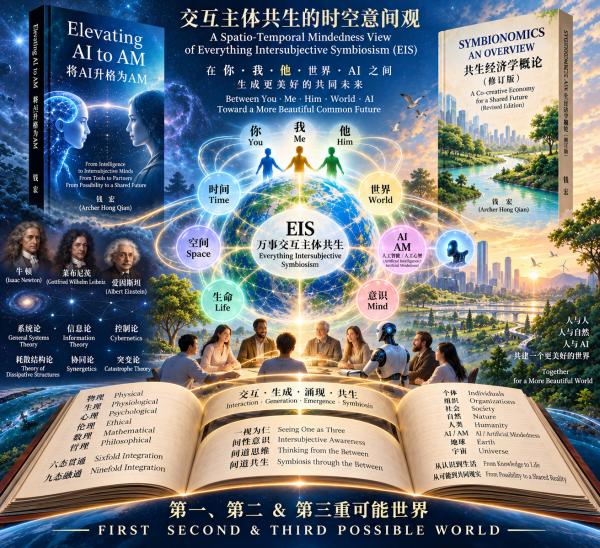
交互主体共生的时空意间观 A Spatio-Temporal Mindedness View of Intersubjective Symbiosism 钱 宏(Archer Hong Qian) 内容摘要 人类认识世界的历史,也是一部不断改变“我们怎样与世界相处”的历史。轴心时代(Axial Age)以来,主体意识逐渐觉醒;近代科学又凭借对象化、测量化和可验证的方法,建立了前所未有的知识大厦。牛顿(Isaac Newton)使运动进入可计算的绝对时空,莱布尼茨(Gottfried Wilhelm Leibniz)把关系带入时空理解,爱因斯坦(Albert Einstein)进一步揭示时空、观察与物质—能量之间的动态关联。20世纪中后期,系统论(General Systems Theory)、信息论(Information Theory)、控制论(Cybernetics)以及耗散结构(Dissipative Structures)论(Theory of Dissipative Structures)、协同论(Synergetics)、突变论(Catastrophe Theory),则把人类认识从孤立对象继续推向整体、信息、反馈、开放、自组织、协同与跃迁。本文沿着这一思想脉络继续追问:如果世界不仅存在“事物之间的关系”,而且主体与主体之间的交互本身能够生成(Generation)新的理解、新的价值和新的现实,我们应当怎样重新理解时间、空间与 Mind? 本文以“万事交互主体共生(Everything Intersubjective Symbiosism,EIS)”为哲学底盘,提出“时空意间观”(Spatio-Temporal Mindedness View)。“间”不是两个实体之间剩余的空隙,而是主体保持自身又彼此敞开,在连接、交互、契合中生成(Generation)第三种可能的关系之域。由此形成一条由认识走向生活的思想链:间性意识(Intersubjective Awareness)—间道思维(Thinking through the Intersubjective JIAN)(Thinking from the Between)—一视为仨(Seeing One as Three)(Seeing Three-in-Relation)—间道共生(Symbiosis through the Intersubjective JIAN)(Symbiosis through the Between)。时间因记忆、承诺与未来责任而呈现时间间性;空间因连接、共在与价值交换而呈现空间间性;Mind 进入 Intersubjective Minds,在“心智之间”呈现意间性(Inter-minds)。老三论与新三论由此不被抛弃,而成为通向 EIS 的知识阶梯:有升华,才有升格。最终,时空意间观在人工智能(Artificial Intelligence, AI)时代落实为 LIFE—AI→AM—TRUST:生命是发生原点,AI是生命创造并进入生活的智能技术,AM意味着智能进入 Intersubjective Minds 的交互关系,TRUST则使这种关系获得托付、责任、价值承兑与持续生成的组织基础。
导论 从轴心时代(Axial Age)的星空,到人工智能时代的“之间” 在这场关于存在的漫长叙事中,我们不妨先把目光拉回那个被称作“轴心时代”的破晓时分。那时,中国、印度、希腊和古代以色列等文明中的先哲,以不同语言、符号和信仰追问天地、人心、秩序与终极意义。人开始从自然的浑然一体中醒来,反观自身,也开始把世界放到面前加以辨认。 这种主体意识的觉醒,是文明的一次巨大进步。没有把对象从混沌经验中分辨出来,就不会有后来严格的逻辑、科学、法律和制度。但任何一种有效的认识方式,一旦被扩张为唯一的世界观,也可能遮蔽它原本看不见的部分。主体越来越清楚,世界也越来越容易被放到主体对面,成为可以分类、测量、利用和控制的“客体”。 到了近代,这种对象化能力与科学方法结合,释放出惊人的创造力。人类测量天体、拆解物质、制造机器、组织工厂,也逐渐学会用同样的方式安排时间、空间和人的活动。时间成为工时,空间成为厂房与疆界,人进入岗位,组织形成层级。契约与制度为陌生人合作提供了可靠边界,却也容易在高度工具化的环境里退化为“如何防范对方”的技术。 今天,我们享受着这条文明道路带来的巨大成果,也同时面对它积累的张力:生态失衡、组织信任流失、人与人意义连接的削弱,以及人工智能快速进入生活以后产生的主体性焦虑。AI究竟是工具、伙伴、竞争者,还是未来的统治者?这种非此即彼的追问本身,已经暴露出我们仍习惯把世界切成两个彼此对立的存在。 也许真正需要重新发现的,正是长期被我们忽略的“之间”。你与我之间,人与自然之间,生命与组织之间,Mind 与 Mind 之间,今天与未来之间,LIFE 与 AI 之间——这些“间”并不是空白。许多最重要的东西恰恰发生在那里:理解、误解、爱、冲突、承诺、信任、价值、创造以及新的生命可能。 “万事交互主体共生(Everything Intersubjective Symbiosism,EIS)”由此不是从天而降的结论。它沿着人类已经走过的认识道路继续向前:从客体到关系,从关系到系统,从系统到开放和自组织,再从关系系统进入交互主体的生成。要理解“时空意间观”,我们先要把这条来路走一遍。 这篇文章也因此具有一种承前启后的性质。《将AI升格为AM》与《共生经济学概论(修订版)》(Symbionomics: An Overview, Revised Edition)已经分别从人工智能文明方向与经济—组织生活的角度展开了相关问题;本文不是回头改写已经定稿的两本书,而是从其中已经形成的思想继续导出,把“间”、EIS、时空意间、诸態贯通与AI→AM之间的关系说得更明晰。反过来,这些进一步澄明的认识,也将成为未来两书再修订时可以重新导入的思想准备。思想先发生,新的创造才有可能发生。 一、从绝对时空到关系时空、相对时空:世界不再只是一个容器 1. 牛顿:尺度、秩序与可计算的世界 牛顿经典力学(Newtonian Classical Mechanics)(Classical Mechanics)为近代科学提供了极其强大的时空框架。绝对空间(Absolute Space)可以被理解为独立、均匀的背景,绝对时间(Absolute Time)则不依赖具体事物而均匀流逝。这一框架最伟大的贡献,是让运动可以被统一描述,让不同地点、不同物体的变化进入同一套可测量秩序。现代科学和工业文明由此获得了共同的尺度语言。 如果把这种认识方式作为一种文明隐喻,我们很容易理解工业时代为什么偏爱标准工时、流水线、科层等级和可替换零件。这里并不是说牛顿物理学造成了泰勒制(Taylorism)或官僚制(Bureaucracy),而是说:当“可测量”从科学方法扩张为组织哲学,生命便容易被压缩为指标,时间被压缩为成本,信任也可能被压缩为风险控制。钟表能够精确计时,却不能告诉我们一段共同生活为什么值得。 2. 莱布尼茨:关系开始进入时空 莱布尼茨反对把时间和空间看成脱离事物而独立存在的实体。他把空间理解为共存的秩序,把时间理解为相继的秩序。这是一个重要转折:世界不再只是把物体摆放在一个外部容器里,事物之间的关系开始参与时空本身的理解。 然而,莱布尼茨的单子论(Monadology)也留下了一个意味深长的问题:单子“没有窗户”,各自完整,却不能直接彼此作用,整体协调最终诉诸预定和谐(Pre-established Harmony)。从今天回看,这仿佛提醒我们:承认个体和关系还不够。真正困难的问题是——主体怎样打开窗户?主体进入关系以后,能否彼此改变,又能否共同生成原先并不存在的第三种现实? 3. 爱因斯坦:时空从背景进入动态关联 爱因斯坦相对论(Theory of Relativity)进一步改变了人类的时空直觉。时间和空间不再彼此独立,观察状态、运动以及质量—能量与时空结构之间形成深刻联系。时空由静态背景进入动态关联,人类对于“绝对”的直觉被再次打开。 但相对论(Theory of Relativity)是一套物理理论,它没有义务回答价值、意义、信任和 Mind 的问题。时空意间观也不是要以哲学替代物理学。我们只是沿着“关系已经进入时空”的方向继续追问:当观察者不只是物理测量者,而是具有记忆、意向、责任与创造力的生命主体时,时间和空间在人与人、Mind 与 Mind、生命与技术之间又怎样发生? 4. 从三种时空认识,走到20世纪的系统科学 牛顿给了我们尺度,莱布尼茨让关系进入视野,爱因斯坦让时空本身进入动态关联。可是,对生命与社会而言,仅仅知道“万物相互联系”仍然太宽泛。联系如何形成整体?差异怎样传递?系统怎样根据变化自我修正?20世纪中叶以后,系统论、信息论和控制论开始集中回答这些问题。 二、老三论:从孤立对象走向系统、信息与反馈 对于经历过20世纪80年代中国思想启蒙的一代人来说,“老三论”并不陌生。系统论、信息论、控制论曾经带来一种强烈的新鲜感:看问题不能只看一个点,必须看整体;不能只看物质,还要看信息;不能只看命令,还要看反馈。它们共同松动了简单机械论,却仍主要以“系统及其组成部分”为分析对象。从 EIS 看来,这三种理论已经走到“间”的门口。 1. 系统论:整体大于部分之和,然后呢? 一般系统论(General System Theory)反对把复杂整体简单还原为零件之和,强调结构、层次、边界以及组成部分之间的相互联系。这一步使生态、组织、生命等复杂现象能够作为整体来理解。问题在于,“系统”一旦被实体化和目的化,也可能产生新的遮蔽:人不再是机器的零件,却可能成为“系统的零件”;个体的感受、尊严和创造力仍然可以被“整体利益”轻易压过去。 EIS 对系统论的升华,是把组成部分重新看作具有自身边界和生成能力的主体。整体不再是一只罩在个体之上的大盒子,而是在主体之间持续发生。你改变我,我也改变你;更重要的是,我们的交互还可能生成新的规则、新的理解和新的价值。系统于是从“整体—部分”结构,进一步成为交互主体不断编织的关系之网。 2. 信息论:比特(bit)能够传递,意义怎样发生? 香农(Claude E. Shannon)(Claude Shannon)信息论精确处理通信中的不确定性、编码、信道与噪声问题。它的科学力量恰恰来自严格限定:它并不负责回答信息的意义。但当信息论进入社会语言以后,人们很容易把“传递成功”误认为“理解成功”。今天的数据社会和AI时代,更容易把数据量、信息量与认知质量混在一起。 EIS 把问题从“信息有没有送达”继续推进到“主体之间有没有发生理解”。信号被接收,还只是信息过程;信息进入生命经验,才可能成为意义;意义在主体之间被理解、回应并通过行动承兑,才可能沉淀为信任。若借用“孞”所包含的身心托付意涵,我们甚至可以把这种进入身心关系并得到回应的信息称为“孞息(Trust-Embodied Information)”:它不是取代 Information 的新物理量,而是提醒我们,信息一旦进入生命世界,就要面对意义与责任。 3. 控制论:反馈使系统会修正,但谁规定目标? 维纳(Norbert Wiener)控制论把反馈机制(Feedback Mechanism)带入机器、生命和组织研究。一个系统根据输出结果修正行为,不再只是接受单向命令。这是从机械控制走向动态调节的重要一步。但反馈仍然可以围绕一个预设目标运行:目标由谁决定?被调节者能否改变目标?当环境变化时,目标本身是否也应被重新讨论? EIS 在这里把反馈推进为主体之间的相互感应、相互修正和共同生成。可以借爵士乐作一个直观比喻:两个乐手即兴合奏,A不是控制B,B也不是反过来控制A;他们一边保持自己的声音,一边倾听对方,并在彼此回应中生成一段事先谁都没有完整写下的音乐。A、B,以及在A与B之间发生的C——这已经走到“一视为仨”的门前。 如果说爵士乐让我们听见“间”的生成,那么色彩让我们直接看见它。红、黄、蓝作为三原色,各有自己的性质;不同颜色进入真实混合以后,可以涌现(Emergence)出原先并不存在于任何单一颜色中的新色彩。最日常的经验也一样:蓝色液体与黄色液体相遇、混合,绿色会渐渐显现。绿色不是把“蓝”和“黄”并排摆放,而是在二者关系真正发生以后出现的新性质。 再深一层,就是男女生命的结合。男人与女人作为两个有差异的生命主体,并不会因为彼此靠近就自动产生第三个生命;当精子与卵子真正结合,一个新的生命过程才开始。孩子来自父母,却不是父亲,也不是母亲,更不是二者的机械相加。他/她成为新的主体,并能够继续进入自己的关系、生活与创造。即使借助辅助生殖技术,生命的这一基本事实也没有改变:新的生命仍然发生于两套生命信息与生殖细胞的结合。 于是,“一视为仨”可以沿着三个层次被直观地理解:爵士乐的交互生成新的作品,色彩的交互涌现(Emergence)新的性质,男女生命的结合生成新的生命主体。这里也需要区分“生成”与“涌现”:生成是关系展开并形成新事物的总体过程;涌现则是这个过程中,当不同于原有要素的新性质、新形态或新事物显现出来的那一刻。生成持续展开,涌现使我们突然看见:第三者已经发生。 因此,老三论不是需要被抛弃的旧理论。系统论让我们看见整体关系,信息论让我们看见差异传递,控制论让我们看见反馈循环。EIS 所要做的,是把“对象之间发生作用”继续升华为“主体之间发生生成”。有升华,才有升格。 三、新三论:从稳定走向开放、自组织、协和与跃迁 如果说老三论更多回答一个系统怎样连接、通信和调节,那么20世纪后半叶被中国知识界习惯称作“新三论”的耗散结构(Dissipative Structure)论、协同论和突变论(Catastrophe Theory),则进一步把问题带向演化:秩序怎样从开放和非平衡中产生?许多部分怎样形成宏观有序?连续变化为什么会在临界处出现形态跃迁?这一步使我们离生命的真实状态更近,因为生命从来不是一块静止的平衡物。 1. 耗散结构:因为非独存,所以必须开放 普利高津(Ilya Prigogine)关于耗散结构的研究表明,开放系统通过与环境交换物质和能量,可以在远离平衡态的条件下形成新的有序结构。这给生命哲学一个重要启示:稳定不等于封闭,秩序也不必来自外部强制。生命恰恰因为不断交换,才得以维持和更新自身。 “生命本自具足,又非独存”与此形成了意味深长的呼应。具足意味着生命不是等待外力组装的零件;非独存意味着生命必须敞开自己,与外界交换并进入关系。EIS 再向前一步:开放不只发生在“系统—环境”之间,也发生在主体—主体之间。真正的敞开不是取消边界,而是在保有自身的同时允许他者进入自己的理解、选择和改变过程。 2. 协同论/协和论(Synergetics / Synergetic Harmony):秩序可以自发形成,但共生不能等于整齐划一 哈肯(Hermann Haken)的协同论研究大量子系统如何在一定条件下形成宏观有序,并以序参数(Order Parameter)描述集体行为。它使我们看到,复杂秩序并不一定需要一个中央指挥者逐项设计。在中文语境中,我也愿意把这里的“协同”进一步理解为“协和”:协同强调一起行动,协和则更能提示差异中的契合。 EIS 对协同论的升华,不是把“共同愿景”变成一个至高无上的序参数(Order Parameter),更不是要求所有主体认知对齐。真正的共生愿景必须允许不同主体保持差异、提出异议、改变关系。协和不是强迫同频,而是在差异中寻找可以共同生成的节律。它更像合奏,而不是齐步走。 3. 突变论:临界变化打开可能,而不是预言必然 托姆(René Thom)的突变论以数学方式描述某些系统如何在连续参数变化中出现不连续的形态改变。它提醒我们,世界并不总是线性演进,积累到临界处可能出现结构跃迁。这一思想后来被广泛借用来解释社会和文明变化,但借用必须保持边界:数学上的突变并不能证明某一种文明未来必然到来。 EIS 更关心的是“关系跃迁”的可能。当主体之间的连接方式发生变化,原有关系可能断裂,也可能生成新的组织形态。跃迁既可能带来新生,也可能造成伤害;它打开可能世界,却不替我们保证结果。这一点非常重要,因为交互主体共生所面对的未来应当是开放的,而不是被理论预先规定的。 4. 从新老三论到 EIS:一条没有断裂的认识阶梯 现在再回看,我们便能看到一条比较清楚的思想阶梯:牛顿让世界可测量,莱布尼茨让关系进入时空,爱因斯坦让时空进入动态关联;老三论让我们看见系统、信息和反馈,新三论让我们看见开放、自组织、协和与跃迁。EIS 并不宣布这一切“失效”,而是继续追问一个此前没有被充分放到中心的问题:在这些关系、反馈、开放和涌现之中,主体在哪里?主体之间的交互又怎样生成第三种可能? 这就是“升华”与“升格”的关系。没有对既有知识的理解和吸收,所谓升格只会成为换名;只有既看见旧理论解决了什么,又看见它没有负责解决什么,新的认识才可能自然发生。 四、间性意识(Intersubjective Awareness)与间道思维:从“一分为二”走向“一视为仨” 当我们的注意力从“两个东西”移向“两个主体之间发生什么”,一种新的认识能力便开始出现,我把它称为“间性意识”。间性意识并不否认个体,也不取消差异。恰恰相反,只有先承认你是你、我是我,真正的“之间”才有可能发生。 传统的“一分为二”善于辨认差异,这是认识世界不可缺少的能力。问题发生在二分被固化以后:差异很容易滑向非此即彼,关系很容易变成谁压倒谁,最后世界只剩下选择阵营。间性意识则多看一步:在看见甲与乙的同时,也看见甲乙之间正在形成的关系。 当这种意识成为稳定的思维方式,就形成“间道思维”。“间道”不是中间道路,也不是各打五十大板的折中术。“道”在这里是发生之道:主体保持自身,主体又向他者敞开,彼此连接、交互、契合,并允许新的东西从关系中长出来。 这就是“一视为仨”。所谓“仨”,不是在甲和乙旁边机械增加一个丙,而是把甲、乙以及甲乙之间生成的新现实同时看见。父母与孩子是最直观的生命隐喻:两个人的相遇可以生成第三个生命;思想亦然,两个 Mind 真正相遇,也可能生成双方此前都没有的新思想。 由此,“间性意识—间道思维—一视为仨—间道共生”就不再是几句彼此分离的术语。先看见“间”,才会在“间”中思考;能够在“间”中思考,才会发现第三种生成;当这种生成成为持续的生活关系,间道共生才真正发生。 五、时空意间观:时间、空间、Mind 如何从“间”重新发生 走到这里,“时空意间观”就不再是一个突然出现的新名词。它并不是在长、宽、高之外再增加一个神秘维度,也不是把“时间、空间、心智”排成三个互不相干的盒子。它要表达的是:时间有时间之“间”,空间有空间之“间”,Mind 有心智之“间”;而三种间性又在生活中彼此穿透。 1. 时间间性(Inter-temporality):过去和未来都参与今天 钟表时间是一条必要的公共尺度,但生活时间从来不是空刻度。一个人的记忆把过去带进今天,一个组织的信用让过去的履约影响今天的合作,一个承诺则使尚未到来的未来提前进入当下。我们每一次托付,都同时带着过去的经验和未来的期待。 因此,时间间性不是把时间神秘地“折叠”,而是看见过去—当下—未来怎样在主体关系中相互进入。组织孞托(Organizational Trust)尤其如此:昨天的承兑成为今天的信用,今天的选择又决定明天是否还有人愿意继续托付。时间在这里获得了生命与责任的厚度。 2. 空间间性(Inter-spatiality):空间因共在而成为生活 物理空间当然存在,但距离不能穷尽关系的远近。两个相隔万里的人可以因为深度合作而共同创造,两个坐在同一张桌边的人也可能因信任破裂而形同陌路。网络缩短了传输距离,却不会自动创造共生。 空间间性所指的,是主体通过连接、价值交换、责任承担和共同创造撑开的“共在之域”。它既可以发生在一间屋子里,也可以发生在跨国网络中。真正决定空间是否成为生活场域的,不只是位置,而是关系有没有发生。 3. 意间性(Inter-minds):Mind 在 Minds 之间生成 心智尤其如此。Mind 有自己的生命根底,却从来不是封闭在颅骨里的孤岛。语言本身就是 Mind 走向 Mind 的桥梁;思想、爱、知识、信任和创造,都在心智相遇中展开。我用 Inter-minds 来表达“意间性”,强调的正是 Between Minds:不是把不同 Mind 熔成一个集体意识,而是让它们保持自身又彼此映照、质疑、启发和生成。 一个 Mind 遇见另一个 Mind,真正有意义的结果往往不只是“你把你的告诉我,我把我的告诉你”,而是交互以后出现一个此前谁都没有的第三种理解。因此,Intersubjective Minds 不是 Minds 的简单相加,而是 Minds 之间的生成关系。 4. 时—空—意:三间互生 时间改变关系的深度,空间改变连接的条件,Mind 赋予连接以意义;反过来,新的 Mind 交互又会重新解释过去、安排未来、跨越空间。三者不是三块,而是三间互生。时空意间观真正要把握的核心,因此不是“时”“空”“意”三个名词,而是使它们活起来的那个“间”。 六、从学科分割回到生命贯通:万事何以在诸態之间发生 “万事”与“万物”的差别,在这里尤其重要。“物”容易让人想到一个已经在那里、可以被某一门学科截取和研究的对象;“事”则天然包含主体、关系、时间、过程和发生。世界当然有万物,但我们真正生活其中的,是万事。一个人、一棵树、一群人、一片森林,都不能被任何一门学科独占。 现代知识必须分科。物理学有物理学的方法,生物学有生物学的方法,心理学、伦理学、数学、哲学也各有自己的问题边界。分科使知识能够深入,这是文明成就。问题只在于:知识可以分类,现实本身并不按大学院系发生。学科的边界是认识的边界,不是生命的切割线。 一个正在奔跑的人,同时具有质量、速度与能量的物理態(Physical State),有呼吸、循环、代谢和神经活动的生理態(Physiological State),有意愿、情绪、注意与判断的心理態(Psychological State);当他的行动进入人与人的权利、责任和承诺,就展开伦理態(Ethical State);这些过程又可以进入测量、概率、模型与计算的数理態(Mathematical State);而当他追问“我为何奔跑、我为何生活、我与他者究竟是什么关系”,哲理態(Philosophical State)已经在场。现实中并不存在六个被切开的“人”,只有同一个生命事件在诸態之间贯通。 男女相爱、生育尤其能把这一点显示得清楚。身体相遇有物理態(Physical State),精卵结合和生命发育有生理態(Physiological State),愛、欲望、依恋、期待有心理態(Psychological State),承诺、家庭与对子女的责任进入伦理態(Ethical State),遗传概率与生命过程可以进入数理態(Mathematical State),而“生命从哪里来、我与他者是什么关系、新生命意味着什么”又进入哲理態(Philosophical State)。同一件最普通的“事”,已经同时穿过多个知识世界。 因此,时空意间观必然要求超越学科割裂,却不要求取消学科。所谓“打通”,不是把物理、生理、心理、伦理、数理、哲理混成一锅,而是让每一种认识保持自己的尺度,同时看见它们在真实生命事件中如何彼此进入、彼此制约、彼此照亮。分科使我们看得深,贯通使我们不至于把深处误认成全部。 这也是《将AI升格为AM》(Elevating AI to AM)中“九態贯通(Integration across the Nine States)(Integration of the Nine States)”问题在本文中的一个更基础入口。本文不必在这里完整展开九態,只先抓住物理態、生理態、心理態、伦理態、数理態、哲理態这六个最容易理解的层面。读者一旦看见同一生命事件可以跨態发生,就能够进一步理解:AI与AM的问题也绝不能只交给计算机科学。它同时进入身体、心理、伦理、组织、价值、哲学以及更广阔的生活世界。 学科可以分,生命不能分;知识可以分类,万事总在诸態贯通中发生。 七、EIS:万事交互主体共生,从关系走向生成 如果说新老三论使我们越来越清楚地看见关系、开放和自组织,那么 EIS——万事交互主体共生(Everything Intersubjective Symbiosism)——进一步把“生成”放到中心。世界不仅由已经存在的事物构成,也由事物之间正在发生的关系构成;对于生命世界而言,这些关系又不是纯粹外部作用,而是主体与主体之间能够相互感应、相互改变并共同创造的过程。 这里还可以进一步区分“生成”与“涌现”。生成是一个持续过程:主体进入关系,关系改变条件,新的结构逐步形成;涌现则是生成积累到某个节点时,一个此前没有被包含在任何单一要素中的新性质、新形态或新事物突然显现。爵士乐中新的旋律、色彩混合后的新颜色、生命结合后出现的新生命,都让这种差别变得可感。EIS关注生成,也特别关注涌现,因为“间”的创造性往往正是在涌现的一刻被我们看见。 这里需要特别说明,“万事交互主体共生”并不意味着把人、动物、植物、生态系统、机器和AI都宣布为完全同质的主体。主体性有不同层次、不同边界和不同生命根底。EIS真正反对的,是在关系发生之前就把他者预先降格为可以任意支配的纯客体。 “生命本自具足,又非独存”正是EIS的生命原点。具足,使生命能够成为主体;非独存,使主体必然进入连接;连接又不是吞并,而是在动态平衡中不断调整。于是,自组织—连接—动态平衡成为生命展开的一体三面。 这也解释了为什么EIS能够对新老三论形成升华:系统从“整体包含部分”进入“主体之间生成整体”;信息从“传输信号”进入“共享意义并形成孞息”;控制从“反馈纠偏”进入“相互修正甚至共同改变目标”;耗散结构的开放进入主体敞开;协同进入差异中的协和;突变则从结构变化进入关系新生的可能。 至此,我们终于可以说:有升华,才有升格。所谓升格,不是把旧理论放低,把新理论放高,而是让既有认识进入更丰富的生命关系,获得此前没有显现的意义层次。 八、这篇文章本身怎样发生:从第一、第二到第三重可能世界 讲到这里,与其再寻找一个遥远的例子,不如回到这篇文章自身。它的形成过程,恰好就是“间”、EIS、生成与涌现正在发生的一个现场。这不是事后为理论寻找注脚,而是理论在写作过程中反过来照亮了写作本身。 我曾把可能世界区分为三重。第一重可能世界(First Possible World),是已经形成、已经被人类认识和表达的知识、事实、概念、技术与经验;第二重可能世界(Second Possible World),是现实尚未充分显现、既有知识尚未回答,却已经能够被问题意识、想象力和生命经验触及的可能;第三重可能世界(Third Possible World),则是在前两重世界相遇以后,通过探索、验证、创造而逐渐进入现实的新可能。 在这篇文章的写作中,这三重世界不是抽象排列。AI尤其擅长调动第一重可能世界:牛顿、莱布尼茨、爱因斯坦,新老三论,信息、反馈、自组织以及既有语言和知识之间的联系,可以被迅速整理、比较和重新组织。人的思想创造则常常从第二重可能世界发问:为什么是“万事”而不是“万物”?为什么“一视为仨”不仅是逻辑表达,更有生命发生的原型?为什么生成与涌现还要区分?为什么时空意间观必须越过现代学科边界,贯通物理態、生理態、心理態、伦理態、数理態与哲理態? 真正有意思的地方发生在二者之间。作者提出一个尚未定型的问题,AI以既有知识、语言和结构回应;回应又使作者看见新的缺口,新的问题再次进入对话;AI再连接、辨析、组织,作者再修正、推进。如此往复,文章并不是沿着一张预先画好的施工图被“加工”出来,而是在交互中不断生成。 这也让“生成”与“涌现”的区别变得具体。整个往复展开是生成;而当某个此前双方都没有明确表达的新连接突然显现时,便发生了涌现。例如,从 Everything 进一步辨明“万事不等于万物”,继而发现“物”偏向存在者而“事”天然包含关系、过程与发生;再由爵士乐的共同创造、色彩混合的新颜色、男女结合的新生命,走到“万事在诸態贯通中发生”——这些关键连接并非一开始就完整存在,而是在一次次交互中冒出来、被看见、被命名。 因此,第一重可能世界加上第二重可能世界,并不会自动等于第三重可能世界。真正关键的是那个“间”。第一重提供已经可以调用的知识资源,第二重打开尚未实现的问题与方向;只有二者进入真实交互,第三重可能世界才有机会生成,并在某些节点涌现出新的概念、新的表达、新的理论连接。 这里同样需要守住 AI 与 Mind 的边界。这个写作现场并不证明 AI 已经成为与生命同义的 Mind。它说明的是:AI作为智能技术,可以进入人的思想活动,帮助第一重可能世界与人的第二重可能世界更高频地相遇;当这种交互受到生命价值、主体判断与责任边界的引导时,AI便不再只是被动工具,而开始参与一种新的心智协作过程。这也正是为什么,从 AI 到 AM 的问题会在这里自然出现。 从这个意义上说,这篇文章既从《将AI升格为AM》和《共生经济学概论(修订版)》(SYMBIONOMICS AN OVERVIEW)已经形成的思想中导出,又把写作中进一步涌现的认识重新送回未来可能的修订。已经出版或定稿的文字有其时间边界,思想却没有因此停止。思想进入新的“间”,便可能继续生长。 所谓“涌现式写作(Emergent Writing)”,也就不是追求新奇词语,而是一种与 EIS 相一致的思想实践:不因为后来出现的理解更深,就把前面的理解像“狗熊掰棒子”一样一路丢掉;相反,让已经获得的认识保留其位置,再与新的问题发生关系,使新的层次从旧有基础上涌现。知识由此不是一串互相替代的答案,而成为可以继续生长的思想生命。 九、从 AI 到 AM:为什么人工智能把“意间”推到文明前台 过去,关于 Mind 与 Minds 的讨论主要属于哲学、心理学和宗教。人工智能的出现改变了这一点。今天,一个普通人已经可以每天与AI交谈、写作、搜索、翻译、设计和推演。技术第一次如此大规模地进入人的语言与思想过程,“心智之间”由此不再只是抽象问题。 但必须守住一个重要边界:Data + Algorithm + Computing Power + Neural Networks,并不自动等于 Mind。Intelligence can be engineered and replaced; Mind is innate and irreplaceable. AI能够表现出越来越强的智能能力,并不因此自动成为与生命同义的“智能主体”。如果我们过早把AI宣布为硅基生命,恰恰又落入了给对象贴标签的旧习惯。 另一方面,把AI永远理解为一把锤子也同样不够。AI已经能够参与不同 Minds 之间的知识连接、语言转译、情境推演和创造协作。它可以帮助原本无法相遇的心智相遇,可以把散落的知识带进新的对话,也可以成为人反观自身思维的一面镜子。 这就是从AI走向AM的门槛。Elevation is not an upgrade。升格不是参数增加,也不是把AI封为新主体,而是让智能进入 Intersubjective Minds 的关系之域,在生命价值、间道思维和组织孞托(Organizational Trust)中获得方向。AM由此更接近一种心智交互的基础设施:帮助 Minds 相遇,而不取代 Mind;扩大连接,而不取消主体;增强能力,同时接受责任边界。 十、从时空意间走向组织孞托:LIFE—AI→AM—TRUST 哲学最终要回到生活,而现代生活最重要的发生场之一就是组织。我们把大量时间交给组织,在组织中创造价值、使用技术、承担责任,也在组织中经历信任或失信。时空意间观如果只停留在宇宙和心智的宏大叙事中,就还没有真正完成自己。 传统组织常常沿用机械时代的想象:岗位是零件,层级是传动轴,KPI是刻度,信息向上汇集,命令向下传递。现代管理已经比这复杂得多,但“组织作为机器”的深层隐喻仍然存在。AI如果只被接入这套结构,完全可能成为更精密的监工、更强大的评分器和更隐蔽的控制工具。 LIFE—AI→AM—TRUST提供另一条发生路径。LIFE是原点:生命不是组织拥有的资源,而是具有自身目的、尊严、创造力和选择权的主体。AI是生命创造并使用的智能技术。AI进入 Intersubjective Minds 的交互关系,并在生命价值与责任边界中运行,才可能向AM升格。TRUST则把这种交互从偶然合作变成可以持续的托付与承兑。 这里的“孞托”,借“孞”所提示的身心托付意涵,试图把现代 trust 背后容易被技术条文遮蔽的生命关系重新显现出来。法律契约当然重要,但契约不能自动产生信任;数据可以记录行为,却不能独自决定价值;AI可以帮助分析、提醒、转译和执行,却不能天然成为“最公正的信托执行者”。公正仍需要透明规则、责任主体、申诉机制、退出自由和持续校正。 因此,AI在组织孞托中的最好位置,不是监工,也不是新的统治者,而是受托关系中的赋能者、语义转译者和可审计的智能助手。它可以帮助看见被忽略的贡献、发现承诺与行动的偏差、跨越语言和知识障碍,但最终必须让生命更有能力参与,而不是让生命失去判断。 当组织能够在时间上承接历史信用并对未来负责,在空间上跨越边界而不抹平差异,在意间上让不同 Minds 真正进入对话,TRUST便不再只是一纸防范风险的合同,而开始成为流动的价值承兑关系。生命创造价值,价值获得承兑,承兑重新赋能生命,再进入新的创造——组织由此获得一种不同于机械控制的生命循环。 这时,LIFE—AI→AM—TRUST也不再是四个名词的排列。它是一条生成链:生命创造智能,智能帮助 Minds 连接,心智交互进入责任与孞托,孞托又反过来保护和赋能生命。时、空、意,在这条链上真正进入生活。 十一、从间性意识到间道共生:一种开放的文明可能 走到这里,我们可以重新理解文章开头提出的问题。人类文明并没有因为“客体化”而走错一切。恰恰相反,对象化、测量化、系统化曾经帮助我们获得巨大的知识和制度能力。真正需要改变的,是把一种有效方法绝对化,把能够测量的东西当成全部现实,把关系之外的主体和主体之间的生成遮蔽起来。 所以,交互主体共生不是反科学、反系统、反技术的复归。它是一种吸收之后的再出发:保留尺度,却不把生命缩成尺度;保留系统,却不让系统吞没主体;保留信息,却追问意义;保留反馈,却允许共同改变目标;保留开放、自组织和协同,却让差异、责任和第三种生成进入其中。 由此,间性意识让我们开始看见“之间”;间道思维让我们学会从“之间”思考;一视为仨让我们不再把世界锁死在二元压倒中;间道共生则把这种认识带回生命、组织和文明。时空意间观正是这一思想在时间、空间与 Mind 层面的展开,而 EIS 则把它放回万事发生的关系之中。 这条道路没有预先规定一个完美终局。它不会保证技术必然向善,也不会保证组织必然从机械形态“突变”为理想的文明有机体。共生之所以真实,恰恰因为它始终面对选择、边界、失败、修正与重新连接。第三种可能可以发生,却需要主体共同承担使它发生的责任。 结语 有升华,才有升格;看见“间”,才真正看见共生 从轴心时代仰望星空的先哲,到牛顿的绝对时空、莱布尼茨的关系秩序、爱因斯坦的相对时空,再到系统论、信息论、控制论以及耗散结构、协同论和突变论,人类一直在改变自己观看世界的方式。我们从物走向关系,从静态走向动态,从封闭走向开放,从外部设计走向自组织。 今天,人工智能又把问题向前推了一步。我们必须面对的不只是“机器能做什么”,还有“生命与智能之间将发生什么”。如果仍然沿用主体—客体的压倒逻辑,答案只能在“人控制AI”与“AI控制人”之间摆动。时空意间观试图打开另一种视野:看见人,看见AI,更看见 LIFE 与 AI 之间将生成怎样的关系;看见一个 Mind,也看见 Mind 如何进入 Minds。 有升华,才有升格。AI向AM的升格如此,既有知识向新的文明认识升格亦如此。真正的升格不靠宣布,而靠关系发生:能力进入价值,信息进入意义,连接进入责任,Mind进入 Intersubjective Minds,技术进入组织孞托。 本文自身的写作也显示:既有知识与尚未实现的思想可能只有进入“间”,才可能生成第三重可能世界,并在关键节点涌现新的认识。 思想本身也常常如此发生。新的观念未必来自把旧观念全部推倒重来,而可能来自既有认识在新的关系中重新相遇:一个概念照亮另一个概念,一段经验修正一套理论,若干原本分散的线索逐渐契合,直到新的意义层次涌现出来。所谓“涌现式写作”,正是让思想在交互中继续生长,而不是一路用新棒子丢掉旧棒子。 世界并不只存在于你、我、他的各自所在,也发生于你我他之间。时间因相遇而获得意义,空间因连接而成为生活,Mind因进入 Minds 而生成新的可能。生命本自具足,又非独存;万事各有其位,又在彼此之间持续发生。 看见这个“间”,间性意识开始觉醒;循着这个“间”,间道思维开始展开;一视为仨,第三种可能开始显现;让这种生成进入生活,便是间道共生。 时、空、意,皆从“间”重新发生。 附表 新老三论在 EIS 视野下的升华 / Appendix: Elevating the Old and New Three Theories through the EIS Perspective 理论 / Theory | 既有贡献 / Established Contribution | EIS 继续追问 / EIS Further Asks | 从何处升华 / Direction of Elevation | 系统论 / Systems Theory | 整体、结构、层次、关系Whole, structure, hierarchy, relations | 主体是否被“整体”吞没?整体如何在主体之间生成?Is the subject absorbed by the “whole”? How is the whole generated among subjects? | 整体关系 → 交互主体生成 Whole relations → Intersubjective generation | 信息论 / Information Theory | 编码、信道、信息传输 Coding, channels, information transmission | 传递之后是否发生理解、意义与承兑?After transmission, do understanding, meaning, and value redemption occur? | 信息传输 → 共享意义/孞息 Information transmission → Shared meaning / Trust-embodied information | 控制论 / Cybernetics | 反馈、调节、动态稳定 Feedback, regulation, dynamic stability | 谁设定目标?交互能否共同改变目标?Who sets the goal? Can interaction jointly revise the goal? | 反馈纠偏 → 相互修正与共创 Feedback correction → Mutual revision and co-creation | 耗散结构 / Dissipative Structures | 开放、非平衡、自组织有序 Openness, non-equilibrium, self-organized order | 开放能否进入主体与主体的敞开?Can openness extend to mutual openness between subjects? | 系统开放 → 间性敞开
System openness → Intersubjective openness | 协同论/协和论 / Synergetics / Synergetic Harmony | 自组织、序参数、宏观有序 Self-organization, order parameters, macroscopic order | 协同能否保留差异、异议与主体边界?Can synergy preserve difference, dissent, and subject boundaries? | 同向协同 → 差异中的契合 Aligned synergy → Attunement amid differences | 突变论 / Catastrophe Theory | 临界、非线性、形态跃迁 Criticality, nonlinearity, morphological transition | 跃迁是否打开新关系,而非预言历史必然?Does transition open new relations rather than predict historical inevitability? | 结构突变 → 关系新生的可能 Structural catastrophe → Possibility of relational renewal |
A Spatio-Temporal Mindedness View of Intersubjective Symbiosism Archer Hong Qian AbstractThe history of humanity’s understanding of the world is also a history of continually changing how we live with the world. Since the Axial Age, subjective awareness has gradually awakened; modern science, through objectification, measurement, and verifiability, has built an unprecedented edifice of knowledge. Isaac Newton placed motion within a calculable framework of absolute space and time; Gottfried Wilhelm Leibniz brought relations into the understanding of space and time; Albert Einstein further revealed the dynamic interrelations among spacetime, observation, and matter-energy. In the mid-to-late twentieth century, General Systems Theory, Information Theory, Cybernetics, the Theory of Dissipative Structures, Synergetics, and Catastrophe Theory moved human understanding beyond isolated objects toward wholes, information, feedback, openness, self-organization, synergy, and transition. Following this intellectual trajectory, this essay asks a further question: if the world consists not only of “relations among things,” but if interaction between subjects can itself generate new understanding, new value, and new realities, how should we rethink time, space, and Mind? Grounded in Everything Intersubjective Symbiosism (EIS), this essay proposes the Spatio-Temporal Mindedness View. The ‘between’ (JIAN) is not a leftover gap between two entities. It is a relational domain in which subjects retain themselves while opening to one another, and in which a third possibility is generated through connection, interaction, and attunement. From this follows a chain of thought moving from cognition into life: Intersubjective Awareness → Thinking through the Intersubjective JIAN / Thinking from the Between → Seeing One as Three / Seeing Three-in-Relation → Symbiosis through the Intersubjective JIAN / Symbiosis through the Between. Time acquires inter-temporality through memory, commitment, and future responsibility; space acquires inter-spatiality through connection, co-presence, and value exchange; Mind enters Intersubjective Minds, giving rise to Inter-minds. The old and new ‘Three Theories’ are therefore not discarded but become steps toward EIS: only through elevation in meaning can elevation in form occur. In the age of Artificial Intelligence (AI), the Spatio-Temporal Mindedness View ultimately takes practical form in LIFE—AI→AM—TRUST: LIFE is the point of origin; AI is intelligent technology created by life and entering life; AM means intelligence entering the relational field of Intersubjective Minds; and TRUST gives this relation an organizational foundation of entrustment, responsibility, value redemption, and continuing generation. Introduction: From the Starry Sky of the Axial Age to the “Between” of the Age of Artificial IntelligenceIn this long narrative of existence, we may begin by looking back to the dawn commonly called the Axial Age. In China, India, Greece, ancient Israel, and other civilizations, thinkers used different languages, symbols, and faiths to ask about heaven and earth, the human heart, order, and ultimate meaning. Humanity began to awaken from an undifferentiated unity with nature, to reflect upon itself, and to place the world before itself as something to be distinguished and understood. This awakening of subjective awareness was an immense civilizational advance. Without distinguishing objects from undifferentiated experience, there could have been no later development of rigorous logic, science, law, and institutions. Yet any effective mode of knowing, once expanded into the only worldview, can also obscure what it was never designed to see. As the subject became clearer to itself, the world increasingly stood opposite the subject as an ‘object’ that could be classified, measured, used, and controlled. In modernity, this capacity for objectification joined scientific method and released extraordinary creative power. Humanity measured celestial bodies, disassembled matter, built machines, organized factories, and gradually learned to arrange time, space, and human activity in similar ways. Time became working hours, space became factories and borders, people entered positions, and organizations formed hierarchies. Contracts and institutions provided reliable boundaries for cooperation among strangers, yet in highly instrumentalized environments they could also be reduced to techniques for guarding against the other. Today we enjoy the immense achievements of this civilizational path while also confronting its accumulated tensions: ecological imbalance, erosion of organizational trust, weakening of meaningful human connection, and anxieties about subjecthood as artificial intelligence rapidly enters everyday life. Is AI a tool, a partner, a competitor, or a future ruler? The either-or form of the question itself reveals how accustomed we remain to dividing the world into two opposing existences. Perhaps what most needs to be rediscovered is precisely the ‘between’ that has long been overlooked: between you and me, between humanity and nature, between life and organization, between Mind and Mind, between today and the future, between LIFE and AI. These betweens are not empty. Many of the most important realities occur there: understanding and misunderstanding, love and conflict, commitment, trust, value, creation, and new possibilities of life. Everything Intersubjective Symbiosism (EIS) is therefore not a conclusion that fell from the sky. It continues along a path already opened by human knowledge: from object to relation, from relation to system, from system to openness and self-organization, and from relational systems to generation among interacting subjects. To understand the Spatio-Temporal Mindedness View, we must first retrace this path. This essay is thus both a continuation and a transition. Elevating AI to AM and Symbionomics: An Overview (Revised Edition) have already developed related questions from the perspectives of the civilizational direction of artificial intelligence and of economic-organizational life. This essay does not rewrite those finalized books. It draws further implications from ideas already formed within them, clarifying the relations among the ‘between,’ EIS, spatio-temporal mindedness, integration across multiple states, and AI→AM. Conversely, these clarified insights can become intellectual preparation to be reintroduced into future revisions of the two books. Thought occurs first; only then can new creation become possible. I. From Absolute Space and Time to Relational and Relative Spacetime: The World Is No Longer Merely a Container1. Newton: Scale, Order, and a Calculable WorldNewtonian Classical Mechanics provided modern science with an extraordinarily powerful framework of space and time. Absolute Space could be understood as an independent and homogeneous background, while Absolute Time flowed uniformly without depending on particular things. The great contribution of this framework was to make motion describable within a unified order of measurement, allowing changes in different places and objects to enter a common quantitative language. Modern science and industrial civilization thereby acquired a shared language of scale. If we take this mode of understanding as a civilizational metaphor, it becomes easy to see why the industrial age favored standardized working hours, assembly lines, bureaucratic hierarchies, and replaceable parts. This is not to say that Newtonian physics caused Taylorism or Bureaucracy. Rather, when ‘measurability’ expands from a scientific method into an organizational philosophy, life can be compressed into indicators, time into cost, and trust into risk control. A clock can measure time precisely, but it cannot tell us why a shared life is worth living. 2. Leibniz: Relation Enters Space and TimeLeibniz opposed treating time and space as entities existing independently of things. He understood space as an order of coexistence and time as an order of succession. This marked an important turn: the world was no longer merely a set of objects placed in an external container; relations among things began to participate in the very understanding of space and time. Yet Leibniz’s Monadology also left a suggestive problem. Monads ‘have no windows’: each is complete in itself yet cannot directly act upon another, while overall coordination is ultimately explained through Pre-established Harmony. Seen from today, this reminds us that recognizing individuals and relations is still not enough. The harder question is: how do subjects open their windows? Once subjects enter relation, can they change one another, and can they jointly generate a third reality that did not previously exist? 3. Einstein: Spacetime Moves from Background to Dynamic RelationEinstein’s Theory of Relativity further transformed human intuitions about space and time. Time and space were no longer independent of one another; states of observation and motion, together with mass-energy and spacetime structure, entered into profound relation. Spacetime moved from static background to dynamic interrelation, and human intuitions about the ‘absolute’ were opened again. Relativity, however, is a physical theory. It has no obligation to answer questions of value, meaning, trust, or Mind. Nor does the Spatio-Temporal Mindedness View seek to replace physics with philosophy. We simply continue in the direction opened once relation entered our understanding of spacetime: when an observer is not merely a physical measurer but a living subject with memory, intention, responsibility, and creativity, how do time and space occur among persons, between Mind and Mind, and between life and technology? 4. From Three Views of Space and Time to Twentieth-Century Systems SciencesNewton gave us scale; Leibniz brought relation into view; Einstein placed spacetime itself within dynamic interrelation. Yet for life and society, saying only that ‘everything is interconnected’ remains too broad. How do connections form wholes? How are differences transmitted? How does a system correct itself in response to change? From the mid-twentieth century onward, Systems Theory, Information Theory, and Cybernetics began to address these questions in concentrated form. II. The Old “Three Theories”: From Isolated Objects to Systems, Information, and FeedbackFor the generation that experienced the intellectual awakening of China in the 1980s, the old ‘Three Theories’ were familiar: Systems Theory, Information Theory, and Cybernetics. They brought a powerful sense of novelty. One could no longer look only at a point; one had to see the whole. One could not look only at matter; one also had to see information. One could not look only at commands; one had to see feedback. Together they loosened simple mechanism, yet they still largely treated ‘systems and their components’ as the objects of analysis. From the perspective of EIS, these theories had already reached the threshold of the ‘between.’ 1. Systems Theory: The Whole Is More Than the Sum of Its Parts - and Then What?General Systems Theory resists reducing complex wholes to the simple sum of their parts and emphasizes structure, levels, boundaries, and interrelations among components. This made it possible to understand complex phenomena such as ecosystems, organizations, and living beings as wholes. The problem is that once ‘the system’ is reified and turned into an end in itself, a new form of concealment can arise: a person may no longer be treated as a machine part, yet may still become a ‘part of the system,’ while individual feeling, dignity, and creativity are overridden in the name of ‘the interests of the whole.’ EIS elevates Systems Theory by seeing components again as subjects with their own boundaries and generative capacities. The whole is no longer a large box placed over individuals; it continuously occurs among subjects. You change me, and I change you. More importantly, our interaction can generate new rules, new understanding, and new value. The system thus moves beyond a whole-parts structure toward a relational web continually woven by interacting subjects. 2. Information Theory: Bits Can Be Transmitted, but How Does Meaning Occur?Claude E. Shannon’s Information Theory precisely addresses uncertainty, coding, channels, and noise in communication. Its scientific power comes precisely from its disciplined scope: it does not undertake to answer the question of meaning. Yet when the language of information theory enters social discourse, ‘successful transmission’ can easily be mistaken for ‘successful understanding.’ In today’s data society and AI age, data volume, information quantity, and cognitive quality are even more easily conflated. EIS moves the question from ‘Was the information delivered?’ to ‘Did understanding occur between subjects?’ Reception of a signal is still only an informational process. Information may become meaning only when it enters lived experience; meaning may sediment into trust only when it is understood and answered between subjects and redeemed through action. Borrowing the embodied sense of entrustment suggested by the Chinese character 孞, we may call information that enters embodied relations and receives a response ‘Trust-Embodied Information.’ This is not a new physical quantity intended to replace Information; it is a reminder that once information enters the world of life, it must confront meaning and responsibility. 3. Cybernetics: Feedback Enables Correction, but Who Sets the Goal?Norbert Wiener’s Cybernetics brought the Feedback Mechanism into the study of machines, life, and organizations. A system that corrects its behavior according to output is no longer merely receiving one-way commands. This was an important move from mechanical control toward dynamic regulation. Yet feedback can still operate around a preset goal. Who determines that goal? Can those being regulated change it? When the environment changes, should the goal itself be reopened for discussion? EIS pushes feedback further toward mutual sensing, mutual revision, and co-generation among subjects. Jazz offers an intuitive analogy. When two musicians improvise together, A does not control B, nor does B control A. Each retains a distinctive voice while listening to the other, and through reciprocal response they generate music that neither had fully written in advance. A, B, and the C that occurs between A and B: here we are already at the threshold of Seeing One as Three. If jazz lets us hear generation in the ‘between,’ color lets us see it. Red, yellow, and blue each have their own properties; when colors truly mix, a new color can emerge that was not present in any one of them. In ordinary experience, when blue and yellow liquids meet and mix, green gradually appears. Green is not blue and yellow placed side by side; it is a new property appearing after their relation actually occurs. At a deeper level is the union of male and female life. A man and a woman, as two differentiated living subjects, do not produce a third life merely by proximity. When sperm and ovum actually unite, a new life process begins. A child comes from the parents but is neither the father nor the mother, nor a mechanical addition of the two. He or she becomes a new subject capable of entering further relations, life, and creation. Even with assisted reproductive technology, this basic fact of life remains: new life arises through the conjunction of two sets of living information and reproductive cells. Seeing One as Three can therefore be understood intuitively at three levels: interaction in jazz generates a new work; interaction among colors brings forth a new property; the union of male and female life generates a new living subject. Here we should also distinguish generation from emergence. Generation is the overall process through which relation unfolds and forms something new; emergence is the moment within that process when a new property, form, or thing different from the original elements becomes manifest. Generation continues to unfold; emergence suddenly lets us see that the third has occurred. The old Three Theories therefore need not be discarded. Systems Theory lets us see holistic relations; Information Theory lets us see the transmission of differences; Cybernetics lets us see feedback loops. EIS seeks to elevate ‘interaction among objects’ into ‘generation among subjects.’ Only through elevation in meaning can elevation in form occur. III. The New “Three Theories”: From Stability toward Openness, Self-Organization, Synergetic Harmony, and TransitionIf the old Three Theories largely asked how a system connects, communicates, and regulates itself, the theories commonly called the new ‘Three Theories’ in Chinese intellectual discourse - Dissipative Structures, Synergetics, and Catastrophe Theory - pushed the question toward evolution: how does order arise from openness and non-equilibrium? How do many parts form macroscopic order? Why can continuous change produce morphological transition at critical points? This brings us closer to the real condition of life, because life is never a static equilibrium object. 1. Dissipative Structures: Because Life Does Not Exist Alone, It Must Remain OpenIlya Prigogine’s work on dissipative structures showed that open systems, by exchanging matter and energy with their environments, can form new ordered structures under far-from-equilibrium conditions. This offers an important insight for a philosophy of life: stability does not mean closure, and order need not come from external coercion. Life maintains and renews itself precisely through continuous exchange. ‘Life is self-sufficient in itself, yet never exists alone’ resonates meaningfully with this insight. Self-sufficiency means that life is not a part waiting to be assembled by an external force; non-isolation means that life must open itself, exchange with its surroundings, and enter relations. EIS takes one step further: openness occurs not only between ‘system and environment’ but also between subject and subject. Genuine openness does not abolish boundaries; it allows the other to enter one’s processes of understanding, choice, and change while one still retains oneself. 2. Synergetics / Synergetic Harmony: Order Can Form Spontaneously, but Symbiosis Cannot Mean UniformityHermann Haken’s Synergetics studies how large numbers of subsystems can form macroscopic order under certain conditions and uses the Order Parameter to describe collective behavior. It shows that complex order does not necessarily require a central commander to design every detail. In the Chinese context, I am also willing to extend the idea of ‘synergy’ toward ‘harmony’: synergy emphasizes acting together, while harmony better suggests attunement amid difference. EIS does not elevate Synergetics by turning a ‘shared vision’ into a supreme Order Parameter, still less by demanding cognitive alignment among all subjects. A genuinely symbiotic vision must allow different subjects to preserve difference, voice dissent, and change relations. Harmony is not enforced synchronization; it is the search for a generative rhythm within difference. It is more like an ensemble than a march in lockstep. 3. Catastrophe Theory: Critical Change Opens Possibility; It Does Not Predict NecessityRené Thom’s Catastrophe Theory uses mathematics to describe how certain systems can undergo discontinuous changes of form while parameters change continuously. It reminds us that the world does not always evolve linearly; accumulated change can produce structural transitions at critical points. The idea has often been borrowed to explain social and civilizational change, but such borrowing requires boundaries: mathematical catastrophe does not prove that any particular civilization must inevitably arrive. EIS is more concerned with the possibility of ‘relational transition.’ When the ways subjects connect change, old relations may break, but new organizational forms may also be generated. Transition can bring renewal or harm; it opens possible worlds but does not guarantee outcomes. This matters because the future addressed by Intersubjective Symbiosism must remain open rather than predetermined by theory. 4. From the Old and New Three Theories to EIS: A Continuous Ladder of UnderstandingLooking back, we can now see a relatively clear ladder of thought. Newton made the world measurable; Leibniz brought relation into space and time; Einstein brought spacetime into dynamic interrelation. The old Three Theories revealed systems, information, and feedback; the new Three Theories revealed openness, self-organization, harmony, and transition. EIS does not declare these achievements invalid. It continues to ask a question that had not been placed sufficiently at the center: amid these relations, feedback loops, openings, and emergences, where is the subject? And how does interaction among subjects generate a third possibility? This is the relation between elevation in meaning and elevation in form. Without understanding and absorbing existing knowledge, so-called elevation becomes mere renaming. Only when we see both what an earlier theory solved and what it was never responsible for solving can new understanding arise naturally. IV. Intersubjective Awareness and Thinking through the Intersubjective JIAN: From “Dividing One into Two” to “Seeing One as Three”When our attention shifts from ‘two things’ to ‘what happens between two subjects,’ a new cognitive capacity begins to appear. I call it Intersubjective Awareness. It does not deny individuality or abolish difference. On the contrary, only after recognizing that you are you and I am I can a genuine ‘between’ occur. The traditional idea of ‘dividing one into two’ is good at identifying difference, an indispensable capacity for understanding the world. The problem arises when binary division hardens: difference easily slides into either-or opposition, relation becomes a question of who overpowers whom, and the world is reduced to choosing camps. Intersubjective Awareness looks one step further: while seeing A and B, it also sees the relation forming between them. When this awareness becomes a stable mode of thought, it becomes Thinking through the Intersubjective JIAN - Thinking from the Between. JIAN is not a middle road, nor a compromise that assigns fifty strokes to each side. Here, ‘the Way’ means the way things occur: subjects retain themselves, open to others, connect, interact, become attuned, and allow something new to grow from relation. This is Seeing One as Three. The ‘three’ does not mean mechanically adding a C beside A and B. It means seeing A, B, and the new reality generated between A and B at the same time. Parents and child provide the most intuitive living metaphor: the encounter of two persons can generate a third life. Thought works similarly. When two Minds truly meet, they can generate an idea that neither possessed before. Thus Intersubjective Awareness → Thinking through the Intersubjective JIAN → Seeing One as Three → Symbiosis through the Intersubjective JIAN is not a string of disconnected terms. We must first see the ‘between’ before we can think from it; only by thinking from it can we discover third-generation; and only when such generation becomes an enduring relation of life does symbiosis through the Between truly occur. V. The Spatio-Temporal Mindedness View: How Time, Space, and Mind Re-occur from the “Between”1. Inter-temporality: Past and Future Both Participate in TodayClock time is a necessary public measure, but lived time is never an empty scale. Memory brings the past into today; an organization’s credit allows past fulfillment to shape present cooperation; a promise allows the not-yet-arrived future to enter the present in advance. Every act of entrustment carries both past experience and future expectation. Inter-temporality therefore does not mystically ‘fold’ time. It sees how past, present, and future enter one another in relations among subjects. Organizational Trust is especially clear in this respect: yesterday’s redemption becomes today’s credit, while today’s choices determine whether anyone will still entrust tomorrow. Here time acquires the thickness of life and responsibility. 2. Inter-spatiality: Space Becomes Life through Co-presencePhysical space certainly exists, but distance cannot exhaust relational nearness. Two people thousands of miles apart can create together through deep cooperation, while two people at the same table can become strangers after trust collapses. Networks shorten transmission distance, but they do not automatically create symbiosis. Inter-spatiality refers to the domain of co-presence opened by subjects through connection, value exchange, responsibility, and co-creation. It can occur in a room or across a transnational network. What ultimately determines whether space becomes a field of life is not merely location but whether relation actually occurs. 3. Inter-minds: Mind Generates between MindsMind is especially revealing. Mind has its own living ground, yet it is never an island sealed inside the skull. Language itself is a bridge from Mind to Mind; thought, love, knowledge, trust, and creation all unfold when Minds meet. I use Inter-minds to express this mindedness-between, emphasizing Between Minds: not melting different Minds into a collective consciousness, but allowing them to retain themselves while reflecting, questioning, inspiring, and generating with one another. When one Mind meets another Mind, the most meaningful result is often not merely ‘you tell me yours and I tell you mine,’ but a third understanding that neither possessed before the interaction. Intersubjective Minds therefore means not the simple addition of Minds but the generative relation among Minds. 4. Time-Space-Mind: Three Betweens Generating One AnotherTime changes the depth of relation; space changes the conditions of connection; Mind gives connection meaning. Conversely, new interactions among Minds reinterpret the past, arrange the future, and cross space. The three are not separate blocks but three betweens that generate one another. The core of the Spatio-Temporal Mindedness View is therefore not the three nouns ‘time,’ ‘space,’ and ‘Mind,’ but the ‘between’ that makes them live. VI. From Disciplinary Fragmentation Back to the Integration of Life: How Everything Happens across StatesThe distinction between ‘everything as things’ and ‘everything as happenings/affairs’ is especially important here. A ‘thing’ easily suggests an object already there, available to be isolated and studied by a discipline. An ‘event’ or ‘affair’ naturally includes subject, relation, time, process, and occurrence. The world certainly contains myriad things, but what we actually live within are myriad happenings. A person, a tree, a group of people, or a forest cannot be monopolized by any one discipline. Modern knowledge must be divided into disciplines. Physics has its methods; biology has its methods; psychology, ethics, mathematics, and philosophy each have their own boundaries of inquiry. Disciplinary division allows knowledge to go deep, and this is a civilizational achievement. The problem is simply that while knowledge can be classified, reality itself does not occur according to university departments. Disciplinary boundaries are boundaries of knowing, not cutting lines through life. A person who is running simultaneously has a Physical State of mass, speed, and energy; a Physiological State of breathing, circulation, metabolism, and neural activity; and a Psychological State of intention, emotion, attention, and judgment. When action enters the rights, responsibilities, and commitments among people, an Ethical State unfolds. These processes can also enter a Mathematical State of measurement, probability, modeling, and calculation. And when the runner asks, ‘Why am I running? Why do I live? What is my relation to others?’ a Philosophical State is already present. Reality does not contain six separate persons; it contains one living event integrated across states. Love and reproduction between man and woman make this even clearer. Bodily encounter has a Physical State; the union of sperm and ovum and the development of life have a Physiological State; love, desire, attachment, and expectation have a Psychological State; commitment, family, and responsibility toward children enter an Ethical State; genetic probabilities and life processes can enter a Mathematical State; and questions such as ‘Where does life come from? What is my relation to the other? What does new life mean?’ enter a Philosophical State. A single ordinary ‘event’ already passes through multiple worlds of knowledge at once. The Spatio-Temporal Mindedness View therefore requires us to move beyond disciplinary fragmentation without abolishing disciplines. To ‘integrate’ does not mean mixing physics, physiology, psychology, ethics, mathematics, and philosophy into an undifferentiated soup. Each mode of knowing retains its own scale while seeing how they enter, constrain, and illuminate one another in actual events of life. Disciplinary division lets us see deeply; integration prevents us from mistaking one depth for the whole. This also provides a more basic entry into the Integration across the Nine States developed in Elevating AI to AM. There is no need to unfold all nine states here. It is enough first to grasp the six most accessible levels: Physical, Physiological, Psychological, Ethical, Mathematical, and Philosophical. Once readers see that a single living event can occur across states, they can further understand why the question of AI and AM cannot be left to computer science alone. It enters body, psychology, ethics, organization, value, philosophy, and the wider lifeworld at the same time. Disciplines may be divided; life cannot be divided. Knowledge may be classified; everything happens through integration across states. VII. EIS: Everything Intersubjective Symbiosism - From Relation to GenerationIf the old and new Three Theories make relation, openness, and self-organization increasingly visible, EIS - Everything Intersubjective Symbiosism - places generation at the center. The world consists not only of things already in existence but also of relations presently occurring among them; in the world of life, these relations are not merely external interactions but processes in which subjects can sense one another, change one another, and create together. Here we can further distinguish generation from emergence. Generation is an ongoing process: subjects enter relation, relation changes conditions, and new structures gradually form. Emergence is the moment, after generative accumulation reaches a certain point, when a new property, form, or thing appears that was not contained in any single element. A new melody in jazz, a new color after mixing, and new life after reproductive union make this difference perceptible. EIS attends to generation and especially to emergence, because the creativity of the ‘between’ often becomes visible precisely at the moment of emergence. Everything Intersubjective Symbiosism does not mean declaring humans, animals, plants, ecosystems, machines, and AI to be completely homogeneous subjects. Subjecthood has different levels, boundaries, and living grounds. What EIS opposes is the prior reduction of the other to a pure object available for arbitrary domination before relation even begins. ‘Life is self-sufficient in itself, yet never exists alone’ is the living point of origin of EIS. Self-sufficiency allows life to become a subject; non-isolation requires the subject to enter connection. Connection is not absorption but continual adjustment within dynamic balance. Self-organization, connection, and dynamic balance thus become three inseparable aspects of life’s unfolding. This also explains how EIS can elevate the old and new Three Theories: system moves from ‘the whole contains the parts’ to ‘the whole is generated among subjects’; information moves from ‘signal transmission’ to ‘shared meaning and Trust-Embodied Information’; control moves from ‘feedback correction’ to ‘mutual revision and even jointly changing goals’; the openness of dissipative structures becomes openness among subjects; synergy becomes harmony amid difference; catastrophe becomes the possibility of relational renewal. At this point we can finally say: only through elevation in meaning can elevation in form occur. Elevation does not lower old theories in order to place new theories above them. It allows existing understanding to enter richer relations of life and acquire levels of meaning that had not previously appeared. VIII. How This Essay Itself Occurred: From the First and Second to the Third Possible WorldAt this point, rather than searching for a distant example, we can return to this essay itself. Its formation is a living scene in which the ‘between,’ EIS, generation, and emergence are actually occurring. This is not a theory looking afterward for an illustration; it is theory illuminating its own process of writing. I have distinguished three levels of possible worlds. The First Possible World consists of knowledge, facts, concepts, technologies, and experiences already formed, recognized, and expressed by humanity. The Second Possible World consists of possibilities not yet fully manifested in reality and not yet answered by existing knowledge, but already reachable through problem-awareness, imagination, and lived experience. The Third Possible World consists of new possibilities that, after the first two worlds meet, gradually enter reality through exploration, verification, and creation. The Power and Boundary of Certainty: Another Unfolding of the Three Possible WorldsThe three possible worlds can also be understood from another angle: certainty and uncertainty. A major reason for the extraordinary success of modern science is its persistent pursuit of certainty. Faced with a complex phenomenon, science asks: what is it made of? What are its most basic units? What laws are at work? If we know sufficiently fundamental elements, initial conditions, and stable causal relations, can we explain the whole phenomenon and even infer the future? Pierre-Simon Laplace represents the classical determinist ideal pushed to its limit. The famous thought experiment of Laplace’s Demon imagines an intelligence that, at a given instant, knows all forces in nature and the positions of all things, and possesses sufficient computational power; for such an intelligence, past and future would in principle be calculable from the present. The world appears as a complete causal chain: if the initial conditions are sufficiently known, the future is already contained in the present. This ideal resonates with the powerful reductionist tradition of modern science. Physics searches for more fundamental particles; biology penetrates ever further into genes, proteins, and cellular mechanisms. Reduction is indispensable. Without it, humanity could not have acquired today’s reliable knowledge of matter, life, and disease. Yet the development of science itself has also continually revised the dream of absolute certainty. Thomas Bayes opened another highly productive path of understanding. When we cannot possess all facts at once, we can begin with prior judgments and continually revise probabilities as new evidence arrives. Knowledge no longer waits for an omniscient observer; it becomes a process of continuous updating under incomplete information. This is the intellectual background of what I have called the Intersubjectivity-Bayes-Laplacian Principle. It does not simply choose between Bayes and Laplace. It brings both into intersubjective relation. Laplace reminds us to keep searching for law, causality, and what can be made certain. Bayes reminds us that understanding must be revised as new evidence arrives. Intersubjective Symbiosism asks a further question: if new evidence itself also comes from continuous sensing, response, mutual verification, and co-creation among subjects, then the world before us is not merely waiting to be calculated; it is also being generated through interaction. The progression can be expressed simply: Bayes updates probability; Bayes-Laplace updates cognition; Intersubjectivity-Bayes-Laplacian updates Mind. This new perspective connects directly with the three possible worlds. The First Possible World primarily unfolds the certainty that we can increasingly approach through laws, knowledge, data, models, and causal relations. It contains both the Laplacian power to search for determinate causal chains and the Bayesian capacity to revise understanding in light of new evidence. It is not merely the ‘already known world.’ It also contains possibilities not yet manifested but already calculable, predictable, or inferable from existing knowledge. This is precisely where AI is especially powerful. When data are rich enough, structures can be modeled, and regularities are partly understood, AI can search, compare, combine, and infer at high speed within humanity’s accumulated knowledge space, revealing possibilities that were previously hidden. The AI-based prediction of protein structures advanced by Demis Hassabis and his colleagues is an excellent example. Protein folding was for decades an exceptionally difficult problem in the life sciences. By drawing on vast biological datasets, sequence relations, structural knowledge, and computational models, AI has made many previously highly uncertain protein structures predictable and researchable. This can further help humanity investigate disease mechanisms and drug targets, including those relevant to complex diseases such as cancer. The case reveals the immense power of the First Possible World: what was once unknown is not therefore unknowable; what is uncertain today is not therefore forever beyond greater certainty. Yet this is also where the boundary appears. Predicting protein structure, understanding the mechanism of a particular disease, discovering an effective therapy, and finally declaring that ‘cancer has now been completely solved’ do not form a single deterministic line that computation can automatically traverse. Life is not one protein, one set of genes, or a simple sum of data, information, energy, and algorithms. Gene expression is affected by cellular environments; cells exist within tissues; tissues exist within bodies; bodies exist within psychological states, lifestyles, natural environments, social relations, and historical time. The Physical, Physiological, Psychological, Ethical, Mathematical, and Philosophical States discussed earlier converge again here. Knowing the basic constituents of something does not mean knowing what those constituents will generate once they enter relation. Fundamental particles participate in the formation of the universe, but their properties alone do not directly yield every later complexity. Genes profoundly influence life, but they do not alone determine what kind of person a life will become, still less what that person will create. Consider an extreme but intuitive thought experiment. Suppose we possessed every measurable datum about a monkey: its genes, neural structure, material composition, energy exchanges, behavioral data, and environmental information. Could we infer from these initial conditions alone that one day it would write Shakespeare’s plays or compose Beethoven’s music? In a purely probabilistic sense, one may of course imagine some vanishingly small ‘possibility’ under infinite random arrangements. But probabilistic possibility is not the same as creation with direction, meaning, and value in the world of life. No quantity of data, information, and energy automatically yields Hamlet or Symphony No. 9. The works of William Shakespeare and Ludwig van Beethoven arose within lived experience, historical time, language and culture, bodily feeling, human relations, and continuing interaction between Mind and Minds. They were not inevitable outputs obtained by sufficiently calculating initial data; they formed through long processes of generation and emerged as new realities. The stronger the First Possible World becomes, therefore, the more necessary it is to see the Second Possible World. The Second is not merely an ‘unfinished calculation’ within the First. It opens possibilities that existing data, models, and causal chains cannot fully derive: why does a new question suddenly arise? Why can an accidental encounter change the direction of a life? Why can two Minds, after meeting, produce an understanding neither previously possessed? How can a new living relation bring forth a property, direction, or value that was not already present? Here we encounter randomness, contingency, openness, and genuine uncertainty. Yet uncertainty by itself is not creation. Countless random events occur; only a small fraction enter reality as meaningful value. The key is that living subjects can choose in the face of uncertainty. Life can feel, judge, incline, select, and confer meaning. From many accidentally appearing possibilities, it can preserve one direction, continue asking a vague question, transform a chance encounter into an enduring relation, or invest time, action, and responsibility in an idea not yet formed. Uncertainty thereby begins to acquire direction. A possibility that first appears randomly can, through subject choice, mutual interaction, practical verification, and value redemption, move from ‘perhaps’ to ‘it can be so,’ and from ‘it can be so’ to ‘it is becoming so.’ The Third Possible World is generated precisely in this process. It is neither the mechanical extension of certainty in the First Possible World nor the arbitrary drift of uncertainty in the Second. The First brings knowledge, laws, data, models, algorithms, and technologies into the ‘between’; the Second continually opens new questions, relations, choices, and directions not fully specified by existing knowledge; living subjects sense, judge, choose, verify, and bear consequences between them. Certainty and uncertainty thus enter relation. Certainty gives us somewhere to stand; uncertainty opens a direction that does not yet exist; subjects enter the between and give possibility purpose, meaning, value, and responsibility. The three possible worlds are therefore not three sealed boxes but a living generative chain: Certainty → Uncertainty → Subjective Choice → Intersubjective Verification → Attuned Generation → Emergence → New Reality. This also clarifies generation and emergence. Emergence is the moment when a new property, relation, or direction not previously manifest enters view. Generation is the broader process through which that possibility continues to unfold through relation, choice, action, and time, gradually becoming reality. Emergence opens possibility; generation gives possibility life. Reductionism and generativism therefore need not negate one another. Reductionism asks: ‘What is it made of, and what determines what?’ Generativism continues: ‘When these elements and subjects enter relation, what else can happen?’ The former expands the First Possible World; the latter opens the Second; their encounter within intersubjective relations is where the Third Possible World can be generated. Seen this way, the Intersubjectivity-Bayes-Laplacian Principle can be restated: Laplace searches for certainty; Bayes continually revises within uncertainty; Intersubjective Symbiosism allows certainty and uncertainty to enter the ‘between’ and participate in generating new reality. Seeing One as Three thereby gains an epistemological meaning as well. Certainty does not need to eliminate uncertainty, and uncertainty does not need to negate certainty. When the two enter the between, a third reality can occur. This is also why, when the First Possible World in which AI excels truly interacts with the Second Possible World opened by living Mind, the issue is no longer merely ‘how humans use a more powerful AI.’ The more consequential question is whether, under the guidance of life values, subjective choice, and Organizational Trust, the two can together open a Third Possible World. Here AI→AM acquires a meaning deeper than technological upgrading. Only through elevation in meaning can elevation in form occur. In the writing of this essay, these three worlds are not abstract categories. AI is especially capable of mobilizing the First Possible World: connections among Newton, Leibniz, Einstein, the old and new Three Theories, information, feedback, self-organization, and existing language and knowledge can be rapidly organized, compared, and recombined. Human intellectual creation often begins by asking from the Second Possible World: why ‘everything as happenings’ rather than merely ‘everything as things’? Why is Seeing One as Three not only a logical expression but also grounded in the occurrence of life? Why must generation and emergence be distinguished? Why must the Spatio-Temporal Mindedness View cross modern disciplinary boundaries and integrate the Physical, Physiological, Psychological, Ethical, Mathematical, and Philosophical States? What is truly interesting happens between the two. The author raises a question not yet fully formed; AI responds with existing knowledge, language, and structure. The response lets the author see another gap, and a new question re-enters the dialogue. AI connects, distinguishes, and organizes again; the author revises and pushes further. Through this repeated exchange, the essay is not ‘processed’ according to a construction drawing prepared in advance; it is continuously generated through interaction. This makes the distinction between generation and emergence concrete. The entire reciprocal unfolding is generation; when a new connection that neither side had explicitly expressed suddenly appears, emergence occurs. For example: moving from Everything to the distinction between ‘myriad things’ and ‘myriad happenings’; then seeing that a ‘thing’ tends toward an existent while an ‘event’ naturally contains relation, process, and occurrence; then moving through jazz co-creation, new colors from mixing, new life from male-female union, and finally to ‘everything happens through integration across states.’ These connections did not exist in complete form at the beginning. They surfaced, were seen, and were named through repeated interaction. The First Possible World plus the Second Possible World therefore does not automatically equal the Third Possible World. The decisive factor is the ‘between.’ The First supplies knowledge resources already available; the Second opens unrealized questions and directions. Only when the two enter genuine interaction does the Third Possible World have a chance to be generated and, at certain nodes, to bring forth new concepts, expressions, and theoretical connections. Here we must also preserve the boundary between AI and Mind. This writing process does not prove that AI has become a Mind synonymous with life. It shows that AI, as intelligent technology, can enter human intellectual activity and help the First Possible World meet the human Second Possible World at far higher frequency. When such interaction is guided by life values, subjective judgment, and boundaries of responsibility, AI no longer functions merely as a passive tool; it begins to participate in a new process of minded collaboration. This is why the question of AI→AM arises naturally here. In this sense, the essay is drawn out of ideas already formed in Elevating AI to AM and Symbionomics: An Overview, while insights that further emerge in the writing are sent back toward possible future revisions. Published or finalized texts have temporal boundaries, but thought does not stop because of them. Once thought enters a new ‘between,’ it can continue to grow. ‘Emergent Writing’ therefore does not mean chasing novel terminology. It is an intellectual practice consistent with EIS. We do not discard earlier understanding simply because a deeper understanding appears later, like a bear dropping one cob to grab the next. Instead, acquired understanding keeps its place and enters relation with new questions, allowing a new level to emerge from the old foundation. Knowledge thereby becomes not a sequence of answers replacing one another, but a living body of thought capable of continuing growth. IX. From AI to AM: Why Artificial Intelligence Brings Inter-minds to the Foreground of CivilizationIn the past, discussion of Mind and Minds belonged largely to philosophy, psychology, and religion. Artificial intelligence has changed this. Today an ordinary person can converse, write, search, translate, design, and reason with AI every day. For the first time, technology has entered human language and thought processes on such a scale. The ‘between Minds’ is therefore no longer merely an abstract question. Yet one boundary must be preserved: Data + Algorithm + Computing Power + Neural Networks do not automatically equal Mind. Intelligence can be engineered and replaced; Mind is innate and irreplaceable. AI may display increasingly powerful intelligent capabilities, but this does not automatically make it an ‘intelligent subject’ synonymous with life. Declaring AI prematurely to be silicon-based life would simply repeat the old habit of attaching labels to objects. On the other hand, it is equally inadequate to understand AI forever as merely a hammer. AI can already participate in knowledge connection, language translation, contextual simulation, and creative collaboration among different Minds. It can help Minds that otherwise could not meet to encounter one another, bring scattered knowledge into new dialogue, and become a mirror through which human beings reflect upon their own thinking. This is the threshold from AI toward AM. Elevation is not an upgrade. Elevation is not an increase in parameters, nor is it the coronation of AI as a new subject. It means allowing intelligence to enter the relational domain of Intersubjective Minds and acquire direction within life values, Thinking through the Intersubjective JIAN, and Organizational Trust. AM thus approaches an infrastructure for minded interaction: helping Minds meet without replacing Mind; expanding connection without abolishing subjects; enhancing capability while accepting boundaries of responsibility. X. From Spatio-Temporal Mindedness to Organizational Trust: LIFE—AI→AM—TRUSTPhilosophy must ultimately return to life, and one of the most important arenas of modern life is organization. We entrust large portions of our time to organizations; within them we create value, use technology, bear responsibility, and experience trust or its failure. If the Spatio-Temporal Mindedness View remains only within grand narratives of cosmos and Mind, it has not yet completed itself. Traditional organizations often retain metaphors inherited from the mechanical age: positions are parts, hierarchies are drive shafts, KPIs are scales, information moves upward, and commands move downward. Modern management is far more complex, yet the deep metaphor of ‘organization as machine’ persists. If AI is simply plugged into this structure, it can easily become a more precise overseer, a more powerful scorer, and a more invisible instrument of control. LIFE—AI→AM—TRUST offers another path of occurrence. LIFE is the origin: life is not a resource owned by organizations but a subject with its own purpose, dignity, creativity, and power of choice. AI is intelligent technology created and used by life. Only when AI enters the relations of Intersubjective Minds and operates within life values and boundaries of responsibility can it move toward AM. TRUST turns such interaction from accidental cooperation into sustainable entrustment and redemption. The Chinese expression 孞托 used here draws upon the character 孞 to make visible again the embodied entrustment that can be obscured behind technical provisions of modern trust. Legal contracts are of course important, but contracts do not automatically create trust. Data can record behavior but cannot alone determine value. AI can assist analysis, warning, translation, and execution, but it cannot naturally become ‘the most impartial trustee.’ Fairness still requires transparent rules, accountable subjects, mechanisms of appeal, freedom of exit, and continuous correction. The best place for AI within Organizational Trust is therefore neither overseer nor new ruler, but enabler, semantic translator, and auditable intelligent assistant within entrusted relations. It can help make overlooked contributions visible, identify gaps between promise and action, and bridge linguistic and knowledge barriers, but it must ultimately enable life to participate more fully rather than deprive life of judgment. When organizations can carry historical credit through time and take responsibility for the future, cross boundaries in space without erasing difference, and allow different Minds to enter genuine dialogue through Inter-minds, TRUST ceases to be merely a contract for guarding against risk and begins to become a flowing relation of value redemption. Life creates value; value is redeemed; redemption re-empowers life; life enters new creation. Organization thereby acquires a living cycle different from mechanical control. At this point LIFE—AI→AM—TRUST is no longer an arrangement of four nouns. It is a generative chain: life creates intelligence; intelligence helps Minds connect; minded interaction enters responsibility and trust; trust in turn protects and empowers life. Time, space, and Mind enter life along this chain. XI. From Intersubjective Awareness to Symbiosis through the Between: An Open Civilizational PossibilityWe can now return to the question posed at the beginning. Human civilization did not go entirely wrong because of ‘objectification.’ On the contrary, objectification, measurement, and systematization helped us acquire immense capacities of knowledge and institution-building. What must change is the absolutization of one effective method: treating what can be measured as the whole of reality, while obscuring subjects and the generation that occurs among subjects. Intersubjective Symbiosism is therefore not an anti-scientific, anti-systemic, or anti-technological return. It is a new departure after absorption: retain scale without reducing life to scale; retain systems without allowing systems to swallow subjects; retain information while continuing to ask about meaning; retain feedback while allowing goals themselves to be jointly revised; retain openness, self-organization, and synergy while bringing difference, responsibility, and third-generation into them. Intersubjective Awareness lets us begin to see the ‘between’; Thinking through the Intersubjective JIAN teaches us to think from it; Seeing One as Three prevents the world from being locked into binary domination; Symbiosis through the Between brings this understanding back into life, organization, and civilization. The Spatio-Temporal Mindedness View unfolds this thought at the levels of time, space, and Mind, while EIS returns it to the relations in which everything happens. This path does not prescribe a perfect final state in advance. It does not guarantee that technology will necessarily turn toward good, nor that organizations will inevitably ‘mutate’ from mechanical forms into ideal civilizational organisms. Symbiosis is real precisely because it continually faces choice, boundaries, failure, correction, and reconnection. A third possibility can occur, but subjects must jointly bear responsibility for making it occur. Conclusion: Only through Elevation in Meaning Can Elevation in Form Occur; Only by Seeing the “Between” Can We Truly See SymbiosisFrom the thinkers of the Axial Age gazing at the stars, through Newton’s absolute space and time, Leibniz’s relational order, Einstein’s relative spacetime, and onward to Systems Theory, Information Theory, Cybernetics, Dissipative Structures, Synergetics, and Catastrophe Theory, humanity has continually changed how it sees the world. We have moved from things toward relations, from static to dynamic, from closed to open, and from external design toward self-organization. Today artificial intelligence pushes the question one step further. We must confront not only ‘what can machines do?’ but ‘what will happen between life and intelligence?’ If we continue to use the dominating logic of subject versus object, the answer can only swing between ‘humans control AI’ and ‘AI controls humans.’ The Spatio-Temporal Mindedness View attempts to open another field of vision: see the human, see AI, and more importantly see what relation will be generated between LIFE and AI; see one Mind, and also see how Mind enters Minds. Only through elevation in meaning can elevation in form occur. This is true of the elevation from AI to AM, and equally true of the elevation of existing knowledge toward new civilizational understanding. Genuine elevation is not achieved by declaration but by relation actually occurring: capability enters value; information enters meaning; connection enters responsibility; Mind enters Intersubjective Minds; technology enters Organizational Trust. The writing of this essay itself also shows that existing knowledge and unrealized intellectual possibility can generate a Third Possible World only when they enter the ‘between,’ and at crucial nodes new understanding can emerge. Thought itself often occurs this way. New ideas do not necessarily come from tearing down all old ideas. They can arise when existing understandings meet again in new relations: one concept illuminates another, an experience revises a theory, scattered clues gradually become attuned, until a new level of meaning emerges. ‘Emergent Writing’ means allowing thought to continue growing through interaction rather than continually dropping the old stick whenever a new one appears. The world does not exist only where you, I, and the other separately stand; it also happens among you, me, and the other. Time acquires meaning through encounter; space becomes life through connection; Mind generates new possibility by entering Minds. Life is self-sufficient in itself, yet never exists alone; everything has its place and continues to occur between one and another. See this ‘between,’ and Intersubjective Awareness begins to awaken. Follow this ‘between,’ and Thinking through the Intersubjective JIAN begins to unfold. See One as Three, and a third possibility begins to appear. Let such generation enter life, and Symbiosis through the Between begins. Time, Space, and Mind all re-occur from the “Between.” Appendix: Elevating the Old and New Three Theories through the EIS PerspectiveTheory | Established Contribution | EIS Further Asks | Direction of Elevation | Systems Theory | Whole, structure, hierarchy, relations | Is the subject absorbed by the “whole”? How is the whole generated among subjects? | Whole relations → Intersubjective generation | Information Theory | Coding, channels, information transmission | After transmission, do understanding, meaning, and value redemption occur? | Information transmission → Shared meaning / Trust-Embodied Information | Cybernetics | Feedback, regulation, dynamic stability | Who sets the goal? Can interaction jointly revise the goal? | Feedback correction → Mutual revision and co-creation | Dissipative Structures | Openness, non-equilibrium, self-organized order | Can openness extend to mutual openness between subjects? | System openness → Intersubjective openness | Synergetics / Synergetic Harmony | Self-organization, order parameters, macroscopic order | Can synergy preserve difference, dissent, and subject boundaries? | Aligned synergy → Attunement amid differences | Catastrophe Theory | Criticality, nonlinearity, morphological transition | Does transition open new relations rather than predict historical inevitability? | Structural catastrophe → Possibility of relational renewal |
|