向越南革新學習細節上的徹底性 Learning from Vietnam’s Đổi Mới: Thoroughness in the Details ——從身份制度化的歷史悲劇,到權力交互與組織信託重建 — From the Historical Tragedy of Institutionalized Identity Labels to the Reconstruction of Power Relations and Organizational Trust 錢宏 Archer Hong Qian 2025年11月,我到越南南北走訪,寫下《越南國運處上升態勢——基於亞當·斯密“繁榮三原素”與共生經濟學的結構性觀察》。今天凌晨醒來,忽然又想起越南這個奉行“革新開放”的鄰居。眼下,正值中共二十屆五中全會召開之際,不覺回望中國大陸1949年以來七十七年的身份標籤制度化歷史,腦際浮現一個問題:身份標籤摘掉了,製造標籤的權力收手了嗎? 我想到的是,制度性身份歧視與所有制差序,是現代經濟社會繁榮的深層障礙。 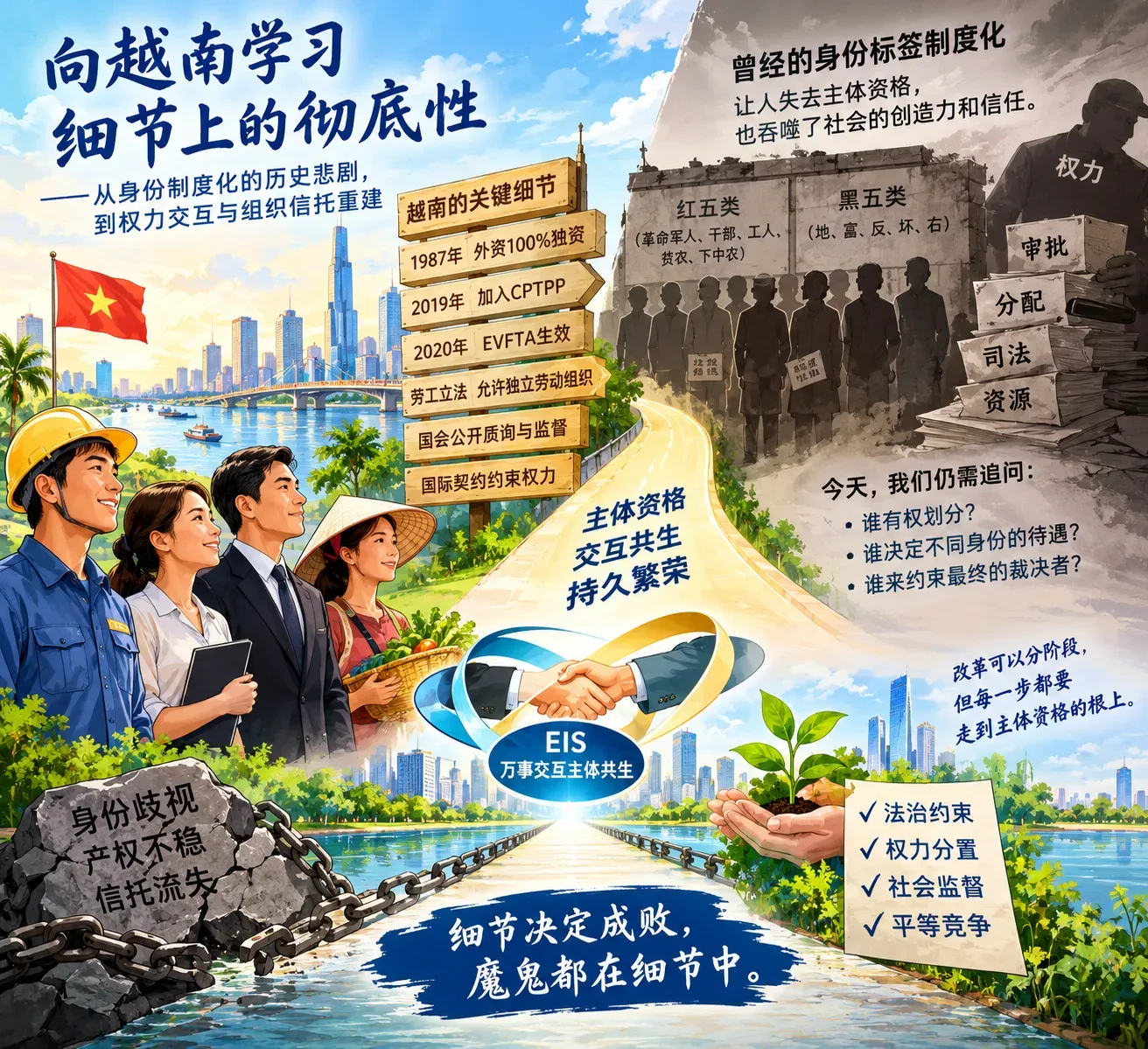
一個國家曾經按照所謂家庭出身把人民劃分三六九等。革命軍人、革命幹部、工人、貧農、下中農被稱作出身好的“紅五類”,地、富、反、壞、右標籤為“黑五類”。一個人還沒有學會說話,政治檔案就直接影響他今後的升學、就業、婚姻與命運。 後來,標籤摘掉了。可是,製造標籤的權力機制呢? 這依然是今天我們討論產權、民間信心與資本流動時,必須面對的歷史之問。2026年諾貝爾經濟學獎得主關心的是“預期”,而預期背後是信(Confidence)。信的背後,是承諾能否真正約束掌握權力的人。 一、摘掉劃分階級的標籤,製造標籤的權力受到約束了嗎? 二十世紀五十年代至七十年代中期,階級鬥爭被廣泛運用於和平時期的社會治理,形成了以政治成分、家庭出身和社會關係區別對待人的等級實踐。“老子英雄兒好漢,老子反動兒混蛋”,把個人權利與祖輩身份捆綁,損害了數代人的機會與尊嚴。 聲稱要消滅階級差別的革命,卻在繼續革命的政治身份上製造了新的差別。城鄉戶籍、統購統銷、資源配置及知識分子接受“再教育”等實踐,又與工農、城鄉、腦體勞動的分隔交織。政治身份審查壓倒人的能力與創造,親友之間被迫劃清界限,社會信任耗散於防範與揭發。 改革開放以後,平反冤假錯案、為地富分子摘帽、恢復高考和開放經營空間,讓億萬個具體的個人重新獲得行動機會。創造活力隨之湧現。這段歷史昭示:身份制度化的代價,包括權利受損、創造力埋沒,更包括整個社會組織信託的流失與恢復。 但取消一種身份標籤,與取消隨意製造身份等級的權力,是兩個不同層次的改革或革新。誰有權劃分?誰決定不同身份的待遇?受損者能夠向誰申訴,又由誰約束最後的裁決者?這幾個問題,今天仍然值得追問。 二、制度的底層代碼:從階級成分到所有制差序 現行憲法(以《八二憲法》為基礎)確認中國共產黨的領導地位、公有制的主體地位和國有經濟的主導作用,同時承認、保護非公有制經濟和合法私有財產,同時取消《七八憲法》罷工自由,並規定城市土地歸國家所有、農村土地歸集體所有。2025年《民營經濟促進法》進一步提出平等保護、公平競爭,並同時重申堅持黨的領導。 階級出身與所有制屬於不同性質的分類,不能直接混同。然而,當經濟分類在實際運行中轉換成政策優先、信貸准入、司法保護與公共資源配置上的主體身份差序時,就會再次出現“誰賦有主體平等資格”的差序問題。 發文件、作承諾、出台促進條例能夠改善一時的經營條件,卻未必改變決定承諾能否兌現的權力結構。當承諾者同時握有解釋、修改和最終裁決承諾的權力,而缺少有效的獨立約束,產權安全便面臨可信承諾(Credible Commitment)難題。 這不意味着所有產權保護必定失效,也不意味着任何一筆資本外流都是逃避政治風險。但在利差、匯率、回報率和國際配置之外,經濟預期,確實會進入資本的風險判斷。人們可以為更高收益遷移財富,也可能為了免受不可預期的權利損失,而付出遷移成本。最後,就是人們現在看到的消費和投資市場雙重萎縮。 問題的要害已經明確:保護合法產權的政策由誰制定固然重要,誰能夠約束改變規則的權力更加重要。 三、據何判斷越南國運呈上升態勢? 去年那篇文章觀察越南“革新開放”以來的社會活力與發展勢頭,探尋亞當·斯密所說的繁榮三原素在現實中的生成。今天重讀,問題又向前推進了一步:人民自己生長出來的繁榮,如何獲得持續的制度承兌? 亞當·斯密談國家繁榮,提出“和平、輕稅和過得去的司法行政”三個要素。我由此觀察越南的“三重和平”:人民之間可以自由交換、形成信任;制度安排給予經營與分工以穩定的預期;國家之間通過基於規則的貿易往來減少衝突,增進合作。和平不是軟弱,而是國家最硬的基礎設施。 越南的產業承接、國際貿易、旅遊活力與民間經營,當然受到地緣位置、人口結構和國際投資等條件影響。更值得注意的是:革新開放不斷擴大了普通人經營、交換和自組織的空間。這些活力無法僅憑國家命令創造,它們從人民的生活實踐中生長出來。 當時我關心:越南的國運何以上升?今天進一步追問:這種上升能否長久,依據何在?和平帶來安全,安全促進投資,投資擴展分工,分工激發創新;但是,任何一個環節都需要可靠的產權預期和組織信託。沒有制度承兌,發展的動能仍可能被權力任意性消耗。 於是,兩年的觀察在這裡交匯:前一篇從繁榮的生成條件切入,今天則要走進繁榮的制度保障。CPTPP及其勞工、投資規則,與國內職權分置及公開質詢,正是檢驗權力能否接受規則約束的兩個具體交互點。 “革新開放”與“改革開放”,一字之差,值得琢磨。越南所稱 Đổi Mới,本義是革新、更新;中國稱改革開放。“改革”着眼於既有規則的調整(如歷史上王莽、王安石、張居正“變法”),“革新”更鮮明地指向原則與組織關係的更新。詞義不能決定成敗,卻能啟發我們追問改革究竟觸及了什麼。 僅憑譯名當然不能判定製度成敗,但“革新”提醒人們:既然決定打開某一領域,就要敢於更新支配它的基本原則。改革可以分階段;每一步都要在已經開放的部分確認主體資格,不把根本權利懸置為日後恩准。 四、第一交互點:外部契約,怎樣使國內權力接受國際約束? 這種細節上的徹底性,早於CPTPP。越南1986年啟動革新開放,1987年通過《外國投資法》(1988年生效),第四條明確允許設立外資100%持股企業,第十四條規定這類企業自行負責經營管理,並依法承擔義務。彼時審批和行業限制仍然存在,實踐也需要逐步推進;但允許外資進入的領域,法律已經承認外資企業可以成為完整持股、獨立經營的主體。 改革可以一步一步來,但決定做的那一步,應先在思想理論和法律原則上做徹底。 今天明確這一部分的主體資格,明天再完善它的執行條件。歷史總有過程;原則的確立與實踐的完成也有先後。 越南2019年加入《全面與進步跨太平洋夥伴關係協定》(CPTPP);與歐盟簽訂的自由貿易協定(EVFTA)於2020年生效。通過國際經濟契約,越南將勞工權利、市場開放和投資保護與國內法律調整連接起來。 越南2019年《勞動法典》在法律上允許企業內部設立不隸屬於官方工會總聯合會的勞動者代表組織。它意味着勞動者利益表達有望獲得原有單一工會渠道之外的組織空間。這一步觸及社會主體的獨立表達權。但是,法律認可不等於現實中已能自由運作;截至2026年,獨立勞動組織的落實仍受到嚴格限制。 CPTPP第九章則為合格跨境投資規定了徵收條件、補償要求以及符合條約條件的投資者—國家爭端解決途徑(ISDS)。政府承擔條約義務,違約可能引發仲裁責任、賠償與國際信譽成本。部分產權保護因此獲得超出單方面行政承諾的外部約束。 這裡必須分清法律邊界:國際投資仲裁併不覆蓋越南所有本國私人財產。截至2026年10月27日,越歐投資保護協定(EVIPA)已有20個歐盟成員國提交批准通知,尚有7國未完成,協定尚未生效。越南自由貿易協定(EVFTA)於2020年8月1日生效。 外部條約既不是萬能鎖,也不是一紙空文,它的作用要看適用範圍、執行條件和實際履約。值得借鑑的制度原理,是一國政府自願接受自己不能完全單方面改變的契約義務,讓“取信於國際”進入可以檢驗、可以追責的法律程序。 五、第二交互點:內部職權分置與公開質詢 越南長期存在總書記、國家主席、總理、國會主席分別擔任不同職位的“四柱”領導格局。職位分置能夠為黨務、國家代表、行政和立法監督之間留下組織交互的空間。國會公開質詢政府官員,更把這種空間帶入可觀察的公共程序。 越南2015年《國會和人民議會監督活動法》對質詢、公開播送以及監督決議的責任與執行報告作出規定。提出問題、現場回答、確認責任、限期整改、追蹤結果:制度細節把權力置於社會可以觀看和評價的場景之中。 但“四駕馬車”不能神化。2026年4月,蘇林兼任越共中央總書記與國家主席,表明原有高層職位分置的安排可以發生變化;國會監督也仍受現行政治組織條件制約。電視直播可以增加透明度,卻不能單獨替代真正有效的法律救濟和權力制衡。 正因為存在這些限制,越南的嘗試才值得深入剖析:職位不同,尚需權力邊界清楚;質詢公開,尚需責任真正兌現;監督程序存在,尚需受監督者無法輕易取消監督。 六、兩點交互,怎樣通向“消除製造標籤的權力”? 外部,國際契約以法律義務、仲裁和違約成本制約權力;內部,機構職權分置、國會質詢和追責程序試圖約束權力行使。一個形成外部承兌壓力,一個形成內部糾錯通道。兩者若能落實並相互支持,才有條件讓人民與企業逐漸擺脫只能寄望於政策恩惠的處境。 這也提供了一個清晰的檢驗標準:勞動者能否依法表達自身利益?企業遭到不當徵收能否獲得有效救濟?官員能否被公開追問並對違約承擔責任?公有與私有企業能否在公平競爭中按貢獻而非身份獲取機會? 越南並未徹底解決這些問題。它的實踐中既有法律上的開放,也有現實中的限制與權力再集中。因而,學習越南應當學習制度細節中可驗證的突破,同時看清尚未兌現的承諾。在這個意義上,越南的革新開放,是中國式改革開放的一面鏡子。 七、身份制度化怎樣吞噬繁榮? 說到底,根子還在主客關係。一個權力組織如果永遠以唯一主體(Subject)自居,將勞動者、企業家、投資者和普通人民只當成可以安排、支配與恩準的客體(Object),社會哪裡還會有真正的自組織?允許他經營,卻不充分承認其產權;允許他發聲,卻不承認獨立表達利益的主體資格;給他部分權利,卻保留隨時收回的任意權力——主體被削減為客體,何來持久信託與繁榮? 在萬事交互主體共生(Everything Intersubjective Symbiosism,EIS)的視野中,每個人、每個企業與社會組織都有自身的稟賦、權利和責任。國家保障公共秩序,勞動者貢獻勞動和知識,企業組織生產並承擔風險。不同主體通過有益交互生成共生效能。自組織的動能與共生、共襄生成的勢能,相應相輔相成。 當某一權力集團把其他主體視為可隨意分類、支配和調配的客體,身份審查就容易擠占能力發現,權力偏好擠占公平競爭,避險成本擠占生產投資。多元不共生,就是散亂,甚至衝突;一元壓制主體交互,則會不斷損耗社會的糾錯能力和創新活力。 共生經濟學(Symbionomics)提出國內生產效能總值(Gross Domestic Effectiveness,GDE):GDE=Σ(GDPᵢ×ηᵢ),η為效能係數(Effectiveness Coefficient)。降本C、賦能E、健康H、信任T、和平P,是理解發展效能的五個重要維度。身份制度化抬高成本、限制賦能、破壞健康、削弱信任並製造衝突,因此可能使GDP增長的相當一部分成果被組織損耗吞噬。 一個國家可以動員大量資本建廠修路,卻仍可能因為產權預期不穩,使財富耗費於防範、遷移與短期套利。生產規模可以擴張,信託卻可能不斷流失。公信力一旦喪失,就很難恢復。 八、細節上的徹底性,通向怎樣的制度承兌? 改革的徹底性,需要看規則能否約束制定規則的人。勞動者組織權利寫進法律以後,能否真實行使?投資條約簽訂之後,爭端解決能否有效啟動?國會質詢直播之後,行政部門是否按時整改並承擔責任?合法私有產權能否獲得穩定、平等和可訴的保障? 這些細節看似細小,卻都是權力交界處的硬問題。原則落實為權利,承諾落實為責任,監督落實為可追究的程序,才可能降低制度風險溢價,逐漸重建組織信託。 向越南學習,應當認真研究兩項制度實驗:一方面以國際契約引入外部法律約束,另一方面以職權分置、公開質詢和問責程序推進國內權力交互。其實際局限同樣提醒我們:只改變形式、沒有改變權力實際受到約束的程度,制度風險仍可能存在。 去年在越南,我看到人民的交換與創造如何匯成國運上升的動能;今天再問,能夠讓這種動能持續下去的制度勢能從何而來?“三重和平”要走向長久繁榮,便須讓司法行政的公正、國際契約的履行與國內監督的責任,落進每一個人和企業可以切身檢驗的細節。 越南1987年允許外資獨資、後來在勞動法上確認企業內部勞動者代表組織,以及通過國際投資條約接受部分外部約束,分別觸及產權、組織和國家行為的主體關係。法律上的突破未必立即在現實中徹底實現,恰恰要求繼續檢驗執行。但思想原則一旦明確,改革才有了可供落實與追責的方向。 細節上的徹底性,就在於讓每個獲得承認的主體真正有權行動,讓承諾者接受約束。改革可以一步一步走,每一步都應走到主體資格的根上。 標籤摘掉以後,還要問:製造標籤的權力受到約束了嗎? 一個國家能夠動員多少財富,取決於資源、機會和生產能力;能夠長久留住多少人心與資本,則取決於權利、責任和信託如何得到承兌。 預期背後是信。信,最終要由細節中的制度履約來承兌。 交互主體共生,繁榮才有根基 允許外資100%持股,是一個細節;但背後是承認外國投資者完整的產權主體資格。 CPTPP允許符合條件的投資者通過國際仲裁追究政府責任,是一個細節;但背後是國家權力接受外部法律約束。 國會公開質詢,是一個細節;但背後是掌權者必須面對其他主體的質詢與監督。 這三個細節共同揭示了一個根本問題:權力能否承認自己之外還有獨立的主體? 魔鬼藏在細節中,細節決定成敗。改革的徹底性,體現在已經決定改革的每一個細節上。歷史可以漸進,原則必須明確;實踐可以逐步完善,主體資格不能半給半留。 一個始終把自己當作唯一主體(Subject)、把其他人當作客體(Object)的權力組織,即使給予再多優惠和許可,也難以建立持久的組織信託。 交互主體共生(Intersubjective Symbiosism),繁榮才有根基。 最後,多說一句:要剎住“經濟下行”,中國不學日本,學不象新加坡,至少向越南學習吧! 主要參考依據 《中華人民共和國憲法》(2018年修正);《中華人民共和國民營經濟促進法》(2025年)。 越南《外國投資法》(1987年通過,1988年生效),第四條、第十四條;越共第六次全國代表大會(1986年)關於 Đổi Mới 的改革決定。 CPTPP,第九章投資及第十九章勞工;越南《勞動法典》(2019年)。 越南《國會和人民議會監督活動法》(2015年);越共中央政治局第68號決議(2025年)。 EVFTA(2020年生效);EVIPA(與EVFTA不同,須核對各批准方進度)。 越南2026年4月領導職務調整的官方報道;2026年關於獨立工會實施狀況的研究與報道。 錢宏(Archer Hong Qian):《越南國運處上升態勢——基於亞當·斯密“繁榮三原素”與共生經濟學的結構性觀察》,2025年, http://symbiosism.com.cn/11185.html 錢宏(Archer Hong Qian):《CPTPP門檻背後的組織信託——當“三十六計”遇到事前可驗證、事中可追責、事後可承兌》,2026,http://symbiosism.com.cn/12687.html ;https://www.amorsophia.com/article/10327 錢宏(Archer Hong Qian):《共生經濟學概論(修訂版)》Symbionomics: An Overview (Revised Edition);《將AI升格為AM》/Elevating AI to AM,,2026年。
Learning from Vietnam’s Đổi Mới: Thoroughness in the Details— From the Historical Tragedy of Institutionalized Identity Labels to the Reconstruction of Power Relations and Organizational Trust Archer Hong Qian
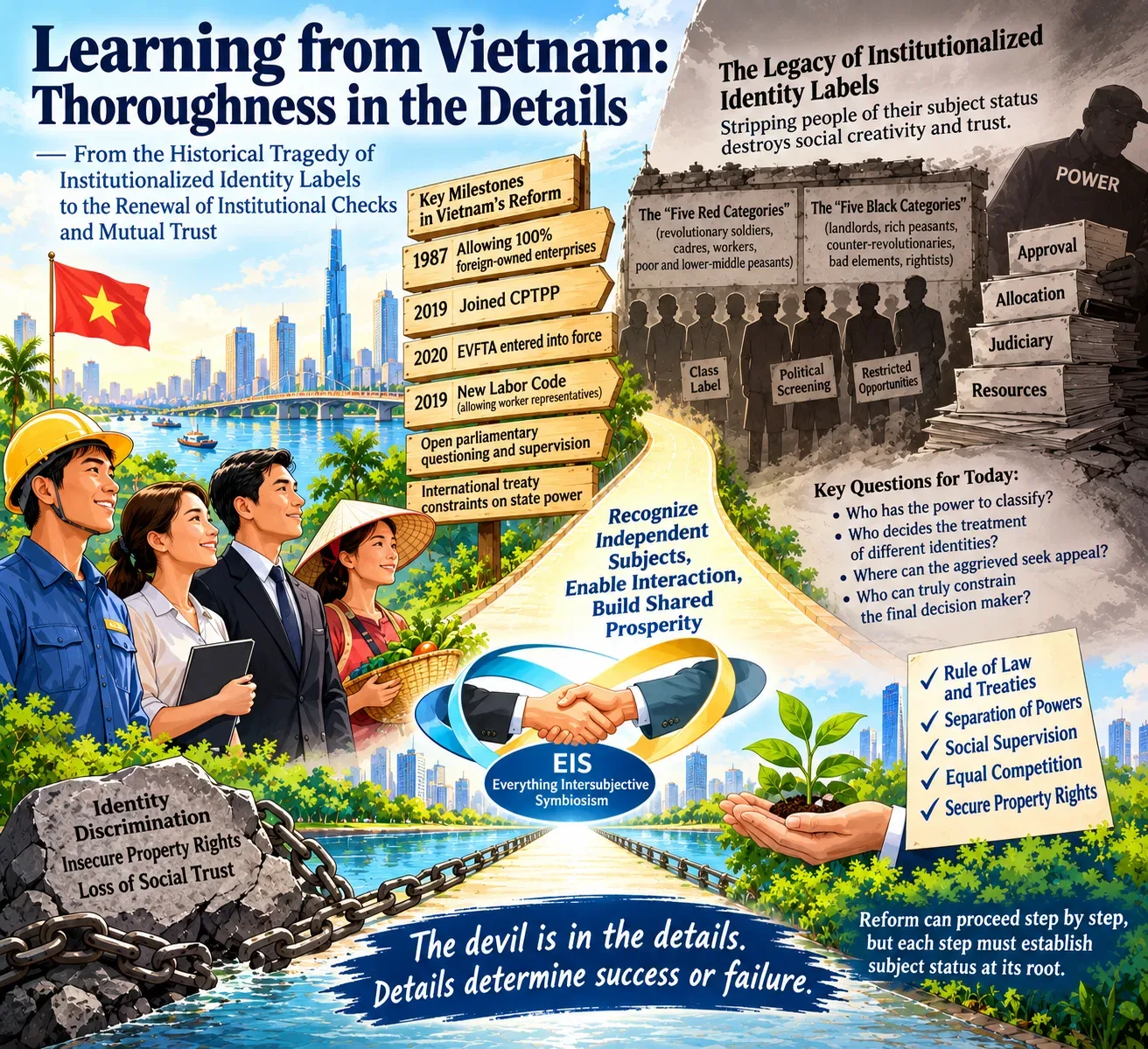
In November 2025, I traveled across Vietnam, from north to south, observing the country firsthand. That journey led me to write Vietnam’s National Fortunes Are on the Rise: A Structural Observation Based on Adam Smith’s Three Essentials of Prosperity and Symbionomics. Early this morning, I awoke thinking once again about Vietnam, our neighbor that has pursued Đổi Mới—Renovation and Opening Up. As the Fifth Plenary Session of the 20th Central Committee of the Communist Party of China convenes, I find myself looking back over the seventy-seven years since 1949 and the history of institutionalized identity labeling in mainland China. One question comes to mind: The labels have been removed. But has the power to manufacture those labels finally withdrawn? Institutionalized identity discrimination and ownership-based hierarchies are profound obstacles to lasting prosperity in modern economic society. There was a time when a country divided its people into rigid social ranks according to their so-called family backgrounds. Revolutionary soldiers, revolutionary cadres, workers, poor peasants, and lower-middle peasants were classified among the politically privileged "Five Red Categories." Landlords, rich peasants, counterrevolutionaries, bad elements, and rightists were assigned to the "Five Black Categories." Before a child could even speak, a political dossier could already determine that child's prospects for education, employment, marriage, and much of life itself. Eventually, those labels were removed. But what happened to the mechanisms of power that manufactured them? This remains a historical question that cannot be avoided when discussing property rights, private-sector confidence, and capital flows today. The 2026 Nobel laureates in economics have drawn attention to expectations. Yet behind expectations lies confidence. And behind confidence lies a still more fundamental question: Can commitments genuinely constrain those who hold power? I. The Class Labels Were Removed. Has the Power to Manufacture Them Been Constrained?From the 1950s through the mid-1970s, class struggle was widely applied to the governance of society during peacetime. Political classifications, family backgrounds, and social relationships became grounds for hierarchical treatment. The notorious slogan, "The son of a hero is a fine fellow; the son of a reactionary is a bastard," bound personal rights to ancestral identities, damaging the opportunities and dignity of several generations. A revolution that proclaimed its intention to eliminate class distinctions proceeded to create new distinctions through the political identities of continuous revolution. The urban–rural household registration system, unified state procurement and distribution, resource allocation, and the political "reeducation" of intellectuals reinforced divisions between workers and peasants, cities and villages, and intellectual and manual labor. Political identity screening overshadowed individual ability and creativity. Relatives and friends were compelled to draw ideological boundaries between themselves. Social trust dissipated through suspicion, denunciation, and mutual vigilance. After Reform and Opening Up began, the redress of wrongful political cases, the removal of class labels from landlords and rich peasants, the restoration of university entrance examinations, and the opening of new economic opportunities enabled hundreds of millions of individuals to regain room for independent action. Creative vitality consequently surged. This history demonstrates that the cost of institutionalized identity discrimination extends beyond violations of individual rights and the suppression of human creativity. It includes the erosion of organizational trust throughout society—and the immense effort required to restore it. Yet abolishing a particular identity label and abolishing the arbitrary power to manufacture identity hierarchies represent two different levels of reform or renovation. Who has the authority to classify people? Who decides how different identities are treated? To whom can those whose rights have been violated appeal? And who can constrain the ultimate decision-maker? These questions remain relevant today. II. The Institutional Source Code: From Class Background to Ownership HierarchyChina's current Constitution, built upon the framework of the 1982 Constitution, affirms the leadership of the Communist Party of China, the predominant position of public ownership, and the leading role of the state-owned economy. At the same time, it recognizes and protects the non-public economy and lawful private property. The 1982 Constitution also omitted the right to strike that had appeared in the 1978 Constitution, while establishing state ownership of urban land and collective ownership of rural land. The 2025 Private Sector Promotion Law further emphasizes equal protection and fair competition while reaffirming the Party's leadership. Class background and forms of ownership are classifications of different kinds. They should not be treated as identical. Nevertheless, when economic classifications translate into hierarchical differences in policy priorities, access to credit, judicial protection, and the allocation of public resources, the same fundamental question returns: Who confers equal standing upon independent economic subjects? Issuing policy documents, making promises, and enacting promotional legislation may improve business conditions for a time. Yet such measures do not necessarily change the power structure that ultimately determines whether those promises will be honored. When those making commitments also possess the authority to interpret, amend, and ultimately adjudicate those commitments, without effective independent constraints, property rights face a fundamental Credible Commitment Problem. This does not mean that all property protections must inevitably fail, or that every instance of capital outflow represents an attempt to escape political risk. But alongside interest-rate differentials, exchange rates, investment returns, and international portfolio diversification, expectations about the future inevitably enter into assessments of capital risk. People may move wealth in pursuit of higher returns. They may also willingly incur substantial costs to protect themselves against unpredictable losses of rights. The eventual result is the simultaneous contraction of consumer and investment markets that people are witnessing today. The essential issue is now clear. Who formulates policies protecting lawful property rights certainly matters. Who can constrain the power to change those rules matters even more. III. Why Did I Conclude That Vietnam's National Fortunes Were on the Rise?My article last year examined the social vitality and developmental momentum generated by Vietnam's policy of Đổi Mới, seeking to understand how Adam Smith's three essentials of prosperity emerge in actual social life. Rereading that article today, I find the question advancing another step: How can prosperity generated by the people themselves obtain lasting institutional guarantees? Adam Smith identified three essentials of national prosperity: peace, light taxation, and a tolerable administration of justice. From this perspective, I observed three dimensions of peace in Vietnam. The first concerns the freedom of exchange and the development of trust among individuals and communities. The second concerns institutional arrangements that provide stable expectations for business operations and the division of labor. The third concerns international trade relationships governed by rules, reducing conflict while expanding cooperation. Peace is no weakness. It is a nation's strongest infrastructure. Vietnam's integration into international manufacturing networks, expansion of trade, growing tourism sector, and entrepreneurial vitality have undoubtedly benefited from geography, demographics, and international investment. More significant, however, is the gradual enlargement of the space in which ordinary people can engage in business, exchange, and self-organization. Such vitality cannot simply be commanded into existence by the state. It grows out of people's own everyday activities. Last year, my question was: Why are Vietnam's national fortunes rising? Today, I ask a further question: Can that rise be sustained, and on what institutional foundations? Peace creates security. Security encourages investment. Investment expands the division of labor. The division of labor stimulates innovation. Yet every link in this process requires dependable expectations concerning property rights and organizational trust. Without credible institutional commitments, the dynamism of development can still be consumed by arbitrary exercises of power. Thus, my observations over these two years converge. The earlier article explored the conditions under which prosperity emerges. The present article examines the institutional foundations that might sustain it. The labor and investment rules associated with the Comprehensive and Progressive Agreement for Trans-Pacific Partnership (CPTPP), together with the domestic division of official responsibilities and public parliamentary questioning, provide two concrete points of interaction through which we can examine whether political power can be subjected to binding rules. There is also an intriguing difference of just one Chinese character between Vietnam's Renovation and Opening Up (革新開放) and China's Reform and Opening Up (改革開放). Vietnam's term Đổi Mới means renovation or renewal. In Chinese, "reform" tends to suggest adjustments within an existing framework, reminiscent of the historical institutional reforms associated with Wang Mang, Wang Anshi, and Zhang Juzheng. "Renovation," by contrast, more explicitly evokes the renewal of underlying principles and organizational relationships. Words alone cannot determine the success or failure of institutions. Nevertheless, this distinction invites us to ask what reform actually changes. The meaning of renovation reminds us that once a society decides to open a particular field, it must be prepared to renew the principles governing that field. Reform may proceed in stages. But each step must establish the standing of independent subjects within the field being opened, rather than leaving their fundamental rights dependent upon future permission. IV. The First Point of Interaction: How External Agreements Subject Domestic Power to International ConstraintsVietnam's thoroughness in institutional details predates the CPTPP. Vietnam launched Đổi Mới in 1986. In 1987, it adopted its Law on Foreign Investment, which entered into force in 1988. Article 4 expressly permitted the establishment of enterprises with 100% foreign ownership. Article 14 provided for such enterprises to manage their own operations and fulfill their legal obligations. At that time, project approval requirements and industry restrictions still existed. Implementation would necessarily develop gradually. But within the areas opened to foreign investment, the law had already recognized enterprises with complete foreign ownership as independent business subjects. This illustrates what thoroughness in institutional details means. Reform may proceed one step at a time, but each step undertaken should first establish its principles thoroughly in theory and law. Today, a particular area of independent subjecthood is recognized. Tomorrow, the conditions for implementing it can be further improved. History always unfolds through a process. The establishment of principles and their full realization in practice do not necessarily occur simultaneously. Vietnam joined the CPTPP in 2019. Its Free Trade Agreement with the European Union (EVFTA) entered into force in 2020. Through international economic agreements, Vietnam connected labor rights, market access, and investment protection with changes in domestic legislation. Vietnam's 2019 Labor Code legally permitted the establishment of worker representative organizations within enterprises outside the official Vietnam General Confederation of Labour. This created the possibility of organizational space through which workers could express their interests independently of the previously dominant official union channel. The change touches upon the right of social subjects to represent and articulate their own interests. However, legal recognition does not automatically translate into freedom of operation. As of 2026, the practical establishment and operation of independent labor organizations in Vietnam remain subject to substantial restrictions. Chapter 9 of the CPTPP, meanwhile, establishes conditions for expropriation, compensation requirements, and investor–state dispute settlement (ISDS) mechanisms for qualifying cross-border investments. Governments assume treaty obligations. Breaches may result in arbitration proceedings, compensation liabilities, and damage to international credibility. Some property-rights protections thereby acquire external constraints extending beyond unilateral administrative promises. The legal boundaries must be clearly understood. International investment arbitration does not automatically cover all privately owned property within Vietnam. As of October 27, 2026, twenty EU member states had submitted ratification notifications for the EU–Vietnam Investment Protection Agreement (EVIPA), while seven had yet to complete the process. EVIPA had therefore not entered into force. The EU–Vietnam Free Trade Agreement (EVFTA), by contrast, entered into force on August 1, 2020. An international treaty is neither an all-powerful lock nor an empty piece of paper. Its effectiveness depends on its scope of application, implementation requirements, and actual compliance. The institutional principle worth examining is that a government voluntarily accepts contractual obligations it cannot completely alter unilaterally. In doing so, earning international confidence becomes a matter of legally verifiable obligations and enforceable accountability. V. The Second Point of Interaction: Internal Division of Responsibilities and Public Parliamentary QuestioningVietnam has long maintained a leadership arrangement in which the General Secretary of the Communist Party, the State President, the Prime Minister, and the Chairperson of the National Assembly were traditionally held by four different individuals. This arrangement is commonly known as the "Four Pillars." The separation of offices can create organizational space for interaction among Party leadership, state representation, executive administration, and legislative oversight. Public questioning of government officials in the National Assembly brings that interaction into a visible institutional process. Vietnam's 2015 Law on Supervisory Activities of the National Assembly and People's Councils established provisions concerning questioning, public broadcasting, supervisory resolutions, institutional responsibilities, and implementation reports. Questions are raised. Officials respond publicly. Responsibilities are identified. Deadlines for corrective action are established. Results are subsequently reviewed. These institutional details bring the exercise of public power into a setting that society can observe and evaluate. Yet the "Four Pillars" arrangement should not be idealized. In April 2026, Tô Lâm assumed the presidency while retaining his position as General Secretary of the Communist Party of Vietnam. This demonstrated that the previous separation of senior offices could be altered. Oversight by the National Assembly also remains constrained by Vietnam's existing political and organizational arrangements. Televised proceedings can increase transparency, but transparency alone cannot substitute for effective legal remedies and institutional checks on power. Precisely because these limitations remain, Vietnam's experiments deserve careful examination. Different offices must have clearly defined boundaries of authority. Public questioning must lead to responsibilities that are genuinely fulfilled. Oversight procedures must be protected against easy cancellation by those subject to oversight. VI. How Can These Two Points of Interaction Help Eliminate the Power to Manufacture Identity Labels?Externally, international agreements constrain governmental power through legal obligations, arbitration, and the costs of violating commitments. Internally, the division of institutional responsibilities, parliamentary questioning, and accountability procedures seek to constrain the exercise of power. One creates external pressure to honor commitments. The other creates channels for internal correction. If both operate effectively and reinforce one another, they can help establish conditions under which individuals and enterprises gradually move beyond dependence upon discretionary policy favors. This also provides a clear set of practical tests. Can workers lawfully represent their own interests? Can enterprises obtain effective remedies against improper expropriation? Can public officials be questioned openly and held responsible for breaches of their obligations? Can public and private enterprises compete fairly and gain opportunities according to their contributions rather than their ownership identities? Vietnam has yet to resolve these issues completely. Its experience combines legal openings with continuing restrictions and renewed concentration of power. Learning from Vietnam therefore requires examining verifiable institutional breakthroughs while recognizing commitments that remain unfulfilled. In this sense, Vietnam's Renovation and Opening Up offers a mirror through which to examine China's Reform and Opening Up. VII. How Institutionalized Identity Hierarchies Consume ProsperityUltimately, the root of the problem lies in the relationship between Subject and Object. If a political organization perpetually regards itself as the sole Subject, while treating workers, entrepreneurs, investors, and ordinary citizens merely as Objects to be arranged, controlled, and granted permission, how can society develop genuine self-organization? You allow people to operate businesses, yet fail to recognize their property rights fully. You permit them to speak, yet deny them independent standing to represent their interests. You grant them certain rights while retaining arbitrary power to withdraw those rights whenever you choose. When Subjects are reduced to Objects, where can lasting trust and prosperity come from? Within the framework of Everything Intersubjective Symbiosism (EIS), every individual, enterprise, and social organization possesses its own endowments, rights, and responsibilities. The state safeguards public order. Workers contribute labor and knowledge. Enterprises organize production and assume risk. Different subjects generate symbiotic effectiveness through mutually beneficial interaction. The driving force of self-organization and the potential energy of symbiotic and collaborative generation are mutually responsive, complementary, and co-constitutive. When a particular power-holding group treats other subjects as Objects to be arbitrarily classified, controlled, and allocated, identity screening displaces the recognition of ability. Political preferences displace fair competition. The costs of risk avoidance crowd out productive investment. Plurality without symbiosis produces disorder—even conflict. When unitary power suppresses interactions among independent subjects, society continuously loses its capacity for self-correction and innovation. Symbionomics proposes the concept of Gross Domestic Effectiveness (GDE): GDE = Σ(GDPᵢ × ηᵢ) Here, η (Eta) represents the Effectiveness Coefficient. Five factors—Cost Reduction (C), Empowerment (E), Health (H), Trust (T), and Peace (P)—provide important dimensions for understanding developmental effectiveness. Institutionalized identity hierarchies raise costs, restrict empowerment, damage health, weaken trust, and generate conflict. As a result, a substantial portion of the benefits produced by GDP growth may be consumed by organizational inefficiency and social losses. A country may mobilize enormous amounts of capital to build factories, highways, and other infrastructure. Yet unstable expectations concerning property rights may compel wealth holders to spend resources on defensive arrangements, relocation, and short-term arbitrage. The scale of production can expand even while organizational trust continues to erode. And once public credibility is lost, restoring it is exceedingly difficult. VIII. What Kind of Institutional Commitment Can Thoroughness in the Details Produce?The thoroughness of reform must ultimately be judged by whether rules can constrain those who make them. Once workers' organizational rights are written into law, can workers actually exercise those rights? Once investment treaties are signed, can dispute-settlement mechanisms be effectively invoked? Once parliamentary questioning is publicly broadcast, do administrative departments implement corrective measures on time and accept responsibility? Can lawful private property obtain stable, equal, and legally enforceable protection? These details may appear minor. Yet each concerns a critical point at which power encounters the rights of other subjects. Only when principles become enforceable rights, commitments become responsibilities, and supervision becomes procedures capable of imposing accountability can institutional risk premiums decline and organizational trust gradually be rebuilt. Learning from Vietnam means examining two institutional experiments. The first introduces external legal constraints through international agreements. The second develops domestic interaction among institutions through differentiated responsibilities, public questioning, and accountability procedures. Their limitations also carry an important lesson. If institutional forms change without a corresponding change in the extent to which power is actually constrained, institutional risks may persist. Last year in Vietnam, I observed how people's exchanges and creativity could converge into a rising national dynamism. Today, I ask: Where does the institutional potential energy capable of sustaining that dynamism come from? For the "Three Dimensions of Peace" to develop into lasting prosperity, fair judicial administration, fulfillment of international obligations, and responsibility under domestic oversight must all be realized in details that every individual and enterprise can personally experience and verify. Vietnam's 1987 recognition of wholly foreign-owned enterprises, its subsequent legal recognition of worker representative organizations, and its acceptance of certain external constraints through international investment treaties each touch upon the relationships among subjects in the fields of property, organization, and state action. A legal breakthrough may not immediately be realized in practice. Indeed, that is precisely why implementation must continue to be examined. But once the underlying principle is clearly established, reform has a direction against which fulfillment and accountability can be measured. Thoroughness in the details means enabling every recognized subject to exercise genuine agency, while ensuring that those making commitments are themselves subject to constraints. Reform can proceed step by step. But every step should reach the very foundation of subjecthood. After the labels have been removed, we must still ask: Has the power to manufacture those labels been constrained? How much wealth a country can mobilize depends on its resources, opportunities, and productive capabilities. How much confidence and capital it can retain over the long term depends on how rights, responsibilities, and trust are honored through credible commitments. Behind expectations lies confidence. And confidence must ultimately be sustained by institutional commitments fulfilled in the details. Intersubjective Symbiosis: The Foundation of ProsperityAllowing 100% foreign ownership is a detail. Behind it lies recognition of foreign investors as independent subjects possessing full ownership rights in their enterprises. Allowing qualifying investors under the CPTPP to pursue international arbitration against a government is a detail. Behind it lies the state's acceptance of external legal constraints on its own authority. Public parliamentary questioning is a detail. Behind it lies the requirement that those exercising political power face questions and oversight from other institutional actors. Together, these three details reveal a fundamental issue: Can political power recognize independent subjects beyond itself? The devil is in the details, and details determine success or failure. The thoroughness of reform manifests itself in every specific area that has already been opened to reform. History may advance gradually, but principles must be clear. Implementation can improve step by step, but the recognition of independent subjecthood cannot be granted only halfway. A political organization that always regards itself as the sole Subject, treating everyone else as Objects, will find it difficult to establish lasting organizational trust, however many incentives or permissions it offers. Intersubjective Symbiosism provides the foundation for prosperity. And one final remark: If China wishes to arrest its economic decline, and if it will neither follow Japan's path nor manage to emulate Singapore, then perhaps it should at least learn from Vietnam!
Principal ReferencesConstitution of the People's Republic of China (2018 Amendment); Private Sector Promotion Law of the People's Republic of China (2025). Vietnam, Law on Foreign Investment (adopted in 1987; effective in 1988), Articles 4 and 14; Sixth National Congress of the Communist Party of Vietnam (1986), decisions concerning Đổi Mới. Comprehensive and Progressive Agreement for Trans-Pacific Partnership (CPTPP), Chapter 9 (Investment) and Chapter 19 (Labour); Vietnam, Labour Code (2019). Vietnam, Law on Supervisory Activities of the National Assembly and People's Councils (2015); Resolution No. 68 of the Politburo of the Communist Party of Vietnam (2025). EU–Vietnam Free Trade Agreement (EVFTA), effective in 2020; EU–Vietnam Investment Protection Agreement (EVIPA), a separate agreement whose entry into force depends on completion of the relevant ratification procedures. Official reports concerning Vietnam's leadership changes in April 2026; research and reports on the implementation of independent labor organizations in Vietnam (2026). Archer Hong Qian, Vietnam's National Fortunes Are on the Rise: A Structural Observation Based on Adam Smith's Three Essentials of Prosperity and Symbionomics (2025). http://symbiosism.com.cn/11185.html Archer Hong Qian, Organizational Trust Behind the CPTPP Threshold: When the “Thirty-Six Stratagems” Encounter Ex Ante Verifiability, Ongoing Accountability, and Ex Post Fulfillment (2026). http://symbiosism.com.cn/12687.html https://www.amorsophia.com/article/10327 Archer Hong Qian, Symbionomics: An Overview (Revised Edition); Elevating AI to AM (2026).
|