The U.S.-EU trade agreement signals that the restructuring of globalization is now taking form 美欧达成新贸易恊议,标志着“全球化重组”成型 钱宏(Archer Hong Qian) 自4月2日“解放日”万国对等关税起,近四个月的“以调关税,促双边谈判”艰难时光,终于以美欧达成新贸易恊议为标志,川普式谋求贸易公平的“全球化重组”开始成型! 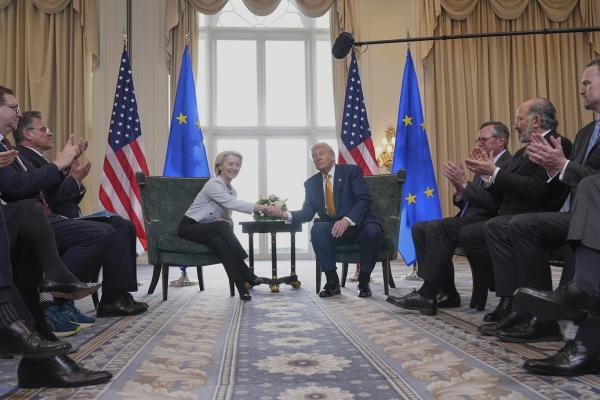
当地时间2025年7月27日,苏格兰特恩伯里,美国总统唐纳德·川普与欧盟委员会主席乌尔苏拉·冯德莱恩在川普特恩伯里高尔夫球场达成贸易协议后握手 世界两个最大的经济体——美国与欧盟,继美英、美日、美越达成双边贸易恊议之后,终于达成双边贸易恊议!让我想起四年前,我在《Trump总统的三大政治遗产(理念和领导力)——写于川普第一任总统离任日》(http://symbiosism.com.cn/5659.html)中写下的话: 2020年1月之前,由于信息不对称,我和其他人一样,看到听到的,都是丑化川普的资訊和漫畫! 2020年1月19日偶然到了北美,什麼信息都不缺,判斷在自己,偉大或是渺小不与个人利益立场关联性为据,而是看当地人的感受,我只看以下三点:“美国国内事务”、“国际社会和世界事务”、“全球化重组”,川普先生做了什么。特别是第三点: 第三,全球化重组:有鉴于WTO自由贸易互惠原则(任何成员在给予其他成员优惠待遇的同时,也享有其他成员给予的同等优惠待遇,却没有“双边对等关税原则”造成“经济全球化”规则漏洞)陷入罗德里克三元悖论(全球自由贸易、国家主权和民主人权三者不可兼得)在过去二十多年间存在事实上的不公平,川普总统以《谈判艺术》锚定双边或多边谈判,在保持买卖公平的前提下,实现基于产业链、供应链、价值链三链趋势的零关税、零壁垒、零歧视三零规则的全球化重组,以改变现行“经济全球化”在政府重商主义或国家资本主义面前束手无策的局面,美墨加自由贸易恊议的签署,只是刚刚开始(其不足是对第三国转口贸易缺乏关税要求,可能是个漏洞),如此这般一个国家一个国家、一个区域一个区域地谈下去,最后的结果,将是一个全新的全球化路线——全球共生主义…… 这个“全球共生主义”,就是我现在说的基于个人、社区、政府生命自组织连接平衡与再平衡的交互主体共生之“全球化III”! 在文章的后面,我十分感慨地写道: 川普的伟大,在于他富有傻子般的发心、圣人般的智慧和骑士般的勇气,知难而进,而且成就卓著,示范性地开启了重建世界秩序之路! 如今,川普回归才半年,看到美欧达成新贸易恊议的新闻,其中关于欧盟身美国购买7500美元产品(大部分是石化能源),我高兴地看到近三个月前,我在《和平,是打出来的,还是谈出来的?——从解决俄乌战争方式,到全球共生新秩序塑造》(http://symbiosism.com.cn/9679.html)中就主张或预言之一得以验证: 仅仅是让俄乌战争的停战只能解决短期问题,而帮助欧洲走出“制裁与输血并存的困局”是关键,基于此,加拿大交互主体共生基金会提出的《欧美石化协议》方案,可能是全球稳定的长期解决方案基础。 《乌美矿产协议》 是短期策略,目的是确保美国援乌的合理性。 《欧美石化协议》 是长期战略,旨在稳定全球能源、经济与金融体系,减少俄罗斯对欧洲的能源威胁,同时提升欧洲的战略自主权(参阅《From the U.S.-Ukraine Mineral Agreement to the U.S.-Europe Petrochemical Agreement: A Strategic Transition》http://symbiosism.com.cn/9644.html)。 协议的六大核心目标: (1)解除欧洲能源依赖,削弱俄罗斯经济影响力。 (2)推动美欧能源市场开放,改善欧美经济关系。 (3)促进美国就业,减少贸易赤字。 (4)终结“关税战”,恢复盟友合作关系。 (5)稳定美元全球储备货币地位,消弥“去美元化”风险。 (6)为全球安全和战略投资提供资金保障。 现在,我再次强调,没有人再注意川普的“解放日”之前,世界各国早征了美国多少关税?中国是67%,台湾是64%,越南是90%,印度是50%,英国是10%,欧盟是39%、日本是46%……川普的对等关税,不过是相当于被征关税百分比减半关税,这也说明川普抱怨“不公平贸易”的同时,真要改变规则(特别是WTO的漏洞)时,还是比较厚道,无论对于兄弟、盟友、朋友、他者,都采取了“一视为仨,间道竞合”的关税策略:讨回部分公平,重组全球化规则。 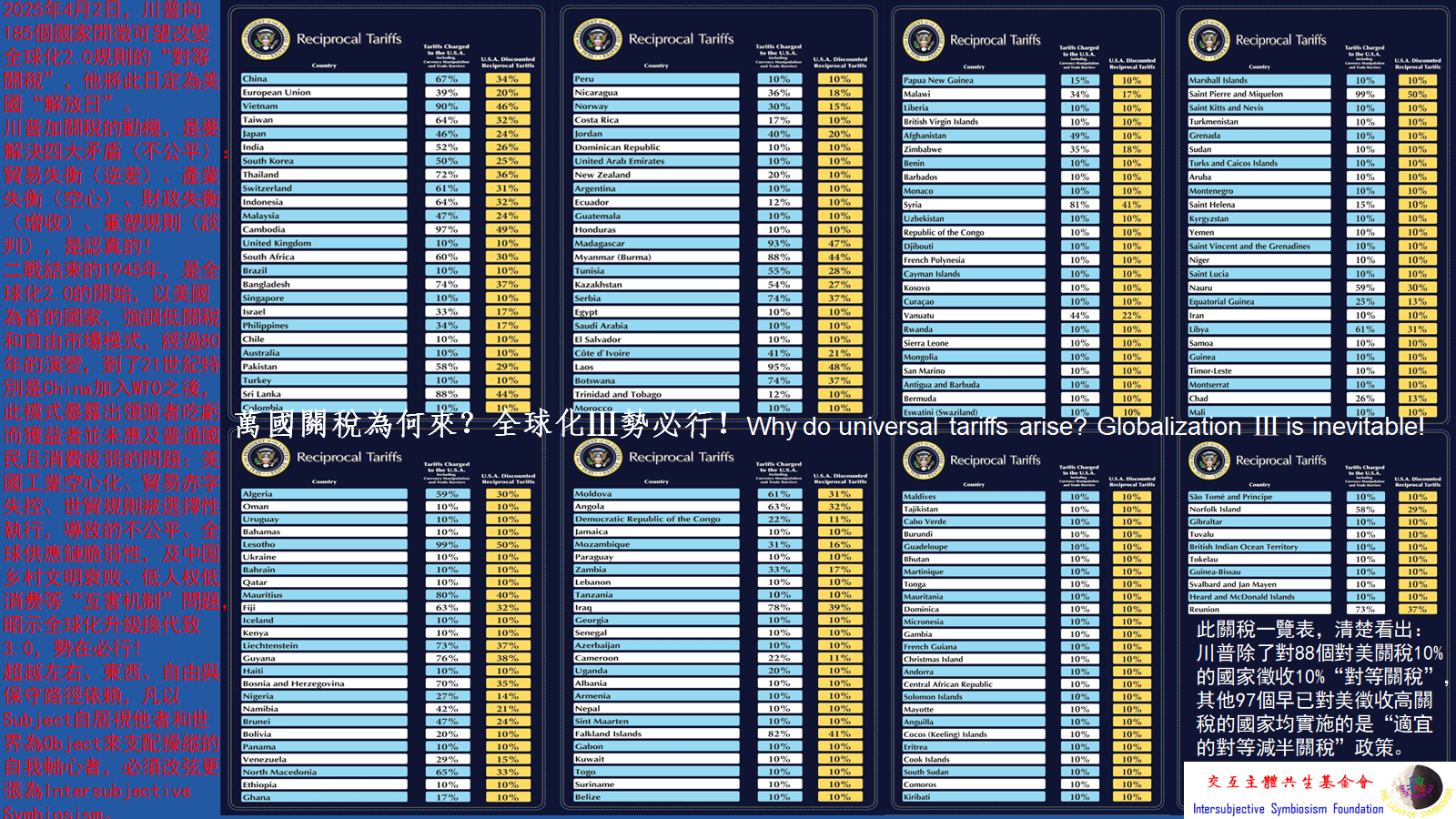
此关税一览表,清楚看出:川普除了对88个对美关税10%的国家征收10%“对等关税”,其他97个早已对美征收高关税的国家均实施的是“适宜的对等减半关税”政策。 2025年4月2日,川普向185个国家开征可望改变全球化2.0规则的“对等关税”,他将此日定为美国“解放日”。 川普加关税的动机,是要解决四大矛盾(不公平):贸易失衡(逆差)、产业失衡(空心)、财政失衡(增收)、重塑规则(谈判),是认真的! 二战结束的1945年,是全球化2.0的开始,以美国为首的国家,强调低关税和自由市场模式,经过80年的演变,到了21世纪特别是China加入WTO之后,此模式暴露出领头者吃亏而获益者并未惠及普通国民且消费疲弱的问题:美国工业空心化、贸易赤字失控、世贸规则被选择性执行,导致的不公平、全球供应链脆弱性,以及中国乡村文明衰败、低人权低消费等“互害机制”问题,昭示全球化升级换代致3.0,势在必行! 超越左右、东西、自由与保守路径依赖,凡以Subject自居视他者和世界为Object来支配操纵的自我轴心者,必须改弦更张为Intersubjective Symbiosism。 三个多月前,我说过:万国关税为何来?全球化III势在必行! 现在是2025年7月28日,坐标温哥华 现在是2025年7月28日,坐标温哥华 The U.S.-EU trade agreement signals that the restructuring of globalization is now taking form The U.S.-EU Trade Agreement Signals that the Restructuring of Globalization Is Now Taking Form
By Archer Hong Qian Since April 2—“Liberation Day”—when reciprocal tariffs were imposed on all nations, nearly four months of difficult “tariff-driven bilateral negotiations” have finally culminated in the landmark U.S.-EU trade agreement. President Trump’s pursuit of fair trade through a strategy of “globalization restructuring” has now begun to take shape! On July 27, 2025 (local time) in Turnberry, Scotland, U.S. President Donald Trump and European Commission President Ursula von der Leyen shook hands at the Trump Turnberry golf course after concluding the trade agreement. The world’s two largest economic powers—the United States and the European Union—have now reached a bilateral trade agreement, following similar deals with the United Kingdom, Japan, and Vietnam. This reminds me of what I wrote four years ago in my article “President Trump’s Three Political Legacies (Ideals and Leadership)” (written on the day he left office at the end of his first term):
http://symbiosism.com.cn/5659.html Before January 2020, due to information asymmetry, I, like many others, only saw and heard caricatures and vilifications of Trump.
But on January 19, 2020, I happened to arrive in North America, where no information was lacking, and I could make my own judgments. Greatness or insignificance was no longer judged by personal interests or positions, but by the feelings of the people on the ground. I looked only at three things: “U.S. domestic affairs,” “international society and global affairs,” and “globalization restructuring.” What did President Trump actually do? Especially the third:
3. Globalization Restructuring:
Given that the WTO's principle of reciprocal free trade (where any member granting favorable treatment to another must extend the same to all members) lacked a “reciprocal bilateral tariff principle”, resulting in a loophole in globalization rules, and given that Dani Rodrik’s Trilemma (that globalization, national sovereignty, and democracy cannot all coexist) revealed unfair practices over the past 20+ years, President Trump, guided by The Art of the Deal, anchored his approach in bilateral and multilateral negotiations. His goal was to achieve globalization restructuring based on the trends of supply chains, industrial chains, and value chains—toward the “three-zero rule”: zero tariffs, zero barriers, zero discrimination. The signing of the USMCA was just the beginning (though its flaw was lacking tariff measures against third-country transshipments). One country at a time, one region at a time, Trump negotiated his way toward a completely new path for globalization—Global Symbiosism. This “Global Symbiosism” is what I now call Globalization III—rooted in the intersubjective symbiosis of personal, community, and governmental self-organizing balance and rebalance. At the end of that article, I wrote with deep emotion: Trump’s greatness lies in his foolishly sincere intention, sagely wisdom, and knightly courage. He pushed forward despite challenges and made remarkable achievements, setting a demonstrative path for rebuilding the world order!
Now, only six months after Trump’s return, we see news of the new U.S.-EU trade agreement. One key provision involves the EU purchasing $7,500 worth of goods per household from the U.S. (mostly petrochemicals). I’m pleased to see that one of my predictions from nearly three months ago in the article “Is Peace Achieved by Fighting or Negotiation?—From Ending the Russia-Ukraine War to Shaping a New Global Symbiosis Order” has come true:
http://symbiosism.com.cn/9679.html A Russia-Ukraine ceasefire alone can only resolve short-term issues. The key lies in helping Europe escape its dilemma of “sanctions and subsidies coexisting.” Based on this, the Intersubjective Symbiosism Foundation of Canada proposed the U.S.-Europe Petrochemical Agreement—which could serve as the long-term foundation for global stability.
While the U.S.-Ukraine Mineral Agreement is a short-term strategy to justify U.S. aid to Ukraine,
the U.S.-Europe Petrochemical Agreement is a long-term strategy to stabilize the global energy, economic, and financial systems—reducing Russia’s energy leverage over Europe and strengthening the EU’s strategic autonomy.
(See: “From the U.S.-Ukraine Mineral Agreement to the U.S.-Europe Petrochemical Agreement: A Strategic Transition” http://symbiosism.com.cn/9644.html) The Six Core Goals of the Agreement Are: Eliminate Europe’s energy dependence and weaken Russia’s economic influence. Promote open energy markets and improve U.S.-EU economic relations. Boost U.S. employment and reduce the trade deficit. End the “tariff war” and restore allied cooperation. Stabilize the U.S. dollar’s global reserve currency status and reduce de-dollarization risks. Provide funding guarantees for global security and strategic investments.
Now, once again, I must stress: before “Liberation Day,” no one paid attention to how much tariff the U.S. had already been charged by other nations—China (67%), Taiwan (64%), Vietnam (90%), India (50%), the UK (10%), the EU (39%), Japan (46%)... Trump’s reciprocal tariffs merely amounted to cutting those percentages in half.
This shows that even while complaining about unfair trade, Trump was relatively fair-minded when it came to actually changing the rules (especially closing WTO loopholes). Whether dealing with brothers, allies, friends, or others, his tariff strategy followed a principle of “equal treatment among the three types”—brothers, friends, and rivals—via competitive cooperation through alternate paths: reclaiming partial fairness and restructuring globalization rules. This tariff overview clearly shows:
Trump imposed a uniform 10% “reciprocal tariff” on 88 countries that had previously charged the U.S. 10%, while 97 other nations that had long imposed high tariffs on the U.S. were subject to “appropriate reciprocal half-tariff” policies. On April 2, 2025, Trump announced reciprocal tariffs on 185 countries, aiming to change Globalization 2.0 rules. He named this day “America’s Liberation Day.” Trump’s tariff increases were meant to resolve four core imbalances (injustices): Trade imbalance (deficit) Industrial imbalance (hollowing out) Fiscal imbalance (revenue needs) Rule reshaping (negotiation leverage)
— and he was serious about it!
Since the end of World War II in 1945, Globalization 2.0 began with the U.S. leading a model of low tariffs and free markets. After 80 years of evolution—especially after China joined the WTO—this model revealed severe flaws:
The leader (the U.S.) suffered losses; the beneficiaries (like China) did not pass on gains to their citizens. Weak consumption, hollowed-out U.S. industry, uncontrollable trade deficits, and selectively enforced WTO rules all led to unfairness, fragile global supply chains, and mutual harm. China’s rural decay, low human rights, and suppressed consumption reflect a mutual harm mechanism, clearly signaling that an upgrade to Globalization 3.0 is imperative. We must transcend the dichotomies of Left vs. Right, East vs. West, Liberal vs. Conservative.
Any mindset that takes itself as the “Subject” and treats others and the world as mere “Objects” to control and manipulate must be transformed into Intersubjective Symbiosism. Over three months ago, I declared: Why did the Universal Tariffs come? Because Globalization III is an inevitable necessity!
Now it is July 28, 2025, in Vancouver.
Now it is July 28, 2025—writing from Vancouver.
转录:共生网http://symbiosism.com.cn/5659.html
Trump
总统的三大政治遗产(理念与领导力) ——写于川普第一任总统离任日 钱 宏(Archer Hong Qian)
2020年1月之前,由于信息不对称,我和其他人一样,看到听到的,都是丑化川普的资訊和漫畫! 2020年1月19日偶然到了北美,什麼信息都不缺,判斷在自己,偉大或是渺小不与个人利益立场关联性为据,而是看当地人的感受,我只看以下三点:“美国国内事务”、“国际社会和世界事务”、“全球化重组”,川普先生做了什么。 第一、美国社会国内事务:川普倡导“美国优先”(或MAGA)内涵是,不只是美国政府而且是各国政府,都首先要对本国社会和社区人民好,并且落实在政策实践毫不动摇,特别是他的减税政策(中国语境叫“轻徭薄赋”),得到美國婦女,尤其是有孩子的婦女、平民勞動者(红脖子)和中产阶级这些不会写文章、不会绘画、更不会操作投票机偷窃选票和不能操纵國家機器程序确认窃选结果的往昔無人關心的美国的沉默大多數的衷心欢迎,这就是偉大——孩子、妇女、勞工再怎麼卑微(他們在政治斗争中也確實沒什麼用,除非革命起義),但却代表著人类的未來和生活的希望,改变了“穷人富人二元对立”而指向特权操纵的社会再平衡认知——从追求结果公平到追求起点、机会公平! 第二,国际社会和世界事务:就是川普做美国总统的四年,猛一回望,人们发现,过去动不动就荼毒平民、让士兵当炮灰的战争,恐怖袭击爆炸几乎消声匿迹了——国别(民族)之争的本质,实际上是不同国家的权力-资本精英代理人绑架本国人民之争——作为政治素人的川普总统,他不是利益团伙的精英代理人,他甚至不与之同流合污(先富起来的他,一再强调他本来没有从政的诉求),当然也就不存在要用战争的极端方式解决国别冲突中的精英代理人矛盾的问题(在一定程度上也由此得罪了所有国家甚至盟国敌国的利益团伙及其精英代理人)——他的方式是,有话好好说,坐下来谈,谈不好宁可用经济制裁也不打仗,然后接着谈,谈好了签约并诚信履行,于是,以色列与中东四国签下了过去想都不敢想的和平协议,塞尔维亚与斯洛文尼亚再也不谈谁统一谁化干戈为玉帛了,朝鲜核试验停止了,ISIS真的销声匿了,伦敦、巴黎太平了,还有中美各国政府对本国难民、非法移民负起了责任,避免了国与国之间、非法移民难民(部分犯罪行为,如贩毒吸毒强奸卖淫)与当地居民之间的冲突……从而开创了世界和平的新方法、新篇章! 第三,全球化重组:有鉴于WTO自由贸易互惠原则(任何成员在给予其他成员优惠待遇的同时,也享有其他成员给予的同等优惠待遇,却没有“双边对等关税原则”造成“经济全球化”规则漏洞)陷入罗德里克三元悖论(全球自由贸易、国家主权和民主人权三者不可兼得)在过去二十多年间存在事实上的不公平,川普总统以《谈判艺术》锚定双边或多边谈判,在保持买卖公平的前提下,实现基于产业链、供应链、价值链三链趋势的零关税、零壁垒、零歧视三零规则的全球化重组,以改变现行“经济全球化”在政府重商主义或国家资本主义面前束手无策的局面,美墨加自由贸易恊议的签署,只是刚刚开始(其不足是对第三国转口贸易缺乏关税要求,可能是个漏洞),如此这般一个国家一个国家、一个区域一个区域地谈下去,最后的结果,将是一个全新的全球化路线——全球共生主义…… 
但是,Trumpism & Trumpnomics=有信仰的平民自组织主义+世界和平+全球化重组,必然与精英代理人主义和东方专制主义(表现为政府重商主义)发生冲突! 川普的伟大,在于他富有傻子般的发心、圣人般的智慧和骑士般的勇气,知难而进,而且成就卓著,示范性地开启了重建世界秩序之路! 不管川普个人有怎样的缺点(确实政治上不成熟,不够“老政客”,比如发推文太多,任性,急躁,动辄退群,大嘴巴乱开玩笑),但是,如何对待川普的三大政治遗产,考验着作为灯塔之国接下来掌控者们的智慧、勇气和担当! 当然,成为美国平民后的川普先生,接下来是选择自己安宁享受富贵生活,还是重新组党和创建媒体继续宣传Trumpism & Trumpnomics?甚至2024年第二次竞选美国总统……这都是他的权利,更无可厚非,他该为美国和世界尽的职责,已经尽过了——至少作出了艰难而明确的示范! 我本人期待他2024年的回归,将他开创的未竟事业——化解冲突重建世界秩序的努力——进行到底! 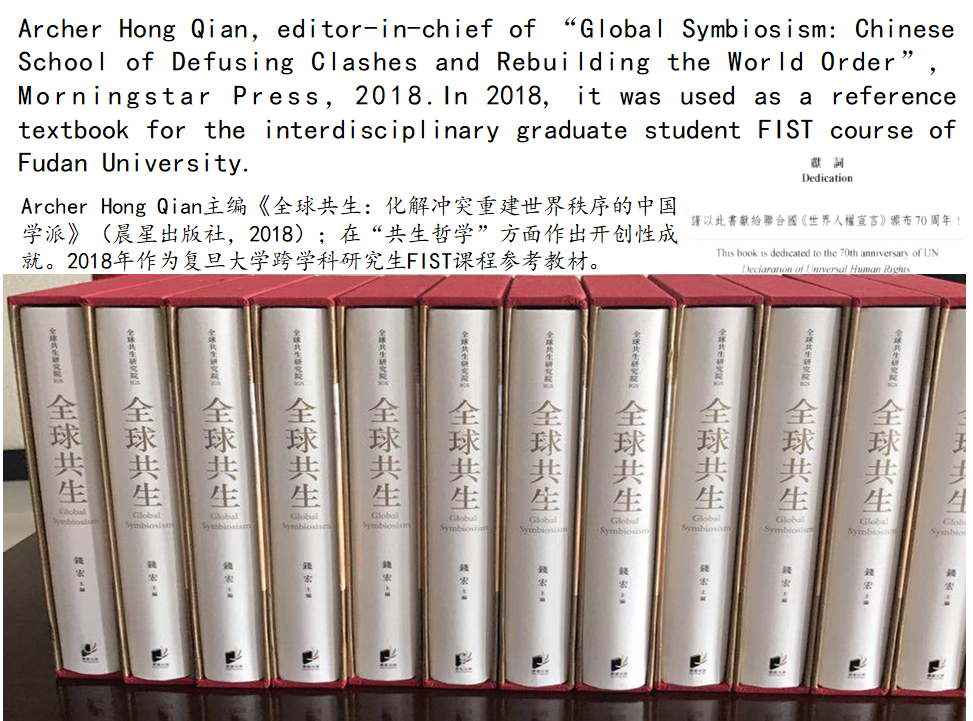
参看文献:
《Trumpism=SG2——化解人类“分裂-对立-冲突”及“美国百年挑战”因应之道!》(2020.11.7,Vancouver) 《谈谈Trumpnomics 10大亮点及2020美国大选和第4权力——川普经济学绝非“逆全球化”,而是要“重组全球化”》(2020.11.9,Vancouver) 《重建世界秩序:Social priority的全球共生主义(上)》
《重建世界秩序:Social priority的全球共生主义(下)》
http://symbiosism.com.cn/3968.html 又,《重建世界秩序:Social priority的全球共生主义》全文分别刊载于2018年9月《经济要参》和《战略与管理》2019年1/2合辑 《建立新范式,重构全球化的哲学基础——由Populism和Elitism中文翻译引发的讨论》(2020.4.23,Vancouver) http://symbiosism.com.cn/3804.html 孞烎2021.1.20晨记于Vancouver
|