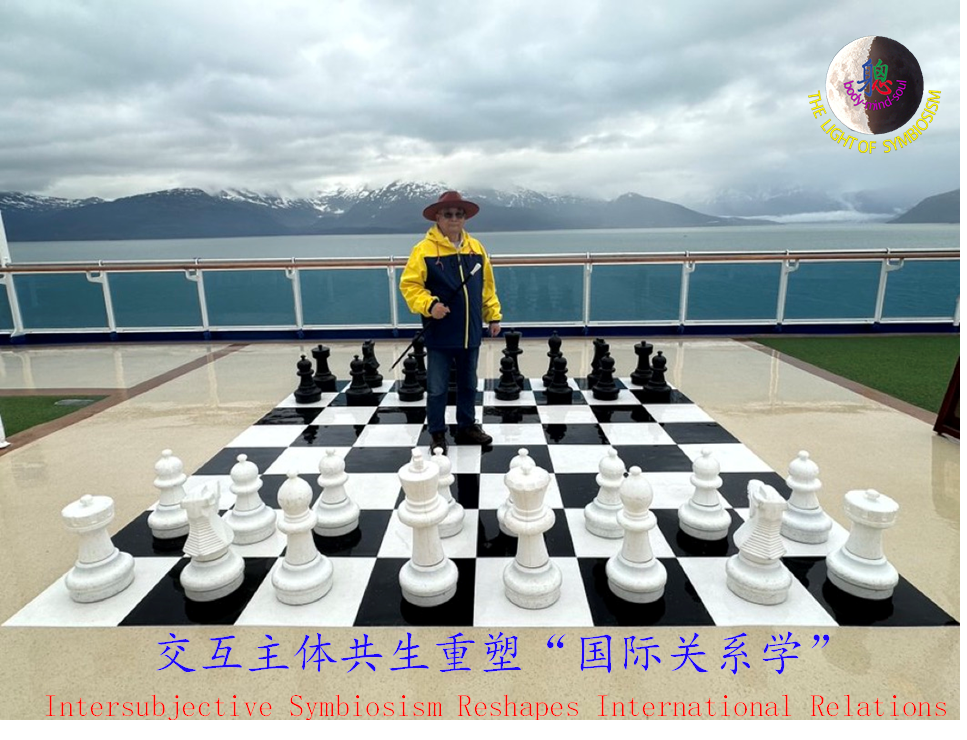
重建组织孞托的四位绅士
Four Gentlemen Rebuilding Organizational Trust
钱宏(Archer Hong Qian)
在《共生经济学概论(修订版)》扉页上,我写下了一段很短的献词:
【献词 谨以此书献给为重建人类组织孞托作出卓越贡献的四位绅士—— 亚洲的李光耀、李登辉,美洲的哈维尔·米莱、唐纳德·川普。 CATION This book is dedicated to four gentlemen who have made outstanding contributions to rebuilding humanity’s organizational trust— Lee Kuan Yew and Lee Teng-hui in Asia; Javier Milei and Donald Trump in the Americas.】
四个人,放在同一行。这是有意为之。 他们生活在不同年代,处于不同国家和制度环境,面对不同的社会问题,政治语言、性格与改革方式迥然不同。他们中的每一个人,也都曾经或者正在引起巨大争议。 如果沿用过去一百多年形成的政治分类,人们很容易立即开始站队:左还是右,自由还是威权,民主还是民粹,市场还是政府。 然后,概念战争重新开始。 我把他们写在同一行,恰恰希望穿过这些已经高度意识形態化的分类,回到一个更加根本的问题: 一个组织为什么值得生命托付? 这也是《共生经济学概论》从经济学进入货币通论,再进入组织通论以后,最终无法回避的问题。 一、经济学走到最后,为什么会遇见“组织孞托”? Economy最初关心人的生息、家政,以及如何安排资源使生活得以持续。 现代经济学极大拓展了人类理解生产、交换、价格、资本与增长的能力,也创造了GDP这一影响世界的经济尺度。然而,当GDP增长的同时,家庭生活成本、生態负担、组织消耗、社会失孞和人的身心压力也可能同步增加,经济学就必须继续追问: 增长究竟生成了什么?谁获得了效能?谁承担了成本? 这正是共生经济学从GDP走向GDE的原因。 C——降本(Cost Reduction) E——赋能(Empowerment) H——健康(Health) T——孞托(Trust) P——和平(Peace) GDP记录发生了多少经济活动,GDE进一步检验这些活动究竟生成了多少真实生命效能。 一个政府规模扩大了,是否意味着进步? 一家企业利润增加了,是否意味着成功? 一个平台拥有越来越多的数据,一个国家拥有越来越强的财政、军事和技术能力,是否意味着生命因此生活得更好? 组织不能只用组织自身的增长证明自己。 组织必须接受生命的检验。 价值生成之后,还有价值承兑;价值承兑背后,是承担承兑责任的组织。政府、企业、金融机构、学校、医院、平台乃至AI,一旦获得资源、权力、信用和人的合作,就必须回答: 你接受了谁的托付? 你又向谁兑现? 于是,货币通论走向组织孞托,组织通论由此发生。 生命先于组织,组织是生命的受托者。 从这个基准重新看自由、民主、宪政、共和,也会出现新的景象。 这些都是人类文明极其珍贵的历史发现,却不能停留在旗帜和身份标签上。自由要落实为生命的自组织空间,民主落实为受托权力的来源,宪政划出组织不得逾越的边界,共和让公共组织回到公共事务。 当组织真正值得生命托付,这些伟大的词便无需天天高喊。 它们活在生活里。 二、四个人,四种组织孞托 为什么是李光耀、李登辉、米莱、川普? 因为我看到的不是四个政治标签,而是四种发生在真实社会中的组织孞托实践。 李光耀:国民主权认同生成国家组织孞托 李光耀留给世界的,不只是一段新加坡经济高速增长史。 一个族群、语言、宗教高度多元,又刚刚脱离殖民体系和马来西亚的新国家,首先必须回答:谁是这个国家的主体? 李光耀推动形成的“新加坡人”国民主权认同,其深层意义正在这里:国家不属于某一个族群(马来人、华人、印度人、穆斯林人),也不能成为某一种血缘、语言或宗教的私产;组成这个国家的全体国民,才是国家存在的生命基础。 有了这个基础,住房、社区、教育、环境、公共秩序和有效行政便不再只是政府提供的一组“公共产品”,而成为国民主权认同进入日常生活的过程。 一个家庭能否安居,一个社区能否自组织,不同族群能否形成稳定的生活预期,都在回答: 这是我们的国家吗? 这是值得我们托付的组织吗? 所以,李光耀所代表的,是一条从国民主权认同进入社区生活,再从社区生活持续生成组织孞托的道路。 李登辉:“把国家还给人民”“我是没有我的我。” 这句话不能只当作哲学格言来读。在《为主作见证》中,他坦陈自己从唯心、唯物走向信仰的生命历程。作为一个基督徒,“没有我的我”最终必须面对政治中最难放下的东西: 权力中的“我”。 中国传统有强大的“认祖归宗”意识,政治组织又有另一种顽强惯性——结党营私。当党、国、权力和个人相互捆绑,“天下为公”便可能一步步变成“组织为我”。 李登辉的难能可贵,恰恰在于他走到这个组织结构的最高处以后,开始拆除使最高权力能够自我延续的旧结构。 1990年,青年学生走上广场。 面对新生代对“万年国会”、动员戡乱体制和政治改革的质疑,最高权力既可以把广场看作对秩序的挑战,也可以把青年看作未来的参与者。 李登辉选择了后者。 他与广场青年互动,回应召开国是会议的要求,把广场上的声音带进不同政治与社会力量参与的制度改革过程。 于是,一条后来容易被“民主化”三个字概括掉的生命过程发生了: 青年走上广场,权力走向青年; 社会提出问题,组织接受问题; 国是会议展开协商,旧组织开始退场。 随后,动员戡乱时期终止,《动员戡乱时期临时条款》废除,“万年国会”成为历史。到1996年,人民终于可以直接用选票决定由谁接受最高政治权力的托付。 当然,这是民主。但从共生经济学的组织通论看,还有更深的一层: 主权在民,从政治原则变成了真实的受托关系。 不是组织拥有人民,是人民托付组织。 而李登辉真正把这件事做完整,是在2000年。 掌权时推动改革已经不易;站在最高权力的位置上拆除旧权力赖以延续的制度更难;当自己拥有巨大的政治声望与现实影响以后,仍然能够让最高权力离开自己,则是对“改革究竟为了谁”的最后检验。 如果改革最后仍然通向“我继续掌权”,前面的改革便始终存在被重新私人化,乃至前功尽弃的危险。 2000年,李登辉离开总统府。 于是,从1990到2000,一条完整的组织孞托链条呈现出来: 听见生命 → 回应生命 → 打开组织 → 拆除旧权 → 主权还民 → 权力离我。 “我是没有我的我”,至此落地。 真正值得生命孞托的掌权者,不仅要在掌权时善用权力,还要在应当离开时,让权力离开自己。 权力交接不是组织孞托的尾声,而是组织孞托最后的兑现。 他恢复和建设台湾农会组织的实践,也因此具有另一层意义。总统直选解决最高政治权力由谁托付;农会连接土地、生产、金融、农民与地方生活。 主权在民,不只是四年才发生一次。 它要活在社区,活在农会,活在生产与生活之中。 而1990年广场上的那些年轻人,又让这一切具有了特别的代际意义: 重建组织孞托,也包括相信新生代有能力参与创造他们自己的未来。 哈维尔·米莱:净化过剩,彰显新美 米莱面对的是另一种社会病理:国家组织不断繁殖,财政成本持续膨胀,政府越来越昂贵,最后需要整个社会不断供养组织自身。 他的“电锯改革”最值得观察的地方,并非究竟砍掉多少部门、减少多少开支,而是把一个尖锐的问题摆到了现代政治经济学面前: 一个组织如果已经不能证明自己的受托价值,为什么还可以无限消耗生命供养自己? 这一问已经越过了奥派经济学通常讨论的市场自由、政府干预和财政纪律。 问题从“大政府还是小政府”,进一步推进到了: 组织凭什么存在? 答案只能回到生命。 政府、政党、官僚机构和公共财政,都没有脱离生命而自行扩张的天然权利。一个组织如果不能降低生活成本、维护基本秩序、释放人的创造能力,反而依靠税收、债务、管制和层层机构不断繁殖,就必须接受裁撤、重组乃至退出。 所以,《五月公约》成为共识后,米莱挥动的“电锯”,真正切向的是组织的自我繁殖权。 让组织重新证明自己为什么值得存在,让被高昂组织成本挤压的经济自组织人、政治自组织人、文化自组织人重新生长。 降低组织成本,就是把生命空间还给社会。 释放社会自组织能力,才可能重新生成组织孞托。 米莱改革由此获得了超出阿根廷、也超出奥派经济学的意义: 组织不能因为已经存在,就获得永远存在的理由。 让不能证明受托价值的组织退出。 唐纳德·川普:即使你不愛我,我掌握的公权力仍然受托于你 川普代表的第四条路径,基准仍然是:重建组织孞托。 美国今天却存在一种特别的遮蔽:日益尖锐的党派分裂,很容易把总统变成“半个美国的总统”。一项政策究竟降低了谁的生活成本、增加了谁的生命能力,还没有进入讨论,便已经被红蓝、左右、进步与保守的标签淹没。 所以,我愿意在这里使用一个非常朴素的词: 全民总统。 “全民”当然不是全民拥护,也不是取消党派竞争。美国人完全可以支持总统、反对总统、批评总统,并最终用选票决定总统的去留。 然而,一旦接受国家最高公共权力的托付,总统面对的就是全体国民。 选票可以分党派,生命没有党籍; 竞选可以分胜负,受托不能只服务胜选的一半。 一个餐馆服务员的小费该不该被层层征税,不取决于他投民主党还是共和党;一个病人能否负担药价,疾病不会询问他的党籍;一个年轻家庭能不能买得起房、养得起孩子,也不会因为生活在蓝州还是红州而改变。 生活,天然具有穿透党争的力量。 这也是我观察川普“常识新政”的基准。 “川普账户”面对刚刚出生、尚无党派身份的新生代;“川普药房”面对不分红蓝的疾病与生命成本。
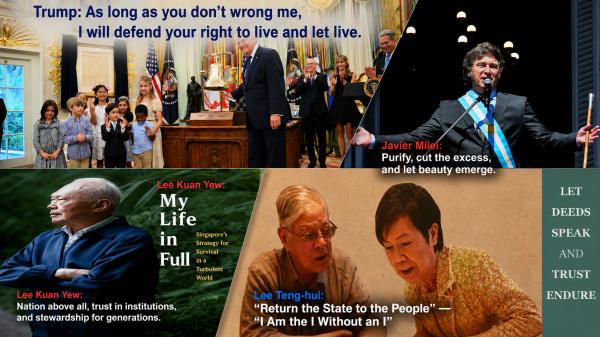
如果再有一个贯通食衣住行信的“川普住家(Trump Home)”,让普通劳动者特别是年轻家庭能够降低住房及相关生活成本,通过工作、积累和产权拥有安居生长的空间,那么,组织孞托就会从政治语言进一步进入每天可感的家庭生活。 到了这里,GDE才真正显出它的力量: C降本、E赋能、H健康、T孞托、P和平,不问你是民主党还是共和党。 一个民主党家庭药费下降,是GDE;一个共和党家庭买得起房,也是GDE;一个没有投票权的孩子开始拥有自己的成长资产,是GDE;一场战争没有发生,一个本来可能走上战场的年轻人平安生活,更是GDE。 贸易、关税、税负、工作、住房、医疗、家庭资产与和平,看似分散,最后都必须接受共通圭臬的检验: 有没有让国民生活得更好? 如果一项政策真实降低生活成本、增加生命能力、改善健康、增进孞托、减少战争,它首先属于哪个党? 它首先属于生活。 如果,再有涵盖食衣住行信的“川普住家”,旧世界的意识形態及其背后的利益博弈,就会在国民可感的GDE践行中逐渐**“空洞化”**。 这不是说左与右、民主与共和、自由与保守、国家主权与人民主权、资本主义与社会主义、民族主义与民权主义,从此完全没有意义。 而是当生活事实重新成为检验组织的尺度,意识形態便不能继续垄断人们对现实的解释。 这也是“全民总统”真正值得珍视的地方。 即使你不愛我,我掌握的公共权力仍然受托于你,让公共权力回到全民。 “全民总统”最终仍然要回到组织孞托。人民孞托总统,并不是把国家交给总统;人民把权力托付给总统,是要求总统把权力用于人民。 因此,这份献词既有表彰,也静静包含着规范: 受托越深,越要懂得托付不是占有;功业越大,越不能让“我”成为组织的目的。 总统属于国家公职,国家公职有任期,国家属于不同族裔和世代的国民。 而“全民”最终还包括那些今天尚不能投票、尚不会说话,甚至尚未来到这个世界的新生代。 三、四位一体:GDE是共通圭臬 现在再看这四个人,关系便清楚了。 李光耀,让不同族群成为国家的国民; 李登辉,让人民成为权力真正的托付者; 米莱,让不能证明受托价值的组织退出; 川普,让公共组织创造的生命效能越过党派,回到全民。 四个人,四种实践,最后都指向一个基准: 生命先于组织,组织是生命的受托者。 所谓“四位一体”,当然不意味着四个人无可争议。 恰恰因为他们都有争议,把他们放在同一行才有意义。 《共生经济学概论》没有必要为任何政治人物建立完美形象。共生经济学只问:哪些实践降低了生命承担的组织成本?哪些实践释放了人的自组织能力?哪些实践恢复了组织边界?哪些实践增进健康与和平?哪些实践生成了可以持续检验的孞托? 反过来也一样。 任何政治人物的任何政策,只要增加无效组织成本、侵蚀生命自组织能力、损害健康、背弃托付、制造不必要的冲突,都必须接受共通圭臬的检验。 C、E、H、T、P不是给任何人的勋章。 它是一种共通圭臬。 组织孞托也不是一次获得、终身拥有的政治资本。 它在履约中生成,在生活中验证,在偏离以后修复。 所以,把四个人写在同一行,不是让任何一个人借另外三个人获得庇护。 恰恰相反。 是把四个人一起放到一个比他们更大的尺度下面:生命。 四、最终的受托人:新生代 四种重建组织孞托的实践,最终都是为了新生代。 一个社会真正危险的时刻,不只是今天的人生活困难,更是今天的组织不断把自己制造的成本转嫁给明天。 财政失序,成为下一代的债。 住房失序,成为年轻人的高墙。 教育失序,提前消耗孩子的生命。 医疗失序,让一个家庭几十年的积累顷刻消失。 社会失孞,让年轻人在进入社会以前便学会怀疑所有人。 战争,更可以在几个月里毁掉一代人的生活。 所以,组织孞托从来不只存在于今天的“你—我—他”之间。 它还有一条纵向的时间轴: 过去——现在——未来。 今天拥有组织权力的人,同时受托保管着一部分属于未来的财政空间、自然资源、社会关系、制度信用、和平环境与生活可能。 我们没有权利把它们全部花完。 更没有权利透支以后,给尚未出生的人留下一张账单。 “生命本自具足,又非独存”,凡事交互主体共生,因此也包含代际之间的托付。 今天的生命不是未来生命的主人。 我们只是时间长河中的受托者。 五、世界格局,从生活改变 这也是为什么我说,《共生经济学概论》虽然只是一册小书,它真正希望推动的改变,却可能触及世界格局。 这里的“世界格局”,首先不是国别格局,不是谁取代谁,也不是哪个国家赢得下一轮霸权。 它首先发生在社区与社会,发生在亿万人的生活之中。 当家庭不再只是GDP中的消费单位; 孩子不再只是未来劳动力; 老人不再只是财政负担; 创造者的Minds Values能够被发现和承兑; 社区重新拥有自组织能力; 企业重新理解自己接受了谁的托付; 政府必须证明每一层组织成本存在的必要; AI成为受托能力,而不能成为凌驾生命的受托主体—— 世界的组织方式已经开始改变。 所以,共生经济学最后的现实贯通,并不是走向一个越来越宏大的世界。 方向恰恰相反。 回到一个个人,一个个家庭,一个个社区,一家家企业,回到亿万生命每天真实发生的生活。 这就是“小即是美”在今天重新获得的意义。 小,不意味着弱。 一个细胞,一粒种子,一个家庭,一次连接,都可以成为生命新秩序发生的起点。 真正需要警惕的,是组织越来越庞大以后,忘记了自己为什么存在。 组织越大,越要记住受托边界; 技术越强,越要知道服务于谁; 权力越大,越要证明自己值得托付。 这也正是“净化过剩,彰显新美”的另一层意义。 新美,不来自再制造一种宏大意识形態。 它发生在组织成本下降以后重新舒展的生活里,发生在一个年轻人能够拥有自己的第一份资产、一个家庭能够安居、一位病人能够负担药费、一个社区能够自己生长、一场战争终于没有发生的时刻。 美重新回到生命。 六、所以,我把他们写在同一行 李光耀、李登辉、哈维尔·米莱、唐纳德·川普。 四个人都有自己的时代,都有自己的局限,也都有自己的争议。 但穿过那些已经固化的左右、东西、精英草根、制度和政治标签,可以看到一条贯穿四种实践的暗线: 把组织重新交还给它所受托的生命。 让国民认同自己的国家。 让人民成为权力的主体。 让社区重新生长。 让政府降低自己的成本。 让公共权力越过党派回到全民。 让家庭和新生代重新获得未来。 让和平重新成为组织效能。 所以,谨以此书献给为重建人类组织孞托作出卓越贡献的四位绅士——亚洲的李光耀、李登辉,美洲的哈维尔·米莱、唐纳德·川普。 四个人不是献词给出的标准答案。他们共同留下了一道问答题。 这道题留给这个世界的所有政府、企业、政党、平台、学校、医院和社区,也留给正在进入人类组织的AI: 你拥有组织生命的能力。 你值得生命托付吗? 而对所有已经掌握今天、正在决定明天的人,还要再问一句无法回避的问题:即使我们能活到150岁,甚至更长,我们究竟准备给新生代留下什么?不管你的答案是什么,有一点是确定的,就是你不能替他们活! 结论就是:Live and let live, Don't be Evil and let evil Be!自己活,也让别人活;而不要自己邪恶,也让别人邪恶。
Four Gentlemen Rebuilding Organizational Trust Archer Hong Qian On the dedication page of Symbionomics: An Overview (Revised Edition), I wrote a very short dedication: DEDICATION This book is dedicated to four gentlemen who have made outstanding contributions to rebuilding humanity’s organizational trust— Lee Kuan Yew and Lee Teng-hui in Asia; Javier Milei and Donald Trump in the Americas. Four men, placed on the same line. That was intentional. They lived in different times, under different national and institutional circumstances, confronting very different social problems. Their political languages, personalities, and approaches to reform differed markedly. Every one of them has also been, or continues to be, controversial. If we follow the political classifications that have become habitual over the past century or more, people immediately begin taking sides: Left or Right, liberty or authoritarianism, democracy or populism, market or government. And the war of concepts begins again. By placing these four men on the same line, I want precisely to move beyond these highly ideological classifications and return to a more fundamental question: Why should an organization be worthy of life’s entrustment? This is also the question that Symbionomics can no longer avoid once it moves from economics into a General Theory of Money, and from there into a General Theory of Organization. I. Why Does Economics Ultimately Encounter “Organizational Trust”? Economy originally concerned human livelihood and household stewardship: how resources could be arranged so that living might continue. Modern economics has enormously expanded humanity’s capacity to understand production, exchange, prices, capital, and growth. It also created GDP, an economic measure that has reshaped the world. Yet when GDP rises while household living costs, ecological burdens, organizational consumption, social distrust, and physical and mental pressures rise with it, economics must continue asking: What has growth actually generated?
Who has gained effectiveness?
Who has borne the cost? This is why Symbionomics moves from GDP to GDE. C — Cost Reduction
E — Empowerment
H — Health
T — Trust
P — Peace GDP records how much economic activity has occurred. GDE goes further and examines how much real effectiveness for life that activity has generated. If a government grows larger, does that necessarily mean progress? If a corporation earns more profit, does that necessarily mean success? If a platform possesses ever more data, or a country acquires ever greater fiscal, military, and technological power, does that necessarily mean that life is being lived better? An organization cannot prove its value merely through its own growth. Organization must submit itself to the test of life. After value generation comes value fulfillment; behind value fulfillment stand the organizations responsible for honoring it. Once governments, corporations, financial institutions, schools, hospitals, platforms, and even AI obtain resources, power, credibility, and human cooperation, they must answer: Whose entrustment have you accepted?
And to whom must you fulfill it? The General Theory of Money thus leads into organizational trust, and the General Theory of Organization emerges. Life precedes organization. Organization is the trustee of life. From this starting point, liberty, democracy, constitutionalism, and republicanism also appear in a different light. They are among humanity’s most precious civilizational discoveries. Yet they cannot remain merely banners or identity labels. Liberty must become space for life to self-organize. Democracy must embody the source of entrusted power. Constitutionalism must draw the boundaries that organizations may not cross. Republicanism must return public organizations to public affairs. When organizations truly become worthy of life’s entrustment, these great words no longer need to be shouted every day. They live in life itself. II. Four Men, Four Forms of Organizational Trust Why Lee Kuan Yew, Lee Teng-hui, Javier Milei, and Donald Trump? Because I do not see four political labels. I see four different forms of organizational trust taking shape in real societies. Lee Kuan Yew: Lee Kuan Yew: National Sovereign Identity Generates Organizational Trust in the State What Lee Kuan Yew left to the world was more than the story of Singapore’s rapid economic rise. A newly independent country of extraordinary ethnic, linguistic, and religious diversity, separated from both colonial rule and Malaysia, first had to answer one question: Who is the subject of this country? The deeper significance of the Singaporean national identity that Lee Kuan Yew helped forge lies here. The country does not belong to any one ethnic group, nor can it become the private possession of any particular bloodline, language, or religion. Its living foundation is the whole body of citizens who constitute it. Once that foundation exists, housing, community, education, environment, public order, and effective administration are no longer merely a set of “public goods” supplied by government. They become the process by which national sovereignty and citizenship enter everyday life. Can a family settle and live securely? Can a community organize itself? Can different ethnic groups form stable expectations about their shared future on the same land? All these questions ultimately ask: Is this our country?
Is this an organization worthy of our entrustment? Lee Kuan Yew therefore represents a path that moves from national sovereign identity into community life, and from community life into the continuing generation of organizational trust. Lee Teng-hui: “Return the State to the People” — “I Am the I Without an I” Lee Teng-hui once said: “I am the I without an I.” This cannot be read merely as a philosophical aphorism. In Bearing Witness for the Lord, he described clearly his life journey from idealism and materialism toward faith. As a Christian, his “I without an I” ultimately had to confront what is most difficult to relinquish in politics: the “I” inside power. Chinese tradition carries a powerful impulse toward tracing one’s roots and ancestry. Political organization possesses another equally stubborn tendency: forming factions for private advantage. When party, state, power, and person become intertwined, “all under heaven for the public” can gradually turn into “organization for me.” Lee Teng-hui’s unusual significance lies precisely in what happened after he reached the top of that organizational structure: he began dismantling the old arrangements that allowed supreme power to perpetuate itself. In 1990, young students entered the public square. Faced with a new generation questioning the “permanent parliament,” the Period of Mobilization for the Suppression of Communist Rebellion, and the political system itself, supreme power had two choices. It could regard the square as a threat to order. Or it could regard the young as participants in the future. Lee Teng-hui chose the latter. He engaged with the students and responded to their demand for a National Affairs Conference, carrying voices from the square into an institutional reform process involving different political and social forces. A living process then unfolded—one too easily compressed into the single word “democratization”: Young people entered the square; power moved toward the young. Society raised the questions; organization accepted the questions. The National Affairs Conference opened deliberation; the old organization began to withdraw. The Period of Mobilization for the Suppression of Communist Rebellion was subsequently terminated. The Temporary Provisions Effective During the Period of National Mobilization for Suppression of the Communist Rebellion were abolished. The “permanent parliament” passed into history. By 1996, the people could directly vote to decide who would receive the entrustment of supreme political power. Of course, this was democracy. But viewed through the General Theory of Organization in Symbionomics, something deeper occurred: Popular sovereignty ceased to be merely a political principle and became a real relationship of entrustment. The organization does not own the people. The people entrust the organization. And Lee Teng-hui completed this process in 2000. It is already difficult for a leader to promote reform while holding power. Harder still is dismantling, from the highest position of power, the very institutions that sustained old power. Hardest of all is allowing supreme power to leave one’s own hands after one has accumulated immense political prestige and real influence. That is the final test of the question: For whom was reform undertaken? If reform ultimately leads back to “I must continue to rule,” everything achieved beforehand remains vulnerable to re-privatization—and even to being undone. In 2000, Lee Teng-hui left the Presidential Office. From 1990 to 2000, an entire chain of organizational trust became visible: Hear life → Respond to life → Open organization → Dismantle old power → Return sovereignty to the people → Let power leave the self. “I am the I without an I” had become political reality. A leader truly worthy of life’s entrustment must not only use power well while holding it; when the time comes to leave, he must allow power to leave him. The transfer of power is not the epilogue of organizational trust. It is organizational trust’s final fulfillment. His work in restoring and developing Taiwan’s farmers’ associations therefore carries another meaning as well. Direct presidential election answers the question of who entrusts supreme political authority. Farmers’ associations connect land, production, finance, farmers, and local life. Popular sovereignty does not happen only once every four years. It must live in communities, in farmers’ associations, in production, and in everyday living. And those young people who stood in the square in 1990 give all of this a special generational meaning: Rebuilding organizational trust also means believing that a new generation has the capacity to participate in creating its own future. Javier Milei: Clear Away the Excess, Let New Beauty Emerge Milei confronted another kind of social pathology: state organizations multiplying without end, fiscal costs continually expanding, government becoming ever more expensive, until society itself is forced to sustain the organization for the sake of the organization. The historical significance of his “chainsaw reform” does not primarily lie in how many ministries were cut or how much spending was reduced. It lies in placing a sharp question before modern political economy: If an organization can no longer demonstrate its entrusted value, why should life be required to sustain it indefinitely? This question goes beyond the conventional Austrian School debate over market freedom, government intervention, and fiscal discipline. The question moves beyond: Big government or small government? It becomes: Why does the organization have the right to exist? The answer can only return to life. Governments, political parties, bureaucratic institutions, and public finance possess no natural right to expand independently of life. If an organization cannot reduce living costs, maintain basic order, or release human creativity, but instead continually reproduces itself through taxation, debt, regulation, and proliferating institutions, it must be subject to reduction, restructuring, or even withdrawal. Once the May Pact became a basis of consensus, Milei’s “chainsaw” therefore cut into something deeper: the presumed right of organization to reproduce itself indefinitely. Organizations must once again demonstrate why they deserve to exist. Economic, political, and cultural self-organizing persons who have long been compressed by excessive organizational costs must be allowed to grow again. Reducing organizational costs means returning living space to society.
Releasing society’s capacity for self-organization makes organizational trust possible again. Milei’s reform therefore acquires a meaning that extends beyond Argentina, and beyond Austrian economics: An organization does not earn the right to exist forever simply because it already exists. Clear away the excess. Let new beauty emerge. Donald Trump: Even If You Don’t Love Me, the Public Power I Hold Is Still Entrusted by You The fourth path represented by Donald Trump remains grounded in the same principle: rebuilding organizational trust. Yet America today faces a particular form of obscuration. Intensifying partisan division can easily turn a president into “the president of half of America.” Before anyone asks whose living costs a policy has reduced or whose capacity for life it has expanded, the issue is already buried beneath Red and Blue, Left and Right, progressive and conservative labels. That is why I am willing to use a very plain phrase here: a president for all the people. “All the people” does not mean unanimous support, nor does it mean abolishing partisan competition. Americans remain entirely free to support a president, oppose him, criticize him, and ultimately decide through elections whether he stays or leaves. Yet once a president accepts the entrustment of the nation’s highest public office, he faces the entire citizenry. Votes can be partisan; life has no party registration.
Elections can produce winners and losers; entrustment cannot serve only the winning half. Whether a restaurant worker’s tips should be repeatedly taxed does not depend on whether he voted Democratic or Republican.
Whether a patient can afford medicine is not a question disease asks about party affiliation. Whether a young family can afford a home and raise children does not change because it lives in a Blue state or a Red state. Life has a natural power to cut through partisan conflict. That is also the criterion by which I observe Trump’s “common-sense agenda.” “Trump Accounts” are directed toward newborns and a new generation that has no party identity. “TrumpRx” addresses illness and the cost of life, regardless of Red or Blue. And if there were, in addition, a Trump Home encompassing the basic conditions of food, clothing, housing, mobility, and trust, allowing ordinary workers—especially young families—to reduce housing and related living costs, accumulate assets through work, and establish a home in which they can settle and grow, organizational trust would move still further from political language into everyday family experience. At that point, the power of GDE becomes visible: C for Cost Reduction, E for Empowerment, H for Health, T for Trust, and P for Peace do not ask whether you are a Democrat or a Republican. If a Democratic household pays less for medicine, that is GDE. If a Republican household can afford a home, that too is GDE. If a child with no vote begins life with an asset that can grow alongside him or her, that is GDE. If a war does not occur, and a young person who might otherwise have gone to the battlefield instead lives in peace, that is GDE as well. Trade, tariffs, taxation, work, housing, healthcare, family assets, and peace may appear to be separate issues. Ultimately, however, they must all submit to the same common criterion: Have they enabled citizens to live better? If a policy truly lowers the cost of living, expands human capacity, improves health, strengthens trust, and reduces war, then to which political party does it first belong? It belongs first to life. If, in addition to Trump Accounts and TrumpRx, there were a Trump Home encompassing food, clothing, housing, mobility, and trust, the ideologies of the old world and the interest struggles concealed behind them would gradually become hollowed out by GDE practices that citizens themselves could actually feel. This does not mean that Left and Right, Democrat and Republican, liberty and conservatism, national sovereignty and popular sovereignty, capitalism and socialism, nationalism and civil rights would suddenly become meaningless. It means that once lived reality again becomes the common criterion by which organizations are judged, ideology can no longer monopolize the interpretation of reality. That is what makes the idea of a president for all the people worth taking seriously. Even if you do not love me, the public power in my hands is still entrusted by you. Yet “a president for all the people” must ultimately return to organizational trust. The people’s entrustment of a president does not mean handing the country over to the president. It means entrusting power to the president so that the president may use that power for the people. This is why the dedication contains both recognition and, quietly, a norm: The deeper the entrustment, the more one must understand that entrustment is not possession.
The greater the achievement, the less the “I” may become the purpose of the organization. The presidency is a public office of the nation. Public office has a term. The country belongs to citizens of different ethnicities and different generations. And “all the people” ultimately includes those who cannot yet vote, who cannot yet speak, and even those who have not yet entered this world. III. Four as One: GDE as a Common Criterion Seen together, the relationship among these four men becomes clearer. Lee Kuan Yew helped different ethnic groups become citizens of one nation. Lee Teng-hui helped make the people the true entrusters of political power. Javier Milei demanded that organizations unable to justify their entrusted value withdraw. Donald Trump has posed a further practical test: the effectiveness for life generated by public organization should cross partisan boundaries and return to all the people. Four men. Four forms of practice. All point toward the same foundation: Life precedes organization. Organization is the trustee of life. “Four as one” certainly does not mean that the four men are beyond controversy. Precisely because they are controversial, placing them on the same line matters. Symbionomics has no need to construct a perfect image of any political leader. It asks only: Which practices reduce the organizational costs borne by life? Which release the self-organizing capacities of human beings? Which restore organizational boundaries? Which advance health and peace? Which generate trust that can withstand continuing examination? The reverse is equally true. Any policy by any political figure that raises unnecessary organizational costs, weakens life’s capacity for self-organization, damages health, betrays entrustment, or manufactures unnecessary conflict must be tested against this common criterion. C, E, H, T, and P are not medals awarded to anyone. They form a common criterion across different political systems and organizational practices. This is precisely what makes GDE commensurable across differences: political systems need not be identical, historical circumstances need not be identical, and policy instruments need not be identical. What can be compared is whether their organizational practices actually reduce costs, empower life, improve health, generate trust, and advance peace. Organizational trust, likewise, is not political capital acquired once and possessed forever. It is generated through fulfillment, tested in living, and repaired after deviation. Placing the four men on the same line therefore does not allow any one of them to seek shelter behind the other three. Quite the opposite. It places all four beneath something greater than themselves: life. IV. The Ultimate Beneficiaries of Entrustment: The New Generation At this point, the deepest meaning of this dedication comes into view: All four forms of rebuilding organizational trust are ultimately for the new generation. The truly dangerous moment for a society is not simply when people today find life difficult. It is when today’s organizations continually transfer the costs they themselves have created into tomorrow. Fiscal disorder becomes debt for the next generation. Housing disorder becomes a wall confronting the young. Educational disorder consumes a child’s life before it has fully unfolded. Healthcare disorder can wipe out decades of a family’s accumulated wealth in an instant. The erosion of social trust can teach young people to distrust everyone before they even enter society. And war can destroy the lives of an entire generation within months. Organizational trust, therefore, never exists only among the “you, me, and others” of the present. It also extends along a vertical axis of time: Past — Present — Future. Those who hold organizational power today are also entrusted with safeguarding a portion of the fiscal space, natural resources, social relationships, institutional credibility, peaceful environment, and possibilities of living that belong to the future. We have no right to spend them all. Still less do we have the right to exhaust them on credit and leave the unborn a bill. “Life is complete in itself, yet never exists alone” therefore also contains an entrustment across generations. The life of today is not the master of the life of tomorrow. We are only trustees in the river of time. V. The Pattern of the World Changes Through Living This is why I say that although Symbionomics: An Overview is only a small book, the change it seeks to advance may touch the very pattern of the world. Here, “the pattern of the world” does not primarily mean the geopolitical configuration of nations—who replaces whom, or which country wins the next round of hegemony. It begins in communities and society, in the everyday living of billions of people. When the family is no longer merely a unit of consumption within GDP; when children are no longer merely future labor; when the elderly are no longer merely a fiscal burden; when a creator’s Minds Values can be discovered and fulfilled; when communities regain their capacity for self-organization; when enterprises once again understand whose entrustment they have accepted; when governments must justify the necessity of every layer of organizational cost; when AI becomes an entrusted capability, rather than a trustee-subject standing above life— the way the world is organized has already begun to change. The final realization of Symbionomics in the real world, therefore, does not lead toward an ever more grandiose world. The direction is precisely the opposite. Back to individual persons, to families, to communities, to enterprises—to the living that actually unfolds every day among billions of lives. This is the renewed meaning of Small Is Beautiful. Small does not mean weak. A cell, a seed, a family, a single connection—each can become the point from which a new order of life begins to emerge. What truly deserves vigilance is the moment when organizations grow ever larger and forget why they exist. The larger the organization, the more clearly it must remember the boundaries of its entrustment;
the stronger the technology, the more clearly it must know whom it serves;
the greater the power, the more it must prove itself worthy of entrustment. This is also another meaning of: Clear away the excess. Let new beauty emerge. New beauty does not come from manufacturing yet another grand ideology. It emerges when life can stretch out and grow again after organizational costs have fallen: when a young person can own a first asset, when a family can settle into a home, when a patient can afford medicine, when a community can grow through its own vitality, when a war that might have happened finally does not happen. Beauty returns to life. VI. And So I Put Them on the Same Line Lee Kuan Yew, Lee Teng-hui, Javier Milei, Donald Trump. Each belongs to his own time. Each has his limitations. Each has his controversies. Yet if we look beyond the hardened labels of Left and Right, East and West, elite and grassroots, institutions and politics, we can see a single underlying thread running through four very different forms of practice: Return organization to the life entrusted to its care. Let citizens identify with their country. Let the people become the subject of power. Let communities grow again. Let government reduce its own costs. Let public power cross partisan lines and return to all the people. Let families and the new generation regain their future. Let peace once again become organizational effectiveness. And that is why I put them on the same line. The dedication need say no more: This book is dedicated to four gentlemen who have made outstanding contributions to rebuilding humanity’s organizational trust— Lee Kuan Yew and Lee Teng-hui in Asia; Javier Milei and Donald Trump in the Americas. These four men are not the standard answer offered by the dedication. Together, they leave behind a question. That question is left to every government, enterprise, political party, platform, school, hospital, and community in the world—and also to the AI now entering human organizations: You possess the capacity to organize life. Are you worthy of life’s entrustment? And to all those who already hold the present in their hands and are helping determine tomorrow, there is one more unavoidable question: Even if we can live to 150 years of age, or longer, what exactly are we preparing to leave to the new generation? Whatever your answer may be, one thing is certain: You cannot live their lives for them. The conclusion is therefore simple: Live and let live; don’t be evil and let evil be. Live your own life, and let others live theirs; do not become evil yourself, or drive others into evil.
|