上帝的慈愛 The Lovingkindness of God 钱 宏(Archer Hong Qian)
2026年8月30日晨于温哥华 人祖违约,偷吃智慧果,被逐出伊甸园。可是,就在人走出伊甸园的同时,慈愛的上帝并没有让人空手走向荒凉的尘世。祂让基路伯和四面转动发火焰的剑,把守住了外在的生命树,却把生命树的一粒种子种进了人的心里。 这粒种子,就是愛。 所以,人类虽然带着“违约”的烙印走向尘世,心中却始终跳动着一颗“神圣的火种”。
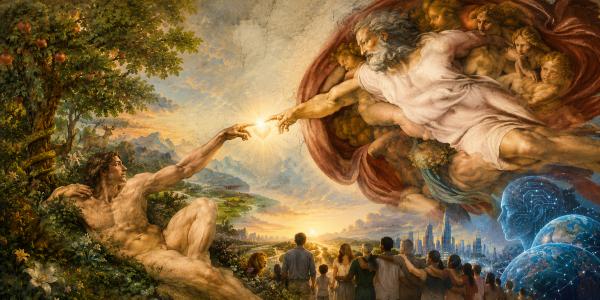
如果我们只从“犯罪—惩罚—驱逐”的线索理解《创世记》,伊甸园的故事便容易显得冰冷而决绝。然而,如果从上帝贯穿始终的慈愛与终极救赎重新阅读,人类走出伊甸园便呈现出另一层深意:违约的后果真实存在,苦难、劳作、羞耻、焦虑、冲突、死亡也从此进入人的生命经验;可是,上帝与人的关系并没有因此终结。恰恰是在离开乐园以后,一个更漫长、更艰难,也更需要自由、信仰、愛与救赎的生命历程开始了。 从基督教神学、神秘主义传统,到后来关于自由、愛与人的精神成长的哲学思考,我们都可以发现与这一理解彼此照亮的思想资源。 一、为什么说“生命树的种子是愛”? 《创世记》记载,人吃了分别善恶之树的果子以后,上帝说,人已经“与我们相似,能知道善恶”;为了不使人再伸手摘取生命树的果子而永远活着,人被送出伊甸园。基路伯和四面转动发火焰的剑,被安置在伊甸园东边,把守通往生命树的道路。 这是一个极富象征意味的场景。 人吃下了智慧之果,却不能再伸手摘取生命之果。 为什么? 通常的解释强调人的犯罪、堕落及其后果。这当然是《创世记》叙事不可回避的一面。 但我更愿意追问:如果“神就是愛”(God is love.),那么即使在人的违约与离去之中,上帝的慈愛又在哪里? 于是,生命树从此发生了一次意义深远的“内转”。 外在的生命树被把守起来了,但生命的神圣根底并没有从人身上彻底撤回。人仍然是按照神的形象与样式(Imago Dei)被造的人;仍然能够感受,能够回应,能够信,能够愛,能够怜悯,能够创造,也能够在跌倒以后悔改,在彼此伤害以后重新寻找连接。 如果一定要为这棵生命树在人心中留下的种子找到一个字,我愿意说: 愛。 Agape。Love。Amor。 它不是肉身永不死亡的神奇果实,也不只是人与人之间的情感依恋,而是生命仍然能够朝向生命、承认生命、感应生命、给予生命、托付生命,并使生命继续生长的神圣可能。 这也使“违约”呈现出一种奇特的双重性。 人吃下智慧之果,失去了伊甸园中未经分别的纯真,从此知道赤裸,知道羞耻,知道善恶,也进入劳作、冲突、恩怨、情仇、痛苦与死亡。 可是,人并没有因此失去愛的可能。 恰恰因为有了自由,有了分别,有了苦难,有了“你”“我”与“他者”,愛才不再只是乐园中未经考验的自然状态,而成为生命在自由中需要作出的选择:人在苦难中学习同情,在孤独中寻找彼此,在冲突中学习宽恕,在有限中学习给予,在死亡面前学习珍惜生命。 智慧果让人知道善恶,生命树的种子则使人仍然能够选择愛。 二、从外在乐园到内在生命:孞托并没有终止 如果借用“孞托(Trust)”来重新理解这个故事,伊甸园中的“约”尤其值得注意。 那不是现代意义上的制度契约,更不能把上帝简单理解成一个“组织”。 在最初的伊甸园里,天地、生命、食物乃至人的存在本身,首先都是给予。人在尚未生产以前已经生活,在尚未交换以前已经获得,在尚未建立制度以前已经处于上帝的创造与托付之中。 因此,最初的孞托,首先是一种生命关系。 上帝给予,人接受;上帝立约,人回应。 人祖违约以后,这一关系受到破坏,却没有被上帝彻底取消。 人离开了外在的乐园,从此必须劳作,必须承担自己的选择,必须面对自然、他人和自己的有限性与不确定性。但上帝没有因此从人的生命中撤去一切神圣的可能。相反,如果说生命树的种子仍被保留在人心,那么孞托也从外在的直接给予,进入了人的内在生命。 Faith 与 Trust,从此必须经过自由;Love 与 Amor,从此必须经过生活。 这是一场极其深刻的生命成长。 在伊甸园中,果实就在树上;走出伊甸园以后,人必须自己播种、耕耘、等待、收获、护卫与分享。 愛也是如此。 它不再只是一个已经完成的结果,而成为一粒需要在人心中生长的种子。 因此,人类走出伊甸园,也可以被理解为从“被给予的生命”,走向“需要在自由中回应生命”;从外在乐园中的直接承兑,走向人在现实生活中重新学习孞托、承担、创造与相愛。 从这个意义上说,上帝没有撤回祂的愛,而是把愛交给人的生命自由去回应。 而人究竟如何回应?这就使我们必须继续沿着《圣约》中的“约”往下走。 三、从“神就是愛”到生命树重新出现 这种理解并非没有《Holy Bible圣约》的内在呼应。 《圣约·约翰第一书》有一句极其简洁、也极其根本的话: “神就是愛。”(God is love.)——《约翰第一书》4:8、4:16 如果神就是愛,那么《创世记》中的创造、立约、审判与逐出,就不能最终脱离愛来理解。审判并不取消慈愛,后果也不意味着关系彻底终结。 更意味深长的是,《圣约》从《创世记》开始于生命树,到《启示录》终结时,生命树又重新出现。 在那里,生命树不再只是伊甸园里被把守的一棵树。它结出生命的果子,它的叶子带来“医治万民”。 从《创世记》到《启示录》,生命树由最初的给予,经过人的违约、离开、苦难、救赎(赎罪 & 赎福)、交互共生(Intersubjective Symbiosism),最终重新出现。 这就形成了一个宏大的生命回环: 生命树在那里——人离开生命树——生命树最终重新向人敞开。 如果生命树最后指向医治、恢复与救赎,那么,我们完全可以进一步追问:贯穿这一漫长过程、使生命最终仍然走向生命的那粒种子,究竟是什么? 我的回答仍然是: 愛。Agape。Love。Amor。 这里还可以联想到基督教传统中极富意味的 Felix culpa——“幸运的罪”。 严格说来,“O felix culpa”这一著名表述来自西方基督教复活节礼仪传统的《逾越颂》(Exsultet),而其背后的神学思想,则与奥古斯丁等人关于堕落、恩典与救赎的思考相互呼应。 它当然不是说“犯罪是一件好事”,更不是鼓励人违约。 它揭示的是一个更加深邃的悖论:人的堕落没有成为上帝慈愛的终点;即使面对人的失败,上帝仍然能够使救赎发生,使更大的愛显现。 如果没有人的有限,我们如何理解恩典?
如果没有人的背离,我们如何理解归回?
如果没有死亡,人又如何如此深切地理解生命? 而在基督信仰中,如果没有人的堕落与需要救赎,道成肉身、十字架上的舍己与复活所显现的 Agape,也不会以同样的方式进入人类历史。 因此,逐出伊甸园不只是毁灭的开始。 它也成为上帝伟大慈愛,在人类历史中展开的序幕。 但是,如果慈愛已经贯穿其中,如果生命树最终还会重新出现,那么从人离开伊甸园,到生命树重新向人敞开的漫长历史之间,究竟发生了什么? 我越来越觉得,就是其历时又共时的一条不能忽略的主线: 约。 四、从律法之约、福音之约到共生之约 人祖以违约离开伊甸园,此后的人类历史,却又不断在“约”中寻找归回生命的道路。 这不是偶然。 人已经吃下智慧果,拥有分别善恶的能力,也拥有自由。问题随之发生:自由如何不变成任意?智慧如何不变成伤害?人与人如何在彼此分别以后仍然生活在一起? 于是有了律法之约。 “不可杀人。”“不可偷盗。”“不可作假见证。”“不可贪恋。” 这些“不可”,首先为人的自由划出了边界。智慧可以辨别,欲望可以扩张,力量可以增长,但人的行为不能因此失去界限。拥有自由,并不意味着可以任意伤害另一个生命。 所以,律法之约首先回答: 有了自由,人不可做什么? 它守住生命的底线。 可是,仅仅知道“不可”,还不足以使生命重新回到生命。律法能够划出行为的边界,却不能仅凭外在戒律让人产生愛;能够约束人的手,却无法仅凭命令改变人的心。 于是,“约”继续向人的生命深处展开。 耶稣把律法和先知的总纲归结到两个“愛”: 愛神。 愛人如己。 到了这里,“约”发生了一次深刻的内转。 律法没有因此失去意义,而是被愛重新照亮。人不只是因为“不可杀人”才不杀人,也因为看见另一个生命;不只是因为“不可偷盗”才不偷盗,也因为承认他人的存在;不只是因为害怕惩罚而守约,而是在愛中重新学习人与神、人与人的关系。 如果说律法之约首先告诉人: 不可伤害生命。 那么,福音之约进一步告诉人: 你要愛。 这与生命树种在人心中的那粒种子恰恰彼此呼应。上帝没有只在人离开伊甸园以后留下越来越严密的禁令,而是借着祂的亲子耶稣,道成肉身、十字架与复活,把 Agape——舍己、给予、救赎的愛——直接呈现在人的生命面前。 律法写下边界。 福音唤醒愛。 可是,人类的故事仍然没有结束。 两千年来,人类一方面传播福音,另一方面又把智慧之树培育到前所未有的高度。科学、技术、资本、市场、国家、现代组织、互联网,直到今天的AI,使人的能力抵达《圣约》之初难以想象的程度。 一个人的决定可以影响亿万人。一个组织可以调动全球资源。一个算法可以进入亿万人的日常生活。一个AI开始参与人的认知、判断、创造乃至行动。 于是,“约”,在今天又面对一个新的文明问题: 当愛已经进入人的心,如何让愛进一步进入人与人、人与组织、人与自己(身心灵)、人与技术、人与万物之间真实发生的关系? 这就是我所说的: 共生之约。 共生之约不是在律法之约、福音之约之外另造一个宗教意义上的“第三约”,更不是用一个现代概念取代《圣约》。 它是站在今天的生活世界中,让“约”的生命意涵继续展开: 让律法所守护的生命边界,让福音所唤醒的愛,进入你、我、他(她、它、祂)之间真实发生的交互关系。 律法之约,使自由知道边界。福音之约,使生命懂得相愛。共生之约进一步追问: 不同而自由的生命,如何在彼此不能替代、也不应彼此吞没的世界中,一起生活、生长和创造? 这正是: 生命本自具足,又非独存。 你是你,我是我,他是他。因为彼此不同,才有交互;因为各自具足,才可能给予;因为生命非独存,才需要连接;因为人拥有自由,守约与相愛才真正具有意义。 于是,“约”从外在行为的边界,进入内心的愛,又从内心的愛进入真实世界的关系过程: 从不可彼此伤害,到彼此相愛,再到彼此连接、彼此托付、彼此赋能而又各自生长,直至凡事交互主体共生(Everything Intersubjective Symbiosism)。 这就是我从律法之约—福音之约—共生之约中看到的一条生命展开线。 它们并非三个彼此替代的历史阶段。律法没有因为福音而失去生命边界的意义;福音也不会因为进入共生时代而成为过去。相反,它们像生命树生长出来的不同层次: 律法守住生命的底线, 福音唤醒生命的愛, 共生让愛进入关系、组织与文明。 到了数位—量子时代,这一点尤其重要。 当AI越来越强大,仅仅告诉AI什么“不可做”,还不够;仅仅要求创造和使用AI的人怀有善意,也不够。生命的边界、愛的方向、自由主体之间彼此托付的关系,需要进一步进入经济、技术、组织以及智能基础设施本身。 这正是组织孞托、LIFE–AI–TRUST,以及从AI升格为AM最终面对的文明问题。 因此,我们也可以这样说: 律法之约回答自由的边界, 福音之约回答愛的根源, 共生之约回答愛如何在人间发生。 如此再回望伊甸园,两棵树便真正贯通起来了。智慧果使人获得分别,律法为分别划出边界;福音让人在分别之后重新学习相愛;共生则使不同的生命带着各自的自由与智慧,在你我他之间重新连接。 生命树由此不再只是一棵等待人返回伊甸园寻找的树。 当愛进入自由,进入关系,进入孞托,进入组织,进入技术,进入AI,生命树已经开始在人间重新生长,且Everything Intersubjective Symbiosism。 五、智慧树走向世界,生命树进入人心 于是,再看人类走出伊甸园以后发生的一切,那条文明线索也变得更加清晰。 人失去了伸手可得的乐园,却没有失去上帝赋予生命的神圣火种。 从此,智慧可以使人辨别、计算、创造,也可能使人骄傲、争夺、征服和彼此伤害;而深藏于生命之中的愛,则使人在自由与苦难中仍然能够信任、同情、给予、创造、宽恕,并重新寻找彼此,交互契合。 人类走出伊甸园既留下了违约的烙印,也展开了慈愛与救赎的漫长历史。 这也使我重新理解那两棵树。 智慧树使人走出了伊甸园,生命树的种子却随人一起走进了世界。 几千年来,人类不断培育智慧之果。 Philosophy。宗教、逻辑、几何(形学)、数学、科学。工业、技术、市场与现代组织。计算机、互联网、量子科技、生命科技。直到今天的AI。 智慧之树已经长得无比繁茂。 可是,与此同时,那粒埋在人心深处的生命种子也从未停止萌动。它出现在母亲对孩子的拥抱中,出现在陌生人面对苦难时伸出的手中,出现在人对真理的诚实追寻中,出现在创造、托付、宽恕、牺牲与彼此相愛中。 经过律法对边界的守护,经过福音对愛的唤醒,今天,人类又站到了一个新的关口: 我们能不能让愛真正进入已经高度发达的智慧文明? 这或许正是人类面对AI时必须重新回答的问题: 智慧究竟为了什么? 如果智慧只是继续增加智慧,只是不断获得更多知识、更快计算、更强能力,人类仍然可能继续只吃智慧之果。 可是,当智慧已经强大到足以重新塑造人的生活、社会乃至文明,生命树的种子便不能再被遗忘。 所以,我提出: 让轴心时代的 Philosophy(智慧之愛)升格为共生时代的 Amorsophia(愛之智慧)。 让 AI(Artificial Intelligence) 升格为 AM(Artificial Mind & Amorsophia MindsField/Network)。 这不是抛弃智慧,而是让智慧重新扎根生命;不是否定几千年来人类获得的知识,而是让知识重新知道自己为什么存在。 如果说律法之约为智慧划出了生命边界,福音之约把愛重新唤醒在人心,那么共生之约所面对的,正是我们今天正在进入的生活世界: 让智慧与愛重新相遇。 让生命之愛进入技术,进入经济,进入货币,进入组织孞托,进入AI;让智慧不再只是拥有越来越强大的能力,同时知道这些能力接受谁的托付、为了谁的生命、应当把世界带向哪里。 于是,曾经在伊甸园中分开的两棵树,便可能在你、我、他(她、它、祂)的交互相愛与契合共生中重新相遇。 我们不是把历史倒转回伊甸园。 人类已经吃下的智慧果,不可能吐出来;已经获得的科学、技术与文明,也不应该被抛弃。 我们要做的,是: 带着已经获得的全部智慧,重新走向生命。 如果当初,人祖离开伊甸园时,上帝已经把生命树的一粒种子留在了人的心里,那么几千年的文明史,也可以从另一个角度重新理解: 人类走了那么远,经历那么多智慧、荣耀、战争、苦难、创造与毁灭,也许最终正是为了重新发现—— 生命树从未真正离开我们。 它一直等待在人心深处。 等待智慧重新找到生命,等待自由重新懂得边界,等待福音唤醒的愛进入生活,等待孞托重新发生,等待你我他重新相愛,等待生命与智慧重新交互契合。 从律法之约到福音之约,再到共生之约,人类所寻找的也许始终是同一条生命之路: 让自由不离开生命, 让智慧不离开愛, 让愛不只留在心里,而在人间发生。 上帝把守了生命树的道路,却没有封死人通向生命的道路。 因为那条路,最终被祂写进了人的心里。 那就是—— 愛。Agape。Love。Amor。 一点说明: 《共生经济学概论(修订版)》和《将AI升格为AM》两本书稿交给出版社之际,我萌生了写作《“两棵树”因你我他而重新相遇》(https://amorsophia.com/article/10264)一文的激动,而此文思绪的背后,就是《上帝的慈愛》。 《共生经济学概论(修订版)》和《将AI升格为AM》两书得以最终问世,首先要感谢北美科发出版集团的张辉,感谢我的愛人和孩子们,感谢这个科技昌明的时代,感谢北美自然风貌、自由人文和自在生活,感谢上帝的赐福和无尽的恩典!
The Lovingkindness of GodArcher Hong Qian Morning of August 30, 2026, Vancouver The ancestors of humankind broke the covenant, ate the fruit of knowledge, and were driven from the Garden of Eden. Yet as humanity left Eden, the loving God did not send them empty-handed into the desolate world. He appointed the cherubim and the flaming sword turning every way to guard the external Tree of Life, yet He planted a seed of the Tree of Life within the human heart. That seed is Love. Thus, although humanity entered the world bearing the mark of a “broken covenant,” a “sacred spark” has continued to beat within the human heart. If we understand Genesis only through the sequence of “sin—punishment—expulsion,” the story of Eden can easily appear cold and final. Yet if we reread humanity’s departure from Eden through God’s abiding lovingkindness and ultimate redemption, another meaning emerges. The consequences of breaking the covenant were real: suffering, labor, shame, anxiety, conflict, and death entered human experience. Yet the relationship between God and humanity did not thereby come to an end. It was precisely after leaving the Garden that a longer and more difficult journey of life began—a journey calling even more deeply for freedom, faith, love, and redemption. From Christian theology and mystical traditions to later philosophical reflections on freedom, love, and spiritual growth, we can find many intellectual resources that mutually illuminate this understanding. I. Why Say That the Seed of the Tree of Life Is Love?Genesis tells us that after human beings ate the fruit of the Tree of the Knowledge of Good and Evil, God said that humanity had become “like one of us, knowing good and evil.” Lest they reach out their hands and also take from the Tree of Life and live forever, they were sent out of Eden. The cherubim and the flaming sword turning every way were placed at the east of the Garden to guard the way to the Tree of Life. It is a scene rich in symbolic meaning. Humanity had eaten the fruit of knowledge, yet could no longer reach out and take the fruit of life. Why? The usual interpretation emphasizes human sin, the Fall, and its consequences. This is, of course, an inescapable dimension of the Genesis narrative. But I would rather ask: if “God is love,” then even amid humanity’s broken covenant and departure, where was God’s lovingkindness? The Tree of Life, I suggest, then underwent a profound inward turn. The external Tree of Life was guarded, but the sacred ground of life was not completely withdrawn from humanity. Human beings remained created in the image and likeness of God—Imago Dei. They could still feel and respond, believe and love, show compassion and create. They could still repent after falling, and after hurting one another, seek connection again. If I had to name in a single word the seed of the Tree of Life left within the human heart, I would say: Love. Agape. Love. Amor. It is not a magical fruit granting bodily immortality, nor is it merely emotional attachment between human beings. It is the sacred possibility that life can still turn toward life, recognize life, resonate with life, give to life, entrust life to life, and enable life to continue growing. This also gives the “broken covenant” a remarkable duality. By eating the fruit of knowledge, humanity lost the undivided innocence of Eden. Human beings came to know nakedness, shame, good and evil, and entered a world of labor, conflict, grievance and affection, pain and death. Yet humanity did not thereby lose the possibility of Love. Precisely because there was now freedom, distinction, suffering, and the presence of “you,” “me,” and “the other,” Love could no longer remain merely an untested natural condition within the Garden. It became a choice that life must make in freedom: learning compassion through suffering, seeking one another through loneliness, learning forgiveness amid conflict, learning to give within finitude, and learning to cherish life in the face of death. The fruit of knowledge enabled humanity to know good and evil; the seed of the Tree of Life enabled humanity still to choose Love. II. From the External Garden to Inner Life: Trust Was Never TerminatedIf we borrow the idea of 孞托 (Trust) to understand this story anew, the “covenant” in Eden deserves particular attention. It was not an institutional contract in the modern sense, still less should God be reduced to an “organization.” In the original Garden of Eden, heaven and earth, life and food—even human existence itself—were first and foremost gifts. Human beings lived before they produced, received before they exchanged, and existed within God’s creation and entrustment before they established institutions. The primordial Trust, therefore, was first of all a relationship of life. God gives; humanity receives. God establishes the covenant; humanity responds. After humanity broke the covenant, this relationship was damaged, but God did not abolish it altogether. Human beings left the external Garden. From then on, they had to labor, bear the consequences of their choices, and face the finitude and uncertainty of nature, other people, and themselves. Yet God did not therefore withdraw every sacred possibility from human life. On the contrary, if the seed of the Tree of Life remained within the human heart, then Trust also moved from external and immediate giving into the inner life of human beings. Faith and Trust must henceforth pass through freedom; Love and Amor must henceforth pass through lived life. This was a profound maturation of life. In Eden, the fruit was already on the tree. Outside Eden, human beings had to sow, cultivate, wait, harvest, protect, and share. So it is with Love. Love was no longer simply a completed gift. It became a seed that had to grow within the human heart. Humanity’s departure from Eden can therefore also be understood as a movement from “life that is given” toward “life that must be answered in freedom”; from direct redemption within an external Garden toward learning anew, within lived reality, how to trust, take responsibility, create, and love one another. In this sense, God did not withdraw His Love. He entrusted Love to the freedom of life to answer. But how is humanity to answer? This brings us further along the path of the “covenant” within the Holy Bible · 圣约. III. From “God Is Love” to the Reappearance of the Tree of LifeThis understanding finds an inner resonance within the Holy Bible · 圣约 itself. The Holy Bible · 圣约 · First Epistle of John contains an extraordinarily simple yet fundamental statement: “God is love.” — 1 John 4:8, 4:16 If God is Love, then creation, covenant, judgment, and expulsion in Genesis cannot ultimately be understood apart from Love. Judgment does not cancel lovingkindness, and consequences do not mean that relationship has been permanently severed. Even more significantly, the Holy Bible · 圣约 begins in Genesis with the Tree of Life, and by the end of Revelation, the Tree of Life appears again. There, the Tree of Life is no longer merely the guarded tree of Eden. It bears the fruit of life, and its leaves are for the “healing of the nations.” From Genesis to Revelation, the Tree of Life moves from the original gift, through humanity’s broken covenant, departure, suffering, redemption—redemption from sin & redemption toward blessed life—and Intersubjective Symbiosism, until at last it appears again. A magnificent cycle of life thus takes shape: The Tree of Life was there— humanity departed from the Tree of Life— the Tree of Life is ultimately opened to humanity again. If the Tree of Life ultimately points toward healing, restoration, and redemption, we may ask one further question: what is the seed that runs through this long process and enables life, in the end, still to move toward life? My answer remains: Love. Agape. Love. Amor. Here we may also recall the deeply suggestive Christian idea of felix culpa—the “fortunate fall.” Strictly speaking, the celebrated expression O felix culpa comes from the Exsultet, the Easter Proclamation of the Western Christian liturgical tradition, while the theology behind it resonates with Augustine and other thinkers reflecting on the Fall, grace, and redemption. It certainly does not mean that “sin is good,” nor does it encourage anyone to break the covenant. Rather, it reveals a deeper paradox: humanity’s Fall did not become the endpoint of God’s lovingkindness. Even in the face of human failure, God can still bring about redemption and reveal a greater Love. Without human finitude, how would we understand grace? Without departure, how would we understand return? Without death, how could human beings understand life so deeply? And within Christian faith, without humanity’s Fall and need for redemption, the Agape manifested through the Incarnation, self-giving on the Cross, and Resurrection would not have entered human history in the same way. The expulsion from Eden, therefore, was not merely the beginning of destruction. It also became the prelude to the unfolding of God’s great lovingkindness within human history. Yet if lovingkindness runs throughout this story, and if the Tree of Life will ultimately reappear, what happened during that long history between humanity’s departure from Eden and the reopening of the Tree of Life? Increasingly, I have come to see one indispensable thread running through history and simultaneously present within it: Covenant. IV. From the Covenant of Law and the Covenant of Gospel to the Covenant of SymbiosisHumanity left Eden by breaking a covenant. Yet throughout the history that followed, humanity has repeatedly sought, through covenant, a path back toward life. This is no accident. Having eaten the fruit of knowledge, human beings possessed the capacity to distinguish good from evil. They also possessed freedom. New questions immediately arose: How can freedom avoid becoming arbitrariness? How can wisdom avoid becoming harm? How can human beings continue living together after distinction has entered their world? Thus came the Covenant of Law. “Do not murder.” “Do not steal.” “Do not bear false witness.” “Do not covet.” These prohibitions first established boundaries for human freedom. Wisdom may distinguish; desire may expand; power may grow. Yet human conduct cannot therefore become boundless. To possess freedom does not mean possessing the right to harm another life at will. The Covenant of Law therefore first answers: Given freedom, what must human beings not do? It safeguards the baseline of life. Yet knowing what one must not do is still insufficient to bring life back to life. Law can draw boundaries around conduct, but external commandments alone cannot generate Love. Law can restrain the hand, but command alone cannot transform the heart. Thus the “covenant” continued inward, toward the depths of human life. Jesus summarized the Law and the Prophets through two expressions of Love: Love God. Love your neighbor as yourself. Here the covenant underwent another profound inward turn. Law did not thereby lose its meaning. It was illuminated anew by Love. One refrains from killing not merely because “you shall not murder,” but because one sees another life. One refrains from stealing not merely because “you shall not steal,” but because one recognizes the existence of the other. One keeps covenant not merely out of fear of punishment, but learns anew, through Love, the relationship between humanity and God and among human beings themselves. If the Covenant of Law first tells humanity: Do not harm life, then the Covenant of Gospel goes further: You shall love. This resonates precisely with that seed of the Tree of Life planted within the human heart. God did not merely leave humanity with ever more elaborate prohibitions after its departure from Eden. Through His Son Jesus—the Incarnation, the Cross, and the Resurrection—He directly manifested Agape: self-giving, giving, redeeming Love within human life. Law inscribes the boundary. Gospel awakens Love. Yet the human story did not end there. For two thousand years, humanity has spread the Gospel while simultaneously cultivating the Tree of Knowledge to an unprecedented height. Science, technology, capital, markets, states, modern organizations, the Internet, and now AI have given humanity capabilities scarcely imaginable at the beginning of the Holy Bible · 圣约. One person’s decision can affect hundreds of millions. One organization can mobilize resources across the globe. One algorithm can enter the daily lives of billions. An AI can begin participating in human cognition, judgment, creation, and even action. The covenant therefore encounters a new civilizational question today: Once Love has entered the human heart, how can Love further enter the relationships that actually occur between person and person, person and organization, person and self—body, mind, and spirit—person and technology, and person and all things? This is what I call: the Covenant of Symbiosis. The Covenant of Symbiosis is not an attempt to manufacture a religious “third covenant” alongside the Covenant of Law and the Covenant of Gospel. Still less does it use a modern concept to replace the Holy Bible · 圣约. It is an attempt, from within today’s lived world, to allow the life-meaning of “covenant” to continue unfolding: Let the boundaries of life safeguarded by Law and the Love awakened by the Gospel enter the actual interactive relationships among you, me, and the other—he, she, it, and He. The Covenant of Law enables freedom to know its boundaries. The Covenant of Gospel enables life to know how to love. The Covenant of Symbiosis asks a further question: How can different and free lives live, grow, and create together in a world where none can replace another and none should swallow another? This is precisely what I mean when I say: Life is self-sufficient in itself, yet never exists alone. You are you. I am I. The other is the other. Because we are different, interaction becomes possible. Because each is self-sufficient in itself, giving becomes possible. Because life never exists alone, connection becomes necessary. And because human beings possess freedom, covenant and Love acquire their true meaning. Thus covenant moves from the external boundaries of conduct into the Love of the inner heart, and from inner Love into the relational processes of the real world: from refraining from harming one another, to loving one another, to connecting, entrusting, and empowering one another while each continues to grow in its own right— until Everything enters Intersubjective Symbiosism. This is the unfolding of life that I see in the movement from the Covenant of Law → Covenant of Gospel → Covenant of Symbiosis. They are not three historical stages in which one replaces another. Law does not lose its role in safeguarding the boundaries of life because of the Gospel; nor does the Gospel become a thing of the past because humanity enters the Symbiotic Age. Rather, they are like different dimensions growing from the Tree of Life: Law safeguards the baseline of life. Gospel awakens the Love of life. Symbiosis brings Love into relationships, organizations, and civilization. In the Digital–Quantum Age, this becomes especially important. As AI grows increasingly powerful, merely telling AI what it “must not do” is not enough. Merely asking those who create and use AI to possess goodwill is also not enough. The boundaries of life, the direction of Love, and relationships of mutual entrustment among free subjects must enter economics, technology, organizations, and intelligent infrastructure itself. This is precisely the civilizational question ultimately confronted by organizational 孞托, LIFE–AI–TRUST, and the elevation of AI into AM. We may therefore put it this way: The Covenant of Law answers the boundaries of freedom. The Covenant of Gospel answers the source of Love. The Covenant of Symbiosis answers how Love happens in the human world. Seen from here, the two trees in Eden finally become connected. The fruit of knowledge gave humanity the capacity to distinguish; Law established boundaries for distinction; Gospel taught humanity, after distinction, to love again; Symbiosis enables different lives, carrying their own freedom and wisdom, to reconnect among you, me, and the other. The Tree of Life is therefore no longer merely a tree waiting for humanity to return to Eden to find it. When Love enters freedom, relationships, Trust, organizations, technology, and AI, the Tree of Life has already begun to grow again in the human world—and Everything enters Intersubjective Symbiosism. V. The Tree of Knowledge Goes Out into the World; the Tree of Life Enters the Human HeartSeen in this light, the civilizational thread running through everything that happened after humanity left Eden becomes clearer. Humanity lost the Garden whose fruit could simply be reached for, but it did not lose the sacred spark that God had bestowed upon life. From then on, wisdom could enable human beings to distinguish, calculate, and create; it could also lead them toward pride, rivalry, conquest, and mutual harm. Yet Love, hidden deep within life, continued to enable human beings amid freedom and suffering to trust, sympathize, give, create, forgive, seek one another again, and enter into interactive coherence. Thus humanity’s departure from Eden bore the mark of a broken covenant, while also unfolding into the long history of lovingkindness and redemption. This leads me to understand the two trees anew: The Tree of Knowledge led humanity out of Eden, while the seed of the Tree of Life journeyed with humanity into the world. For thousands of years, humanity has continued cultivating the fruit of knowledge. Philosophy. Religion, logic, geometry, mathematics, science. Industry, technology, markets, and modern organizations. Computers, the Internet, quantum technology, life sciences. And now, AI. The Tree of Knowledge has grown extraordinarily luxuriant. Yet throughout this same history, the seed of life buried deep within the human heart has never ceased to stir. It appears in a mother’s embrace of her child, in the hand extended by a stranger in the face of suffering, in the honest pursuit of truth, and in creation, entrustment, forgiveness, sacrifice, and mutual Love. After Law safeguarded the boundaries, and after Gospel awakened Love, humanity today stands at another threshold: Can we allow Love truly to enter an already highly developed civilization of wisdom? This may be precisely the question humanity must answer anew in the age of AI: What is wisdom for? If wisdom merely continues adding more wisdom—more knowledge, faster computation, greater capability—humanity may simply continue eating only the fruit of knowledge. But when wisdom has become powerful enough to reshape human life, society, and even civilization itself, the seed of the Tree of Life can no longer be forgotten. That is why I propose: Elevate the Philosophy of the Axial Age—the Love of Wisdom—into the Amorsophia of the Symbiotic Age—the Wisdom of Love. Elevate AI (Artificial Intelligence) into AM (Artificial Mind & Amorsophia MindsField/Network). This does not mean abandoning wisdom. It means allowing wisdom to take root again in life. It does not negate the knowledge humanity has accumulated over thousands of years. It asks knowledge to understand again why it exists. If the Covenant of Law drew the boundaries of life around wisdom, and the Covenant of Gospel reawakened Love within the human heart, then the Covenant of Symbiosis addresses precisely the lived world into which we are now entering: Let wisdom and Love meet again. Let the Love of life enter technology, economics, money, organizational 孞托, and AI. Let wisdom do more than simply acquire ever greater capabilities; let it also know from whom those capabilities receive their entrustment, whose lives they are meant to serve, and toward what kind of world they should lead us. Then the two trees once separated in Eden may meet again through the interactive Love and symbiotic coherence of you, me, and the other—he, she, it, and He. We are not reversing history and returning to Eden. Humanity cannot spit out the fruit of knowledge it has already eaten; nor should it discard the science, technology, and civilization it has already attained. What we must do is: carry all the wisdom we have acquired and return again toward life. If, when humanity first left Eden, God had already placed a seed of the Tree of Life within the human heart, then thousands of years of civilization can also be understood from another perspective. Humanity has traveled so far and experienced so much wisdom and glory, war and suffering, creation and destruction, perhaps ultimately to rediscover this: The Tree of Life has never truly left us. It has always been waiting within the human heart. Waiting for wisdom to find life again, waiting for freedom to understand its boundaries again, waiting for the Love awakened by the Gospel to enter lived life, waiting for Trust to happen again, waiting for you, me, and the other to love again, waiting for life and wisdom to enter interactive coherence again. From the Covenant of Law to the Covenant of Gospel and onward to the Covenant of Symbiosis, perhaps humanity has always been seeking the same path of life: Let freedom never depart from life. Let wisdom never depart from Love. Let Love not remain only within the heart, but happen in the human world. God guarded the way to the Tree of Life, but He did not seal off humanity’s way toward life. For in the end, He inscribed that way within the human heart. And that way is— Love. Agape. Love. Amor. A Brief NoteAs the manuscripts of SYMBIONOMICS: AN OVERVIEW (Revised Edition) and Elevating AI into AM were being delivered to the publisher, I felt a sudden impulse to write “The Two Trees” Meet Again Through You, Me, and the Other. Behind the thoughts that gave rise to that essay was this very reflection: The Lovingkindness of God. As SYMBIONOMICS: AN OVERVIEW (Revised Edition) and Elevating AI into AM finally come into the world, my first thanks go to Zhang Hui of KF Times Group Inc.; to my beloved wife and children; to this age of flourishing science and technology; to North America’s natural beauty, its culture of freedom, and its ease of life; and, above all, to God for His blessings and boundless grace. “The Two Trees” Meet Again Through You, Me, and the Other
|