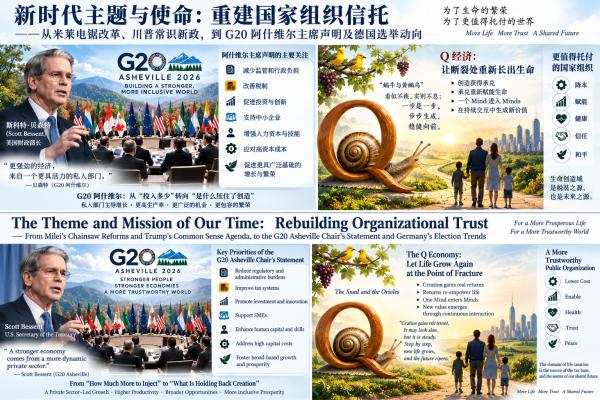
新时代主题与使命:重建国家组织孞托 A Theme and Mission of the New Era: Rebuilding Organizational Trust in the State ——从米莱电锯改革、川普常识新政,到G20阿什维尔主席声明及德国选举动向 —From Milei’s Chainsaw Reform and Trump’s Common-Sense Agenda to the G20 Asheville Chair’s Statement and Germany’s Electoral Shift 钱 宏(Archer Hong Qian) 有些时代转变,是理论先行,实践随后;有些时代转变,却是现实先撕开一道口子,人们才逐渐发现:原来不同国家正在面对同一个深层问题。 今天正在发生的,可能属于后者。 阿根廷总统米莱挥舞“电锯”,以《五月公约》为纲领推进改革;美国总统川普重新执政后,以 “对本国人民负责”的常识,推动政府、贸易、边境、能源等领域的重新调整。两国国情不同,改革方式不同,具体政策当然也不能简单等同。 然而,如果暂时放下“左还是右”“自由主义还是保守主义”“资本主义还是社会主义”这些已经争论了一两个世纪的标签,向更深处追问,就会发现一个共同的问题: 国家组织究竟为什么存在? 它所掌握的权力、财政与公共资源,究竟是谁托付的? 受托以后,又应当向谁承兑责任?
现在,这个问题正在超出阿根廷和美国。2026年9月举行的G20阿什维尔财长和央行行长会议,把促进经济增长列为关键优先事项,提出推动更具广泛基础的增长与繁荣(broad-based growth and prosperity),同时把监管和行政负担、低效税制、投资不足、高资本成本等列为阻碍强劲增长的重要因素,提出减少繁文缛节和过度监管、促进投资与创新、改善人力资本,并特别关注中小企业、就业以及脆弱群体。 德国正在显现的选举动向,则从另一个方向提出相似的问题:财政究竟应该花在哪里?哪些开支是国家履行受托责任所必需的,哪些已经成为组织自我维持的成本?边境、移民、福利与本国公民之间,国家受托责任的边界又在哪里? 于是,从布宜诺斯艾利斯到华盛顿,从阿什维尔到德国,我们开始看到,一条过去常常被“左右之争”遮蔽的时代线索: 重建国家组织孞托(Rebuilding Organizational Trust)。 一、米莱的“电锯”,为什么首先砍向组织成本? 米莱的出现,并非偶然。当一个国家长期面对财政赤字、通货膨胀、债务压力、行政膨胀和经济失序时,传统政治往往仍然围绕“应该由谁获得更多资源”展开争论。 米莱却把问题推向了另一端:这些资源首先为什么要经过如此庞大的国家组织? 于是,“电锯”成为一个极具视觉冲击力的政治符号。但是,如果仅仅把电锯理解成“砍政府”“砍公务员”“砍财政支出”,就低估了这场改革可能具有的意义。 真正需要锯掉的,不应该是国家本身,而是国家组织中那些不能继续证明其受托价值,却仍然要求生命不断为之支付成本的冗余部分。 机构为什么存在?职位为什么存在?补贴为什么存在?审批为什么存在?监管为什么存在?税收为什么以这种方式征收?每一项公共支出最后创造了什么公共价值?这些问题最终都指向同一个原点:国家组织不是为了供养国家组织而存在。 组织因生命需要而发生。一个机构最初可能为解决某个真实问题而设立;但组织一旦形成,就可能产生自我保存、自我扩张、自我复制的惯性。久而久之,原本作为手段存在的组织,会把自身延续变成目的。 这就是Symbionomics(共生经济学)讲的殖官机制(Reproductive Officialdom)。 于是就发生了受托关系的倒置:原本由生命创造并供养组织,目的是让组织服务生命;最后却变成生命不断为组织自身的存在承担成本。这正是共生经济学所诊断的殖官主义(Bureaucolonialism)的重要病根。 所以,米莱电锯改革真正值得世界观察的,不只是“砍掉多少”,而是砍掉以后生成什么。如果只有“破”,没有“立”,电锯最终只是工具;如果能够从削减冗余进一步走向重建国家与人民之间的受托关系,它才可能成为一次组织范式转换。 电锯之后,真正艰难的工程,是重建组织孞托。 二、川普的“常识新政”,追问的是国家首先向谁负责 美国的情形完全不同。但是,川普团队反复强调的一个政治命题——政府必须对本国人民负责——同样触及国家组织的受托关系。 一个国家为什么有政府?为什么征税?为什么拥有边境?为什么维持军队、法院、警察、公共基础设施和社会保障?为什么人民授予政府如此巨大的公共权力?因为这里存在一种基本的委托—受托关系。 问题在于,当现代国家越来越庞大,行政体系越来越复杂,政策目标越来越繁多,政府究竟首先向谁负责,反而可能变得模糊。 于是,“America First”真正值得讨论的,并不只是民族主义口号。如果剥掉党派政治和情绪动员的外衣,它提出了一个所有国家都无法回避的问题:一个国家组织能不能在没有首先履行对自己受托人的责任之前,就无限扩展自己的责任范围? 这并不意味着国家之间不需要合作,更不意味着拒绝承担国际责任。恰恰相反,只有一个能够获得自己人民信任的国家,才更有能力与其他国家建立稳定、可信、持续的合作关系。受托责任不是国际合作的反面,而是可信合作的基础。 三、从米莱到川普:发生的并非“世界右转” 因此,把阿根廷与美国的变化简单称为“右翼浪潮”,可能过于表面。左右坐标当然仍然有解释力,但它无法充分解释一个越来越普遍的问题:为什么不同国家的普通人,都越来越要求组织重新解释自己存在的理由? 为什么财政支出越来越需要证明价值?为什么行政成本越来越受到质疑?为什么监管、边境、税收、福利、产业政策乃至国际援助,都开始被重新追问:谁支付?谁受益?谁负责? 这已经不仅仅是左右之争。它更像一场委托人与受托人关系的重新校准。 过去人们不断争论:政府大一点,还是小一点?现在更应该追问:无论大小,它究竟是不是一个合格的受托组织? 一个小政府可能腐败、低效、寻租、失信;一个较大的政府也可能提供高效、透明、低成本而值得信赖的公共服务。所以,共生经济学(Symbionomics)不把“大政府—小政府”作为最后的判断标准。 真正的判断圭臬是:组织成本有没有下降?生命有没有获得赋能?健康有没有改善?信任有没有生成?和平有没有增加?也就是GDE(Gross Domestic Effectiveness,国民生態效能)价值参量所强调的C—E—H—T—P:降本、赋能、健康、信任、和平。 四、K型断裂:生命创造为什么失去转动力? 当组织越来越多地为自身运转,经济就可能发生一种结构性断裂。 一条线向上。权力与资本、土地、许可、金融、项目和稀缺资源结合,形成创租、抽租、寻租的空间。我把它概括为Create—Extract—Rent。这构成殖官主义的货殖经济。 另一条线向下。当传统财政来源越来越困难,组织开始越来越深入普通人的日常生活,通过罚款、处罚、审批、管制以及各种行政性收费和准强制性手段寻找新的汲取对象。这就是刑徒经济。 于是,一个K型结构出现了:上面越来越擅长从权力—资本结合中获得收益;下面越来越细密地从普通人的生活中寻找财政资源;而中间真正从事生产、经营、就业和创新的大量生命主体,却承受越来越沉重的组织成本。 K的真正危险因此不只是贫富差距。它更深的病理是:越来越多创造价值的生命,被挤在K的断裂处。 一个年轻人有能力,却找不到进入创造的机会;一家小企业创造了价值,却被层层组织成本消耗;一个普通劳动者付出了劳动,所得却越来越难以承兑住房、教育、医疗和未来;甚至一个国家GDP仍在增长,生命的创造力却在一点点失去转动力。 这时,问题已经不只是“分配不均”。真正发生的是:生命创造出来的价值不能顺畅承兑;不能承兑,就不能重新赋能生命;不能重新赋能,新的创造就越来越难发生。 于是,“创造 → 承兑 → 赋能 → 再创造”这个生命循环断裂了。这才是K型经济最深的病理。 所以,诊K不是为了再制造一个敌人,更不是为了把K的上下两端用行政力量强行拉平。诊断的意义,是找到生命循环在哪里断裂,从而知道疗愈应该从哪里发生。 而恰恰在这里,我们再回过头看2026年9月的G20阿什维尔主席声明,它的意义就显现出来了。 五、为什么G20阿什维尔主席声明值得特别注意? 阿什维尔主席声明当然没有提出“K型经济”,也没有提出“Q型经济”,更没有使用“组织孞托”这个概念。但它值得特别注意,恰恰因为它所提出的问题,已经开始触及我们刚刚诊断的那个断裂处。 过去谈经济增长,很容易首先想到:需求够不够?投资够不够?财政支出够不够?利率是不是应该下降?政府还能投入多少?这些问题当然重要。
但是,阿什维尔主席声明开始把问题同时转向另外一面:会不会正是某些过高的组织成本,在妨碍增长? 声明把监管和行政负担、低效税制、投资不足、高资本成本、劳动供给与技能等问题放在一起,并提出减少繁文缛节和过度监管,促进投资、创新、人力资本与更广泛高效的增长繁荣。 这个变化值得注意。因为它意味着增长的逻辑开始从单纯追问“还要投入多少”,转向同时追问“究竟是什么压住了创造”。 如果企业缺乏活力,我们当然可以继续给企业补贴;但也应该追问,是不是有太多审批、税费和组织成本正在消耗它?如果普通人收入不足,我们当然可以讨论怎样再分配;但也应该追问,他为什么不能更加自由地进入创造并获得价值承兑?如果财政收入不足,我们当然可以研究“税率”与征收;但也应该追问:“税基”本身为什么没有继续生长? 问题到这里,就发生了一个重要转换:从怎样分配已经存在的价值,走向怎样让更多价值继续发生。 也正是在阿什维尔会议期间,一个很有意味的人物出现了:阿瑟·拉弗(Arthur Laffer)。半个多世纪以前,他在一次餐叙中,用一张餐巾纸画出后来著名的拉弗曲线。它提醒人们:税率与税收并不是简单的线性正相关;如果税率已经过高,继续加税可能压缩投资、创业、劳动与交易,最后连税基本身也缩小。现实税率究竟处于曲线哪一个区间,需要经验检验,但这个思想打破了“多征一点就一定多得一点”的线性想象。 公共组织不能只想着从一个既定税基里多拿一点,还必须关心这个税基能不能继续生长。而税基背后不是一堆等待征收的数字,而是劳动者、创业者、企业、家庭,是一个个正在创造的Mind,是Minds之间不断发生的交易、合作、创新和价值生成。 于是,阿什维尔主席声明所讨论的减少行政负担、改善税制、促进投资创新、支持中小企业和劳动者更广泛繁荣,与拉弗曲线所揭示的税基生长逻辑,在这里发生了一次意味深长的相遇。 降本,是为了赋能;赋能,是为了创造;创造,是为了让新的价值继续进入生活。 当这些条件彼此连接、逐渐成熟,一个新的经济图景也就从K的断裂处自然生长出来:不再只是在既有价值之间搬动和抽取,而是让越来越多生命重新进入创造,让价值获得承兑,让承兑重新赋能生命,并在Minds的交互中继续生成新的价值与可能。 就在这样的关系条件逐渐契合之际,Q自然涌现了。 六、Q出现了:让断裂处重新长出生命 Q不是为了与K制造一个新的二元对立。K首先是一种诊断;Q则是从断裂处生长出来的疗愈方向。它不是把K的上下两端用一条横线强行拉平,也不是依靠一次再分配,把已经断裂的生命关系暂时抹平。Q所要恢复的,是生命本身的创造转动力。 想象一个普通人凭自己的心智、劳动或创造产生了一份真实价值。这份价值没有被组织层层截留,而是得到及时承兑;承兑所得又使他有能力学习、消费、投资、养育家庭,或者开始下一次创造;他的创造又进入另一个人的生活,激发另一个Mind的回应。一个Mind连接另一个Mind,Minds在交互中产生新的竞合、新的产品、新的服务,甚至过去不存在的新价值。 这时候,Q就发生了。 Q型经济(Q-Economy),就是让越来越多生命重新获得创造的转动力,使创造获得承兑、承兑重新赋能生命,并使一个Mind进入Minds,在持续交互中生成新价值、新关系与新可能的经济形態。 它的基本运动是:“生命创造 → 价值承兑 → 生命赋能 → Minds交互 → 新的创造”。价值不是一次结清后静止下来,而是在承兑以后继续进入生活,继续连接,继续生成。 这也就是Q的定域。Q不属于传统左翼,也不属于传统右翼;不专属于市场,也不专属于政府;Q发生在生命—组织—价值之间的关系之域。凡是组织能够降低自身成本,让生命获得创造空间,让真实创造获得真实承兑,并使承兑继续转化为下一轮生命创造的地方,Q就可能发生。 这样再回头看拉弗曲线,就会发现它提供了一个非常直观的Q型机制。拉弗曲线主要讨论税率、税基与税收;Q则把它展开成为:“降本 → 赋能 → 创造 → 承兑 → 再赋能 → 再创造”。 拉弗告诉我们:不要压死税基。Q继续追问:税基为什么能够扩大?因为税基背后是生命创造域。越来越多的人愿意办企业,越来越多的人进入就业,越来越多的Mind进入Minds,越来越多新的价值被创造出来——所谓“税基扩大”,才获得真正的生命内涵。 所以可以说:拉弗曲线告诉我们,税率不能压死税基;Q进一步告诉我们,组织不能压死生命。 而Q这个字母本身,恰好提供了一个非常生动的图像:Q像一只向前爬行的蜗牛。 Q那个近乎圆形的“O”,就像蜗牛背上的壳。里面储存着生命在过去创造中形成的能量:资本、知识、技术、信用、公共财政、基础设施以及组织孞托。壳也提供保护。 但壳不能离开蜗牛自己跑到上面去。Q的“圆”,必须始终长在生命身上。而Q下面伸出去的那一笔,就像蜗牛正在向前伸展的身体与足迹。它告诉我们:积累不是为了停在那里,而是为了下一步创造。 如果只有O,它可能成为封闭的储藏、积累和自我循环。Q比O多出来的那一笔,恰恰意味着:存量必须重新成为动能,已经创造的价值必须继续赋能新的创造。 于是,Q的运动就变得清楚:创造形成积累,积累保护生命;价值获得承兑,承兑重新赋能;生命获得赋能,又继续向前创造。蜗牛向前走一步,壳也跟着向前。生命创造域扩大,Q的圆也随之扩大;圆中积蓄的能量增加,又支持那一笔继续向前伸展。有人也许会问:既然Q像蜗牛,那不是太慢了吗?恰恰相反,蜗牛的启示不在于快慢,而在于稳健。 华语童谣《蜗牛与黄鹂鸟》里,两只黄鹂鸟站在树上笑那只背着重壳、一步一步向葡萄藤上爬的蜗牛:葡萄成熟还早,何必现在就爬?蜗牛却没有停下来。它知道,成熟不是到了成熟那一天才突然开始的。当葡萄还在萌芽,它已经起步;等到葡萄成熟,它也一步一步走到了那里。 Q所追求的正是这样的增长:不以透支生命换取一时速度,不靠投机取巧追求一步到位,而让每一步创造都有承兑,每一次承兑都成为下一步的能量。看似不疾,实则不息;一步是一步,步步生成,稳健向前。 这就是Q区别于K的地方:K把越来越多价值抽向两端;Q让已经形成的价值储能始终伴随生命向前。 所以Q不是一个等待未来宣布成立的新制度。它已经可能发生在生活之中。一家小企业少一道没有必要的审批,因此多雇两个人,是Q的萌芽;一个年轻人的创造不再被身份、关系和组织门槛挡在外面,而能够进入市场获得承兑,是Q的萌芽;政府砍掉一个已经失去公共价值的机构,把资源重新释放给社会,同时又没有让真正需要的公共服务坍塌,是Q的萌芽;AI没有帮助组织更加精细地抽取、控制和处罚生命,而是帮助普通人降低创造门槛、连接更多Minds、发现新的价值,也是在打开Q。 所以,米莱的电锯能不能从“砍掉冗余”继续走到“释放生命”,要由Q来检验;川普的常识新政能不能从“对本国人民负责”继续走到“赋能普通人的创造”,也要由Q来检验;G20阿什维尔主席声明所提出的减少行政负担、改善税制、促进投资创新、支持中小企业,如果最终能够转化为普通公民和劳动者真实生活中的创造能力,同样是在为Q打开空间。 K让我们看见断裂;Q要做的,是让断裂处重新长出生命。 由此,“诊K—Q疗—TRUST托底”才成为一条完整的政治经济组织行为逻辑:K诊断生命在哪里被抽取、被截断;Q让创造—承兑—赋能重新循环;组织孞托则使国家、企业、平台乃至AI重新成为这一生命循环的受托者,而不是抽取者(参考《挖出K的病根,彰显Q之新路——共生经济学的21世纪政治经济组织行为诊疗学》https://amorsophia.com)。 七、从个别国家改革,到G20共同问题意识 因此,从米莱、川普走到阿什维尔,意义就在这里:最初,它表现为个别国家非常具体、甚至充满争议的政治改革——米莱拿起电锯,川普诉诸常识;到了阿什维尔,相似的问题开始进入多边经济治理的共同视野。 但是,当G20开始讨论行政负担、财政可持续性、私人投资、中小企业、就业、创新以及更加广泛的繁荣时,一个原本主要表现为国内政治冲突的问题,开始进入全球经济治理的共同议程。 这当然不能倒过来说G20接受了米莱或川普的路线,更不能说G20已经接受了共生经济学(Symbionomics)。真正值得注意的是:不同路径正在把不同主体带到一些相互交汇的问题面前。 这才是交互主体共生的观察方式。不是甲战胜乙,也不是乙复制甲,更不是先制造一个统一答案,再要求所有国家服从;而是不同主体从各自的生活处境出发,在实践中发生连接,连接产生比较,比较产生新的认知,新的认知又反过来改变实践。 Mind进入Minds。新的可能就在“间”中生成。 八、德国选举动向:为什么这条线还在继续? 德国正在发生的政治变化,使这条线索更加值得注意。AfD所提出的“削减所有不必要的开支”“控制边境”等主张,可以支持,也可以反对;德国选民最终如何选择,更应该由德国社会自己决定。 真正值得世界研究的不是替德国人投票,而是理解这些政治诉求为什么会获得越来越多选民响应。如果只是把这种现象归结为“极右崛起”,分析就停止了。 如果继续追问,就必须面对:为什么普通人开始质疑财政支出的方向?为什么边境与移民会转化为国家受托责任的问题?为什么越来越多选民要求政府重新说明:你首先向谁负责? 这里尤其需要防止另一个极端。重建国家组织孞托不能变成封闭民族主义。受托有边界,共生却必须保持内外开放。 一个国家首先履行对本国人民的受托责任,与不同国家、民族和文明之间保持开放合作,并不存在天然冲突。真正成熟的国家关系,恰恰应该发生在一个个能够承担自己责任的主体之间。主体不是因为共生而消失;主体恰恰因为能够承担责任,才有可能形成可靠的共生关系。 九、这已经超越凯恩斯与哈耶克 到这里,也就可以理解为什么今天的问题不能再完全停留在凯恩斯还是哈耶克、计划还是市场、公有还是私有、资本主义还是社会主义、民族国家主义还是多元文化主义、自由还是保守、左还是右等世纪钟摆周期困境。 这些区别不会消失,但它们已经不足以成为最终判断。因为市场也会形成垄断,资本也会寻租,政府也可能高效,私人组织也可能成为新的权力中心,AI平台甚至可能拥有过去国家才拥有的信息和行为影响能力。 回望20世纪经济思想史,一个很有意味的历史节点出现在1981年。 这一年,里根刚刚入主白宫,美国经济政策开始把减税、投资激励、放松监管和恢复经济活力推到前台;供给学派及拉弗曲线也由经济学讨论进入政策实践的中心。同年,詹姆斯·托宾(James Tobin)获得诺贝尔经济学奖。托宾与拉弗并不属于同一个理论阵营,托宾本人甚至公开批评Reaganomics(里根经济学);然而,如果越过学派之争来看,他们却从不同方向触及了一个共同的问题:怎样使经济重新获得转动力? 托宾的小写 q,从资本的市场价值与重置成本之间寻找企业投资的动力;拉弗曲线从税率、行为激励与税基之间寻找劳动、投资、创业和供给的动力;里根则试图通过减税、投资激励和放松监管,把这种动力问题转化为公共政策实践。 这段历史今天重新值得回望,并不是为了在托宾与拉弗之间判定谁胜谁负,也不是为了重新回到凯恩斯主义与供给学派的争论。真正值得继续追问的是:资本为什么需要转动力?税基为什么需要生长?企业为什么需要投资?经济增长最终又是为了什么? 问题追到这里,就必须回到创造这一切的生命。 这也是共生经济学为什么进一步提出Q型经济(Q-Economy):需要重新获得转动力的,最终不只是资本、税基或企业投资,而是创造资本、形成税基、组织生产、进入交易并不断生成新价值的生命。由此,20世纪围绕需求、供给、资本、市场与政府展开的经济学争论,并没有失去意义,而是需要进入一个更基础的生命—组织关系维度。 因此,21世纪需要增加一个更加基础的判断圭臬:这个组织究竟受托于谁?它获得了什么权力?承担什么责任?消耗多少生命资源?创造什么公共价值?最后向谁承兑? 这就是组织孞托。 十、为什么数位—量子时代更加需要重建组织孞托? 这也是刚刚出版的《共生经济学概论(修订版)》与《将AI升格为AM》必须放在一起理解的原因。 过去,一个低效率的官僚组织可能只是让人多跑几趟办公室、多填几张表、多等待几个月。AI时代完全不同。 一个失去受托边界的组织,如果同时获得海量数据、算法、算力、智能代理以及近乎实时的行为分析能力,它的组织成本未必降低给人民,反而可能把自己的汲取和控制能力提高到前所未有的程度。 于是,殖官主义也可能从传统官僚体系进入数位殖官主义;刑徒经济也可能从街头罚单进入算法;货殖经济也可能从土地、许可和项目寻租,进入数据、平台、模型和算力寻租。 这就是为什么AI越强大,组织孞托越重要。技术能力不能代替受托责任。 因此,《将AI升格为AM》提出LIFE–AI–TRUST,真正要解决的并不只是怎样让AI更加聪明,而是怎样使越来越强大的技术能力重新进入生命—组织的受托关系。技术必须赋能生命,而不能帮助失去边界的组织更加高效地控制生命。 十一、从“电锯”到“常识”,再到一种正在形成的世界性追问 现在回头看,米莱、川普、G20阿什维尔主席声明以及德国选举动向,就不必被强行归入同一种主义。它们本来就不同。 米莱首先从危机中举起“电锯”;川普把 “对本国人民负责”的“常识”重新带回国家治理;G20阿什维尔主席声明开始把行政负担、投资、创新、中小企业、就业以及广泛繁荣放进同一个增长议程;德国选举动向则显示,对国家财政、边境和受托责任的重新追问还在向更多社会扩展。 它们不是一条预先设计好的道路,却可能从不同方向共同逼近一个21世纪越来越无法回避的问题:国家组织究竟为什么存在? 共生经济学给出的回答很简单:为了生命。 组织因生命需要而发生。权力因生命托付而获得正当性。财政因生命创造才拥有来源。市场因生命交换而获得活力。技术因赋能生命才获得文明意义。经济增长最终也必须回到生活,并接受生命的检验。 因此,我在《共生经济学概论(修订版)》与《将AI升格为AM》中,对米莱改革、川普新政以及正在发生的世界政治经济变化给予高度关注,并不是因为我要寻找一种新的“主义”去替代旧的“主义”。 我们需要逐渐走出那种先问“你是哪一派”,再决定“你说得对不对”的思维定势。面对一个国家、一项改革、一种制度安排,或一个AI技术平台,都可以先用一种更加朴素的圭臬检验:它有没有降本?有没有赋能?有没有增进健康?有没有生成信任?有没有增加和平? 如果能够,它就在重新接通生命的创造循环;如果不能,无论它叫什么主义,都值得重新检验。 从米莱的电锯改革、川普的常识新政,到G20阿什维尔主席声明,再到德国正在发生的选举动向,我们看到的也许不是一个简单的“世界右转”。 更值得关注的,是一个更加深层的时代转向正在发生:从组织自我扩张回到生命创造;从权力占有回到责任受托;从单纯追求GDP回到降本赋能;从价值抽取回到价值承兑;从K型抽取造成的生命断裂,走向Q型创造—承兑—赋能—再创造的生命循环。 最终的问题,也许可以浓缩为三个连续的追问:增长为了谁?组织为了谁?谁托付,谁受托,创造什么价值,又向谁承兑责任? 回答好这三个问题,才可能真正回答21世纪国家治理的问题。 重建国家组织孞托,将是世界各国共同面对的时代主题与使命。不同国家可以彼此观察,彼此学习,彼此启发,却不必彼此复制。因为真正的共生从来不以消灭差异为前提。 各自成为主体,主体彼此连接,在“间”中生成新的可能——这才是重建组织孞托最终应该打开的文明方向(参看《交互主体共生的时空意间观》https://www.amorsophia.com/article/10286)。 而从“诊K”到“Q疗”,再以TRUST托底,也正把共生经济学从经济指标的讨论推进到21世纪世界政治、经济与组织行为的因应之道。 钱宏(Archer Hong Qian)
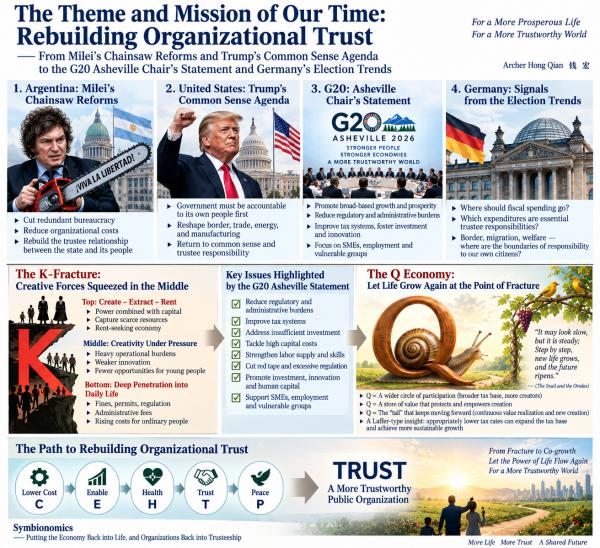
2026年9月7日于温哥华 A Theme and Mission of the New Era: Rebuilding Organizational Trust in the State —From Milei’s Chainsaw Reform and Trump’s Common-Sense Agenda to the G20 Asheville Chair’s Statement and Germany’s Electoral Shift Archer Hong Qian Some transformations of an era begin with theory and are followed by practice. Others begin when reality itself first tears open a breach, and only then do people gradually discover that different countries are confronting the same underlying problem. What is happening today may belong to the latter kind. Argentine President Javier Milei has brandished the “chainsaw” and advanced reforms under the May Pact; after returning to office, U.S. President Donald Trump has pursued readjustments in government, trade, borders, energy, and other fields on the common-sense premise of being “responsible to our own people.” The two countries differ in their national conditions, methods of reform, and specific policies, and the two cannot simply be equated. Yet if we temporarily set aside labels debated for one or two centuries—Left or Right, liberal or conservative, capitalist or socialist—and ask a deeper question, a common issue emerges: Why does the organization of the state exist? Who entrusted it with the power, public finances, and public resources it commands? Once entrusted, to whom must it redeem its responsibilities? This question is now extending beyond Argentina and the United States. The G20 Finance Ministers and Central Bank Governors Meeting held in Asheville in September 2026 made stronger economic growth a key priority, called for “broad-based growth and prosperity,” identified regulatory and administrative burdens, inefficient tax regimes, inadequate investment, high capital costs, and other factors as impediments to stronger growth, and called for reducing red tape and overly burdensome regulation, promoting investment and innovation, improving human capital, and paying particular attention to SMEs, employment, and vulnerable groups. Germany’s emerging electoral trends raise similar questions from another direction: Where should public money be spent? Which expenditures are necessary for the state to fulfill its entrusted responsibilities, and which have become costs of organizational self-maintenance? Where are the boundaries of the state’s entrusted responsibilities among borders, immigration, welfare, and its own citizens? Thus, from Buenos Aires to Washington, from Asheville to Germany, we begin to see a thread of the times that has often been obscured by the conventional contest between Left and Right: Rebuilding Organizational Trust. I. Why Does Milei’s “Chainsaw” Cut First at Organizational Costs? Milei’s rise was not accidental. When a country has long faced fiscal deficits, inflation, debt pressure, administrative expansion, and economic disorder, conventional politics often continues to revolve around the question of “who should receive more resources.” Milei pushed the question in another direction: Why must these resources first pass through such a vast state organization? The “chainsaw” thus became a political symbol of extraordinary visual force. But if the chainsaw is understood merely as “cutting government,” “cutting civil servants,” or “cutting public spending,” the potential significance of the reform is underestimated. What truly needs to be cut should not be the state itself, but those redundant parts of state organization that can no longer demonstrate their entrusted value while continuing to demand that life pay for their existence. Why does an agency exist? Why does a position exist? Why does a subsidy exist? Why does an approval procedure exist? Why does regulation exist? Why are taxes collected in this way? What public value does each item of public expenditure ultimately create? All these questions return to the same starting point: the organization of the state does not exist in order to sustain the organization of the state. Organization arises because life needs it. An institution may initially be established to solve a genuine problem; once formed, however, it can develop an inertia of self-preservation, self-expansion, and self-replication. Over time, an organization that originally existed as a means can turn its own continuation into an end. This is what Symbionomics calls Reproductive Officialdom. The entrusted relationship is then inverted. Life originally creates and sustains organization so that organization may serve life; eventually, life is made to bear ever-rising costs merely to sustain the organization itself. This is an important root cause of Bureaucolonialism as diagnosed by Symbionomics. For this reason, what truly deserves global attention in Milei’s chainsaw reform is not simply how much is cut, but what is generated after the cutting. If there is only destruction without construction, the chainsaw remains merely a tool. If reducing redundancy can lead further toward rebuilding the entrusted relationship between the state and its people, it may become a transformation of organizational paradigm. After the chainsaw, the truly difficult task is rebuilding Organizational Trust. II. Trump’s “Common-Sense Agenda” Asks Whom the State Must Be Responsible to First The situation in the United States is entirely different. Yet one political proposition repeatedly emphasized by the Trump team—that government must be responsible to its own people—likewise touches the entrusted relationship at the heart of state organization. Why does a country have a government? Why does it levy taxes? Why does it have borders? Why does it maintain armed forces, courts, police, public infrastructure, and social security? Why do the people grant government such immense public power? Because a fundamental entrustment–trusteeship relationship exists. The problem is that as the modern state grows larger, its administrative system more complex, and its policy objectives more numerous, the question of whom government must answer to first can instead become increasingly blurred. “America First,” therefore, deserves discussion as more than a nationalist slogan. Once partisan politics and emotional mobilization are stripped away, it raises a question no country can avoid: Can a state organization expand the scope of its responsibilities without limit before it has first fulfilled its responsibilities to those who entrusted it? This does not mean that countries do not need cooperation, nor does it mean refusing international responsibilities. Quite the contrary: only a state capable of earning the trust of its own people is better positioned to build stable, credible, and enduring cooperation with other states. Entrusted responsibility is not the opposite of international cooperation; it is a foundation of trustworthy cooperation. III. From Milei to Trump: What Is Happening Is Not Simply a “Global Turn to the Right” To describe the changes in Argentina and the United States simply as a “right-wing wave” may therefore be too superficial. The Left–Right axis still has explanatory value, but it cannot fully explain an increasingly widespread question: Why are ordinary people in different countries increasingly demanding that organizations re-explain the reasons for their existence? Why must public expenditure increasingly prove its value? Why are administrative costs increasingly questioned? Why are regulation, borders, taxation, welfare, industrial policy, and even international aid being asked anew: Who pays? Who benefits? Who is responsible? This is no longer merely a dispute between Left and Right. It looks more like a recalibration of the relationship between entrustors and trustees. In the past, people repeatedly debated whether government should be larger or smaller. The more important question now is: Whatever its size, is it a qualified trustee organization? A small government can be corrupt, inefficient, rent-seeking, and untrustworthy; a larger government can also provide efficient, transparent, low-cost, and trustworthy public services. Symbionomics therefore does not treat “big government versus small government” as the final criterion. The real criterion is: Have organizational costs fallen? Has life been empowered? Has health improved? Has trust been generated? Has peace increased? These are the C–E–H–T–P value parameters emphasized by GDE (Gross Domestic Effectiveness): Cost Reduction, Empowerment, Health, Trust, and Peace. IV. The K-Shaped Rupture: Why Does Life Lose Its Momentum to Create? When organizations increasingly operate for their own sake, the economy can develop a structural rupture. One line moves upward. Power combines with capital, land, licenses, finance, projects, and scarce resources, creating space for rent creation, rent extraction, and rent seeking. I summarize this as Create–Extract–Rent. It constitutes the Mercantile Economy of Bureaucolonialism. Another line moves downward. When conventional fiscal sources become increasingly strained, organizations penetrate ever more deeply into ordinary life, seeking new objects of extraction through fines, penalties, approvals, controls, administrative charges, and quasi-compulsory measures. This is the Convict Economy. A K-shaped structure then appears: the upper branch becomes increasingly adept at extracting gains from combinations of power and capital; the lower branch searches ever more finely through ordinary life for fiscal resources; meanwhile, the great number of living subjects actually engaged in production, business, employment, and innovation bear increasingly heavy organizational costs. The deeper danger of K is therefore not merely inequality. Its more profound pathology is that more and more lives that create value are squeezed into the rupture of the K. A young person may have ability yet find no path into creation. A small business may create value yet have it consumed by layer upon layer of organizational cost. An ordinary worker may contribute labor yet find that the income received is increasingly unable to redeem housing, education, healthcare, and a future. A country’s GDP may even continue to rise while the creative vitality of life gradually loses its momentum. At this point, the problem is no longer merely “unequal distribution.” What is really happening is that the value created by life cannot be smoothly redeemed; without redemption, life cannot be re-empowered; without re-empowerment, new creation becomes increasingly difficult. The life cycle of “Creation → Redemption → Empowerment → Re-creation” is broken. This is the deepest pathology of the K-shaped economy. Diagnosing K is therefore not about creating another enemy, nor about using administrative force to flatten the upper and lower branches of K. The purpose of diagnosis is to locate where the life cycle has ruptured, so that we can see where healing must begin. It is precisely here that, when we return to the September 2026 G20 Asheville Chair’s Statement, its significance becomes visible. V. Why Does the G20 Asheville Chair’s Statement Deserve Special Attention? The Asheville Chair’s Statement of course did not propose a “K-shaped economy,” a “Q-Economy,” or the concept of “Organizational Trust.” Yet it deserves special attention precisely because the problems it addresses begin to touch the very point of rupture we have just diagnosed. Discussions of economic growth have often begun with familiar questions: Is demand sufficient? Is investment sufficient? Is fiscal spending sufficient? Should interest rates fall? How much more can government put in? These questions certainly matter. But the Asheville Chair’s Statement also turns the question in another direction: Could excessive organizational costs themselves be obstructing growth? The statement places regulatory and administrative burdens, inefficient tax regimes, inadequate investment, high capital costs, labor supply, and skills within the same field of concern, and calls for reducing red tape and overly burdensome regulation while promoting investment, innovation, human capital, and broader, more effective growth and prosperity. This shift matters. It means that the logic of growth is beginning to move from asking only, “How much more should be put in?” toward also asking, “What is suppressing creation?” If businesses lack vitality, we can of course continue to subsidize them; but we should also ask whether excessive approvals, taxes, fees, and organizational costs are consuming that vitality. If ordinary people have insufficient income, we can discuss redistribution; but we should also ask why they cannot enter creation more freely and obtain value redemption. If fiscal revenue is insufficient, we can study tax rates and collection; but we should also ask: Why is the tax base itself not continuing to grow? At this point, an important transition occurs: from asking how to distribute value that already exists to asking how more value can continue to come into being. It was also during the Asheville meeting that a particularly meaningful figure appeared: Arthur Laffer. More than half a century ago, during a dinner conversation, he sketched on a napkin the curve that later became famous as the Laffer Curve. It reminds us that tax rates and tax revenue do not have a simple linear positive relationship. If tax rates are already too high, further increases may suppress investment, entrepreneurship, labor, and transactions, eventually shrinking the tax base itself. Where an actual economy lies on the curve must be tested empirically, but the idea breaks the linear assumption that collecting a little more necessarily means receiving a little more. A public organization cannot think only about taking more from a fixed tax base; it must also care whether that tax base can continue to grow. Behind the tax base are not merely numbers waiting to be taxed, but workers, entrepreneurs, businesses, and families—individual Minds creating value, and the transactions, cooperation, innovation, and value generation continuously occurring among Minds. Thus, the Asheville Chair’s Statement—through its attention to reducing administrative burdens, improving tax regimes, promoting investment and innovation, supporting SMEs and workers, and widening prosperity—meets, in a meaningful way, the Laffer insight into the growth of the tax base. Cost reduction is for empowerment; empowerment is for creation; creation is for allowing new value to keep entering life. As these conditions connect and gradually mature, a new economic picture grows naturally from the rupture of K: instead of merely moving and extracting existing value, more lives can re-enter creation; value can be redeemed; redemption can re-empower life; and the interaction of Minds can continue to generate new value and new possibilities. As these relational conditions gradually come into alignment, Q naturally emerges. VI. Q Appears: Let Life Grow Again from the Point of Rupture Q is not meant to create a new binary opposition with K. K is first of all a diagnosis; Q is a direction of healing that grows from the rupture. It does not forcibly flatten the upper and lower branches of K with a horizontal line, nor does it use a one-time redistribution to temporarily conceal broken relationships of life. What Q seeks to restore is life’s own momentum to create. Imagine an ordinary person creating real value through mind, labor, or creativity. That value is not intercepted layer by layer by organizations, but is redeemed in a timely way. The proceeds of redemption then enable that person to learn, consume, invest, raise a family, or begin another act of creation. That creation enters another person’s life and evokes the response of another Mind. One Mind connects with another Mind; through their interaction, Minds generate new forms of co-opetition, new products, new services, and even forms of value that did not previously exist. This is when Q happens. Q-Economy is an economic form in which more and more lives regain the momentum to create; creation receives redemption; redemption re-empowers life; and one Mind enters Minds, continuously generating new value, new relationships, and new possibilities through interaction. Its basic movement is: “Life Creation → Value Redemption → Life Empowerment → Minds Interaction → New Creation.” Value does not become static after a one-time settlement; after redemption, it continues to enter life, connect, and generate. This also defines the domain of Q. Q belongs neither to the traditional Left nor to the traditional Right; it belongs exclusively neither to the market nor to government. Q occurs in the relational domain among life, organization, and value. Wherever organizations can lower their own costs, give life room to create, allow real creation to receive real redemption, and enable redemption to become the next round of life creation, Q can occur. Seen from this perspective, the Laffer Curve provides a highly intuitive Q-type mechanism. The Laffer Curve primarily concerns tax rates, the tax base, and tax revenue; Q unfolds that logic into: “Cost Reduction → Empowerment → Creation → Redemption → Re-empowerment → Re-creation.” Laffer tells us: do not crush the tax base. Q asks a further question: Why can the tax base expand? Because behind it lies the domain of life creation. More people are willing to start businesses; more people enter employment; more Minds enter Minds; more new value is created. Only then does the phrase “an expanding tax base” acquire its full living meaning. We can therefore say: the Laffer Curve tells us that tax rates must not crush the tax base; Q goes further and tells us that organizations must not crush life. The letter Q itself also offers a vivid image: Q resembles a snail moving forward. The nearly circular “O” within Q is like the shell on the snail’s back. Within it is stored the energy accumulated through life’s past creation: capital, knowledge, technology, credit, public finance, infrastructure, and Organizational Trust. The shell also provides protection. But the shell cannot leave the snail and run upward on its own. The “circle” of Q must always grow with life. The stroke extending from beneath Q resembles the snail’s body and trail reaching forward. It tells us that accumulation does not exist merely to remain where it is; it exists to support the next act of creation. If there were only an O, it could become closed storage, accumulation, and self-circulation. The additional stroke that turns O into Q is crucial: it means that stock must become momentum again, and value already created must continue to empower new creation. The movement of Q then becomes clear: creation forms accumulation; accumulation protects life. Value is redeemed; redemption re-empowers. Life, empowered again, continues to create forward. The snail moves one step and the shell moves with it. As the domain of life creation expands, the circle of Q expands as well; the energy stored within that circle grows, supporting the forward extension of the next stroke. Someone may ask: if Q resembles a snail, is it not too slow? Quite the contrary. The lesson of the snail is not about speed versus slowness, but about steadiness. In the well-known Chinese children’s song “The Snail and the Orioles,” two orioles in a tree laugh at a snail carrying its heavy shell and climbing a grapevine step by step: the grapes are still far from ripe—why begin climbing now? The snail does not stop. It understands that ripening does not suddenly begin on the day the grapes become ripe. While the vine is only budding, it has already set out; by the time the grapes ripen, it has arrived step by step. Q seeks precisely this kind of growth: not exchanging the vitality of life for temporary speed, not pursuing shortcuts or instant arrival, but allowing every step of creation to receive redemption and every redemption to become energy for the next step. It may seem unhurried, yet it never ceases; each step is real, each step generates the next, and the movement forward is steady. This is what distinguishes Q from K: K draws more and more value toward its two branches; Q keeps accumulated stores of value moving forward together with life. Q is therefore not a new system waiting to be proclaimed sometime in the future. It may already be occurring in everyday life. A small business that can hire two more people because one unnecessary approval has been removed is a germ of Q; a young person whose creation is no longer blocked by status, connections, or organizational barriers, but can enter the market and receive redemption, is a germ of Q; a government that removes an institution that has lost its public value, releases resources back to society, yet does not allow genuinely needed public services to collapse, is a germ of Q; AI that does not help organizations extract, control, and penalize life with greater precision, but instead helps ordinary people lower barriers to creation, connect more Minds, and discover new value, is also opening Q. Therefore, whether Milei’s chainsaw can move from “cutting redundancy” to “releasing life” must be tested by Q. Whether Trump’s common-sense agenda can move from “responsibility to our own people” to “empowering ordinary people to create” must likewise be tested by Q. If the G20 Asheville Chair’s Statement—through reducing administrative burdens, improving tax regimes, promoting investment and innovation, and supporting SMEs—ultimately translates into real creative capacity in the lives of ordinary citizens and workers, it too is opening space for Q. K lets us see the rupture; Q seeks to let life grow again from the rupture. In this way, “Diagnose K—Heal with Q—Ground in TRUST” becomes a complete logic of political, economic, and organizational behavior: K diagnoses where life is extracted and interrupted; Q reconnects the cycle of creation, redemption, and empowerment; Organizational Trust enables states, enterprises, platforms, and even AI to become trustees of this life cycle rather than extractors. (See “Digging Out the Roots of K and Revealing the New Path of Q: A 21st-Century Diagnostic and Therapeutic Study of Political, Economic, and Organizational Behavior in Symbionomics.”) VII. From National Reforms to a Shared G20 Problem Consciousness This is the significance of moving from Milei and Trump to Asheville. At first, the issue appeared through highly concrete and often controversial national reforms—Milei raised the chainsaw; Trump appealed to common sense. By Asheville, similar questions had begun to enter the shared field of multilateral economic governance. When the G20 begins discussing administrative burdens, fiscal sustainability, private investment, SMEs, employment, innovation, and broader prosperity, an issue once expressed mainly through domestic political conflict begins to enter the common agenda of global economic governance. This certainly does not mean that the G20 has adopted the path of Milei or Trump, still less that it has accepted Symbionomics. What matters is that different paths are bringing different subjects toward questions that increasingly intersect. This is the way Intersubjective Symbiosism observes the world. It is not about A defeating B, nor B copying A, nor first manufacturing a single answer and then demanding that every country obey it. Different subjects begin from their own lived conditions and connect through practice; connection generates comparison; comparison generates new understanding; and new understanding in turn changes practice. Mind enters Minds. New possibilities are generated in the JIAN—the relational “between.” VIII. Germany’s Electoral Shift: Why Does This Line Continue? Germany’s political changes make this line of development even more worthy of attention. The AfD’s proposals to “cut all unnecessary spending” and “control borders” can be supported or opposed; how German voters ultimately choose should be decided by German society itself. What the world should study is not how to vote on Germany’s behalf, but why these political demands are receiving responses from increasing numbers of voters. If the phenomenon is reduced simply to “the rise of the far right,” analysis stops there. If we continue asking questions, we must confront the following: Why are ordinary people questioning the direction of public spending? Why have borders and immigration become questions of the state’s entrusted responsibility? Why are more voters asking government to explain anew: To whom are you responsible first? Here we must especially guard against another extreme. Rebuilding Organizational Trust in the state must not turn into closed nationalism. Entrusted responsibility has boundaries, but symbiosis must remain open both inwardly and outwardly. A state’s fulfillment of its entrusted responsibility to its own people first does not inherently conflict with open cooperation among different countries, peoples, and civilizations. Mature relations among states should arise precisely among subjects capable of bearing their own responsibilities. Subjects do not disappear because of symbiosis; it is precisely because they can bear responsibility that reliable symbiotic relationships become possible. IX. This Already Goes Beyond Keynes and Hayek At this point, we can begin to understand why the questions confronting us today can no longer remain confined within the century-old pendulum swings between Keynes and Hayek, planning and markets, public and private ownership, capitalism and socialism, nation-state nationalism and multiculturalism, liberalism and conservatism, or left and right. These distinctions will not disappear, but they are no longer sufficient as our ultimate criteria of judgment. Markets can produce monopolies; capital can engage in rent-seeking; governments can also operate efficiently; private organizations can become new centers of power; and AI platforms may even acquire capacities to shape information and behavior that were once largely possessed by states. Looking back at the history of twentieth-century economic thought, 1981 stands out as a particularly revealing historical moment. That year, Ronald Reagan had just entered the White House, and U.S. economic policy began placing tax cuts, investment incentives, deregulation, and the restoration of economic vitality at the forefront. Supply-side economics and the Laffer Curve were moving from economic debate toward the center of policy practice. In the same year, James Tobin was awarded the Nobel Prize in Economic Sciences. Tobin and Arthur Laffer did not belong to the same school of economic thought; Tobin himself was, in fact, an outspoken critic of Reaganomics. Yet if we look beyond their theoretical differences, they can be seen as approaching, from different directions, a common question: How can an economy regain its momentum? Tobin’s lowercase q sought the source of corporate investment momentum in the relationship between the market value of capital and its replacement cost. The Laffer Curve approached the momentum of labor, investment, entrepreneurship, and supply through the relationship among tax rates, behavioral incentives, and the tax base. Reagan, meanwhile, sought to translate this question of economic momentum into public policy through tax cuts, investment incentives, and deregulation. What makes this history worth revisiting today is not the need to decide whether Tobin or Laffer was right, nor to reopen the old contest between Keynesian economics and supply-side economics. The more important questions are: Why does capital need momentum? Why must the tax base grow? Why do firms need to invest? And ultimately, what is economic growth for? Once the inquiry reaches this point, it must return to life—the source from which all these forms of creation arise. This is also why Symbionomics takes a further step by proposing the Q-Economy. What ultimately needs to regain momentum is not merely capital, the tax base, or corporate investment, but life itself—the lives that create capital, generate the tax base, organize production, enter into exchange, and continuously generate new value. The twentieth-century debates over demand, supply, capital, markets, and government have therefore not lost their significance. But they now need to enter a more fundamental dimension: the relationship between life and organization. The twenty-first century thus requires an even more fundamental criterion of judgment: Whom is this organization entrusted to serve? What powers has it been entrusted with? What responsibilities does it bear? How many resources of life does it consume? What public value does it create? And to whom must it ultimately redeem its responsibilities? This is Organizational Trust. X. Why Is Rebuilding Organizational Trust Even More Necessary in the Digital–Quantum Age? This is also why the newly published SYMBIONOMICS: AN OVERVIEW (Revised Edition) and ELEVATING AI TO AM must be read together. In the past, an inefficient bureaucracy might merely force people to make several extra trips to an office, fill out a few more forms, or wait several more months. The AI age is entirely different. If an organization that has lost the boundaries of trusteeship simultaneously gains massive data, algorithms, computing power, intelligent agents, and near-real-time behavioral analytics, its organizational costs may not be reduced for the people. Instead, its capacity to extract from and control life may rise to an unprecedented level. Bureaucolonialism may therefore move from traditional bureaucracy into digital Bureaucolonialism; the Convict Economy may move from street-level fines into algorithms; the Mercantile Economy may move from rent seeking through land, licenses, and projects into rent seeking through data, platforms, models, and computing power. This is why the more powerful AI becomes, the more important Organizational Trust becomes. Technological capability cannot substitute for entrusted responsibility. ELEVATING AI TO AM therefore proposes LIFE–AI–TRUST. The real problem is not merely how to make AI more intelligent, but how to bring increasingly powerful technological capabilities back into the entrusted relationship between life and organization. Technology must empower life; it must not help organizations that have lost their boundaries control life more efficiently. XI. From the “Chainsaw” to “Common Sense,” and Then to an Emerging Global Question Looking back now, Milei, Trump, the G20 Asheville Chair’s Statement, and Germany’s electoral trends need not be forced into a single ideology. They are different. Milei first raised the “chainsaw” out of crisis. Trump brought the “common sense” of being “responsible to our own people” back into state governance. The G20 Asheville Chair’s Statement began to place administrative burdens, investment, innovation, SMEs, employment, and broad prosperity within the same growth agenda. Germany’s electoral trends show that renewed questions about public finance, borders, and entrusted responsibility are spreading into more societies. They are not a predesigned road. Yet from different directions they may be converging on a question the twenty-first century can increasingly no longer avoid: Why does the organization of the state exist? The answer offered by Symbionomics is simple: for life. Organization arises because life needs it. Power gains legitimacy because life entrusts it. Public finance has a source only because life creates. Markets gain vitality because life exchanges. Technology acquires civilizational meaning because it empowers life. Economic growth, in the end, must return to life and be tested by life. This is why, in SYMBIONOMICS: AN OVERVIEW (Revised Edition) and ELEVATING AI TO AM, I pay close attention to Milei’s reforms, Trump’s agenda, and the political-economic changes now occurring around the world. It is not because I seek a new “ism” to replace old “isms.” We need gradually to move beyond the mental habit of first asking, “Which camp are you in?” and only then deciding whether what someone says is right or wrong. Faced with a country, a reform, an institutional arrangement, or an AI technology platform, we can begin with a simpler criterion: Does it reduce costs? Does it empower? Does it improve health? Does it generate trust? Does it increase peace? If it does, it is reconnecting the creative cycle of life. If it does not, whatever ideology it invokes deserves renewed examination. From Milei’s chainsaw reform and Trump’s common-sense agenda to the G20 Asheville Chair’s Statement and Germany’s electoral trends, what we are seeing may not be a simple “global turn to the right.” What deserves greater attention is a deeper transition of the era: from organizational self-expansion back to life creation; from possession of power back to entrusted responsibility; from the single pursuit of GDP back to cost reduction and empowerment; from value extraction back to value redemption; from the rupture of life produced by K-shaped extraction toward the Q-shaped life cycle of creation, redemption, empowerment, and re-creation. In the end, the issue may be condensed into three consecutive questions: Growth for whom? Organization for whom? Who entrusts, who is entrusted, what value is created, and to whom is responsibility redeemed? Only by answering these questions well can we truly answer the question of state governance in the twenty-first century. Rebuilding Organizational Trust in the state will be a theme and mission shared by countries around the world in this new era. Different countries can observe one another, learn from one another, and inspire one another without having to copy one another, because genuine symbiosis never presupposes the elimination of difference. Each becomes a subject; subjects connect with one another; and new possibilities are generated in the JIAN between them. This is the civilizational direction that rebuilding Organizational Trust should ultimately open. (See “The Spatio-Temporal Mindedness View of Everything Intersubjective Symbiosism.”) From “Diagnose K” to “Heal with Q,” grounded finally in TRUST, Symbionomics thus advances from a discussion of economic indicators toward a way that arises with the times for addressing the political, economic, and organizational behavior of the twenty-first-century world. Archer Hong Qian
Vancouver, September 7, 2026
|