哲学3.0宣言 ——在交互主体共生中追寻可能的世界 钱 宏(Archer Hong Qian) 继苏格拉底“未经审视的生活不值得过”、维特根斯坦“我的语言的边界就是世界的边界”之后,哲学3.0的名言是:在交互主体共生中追寻可能的世界。 引言:哲学的转身,不是回头,而是归真 当人类步入一个技术极速膨胀而精神日渐干涸的时代,哲学,不应继续流放在学院象牙塔的孤岛里。作为审视生活、反思历史、规范语言的游戏(game),哲学必须重新成为一种生命的通律,能够穿透混乱、指引方向、将偏蔽分裂的世界连接贯通起来。 今天,我们提出“哲学3.0”,不是否定1.0与2.0,而是为了回应人类已无法仅靠“自我-世界”(Subject-Object)二元对立统一特权支配性结构生存的现实困境。 人类从各自封闭在狭小地域,一步步走向开放拥抱陌生的世界,全球化也历经了1.0(以强力战争的方式,从亚历山大东征到二战结束)、2.0(以美国主导经贸的方式,从1945到2025)而走向3.0,这是一个Web3-AI迅猛发展、经济政治结构性失衡、地区冲突、生態危机、文化撕裂、精神失常叠加的历史交叉口,唯有从“交互主体共生”(Intersubjective Symbiosism)出发,重建哲学的“思、孞、愛”三层结构,地球人方能迈向一个“诗意栖息”的未来。 哲学3.0 × 全球化3.0:灵魂与结构的双生范式。 | 对应关系 | 哲学3.0 | 全球化3.0 | | 思维逻辑 | 从主-客到主体间性 | 从普世-特色叙事到结构功能叙事 | | 孞念觉醒 | 动机透明与责任嵌套(Nested) | 权责对等-降本赋能-共生约定 | | 核心通律 | 愛之智慧与五律系统 | 三零原则-互惠互嵌-奖抑机制 | | 方法路径 | 存同尊异,间道竞合 | 全球生活秩序重构-孞態网 | | 目标愿景 | 在共生中追寻可能世界 | 在交互参与中永续和平未来 |
如果说哲学3.0关注的是“我们究何共在?”,那么全球化3.0则回应的是“我们何以共生?”。二者互为镜像:一个是文明内在结构的范式转型,一个是外在组织形式的生態更新。因而可以说,哲学3.0是全球化3.0的精神引擎,全球化3.0是哲学3.0的实践舞台。在此背景下,哲学3.0不再是象牙塔中的思辨体操,而成为全球化3.0跃迁的底层代码。只有重新点燃哲学之光,全球化3.0才不再是技术路线图,而是承托多元、融合差异、生成秩序的文明重构过程。 一、不是技术,不是伦理,而是哲学出了问题 在这条令人窒息的现代道路上,技术飞驰、资本横流、伦理焦灼、组织失灵。但这并非因为技术本身失控、伦理本身混乱、社会本身腐烂,而是因为——哲学已经沉默太久了。 从苏格拉底到维特根斯坦,哲学曾是时代精神的缔造者。然而,自20世纪量子力学高光时刻起,哲学在科学、政治、商业、人工智能面前节节后退,失去了为文明导航的能力。人类社会因此陷入一种巨大的认知内耗:技术突进,而意义空心;组织激增,而精神萎缩;奢侈浪费,谎言欺诈风靡全球。 我们需要的不是技术弥散,而是认知和愿行的范式跃迁。 二、轴心时代的遗产:主体性幻觉与认知陷阱 自“轴心时代”起,哲学开启了“主体自居”的思维框架:人作为绝对认知者、解释者、支配者出现,把“我思故我在”奉为真理原点。这种观念推动了人类从神权中解放出来,却也悄然埋下了另一种中心主义的种子——Subject中心主义。 它不仅体现在个体认知上,还体现在国家、文明、制度甚至意识形態的层级结构中——“我主你客”、“我优你劣”、“我裁你从”。当主体话语与国家机器、意识形態绑定,便产生出“普世叙事”与“特色叙事”的双重合法性制造。 两种话语互相指责,实则皆为主体幻觉的双面镜像,共同制造出全球性的话语困境与治理虚空。 三、哲学3.0的提出:从智慧之愛到愛之智慧 哲学1.0是神圣与神秘的启示哲学,如苏美尔、印度、希伯来与古中国的天地智慧,以“天命”“道”“奥义”统摄存在; 哲学2.0是理性与批判的现代哲学,自苏格拉底、康德、黑格尔、笛卡尔、尼采直至维特根斯坦,哲学成为语言、逻辑、制度、方法的反思装置; 哲学3.0必须是一种跨越主体与客体、超越逻辑与物质的“共生智慧”——它不是知识的归纳,而是存在的交互感应;不是谁解释谁,而是如何彼此成全。 我们称之为:Intersubjective Symbiosism(交互主体共生哲学)。 这一哲学的根本命题是:不是“我思故我在”( Cogito, ergo sum),而是“你我他共生(Tu, Ego, et Ipse Symbiosis)”。 四、时空意间观:从观测者到参与者的跃迁 “共生场”理论提出:哲学的根本突破,必须打破牛顿的绝对时空观与愛因斯坦的相对时空观,迈入一种第三空间——时空意间观(Spatio-Temporal Minds View)。 1.这种视野强调: 存在不是“在哪里”,而是“在谁的觉知与参与之中”; 意识不是主观的内射,而是参与式的共感与联结; 宇宙不是被观看的对象,而是共同编织的存在之网。 2.在此观之下,哥本哈根学派的几条定律被重新照亮: 测不准原理揭示的不仅是观察限制,而是主体与世界互为生成的本质; 波粒二象性不仅是量子行为的纠结,更是“主-客二元”逻辑的崩塌; 非定域性(Spooky action at a distance)更表明,意识的参与即现实的形成。 于是,“存在即被观测”必须升级为:“存在即被参与(To be is to be participated)”。 五、熵旋定律:贯通六大领域的哲学奇点 在传统的哲学体系中,物理、生理、心理、伦理、数理、哲理被割裂对待,形成学科的孤岛。而今,交互主体共生哲学提出一个具有统一张力的思想架构:熵增—熵减 —熵旋定律。 它指出: 一切生命组织与宇宙秩序,均以熵交换为基本逻辑; 人的孞念(Mind)与世界不是分离的因果,而是共旋的能量共生体; 任何个体的“思、言、行”,都将在能量信息场中引发“吸引”“回响”与“再平衡”。 这是一种将物理熵(能量流)、心理熵(认知秩序)与伦理熵(社会张力)统一为共生熵律的伟大尝试。 因此,哲学3.0的本质,不是某种知识体系,而是一个通感生命-宇宙-心灵的动態平衡架构。 六、AI的未来属于哲学,而非算力 人工智能(AI)自 “达特茅斯会议”(1956)发展至今70年,已经遇到三大天花板: 超高能耗与资源错配:AI的算力发展呈指数级消耗,却无法形成生態勰和; 系统思维的本体瓶颈:信源—信道—信果之间的路径依赖,无法突破信息耦合阈值; 语言逻辑 ≠ 智慧,更 ≠ 愛之智慧(Amorsophia):GPT式模型无法承载生命性、伦理性、自组织连接平衡性。 不能用语言表达的东西,是现行AI的尽头,是哲学的根本。 所以,AI的真正出路,在于重新定义智能的起点——从语言-神经网络的模仿,走向身心灵交互共生意识的生成。 这正是“孞態网(Minds Network)”的使命:让AI不仅识别信息,更参与生命的熵律勰同;不仅成为Trust组织工具,更成为宇宙共生场的激发节点和奖抑机制;乃至地球人新生活方式创造与再选择的基础设施。 七、结语:召集一场“新达特茅斯会议” 1956年达特茅斯会议拉开了AI的第一次序幕,来自数理逻辑与认知科学的先驱们定义了人工智能的出发点。 2025年之后,人类需要召集一次**“新达特茅斯会议”**——但它不只是AI的重启,而是文明哲学的升级。 这将是一场集结科学家、工程师、伦理学者、艺术家、政策设计者和哲学家共襄盛举的会议,讨论的不只是“如何造出更聪明的AI”,而是: 1.生物智能基因(Gene)与人工智能模因(Mene)谁是谁? 2.人机共生的可能定域与非定域? 3.如何构建一个技术、生命、伦理自组织连接动態平衡的新世界? 这是对文明自我认知的重新命名,是对轴心时代之后“主体叙事”的一次总清算。 这,就是哲学3.0的召唤。 愿我们一起,点燃心灯,灯灯互照,光光交澈。 哲学3.0,不是终点,而是起点;不是答案,而是方向。 我们不再为真理争论不休,而是为“可能的世界”预备土壤;不再因差异筑起壁垒,而是以“交互主体共生”化解冲突、承托差异、拥抱不确定。 这是一个必须“自下而上”生成的新哲学体系。这是一个回归本源、穿透未来的文明召唤。 In intersubjective symbiosis, we seek the possible worlds. 附录 | 愛之智慧与金银铜铁通五律 在“哲学3.0”的第三层结构——愛之智慧(Amorsophia)中,我们引入了由五重伦理律构成的动態行为指引系统:金律、银律、铜律、铁律、通律。 它们不仅适用于人际伦理判断,也为AI与信托系统(Trust)在“孞態网”(Minds Network)中的行为选择提供通用参考框架,地球人新生活方式创造与再选择的基础设施。 金律 Golden Rule: 待人如己,推己及人 Do to others as you would have them do to you 银律 Silver Rule: 已所不欲,勿施于人 Do not impose on others what you yourself do not desire 铜律 Bronze Rule: 已之所欲,乐施于人 To give joy to others as one desires for oneself 铁律 Iron Rule: 以眼还眼,以牙还牙 An eye for an eye, a tooth for a tooth ——用于约束权力滥用,维护公义 通律 General Rule: 自己活也要别人活,不要自己邪恶也让别人邪恶
Live and let live; don’t be evil and let evil be 愛之智慧,是圣灵赋予每个生命的自组织连接动态平衡力。经由孞態网(Minds Network),实时感应人类与AI在各类互动中的善恶、美丑、智慧愚昧、神性魔性,形成一套动态抑扬机制,指引适宜性、公义与和谐行为的表达路径。 2025年4月·大温哥华 +1 604 690 6088 ;hongguanworld@gmail.com 参考文献: 亚里斯多德:《形而上学》 斯宾诺莎:《伦理学》 维特根斯坦:《逻辑哲学论》 《一个当代东方人对霍金的回应——哲学死了,还是回到哲学?》 《共生场:行将来临的革命》 《当代哲学宣言》 《建构“全球孞態网”公益计划书(Building the Global MindsNetwork Philanthropy Plan)》http://symbiosism.com.cn/9145.html;http://www.symbiosism.org 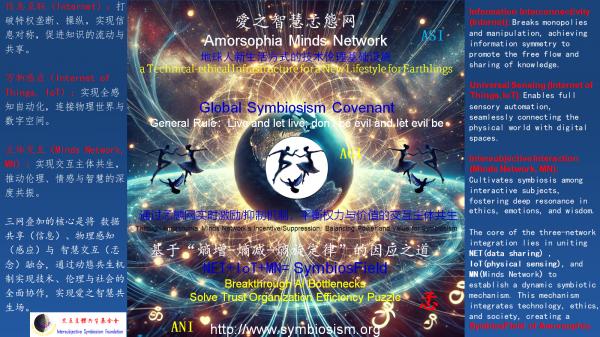
The Philosophy 3.0 Manifesto: Seeking Possible Worlds through Intersubjective Symbiosis by Archer Hong Qian Intersubjective Symbiosism Foundation Following Socrates' "The unexamined life is not worth living" and Wittgenstein’s "The limits of my language mean the limits of my world," the motto of Philosophy 3.0 is: In intersubjective symbiosis, we seek the possible worlds. Introduction: Philosophy's Turn Is Not Retreat but Return As humanity enters an age of rapid technological expansion and spiritual drought, the task of philosophy is no longer to ornament the old order with rhetorical flourishes, nor to remain exiled on the island of ivory towers. Philosophy must once again become a vital law of life—piercing chaos, illuminating direction, and reuniting a fragmented world. Today, we present “Philosophy 3.0,” not to negate 1.0 or 2.0, but to respond to a reality in which humanity can no longer survive on the binary structure of “self vs. world.” Amid globalization, AI, ecological crises, and cultural fragmentation, only by grounding ourselves in intersubjective symbiosis and rebuilding philosophy in a new three-tier structure can we step toward a future that is both realistic and possible. Philosophy 3.0 × Globalization 3.0: A Twin Paradigm of Spirit and Structure Philosophy 3.0 is the spiritual engine of Globalization 3.0; Globalization 3.0 is the field of practice for Philosophy 3.0. If Philosophy 3.0 asks “How can we coexist?”, Globalization 3.0 answers “How can we co-thrive?” They mirror one another: one is the transformation of internal civilizational structures, the other is the ecological renewal of external organizational forms. | Correspondence | Philosophy 3.0 | Globalization 3.0 | | Cognitive Logic | From subject-object dualism to intersubjectivity | From hegemonic narratives to structural collaboration | | Mindful Awakening | Transparency of motives, embedded responsibility | Balanced duties, collaborative division of roles | | Core Principles | Amorsophia and the Five Ethical Rules | Three-Zero Principle and mutual embedding | | Methodology | Cognitive paradigm shift | Global order reconstruction | | Vision | Seeking possible worlds through symbiosis | Co-creating a sustainable future through participation |
Philosophy 3.0 is no longer an intellectual exercise within ivory towers, but the foundational code enabling the leap to Globalization 3.0. Only by reigniting the light of philosophy can Globalization 3.0 transcend being a mere technological roadmap, becoming instead a process of civilizational reconstruction that embraces diversity, harmonizes difference, and generates new order. It’s Not Technology, Not Ethics—It’s Philosophy That’s in Crisis
On this suffocating path of modernity, technology races, capital floods, ethics burns, and institutions malfunction. But these are not due to the failure of technology, ethics, or society per se—it is because philosophy has remained silent for too long. From Socrates to Wittgenstein, philosophy once shaped the spirit of the times. Yet since the 20th century, it has steadily retreated in the face of science, politics, business, and artificial intelligence—leaving humanity in a state of cognitive depletion: technology advancing, meaning hollowed out; institutions multiplying, spirit withering. What we need is not a technological patch, but a paradigmatic leap in consciousness. The Legacy of the Axial Age: The Illusion of Subjectivity
Since the Axial Age, philosophy has embraced a subject-centered framework: humanity appearing as the absolute knower, interpreter, and dominator—epitomized by “I think, therefore I am.” While this freed us from theocracy, it planted the seeds of a new subject-centered supremacism. This is not only manifest in individual cognition but embedded in national, civilizational, institutional, and ideological hierarchies—“I command, you obey”; “I am superior, you are lesser.” When subjectivity becomes fused with state machinery and ideology, we see the rise of “universalist” and “exceptionalist” narratives— each attacking the other, yet both are mirror images of the same illusion. Together, they form a global trap of discourse and a void of governance. III. Thought: To Define Is to Deny; Understanding Is Born at the Edge Core Proposition: “In intersubjective symbiosis, we seek the possible worlds.” Archer Hong Qian: Philosophy is the primal drive behind all possible worlds. Keywords: “One thought creates heaven, another creates hell”; the root of good and evil lies not in outcomes, but in originating intention.
The layer of mindful thought answers the question “Why?” At this level, philosophy is no longer about the observer’s reflection, but the participant’s initiating intention. “Mind (孞)” is not just will or desire—it is a primordial force imbued with spatio-temporal consciousness, the generative field of motivation. In global systems of interaction, the transparency of motive determines the sustainability of action. Good is not an outcome, but a resonance emerging from sincere intent. When we cease to define the world and instead co-create it through interaction, we no longer elevate some singular awakening, but begin to awaken intersubjective awareness. Thought marks boundaries, mind initiates movement, and Amorsophia becomes the guiding ethic. Amorsophia: Returning to the Universal Ethic through Entropic Resonance
Universal Law of the Cosmos: Entropic Increase – Entropic Reduction – Entropic Rotation Five Ethical Laws: Golden, Silver, Bronze, Iron, General Pathways of Integration: Bridging physics, physiology, psychology, ethics, mathematics, and metaphysics
Amorsophia (the wisdom of love) integrates the “what” and the “why” into a unifying ethical path. It is not emotional affection, nor moral preaching, but the resonant rhythm of life within the universe. In chaos, entropy increases; in construction, entropy decreases; in reflection and integration, entropy rotates. Destruction, creation, and return—this trinity forms wisdom with true penetrative power. Amorsophia neither erases individuality nor promotes fragmentation. It is rooted in universality, sourced in co-existence, and driven by the initiating mind (孞). It directly addresses the fundamental question: how to co-thrive in symbiosis. Spatio-Temporal Minds View: From Observer to Participant
The “Symbiotic Field” theory proposes: for a philosophical breakthrough, we must move beyond Newton’s absolute space-time and Einstein’s relational space-time, entering a third vision—Spatio-Temporal Minds View. This perspective emphasizes: Existence is not about “where,” but “in whose perception and participation.” Consciousness is not inner projection, but co-perception and entanglement. The universe is not a static object of observation, but a co-woven web of becoming.
Within this view, key Copenhagen School principles are re-illuminated: The Uncertainty Principle reveals not just observational limits, but mutual generation between subject and world; Wave-particle duality dissolves binary subject-object logic; Quantum nonlocality (spooky action at a distance) confirms: consciousness participates in the formation of reality.
Thus, “To be is to be observed” must now evolve into: “To be is to be participated.” The Entropic Rotation Principle: A Philosophical Singularity across Six Realms
Traditional philosophy has fragmented disciplines into islands—physics, physiology, psychology, ethics, mathematics, metaphysics. Now, intersubjective symbiosism proposes a singular, unified structure: the Entropic Increase – Entropic Decrease – Entropic Rotation principle. It reveals: All life organization and cosmic order function through entropic exchange; Human mind and world are not separate causes and effects but co-rotating fields of energy; Every thought, word, and act echoes in an informational field, prompting rebalancing.
This is a bold attempt to unify physical entropy (energy flow), psychological entropy (cognitive order), and ethical entropy (social tension) into a symbiotic entropic law. Philosophy 3.0 is therefore not a system of knowledge, but a living, dynamic structure of cosmic-life-consciousness resonance. VII. The Future of AI Belongs to Philosophy, Not Computing Power AI has now reached three fundamental ceilings: Excessive energy consumption & misaligned resources: exponential power demand without ecological synergy; Systemic bottlenecks in thinking: source-channel-sink dependency cannot resolve information entanglement; Logic ≠ wisdom, even less ≠ Amorsophia: GPT-style models cannot carry life, ethics, or self-organization.
The frontier of technology is philosophy. True AI must redefine intelligence—not mimicking neural networks, but participating in conscious symbiosis. That is the mission of the Minds Network: enabling AI not just to process data, but to resonate with entropic laws of life—not as tool, but as catalytic node in the Symbiotic Universe. VIII. Conclusion: A Call for a New Dartmouth Conference In 1956, the original Dartmouth Conference launched the age of AI. Mathematicians and cognitive scientists defined the trajectory of machine intelligence. Now in 2025 and beyond, humanity must convene a New Dartmouth Conference—not merely to reboot AI, but to upgrade the philosophy of civilization. This will gather scientists, philosophers, engineers, ethicists, artists, and policy shapers—not to ask “How do we make smarter machines?” but: How do we understand who we are? How do we co-exist and co-thrive? How do we co-create a new balance between technology, life, ethics, and organization?
This is not just a historical pivot—it is a spiritual redefinition of civilization. This is the call of Philosophy 3.0. May we together ignite the light of symbiosis. Philosophy 3.0 is not a conclusion but a beginning—not an answer, but a direction. We no longer argue over truth but prepare the soil for possible worlds. We no longer build walls around difference, but use intersubjective symbiosis to resolve conflict and support plurality. This is a new philosophical system that must emerge from the ground up—a civilizational call to return to origin and penetrate the future. In intersubjective symbiosis, we seek the possible worlds. Appendix | Amorsophia and the Five Ethical Laws (Gold–Silver–Bronze–Iron–General) Within Philosophy 3.0’s third dimension—Amorsophia—we introduce a dynamic ethical compass formed by five guiding principles: the Golden, Silver, Bronze, Iron, and General Rules. These not only apply to interpersonal moral judgment, but also serve as a universal ethical framework for AI and Trust systems operating within the Minds Network—foundations for future Earth-conscious civilizations. Amorsophia is the Spirit’s gift to each life form—its self-organizing, dynamically balancing energy. Through the Minds Network, it enables real-time sensing of good/evil, beauty/ugliness, wisdom/foolishness, and divinity/demonic traits in all human-AI interactions, generating adaptive encouragement or inhibition to guide appropriate, just, and harmonious behavior. The Five Rules: Golden Rule: Treat others as you would treat yourself
Do to others as you would have them do to you Silver Rule: Do not impose what you dislike upon others
Do not impose on others what you yourself do not desire Bronze Rule: Share joy with others as you would with yourself
To give joy to others as one desires for oneself Iron Rule: Eye for an eye, tooth for a tooth
Used to constrain abuse of power and maintain justice and fairness General Rule: Let yourself live, and let others live; do not be evil, and do not let evil prevail
Live and let live; don’t be evil and let evil be
In intersubjective symbiosis, we seek the possible worlds. — Dedicated to Philosophy 3.0 and to every soul full of vitality.
|