复兴“爱之智慧”,重建组织信托 Reviving Amorsophia and Rebuilding Organizational Trust ——250周年来,美利坚合众国为人类提供了怎样的制度坐标? What Institutional Coordinates Has the United States Offered Humanity Over the Past 250 Years?
钱宏(Archer Hong Qian) 2026年7月4日于温哥华
今天,历史的指针走到了公元2026年7月4日。美利坚合众国迎来了建国250周年。 站在北美这片土地上,回望1776年的《独立宣言》和1787年的费城制宪会议,我们纪念的,不只是一个国家的诞生,更是一场为现代政治文明重新确立制度坐标的伟大探索。 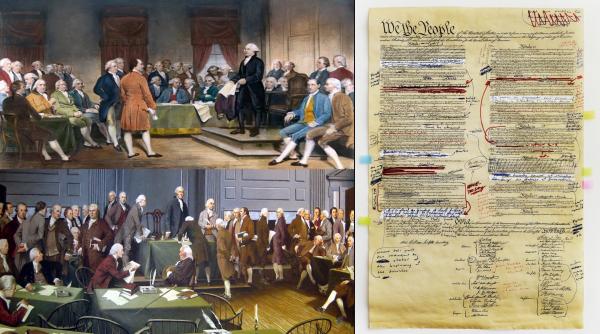
250年来,自由共和宪政在这里从一项大胆的制度实验,发展成为影响世界的重要政治实践。 可是,在这个伟大的节日里,作为一个生长在东方大地,自幼耳濡目染着“人民民主专政”与“科学”等大词的我,却不无惊奇地发现:《美国宪法》通篇没有出现 democracy(民主)一词,也没有出现 monarchy(君主制)或 despotism(专制)等概念。这究竟是为什么呢? 250年前,美国建国先贤们面对的,不是一个抽象的政治理论问题,而是一个迫在眉睫的现实问题:独立之后,究竟建立一个什么样的国家? 他们并没有围绕政治标签建构国家,而是把全部注意力放在权力如何配置、如何分立、如何制衡、如何保障人民自由之上。对他们而言,决定一个国家性质的,不是名称,而是制度结构。 他们深刻认识到,无论是未经约束的多数统治,还是不受限制的个人统治,都可能侵蚀人的主体(Subject)地位。刚刚获得独立自由的先贤们,自己不想失去生命主体性,也不想以主体自居,把别人作为客体(Object)来加以支配、操纵和榨取。 放眼当时的世界,东方长期实行中央集权的郡县制,地方官员由中央任免但定于一尊赢者通吃,势必引发造反僭越,循环取而代之兴亡百姓苦;欧洲大陆,则长期在封建割据与君主专制之间反复摆动。 制宪会议的美国人没有照搬任何一种旧制度与大革命的方式,而是让十三个州基于自由意志结成联邦,各州保留高度自治,由此确立中央与地方之间的纵向分权,新闻自由和人民权利等一整套制度安排,逐步生成了一种既区别于传统君主制,也区别于简单多数政治的新型共和秩序。这一秩序显然秉承了古代罗马共和传统,但在方式方法上又有独特的创新。 在联邦政府内部,他们不但没有把全部权力交给任何个人,也没有交给任何一个机构,而是建立行政、立法、司法三权分立,以相互制衡防止权力集中;在政府之外,他们又以新闻自由、公民社会和人民权利形成持续监督,使国家权力始终置于公共社会的约束之下。 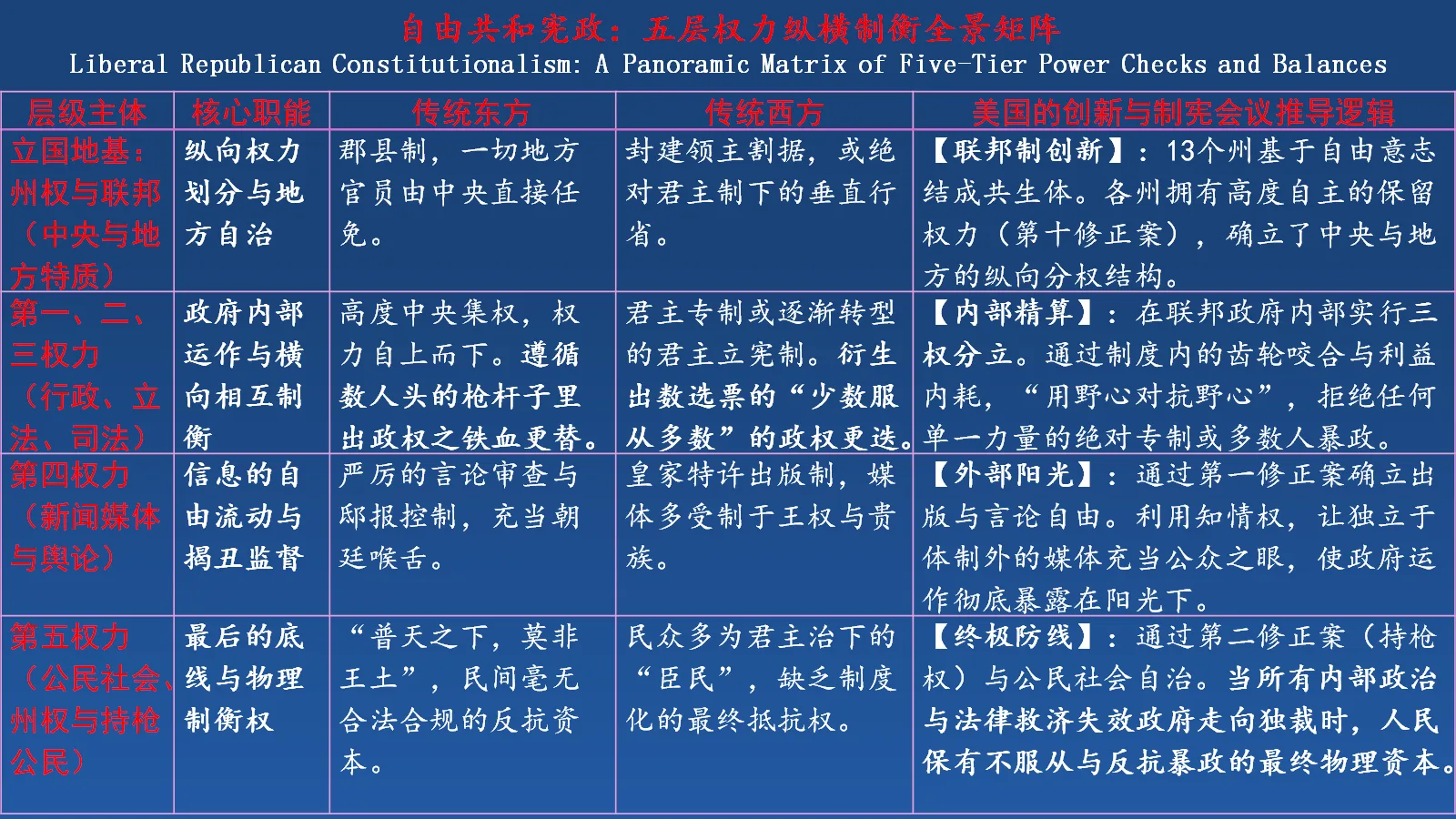
后来,人们把这一制度称为自由宪政共和。 然而,这样一套制度,并不是哪一位政治家灵机一动设计出来的,也不是哪一本政治学著作推演出来的。 且看,美国的自由宪政共和制,是如何在1787年那个炎热的夏天,一步一步自己生成、涌现出来的。 从1787年5月25日至9月17日,费城制宪会议历时近四个月,十三个州五十五位代表,聚集在费城独立厅(Independence Hall)的一间会议室里,在极端恶劣的环境与剧烈的利益冲突中,生动地诠释了一场什么叫作“理性的争吵”与“妥协的艺术”。 如果拍成电影,其情其景其细节,可谓惊心动魄。 1. 密不透风的“蒸笼密室” 那年的费城遭遇了史诗级的酷暑,蚊蝇肆虐。然而,为了确保代表们能畅所欲言、不受外界舆论和选民压力的干扰,会议通过了极其严苛的保密纪律。 死封的窗户:会议室的窗户被全部死死钉住,并拉上厚厚的窗帘。 全副武装的警卫:门外有手持武器的士兵把守,任何人不得旁听。 严厉的训斥:某天有代表不慎将一份提案草稿遗落在地上,被捡到后交给大会主席乔治·华盛顿。华盛顿面色铁青,将纸拍在桌上冷冷地说:“先生们,我不知道是谁的,但请认领。你们的粗心会毁了这场大会!”此后没人再敢泄密。 中暑与羊毛正装:在没有风扇和空调的18世纪,代表们必须身着厚重的羊毛正装、戴着假发,连续数小时闷在如同蒸笼的房间里。许多老代表因体力不支或中暑,只能躺在长椅上听会。 2. 众生相:天才、巨头与沉默的领袖 会场里的55个人,几乎集中了当时北美最精英的大脑,他们的互动充满了戏剧性: “沉默的定海神针”华盛顿:作为大会主席,华盛顿全场几乎不发一言。他身着威严的独立战争将军制服,笔挺地坐在高高的主席台椅子上。他的存在本身就是凝聚力——只要他坐在那里,代表们就不至于掀翻桌子打起来。 “人肉速记机”麦迪逊:身材矮小、体弱多病的詹姆斯·麦迪逊坐在最前排。他像一台不知疲倦的机器,一边疯狂地发言、推销他的“弗吉尼亚方案”,一边用自己发明的速记符号记录下会场的每一句辩论,留下了今天研究制宪会议最珍贵的《麦迪逊辩论笔记》。 “和事大佬”富兰克林:81岁高龄的本杰明·富兰克林,是全场最年长者。他因严重的痛风无法行走,每天坐着由四名囚犯抬着的轿子来到会场。每当会场吵到要散伙时,富兰克林就会讲个幽默的笑话或寓言,把大家逗笑,以此缓和剑拔弩张的气氛。 3. 三大惊心动魄的对决与妥协 会议绝非一团和气,而是充满了拍桌子、退场威胁和长达数周的僵局。 大州 vs 小州(“弗吉尼亚方案”vs“新泽西方案”)冲突:大州主张国会席位按人口分配(大州通吃);小州(如特拉华、新泽西)怒不可遏,威胁说“如果这样,我们宁可去寻找外国盟友(比如英国)支持!” 生动瞬间:吵到7月,会议陷入彻底死局。关键时刻,康涅狄格州的代表提出了“伟大妥协”(Great Compromise):国会分两院,众议院按人口比例,参议院每州死死固定两席。这个精妙的“双轨制”,让大州和小州都活了下来。 南方 vs 北方(黑奴如何计算人口)冲突:南方蓄奴州主张:收税时黑奴是资产,不计入人口;但在分配众议院席位(争夺权力)时,黑奴必须算作人。北方州愤怒怒斥:“这简直是无耻的投机!” 妥协:为了不让国家在诞生前夕分裂,双方达成了极为冷酷,但也极其现实的“五分之三妥协”(Three-Fifths Compromise)——一个黑奴在计算人口和纳税时,折合为3/5个自由人。 “旭日”还是“落日”大结局:1787年9月17日,历经近4个月的煎熬,宪法最终定稿。当最后的39位代表依次走向主席台签字时,富兰克林看着华盛顿椅背上雕刻的一轮太阳,对身边的人感慨道: “在过去的四个月里,我常常看着主席身后的那轮太阳,分不清它到底是旭日还是落日。但现在,我很欣慰地知道,那是一轮旭日,而不是落日(It is a rising and not a setting Sun)。” 这就是美国建国史上著名的“旭日之椅”(Rising Sun Chair)的典故。这场会议没有流一滴血,全凭55个极其自私、又极其聪明的政治家,在密室里用汗水、争吵与妥协,硬生生“炼”出了现代自由宪政共和的基石。 我们清楚地看到,无论是活的制宪会议本身,还是《美国宪法》,对历史上业已存在的“民主”和“专制”,都保持着高度警惕。13个州的55位代表,都是赋有个性差异、自私而顶级聪明的人。他们在“沉默的定海神针”华盛顿、“人肉速记机”麦迪逊、“和事大佬”富兰克林交互示范作用下,在长达4个月的“蒸笼密室”里,一种奇妙的多主体高频碰撞、利益冲突又相互抵消耦合,众生自组织连接动态平衡悄然发生——这不就是灯放在台上的“山巅之城”精神,激发多主体绽放出融激情、愿景、理性与践行为一体,如旭日初升的“自由宪政共和制”的由来吗?! 写到这里,忽然萌发一个穿越性设想。假设当时有个英国的间谍或大清国的密探,在长达4个月的制宪会议的任何一天,潜入“蒸笼密室”,在他或她看到的景象会是什么?会不会很容易得出一个管中窥豹式结论:“美国反对美国”? 可立国先贤们没有让私欲走向毁灭,争吵归争吵,反而将其熔炼为一种超越个体的整体理性。 清教徒先祖“山巅之城”的精神,没有停留在宗教乌托邦中,而是被这群务实的先贤,用白纸黑字化为世俗的法律契约,将那盏照亮人类自由的灯,硬生生放在了制度的台面上。
当本杰明·富兰克林在走出独立厅,回答围观群众“你们决定建立一个什么样的国家?”的提问,说出那句“一个共和国,如果你们能保持它的话”(A republic, if you can keep it.)时,华盛顿椅背上那露出半个脸蛋的太阳,便注定成为一轮旭日初升的“自由共和宪政”之光。 富兰克林没有看错,这轮旭日,照亮了美国后来的历史,也为近代世界提供了一个持续250年的制度坐标:自由共和宪政可以通过分权、制衡、自治与法治,在人的主体性基础上不断自我纠偏、自我完善,吸引着世界万众的目光(drawing the eyes of the world )。 1789年,联邦政府正式运作;1791年,《权利法案》通过,把宗教信仰、言论出版、集会结社等基本自由写入宪法。此后两个半世纪,美国经历了西进运动、南北战争、工业革命、经济大萧条、两次世界大战、冷战、信息革命和人工智能时代,也经历了一次又一次政治危机和社会分歧,却始终没有放弃1787年建立起来的自由共和宪政框架,而是在新的历史条件下不断修正纠偏、不断完善。 然而,历史并不会因为一部宪法的诞生而一劳永逸。 两百五十年前,建国先贤需要回答的是怎样建立一个国家;两百五十年后的今天,美国面对的,则是怎样让一个已经高度复杂、高度组织化、高度数字化的现代国家继续保持建国时的生命力。 进入二十一世纪,新的挑战不断出现。政府越来越庞大,法律越来越繁复,资本越来越集中,平台越来越强大,人工智能迅速进入社会生活。人与人之间的直接联系越来越少,人与组织之间的距离越来越远,组织越来越依赖程序,越来越依赖技术,组织信托却不断下降。 今天,正当世界持续陷入左右、东西、社会主义与资本主义周期性循环倒腾之际,第47任美国总统川普,来到拉什莫尔山(总统山)发表的建国250周年演说,他热情澎湃、充满自信地宣布了美国的例外和伟大,但同时又高度忧虑地发出警告——这个250年前靠“自由宪政共和”立国的超级大国,现在正面临着一个极端的内部矛盾、撕裂与信任秩序分裂。这恰恰以戏剧性的方式证明了当大型组织走向熵增异化,即使是自由共和的灯塔,其内部的制度信托也会不可避免地发生溃败”。 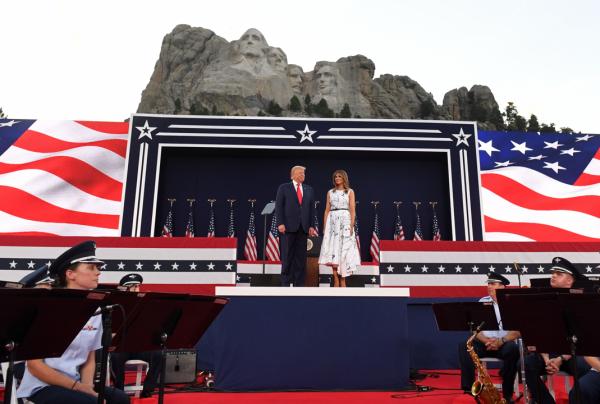
这不仅道出了左右、东西、意识形态的摇摆,而是在“生命形态(LIFE)-智能形态(AI)-组织形态(TRUST)结构性失衡”的条件下,任何大型组织都逃不过“组织熵增异化”的规律。不仅是美国的撕裂,更是全球文明进入“生命与组织重组期”的病理学铁证。 正如250年前的先贤用“持枪权”作为反抗组织暴政的第五权力;在数位-量子时代,AI与信托技术(TRUST)正是生命个体用来对冲大型组织熵增、守护自身主体性的全新“数位防线”。 无论是在阿根廷米莱革新,还是在美国川普新政和欧洲地缘政治的最新动荡中,我们看到的,都是旧有制度组织信托溃败后,生命对重组秩序的渴望,而非重回“冷战”或非黑即白的二元相杀。 幸运的是,今天数位-量子时代(Digital–Quantum Age)的跃升,为人类提供了从工具革命走向组织革命的终极可能。我们无须再通过毁灭对方来完成历史钟摆的残酷倒腾,而是要跨越修昔底德陷阱,超越资本主义与社会主义的二元对立非此即彼循环,共同构建 LIFE–AI–TRUST交互契合的共生秩序! 正如先贤们的“伟大实验”绝非仅仅依靠冰冷的法律条文(理性),而是亲身践行了这种高强度的“交互主体共生”(Intersubjective Symbiosis)。今天,唯有复兴先贤们愛之智慧(激情、愿景、理性、践行),将自由宪政共和进行到底。 在数位-量子时代(Digital–Quantum Age)巨变中,我们需要以“Amorsophia”的四个维度进行深刻的复兴与演进: 1. 以“激情与愿景”重塑日益撕裂的政治部落 当下的危机:当下的互联网和算法将人群切割成无数个信息茧房(Echo Chambers),1787年费城密室中那种“面对面聆听、正面碰撞”的连接被切断。政治变成了纯粹的身份认同战争与否定对方的仇恨。 愛之智慧的化解:这是一个共同体需要重新连接为共生体的时代,自由与共和不是用来消灭异己的武器,而是包容差异的容器。需要将对自我的激情,转化为对“宪政游戏规则”本身的敬畏与愿景。 2. 以“理性与践行”驯服失控的第四、第五权力 当下的危机:自媒体、AI与社交算法构成的现代“第四/第五权力”极大地泛滥了。它们不再像当年的纸媒那样追求事实与阳光,而是通过贩卖焦虑和放大极端来获取流量,导致民粹主义对“共和”的宪政防线发动猛烈冲击。 愛之智慧的化解:践行(Action)是理性的试金石。宪政不能只停留在键盘上的口水战,而必须回归到地方自治、社区建设、法律诉讼等具体的、面对面的制度践行中。在世俗的妥协中寻找理性的最大公约数,而不是在数字乌托邦里寻找绝对真理。 3. 在数位-量子时代的“重建组织信托” 核心逻辑:美国宪法最伟大的核心在于“分权与制衡”(Checks and Balances),这本质上就是一种政治生态学上的交互主体共生(Intersubjective Symbiosis)。而当前的情况是,发生变化的,是组织,组织越来越庞大,层级越来越复杂,程序越来越繁琐,责任越来越分散,人与组织之间的真实联系越来越弱,组织信托不断流失,组织熵增不断积累。当组织逐渐脱离生命,生命开始服务组织,组织便开始异化。这种异化不会因为左派执政而消失,也不会因为右派执政而消失;不会因为资本主义而自动解决,也不会因为社会主义而自动解决。 未来的方向:面对资本、跨国科技巨头与主权国家之间的新一轮权力博弈,我们需要在技术、平台与公民之间,推导并构建全新的制衡机制。如果1776年的历史贡献,是回答了轴心时代(Axial Age)以来,世界格局中“怎样建立一个自由宪政共和国”;那么数位-量子文明时代(Digital–Quantum Age)真正提出的新问题,则是如何在“LIFE-AI-TRUST交互契合共生秩序”中重建组织信托,守护人的主体性、组织的可信性,以确保自由宪政共和生活方式的创新与再选择! 从这个意义上说,复兴“爱之智慧”(Amorsophia),重建组织信托,通过打造“AM生活基础设施”(AM Living Infrastructure),让生LIFE-AI-TRUST重新形成交互契合共生的文明秩序。让生命在组织熵增异化中重新取得主导权,那一轮在费城天空升起、承载着自由宪政共和精神的旭日,才会超越历史钟摆,历久弥新。
Reviving Amorsophia and Rebuilding Organizational Trust What Institutional Coordinates Has the United States Offered Humanity Over the Past 250 Years? Archer Hong Qian
July 4, 2026, in Vancouver (p. 1) Today, the clock of history strikes July 4, 2026, marking the 250th anniversary of the founding of the United States of America (p. 1). Standing on this North American soil and looking back at the 1776 Declaration of Independence and the 1787 Philadelphia Constitutional Convention, we commemorate more than just the birth of a nation (p. 1). We celebrate a magnificent exploration that redefined institutional coordinates for modern political civilization (p. 1). Over the past 250 years, liberal constitutional republicanism has evolved from a daring institutional experiment into a momentous political practice influencing the entire globe (p. 1). Yet, on this historic day, as someone born and raised in the East—steeped since childhood in grand narratives like the "people's democratic dictatorship" and "science"—I discovered with immense surprise a striking fact: the text of the U.S. Constitution does not contain a single mention of the word "democracy," nor does it feature terms like "monarchy" or "despotism" (p. 1). Why exactly is this the case? (p. 1) Two hundred and fifty years ago, the American Founders faced an urgent practical reality rather than an abstract political theorem: after achieving independence, what kind of nation should they build? (p. 1) They chose not to construct a state around ideologues or political labels (p. 1). Instead, they focused their entire attention on how power should be allocated, separated, balanced, and how individual liberty could be secured (p. 1). To them, the nature of a state is determined not by its name, but by its institutional architecture (p. 1). They profoundly recognized that both unchecked majority rule and unrestricted individual autocracy erode the status of the human being as a Subject (p. 1). Having just won their independence and freedom, the Founders refused to lose their own vital subjectivity (pp. 1-2). Nor did they wish to position themselves as absolute masters who treat others as mere Objects to be dominated, manipulated, or exploited (p. 2). Surveying the world at that time, the East had long operated under a highly centralized prefecture system where local officials were directly appointed and dismissed by the central court (p. 2). Meanwhile, continental Europe continuously oscillated between feudal fragmentation and absolute monarchy (p. 2). Rejecting both the old regimes and the formulas of violent revolution, the United States allowed thirteen independent states to form a federation based on free will, with each state retaining a high degree of autonomy (p. 2). This established a vertical division of power between the center and the localities (p. 2). Complemented by a suite of institutional arrangements including freedom of the press and fundamental rights, this architecture gradually generated a novel republican order (p. 2). It was distinct from traditional monarchy and simple majority politics alike (p. 2). While clearly inheriting the ancient Roman republican tradition, it introduced uniquely brilliant innovations in its mechanisms (p. 2). Within the federal government, they refused to vest absolute power in any single individual or institution (p. 2). Instead, they engineered a tripartite separation of powers—legislative, executive, and judicial—preventing the concentration of authority through mutual checks and balances (p. 2). Outside the formal government, they established continuous oversight via press freedom, civil society, and popular rights, ensuring state power remained structurally bound by public society (p. 2). Later, this system came to be known as liberal constitutional republicanism (p. 2). Yet, this intricate framework was not born from a sudden stroke of individual genius, nor was it merely deduced from a political science textbook (p. 2). It was forged step by step during that sweltering summer of 1787 (p. 2). From May 25 to September 17, 1787, the Philadelphia Constitutional Convention lasted nearly four months (p. 2). Fifty-five delegates representing thirteen states gathered in a single meeting room at Independence Hall (p. 2). Amidst brutal environmental conditions and fierce clashes of interest, they vividly demonstrated the ultimate meaning of "rational argument" and the "art of compromise." (p. 2) If captured on film, the scenes, atmosphere, and human details would be nothing short of breathtaking (p. 3). 1. The Sealed "Steam Room" Philadelphia suffered an epic, mosquito-ridden heatwave that year (p. 3). Yet, to ensure delegates could speak their minds freely, insulated from external media pressures and voter backlashes, the convention enforced an exceptionally strict rule of secrecy (p. 3). Dead-bolted Windows: The windows of the assembly room were completely nailed shut and covered with thick curtains (p. 3). Armed Guards: Armed sentries stood watch outside the doors; no spectators were permitted entry (p. 3). Stern Reprimand: One day, a delegate carelessly dropped a draft proposal on the floor (p. 3). It was recovered and handed to the Convention President, George Washington (p. 3). Facing the room with an iron expression, Washington slammed the paper onto the desk and said coldly: "Gentlemen, I know not whose paper it is, but let him claim it. Your carelessness will ruin this convention!" No one dared leak information again (p. 3). Wool Suits in Heatstrokes: In an 18th century devoid of fans or air conditioning, delegates were required to wear heavy woolen formal attire and wigs, remaining cooped up for hours inside a room resembling a steamer (p. 3). Several elderly delegates, physically exhausted or suffering from heatstroke, could only listen to the debates while lying across benches (p. 3).
2. The Dramatis Personae: Geniuses, Giants, and the Silent Anchor The fifty-five men in the hall concentrated the most elite minds of North America at the time, and their chemistry was intensely theatrical: George Washington, the "Silent Anchor": As president of the convention, Washington barely uttered a word during the proceedings (p. 3). Clad in his majestic Revolutionary War general's uniform, he sat perfectly erect in his high-backed chair on the dais (p. 3). His mere presence was the ultimate binding force—as long as he sat there, delegates refrained from tearing the room apart (p. 3). James Madison, the "Human Shorthand Machine": Slight of build and plagued by frail health, James Madison sat at the very front (p. 3). Operating like an untiring engine, he fiercely championed his "Virginia Plan" while simultaneously recording every speech using a custom shorthand system, leaving behind the Notes of Debates in the Federal Convention—the most precious historical record of the event (p. 3). Benjamin Franklin, the "Master Mediator": At 81, Benjamin Franklin was the elder statesman of the assembly (p. 3). Suffering from severe gout that impeded his walking, he arrived daily in a sedan chair carried by four prison convicts (p. 3). Whenever arguments grew so heated that dissolution loomed, Franklin would defuse the tension by sharing a witty anecdote or parable, restoring a sense of perspective and calm (p. 3).
3. Three Dramatic Confrontations and Compromises The convention was never a harmonious affair; it was a gauntlet of slammed tables, walkout threats, and weeks of agonizing gridlock (p. 3). Big States vs. Small States ("Virginia Plan" vs. "New Jersey Plan"): Large states demanded that congressional representation be allocated strictly by population (winner-take-all for the populous) (p. 3). Small states (such as Delaware and New Jersey) reacted with fury, threatening that "if this happens, we would rather seek foreign allies (like Britain) for protection!" (p. 3) By July, the convention hit an absolute dead end (p. 3). At this critical juncture, delegates from Connecticut proposed the Great Compromise: a bicameral legislature where the House of Representatives reflects population size, while the Senate grants exactly two seats to every state regardless of size (p. 3). This ingenious dual-track system allowed both large and small states to survive (p. 3). South vs. North (How to Count Enslaved Populations): Southern slave-holding states argued that for taxation purposes, enslaved people were property and should not count toward population; yet for allocating House seats (the accumulation of political power), they must be counted as whole persons (p. 4). Northern states retorted with indignation: "This is nothing short of shameless opportunism!" (p. 4) To prevent the nation from fracturing before its birth, the two sides struck a cold but highly pragmatic bargain—the Three-Fifths Compromise, dictating that an enslaved person would count as three-fifths of a free person for both representation and taxation (p. 4).
4. A "Rising" or a "Setting" Sun The Climax: On September 17, 1787, after nearly four months of grueling mental siege, the Constitution reached its final form (p. 4). As the final thirty-nine delegates stepped forward to sign the document, Benjamin Franklin gazed at the sun carved into the back of Washington's chair and remarked to those around him: (p. 4) "I have often, in the course of the session, looked at that sun behind the President without being able to tell whether it was rising or setting. But now at length I have the happiness to know that it is a rising and not a setting Sun." (p. 4)
This gave rise to the celebrated "Rising Sun Chair" anecdote in American history (p. 4). Without shedding a single drop of blood, fifty-five self-interested yet extraordinarily brilliant politicians forged the bedrock of modern liberal constitutional republicanism within that sealed room through sweat, conflict, and compromise (p. 4). We can clearly see that both the living convention and the U.S. Constitution itself maintained a profound vigilance against the historically existing forces of both "democracy" and "autocracy." (p. 4) These fifty-five individuals were self-interested, highly distinct, and ultra-intelligent agents (p. 4). Under the interactive modeling of Washington (the Silent Anchor), Madison (the Human Shorthand), and Franklin (the Wise Mediator), a miraculous self-organizing dynamic equilibrium occurred in that four-month "steam room." (p. 4) This is the exact secularization of the "City upon a Hill" spirit—placing the light high upon the institutional stand, synthesizing passion, vision, reason, and praxis into the dawn of a liberal constitutional republican system (p. 4). Instead of allowing self-interest to trigger mutual destruction, the Founders melted these raw forces down into an overarching institutional rationality (p. 4). The Puritan vision of a "City upon a Hill" did not remain a lofty religious utopia; it was anchored to the earth by pragmatic statesmen in black-and-white legal covenants, forcibly grounding the torch of human liberty into institutional reality (p. 4). When Benjamin Franklin emerged from Independence Hall and was asked by citizens, "What kind of government have you given us?" his legendary reply was: "A republic, if you can keep it." (p. 4) At that moment, the half-hidden sun carved on Washington's chair was destined to become the dawn of liberal constitutional constitutionalism (p. 4). Franklin’s vision proved correct (p. 4). This rising sun illuminated the next 250 years of American history and offered a durable institutional coordinate system for the modern world (p. 4). It demonstrated that a liberal constitutional republic could continuously self-correct and self-optimize on the foundation of human subjectivity through checks and balances, federalism, autonomy, and the rule of law, permanently drawing the eyes of the world (pp. 2, 4). In 1789, the federal government commenced operations; in 1791, the Bill of Rights was ratified, cementing fundamental freedoms—such as religion, speech, press, and assembly—directly into the constitutional fabric (pp. 2, 4). Over the subsequent two and a half centuries, through the Westward Expansion, the Civil War, the Industrial Revolution, the Great Depression, two World Wars, the Cold War, the Information Age, and the dawn of Artificial Intelligence, America weathered successive political convulsions and societal cleavages without ever abandoning its 1787 structural blueprint (pp. 2, 4). Instead, it continually corrected, adapted, and refined it under evolving historical conditions (pp. 4-5). Liberal Constitutionalism: A Panoramic Matrix of Five-Tier Power Checks and Balances | Tier & Subject | Core Function | Traditional East (e.g., Ancient China) | Traditional West (Europe at Founding) | US Innovation & Convention Logic |
|---|
Institutional Bedrock: States & Federation
(Vertical Power & Local Autonomy) | Vertical Division of Power and Local Self-Governance | The prefecture (Junxian) system, where all local officials are directly appointed and dismissed by the centralized imperial court (p. 2). | Feudal fragmentation or rigid administrative provinces under an absolute monarchy (p. 2). | 【Federalist Innovation】: Thirteen states joined based on free will to create a symbiont (p. 2). States retain highly autonomous reserved powers (10th Amendment), cementing a robust vertical division of power (p. 2). | 1st, 2nd, & 3rd Powers
(Executive, Legislative, Judicial) | Horizontal Internal Operation and Checks and Balances | High centralization of power around the Emperor; power flows strictly top-down (p. 2). Governed by the blood-drenched tradition of "power grows out of the barrel of a gun" (counting heads via decapitation). | Absolute monarchy or transitioning constitutional monarchies with highly concentrated royal power (p. 2). Derived the political transition logic of "majority rule" (counting heads via ballots). | 【Internal Engineering】: Implemented the Separation of Powers within the federal government (p. 2). By designing grinding gears and intentional friction, "ambition counteracts ambition," preventing any single faction from achieving absolute autocracy or majoritarian tyranny (p. 2). | 4th Power
(Press & Public Opinion) | Free Flow of Information and Watchdog Oversight | Strict censorship of speech and printing; media functions strictly as the mouthpiece of the imperial court. | Royal licensing of printing; media largely dependent on and subservient to the crown and aristocracy. | 【External Sunshine】: Guaranteed freedom of speech and the press via the 1st Amendment (p. 2). Leverages the public's right to know, positioning an independent press as a watchdog to expose government operations to the light of day (p. 2). | 5th Power
(Civil Society, State Rights, & Armed Citizens) | Ultimate Line of Defense and Physical Leverage | "All lands under heaven belong to the crown"; the populace possesses zero legal or institutional leverage for resistance. | The population consists of "subjects" under a monarch, lacking institutionalized mechanisms for ultimate resistance. | 【The Ultimate Firewall】: Preserved structural leverage for the states and individuals through the 2nd Amendment (right to bear arms) and robust civil society autonomy (p. 2). Should all internal political and legal remedies fail and government turn tyrannical, citizens retain the physical capital for ultimate non-compliance and resistance. |
Yet, history does not settle into perpetuity simply because a constitution is written (p. 5). Two hundred and fifty years ago, the Founders answered how to establish a nation; today, America faces an entirely different puzzle: how to maintain the foundational vitality of a country that has become profoundly complex, ultra-organized, and deeply digitized (p. 5). As we advance into the 21st century, novel systemic crises loom (p. 5). Bureaucracies balloon, legal codes turn hyper-convoluted, capital concentrates into fewer hands, digital platforms wield immense sovereignty, and artificial intelligence swiftly permeates the intimate layers of social life (p. 5). Direct human-to-human relationships are evaporating, replaced by a growing alienation between the individual and massive institutions (p. 5). Organizations rely increasingly on automated procedures and cold technologies, while institutional trust collapses precipitously (p. 5). Today, precisely as the world finds itself trapped in cyclical, decades-long oscillations between left and right, East and West, socialism and capitalism, the 47th President of the United States, Donald J. Trump, stood beneath Mount Rushmore to deliver his 250th anniversary address (p. 5). While passionately and confidently proclaiming American exceptionalism and grandeur, he simultaneously issued a deeply anxious warning: this superpower, founded 250 years ago on the principles of a "free constitutional republic," now confronts an extreme crisis of internal contradiction, polarization, and a fractured trust architecture (p. 5). This paradox serves as a dramatic, living proof: when large organizations succumb to entropic alienation, even the lighthouse of a liberal republic cannot insulate its internal institutional trust from catastrophic decay. This is more than an American fracture; it is a civilizational "pathological biopsy" signaling that global civilization has entered a profound realignment phase between life and organization (p. 5). It demonstrates that under the conditions of a structural imbalance between Life, Intelligence, and Organization, no large-scale entity can evade the law of organizational entropic alienation (p. 5). Just as the Founders 250 years ago instituted the "right to bear arms" as the fifth power to resist organizational tyranny, in our digital-quantum era, AI and cryptographic trust technologies (TRUST) must become the brand-new "digital defense line" for the individual to counter organizational entropy and safeguard human subjectivity (pp. 2, 5). Whether observing Javier Milei’s radical experiments in Argentina, the disruptions of the Trump administration in the United States, or the geopolitical convulsions reshaping Europe, what we are witnessing is not a simplistic return to the Cold War or a binary, zero-sum ideological war (p. 5). It is the primal scream of vital life forces demanding a re-ordering of systems in the wake of collapsed institutional trust (p. 5). Fortunately, the current leap into the Digital-Quantum Age offers humanity the ultimate possibility of transitioning from a mere tool revolution to a profound organizational revolution (pp. 5-6). We no longer have to resolve the historical pendulum through mutual destruction or binary cycles (p. 5). Instead, we can transcend the Thucydides Trap and move past the rigid dichotomies of capitalism versus socialism to build a LIFE–AI–TRUST interactive, symbiotic order (pp. 5-6)! The original "Great Experiment" of the Founders never relied solely on the cold lettering of statutory law (reason); it was vitalized because they actively practiced a high-intensity intersubjective symbiosis in that room (pp. 2, 5). Today, only by reviving the Founders' Amorsophia—the vibrant alignment of passion, vision, reason, and praxis—can we carry the liberal constitutional republic forward to its ultimate realization (p. 5). In the midst of this digital-quantum civilizational transformation, we must pursue a profound revival and evolution across four dimensions of Amorsophia: (p. 5) 1. Reconnecting Fragmented Political Tribes with "Passion and Vision" The Crisis: Modern algorithms and internet architectures partition populations into hyper-polarized echo chambers, severing the face-to-face listening and direct friction that defined the 1787 Philadelphia room (p. 6). Politics degenerates into absolute identity warfare and venomous negation of the other (p. 6). The Resolution through Amorsophia: We must recognize that our era demands the evolution of communities into deliberate symbionts. Liberty and republicanism are not weapons designed to liquidate differences; they are the ultimate containers engineered to safely hold diversity (p. 6). We must channel individual passion away from tribal warfare and back toward a shared vision of, and reverence for, the "constitutional rules of the game." (p. 6)
2. Taming an Unchecked Fourth and Fifth Power through "Reason and Praxis" The Crisis: The contemporary "Fourth and Fifth Powers"—now supercharged by self-media, algorithmic networks, and generative AI—have expanded exponentially (pp. 2, 6). No longer bound to the pursuit of objective facts and transparency like the print press of old, they weaponize anxiety and amplify polarization to optimize for algorithmic traffic, mounting a fierce assault on the constitutional guardrails of the republic (p. 6). The Resolution through Amorsophia: Praxis (action) remains the ultimate touchstone of reason (p. 6). Constitutionalism cannot survive as a perpetual keyboard war in digital arenas; it must return to concrete, face-to-face institutional practices like local self-governance, community organizing, and strategic legal remedies (p. 6). We must seek rational greatest common denominators through real-world compromise rather than chasing absolute dogmas in ideological utopias (p. 6).
3. "Rebuilding Organizational Trust" in the Digital-Quantum Era The Core Logic: The architectural brilliance of the U.S. Constitution lies in checks and balances, which fundamentally represents an intersubjective symbiosis rooted in political ecology (p. 6). Today, however, the organization itself has mutated (p. 6). It has grown colossal, hyper-layered, and drowning in procedural bureaucracy (p. 6). Responsibility is atomized, and the genuine link between the individual and the institution has decayed, leaking trust and accumulating entropic alienation (p. 6). When organization detaches from life and demands that life serve the organization, alienation matures (p. 6). This distortion does not vanish simply by shifting from left-wing to right-wing governance, nor is it resolved automatically by switching between capitalism and socialism (p. 6). The Future Frontier: In the face of a raw power trilemma involving transnational capital, tech monopolies, and sovereign states, we must deduce and engineer entirely new balancing frameworks among technologies, platforms, and citizens (p. 6). If the historical contribution of 1776 was solving how to build a free constitutional republic within the Westphalian landscape, the unique challenge posed by the digital-quantum civilizational era is: how do we rebuild organizational trust within a LIFE–AI–TRUST interactive symbiotic order to preserve human subjectivity and institutional integrity, thereby securing the ongoing innovation and re-selection of our liberal constitutional way of life? (p. 6)
Two hundred and fifty years ago, the American Founders answered how to build a free constitutional republic, anchoring a system of coordinates that has guided the modern world to this day (pp. 2, 6). Today, as the digital-quantum civilization prompts a new epochal question, those coordinates do not fail us—they demand to be boldly extended forward (p. 6). In this light, reviving Amorsophia and rebuilding organizational trust by constructing AM Living Infrastructures will allow LIFE, AI, and TRUST to coalesce into a deeply integrated, symbiotic civilizational order (pp. 1, 6). By empowering vital life to reclaim sovereignty over organizational entropic alienation, that sun which rose over the Philadelphia sky 250 years ago will continuously transcend the historical pendulum, enduring vibrant, radiant, and permanently renewed (pp. 4, 6).
Thought & Document Navigation: The Source Text / Western Framework: 爱之智慧网(Amorsophia) (amorsophia.com) The Eastern / Symbiotic Dialogue: 共生网(Symbiosism) (symbiosism.com.cn) Global / Chinese Intellect Network: 万维读者网(Creaders) (blog.creaders.net)
|