自序:Economy从哪里发生?
——共生经济学的生命原点 钱宏(Archer Hong Qian)
人类生活在一个极其富饶的世界里。 太阳每天升起,并不向我们收费。空气、水、土地、草木以及生命自身的生长和修复能力,也都先于人类的市场、国家和货币存在。一个孩子来到世界之前,没有签订契约,没有购买出生权,也没有向任何组织申请生命许可。 后来,人类创造了农业、城市、市场、国家、科学、工业和互联网,又创造了能够在瞬间处理海量信息的人工智能。我们生产得越来越多,走得越来越快,能够调用的知识、能源和技术越来越丰富。 可是,一个越来越难回避的问题也随之出现: 一个本来如此富饶的世界,为什么被我们组织成越来越昂贵的生活? 为什么GDP不断增长,许多家庭仍然为住房、教育、医疗和养老焦虑?为什么机器越来越高效,人的时间反而越来越紧张?为什么商品越来越丰富,人与人之间的关系有时越来越疏离?为什么知识触手可及,组织却可能越来越庞大,生命为了维持组织运转而支付的成本越来越高? 这其实就是二十年前我写《共生经济学》最初的问题,也是今天仍然没有改变的问题。 一、从“终极免费午餐”开始的一次反问 很多年前,我在《时间简史》中读到霍金转述宇宙暴胀理论先驱阿兰·古斯(Alan Guth)的一个说法:宇宙也许是一顿“终极的免费午餐”(Ultimate Free Lunch)。 经济学却用另一句话教育了我们很多年: 天下没有免费的午餐。 两句话都对。 人的劳动需要付出,资源有边界,选择有机会成本,一个社会不能靠凭空许诺长期生活下去。从这一意义上说,经济学提醒人们“没有免费的午餐”,非常重要。 可是,大自然给予生命的阳光、空气、水、生长力、修复力和无数尚待发现的可能,并不是人类组织创造出来以后再分配给我们的。科技进步又不断把昨天昂贵的东西变成今天廉价甚至接近零边际成本的东西。 问题于是变了。 真正值得经济学研究的,也许不只是“午餐究竟由谁付钱”,还包括: 为什么一些本来可以越来越便宜的生活,被层层组织成本重新变得昂贵? 为什么人的创造力越强,有些组织反而越擅长抽取、阻隔和重新分配这种创造? 为什么有些制度能够让有限资源生生不息,有些制度却能在资源极其丰富时制造匮乏、焦虑和争夺? 我后来逐渐意识到,贫困与富足之间并不只有资源多少这一条轴线。生命怎样组织自己,人与人怎样连接,组织怎样受托,成本怎样流动,价值怎样被承认和承兑,同样决定一个社会究竟生活在匮乏之中,还是走向丰饶。 共生经济学由此发生。 二、Economy原本就是料理家园 经济学究竟从哪里开始? 这个问题看上去属于词源学,实际上决定经济学往哪里走。 Economy来自古希腊语 oikos 与 nomos。前者是家、家园以及人赖以生活的地方,后者包含规则、秩序与料理。它最初关心的事情很朴素:怎样料理家园,使人能够生活,使资源得以节用,使家庭得以延续。 所以,经济在最初并没有与生活分家。 生产、交换、消费、养育、照护、教育、伦理和公共事务,都发生在同一个生命世界里。 经济生活中还有一个再普通不过的事实:一个人的支出,往往就是另一个人的收入;一群人的支出,也会成为另一群人的收入。从整个经济生活看,收入与支出原本就是价值在不同生命主体之间交互流动的一体两面。 那么,支出的是什么?收入的又是什么?
在现代经济中,通常是货币。 货币本身不能吃、不能穿、不能居住,也不能替人照护孩子、医治疾病、运输货物。它之所以能够从一个人手中进入另一个人手中,又继续进入第三个人的生活,是因为人们接受它所代表的价值索取与承兑关系。由此往下追问,经济发生的次序便逐渐显现出来:生命要生活,生活发生交互,交互生成价值,价值需要承兑,承兑需要货币与组织,组织最终需要孞托。 所以,Economy从来不只是资源配置。资源为什么需要配置?因为生命正在生活。交换为什么发生?因为生命本自具足,又非独存。货币为什么发生?因为彼此错开的价值交付需要获得连续承兑。 经济由此从生活发生,又不断返回生活。 现代经济学后来获得了巨大的分析能力。价格、资本、劳动、货币、投资、出口、消费、增长、均衡,被一个个从复杂生活中抽取出来,成为可以计算和比较的变量。这样的抽象推动了现代文明,也带来一个容易被忽略的结果:经济学越来越知道市场里发生了什么,却未必同时知道生活发生了什么。 GDP增长了。 谁的生活改善了? 资本增值了。 谁承担了它没有进入财务报表的成本? 组织扩大了。 它究竟降低了生活成本,还是要求生命投入更多时间、服从、税费、证明和焦虑来供养它? 于是,我愿意把Economy重新带回它发生的地方。 生产回归生活,生活呈现生態,生態激励生命。 这不是一句修辞。 它是这本书全部理论最终要接受的方向检验。 三、我越来越相信,经济学需要“净化过剩” 旧稿自序里,我曾引用过一句归于米开朗基罗的话:“美就是净化过剩的过程。” 这些年我越来越喜欢这个意思。 一尊雕像似乎不是不断往石头上增加什么,而是把多余的部分一点点凿掉,让本来隐在石头里的形態显现出来。 经济学或许也到了需要这样做的时候。 过去几百年,人类积累了极其丰厚的经济学知识。斯密、李嘉图、马克思、马歇尔、熊彼特、凯恩斯、哈耶克、科斯、索洛……他们打开的问题,今天依然存在。 我无意把这些思想扫进历史。 我更愿意做的,是把后来覆盖在真实生活之上的一些多余层次重新打开:把被“理性经济人”压缩的人,还原得丰富一点,把被GDP遮蔽的生活成本重新记账,把长期被市场—政府二元摆动挤到边缘的社区重新带回来,把货币重新放回承诺与价值承兑,把组织重新放回生命托付。 值得注意的是,现代国民经济核算体系的重要奠基者西蒙·库兹涅茨,其实很早就对自己参与建立的测度体系保持着清醒的边界意识。1934年,他提醒人们,一国福祉很难从国民收入的计量中推断出来;1962年又把问题推进到增长本身:必须分辨增长的数量与质量、成本与回报,并追问究竟“什么在增长,又为什么增长?” 这个问题还可以继续往前追问:是谁在增长?谁在生活?经济究竟为了什么? 沿着这一追问回到Economy的发生处,我们首先看见的不是GDP,不是消费、投资和进出口,也不是等待“调节”的分配对象,而是生命正在生活。 这样做以后,一些本来被不同学科分开的问题重新相遇了。 经济、政治、文化重新相遇。 生命、技术、制度重新相遇。 效率、公平与责任重新相遇。 市场、政府和社区重新相遇。 也许思想的原创,很多时候并不是凭空创造出一个前所未有的复杂体系,而是去掉遮蔽,让原来彼此相通的东西重新看见彼此。 四、“孞”:从心念到托付 这本书里,我恢复使用了一个古老而陌生的汉字: 孞。 第一次看到它的人,也许会停一下。 这一停很好。 因为“孞”正要我们重新想一想:我们每天说“信任”“信用”“相信”,究竟在说什么? 孞与信,同音、同义,不同形,形就是结构。 “孞”,上为“子”,下为“心”,引出赤子之心,君子之心! 我愿意把它理解为由心念发生、经关系验证、最后成为可以相约、相托的生命状態。 上世纪八十年代,我曾参与钱学森倡导的思维科学研究。那时我心里经常冒出一些看来很幼稚的问题:中国人为什么会说“我知道你肚子里想什么”?为什么又说“人算不如天算”“智者千虑,必有一失”?理性的算计、逻辑、意识和神经活动后面,是否还有某种更深的生命活动? 这些问题后来没有把我带向一种关于心智的简单答案,反而让我越来越谨慎。 人的心念显然不能被简化成一个逻辑模块。身体感受、神经活动、记忆、情绪、意愿、关系和生命经历相互作用,才形成那个不断变化的“我想”“我愿”“我相信”“我不相信”。 所以我后来越来越重视 Mind走向Minds。 一个人的心念进入另一个人的心念,发生理解、怀疑、呼应、修正、承诺,才逐渐形成社会秩序。 “信”可以是一句话。 “孞”还包含一个更长的过程: 我愿意把一部分时间、资源、希望甚至未来交给你,因为你的行为一次次证明自己值得托付。 由此才有本书所谓的组织孞托。 政府、企业、学校、医院、银行、平台以及今天越来越强大的AI系统,它们真正稀缺的资源,最终都不只是数据、资本和权力,而是生命愿不愿意继续把自己托付给它们。 因信守约。 因孞成序。 五、人口首先是生命,然后才是数字 从这里再看人口,问题也会改变。 传统经济学和国家治理常常把人口理解为劳动力、消费者、纳税人、人力资本、人口红利,或者需要配置和调节的统计变量。这些概念各有用途,却很容易忘掉“人口”这个宏大的词,其实由一个个出生、成长、相爱、劳动、创造、衰老并终将离去的具体生命组成。 人口首先是生命的代际发生,然后才是劳动力供给。 一个社会年轻人愿不愿意恋爱、成家、生育,一个家庭有没有时间照顾孩子和老人,一个社区能不能承载生活,一个人是否相信自己的下一代能够过得更好,都不是单纯的人口政策能够制造出来的。 当住房、教育、医疗、就业、组织服从和未来不确定性不断侵占家庭的时间与能力时,人口收缩本身就可能成为一张最诚实的生命资产负债表。 所以,共生经济学并不追求人口最大化,也不把低生育简单理解为人的自私。它追问的是:我们的经济和组织,是否还给生命留下了恋爱、成家、生育、养育、创造以及安心老去的空间? 人口问题因此重新回到生命问题,也重新回到组织孞托。 六、从生命的语言,到AI的语言 我曾经很受弗朗西斯·柯林斯(Francis S. Collins)那本《The Language of God》触动。 一位领导人类基因组计划的重要科学家,同时公开讨论科学与信仰的关系,这件事本身比任何简单结论更有意味。 人类解读三十多亿个DNA碱基对,并没有因此把生命变成一张已经读完的说明书。恰恰相反,每解开一层,人们常常又发现更深一层关系。 基因如此。 心智如此。 社会如此。 今天的人工智能同样如此。 大模型可以读懂语言,可以计算,可以归纳,可以生成,可以帮助我们越过过去极其昂贵的知识门槛。这是伟大的进步。 但智能不等于生命,信息也不等于心念。 一张没有任何文字的白纸,在特定历史时刻可以让成千上万人同时知道彼此想说什么。纸上没有信息,人与人之间却生成了巨大的意义。 这就是我越来越关心人工智能为什么还要走向Mind、Minds以及MindsField的原因。 未来的技术当然还会继续突破。CPU、GPU之后会有新的处理架构,人工智能也会从语言、图像和数据处理进一步进入更复杂的现实感应和行动空间。 然而,真正决定技术文明方向的,不只是“还能算多快”,而是: 它为谁赋能? 谁承担后果? 它帮助生命发现新的可能,还是帮助强组织更高效地控制生命? 这正是后来 LIFE—AI—TRUST 逐渐成为我思考核心的原因。 生命给出目的。 AI提供能力。 TRUST规定受托关系和责任边界。 沿着这条路,我才进一步提出从AI走向AM——从 Artificial Intelligence 走向 Artificial Mind 与 Amorsophia MindsField/Network——的开放构想。 它首先不是一个技术预言。 它是一种文明方向。 七、从发生学、动力学到恊和学 我曾经想用三个词来理解这个世界: 发生学、动力学、恊和学。 任何经济秩序都不是从模型里凭空落下来的。 它先发生。 一个需要出现,一个关系建立,一项创造获得回应,一个家庭形成,一个市场出现,一个组织被托付。 发生以后,各种力量开始流动、碰撞、增减、放大和耗散,于是进入动力学。 而生命真正奇妙的地方,是这些不同力量并不只有冲突和消耗。它们也可能在交互中找到新的关系,使原来彼此分离的能力发生共振,生成任何单一主体都没有的东西。 这就是我所理解的恊和。 熵增、熵减、熵旋;自组织、自适应、自相互作用;你、我、他的交互主体共生,其实都在这三重过程中展开。 共生经济学由此也不只是研究一种资源配置方法。 它试图把经济重新放回生命怎样发生、关系怎样运动、不同主体怎样共襄生成的问题之中。 所以,本书后来出现了“仨自组织人”、Minds Values、共生权、社区—市场—政府三大经济形態、GDE、六张资源—资产负债表、价值承兑、思想银行、组织孞托、LIFE—AI—TRUST交互契合共生秩序…… 这些概念看上去很多。它们其实都在追问同一件事情: 一个生命如何更好地活着,又让别的生命能够活着,并在彼此连接中创造出原来不存在的可能? 八、从稀缺性时代走向丰饶性时代 传统经济学常常从稀缺开始。 这没有错。 人的时间有限,资源有限,土地有限,选择总有代价。 可是,人类文明还有另一面长期被低估: 创造会使可能增加。 一粒种子可以成为一棵树。 一个思想可以被无数人使用而不因使用耗尽。 一个算法可以被复制。 一个好制度可以降低亿万人反复付出的交易成本。 一种孞托关系,可以使原本用于怀疑、防范、证明、审批和争夺的巨大能量重新进入创造。 所以,我越来越愿意把21世纪理解为从“稀缺性时代”向“丰饶性时代”打开的一道门。 这并不意味着匮乏从此消失,也不意味着人类可以忘记边界。 恰恰因为技术第一次让我们看见如此巨大的丰富可能,我们更需要知道如何不把丰富重新组织成匮乏。 这也是为什么我不愿意把经济学最终停在增长率上。 GDP可以告诉我们生产了多少。 GDE还要问这些生产转换成了多少真实生命效能。 货币必须回答价值怎样得到承兑。 组织则必须回答自己为什么值得生命托付。 人工智能最终也必须接受同一个检验。 于是,几十年前那个“终极免费午餐”的问题,在这本修订版里并没有消失。 它只是变得更集中,也更现实了: 一个本来如此富饶的世界,为什么被我们组织成越来越昂贵的生活? 如果这个问题能够被重新提出,我们也就获得了另一种可能: 把那些无效的组织成本一点点减下来,把被压抑的生命能力一点点释放出来,把遮蔽的价值重新看见,把失去的孞托慢慢修复。 像雕塑家从石头中去掉多余的部分。 美也许一直在那里。 生活也许本可以更简单一些。 Economy从家园发生,也应该回到家园。 生产回归生活,生活呈现生態,生態激励生命。 生命本自具足,又非独存。凡事交互主体共生。 这就是我写作《共生经济学》的生命原点。 也是我愿意把这本书交给读者的理由。 2023年,这本书已经形成一个可以出版的版本。朱嘉明先生还为之作序。只是当时我越来越清楚地意识到,书中的若干核心问题虽然已经提出,却还没有真正展开到我愿意停笔的程度。尤其是GDE、思想价值、价值承兑、组织孞托,以及人工智能进入组织以后,人与技术的关系,都还处在继续生长之中。与其急于把一个尚在展开的思想固定下来,我宁愿让它再走一程。因此,2023年版最终没有正式印行。 三年过去,世界变化得很快,人工智能更深地进入生活和组织,增长、债务、人口、治理与孞托问题也变得更加集中。原来散落在书中的问题,逐渐汇聚成一条更清楚的思想主线:从生命自组织连接出发,重新理解人、价值、效能、货币与组织,并以LIFE—AI—TRUST回应数位—量子时代正在发生的现实。这次修订,也就成为一部已经发生的书继续生长的过程。 所以,现在呈现在读者面前的,是《共生经济学》的修订本,也是我愿意在此刻正式交出的版本。 钱 宏(Archer Hong Qian) 2026年8月18日,于加拿大温哥华 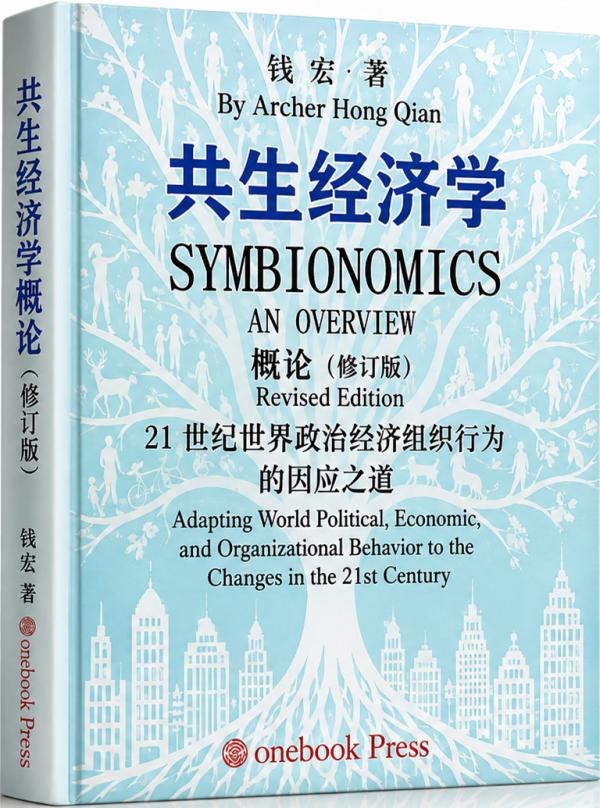
AUTHOR’S PREFACE Where Does Economy Arise? — The Life Origin of Symbionomics Human beings live in an extraordinarily abundant world. The sun rises every day without charging us a fee. Air, water, land, plants, and life’s own capacities for growth and repair all existed before human markets, states, and money. Before a child enters the world, no contract is signed, no birthright is purchased, and no organization is asked for permission to live. Humanity later created agriculture, cities, markets, states, science, industry, and the Internet, and then artificial intelligence capable of processing immense quantities of information in an instant. We produce more and more, move faster and faster, and have ever greater stores of knowledge, energy, and technology at our disposal. Yet one question has become increasingly difficult to avoid: Why have we organized an originally abundant world into a life that grows ever more expensive? Why does GDP continue to grow while so many families remain anxious about housing, education, healthcare, and old age? Why, as machines become more efficient, does human time seem to become more constrained? Why, amid an abundance of goods, do relationships sometimes grow more distant? Why, when knowledge is within easy reach, can organizations become ever larger, requiring life itself to pay ever higher costs merely to sustain their operation? This was, in fact, the question from which I first began writing Symbionomics some twenty years ago. It remains the question today. I. A Question Beginning with the “Ultimate Free Lunch” Many years ago, in A Brief History of Time, I encountered Stephen Hawking’s reference to a remark by Alan Guth, a pioneer of inflationary cosmology: the universe may be the “ultimate free lunch.” Economics, however, has taught us another maxim for many years: There is no such thing as a free lunch. Both statements are true. Human labor entails effort. Resources have boundaries. Choices carry opportunity costs. No society can live indefinitely on promises conjured from nothing. In this sense, economics is right to remind us that “there is no free lunch.” And yet the sunlight, air, water, powers of growth and repair, and countless still-undiscovered possibilities that nature gives to life were not first created by human organizations and then distributed to us. Technological progress, moreover, continually turns what was expensive yesterday into something inexpensive today, sometimes approaching zero marginal cost. The question therefore changes. What economics should investigate may be more than “Who pays for lunch?” It should also ask: Why do some forms of life that could become progressively less costly become expensive again under layer upon layer of organizational cost? Why, as human creativity grows stronger, do some organizations become more adept at extracting, obstructing, and redistributing the fruits of that creativity? Why can some institutions enable finite resources to renew and regenerate themselves, while others manufacture scarcity, anxiety, and conflict amid extraordinary abundance? I gradually came to understand that poverty and prosperity cannot be located on a single axis measuring the quantity of resources. How life organizes itself, how people connect with one another, how organizations are entrusted, how costs flow, and how value is recognized and honored are equally decisive in determining whether a society remains trapped in scarcity or moves toward abundance. This is where Symbionomics arises. II. Economy Originally Meant Tending the Home Where does economics begin? The question may appear to belong to etymology, but in fact it helps determine where economics is going. The word Economy comes from the ancient Greek oikos and nomos. The former refers to the home, the household, and the place in which people live; the latter carries the meanings of rule, order, and management. Its original concern was simple: how to tend the home so that people can live, resources can be used with care, and the household can continue. Economy, at its origin, was therefore never separate from Living. Production, exchange, consumption, upbringing, care, education, ethics, and public affairs all took place within the same world of Life. Economic life also contains a fact so ordinary that it is easily overlooked: one person’s expenditure is often another person’s income; the expenditure of one group becomes the income of another. Seen across economic life as a whole, income and expenditure are two sides of the same movement of value among living subjects. What, then, is being spent? And what is being received? In a modern economy, usually money. Money itself cannot be eaten, worn, or lived in. It cannot care for a child, treat an illness, or transport goods. It can pass from one person to another, and then into the life of a third, because people accept the claim to value and the relationship of Value Fulfillment that it represents. Follow this question further, and the sequence through which an economy arises gradually becomes visible: Life seeks to live; Living gives rise to interaction; interaction generates value; value requires fulfillment; fulfillment requires money and organization; and organization ultimately requires Trust. Economy, therefore, has never been merely about the allocation of resources. Why must resources be allocated? Because Life is being lived. Why does exchange arise? Because Life is self-sufficient, yet never self-contained. Why does money arise? Because value delivered at different times and among different subjects requires continuing fulfillment. Economy arises from Living, and continually returns to Living. Modern economics later acquired extraordinary analytical power. Price, capital, labor, money, investment, exports, consumption, growth, and equilibrium were progressively abstracted from complex Living and turned into variables that could be calculated and compared. This abstraction helped propel modern civilization, but it also produced an easily overlooked consequence: economics became increasingly capable of knowing what was happening in Markets without necessarily knowing what was happening in Living. GDP has grown. Whose Living has improved? Capital has appreciated. Who has borne the costs that never entered its financial statements? Organizations have expanded. Have they lowered the cost of Living, or required Life to contribute ever more time, compliance, taxes and fees, proofs, and anxiety to sustain them? I therefore want to bring Economy back to where it arises: Production returns to Living; Living manifests Ecology; Ecology inspires Life. This is not a rhetorical slogan. It is the directional test that every theory in this book must ultimately pass. 
III. I Have Come to Believe That Economics Needs to “Remove the Excess” In the preface to an earlier manuscript, I quoted a saying attributed to Michelangelo: “Beauty is the purification of superfluities.” Over the years, I have come to appreciate this idea more and more. A sculpture seems to emerge not by endlessly adding something to the stone, but by chiseling away what is unnecessary, little by little, until the form already latent within it becomes visible. Economics, perhaps, has reached a moment when it needs something similar. Over the past several centuries, humanity has accumulated an extraordinarily rich body of economic knowledge. Smith, Ricardo, Marx, Marshall, Schumpeter, Keynes, Hayek, Coase, Solow—the questions they opened remain with us today. I have no wish to sweep these ideas into history. What I would rather do is reopen some of the layers that have accumulated over real life: restore some of the richness of the human being compressed into the “rational economic man”; bring back onto the books the costs of living obscured by GDP; return community to the picture after its long marginalization by the market–government binary; place money once again within promise and value fulfillment; and place organizations once again within the entrustment of life. It is worth noting that Simon Kuznets (1901–1985), one of the principal founders of modern national income accounting, was already keenly aware of the limits of the measurement system he helped to build. In 1934, he warned that the welfare of a nation could scarcely be inferred from a measurement of national income. In 1962, he carried the question further into growth itself: we must distinguish the quantity and quality of growth, its costs and returns, and ask, “What is growing, and why is it growing?” The question can be carried one step further: Who is growing? Who is living? What is the economy ultimately for? Following this inquiry back to the point from which Economy arises, what we first encounter is not GDP, not consumption, investment, or exports and imports, nor a distributive object waiting to be “adjusted,” but Life being lived. When we do this, questions long separated by academic disciplines begin to meet again. Economics, politics, and culture meet again. Life, technology, and institutions meet again. Efficiency, fairness, and responsibility meet again. Market, government, and community meet again. Perhaps originality in thought often does not mean inventing an unprecedentedly complicated system out of nothing. It can mean removing what obscures, so that things that were connected all along can see one another again. IV. “孞”: From Mind to Entrustment In this book I restore an ancient and now unfamiliar Chinese character: 孞. A reader seeing it for the first time may pause. That pause is useful. For 孞 asks us to reconsider what we mean when, every day, we speak of trust, credit, belief, and confidence. 孞 and 信 are pronounced alike and share a field of meaning, but they are written differently—and form itself carries structure. The character 孞 places 子, “child,” above 心, “heart-mind.” To me it evokes the heart of a child, and the heart of a person of integrity. I understand 孞 as a living state that arises from mind and intention, is tested through relationships, and ultimately becomes a condition in which people can make commitments to one another and entrust themselves to one another. In the 1980s, I participated in research on the “science of thinking” advocated by Qian Xuesen. At the time, questions that seemed almost naïve kept occurring to me. Why do Chinese people say, “I know what you are thinking in your belly”? Why do we also say, “Human calculation falls short of Heaven’s calculation,” or “Even the wise, after a thousand considerations, will make a mistake”? Behind rational calculation, logic, consciousness, and neural activity, might there be a deeper activity of life? Those questions did not lead me to a simple answer about mind. They made me more cautious. Human thought and intention clearly cannot be reduced to a logical module. Bodily sensation, neural activity, memory, emotion, will, relationships, and lived experience interact to form the continuously changing “I think,” “I will,” “I believe,” and “I do not believe.” This is why I have increasingly emphasized the movement from Mind to Minds. When one person’s mind enters into relation with another’s—through understanding, doubt, resonance, correction, and commitment—social order gradually takes shape. 信 can be a statement of belief or promise. 孞 contains a longer process: I am willing to entrust to you some portion of my time, resources, hopes, and even my future, because your conduct has repeatedly shown that you are worthy of that entrustment. From this arises what I call Organizational Trust in this book. For governments, companies, schools, hospitals, banks, platforms, and today’s increasingly powerful AI systems, the ultimately scarce resource is not merely data, capital, or power. It is whether life remains willing to entrust itself to them. By 信, commitments are kept.
By 孞, order is generated. V. Population Is Life Before It Is a Number Seen from here, the population question also changes. Traditional economics and state governance often understand population as labor, consumers, taxpayers, human capital, a demographic dividend, or a statistical variable to be allocated and adjusted. Each of these concepts has its use. Yet they can easily make us forget that the grand abstraction “population” is composed of concrete lives—each one born, growing, loving, working, creating, aging, and eventually departing. Population is first the intergenerational arising of life, and only then a supply of labor. Whether young people are willing to fall in love, form families, and have children; whether families have time to care for children and the elderly; whether communities can sustain everyday life; and whether people believe that the next generation can live better than they do—none of these can be manufactured by population policy alone. When housing, education, healthcare, employment, organizational demands for compliance, and uncertainty about the future continually consume the time and capacity of families, population contraction itself may become one of the most honest balance sheets of life. Symbionomics therefore does not seek to maximize population, nor does it simply interpret low fertility as selfishness. It asks instead: do our economies and organizations still leave life enough room to love, form families, bear and raise children, create, and grow old with peace of mind? The population question thus returns to the question of life—and to Organizational Trust. VI. From the Language of Life to the Language of AI I was deeply moved by Francis S. Collins’s The Language of God. That a leading scientist of the Human Genome Project could at the same time openly explore the relationship between science and faith was, in itself, more meaningful to me than any simple conclusion. Humanity’s reading of more than three billion DNA base pairs did not turn life into an instruction manual that had finally been read from cover to cover. Quite the contrary: with every layer opened, deeper relations came into view. So it is with genes. So it is with mind. So it is with society. And so it is with artificial intelligence today. Large models can understand language, calculate, generalize, generate, and help us cross knowledge thresholds that were once prohibitively expensive. This is a great advance. Yet intelligence is not life, and information is not mind or intention. A blank sheet of paper bearing no words at all can, at a particular historical moment, allow thousands of people to know what one another wishes to say. There is no information on the paper, yet immense meaning is generated among people. This is why I have become increasingly concerned with why artificial intelligence must continue toward Mind, Minds, and MindsField. Technology will of course continue to advance. New processing architectures will follow CPU and GPU, and artificial intelligence will move beyond language, images, and data processing into more complex forms of real-world sensing and action. But what ultimately determines the direction of technological civilization is not simply “How much faster can it compute?” It is: Whom does it empower? Who bears the consequences? Does it help life discover new possibilities, or help powerful organizations control life more efficiently? This is why LIFE—AI—TRUST gradually became central to my thinking. LIFE gives purpose. AI provides capability. TRUST defines the entrusted relationship and the boundaries of responsibility. Along this path, I further proposed the open-ended movement from AI to AM—from Artificial Intelligence toward Artificial Mind and the Amorsophia MindsField/Network. It is, first of all, not a technological prophecy. It is a direction for civilization. VII. From Genesis and Dynamics to Synergetics I once tried to understand the world through three terms: Genesis, Dynamics, and Synergetics. No economic order simply drops out of a model. It first arises. A need appears. A relationship is formed. A creation receives a response. A family takes shape. A market emerges. An organization is entrusted. Once something has arisen, forces begin to flow, collide, increase, diminish, amplify, and dissipate. We enter the realm of dynamics. The real wonder of life is that different forces do more than conflict and consume one another. Through interaction, they may discover new relations; capacities that were previously separate may resonate and generate something no single actor possessed alone. This is what I mean by synergy. Entropy increase, entropy reduction, and entropic rotation; self-organization, self-adaptation, and self-interaction; the intersubjective symbiosis of you, me, and others—all unfold through these three processes. Symbionomics, therefore, is more than the study of a method of resource allocation. It seeks to return economy to the questions of how life arises, how relationships move, and how different subjects co-generate new possibilities. This is why the book eventually came to include the Three Self-Organizing Persons, Minds Values, Symbiorights, the three economic forms of Community–Market–Government, GDE, the Six Resource–Asset/Liability Statements, Value Fulfillment, the Mind Bank, Organizational Trust, and the LIFE—AI—TRUST order of interactive fit and symbiotic co-generation. There may seem to be many concepts here. In fact, they all ask the same question: How can a life live better, allow other lives to live, and—through connection with them—create possibilities that did not previously exist? VIII. From an Age of Scarcity toward an Age of Abundance Traditional economics often begins with scarcity. There is nothing wrong with that. Human time is finite. Resources are finite. Land is finite. Every choice carries a cost. Yet human civilization has another side that has long been underestimated: Creation expands possibility. A seed can become a tree. An idea can be used by countless people without being exhausted by use. An algorithm can be copied. A good institution can reduce transaction costs that would otherwise be paid repeatedly by hundreds of millions of people. A relationship of 孞-Trust can redirect enormous amounts of energy—previously spent on suspicion, defense, proof, approval, and contention—back into creation. I have therefore become increasingly willing to see the twenty-first century as a doorway opening from an “Age of Scarcity” toward an “Age of Abundance.” This does not mean scarcity will disappear, nor does it mean humanity can forget boundaries. Precisely because technology has, for the first time, allowed us to glimpse possibilities of abundance on such a scale, we need all the more to understand how not to organize abundance back into scarcity. This is why I do not want economics to end with the growth rate. GDP can tell us how much we have produced. GDE must also ask how much real life effectiveness that production has generated. Money must answer how value is recognized and fulfilled. Organizations must answer why they deserve the entrustment of life. Artificial intelligence must ultimately pass the same test. And so the question of the “ultimate free lunch” that confronted me decades ago has not disappeared from this revised edition. It has simply become more concentrated and more real: Why have we organized an originally abundant world into a life that grows ever more expensive? If we can pose that question anew, another possibility opens before us: to reduce, little by little, the ineffective costs imposed by organizations; to release, little by little, the capacities of life that have been suppressed; to see again the value that has been obscured; and to repair, little by little, the 孞-Trust that has been lost. Like a sculptor removing the excess from stone. Beauty may have been there all along. Life, perhaps, could have been simpler all along. Economy arises from the home, and to the home it should return. Production returns to Living; Living manifests Ecology; Ecology inspires Life. Life is self-sufficient, yet not self-contained. Everything is intersubjective symbiosis. This is the life origin from which I write Symbionomics. It is also why I am willing to place this book in the hands of its readers. By 2023, the book had already taken shape in a form ready for publication, and Mr. Zhu Jiaming had written a preface for it. Yet I became increasingly aware that several of its central questions, though already raised, had not unfolded far enough for me to be willing to stop writing. GDE, Minds Values, Value Fulfillment, Organizational Trust, and the relationship between human beings and technology after artificial intelligence enters organizations were all still growing. Rather than hurry to fix an unfolding body of thought into a finished form, I chose to let it travel a little farther. The 2023 edition was therefore never formally published. Three years have passed, and the world has changed rapidly. Artificial intelligence has entered more deeply into life and organizations, while questions of growth, debt, population, governance, and 孞-Trust have become more concentrated. Problems once scattered throughout the book have gradually converged into a clearer line of thought: beginning from life’s self-organizing connections, to rethink the human person, value, effectiveness, money, and organization, and to respond through LIFE—AI—TRUST to the realities now emerging in the Digital–Quantum Age. This revision has therefore become the continued growth of a book that had already begun to live. What now stands before the reader is the revised edition of Symbionomics—and the version I am ready, at this moment, to release. Archer Hong Qian Vancouver, Canada August 18, 2026
|