随缘而安,落地生根
——在“枫叶科发沙龙”上的即席总结发言
今天是第三次参加"枫叶科发沙龙“,话题很广。诸君有讲中国绘画笔法的,有讲如何运用法律在加拿大维权的,有讲房地产的,也有专门讲历史上华人对加拿大政治、经济所作重要贡献的;从多元文化,又谈到今天华人应当怎样积极参与加拿大政治、参加选举。现场还有来了一位祖籍香港的列治文市长参选人,就是坐我右边的这位年轻有为的张可仁先生。 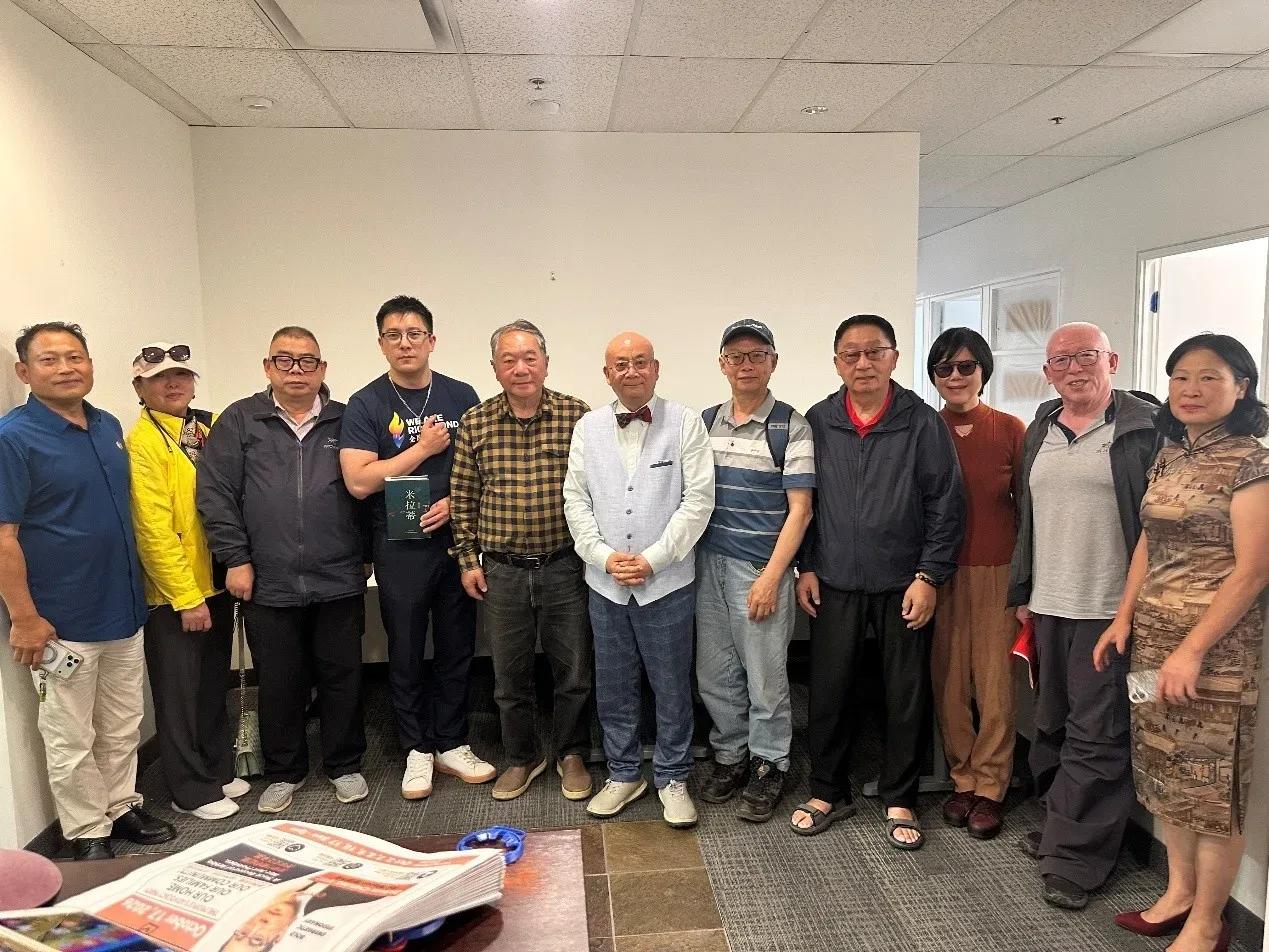
主持人让我作一个总结发言。 我想了想,还是从一个很简单的问题讲起:华人既然来到加拿大,参与当地政治也好,参与经济社会生活也好,首先要有一种“随缘而安,落地生根”的心态。 我常讲我小外孙的一件事,他叫Richard。2020年1月19号我到这里的当天,时差还没倒过来就去参加一个由中国央视来本拿比组织的一个儿童演唱会,我外孙参加合唱团,我坐在前排有点迷糊地观看孩子很认真唱《我和我的祖国》。回家以后我问他:“你的祖国是哪里?”他脱口而出:“加拿大呀!”当时Richard5岁! 我觉得这太正常了。 一个孩子出生在这里、成长在这里,他当然会把加拿大当作自己的祖国。我们成年人反而容易把事情想复杂了。 一些人当年在中国改革开放中赚了一笔钱,后来来到加拿大生活。既然来了,就好好建设这个地方,为什么老想着什么时候再回中国赚一把,还要给自己套上一顶“落叶归根”的道德帽子? 财富总要有人创造,也要有人分享。中国那块土地上的发展机会,为什么不能多留一点给继续生活在那里的人去创造、去获得?而我们既然选择在加拿大生活,就在这里落地生根,为这块土地多创造一点东西。 这也涉及我来加拿大以后经常听到的另一个话题:歧视。 我不是说歧视存在不存在。我想说的是,如果把“歧视”讲过了头,也可能在新的关系中产生“逆向歧视”。 我想这个问题想了很久,后来形成了一个很朴素的判断: 一个族裔受到的歧视程度,与这个族裔的在地贡献大体呈反比关系。 什么意思? 一个族裔对所在社会的生产建设、科学技术、文学艺术、体育康乐等方面贡献越大,社会对这个族裔的认同往往越强,歧视就越弱,甚至可能在具体情境中消失。 我一直记得一个例子。 2021年东京奥运会上,一个出生于中国、后来被加拿大夫妇收养长大的女孩(弃婴)麦克尼尔,代表加拿大队夺得奥运冠军。那一刻,我们看到的是什么? 是不分族裔的加拿大人都在为她欢呼。 那个时候,还有多少人首先去问她是什么族裔、出生在哪里?人们看到的是:这是代表加拿大赢得荣誉的运动员。 所以我后来越来越觉得,反歧视当然重要,但反歧视不能成为终点。如果我们永远只把自己讲成“受歧视者”,那就仍然被过去的关系规定着。 更重要的问题是:我们为这块土地贡献什么? 这也正好讲到今天大家谈得很多的多元文化。 我本人2021年得到过一个多元文化方面的小奖。当时区泽光议员主动提出为我主持,他介绍我的时候说,他认识的钱老师是“一位很接地气的思想家”。2024年,我代表复旦大学温哥华校友会,领取了BC省政府“多元文化与反种族主义奖”中的“增进跨文化信任奖”(Intercultural Trust Award)类别提名奖。 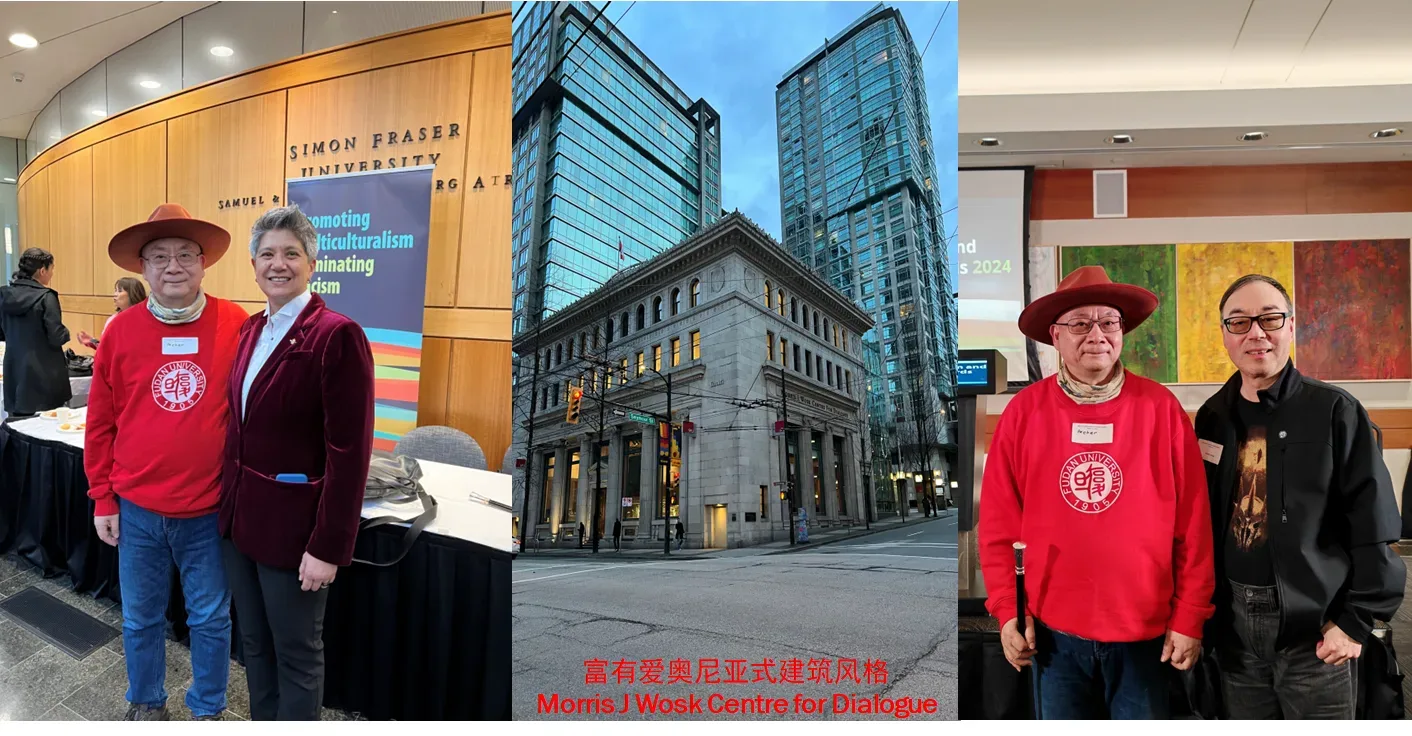
但是在会议休息时,我对主动过来和我握手的负责有关奖项的省议员艾美宝讲过:多元主义也好,生态主义也好,背后还缺一点哲学规范。应当在 Multiculturalism 中注入 Symbiosis的意涵。 多元不能只是说:你有你的文化,我有我的文化,大家都存在就好了。 多元文化必须有一个底线。 这个底线,在我看来,就是交互主体共生(Intersubjective Symbiosism)。 讲得通俗一点,其实就是一句流传很久的西方谚语: Live and let live. 自己活,也要让别人活。这个英文习语本身表达的就是对不同生活方式的宽容和尊重。 但是我还要把它往前推进一步。 如果只讲 Live and let live,仍然不够,因为共生绝不意味着对邪恶也听之任之。所以反过来还要有一句: Don’t be evil and let evil be. 不要自己作恶,也让别人邪恶。 这两句话放在一起,才比较接近我所理解的共生:尊重差异,但有生命底线;允许不同主体按照自己的方式生活,同时又共同维护彼此能够继续生活、继续创造的条件。 前几天参加一个晚宴,我又碰到区泽光国会议员。他见到我,第一句话就说,他现在提出“全国华裔加拿大人贡献日”议案时,首先想到的就是钱老师讲的 Live and let live。 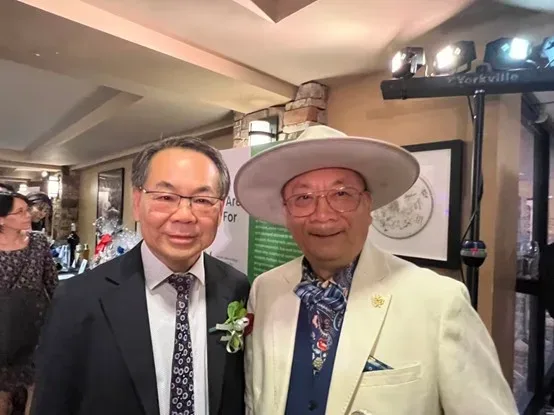
我听了很感动。 因为这让我想到,早在2023年,我应邀参加“《排华法案》100周年暨加拿大建国156周年庆”,与胡元豹参议员同台作主旨发言。当时我的题目就是: 《历史总要翻篇,反思亟需升维:创建一个全新的“共生加拿大”!》 为什么历史要翻篇? 翻篇当然不是忘记历史。历史应该记住,歧视也应该反思。但是反思最后总要回答一个问题:我们今天如何相处?我们准备和能够贡献什么,创造什么? 如果一百年前的华人曾经受到歧视,那么一百年后的华人更应该思考:我们怎样从历史的受害者走向今天加拿大的贡献者? 这就回到了今天沙龙最后谈到的华人参政问题。 我很赞成桑宜川教授在讲历史上的加拿大华人政要时概括的一句话:华人要从政,就要放下自己的族裔、文化包袱。他还在分析了来自大陆、香港、台湾华人构成及心理精神姿态后,幽默地提醒最后一个“省部级”华人,已经是几十多前的事了! 这句话很重,很重要。 华裔身份当然不需要丢掉,自己的文化也不需要丢掉。但是,当你参加加拿大的公共政治,特别是竞选一个城市的市长,你面对的就不能只是华人。 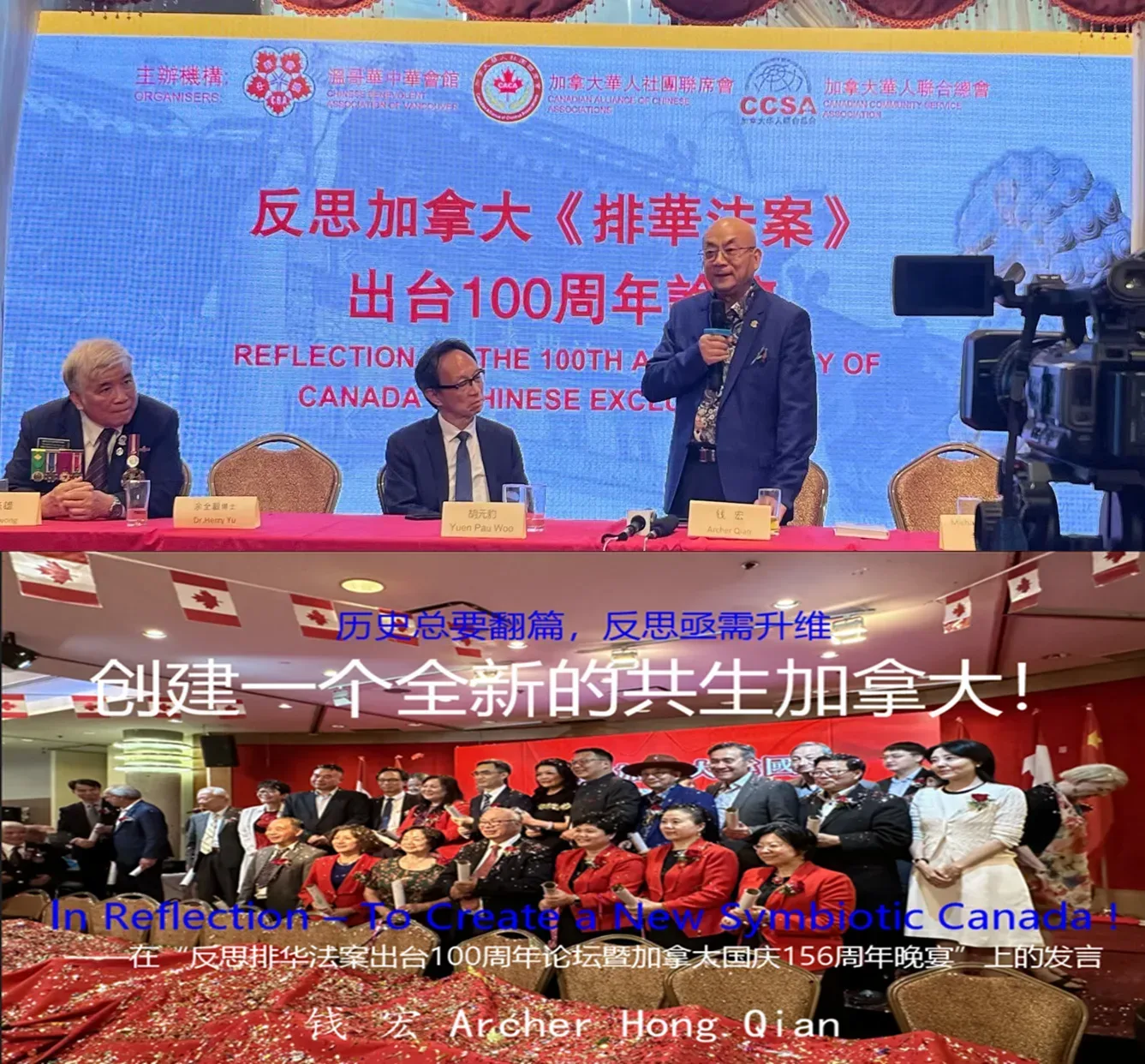
所以,我看到张可仁先生选举团队提出“全民列治文”,我觉得这个提法很好。因为从“华人参政”真正走向加拿大政治,关键的一步恰恰是:从一个族裔的人,走向所有市民的受托者。 因此,我今天最后送给张可仁先生一句话: 如果真的当选,希望你做的不是“华人市长”,而是“全民市长”。 华人参与加拿大政治的意义,也许恰恰就在这里。 从随缘而安、落地生根开始; 从总是追问“别人怎样看我们”,走向“我们能为这里贡献什么”; 从反歧视走向在地贡献; 从多元文化走向交互主体共生; 从华人参政走向全民政治。 给大家报告一下,我的《共生加拿大》一书的大纲已经出来,请大家批评指教。 这样回头再看我小外孙那句脱口而出的—— “我的祖国就是加拿大。” 它其实一点都不幼稚。 也许一个六岁孩子,早就用最简单的一句话,把我们成年人绕了很久的问题说清楚了: 既然在这里生活,就愛这块土地;既然在这里扎根,就为这块土地创造;既然参与这里的政治,就为生活在这块土地上的所有人服务。 我想,这也正是我所说的——共生加拿大。
钱宏(Archer Hong Qian) 2026年9月19日于加拿大列治文
Settle with Circumstance, Put Down Roots —Impromptu Concluding Remarks at the “Maple Leaf KF Salon” Today is my third time attending the “Maple Leaf KF Salon.” The topics have ranged widely. Some of you spoke about brushwork in Chinese painting; some about how to use the law to protect one’s rights in Canada; some about real estate; and some specifically about the important contributions Chinese Canadians have made to Canada’s political and economic development. From multiculturalism, the discussion moved on to how Chinese Canadians today should actively participate in Canadian politics and elections. We also have with us a candidate for mayor of Richmond whose family roots are in Hong Kong—the promising Mr. Zhang Keren, seated here to my right. The moderator asked me to offer some concluding remarks. After thinking for a moment, I decided to begin with a very simple point: once Chinese people have come to Canada, whether we participate in local politics or in its economic and social life, the first thing we need is a mindset of “settling with circumstance and putting down roots.” I often tell a story about my young grandson, Richard. On January 19, 2020, the very day I arrived here, before I had even recovered from jet lag, I went to a children’s concert in Burnaby organized with China Central Television. My grandson was singing in the choir. Sitting in the front row, still a little dazed, I watched the children earnestly sing “My Motherland and Me.” When we got home, I asked him, “Where is your motherland?” He answered without hesitation: “Canada!” Richard was five years old at the time! I thought that was perfectly natural. A child born and raised here will naturally regard Canada as his own country. We adults are the ones who tend to make the matter complicated. Some people made money during China’s reform and opening-up and later came to live in Canada. Since we have come here, why not help build this place well? Why keep thinking about going back to China to make another fortune, while wrapping that impulse in the moral banner of “fallen leaves returning to their roots”? Wealth has to be created, and it also has to be shared. Why not leave more of the opportunities on Chinese soil to the people who continue to live there, so that they too can create and benefit from them? Since we have chosen to live in Canada, then let us put down roots here and create more for this land. This also touches on another subject I have heard frequently since coming to Canada: discrimination. I am not debating whether discrimination exists. What I want to say is that if we talk about “discrimination” too far and too exclusively, new relationships may also produce “reverse discrimination.” I thought about this for a long time and eventually arrived at a very simple observation: The degree of discrimination experienced by an ethnic group is, broadly speaking, inversely related to that group’s local contribution. What do I mean? The greater an ethnic group’s contribution to the society in which it lives—in production and development, science and technology, literature and the arts, sports and recreation—the stronger society’s recognition of that group tends to become, and the weaker discrimination tends to be; in some specific circumstances, it may even disappear altogether. One example has always stayed with me. At the Tokyo Olympics in 2021, Maggie Mac Neil—a girl born in China, abandoned as an infant and later adopted and raised by Canadian parents—won Olympic gold representing Canada. What did we see at that moment? Canadians of every ethnic background were cheering for her. At that moment, how many people first asked what ethnicity she was or where she had been born? What people saw was an athlete winning honor for Canada. That is why I have increasingly come to feel that opposing discrimination is of course important, but it cannot be the endpoint. If we forever describe ourselves only as “the discriminated against,” then we are still allowing ourselves to be defined by past relationships. The more important question is: What do we contribute to this land? That brings us naturally to another subject much discussed today: multiculturalism. In 2021, I myself received a small award related to multiculturalism. Councillor Chak Au volunteered to host the event for me, and in introducing me he said that the Professor Qian he knew was “a very down-to-earth thinker.” In 2024, representing the Fudan University Alumni Association of Vancouver, I received a nomination recognition in the Intercultural Trust Award category of the Government of British Columbia’s Multiculturalism and Anti-Racism Awards. But during a break at the event, I said to MLA Mable Elmore, who had come over to shake my hand and who was responsible for the relevant awards: whether we speak of multiculturalism or ecologism, something is still missing behind them—a philosophical norm. Multiculturalism should be infused with the meaning of Symbiosis. Diversity cannot simply mean: you have your culture, I have mine, and it is enough that we all exist side by side. Multiculturalism must have a bottom line. That bottom line, in my view, is Intersubjective Symbiosism. Put in everyday language, it can be expressed through a long-standing Western saying: Live and let live. Live yourself, and let others live as well. The saying itself conveys tolerance and respect for different ways of life. But I would take it one step further. “Live and let live” alone is still not enough, because symbiosis can never mean standing by and allowing evil to run unchecked. So I would add its converse: Don’t be evil and let evil be. Do not do evil yourself, and do not let evil simply be. Taken together, these two sentences come closer to what I mean by symbiosis: respect differences, but maintain a bottom line grounded in life; allow different subjects to live in their own ways, while jointly safeguarding the conditions that enable one another to continue living and creating. A few days ago, at a dinner, I again met Member of Parliament Chak Au. The first thing he said to me was that, when he proposed a “National Chinese Canadian Contribution Day,” the first thing that came to mind was Professor Qian’s phrase, “Live and let live.” I was deeply moved to hear that. It reminded me that back in 2023, I was invited to speak at an event marking the 100th anniversary of the Chinese Exclusion Act and the 156th anniversary of Canadian Confederation, where I delivered a keynote address alongside Senator Yuen Pau Woo. My title was: “History Must Eventually Turn the Page; Reflection Urgently Needs to Rise to a Higher Dimension: Create a New ‘Symbiotic Canada’!” Why must history turn the page? Turning the page certainly does not mean forgetting history. History should be remembered, and discrimination should be reflected upon. But reflection must ultimately answer a question: How do we live together today? What are we prepared and able to contribute, and what are we going to create? If Chinese people a century ago suffered discrimination, then Chinese Canadians a century later should think even more seriously about this question: How do we move from being victims in history to becoming contributors to Canada today? That brings us back to the final subject discussed at today’s salon: Chinese participation in politics. I very much agree with Professor Sang Yichuan’s conclusion when he spoke about Chinese Canadian political figures in history: if Chinese Canadians want to enter politics, they must put down their own ethnic and cultural baggage. After analyzing the composition and psychological outlook of Chinese communities originating from mainland China, Hong Kong, and Taiwan, he also humorously reminded us that it has already been decades since the last Chinese Canadian reached a “provincial-ministerial” level of office! That is a weighty point, and an important one. Of course, Chinese Canadians do not need to discard their identity, nor do they need to abandon their culture. But once you enter Canadian public life—especially when you run for mayor of a city—the people you face cannot be only Chinese Canadians.
So when I saw Mr. Zhang Keren’s campaign team put forward “We Are Richmond,” I thought it was a very good formulation. The crucial step in moving from “Chinese participation in politics” to genuine participation in Canadian politics is precisely this: to move from being a member of one ethnic group to becoming a trustee for all citizens. So today I would like to leave Mr. Zhang Keren with one final sentence: If you are elected, I hope you will be not a “Chinese mayor,” but a “mayor for all.” Perhaps this is precisely where the significance of Chinese Canadian participation in Canadian politics lies. Begin by settling with circumstance and putting down roots; Move from always asking, “How do others see us?” to asking, “What can we contribute here?”; Move from opposing discrimination to making local contributions; Move from multiculturalism to Intersubjective Symbiosism; Move from Chinese participation in politics to politics for all. Let me also report to everyone that the outline of my book Symbiotic Canada is now complete. I welcome your criticism and suggestions. Now, looking back again at the words my young grandson blurted out— “My motherland is Canada.” There was nothing childish about them. Perhaps a six-year-old child had already expressed, in the simplest possible sentence, something that we adults have spent a long time circling around: If we live here, then love this land; if we put down roots here, then create for this land; if we participate in its politics, then serve everyone who lives on this land. I think this is precisely what I mean by—Symbiotic Canada. Archer Hong Qian Richmond, Canada | September 19, 2026
|