真實民意的辨識理念和方法革新A New Philosophy and Methodology for Identifying Genuine Public Opinion ——從美國中期選舉到共生經濟學的總體效能檢驗 From the U.S. Midterm Elections to the Assessment of Overall Effectiveness in Symbionomics 錢 宏(Archer Hong Qian) 2026年11月2日晨於溫哥華
今天是我的生日,明天就是將可能影響美國及世界格局的中期選舉日。 有趣的是,有朋友發來一張圖,《你不投票就別抱怨》,其中列舉了10個選項,又有朋友歸結為: 選擇堅守常識,還是選擇癲狂? 我想,這是美國當下多數決選舉制度與自願投票參與機制共同作用下出現的一種極端現象級問題,也確實是當今美國政治乃至世界政治值得追問的問題。 加上我昨天寫《若非必要,勿增實體》時讓AI畫的插圖,兩幅圖放在一起,很有意思。第一幅圖,從川普常識新政出發,討論世界秩序如何重構,最終落到“組織信託”與“萬事交互主體共生”。第二幅圖,把民主黨與共和黨描繪成常識與癲狂的對立。可是,當政治競爭被壓縮成這樣的標籤,誰來辨識真實民意?誰來檢驗公共政策的實際後果? 一、從兩黨對立的現象,看民意的辨識對象 保護兒童、打擊犯罪、維護邊境秩序、控制財政成本、保障公民權利,都是可討論的公共目標。民主黨2024年綱領同樣提出邊境安全、打擊犯罪和扶持小企業等主張。真正需要辨識的,是具體政策怎樣實施、權責怎樣安排、代價由誰承擔。 選舉中的多數,是候選人組合、選舉規則、參與意願與信息條件共同形成的多數。它決定合法授權,卻無法窮盡全體公民對每一項政策的真實判斷。尤其在自願投票條件下,沉默者、棄權者、無適當選擇者與搖擺者的意願,不能簡單塞進勝負數字。 皮尤研究中心2026年7月調查發現,美國成年人在經濟政策上較認同民主黨的占37%,共和黨的36%,認為兩黨均不符合自己看法的25%。政治圖像可以黑白分明,社會現實卻有交錯、矛盾、遲疑與尚未表達的孞念。關鍵問題已經出現:民調究竟在辨識什麼? 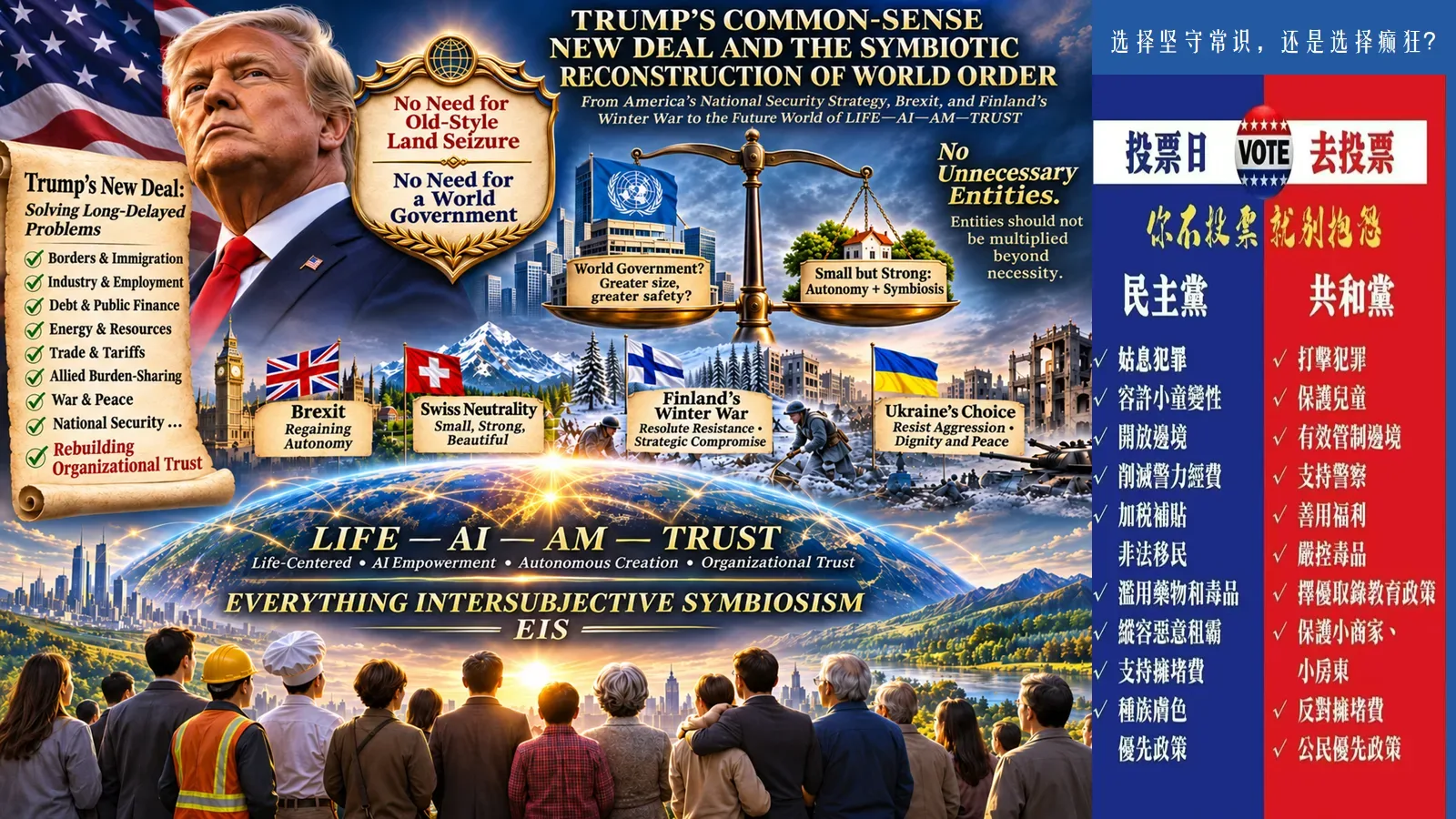
二、給舊方法打補丁,無法創造新的認識對象 傳統民調把參與者放在被提問、被抽樣、被歸類的位置。改進抽樣、增加權重、校正偏差,可以修正部分統計誤差,卻仍主要圍繞特定時點的回答組織知識。問卷測到了表態,未必辨識了主體的真實利益、潛在願望、承擔能力與選擇後果。 這個問題遠遠超出民調。經濟統計重產出,政治組織重選票,政府部門重預算,文化傳播重流量,AI重數據、算法和算力。可計量的東西越來越多,生命真正得到什麼、失去什麼,反而常常被數字遮蔽。組織把工具變成目標,指標便可能吞噬創造指標的生命。 2025年3月,我完成了《論富豪治國》,4月1日又基於此文,運用共生經濟學(Symbionomics)“健康黃金率五因交互權能”模型(即降本C、賦能E、健康因子H、信託結構T、和平因子P),設計了《全新民調基準率綱要》(Symbiotic Benchmark Poll Outline,SBPO)。在SBPO中,提出“健康黃金律五因交互權能”的新民調基準。其起點是交互主體共生(Intersubjective Symbiosism)的民眾參與活力:讓被調查者從被動答題、勾選“Yes/No”,轉為自主表達、點透新知、共鳴互動、自組織交互,激活潛藏在心裡的孞念(Mind Intent)。在心智交互(Inter-minds)的過程中,民調可以成為一次自我發現,也成為公共認知與責任生成的過程。Inter-minds在這裡說明心智之間的交互,不替換“交互主體共生”的正式英文名稱。 這個構想包含一項根本變化:參與者有權發現問題、提出自己的問題,也有權在了解到新事實、他人的處境和政策代價後修正意見。調查者的任務,是保障這種主體性交互得以真實發生,而非借“教育”“共識”之名誘導出預定答案。使意見發生變化的證據、過程及其原因,也應成為真實民意的一部分。 AI的問題也在這裡。發現缺陷便追加規則,擴大模型便增加算力,仍不能由數據、算法、算力與神經網絡的總和自動生成Mind。提出將AI升格為AM(Artificial Mind & Amorsophia),所要解決的是認識主體、判斷與責任的根本問題。真實民意的辨識也必須從這裡起步。 三、以生命為本位,建立總體效能的辨識尺度 共生經濟學(Symbionomics)以生產—生活—生態—生命的內在聯係為視野。生命具有主體性,工具延展生命能力,組織匯聚主體行動;主體的自組織動能與共生、共襄生成勢能相應相輔相成。工具與組織創造了什麼實際價值,轉嫁了多少社會代價,須由生命及其交互共生的結果來回答。 GDP可以記錄經濟產出,卻難單獨核算組織固化、交易摩擦、生態背負、健康損耗與信託流失。共生經濟學由此提出效能係數η,並以國內生產效能總值GDE檢驗產出與實際效能的關係: ηᵢ = GDEᵢ / GDPᵢ GDE = Σ(GDPᵢ × ηᵢ) R = GDE / GDP η是核心,GDE是總體表達,R是總體效能相對於產出的比率。它們不是把GDP換個名字;必須在具體核算邊界內,說明貢獻、損耗、受益者、承擔者及歸因依據。政治、文化等活動還須建立與其對象相應的效能賬目,不能機械地把生命的一切價值折算為貨幣。 實際效能來自哪裡?五個問題必須一起問:是否降本(C),減少組織、交易與生態背負;是否賦能(E),釋放主體創造和行動能力;是否增進健康(H),改善生命及經濟運行狀態;是否建立信任(T),實現權責一致、承諾可兌的組織信託;是否促進和平(P),降低衝突損耗、擴展持續合作。由此構成“五因指數”(Five-Cause Index)。 η是效能係數,GDE是產出經效能檢驗後的總體表達;五因指數則從降本、賦能、健康、信任、和平五個相應方面,揭示效能從哪裡生成、在哪裡受損。健康黃金率把效能與生命健康聯繫起來;民調基準率則將這種認識用於公眾對政治、經濟、文化活動的體驗與判斷。民調因此是共生經濟學總體效能辨識的一項具體應用。 去年綱要還提出健康值(Health Value,HV)的交互試算式: HV = (C ÷ E) × H × T × P / STC 其中,C為降本(Cost Reduction),E為賦能(Empowerment),H為健康因子(Health Factor),T為信託結構(Trust Structure),P為和平因子(Peace Factor);STC為社會交易成本(Social Transaction Cost),涉及官僚摩擦、尋租和不透明等,原綱要設默認值為1,並以HV=1作為基準線。這裡必須把原模型的思想、參數和實驗基準完整保留下來,作為2025年方法構想的明確記錄。 健康值模型提出了將政策感受、交互關係與執行摩擦一起辨識的途徑。HV與η、GDE各有核算對象:五因主觀評分記錄公眾感知,STC需要可核實的社會交易成本口徑,η與GDE則檢驗可歸因的實際效能。2025年原式HV=(C÷E)×H×T×P/STC應作為方法發展記錄完整保留;但若C與E分別表示“降本改善”和“賦能改善”,二者同為正向因素,E置於分母便會出現賦能越高、HV反而越低的方向衝突。把C改釋為“成本率”、E改釋為“賦能率”,仍不能消除這一衝突:成本下降使C變小,同樣會使HV下降。可實施的下一步是把五因的指標方向統一、以明確基準歸一化,另行校準同向的健康值計量式,並在樣本與政策效果中檢驗;原式與校準後的試算式應分別標識,不能混用。 四、從“被調查的對象”到“參與辨識的主體” SBPO有一條完整的交互路徑:直覺(Intuition)—打分(Scoring)—算賬(Calculation)—對比(Comparison)—結論(Conclusion)。其中貫穿多維評估、點透新知、共鳴互動、自組織交互四種活動。五個步驟不是五道固定題,而是讓主體、事實、責任和效能發生聯繫的一次完整過程。 直覺:先問“你怎麼看”,讓參與者不受選項束縛地表達立場、疑問、利益期待和真實顧慮,形成未經引導的初始基準。打分:對同一政策分別就C、E、H、T、P作出評估,記錄不同維度的取捨,拒絕以單一贊成率掩蓋複雜判斷。算賬:展示五因評分及健康值HV的試算,同時列出資金來源、組織交易成本STC、健康與生態背負以及各主體實際承擔的代價;公眾感受與可核實的實際效能分別記錄。對比:將個人判斷與群體分布、不同人群處境和政策證據作交互呈現,詢問“調不調?為什麼?”,保留原始分數及修改理由。結論:呈現初始意願、知情後判斷、五因分布、仍存異議,並以日後政策兌現的效能反饋持續覆核。 因此,新民調基準率調查表(Symbiotic Benchmark Poll Form,SBPF)應有兩本賬:一本記錄“民眾怎樣感知、理解和選擇”,一本記錄“政策怎樣投入、執行與兌現”。前者展示主體意願、HV試算及其變化,是社會心理的晴雨表,也可為組織信託、健康損耗和公共成本發出早期信號;後者以可核查的投入、損耗、歸因和結果檢驗η、GDE等總體效能。前哨信號引導覆核,實際賬目反過來檢驗公眾感受;兩本賬互相參照、各守邊界。GDP增長不能僅憑公眾滿意度認定為GDE增長,群眾的真實體驗也不能因宏觀數字好看而被抹去。參與者可以形成新共識,也有權保留異議;從“我”到“我們”的共鳴,來自自由、自律與知情交互,不能用一個平均值代替眾私的正當權利。 2025年綱要用國內政策、外交政策及其組合,設計了具體的練習:減稅是否真的減輕總體成本,制裁會否傷及健康與和平,關稅談判與國內減稅相結合時由誰承擔代價,政府精簡省下的財政費用是否轉為居民和企業的新負擔。這些案例最值得吸收的是同一項政策的五因交互分析:降本可能伴隨信託損耗,短期賦能可能帶來長期交易成本;一個人也可能同時支持某項政策的目標、反對其執行方式。單一“Yes/No”統計無法呈現這樣的民意結構。 例如,有人贊同減稅,卻擔心公共服務萎縮;有人贊同邊境秩序,卻要求正當程序;有人支持貿易談判,卻擔心消費者承擔關稅。這些都可以先開放陳述,再作五因辨識,通過健康值試算與STC核查呈現不同代價,最後讓參與者面對賬目、事實與他人處境重新判斷。民意因此同時包含選擇、理由、條件與後果。 原綱要還設計了線上評分、可視化、AI處理開放式意見以及數據透明機制。今天可進一步藉助AM(Artificial Mind & Amorsophia)的孞態交互能力服務主體辨識,但任何技術都須明確數據來源、隱私保護、公開審核及誤差糾正;工具不能代替主體判斷,組織不能用算法暗中操控民意。這也使新民調有機會從一次性的選前預測,發展為長期的公共效能追蹤和組織信託建設。 五、真實民意辨識,如何進入現實政治與世界秩序 以川普新政為例,邊境、能源、貿易、財政、產業與盟友責任,都不宜停留在口號與支持率上。關稅的最終負擔落在哪裡?政府精簡省下的成本,是否被新的支出和生態背負抵消?邊境治理如何兌現安全與正當程序?盟友分擔能否形成可持續的共同安全?每項政策都應接受同一套五因效能檢驗。對民主黨、共和黨及其他政治組織亦然。 公眾可以先表達支持或反對,再看到相關事實、成本歸屬和可能後果,經過交互重新判斷,待政策實施後繼續檢驗。如此便能辨明:誰只是善於動員選票,誰承諾了什麼,誰兌現了多少公共價值,誰把組織成本轉嫁給了別人。這比一次支持率更接近真實民意的生成過程,也更接近公共責任的實質。 世界政治大洗牌,背後有組織固化、利益錯配、財政與信託成本累積的共同難題。民眾對既有秩序的質疑、對變革的期待,往往被歸入左、右、激進或保守的陣營;而究竟哪些組織失去效能,哪些新舉措能夠修復生命與社會的聯繫,卻缺少同等嚴密的檢驗。 “若非必要,勿增實體”,由此獲得政治經濟學的可追責尺度:凡要求擴大組織、增加權力、財政及社會成本者,都應證明必要性,交付相稱的公共價值。減少機構本身也要接受效能檢驗;成本降在賬面上,損失轉嫁到社會,仍然不是實際降本。 常識始於事實,成於責任,驗於效能;癲狂始於偏執,陷於權力,終於代價。 真實民意的辨識,由此連到經濟、政治、文化活動的總體效能:民眾如何從被動受測走向主動判斷,生命如何藉助工具與組織拓展創造,國家及國際組織又如何在信託和責任中兌現公共價值?新民調基準率讓真實利益、生命感受、政策代價和履約後果進入同一場公開交互,使標籤對立重新面對事實與責任。選舉的一次性多數與持續生成的民意、政策的短期成績與長期淨效能,都要接受同一生命尺度的檢驗。世界秩序的共生重構,才有能夠辨識、核算、追責的基礎。 最後,我懇請讀者諸君一道來完善《全新民調基準率綱要》的操作部分,有興趣的朋友可留言索取《綱要》,向皮尤等有影響力的民調機構推薦,也不排除我們組建一家全新民調機構的可能。 參考依據 錢宏:《新民調基準率綱要——基於“健康黃金律五因交互權能”模型》,2025年4月1日(未刊綱要;含SBPO與調查表)。 錢 宏(Archer Hong Qian):《共生經濟學概論(修訂版)》(Symbionomics: An Overview, Revised),2026。 錢 宏(Archer Hong Qian):《將AI升格為AM》(Elevating AI to AM),2026。 Pew Research Center, “As the 2026 Midterms Approach, Economy Is Front and Center,” July 23, 2026(調查時間:7月6日至12日)。 Federal Election Commission, “Election and Voting Information”(2026年聯邦大選日期:11月3日)。 Democratic National Committee, 2024 Democratic Party Platform.
A New Philosophy and Methodology for Identifying Genuine Public Opinion
From the U.S. Midterm Elections to the Assessment of Overall Effectiveness in Symbionomics
Archer Hong Qian Morning of November 2, 2026 | Vancouver
Today is my birthday. Tomorrow is the U.S. midterm Election Day, which may influence the political landscape of both America and the wider world. Interestingly, a friend sent me an image titled “If You Don't Vote, Don't Complain,” presenting ten contrasting choices. Another friend summed it up in one question: Will America choose to uphold common sense, or embrace madness? I believe this is an extreme, almost emblematic phenomenon arising from the combined effects of America's majority-rule electoral arrangements and voluntary voter participation. It is indeed a question worth asking about American politics and, more broadly, world politics today. Together with an illustration I asked AI to create yesterday for my essay “Entities Should Not Be Multiplied Beyond Necessity,” the two images make an interesting comparison. The first illustration begins with Trump's common-sense New Deal, examines the reconstruction of the world order, and ultimately arrives at Organizational Trust and Everything Intersubjective Symbiosism (EIS). The second portrays the Democratic and Republican parties as opposing embodiments of common sense and madness. But when political competition is reduced to such labels, who can identify genuine public opinion? And who can examine the actual consequences of public policies? 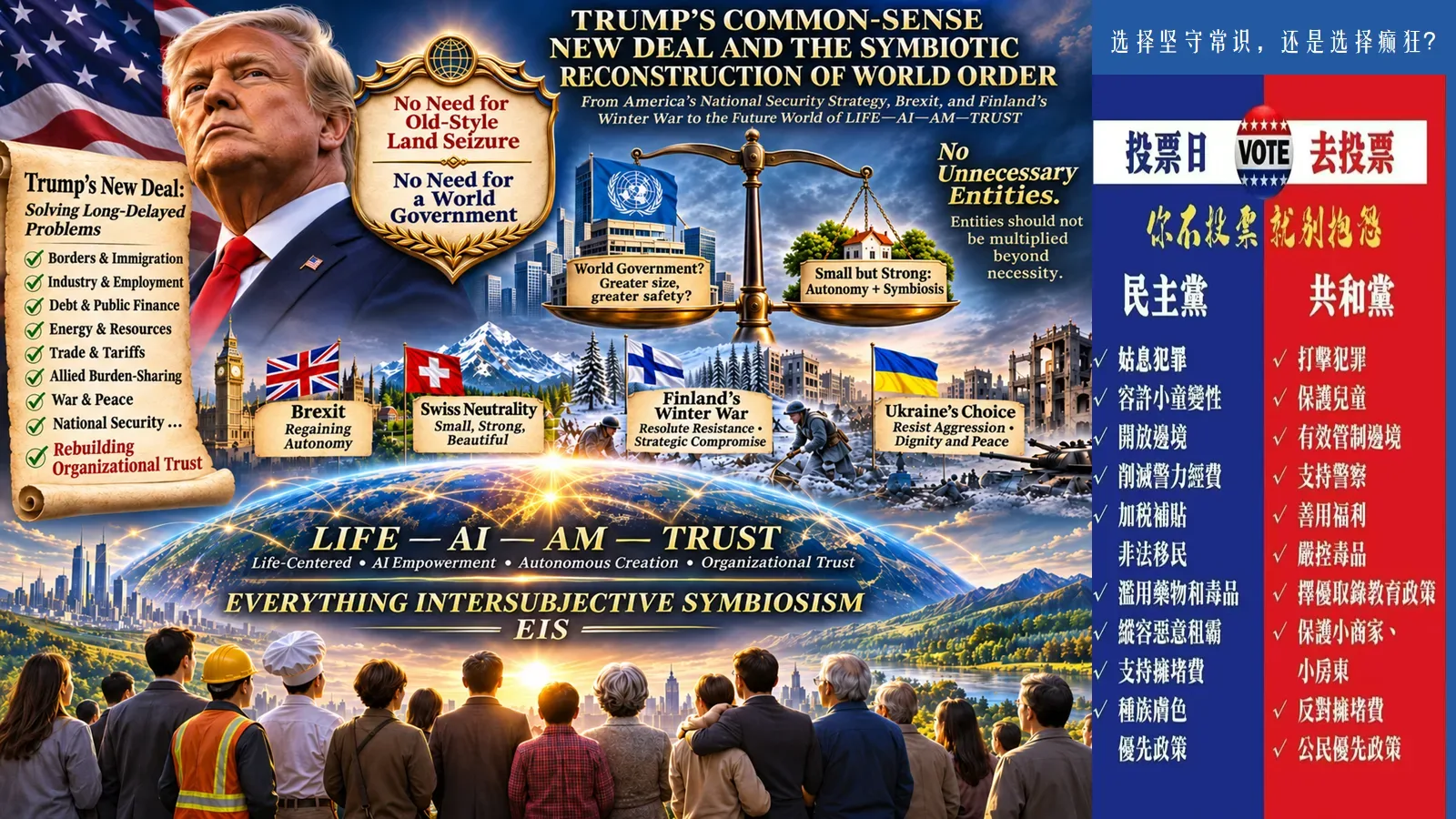
I. Beyond Two-Party Confrontation: What Exactly Are We Trying to Identify?Protecting children, combating crime, maintaining border order, controlling fiscal costs, and safeguarding citizens' rights are all legitimate public objectives. The Democratic Party's 2024 platform likewise advocated border security, fighting crime, and supporting small businesses. What requires closer examination is how particular policies are implemented, how rights and responsibilities are arranged, and who ultimately bears the costs. An electoral majority emerges from a particular combination of candidates, electoral rules, willingness to participate, and information available to voters. It determines legitimate political authorization, but cannot exhaust the genuine judgments of all citizens on every policy. Especially under voluntary voting arrangements, the preferences of silent citizens, nonvoters, those who find no suitable choice, and undecided voters cannot simply be absorbed into the numbers determining victory or defeat. A July 2026 Pew Research Center survey found that, among American adults, 37% identified more closely with Democratic economic policies, 36% with Republican policies, while 25% felt that neither party reflected their views. Political imagery may be sharply divided into black and white. Social reality, however, contains overlapping interests, contradictions, hesitation, and Mind Intent (孞念) that has yet to find expression. A fundamental question therefore arises: What, exactly, are opinion polls identifying? II. Patching Old Methods Cannot Create a New Object of UnderstandingTraditional opinion polling places participants in the position of being questioned, sampled, and classified. Improving sampling procedures, adding statistical weights, and correcting biases can reduce certain measurement errors. Yet these techniques continue to organize knowledge primarily around responses given to particular questions at a particular moment. A questionnaire may measure expressed attitudes without identifying people's genuine interests, latent aspirations, capacity to bear consequences, or the actual outcomes of their choices. This problem extends far beyond opinion polling. Economic statistics emphasize output. Political organizations emphasize votes. Government departments emphasize budgets. Cultural communication emphasizes audience traffic. AI emphasizes data, algorithms, and computing power. More and more things can be measured, while what human life actually gains or loses may become increasingly obscured by numbers. When organizations turn their instruments into ends in themselves, the indicators may begin to consume the very lives for which they were created. In March 2025, I completed On Government by the Wealthy. On April 1, drawing on that essay and the Golden Rule of Health Five-Factor Interactive Empowerment Model of Symbionomics—Cost Reduction (C), Empowerment (E), Health (H), Trust Structure (T), and Peace (P)—I developed A New Symbiotic Benchmark Poll Outline (SBPO). In the SBPO, I proposed a new polling benchmark grounded in the Golden Rule of Health and five-factor interactive empowerment. Its starting point is the vitality of public participation under Intersubjective Symbiosism. Participants move beyond passively answering questions or checking “Yes/No” boxes. They engage in independent expression, insight ignition, resonant interaction, and self-organized interaction, activating the Mind Intent (孞念) that may lie dormant within them. Through Inter-minds interaction, polling can become a process of self-discovery, as well as one through which public understanding and responsibility are generated. Here, Inter-minds refers to interaction among minds. It does not replace Intersubjective Symbiosism, the established English designation of 交互主體共生. This conception involves a fundamental change. Participants have the right to discover problems and raise questions of their own. They also have the right to revise their opinions after encountering new facts, understanding the circumstances of others, and recognizing the costs of public policies. The responsibility of poll organizers is to ensure that such interactions among autonomous subjects genuinely take place, without using “education” or “consensus” as a pretext for steering participants toward predetermined answers. The evidence, processes, and reasons behind changes in opinion must themselves become part of genuine public opinion. The same fundamental problem appears in AI. When defects emerge, more rules are added. When models need to expand, more computing power is introduced. Yet data, algorithms, computing power, and neural networks, even taken together, do not automatically generate Mind. My proposal to elevate AI to AM (Artificial Mind & Amorsophia) addresses the fundamental questions of the knowing subject, judgment, and responsibility. The identification of genuine public opinion must begin from the same philosophical foundation. III. Taking Life as the Foundation: Establishing a Measure of Overall EffectivenessSymbionomics examines the intrinsic connections among Production, Living, Ecology, and Life. Life possesses its own subjectivity. Tools extend the capabilities of life, while organizations bring together the actions of different subjects. The kinetic energy of self-organization and the potential energy of symbiosis and co-generative development are mutually responsive, complementary, and mutually reinforcing. What actual value do tools and organizations create? How much social cost do they transfer to others? The answers must ultimately be found in the consequences for life and its intersubjective symbiotic relationships. GDP records economic output, but cannot, by itself, fully account for organizational rigidity, transaction friction, ecological burdens, health losses, and the erosion of trust. Symbionomics therefore introduces the effectiveness coefficient η and Gross Domestic Effectiveness (GDE) to examine the relationship between economic output and actual effectiveness: ηᵢ = GDEᵢ / GDPᵢ GDE = Σ(GDPᵢ × ηᵢ) R = GDE / GDPThe effectiveness coefficient η is the core measure. GDE expresses aggregate effectiveness, while R measures overall effectiveness relative to economic output. These concepts do more than rename GDP. Within clearly defined accounting boundaries, they require the identification of contributions, losses, beneficiaries, cost-bearers, and the evidence supporting causal attribution. Political, cultural, and other activities also require effectiveness accounts appropriate to their respective objects. The full value of human life cannot be mechanically converted into monetary terms. Where does actual effectiveness come from? Five interconnected questions must be asked: Does an activity reduce costs (C), including organizational expenses, transaction costs, and ecological burdens? Does it empower (E), releasing the creative and practical capabilities of individuals and other participating subjects? Does it improve health (H), strengthening the continuing vitality of human life and economic activity? Does it generate trust (T), establishing consistency between rights and responsibilities, credible commitments, and reliable organizational trust? Does it promote peace (P), reducing the losses caused by conflict and expanding the possibilities of sustained cooperation? Together, these dimensions constitute the Five-Cause Index. The effectiveness coefficient η measures effectiveness, and GDE expresses aggregate output after effectiveness has been taken into account. The Five-Cause Index, through Cost Reduction, Empowerment, Health, Trust, and Peace, reveals where effectiveness is generated and where it is diminished. The Golden Rule of Health connects effectiveness with the health of life. The symbiotic polling benchmark applies this understanding to public experiences and judgments concerning political, economic, and cultural activities. Opinion polling thus becomes one specific application of Symbionomics' broader methodology for identifying overall effectiveness. The 2025 outline also introduced an interactive trial formula for Health Value (HV): HV = (C ÷ E) × H × T × P / STCHere: STC encompasses bureaucratic friction, rent-seeking, lack of transparency, and other costs arising in implementation. The original outline assigned STC a default value of 1 and established HV = 1 as the benchmark. The original model, its parameters, and its experimental benchmark should be preserved in full as a clear record of the methodological conception developed in 2025. The Health Value model provides an approach to identifying policy perceptions, interactive relationships, and implementation friction together. HV, η, and GDE, however, have distinct objects of measurement. Subjective five-factor scores record public perceptions. STC requires a verifiable measure of social transaction costs. η and GDE assess actual effectiveness that can be attributed to identifiable activities. The original 2025 expression, HV = (C ÷ E) × H × T × P / STC must be preserved as part of the methodology's development. However, if C and E respectively represent improvements in cost reduction and empowerment, both are positive factors. Placing E in the denominator creates a directional conflict: greater empowerment would produce a lower HV. Redefining C as a cost ratio and E as an empowerment ratio does not resolve the conflict. A reduction in costs would lower C and therefore also lower HV. The practical next step is to align the directions of the five indicators, normalize them against explicit benchmarks, independently calibrate a Health Value formula with consistent directional properties, and test it against empirical samples and policy outcomes. The original expression and any subsequently calibrated trial formula must be clearly distinguished and must not be used interchangeably. 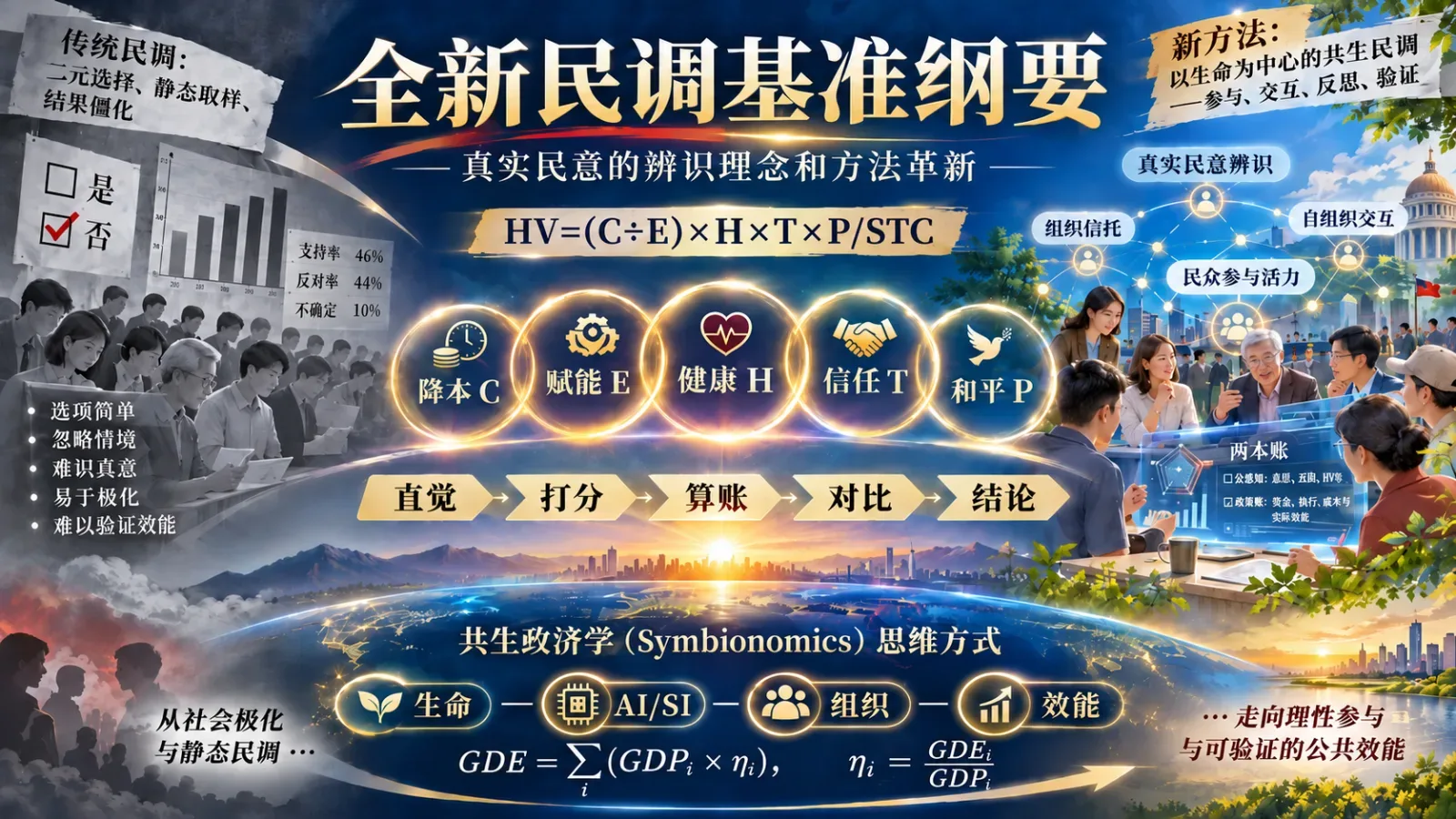
IV. From “Subjects of a Survey” to “Autonomous Participants in Identification”The SBPO establishes a complete interactive pathway: Intuition → Scoring → Calculation → Comparison → Conclusion Four activities run throughout this process: multidimensional assessment, insight ignition, resonant interaction, and self-organized interaction. These five stages are more than five predetermined questions. Together, they create a complete process connecting autonomous subjects, facts, responsibility, and effectiveness. Intuition: Begin by asking, “What do you think?” Allow participants to express their positions, questions, expectations, and genuine concerns without being confined by predetermined options. This establishes a baseline of spontaneous, unprompted judgments. Scoring: Evaluate a particular policy separately along the five dimensions C, E, H, T, and P. Record the trade-offs between dimensions rather than allowing a single approval percentage to conceal the complexity of public judgment. Calculation: Present the five-factor scores and the trial calculation of Health Value (HV), while also disclosing funding sources, organizational transaction costs (STC), health and ecological burdens, and the costs actually borne by different subjects. Public perceptions and independently verifiable effectiveness must be recorded separately. Comparison: Present individual judgments alongside the distribution of group responses, the circumstances of different populations, and relevant policy evidence. Ask participants: “Would you change your assessment? Why?” Preserve their original scores and the reasons for any revisions. Conclusion: Present initial preferences, judgments made after receiving additional information, five-factor distributions, and unresolved disagreements. Continue to verify the findings through feedback on the actual effectiveness of policies after implementation. Accordingly, the Symbiotic Benchmark Poll Form (SBPF) should maintain two distinct sets of accounts. One records how people perceive, understand, and choose. The other records how policies are funded, implemented, and fulfilled. The first account presents participants' preferences, trial HV calculations, and changes in judgment. It serves as a barometer of social psychology and may provide early warning signals concerning organizational trust, health losses, and public costs. The second examines verifiable inputs, losses, causal attribution, and outcomes to evaluate overall effectiveness through indicators such as η and GDE. Early warning signals direct attention to matters requiring verification, while actual performance accounts, in turn, help test public perceptions. The two accounts refer to and cross-check each other while maintaining their respective boundaries. GDP growth cannot be declared GDE growth merely because public satisfaction is high. Equally, genuine public experiences cannot be erased simply because macroeconomic indicators look favorable. Participants may develop new consensus, but they also retain the right to dissent. Resonance between “I” and “We” emerges through freedom, self-discipline, and informed interaction. An average score cannot replace the legitimate rights and interests of individual subjects—the foundation of the symbiosis of legitimate individual interests. The 2025 outline designed concrete exercises involving domestic policies, foreign policies, and their combinations. Does a tax cut genuinely reduce total social costs? Might economic sanctions damage health and peace? When tariff negotiations are combined with domestic tax reductions, who bears the ultimate costs? Might fiscal savings achieved through government downsizing become new burdens on households and businesses? The most valuable feature of these examples is their five-factor interactive analysis of a single policy. Cost reductions may be accompanied by losses of trust. Short-term empowerment may generate long-term transaction costs. An individual may simultaneously support the objectives of a policy and oppose the way it is implemented. A simple Yes/No survey cannot reveal such a structure of public opinion. For example, someone may support tax reductions while worrying about the deterioration of public services. Another person may support border order while insisting on due process. Someone else may favor trade negotiations while fearing that consumers will ultimately bear the burden of tariffs. Such views can first be expressed openly, then examined through the five factors. Health Value trial calculations and STC verification can reveal the different costs involved. Participants can then reconsider their judgments in light of actual accounts, relevant facts, and the circumstances of others. Public opinion thereby encompasses choices, reasons, conditions, and consequences. The original outline also proposed online scoring, data visualization, AI-assisted analysis of open-ended responses, and mechanisms for data transparency. Today, the interactive capabilities of AM (Artificial Mind & Amorsophia) and Minds-based interaction may further support the autonomous identification and evaluation of public opinion. Yet every technological application must clearly identify its data sources, protect privacy, permit public scrutiny, and provide mechanisms for correcting errors. Tools must not replace independent human judgment. Organizations must not secretly manipulate public opinion through algorithms. This also opens the possibility of transforming polling from a one-off exercise in pre-election prediction into continuous monitoring of public effectiveness and the rebuilding of organizational trust. V. How the Identification of Genuine Public Opinion Can Inform Politics and the Reconstruction of World OrderConsider Trump's New Deal. Border policy, energy, trade, public finance, industrial development, and the responsibilities of allies should all be examined beyond slogans and approval ratings. Who ultimately bears the burden of tariffs? Are the savings from government downsizing offset by new expenditures or ecological burdens transferred elsewhere? How can border governance deliver security while respecting due process? Can greater burden-sharing among allies produce sustainable collective security? Every policy should be subjected to the same five-factor effectiveness examination. The same standard applies to Democrats, Republicans, and other political organizations. Citizens may initially express support or opposition, then examine relevant facts, the distribution of costs, and possible consequences. Through informed interaction, they may reconsider their judgments and continue to evaluate actual effectiveness after policies have been implemented. This process makes it possible to distinguish who is merely effective at mobilizing votes, what particular actors have promised, how much public value has actually been delivered, and who has transferred organizational costs to others. It comes closer to understanding how genuine public opinion develops—and to the substance of public responsibility—than any single approval rating. Behind the great realignment of world politics lie common problems of organizational rigidity, mismatched interests, and accumulating fiscal and trust-related costs. Public dissatisfaction with established arrangements and expectations of change are frequently classified under ideological labels such as left, right, radical, or conservative. Yet equally rigorous examination is often missing when it comes to identifying which organizations have lost effectiveness and which new initiatives can repair the connections between life and society. “Entities should not be multiplied beyond necessity.” This principle thus acquires an accountable standard in political economy. Any proposal to expand organizations, increase power, or impose additional fiscal and social costs must demonstrate its necessity and deliver corresponding public value. Reducing the number of institutions must itself undergo effectiveness examination. If costs disappear from government accounts only to be transferred to society, there has been no genuine reduction in costs. Common sense begins with facts, takes shape through responsibility, and is verified by effectiveness; madness begins with prejudice, becomes trapped in power, and ultimately exacts its price. The identification of genuine public opinion is therefore connected to the overall effectiveness of economic, political, and cultural activities. How can citizens move from passive survey respondents to autonomous participants in judgment? How can life expand its creative capacities through tools and organizations? And how can national and international organizations fulfill their commitments to public value through trust and responsibility? The new symbiotic polling benchmark brings genuine interests, lived experiences, policy costs, and the consequences of fulfilled—or broken—commitments into a common process of open interaction. It compels polarized political labels to confront facts and responsibilities once again. The temporary majority produced by an election and the continuously evolving reality of public opinion, just like short-term policy achievements and long-term net effectiveness, must all be examined in relation to the same fundamental measure: life. Only then can the symbiotic reconstruction of world order acquire a foundation that can be identified, measured, and held accountable. Finally, I sincerely invite readers to join me in refining the operational components of A New Symbiotic Benchmark Poll Outline. Interested friends are welcome to leave a comment to request the outline, recommend it to influential polling institutions such as Pew Research Center, or explore the possibility of establishing an entirely new polling organization ourselves. ReferencesQian, Archer Hong. A New Symbiotic Benchmark Poll Outline: Based on the Golden Rule of Health Five-Factor Interactive Empowerment Model. April 1, 2025. Unpublished outline, including the SBPO and survey form. Qian, Archer Hong. Symbionomics: An Overview (Revised Edition). 2026. Qian, Archer Hong. Elevating AI to AM. 2026. Pew Research Center. “As the 2026 Midterms Approach, Economy Is Front and Center.” July 23, 2026. Survey conducted July 6–12, 2026. Federal Election Commission. “Election and Voting Information.” U.S. federal election date: November 3, 2026. Democratic National Committee. 2024 Democratic Party Platform.
|