剥落意识形态以后,殖官主义还在那里 After Ideology Is Stripped Away, Bureaucolonialism Is Still There
——从越南革新、米莱联合国演讲到全球组织信托重建 —From Vietnam’s Đổi Mới and Milei’s UN Speech to Rebuilding Global Organizational Trust 钱 宏(Archer Hong Qian) 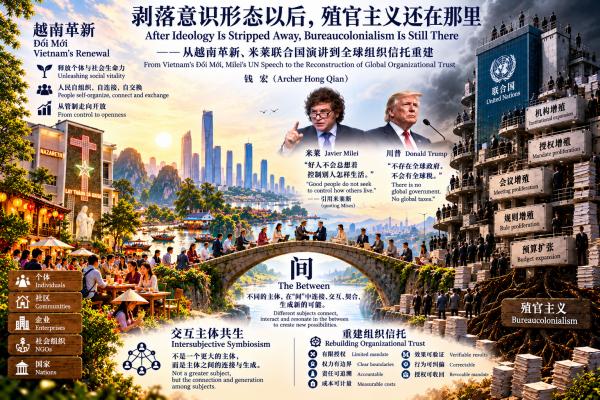
2026年9月23日,阿根廷总统哈维尔·米莱再次站上纽约联合国大会讲台。 这一次,他没有把矛头停留在某项政策、某个机构或者某个国家,而是直接指向联合国本身的组织运行机制。 米莱首先承认,联合国创立之初关于自由、平等、国家主权、和平解决争端的理想是高尚的。但他认为,这个当初共同订立的“神圣契约”已经被破坏:本来应当维护集体安全和基本权利的国际组织,在许多真正需要有所作为的地方无能为力,却又逐渐形成一个庞大的官僚体系,越来越热衷于规定各国及其人民应该怎样生活。 他甚至使用了极其尖锐的语言,把联合国称为一个供养“傲慢官僚”的无用组织,并援引奥地利经济学家路德维希·冯·米塞斯的话,大意是:好人不会总想着控制同胞怎样生活。 无论人们是否赞同米莱的政治立场,这句话背后所指向的问题,却不能因为措辞尖锐而被轻轻放过。 米塞斯更深一层的警告是: 一旦国家开始干预个人生活方式,就会一路走向对生活细节的规制,最终取消个人自由。 这既是制度警告,也是一种道德审判。 因为它最终追问的是: 一个人、一群人或者一个组织,凭什么把自己变成 Subject(主体),再以某种崇高目标的名义,把另外的人变成由自己安排、管理、支配甚至榨取的 Object(客体)? 如果我们暂时把20世纪以来那些已经争论得令人眼花缭乱的社会主义与资本主义、左倾与右倾、东方与西方、民族主义与全球主义、多元文化与传统价值等等意识形态外壳一层层剥落,也许会发现: 殖官主义(Bureaucolonialism)还在那里。 一、去年行走越南,我首先看到的不是意识形态政治正确 2025年11月,我从新加坡进入越南,一路行走长安、下龙湾、河内。 人口超过一亿、平均年龄约32岁的越南,给我留下最深印象的,并不是教科书里的“社会主义越南”,而是一种扑面而来的社会生命力。 街边摊、咖啡馆、家庭旅馆、小企业、农村手工业、城市服务业,到处都可以看见普通人的自组织、自连接、自交换。 我当时在《越南国运处上升态势——基于亚当·斯密“繁荣三原素”与共生经济学的结构性观察》中写了一句话: “这些不是国家命令出来,而是人民自己生长出来的。” 这句话至今仍是我理解越南近四十年变化的一把钥匙。 1986年开始的革新开放(Đổi Mới),如果仅仅理解为社会主义向资本主义让步,恐怕仍然没有走出20世纪意识形态叙事。 我看到的更深层变化是: 拆除妨碍生命自组织连接的资讯防火墙和体制机制藩篱,让个体、家庭、企业、市场、贸易以及整个社会生活重新生长。 这就是为什么我当时借用亚当·斯密1755年关于国家繁荣的著名概括——和平、轻税和过得去的司法行政——进一步提出“三重和平”: 个体与社群之间的和平,使交换与信任发生; 社会制度中的和平,使分工、规则与组织具有可预测性; 国家之间的和平,使贸易、旅游、投资和友谊成为可能。 和平不是软弱,而是尊重生命自组织连接动态平衡的交互主体共生过程。 于是,一个值得重新思考的问题出现了: 越南究竟“姓社”还是“姓资”,真的那么重要吗? 如果一个自称社会主义的国家不断释放个体、家庭、市场与社会自组织活力;而另一个自称自由、民主或者资本主义的组织,却不断增加规则、机构、职位和控制,那么,究竟谁更加尊重生命? 真正值得检验的,已经不是标签。 而是: 组织与生命之间究竟发生了什么? 二、联合国恰好提供了一个剥落意识形态的组织标本 这就把问题带到了联合国。 联合国不是社会主义国家。 也不是资本主义国家。 它不是东方国家,也不是西方国家;不是民族国家,更不能简单归属于某一种阶级、宗教或者文明。 正因为如此,联合国反而成为观察组织病理的一个极其难得的样本。 如果把社会主义—资本主义、左—右、东方—西方这些变量暂时拿掉,我们就可以更直接地追问: 为什么一个以和平、安全、人权与国际合作为使命建立起来的组织,同样会产生机构增殖、授权增殖、会议增殖、报告增殖以及官僚程序增殖? 联合国自己已经不得不承认这个问题。 截至2026年,联合国80年间累计产生了超过4万项决议、决定和相关授权;仅2024年,秘书处服务的政府间会议就超过2.7万场。2026年3月31日,联大主席安娜莱娜·贝尔伯克在推动授权审查改革时公开指出,超过4万项有效授权和每年2.7万场会议所造成的负担已经不能继续照旧。联合国UN80改革文件也承认,长期累积形成了重复、重叠、碎片化、资金错配以及责任边界不清等问题。 更值得注意的是,古特雷斯2026年5月公布UN80改革进展报告时已经直言: 现状不可持续。 改革联合国,当然不是古特雷斯才想到的。 从加利到安南,从潘基文到古特雷斯,联合国改革已经讲了几十年。机构调整、预算改革、管理改革、发展系统改革、维和改革、安理会改革……方案不可谓不多。 可是为什么“联合国改革”本身几乎也变成了联合国的一项常设议题? 为什么改革了几十年,还要在成立80周年的时候再搞一次UN80? 如果只说“改革还不够彻底”,恐怕已经解释不了问题。 我们必须再往里面挖一层: 是不是组织本身存在一种自我繁殖机制? 三、从“官僚主义”进一步看到“殖官主义” 我这些年一直使用“殖官主义”这个概念。 今天看来,它的定义域应该进一步打开。 殖官主义不是社会主义的专利,不是资本主义的专利;不是东方的专利,也不是西方的专利;甚至不是国家机器的专利。 它是一种跨制度、跨文化、跨意识形态的组织癌变。 任何组织建立之初,都有一个受托目的。 政府受人民、国民、公民之托; 企业承担投资者、员工、消费者以及社会契约所形成的责任; 大学受教育与知识创造之托; 医院受生命健康之托; 公益组织受公益使命之托; 联合国则受会员国以及人类对于和平、安全、合作的共同期待之托。 但是,组织一旦形成,就会产生职位、权力、预算、规则、资源以及解释规则的人。 危险由此开始。 掌管国家机器以及其他大型组织中有权、有势、有钱的人们,可能逐渐以 Subject(主体) 自居,假公济私,将本来同样具有主体性的他者降格为 Object(客体),加以支配、操纵和榨取。 于是: 使命产生机构; 机构产生职位; 职位需要预算; 预算需要项目; 项目需要授权; 授权产生规则; 规则需要更多执行者; 执行者又需要更多管辖对象来证明自己存在的必要性。 组织由此不断自我繁殖为Reproductive Officialdom(殖官)。 终于有一天,原本为了完成使命而存在的组织,开始为了维持组织自身而寻找使命。 这就是我所说的殖官主义。 它比一般意义上的“官僚主义”更深一层。 官僚主义可以表现为繁文缛节、低效、推诿、僵化; 殖官主义追问的却是: 为什么明明已经低效、失效甚至有害的组织结构,仍然能够继续繁殖? 因为官可以生权,权可以生利,利又可以护官;机构可以生机构,规则可以生规则,预算可以生预算,并最终形成一套自我繁殖、自我保护、自我解释、自我正当化的组织生态。 所以,“殖”这个字不能丢。 四、“好话说尽,坏事做绝”的那个“绝” 殖官主义最危险的时候,往往不是公开宣布: “我要支配你。” 恰恰相反,它经常满嘴都是最好听的话。 天下为公。 为人民服务。 人民至上。 公平正义。 共同利益。 全人类福祉。 和平与发展。 人类政治史从来不缺好话。 所以古人才会留下那句尖锐的话: 说尧舜之言,行桀纣之实。 用今天的话说,就是: 好话说尽,坏事做绝。 但是,这里的“绝”,不能只理解为坏事做到极端。 它还有更深的一层: 把生命正常生长的道路堵绝。 掌管国家机器、有权有势有钱的人们以Subject(主体)自居,假公济私,将他者作为Object(客体)加以支配、操纵和榨取;组织自我繁殖而失信于人民、国民、公民生命所托,拖累经世济民,脱离社会生活常规,最后,不仅耗尽社会资源,而且把生命原本可以自组织、自连接、自创造的通道一条条堵绝。 于是,一边说“天下为公”,一边结党营私; 一边说“为人民服务”,一边与民争利; 一边说公共利益,一边把公共权力转换成职位、审批、预算、垄断和特殊利益; 一边要求普通人无私奉献,一边让组织内部的利益结构不断自我繁殖。 到了这里,我们必须追问: “天下为公”的那个“公”,究竟是谁的公? 如果所谓“公”,不是一个个生命主体之间交互生成的公共性,而是某个政治组织首先把自己宣布为“公”的化身,再由自己垄断对“公”的定义权、解释权和执行权,那么“天下为公”甚至可能发生最危险的语义倒置: 公,不再意味着权力属于所有人; 公,反而变成少数人以所有人的名义行使权力。 同样,“为人民服务”也可能发生委托—受托关系的倒置: 本来人民是委托人,组织是受托人; 最后却变成组织是主人,人民反过来必须供养、服从和服务于组织。 这已经不是简单的公私之争。 而是生命主体与组织受托者的位置被颠倒了。这就是吉拉斯1957年《新阶级》的洞见。 五、米塞斯的警告为什么也是一种道德审判? 因此,再回头看米莱在联合国大会上援引米塞斯,就会发现它的意义远远超过一场自由主义政治演说。 米塞斯真正值得重视的制度洞见是: 一旦国家开始干预个人生活方式,就会一路走向对生活细节的规制,最终取消个人自由。 为什么? 因为一次干预需要一条规则; 一条规则需要一个执行机构; 一个机构需要人员、职位和预算; 职位和预算又需要更多事项进入其管辖范围,以证明这个机构继续存在的合理性。 于是,原本以某种公共目的开始的有限干预,可以逐渐生成一整套以规制他人生活为职业、资源和权力来源的组织结构。 这当然是制度分析。 但它同样构成道德审判。 因为它最终问的是: 善意能不能自动构成支配他者生命的授权? 不能。 “天下为公”不能。 “为人民服务”不能。 “全人类福祉”同样不能。 Intersubjective Symbiosism(交互主体共生)所要改变的,恰恰就是这种Subject—Object关系。 我承认你是主体; 你也承认我是主体; 不同主体之间发生连接、交互、契合,并由此生成新的价值、新的可能、新的生命。 生命本自具足,又非独存。 所以真正的“公”,不是某个高高在上的主体替亿万个客体预先定义出来的结果,而只能从无数主体之间真实的交互关系中不断生成。 六、联合国80年改革史为什么始终改不动? 这样再看联合国,问题就清楚多了。 1945年成立的联合国当然不是一个“坏组织”。 恰恰相反,它诞生于两次世界大战之后,人类希望避免再次走向毁灭,其和平理想具有不可否认的历史意义。 但是: 组织的创始理想高尚,并不能证明组织80年后的每一种运行机制仍然合理。 联合国今天的财政困境就是一个非常具体的信号。 2026年度,中国作为联合国第二大会费分摊国,直到9月1日才缴清约6.414亿美元常规预算会费。美国则到9月中旬才支付7.25亿美元常规预算款,另支付约1.02亿美元维和款;付款之后,美国常规预算仍有超过13亿美元欠款。 第一、第二大会费分摊国都把巨额缴费拖到联大召开前夕附近,这当然各有国内政治、财政安排以及对联合国政策不同意见等复杂原因,不能简单归结为一个因素。 但是,对于一个以组织信托为分析对象的人来说,这至少值得提出一个问题: 为什么会员国越来越不愿意及时把钱交给这个组织? 信托不仅存在于语言里。 钱,也是信任票。 资源是否愿意继续交付,本身就是委托人对受托组织的一种现实反馈。 而联合国自己的UN80改革恰恰承认,系统存在授权过多、会议和报告过多、职责重复、执行碎片化、资源与任务错配以及问责结果不足等问题。 所以,米莱的话并不是从天上掉下来的。 他说联合国形成了一个越来越庞大的官僚体系,要决定世界各国人民应该怎样生活;他认为一个组织如果说了无数话、通过无数决议,却不能让自己的话在现实世界产生相应结果,就会失去最重要的东西——权威。 这种批评可以争论。 但不能因为它来自米莱,就用一个“右翼”“自由意志主义”的标签把它处理掉。 标签不能代替事实。 七、其实,我在2018年并没有主张“不要联合国” 早在2018年台湾晨星出版社正式出版的《全球共生:化解冲突重建世界秩序的中国学派》中,我已经收入《全球治理与联合国改革》一文。 我当时的基本判断恰恰是: 联合国不同于欧盟、东盟、七国集团或者二十国集团,它不应该成为任何排他性的利益共同体,而应该成为“不舍弃任何地球生灵”的 Civil Symbiont(公民共生体)。 我当时已经看到另一个结构性矛盾: 荒漠化、环境气候、难民、粮食安全、生化核武、跨国灾难、外层空间、公共卫生等等全球性问题,越来越具有超主权、超地缘、超文明性质,而现行联合国却仍主要以主权国家为单位构造组织机制。 全球性问题已经越过旧边界,组织结构却没有同步越过旧边界。 因此,我当时提出拓展已经基本停止运作的托管理事会功能,并进一步建立 UN Global Symbiosism Council(全球共生理事会,GSC),让地球公民、国家和地区、国际组织、NGO、教科文卫体艺媒组织、跨国企业及其他社会主体共同进入全球治理。 那时,我关注的主要问题是: 联合国应该怎样改革? 八年以后,今天再看,我愿意向自己的方案继续追问: 即使真的建立一个GSC,谁能保证它几十年以后不会再次殖官化? 没人能够仅凭名称保证。 一个机构叫“共生理事会”,不等于它天然共生。 就像一个组织把“人民”“共和国”“民主”“公共”“公益”写进名称,也不能证明它天然属于人民、天然民主、天然公共。 任何组织都没有免检资格。 八、超主权治理,不等于建立一个“超级主权” 就在米莱演讲前一天,川普站在同一个联合国大会讲台上,从另一个方向触及了全球组织信托的边界。他明确说: “There is no global government.”——“不存在全球政府。” 紧接着又表示,只要他担任总统,就不会有“global taxes(全球税)”。他的意思很明确:国际合作不能成为未经各国人民授权的全球官僚不断扩张权力的理由,国际组织不能由国家之间的协调者异化为凌驾主权国家之上的统治者。 把川普与米莱前后两天的讲话放在一起看,问题就更清楚了: 川普追问:国际组织凭什么从协调者变成凌驾主权国家之上的Subject? 米莱追问:官僚组织凭什么从受托者变成规定别人怎样生活的Subject? 而我们还要继续追问: 任何组织,凭什么从生命的受托者变成生命的支配者? 这也使我2018年提出的 UN Global Symbiosism Council(全球共生理事会,GSC) 有必要进一步明确自己的边界。当年我提出,气候、海洋、难民、公共卫生、外层空间等越来越多问题具有超主权、超地缘、超文明性质,需要超越单一国家边界的共同治理。 这个判断今天仍然成立。但是必须同时强调: 超主权问题,不等于超级主权;超主权治理,更不等于建立“世界政府”。 世界需要全球合作,但未必需要世界政府。不能因为需要解决全球问题,就把国家、公民和社会组织从Subject降格为Object,再在它们之上制造一个更大的Subject。否则,使命产生授权,授权产生机构,机构产生职位、预算和更多规则,最终同样可能发生殖官主义癌变。 因此,GSC不应成为“世界政府”的雏形,而应成为一种交互主体共生的全球组织信托机制:国家、公民、社区、企业、社会组织和国际组织都是不同主体,通过有限授权,在共同事务中连接、交互、契合;权力有边界,责任可追溯,成本可计量,效果可验证,行为可纠偏,授权可收回。 这正是 Intersubjective Symbiosism(交互主体共生) 与“世界政府”思维的根本区别: 不是 One Subject → All Objects,
而是 Subjects ↔ Subjects → Symbiosis。 所以,真正的问题并不是“国家主权还是全球治理”的二选一,而是找到两者之间能够生成新可能的“间”: 全球性问题需要共同治理,但共同治理必须发生在主体之间,而不是凌驾于主体之上。 川普的“There is no global government”、米莱对官僚组织控制他人生活的质问,与交互主体共生在这里形成了一个重要交汇: 世界需要全球合作,但未必需要世界政府;需要超主权治理,但不能制造超级主权。 而怎样保证这样的组织也不发生殖官主义癌变,正是下面必须回答的组织免疫机制问题。 九、问题已经从“怎样改革组织”走向“怎样阻断组织癌变” 因此,今天再讨论联合国改革,如果仍然只是: 裁撤几个机构; 减少几个职位; 压缩一些预算; 合并几个部门; 恐怕仍然不够。 这些当然应该做。 但如果殖官主义的生成机制没有改变,今天砍掉十个机构,明天完全可能再长出二十个。 真正需要建立的,是一种组织免疫机制。 任何组织都必须不断回答: 谁托付你? 托付你做什么? 你占用了多少生命资源? 你降低了多少成本? 你赋予了多少能力? 增加了多少健康? 创造了多少信任? 带来了多少和平? 这正是共生经济学提出GDE的意义: C——降本;E——赋能;H——健康;T——信任;P——和平。 进一步通过 ηᵢ=GDEᵢ/GDPᵢ 检验具体项目、组织和经济活动的生命效能,并最终进入 R=GDE/GDP 的总体观察。 组织不能自己宣布: “我的使命很伟大,所以我的存在天然合理。” 而必须允许生命反过来询问: 你究竟给我带来了什么? 继而经过发现、记录、确权、奖—抑—通、Mind Bank与价值承兑,使组织行为进入真实的反馈机制: 奖励真正赋能生命的行为; 抑制不断制造负载的行为; 打通被权力、部门和特殊利益堵塞的生命连接。 到这里,组织信托才不是一个漂亮的词。 十、越南与米莱为什么会在这里相遇? 一个是越南共产党领导下的越南。 一个是公开信奉自由意志主义的阿根廷总统米莱。 按照20世纪的意识形态地图,两者似乎相距甚远。 但如果把标签剥掉,反而可以看到一个值得研究的共同问题。 越南近四十年的革新,在相当程度上表现为: 拆除妨碍生命自组织连接的藩篱。 米莱在阿根廷推进的改革,则集中于压缩政府组织成本、削减规制、裁撤部分机构,并强调限制国家对经济社会生活的不必要干预;而在联合国讲台上,他又把这种批判进一步指向国际组织。 两者当然不是同一种改革,更不意味着所有具体政策都可以互相复制。 但是它们都迫使我们重新回答: 组织究竟应该支配生命,还是赋能生命? 因此,越南与米莱真正值得中国大陆研究的,并不是复制越南,更不是照搬阿根廷。 而是重新检查那些我们已经听得过于熟悉的词: 公有。 国有。 全民。 集体。 为人民服务。 天下为公。 名称说明不了受托关系。 判断一个组织究竟是不是“为公”,不能只听它怎样称呼自己,而应该看: 谁掌握权力? 谁承担成本? 谁获得利益? 谁能够纠错? 谁可以说“不”? 受托者能不能真正受到委托者约束? 如果掌握国家机器、有权有势有钱的人们成为永恒的Subject,而人民、国民、公民只能作为被管理、被配置、被支配乃至被榨取的Object,那么,再漂亮的意识形态包装,也改变不了受托关系已经发生倒置的事实。 十一、殖官主义为什么最终可能走向“同归于尽”? “癌变”并不是为了耸人听闻。 癌细胞最可怕的地方,不是它具有某种“坏思想”。 它本来就是生命体的一部分。 问题在于它失去了与整体生命之间正常的关系,开始异常增殖,并不断吸取整个生命体的营养供自己继续繁殖。 最后发生什么? 宿主越来越虚弱。 癌细胞却越来越多。 直到宿主死亡。 而宿主死亡之日,也是癌细胞自身失去生存条件之时。 殖官主义与此存在一个令人警醒的结构对应: 组织因社会需要而生成; 组织逐渐异常自我繁殖; 组织不断吸取社会资源维持自身繁殖; 生命主体越来越衰弱; 组织信托不断坍塌; 最终整个社会进入系统性危机。 所以我说: 掌管国家机器、有权有势有钱的人们以Subject(主体)自居,假公济私,将他者作为Object(客体)加以支配、操纵和榨取,组织自我繁殖而失信于人民、国民、公民生命所托,拖累经世济民,脱离社会生活常规,最后—— 要么自行毁灭,要么同归于尽! 这就是“好话说尽,坏事做绝”的那个“绝”。 不仅把坏事做到极端。 而且可能把生命赖以继续生成的道路也堵绝。 十二、20世纪争主义,21世纪必须重建组织信托 回头看过去一百多年,人类在意识形态争论上投入了巨大的生命成本。 社会主义还是资本主义? 左还是右? 国家还是市场? 东方还是西方? 民族主义还是全球主义? 这些问题当然有意义。 但如果所有注意力都停留在这些问题上,我们可能漏掉了一个更底层的事实: 无论什么主义,只要形成组织;无论什么组织,只要掌握权力、资源和规则,就必须面对同一种危险:受托者会不会变成统治者?服务者会不会变成支配者?组织会不会从赋能生命转向供养自身? 癌细胞不问意识形态。 殖官主义同样如此。 所以,米莱在联合国讲台上援引米塞斯,真正值得听进去的,不只是自由主义者。 它实际上向一切试图以崇高目标取得支配他者生活之权的组织提出了一个最朴素的道德问题: 你凭什么? 这不是反对公共生活。 恰恰相反。 只有一个主体不再把另一个主体降格为客体,真正的“公”才可能发生。 只有从Subject—Object的支配关系走向 Intersubjective Symbiosism(交互主体共生),组织才可能重新成为生命的受托者。 2018年,我提出全球共生理事会,希望改变联合国处理全球事务的组织结构。八年后的今天,我愿意给当年的方案再加上一条更加严格的原则: 任何组织,无论以多么崇高的理想建立,都没有天然的道德豁免权;任何权力,无论以“天下为公”“为人民服务”还是“全人类福祉”的名义行使,都必须接受生命效能的持续检验。 因为: 组织因生命所托而生,也必须因生命是否得益而接受检验。 20世纪,人们争论的是: 什么主义来组织人? 21世纪,我们还必须追问: 谁来阻止组织吞噬人? 剥落社会主义与资本主义、左与右、东方与西方、民族国家与多元文化等等意识形态外壳以后,我们会发现: 殖官主义还在那里。 因此,真正需要的不是再发明一种漂亮的主义去替代另一种主义,而是建立一种能够持续阻断殖官主义癌变的组织免疫机制。 从支配生命回到赋能生命; 从组织自我繁殖回到生命自组织连接; Subject—Object回到Intersubjective; 从组织失信回到组织信托。 彻底阻断殖官主义对形形色色、大大小小不同组织的癌变效应—— 这才是重建组织信托真正开始的地方。 After Ideology Is Stripped Away, Bureaucolonialism Is Still There —From Vietnam’s Đổi Mới and Milei’s UN Speech to Rebuilding Global Organizational Trust Archer Hong Qian On September 23, 2026, Argentine President Javier Milei once again took the podium at the United Nations General Assembly in New York. This time, he did not stop at criticizing a particular policy, institution, or country. He directed his criticism at the operating mechanism of the United Nations itself. Milei first acknowledged the nobility of the ideals on which the United Nations was founded: liberty, equality, national sovereignty, and the peaceful settlement of disputes. Yet in his view, the “sacred covenant” originally made together has been broken. An international organization that was supposed to safeguard collective security and fundamental rights has proved powerless in many areas where action is genuinely needed, while gradually developing an enormous bureaucracy increasingly inclined to prescribe how countries and their peoples should live. He even used exceptionally sharp language, calling the United Nations a useless organization that sustains “arrogant bureaucrats,” and cited the Austrian economist Ludwig von Mises to the effect that good people do not constantly seek to control how their fellow citizens live. Whether or not one agrees with Milei’s political position, the question behind those sharp words should not be brushed aside simply because of their severity. Mises’s deeper warning was this: Once the state begins to intervene in individual ways of life, it will proceed toward regulating the details of life and ultimately abolishing individual freedom. This is both an institutional warning and a moral judgment. For in the end it asks: What gives a person, a group of people, or an organization the right to turn itself into the Subject and, in the name of some lofty objective, turn others into Objects to be arranged, managed, dominated, or even exploited? If we temporarily peel away, layer by layer, the ideological shells that have dazzled and divided people since the twentieth century—socialism versus capitalism, left versus right, East versus West, nationalism versus globalism, multiculturalism versus traditional values—we may discover: Bureaucolonialism is still there. I. Traveling Through Vietnam Last Year, What I Saw First Was Not Ideological Political Correctness In November 2025, I entered Vietnam from Singapore and traveled through Tràng An, Hạ Long Bay, and Hanoi. Vietnam, with a population exceeding 100 million and an average age of about 32, left its deepest impression on me not as the “socialist Vietnam” of textbooks, but through the social vitality that seemed to be everywhere. Street stalls, cafés, family-run inns, small businesses, rural handicrafts, and urban services all revealed ordinary people self-organizing, self-connecting, and exchanging on their own initiative. At the time, in “Vietnam’s National Fortunes Are on the Rise—A Structural Observation Based on Adam Smith’s ‘Three Elements of Prosperity’ and Symbionomics,” I wrote: “These were not ordered into existence by the state; they grew out of the people themselves.” That sentence remains a key to my understanding of Vietnam’s transformation over nearly four decades. If the Đổi Mới reforms begun in 1986 are understood merely as socialism making concessions to capitalism, we may still be trapped within the ideological narrative of the twentieth century. What I saw at a deeper level was this: Dismantle the information firewalls and institutional barriers that obstruct life’s self-organizing connections, and allow individuals, families, enterprises, markets, trade, and social life as a whole to grow again. This is why, drawing on Adam Smith’s famous 1755 formulation of the conditions of national prosperity—peace, easy taxes, and a tolerable administration of justice—I further proposed “threefold peace”: Peace between individuals and communities, enabling exchange and trust; Peace within social institutions, making division of labor, rules, and organizations predictable; Peace among nations, making trade, tourism, investment, and friendship possible. Peace is not weakness. It is an intersubjective symbiotic process that respects the dynamic balance of life’s self-organizing connections. This raises a question worth reconsidering: Does it really matter so much whether Vietnam is labeled “socialist” or “capitalist”? If a country calling itself socialist continually releases the self-organizing vitality of individuals, families, markets, and society, while another organization calling itself free, democratic, or capitalist continually adds rules, institutions, positions, and controls, then which one is actually more respectful of life? What truly deserves examination is no longer the label. The question is: What, exactly, is happening between organization and life? II. The United Nations Provides a Revealing Organizational Specimen Once Ideology Is Peeled Away This brings us to the United Nations. The United Nations is not a socialist state. Nor is it a capitalist state. It is neither an Eastern nor a Western country; it is not a nation-state, and it cannot simply be assigned to a particular class, religion, or civilization. Precisely for that reason, the United Nations offers an unusually revealing specimen for observing organizational pathology. If we temporarily remove variables such as socialism versus capitalism, left versus right, and East versus West, we can ask more directly: Why does an organization founded for peace, security, human rights, and international cooperation also generate proliferating institutions, proliferating mandates, proliferating meetings, proliferating reports, and proliferating bureaucratic procedures? The United Nations itself has had to acknowledge this problem. By 2026, more than 40,000 resolutions, decisions, and related mandates had accumulated over the UN’s eighty-year history. In 2024 alone, the Secretariat serviced more than 27,000 intergovernmental meetings. On March 31, 2026, while advancing mandate-review reform, President of the General Assembly Annalena Baerbock publicly noted that the burden created by more than 40,000 active mandates and 27,000 meetings a year could not continue as before. UN80 reform documents likewise acknowledged long-standing problems of duplication, overlap, fragmentation, misaligned funding, and unclear lines of responsibility. More strikingly, when António Guterres released the UN80 reform progress report in May 2026, he stated plainly: The status quo is unsustainable. Reforming the United Nations, of course, did not begin with Guterres. From Boutros-Ghali to Annan, from Ban Ki-moon to Guterres, UN reform has been discussed for decades: institutional restructuring, budget reform, management reform, development-system reform, peacekeeping reform, Security Council reform—the proposals have hardly been few. Yet why has “UN reform” itself almost become a standing item on the UN agenda? Why, after decades of reform, was another UN80 initiative still needed at the organization’s eightieth anniversary? To say merely that “reform has not gone far enough” may no longer explain the problem. We have to dig one layer deeper: Does organization itself contain a mechanism of self-reproduction? III. From “Bureaucratism” to “Bureaucolonialism” I have used the concept of “Bureaucolonialism” for years. Today, I believe its domain of application should be broadened further. Bureaucolonialism is not the monopoly of socialism or capitalism; it belongs neither exclusively to East nor West; indeed, it is not even confined to the machinery of the state. It is a form of organizational cancer that cuts across systems, cultures, and ideologies. Every organization begins with a purpose entrusted to it. Government is entrusted by the people, nationals, and citizens; Enterprises bear responsibilities arising from their relationships with investors, employees, consumers, and the social contract; Universities are entrusted with education and the creation of knowledge; Hospitals are entrusted with human health; Public-interest organizations are entrusted with public purposes; The United Nations is entrusted by its member states and by humanity’s shared expectations for peace, security, and cooperation. But once an organization is formed, it generates positions, power, budgets, rules, resources, and people empowered to interpret those rules. The danger begins there. Those who control the machinery of the state or other large organizations, possessing power, status, and money, may gradually cast themselves as the Subject, use public purposes for private ends, and reduce others—who are equally subjects—to Objects to be dominated, manipulated, and exploited. Then: Missions create institutions; Institutions create positions; Positions require budgets; Budgets require projects; Projects require mandates; Mandates generate rules; Rules require more executors; And executors require more objects of jurisdiction to justify their own necessity. Organization thus reproduces itself continuously as Reproductive Officialdom. Eventually, an organization that originally existed to fulfill a mission begins searching for missions in order to sustain itself. This is what I call Bureaucolonialism. It goes a layer deeper than “bureaucratism” in the ordinary sense. Bureaucratism may appear as red tape, inefficiency, buck-passing, and rigidity. Bureaucolonialism asks a further question: Why can an organizational structure that is already inefficient, ineffective, or even harmful continue to reproduce itself? Because office can generate power, power can generate benefits, and benefits can in turn protect office; institutions can generate institutions, rules can generate rules, and budgets can generate budgets, ultimately forming an organizational ecology capable of self-reproduction, self-protection, self-interpretation, and self-justification. That is why the “reproductive” in Reproductive Officialdom cannot be discarded. IV. The “Utmost” in “Saying All the Right Things While Doing Harm to the Utmost” Bureaucolonialism is often most dangerous not when it openly declares: “I want to dominate you.” Quite the opposite: it frequently speaks in the most appealing language. “All under Heaven belongs to the public.” “Serve the people.” “The people above all.” “Fairness and justice.” “The common interest.” “The welfare of all humanity.” “Peace and development.” Human political history has never lacked beautiful words. Hence the sharp old saying: Speaking the words of Yao and Shun while doing the deeds of Jie and Zhou. In today’s language: Saying all the right things while doing harm to the utmost. But the “utmost” here should not be understood merely as carrying wrongdoing to an extreme. It has a deeper meaning: Blocking off the normal paths through which life grows. Those who control the machinery of the state and possess power, status, and money cast themselves as the Subject, use public purposes for private ends, and treat others as Objects to be dominated, manipulated, and exploited. Organizations reproduce themselves and lose the trust placed in them by the lives of the people, nationals, and citizens; they burden the work of ordering the world and benefiting the people, depart from the normal workings of social life, and ultimately not only exhaust social resources but block, one by one, the channels through which life could otherwise self-organize, self-connect, and create. Thus one may proclaim “All under Heaven belongs to the public” while forming factions for private gain; Proclaim “serve the people” while competing with the people for benefits; Invoke the public interest while converting public power into positions, approvals, budgets, monopolies, and special interests; Demand selfless sacrifice from ordinary people while allowing internal organizational interests to reproduce without end. At this point we must ask: Whose “public” is the “public” in “All under Heaven belongs to the public”? If the “public” is not a publicness generated through interaction among living subjects, but instead a political organization first declares itself the embodiment of “the public” and then monopolizes the power to define, interpret, and enforce that “public,” the phrase may undergo its most dangerous semantic inversion: “Public” no longer means that power belongs to everyone; It becomes the exercise of power by a few in everyone’s name. Likewise, “serving the people” can invert the principal-trustee relationship: The people are originally the principals, and the organization is the trustee; In the end, the organization becomes the master, while the people are required to support, obey, and serve the organization. This is no longer simply a dispute between public and private. It is the reversal of the positions of living subjects and organizational trustees. This is the insight of Milovan Djilas’s 1957 book The New Class. V. Why Is Mises’s Warning Also a Moral Judgment? Seen in this light, when we return to Milei’s citation of Mises at the United Nations General Assembly, its significance reaches far beyond a libertarian political speech. Mises’s institutional insight worth taking seriously is this: Once the state begins to intervene in individual ways of life, it will proceed toward regulating the details of life and ultimately abolishing individual freedom. Why? Because one intervention requires a rule; A rule requires an enforcement institution; An institution requires personnel, positions, and a budget; And positions and budgets require more matters to enter their jurisdiction in order to justify the institution’s continued existence. Thus, limited intervention initially undertaken for some public purpose can gradually generate an entire organizational structure that derives its occupation, resources, and power from regulating the lives of others. This is certainly institutional analysis. But it is also a moral judgment. For in the end it asks: Can good intentions automatically confer authorization to dominate the lives of others? No. “All under Heaven belongs to the public” cannot. “Serving the people” cannot. “The welfare of all humanity” cannot either. What Intersubjective Symbiosism seeks to change is precisely this Subject–Object relationship. I recognize you as a subject; You recognize me as a subject; Different subjects connect, interact, and resonate with one another, thereby generating new value, new possibilities, and new life. Life is inherently self-sufficient, yet never exists alone. True “publicness,” therefore, is not an outcome predefined by some subject standing above billions of objects. It can only be continually generated through real interactions among countless subjects. VI. Why Has Eighty Years of UN Reform Still Failed to Reform the UN? Seen from this perspective, the United Nations becomes easier to understand. The United Nations founded in 1945 is certainly not a “bad organization.” Quite the contrary. It emerged after two world wars from humanity’s desire to avoid another descent into destruction, and the historical significance of its ideal of peace cannot be denied. But: The nobility of an organization’s founding ideals does not prove that every aspect of its operating mechanism eighty years later remains reasonable. The UN’s present financial difficulties provide a very concrete signal. For 2026, China, the second-largest contributor to the UN regular budget, did not pay its regular-budget assessment of approximately US$641.4 million in full until September 1. The United States did not pay US$725 million toward the regular budget and roughly US$102 million toward peacekeeping until mid-September; even after those payments, more than US$1.3 billion in U.S. regular-budget arrears remained. The two largest contributors both delayed substantial payments until around the eve of the General Assembly. This of course reflects complex and differing factors—domestic politics, fiscal arrangements, and disagreements over UN policies among them—and cannot simply be attributed to a single cause. But for someone analyzing Organizational Trust, it at least raises a question: Why are member states increasingly reluctant to hand over their money to this organization on time? Trust does not exist only in words. Money is also a vote of confidence. Whether resources continue to be entrusted is itself a form of real-world feedback from principals to a trustee organization. The UN’s own UN80 reform initiative acknowledges excessive mandates, too many meetings and reports, overlapping responsibilities, fragmented implementation, mismatches between resources and tasks, and inadequate accountability for results. Milei’s criticism, therefore, did not come out of nowhere. He argued that the United Nations had developed an increasingly large bureaucracy seeking to decide how people in countries around the world should live. He also argued that an organization that says countless things and adopts countless resolutions, yet cannot make its words produce corresponding results in the real world, loses what matters most—authority. Such criticism can be debated. But it cannot be disposed of simply by attaching the labels “right-wing” or “libertarian” to Milei. Labels cannot substitute for facts. VII. In 2018, I Was Not Arguing That We Should “Do Away with the United Nations” As early as 2018, my essay “Global Governance and United Nations Reform” was included in Global Symbiosism: A Chinese School for Resolving Conflict and Rebuilding World Order, formally published in Taiwan by Morning Star Publishing. My basic judgment at the time was precisely this: Unlike the European Union, ASEAN, the Group of Seven, or the Group of Twenty, the United Nations should not become an exclusive community of interests. It should become a Civil Symbiont that “abandons no living being on Earth.” I had already identified another structural contradiction: Desertification, environmental and climate issues, refugees, food security, biochemical and nuclear weapons, transnational disasters, outer space, public health, and other global issues were increasingly supranational, trans-geopolitical, and trans-civilizational in character, while the existing United Nations remained organized primarily around sovereign states. Global problems had crossed old boundaries, but organizational structures had not crossed them at the same pace. I therefore proposed expanding the functions of the largely inactive Trusteeship Council and further establishing a UN Global Symbiosism Council (GSC), bringing global citizens, countries and regions, international organizations, NGOs, organizations in education, science, culture, health, sports, arts and media, multinational enterprises, and other social actors into global governance. At that time, my main question was: How should the United Nations be reformed? Eight years later, I am willing to ask a further question of my own proposal: Even if a GSC were actually established, who could guarantee that it would not itself become bureaucolonialized decades later? No one can guarantee that merely by virtue of a name. An institution called a “Symbiosism Council” is not inherently symbiotic. Just as an organization that includes words such as “people,” “republic,” “democracy,” “public,” or “public interest” in its name is not thereby inherently of the people, democratic, or public. No organization is exempt from examination. VIII. Supranational Governance Does Not Mean Creating a “Super-Sovereign” The day before Milei’s speech, Trump stood at the same United Nations General Assembly podium and approached the boundary of global Organizational Trust from another direction. He stated explicitly: “There is no global government.” He immediately added that as long as he was president there would be no “global taxes.” His meaning was clear: international cooperation cannot become a justification for unelected global bureaucrats continually expanding their power, and international organizations cannot mutate from coordinators among states into rulers standing above sovereign nations. Placed side by side, Trump’s and Milei’s speeches make the question clearer: Trump asks: What gives an international organization the right to move from coordinator to Subject standing above sovereign states? Milei asks: What gives a bureaucratic organization the right to move from trustee to Subject prescribing how others should live? We must go one step further: What gives any organization the right to move from trustee of life to ruler over life? This also requires a clearer boundary for the UN Global Symbiosism Council (GSC) I proposed in 2018. I argued then that climate, oceans, refugees, public health, outer space, and many other issues were becoming supranational, trans-geopolitical, and trans-civilizational and therefore required governance extending beyond the boundaries of any single state. That judgment still stands. But another point must be stated just as clearly: Supranational problems do not imply super-sovereignty; supranational governance certainly does not mean establishing a “world government.” The world needs global cooperation, but not necessarily a world government. The need to solve global problems cannot justify reducing states, citizens, and social organizations from Subjects to Objects and then constructing an even larger Subject above them. Otherwise, missions create mandates, mandates create institutions, institutions create positions, budgets, and more rules, and Bureaucolonialism can emerge all over again. The GSC, therefore, should not become an embryo of “world government.” It should be a global Organizational Trust mechanism based on Intersubjective Symbiosism: states, citizens, communities, enterprises, social organizations, and international organizations remain different subjects; through limited authorization they connect, interact, and resonate in common affairs. Power has boundaries, responsibility is traceable, costs are measurable, results are verifiable, conduct is correctable, and mandates are revocable. This is the fundamental distinction between Intersubjective Symbiosism and the logic of “world government”: Not One Subject → All Objects, but Subjects ↔ Subjects → Symbiosis. The real question, therefore, is not the binary choice of “national sovereignty or global governance,” but how to find the “between” in which a new possibility can be generated: Global problems require common governance, but common governance must occur among subjects, not above them. Trump’s “There is no global government,” Milei’s challenge to bureaucratic control over other people’s lives, and Intersubjective Symbiosism converge here on an important point: The world needs global cooperation, but not necessarily a world government; it needs supranational governance, but must not manufacture super-sovereignty. How to ensure that such organizations do not themselves undergo Bureaucolonialist cancerization is precisely the question of organizational immunity that must be answered next. IX. The Question Has Moved from “How to Reform Organizations” to “How to Block Organizational Cancerization” Therefore, if today’s discussion of UN reform still consists only of: Abolishing a few institutions; Reducing a few positions; Cutting some budgets; Merging a few departments; that is probably still not enough. These things should of course be done. But if the generative mechanism of Bureaucolonialism remains unchanged, ten institutions cut today may be replaced by twenty tomorrow. What is truly needed is a form of organizational immunity. Every organization must continually answer: Who entrusted you? What were you entrusted to do? How many resources of life have you consumed? How much cost have you reduced? How much capability have you enabled? How much health have you increased? How much trust have you created? How much peace have you brought? This is precisely the significance of GDE in Symbionomics: C—Cost Reduction; E—Empowerment; H—Health; T—Trust; P—Peace. We can then use ηᵢ = GDEᵢ/GDPᵢ to examine the life-effectiveness of specific projects, organizations, and economic activities, and ultimately move toward the overall measure R = GDE/GDP. An organization cannot simply declare: “My mission is great, therefore my existence is inherently justified.” Life itself must be allowed to ask in return: What, exactly, have you brought to me? Through discovery, recording, rights confirmation, Reward–Restrain–Pass-Through, Mind Bank, and value fulfillment, organizational behavior can then enter a real feedback mechanism: Reward behavior that genuinely empowers life; Restrain behavior that continually creates burdens; Open the connections of life blocked by power, departments, and special interests. Only then does Organizational Trust cease to be merely a beautiful phrase. X. Why Do Vietnam and Milei Meet Here? One is Vietnam under the leadership of the Communist Party of Vietnam. The other is Javier Milei, an Argentine president who openly embraces libertarianism. On the ideological map of the twentieth century, the two appear far apart. But once the labels are stripped away, a common question worth studying becomes visible. Vietnam’s reforms over nearly four decades have, to a considerable extent, involved: Removing barriers that obstruct life’s self-organizing connections. Milei’s reforms in Argentina have focused on reducing the organizational costs of government, cutting regulations, eliminating some institutions, and limiting unnecessary state intervention in economic and social life; at the United Nations, he extended this criticism to international organizations. The two are certainly not the same kind of reform, nor does this mean that all of their specific policies can be copied from one to the other. But both force us to answer anew: Should organization dominate life, or empower life? What makes Vietnam and Milei especially worth studying for people in mainland China, therefore, is not the prospect of copying Vietnam or mechanically transplanting Argentina. It is the need to re-examine words that have become all too familiar: Public ownership. State ownership. Ownership by the whole people. Collective ownership. Serving the people. All under Heaven belongs to the public. Names tell us nothing decisive about the relationship of trust. To determine whether an organization is truly “for the public,” we cannot merely listen to what it calls itself. We must ask: Who holds power? Who bears the cost? Who receives the benefit? Who can correct errors? Who can say “no”? Can the trustee truly be constrained by the principal? If those who control the machinery of the state and possess power, status, and money become permanent Subjects, while the people, nationals, and citizens can only be Objects to be managed, allocated, dominated, or even exploited, then no beautiful ideological packaging can change the fact that the relationship of trust has been inverted. XI. Why Can Bureaucolonialism Ultimately Lead to “Mutual Destruction”? The metaphor of “cancerization” is not used for sensational effect. What makes a cancer cell dangerous is not that it possesses some “bad ideology.” It was originally part of the living body. The problem is that it loses its normal relationship with the whole organism, begins to proliferate abnormally, and continually draws nutrients from the entire organism in order to sustain its own reproduction. What happens in the end? The host becomes weaker and weaker. The cancer cells become more and more numerous. Until the host dies. And the day the host dies is also the day the cancer cells lose the conditions of their own survival. Bureaucolonialism has an alarming structural correspondence with this process: Organizations arise from social needs; Organizations gradually begin abnormal self-reproduction; Organizations continually absorb social resources to sustain that reproduction; Living subjects become progressively weaker; Organizational Trust continually collapses; Ultimately, the whole society enters systemic crisis. That is why I say: Those who control the machinery of the state and possess power, status, and money cast themselves as the Subject, use public purposes for private ends, and treat others as Objects to be dominated, manipulated, and exploited. Organizations reproduce themselves and lose the trust placed in them by the lives of the people, nationals, and citizens; they burden the work of ordering the world and benefiting the people and depart from the normal workings of social life. In the end— Either they destroy themselves, or they drag everyone into mutual destruction. This is the “utmost” in “saying all the right things while doing harm to the utmost.” It means not only carrying wrongdoing to an extreme. It may also mean blocking off the very paths by which life can continue to generate itself. XII. The Twentieth Century Fought over Ideologies; the Twenty-First Century Must Rebuild Organizational Trust Looking back over more than a century, humanity has invested enormous amounts of life-energy in ideological disputes. Socialism or capitalism? Left or right? State or market? East or West? Nationalism or globalism? These questions certainly matter. But if all our attention remains fixed on them, we may miss a more fundamental fact: Whatever the ideology, once it forms an organization; whatever the organization, once it controls power, resources, and rules, it faces the same danger: Will the trustee become the ruler? Will the servant become the dominator? Will the organization turn from empowering life to sustaining itself? Cancer cells do not ask about ideology. Neither does Bureaucolonialism. Thus, when Milei cited Mises from the UN podium, the people who should listen were not only libertarians. His words in fact pose the simplest moral question to every organization that seeks the right to dominate other people’s lives in the name of a lofty objective: What gives you the right? This is not an argument against public life. Quite the opposite. Only when one subject ceases to reduce another subject to an object can a genuine “public” come into being. Only by moving from the domination of Subject–Object relations toward Intersubjective Symbiosism can organizations once again become trustees of life. In 2018, I proposed a Global Symbiosism Council in the hope of changing the organizational structure through which the United Nations addresses global affairs. Eight years later, I would add a stricter principle to that proposal: No organization, however lofty the ideal on which it was founded, possesses an inherent moral exemption; no power, whether exercised in the name of “All under Heaven belongs to the public,” “serving the people,” or “the welfare of all humanity,” can be exempt from continuous examination of its effectiveness for life. Because: Organizations arise from what life entrusts to them, and they must be examined according to whether life actually benefits. In the twentieth century, people argued over: What ideology should organize human beings? In the twenty-first century, we must also ask: Who will prevent organizations from devouring human beings? Once the ideological shells of socialism and capitalism, left and right, East and West, nation-state and multiculturalism are peeled away, we discover: Bureaucolonialism is still there. What is truly needed, therefore, is not another beautiful ideology to replace the previous one, but an organizational immune mechanism capable of continuously blocking the cancerization of Bureaucolonialism. From dominating life back to empowering life; From organizational self-reproduction back to life’s self-organizing connections; From Subject–Object back to Intersubjective; From organizational distrust back to Organizational Trust. To completely block the cancerizing effects of Bureaucolonialism on organizations of every kind, large and small— That is where rebuilding Organizational Trust truly begins.
|