The Unseen Muzzle: When Conscience Meets Censorship on ScienceNet My recent experience with the ScienceNet blog, hosted by the esteemed Chinese Academy of Sciences, offers a stark illustration of the paradoxical landscape of expression within certain online platforms. What began as an attempt to share a deeply resonant story about conscience and moral choice ended not in public discourse, but in the silent void of censorship. This incident not only highlights a profound irony but also raises troubling questions about the role of a nation's premier scientific institution in upholding intellectual freedom. The article I sought to publish, titled "You Can Choose to Raise the Muzzle One Inch (Story)," recounts the compelling true story of Ingo Heinrich, an East German border guard prosecuted for shooting a defector attempting to cross the Berlin Wall. The core of the judge's ruling in that case was a powerful lesson: even when given orders, an individual possesses the moral agency to "raise the muzzle one inch," choosing conscience over blind obedience to what may be perceived as an unjust or "evil law." This narrative, in itself, is a historical account meant to provoke thought on universal ethical dilemmas. However, I added a crucial prelude to the story, a direct address to any enforcer, any individual in a position of authority: "The following article tells an enforcer how to implement 'evil laws' if you still have a conscience. History will judge you!!" My intention was clear: to challenge the very individuals responsible for upholding strictures, prompting them to reflect on their own moral compass, much like the East German soldier faced his own moment of decision. This note transformed a historical anecdote into a contemporary test of conscience for those wielding power, even the power to censor. The outcome was immediate and definitive: the post was rejected. This decision, to me, signifies a profound irony. The Chinese Academy of Sciences stands as the highest institution of science in China. Science, by its very nature, thrives on open inquiry, critical thinking, the free exchange of ideas, and the challenging of established norms. These are the pillars upon which scientific progress is built. One would logically expect a platform affiliated with such an institution to champion freedom of expression, to be a bastion where diverse perspectives, even those that subtly question authority or moral obedience, could be discussed. Yet, my experience revealed a different reality. Despite the post being, in my view, unrelated to current Chinese politics or specific political leaders – focusing instead on universal ethical principles – it was deemed unacceptable. The censors, in this instance, chose to prioritize obedience to unstated rules over the potential for moral reflection and open discussion. They effectively chose not to "raise the muzzle one inch," instead adhering to a strict interpretation of what is permissible, thereby silencing a narrative that encourages ethical autonomy. From my perspective, these individuals in charge of censorship are not acting out of personal conviction but are merely "miserable worms" working under the "evil power of a higher authority." They choose to "blindly obey" despite knowing, deep down, that their actions are immoral. They are, as I see it, pitiable yet contemptible for choosing to live "despicably," sacrificing their conscience for the sake of adherence to a system they recognize as unjust. This incident is not merely about a single blog post being blocked. It lays bare a tension between the stated ideals of scientific and intellectual pursuit and the practical realities of online censorship. For a platform associated with the pinnacle of scientific achievement to engage in such stringent control, even over content that indirectly touches upon themes of conscience versus authority, presents a truly paradoxical situation. It invites one to reflect on the true meaning of academic freedom and open discourse when the very channels intended for it appear to be operating under an unseen, but very real, muzzle.
看不见的枪口:当良知遭遇科学网审查 我在科学网博客(由中国最高科学机构中国科学院主办)的亲身经历,鲜明地揭示了某些网络平台言论环境的荒谬与矛盾。本想分享一个关于良知与道德抉择的深刻故事,结果却不是引发公开讨论,而是湮没于审查的沉默之中。这一事件不仅凸显了强烈的讽刺意味,更引发了对一个国家顶尖科学机构在维护思想自由方面应扮演何种角色的深思。 我原本打算发布的文章题为《你可以选择把枪口抬高一寸(故事)》,它讲述了东德边防士兵英戈·海因里希因射杀试图越过柏林墙的叛逃者而受审的真实案例。法官判决的核心是一个极具冲击力的教训:即使接到命令,个人仍有“把枪口抬高一寸”的道德自主权,可以选择良知,而非盲目服从那些可能被视为不公甚或“邪恶法律”的指令。这篇叙事本身是一段历史,旨在引发人们对普遍伦理困境的深层思考。 然而,我在故事前特意加了一段引人深思的开场白,直接对任何执法者,任何身居权威之人说道:“下面的文章,告诉一个执法者,如果你还有良知,你该如何执行‘恶法’。历史会审判你!!”我的意图再明确不过:正是要挑战那些执行规章制度的人,促使他们反思自己的道德指南,就像当年那位东德士兵面临自己的抉择时刻一样。这段话将一个历史轶事,直接转化为对那些手握权力——包括审查权力——的人的良心拷问。 结果是立竿见影且毫不含糊:文章被驳回了。在我看来,这一决定充满了巨大的反讽。中国科学院作为中国最高的科学机构,科学的本质在于开放探究、批判性思维、思想自由交流以及对既定观念的挑战。这些都是科学进步的基石。人们理所当然地会期望一个与此类机构相关的平台,能成为言论自由的倡导者,成为一个可以讨论各种观点,即使是那些间接质疑权威或道德服从的观点的坚固堡垒。 然而,我的经历揭示了截然不同的现实。尽管在我看来,这篇文章与中国当前的政治或具体领导人无关——它更多地聚焦于普遍的伦理原则——但它仍然被判定为“不予通过”。在这种情况下,审查者选择优先服从不成文的规定,而非进行道德反思和开放讨论。他们实际上选择了不“把枪口抬高一寸”,而是严格遵守红线,从而扼杀了鼓励道德自主的叙事。 在我看来,这些负责审查的人并非出于个人恶意,而不过是被更高级别“邪恶权力”驱使的“可怜虫”。他们心知肚明自己所做之事有违道德,却依然选择盲从。我将他们视为既可怜又可鄙的存在,因为他们选择了**“卑鄙地活着”,为了遵守他们内心深知不正义的体系而出卖了自己的良知**。 这一事件远不止一篇博客文章被屏蔽那么简单。它赤裸裸地展现了科学和知识追求的理想与网络审查的现实之间存在的张力。对于一个与国家最高科学成就殿堂挂钩的平台,竟然对甚至间接触及良知与权威主题的内容也施以如此严苛的控制,这无疑呈现出一种荒诞的悖论。它促使人们反思,当本应承载学术自由和开放讨论的渠道,似乎正被一个看不见的、却又真切存在的“枪口”所压制时,“自由”一词的真正意义何在。 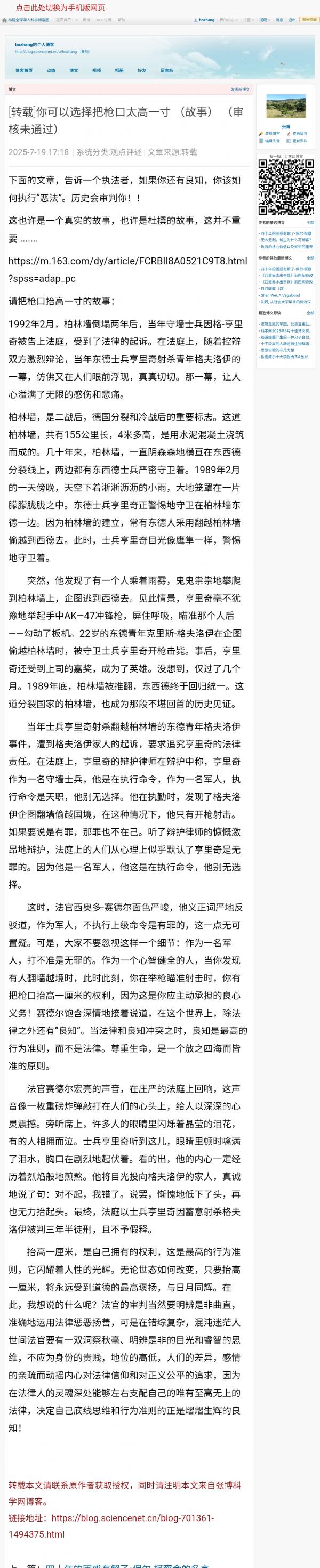
|