媽媽問:“大姐夫!你在哪兒聽來的這麼多?” 梁伯回答: “一次我出差,在一個研究所等待我要見的人。聽他們那些年輕的研究人員說的。鳳玲,那些年輕的研究人員都會說外語。他們還用現代醫學理論研究古代故事裡人物的病情。他們還知道肉眼通是什麼時間從哪兒傳入中國的。說是,開始的時候,是做靈魂轉世、轉世活佛用的。後來,有錢有勢的達官貴人們也要給自己的孩子做,這種作法就在中國廣泛傳播開來了。” 媽媽說: “當然了!好東西人人都想要。你接着說,你還聽說了多少?” Mom asked: “Big Brother! Where did you hear so much?” Uncle Liang replied: “Once I was on a business trip, waiting for someone I wanted to meet at a research institute. Listened to those young researchers of theirs. Fengling, those young scientists speak foreign language. They also use modern medical theories to study the conditions of characters in ancient stories. They also know when and where the Flesh Eye Through was introduced to China. It says that, in the beginning, it was used for soul reincarnation and reincarnation of living Buddhas. Later, rich, and powerful dignitaries wanted to do it for their children, so the practice spread widely in China.” Mom said: “Of course! Everyone wants good things. You go on, how much more have you heard?”
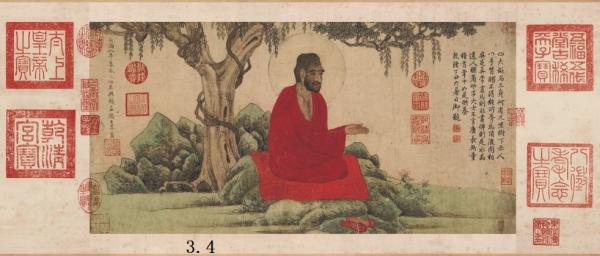
注3.4, 2014年,我完成回憶錄後,判斷梁伯所說的地方是中國醫科大學的巴甫洛夫樓,是個國際醫學交流中心。我認為他們所說的那個古代故事就是本書第二章《啟蒙》中的《桃花劫》。約在公元二世際,伊朗人安士高(如紅袍和尚插圖3.4)把這秘密傳入中國。應該說這作法在中國那之前就有,安士高更正了其中的一些錯誤認識。 Annotation 3.4,In 2014, after completing my memoirs, I judged that the place Uncle Liang was talking about was the Pavlov Building of China Medical University, a centre for international medical exchange. I believe that the ancient story they are referring to is the Peach Flower Catastrophe in Chapter 2 Revelation. The Iranian Anshi Gao (as illustrated 3.4 as the red-robed monk) introduced the secret into China around the second century AD. It should be noted that this practice existed in China before that time, and Anshi Gao corrected some of the misconceptions. 3.5 觸目的鑑別 Identification of Touch-Eye過了一會兒,媽媽又問: “大姐夫!你說肉眼通的眼神與眾不同,咋個不一樣?” 梁伯說: “肉眼通的眼睛看東西時,看的時間長。” 媽媽說: “我早就發現某盧岩看東西時,像似看不清楚似的,看的時間長。” 梁伯說: “肉眼通的眼神,別人看了,總是以為他明白。” 媽媽說: “某盧岩的眼睛是有那麼一點兒意思。有幾次,我認為他在旁邊看明白了,就不信他能懂,就試探他到底明白不,結果發現他根本就不懂。” After a while, Mom asked: "Big Brother! You said that Flesh Eye Through's eyes are different, how are they different?" Uncle Liang said: "When Flesh Eye Through's eyes look at things, they look for a longer time." Mom said: "I have long noticed that when Luyan looks at something, it looks as if he can't see clearly for a long time." Uncle Liang said: "Flesh Eye Through’s eyes, when others look at them, they always think he understands." Mom said: "Luyan's eyes are that little interesting. There were times when I thought he understood as he was looking at the side, I didn't believe that he could understand, so I tried to find out if he did or not, only to find out that he didn't understand at all." 梁伯和媽媽互相看了看。梁伯轉過身去,過了一會兒,轉回來說: “我還知道肉眼通的另一個特徵,不眩眼。就是那種眼睛,有東西在他眼前晃時,他不眨眼,眨眼即慢又少,還不遜光。” 媽媽說: “啊!那叫眩眼啊!也是,丟臉眩眼是慫啊!這我可沒注意!” 梁伯叫我到他的近前,開始舉手做出打我的舉動,試驗了幾次。媽媽開始試驗她自己。 梁伯對媽媽說: “自己試驗自己不行,得別人試驗你。” 媽媽說: “他反應慢,也眨眼。” Uncle Liang and my mother looked at each other. Uncle Liang turned away, after a moment, turned back and said: “I also know another characteristic of the Flesh Through, the Undazzling Eye. It's the kind of eye that doesn't blink when something is in front of his eyes, blinking that is slow and little, and is also not yielding to light.” Mom said: "Ah! That's called a Dazzling Eye! Yeah, well, Dazzling eyes losing face is a coward! I didn't notice that!" Uncle Liang called me to his nearness and began to raise his hand in a gesture of hitting me, testing it a few times. Mom started testing herself. Uncle Liang said to my mother: "You can't test yourself; it has to be tested by others." Mom said: “He's slow to react and blinks.” 梁伯對媽媽說: “我聽說,這種測試,得四十分就算成功;不過人家用十幾種實驗方法。” 媽媽說: “一般是60分算成功。” 梁伯說: “我知道,但是人家的那個算法是40分算成功。他們那種算法,我考慮應該是35或者45是最好。但我不知道是高於40還是低於40算是通過。” 媽媽問: “那你看某盧岩的眼睛算不算是肉眼通?” 梁伯說: “我是道聽途說,二五眼。鳳玲!你別認真,我認為他就在成功和失敗的分界線上;說是就是,說不是就不是。” Uncle Liang said to my mother: "I've heard that for this kind of test, a score of 40 is considered successful; but people use a dozen or so experimental methods." Mom said: "It's usually 60 points that counts as success." Uncle Liang said: "I know, but their algorithm is 40 points for success. The kind of algorithm they have, I think it should be 35 or 45 is the best. But I don't know if it's higher than 40 or lower than 40 is considered a pass." Mom asked: “Then do you think the eyes of our Luyan are considered to be Flesh Eye Through?" Uncle Liang said: "I heard it from hearsay, do not truthfully understand. Fengling! Don't you take it seriously, I think he's right on the dividing line between success and failure; saying yes is yes, saying no is not.” 3.6 我幼時的性格特質 Trait of my Childhood我媽媽對梁伯說: “大姐夫,你在地上呢!你把箱子上的那頭大蒜遞給盧岩。” 梁伯問: “給盧岩大蒜幹什麼?” 媽媽回答: “我看他瞪着眼睛聽咱倆說話,怕累着他;讓他轉移一下注意力。” 梁伯明白了: “啊!我第一次給孩子玩具,怎麼能給一頭大蒜呢! 說着,他在自己的兜里摸,掏出了一個花紐扣遞給了我。” My mother said to Uncle Liang: "Big Brother, you're on the floor! You hand Luyan the head of garlic on the box." Uncle Liang asked: "What are you giving Luyan garlic for?" Mom replied: "I saw him staring at us listening to us talking, and I was afraid of tiring him out; let him divert his attention." Uncle Liang understood: "Ah! How can I give a head of garlic when it's the first time I've given a child a toy! Saying this, he felt in his pocket,pulled out a flower button and handed it to me." 媽媽說: “某盧岩可好待了,你給他一根雞毛,他就能拿着琢磨倆小時。你要是再告訴他,那根雞毛是令劍,那他就得琢磨兩、三天,甚至一、兩個星期都放不下。” 梁伯突然驚訝地說: “啊呀!我給他個紐扣,他會不會吃了?” 媽媽說: “他不吃!就連我餵他沒吃過的東西,他都不吃,那才難吶!就像我要騙他吃毒藥似的!不知怎麼回事,就對你還行!別人,誰想摸摸他,那可不行,可把他煩壞了!他就躲;抱他,他就拼命掙扎;放下他,他就躲到一邊,自己呆着。平時,他就自己在那兒呆着,不用管他。” Mom said: "Our Luyan is very easy to be taken care of, that if you give him a chicken feather, he can hold it for two hours and ponder over it. If you tell him that chicken feather is a commanding sword, he can't put it down for two or three days, or even a week or two." Uncle Liang suddenly said in surprise: "Ala! I gave him a button; will he eat it?" Mom said, "He won't eat it! He won't eat anything I feed him that he hasn't eaten before, that's hard! It's like I'm trying to trick him into eating poison! I don't know what's wrong with him, but he's fine with you! Anyone else who tries to touch him, it's a no-no. It annoys him! He hides; if you hold him, he struggles; if you put him down, he hides and stays by himself. Usually, he just stays there by himself, don't mind him." 注3.6,這些描述都是嬰幼兒神經發育失調症的症狀:不信任人,喜歡獨處。美國心理疾病手冊中有對這種人的跟蹤觀察描述。學生階段,這種人也可以學會所有的知識,但明顯比正常人慢;成年後可以學會大部分常用的生活技能。他們的一生都掙扎在思考當中。許多他們考慮的問題,在正常人看來不是問題,不需要思考。 Annotation 3.6, These descriptions are all symptoms of infantile neurodevelopmental disorder: distrust of people and prefer for being alone. The Diagnostic and Statistical Manual of Mental Disorders contains descriptions of follow-up observations of such individuals. At the student stage, such people can also learn everything, but significantly slower than normal; as adults, they can learn most of the common life skills. They struggle with thinking throughout their lives. Many of the problems they consider are not problems to normal people and do not require thinking. 返回 Return
|