生命之树结的果共有五种,分别是异熟果、等流果、士用果、离系果、和增上果。 Tree of Life bears five kinds of fruits, namely, Mutant Fruit, Equal Stream Fruit, Warrior’s Usage Fruit, Off-is Fruit, and Escalator Fruit. 10.6.1 异熟果 Mutant Fruit异熟,是无意识的主要特性。变异即是成熟,因为变异可以持业。业是身口意的行为习惯。现在的身口意行为是过去积累的业的现行,所以业就是身口意的行为。异熟果是说无意识收集来的诸法种在生活中受熏染而成长,异类、异地、异时而成熟。什么是诸法种子?如本章生命之树所谈的五位百法就是。什么是异类?如本章的百法就是众生被分成了五位,每位法中还有分位,都可以认为是彼此各异的类。什么是异地?如插图10.6.2-23至31所示的九地各异。什么是异时而熟?任何一个行为,其异熟果可能三个月后成熟,也可能三年后成熟,也可能十年、三十年后成熟。 无意识自是自果;异熟果是无意识自体变异的体现。无意识的异熟果一但成熟,许多异熟果流出如同瀑布的水流,恒相续,可以保持有情的身命和业,因此有情有了命根和业力。在因果关系的分析中,异熟自成一类,异熟果的原因是异熟。 Mutation is the main characteristic of unconsciousness. Mutation is ripening because it can keep karma. Karma is the behavioral habits of the body, mouth, and intention. The present behaviors of body, mouth, and intention are the performance of karma accumulated in the past, so karma is the bodily orally and intentional behavior. Mutant Fruits means that the juristic seeds collected by unconsciousness grow in life by being fumigated, and ripen in different species, in different places, at different times. What are the juristic seeds? As for the “5 positions 100 laws” explained in the Tree of Life, all are juristic seeds. What is the said different species? As for the 100 laws in the chapter are all sentient, are categorized into five positions, and more sub-positions, what can be viewed as such a few different sentient species. What is the said different locations? As for any behaviors of present, their mutant fruits may ripen at any heartlands in illustration 10.6.2-23 to 31. What is the said different time? As for any behavior, its mutant fruit may ripen in 3 months, in 3 years, in 10 years, or in 30 years. Unconsciousness self is the self-fruit; the mutant fruit is the manifestation of unconsciousness’ mutation. As soon as the mutant fruits in unconsciousness are ripe, many of them flow out like waterfall streams, constant and continuous, which can maintain the body's life and karma, and thus sentient beings have their life root and karmic power. In the analysis of causality, mutant fruit is in a category of its own, the cause of mutant fruit is mutation. 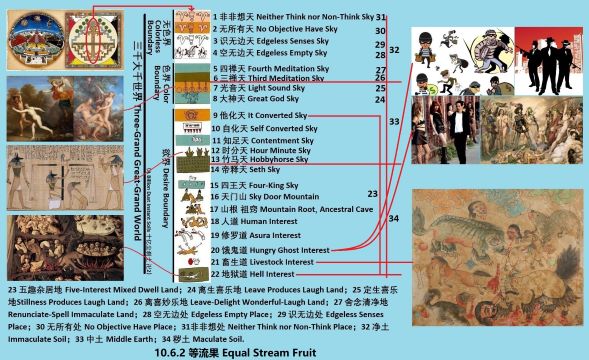
10.6.2 等流果 Equal Stream Fruit果与因相似,同类或相似的果法,前法为后法开导,持续不断地从生命之树中流出,被称为等流果。前法为后法开导是说,前善果引后善法相继,被牵引的后果与前因相似;前无记业引流后无记业同类跟随;前念恶行招引后面的恶业相继,果似因而流出。此果虽然是以前意识为主导,圣人说,应当考虑这是心整体的功能,八种识中都有等流果。 Fruits are like causes, same category or similar fruit laws, the former leading the latter, continually flowing out from Tree of Life are named as Equal Stream Fruit. The former leading the latter is saying that former benevolent fruits lead succeeding benevolent laws, the being led latter fruits and the former causes are similar; former memory-less karma draws the flow of the latter memory-less karma of the same kind to follow; the front ferocious spells of ferocious behaviors attract the evil karma that follows, the fruits are similar to the reasons, hence flowing out. The fruits are dominated by preconscious-ness though, sages say, it should be considered that this is a function of the heart (i.e., mind) as a whole and that there are Equal Stream Fruits in all the eight senses. 在因果关系的分析中,等流因由三种因构成:遍行因、相应因、同类因。遍行因是说心所有法中的五位遍行法,无处不在,可以为因。相应因,例如,当前意识生起时,与其相应的18位心所有法(参见识蕴)会相应而起;当意识升起时,与其相应的51位心所有法也会伺机而动;当行舍时,无意识(古作神识,亦作福)会出现。同类因,意处(即前意识)中的胜者招引分布在三界九地(如图10.6.2)的同类来分食可爱果。 广义上讲,等流果亦是异熟果。五果中的异熟果、士用果和增上果,都可以通摄一切因果。五果的区分需从依处着眼:习气依处得异熟果;随顺依处得等流果;士用依处得士用果;真见依处得离系果;所余依处得增上果。 In the analysis of causation, equal stream causes consist of three kinds of causes: omnipresent migration cause, correspondence cause, and same category cause. The omnipresent migration cause means that the five Omnipresent Heartland Laws (cf. section 10.4.4.1.1) are ubiquitous and can be the causes. Corresponding causes, e.g., when preconsciousness arises, its corresponding 18 associative heartland laws (cf. sense node) will arise; when intent-sense (i.e., consciousness) rises, its corresponding 51 correlative heartland laws (cf. sense node) will also be waiting for the opportunity to move; and when acting renunciation, unconsciousness (anciently known as God-sense, Fortune) will appear. Same category causes are such as victors in preconsciousness attract the same kinds of interests distributed in the three boundaries nine heartlands (see figs. 10.6.2) to partake of the lovely fruits. In a broader sense, equal-stream fruits are also mutant fruits. Among the five fruits, mutant fruit, warrior’s usage fruit, and escalatory fruit, each can assimilate all causalities. To distinguish the five fruits, should look at the dependent places: dependent place of habits, life tree bears mutant fruits; dependent place of obedience, life tree bears equal-stream fruits; dependent place of warrior’s usage, life tree bears warrior’s usage fruits; dependent place of true view, life tree bears off-is fruits (i.e., liberation fruit); all other dependent places, life tree bears escalatory fruits. 下面以十恶十善的因果来说明等流果。 甲)杀生因果,杀生之罪能令众生堕三恶道(如图10.6.2-20,21,22)。若生人中,得二种果报,短命,多病。若离杀生,即得成就十离恼法:(一)于诸众生普施无畏;(二)常于众生起大慈心;(三)永断一切嗔恚习气;(四)身常无病;(五)长寿;(六)恒为非人之所守护;(七)常无恶梦,寝觉快乐;(八)灭除怨结,众怨自解;(九)无恶道怖;(十)命终生天。 The following is illustrations of equal-stream fruits in terms of the cause and effect of the ten evils and ten goods. I) Cause and effect of killing livings, the crime of killing can cause sentients to fall into the three ferocious paths (cf. Figs. 10.6.2-20, 21, 22). If born among human beings, gain the two kinds of fruit retributions: short life, and many illnesses. If leaving killing, achieves the Ten Laws of leaving annoyance: (1) pervasively donating fearlessness to sentient beings; (2) constantly with great merciful heart to sentient beings; (3) permanently severance off all habits of irritable indignity; (4) constant absence of disease in body; (5) longevity; (6) constant guardianship from non-humans; (7) constant absence of nightmares and enjoyment of delightful sleep; (8) extinction of complaining ties, and self-solutions of all grudges; (9) absence of terrors from ferocious paths; (10) will escalate to sky at end of the life. 乙)偷盗之因果,劫盗之罪亦使众生堕三恶道。若生人中,得二种果报:贫穷,共财不得自在。若离偷盗,即得十种信法:(一)资财盈积;(二)多人爱念;(三)人不欺负;(四)十方赞美;(五)不忧损害;(六)善名流布;(七)处众无畏;(八)财命色力,安乐辩才,具足无缺;(九)常怀施意;(十)命终生天。 丙)邪淫之因果,邪淫之罪亦令众生堕三恶道。若生人中,得二种果报:妻子不贞洁,不得随意眷属。若离邪淫,即得四种智所赞法:(一)诸根调顺;(二)永离喧掉;(三)为世称叹;(四)妻莫能侵。 II) Cause and effect of stealing, the crime of robbery and theft also cause sentient to fall into the three ferocious paths. If born among human beings, gain the two types of fruit retributions: poverty, and insufficient on commonwealth. If leaving stealing, gain the ten kinds of belief laws: (1) accumulating wealth to fulfillment; (2) being loved and spelled by many; (3) not to be bullied; (4) being praised in ten directions; (5) not worrying losses and damages; (6) good reputations spreading prevailingly; (7) being fearless in crowds; (8) wealthy fate, colorful power (color means matter, substance in Buddhism, so here it means physical; cf. color node), and ease-fully enjoying eloquence; (9) always bosom renunciative intentions; (10) escalating to sky at the end of life. III) Cause and effect of heretical sexuality, the crime of heretical sexual conducts also causes sentients to fall into the three ferocious paths. If born among humans, gain the two kinds of fruit retributions: wife is unchaste; cannot get agreeable affiliations. If leaving heretical sexual behaviors, gain the four kinds of intelligences praised by all: (1) all roots are concordant; (2) forever left from clamor; (3) being praised by mundane beings; (4) wife not being intruded. 丁)妄语之因果,妄语之罪亦令众生堕三恶道(如图10.6.2-20、21、22)。若生人中,得二种果报:多被诽谤,为他所诳。若离妄语,即得八种天所赞法:(一)口常清净,如优钵华香;(二)为诸世间之所信服;(三)发言成证,人天敬爱;(四)常以爱语安慰众生;(五)得胜意乐,三业清净;(六)言无误失,心常欢喜;(七)发言尊重,人天奉行;(八)智慧殊胜,无能制伏。 戊)绮语之因果,绮语之罪,亦令众生堕三恶道。若生人中,得二种果报:言人不信,语不明了。若离绮语,即得成就三种决定:(一)定为智人所爱;(二)定能以智,如实答问;(三)定于人天威德最胜,无有虚妄。 IV) Cause and effect of delusive speech, the crimes of delusive speeches also cause sentients to fall into the three ferocious interests (Fig. 10.6.2-20, 21, 22). If born among humans, receives two kinds of fruit retributions: being slandered often; being deceived by others. If afar delusive speeches, gain the eight honorable laws praised by skies: (1) a constantly immaculate mouth, like fragrant flower in a beautiful vase; (2) faithfully believed by all mundane beings; (3) speeches are readily testified, are respected and loved by humans and skies; (4) always consoling sentient beings with lovable words; (5), gain victoriously intentional laughs, with bodily, oral, and intentional, the three kinds of immaculate karmas; (6) no mistakes in speeches, the heart always rejoices; (7) speech is respected and valued, humans and skies follow it; (8) intelligence and gnosis are superiorly victorious, no one who can subdue it. V) Cause and effect of flowery speeches, the crime of flowery speeches also causes sentient beings to fall into the three ferocious paths. If born among humans, gain the two kinds of fruit retributions: words are not believed, and speeches are not clear. If leaving away flowery speeches, gain the three kinds of certainties: (1) being loved by the wise; (2) capable to answer questions factually by intelligence; (3) definitely the most victorious virtues and majesties among humans and skies, without illusions. 己)恶口之因果,恶口之罪,亦令众生堕三恶道。若生人中,得二种果报:常闻恶声,言多诤讼。若离恶口,即得成就八种净业:(一)言不乖度;(二)言皆利益;(三)言必契理;(四)言词美妙;(五)言可承领;(六)言则信用;(七)言无可讥;(八)言尽爱乐。 庚)两舌之因果,两舌之罪,亦令众生堕三恶道。若生人中,得二种果报:眷属乖离,亲族弊恶。若离两舌,即得五种不可坏法:(一)得不坏身,无能害故;(二)得不坏眷属,无能破故;(三)得不坏信,顺本业故;(四)得不坏法行,所修坚固故;(五)得不坏善知识,不诳惑故。 VI) Cause and effect of ferocious mouth, the crime of ferocious mouth also causes sentients to fall into the three ferocious paths. If born among humans, gain the two fruit retributions: often hearing ferocious voices; words are more about expostulations and litigations. If leaving ferocious mouth, soon can achieve the eight kinds of immaculate karma: (1) words do not misbehave; (2) speeches are beneficial; (3) words definitely concord to principles; (4) sayings and words are wonderful; (5) speeches are agreeably acceptable; (6) speeches are trustworthy and useful; (7) speeches are free from ridicule; (8) sayings are all lovable and laughable. VII) Cause and effect of two-tongue (i.e., sowing discord among people), the crimes of two-tongue also cause sentients to fall into the three ferocious paths. If born among humans, gains two kinds of fruit retributions: family members leave him or her; relatives and clansmen despise him or her. If leaving two-tongue, gain the five indestructible laws: (1) gain of an indestructible body, because of none the capable to harm him or her; (2) gain of an indestructible family, because of none the capable to separate them; (3) gain an indestructible belief, which is obedient to one's own karma; (4) gain indestructible juristic behaviors, because of solid cultivation; (5) gain of indestructible benevolent knowledge, because of not deceiving and suspecting. 辛)贪欲之因果,贪欲之罪,亦令众生堕三恶道(如图10.6.2-20,21,22)。若生人中,得二种果报:心不知足,多欲无厌。若离贪欲,即得成就五种自在:(一)三业自在,诸根具足故;(二)财物自在,一切怨贼,不能夺故;(三)福德自在,随心所欲,物皆备故;(四)王位(注1)自在,珍奇妙物,皆奉献故;(五)所获之物,过本所求,百倍殊胜,由于昔时,不悭嫉故。 注10.6.2-1,全部的佛教徒都是真正的上帝的子女,所以都是法王子,法公主,法王,或法女王。这是佛教的传统。 VIII) Cause and effect of greedily desire, the crime of greedy desire also causes sentients to fall into the three ferocious paths (see fig. 10.6.2-20, 21, 22). If born among human beings, gain the two fruit retributions: heart without contentment; insatiable multi desires. If leaving greedy desires afar, soon achieve the five kinds of self-sufficiencies: (1) three karmas self-sufficiencies, because of having all the roots; (2) financial assets self-sufficiency, because all resentful thieves can not take them away; (3) fortune and virtue self-sufficiency, because everything is available at one's own will; (4) king’s throne (note 1) self-sufficiency, because all the treasures and wonders are offered; (5) all things gained are a hundred times more than one could ever ask for, because one did not be stingy and jealous in the past. Note 10.6.2-1, All Buddhists are authentic children of God, and so all are juristic princes, juristic princesses, juristic kings, and juristic queens. This is a Buddhist tradition. 壬)嗔恚之因果,恚嗔之罪,亦令众生堕三恶道。若生人中,得二种果报:常被他人求其长短,常被于他之所恼害。若离嗔恚,即得八种喜悦心法:(一)无损害心;(二)无嗔恚心;(三)无诤讼心;(四)柔和质直心;(五)得圣者慈心;(六)常作利益,安众生心;(七)身相端严,众共尊敬;(八)以和忍故,速生仙境。 IX) Cause and effect of irritable indignity, the crime of irritable indignity also causes sentients to fall into the three ferocious paths. If born among humans, gain the two fruit retributions: always being asked for faults and deficiencies; often being annoyed and harmed by others. If leaving irritable indignity afar, soon gain the eight kinds of delightful heart laws: (1) harmless heart; (2) non-irritable heart; (3) no heart of expostulation and litigation; (4) soft and qualitative upright heart; (5) gain of sagely merciful heart; (6) always to do beneficial profit to comfort sentients’ hearts; (7) decent bodily appearances are respected by crowds; (8) due to harmonious countenances, speedily aboard godly environment. 癸)邪见之因果,邪见之罪,亦令众生堕三恶道。若生人中,得二种果报:生邪见家,其心谄曲。若离邪见,即得成就十功德法:(一)得真善意乐,及真善等侣;(二)深信因果,宁殒身命,终不作恶;(三)唯归依佛,非余天等;(四)直心正见,永离一切之吉凶疑网;(五)常生人天,更不在于恶道;(六)无量福慧,转更增胜;(七)永离邪道,行于正道;(八)不起身见,舍诸恶业;(九)住无碍见;(十)不堕诸难。 X) Cause and effect of heretical views, the crime of heretical views also can cause sentients to fall into the three ferocious paths. If born among humans, receive the two fruit retributions: born in heretical family, with a flattery heart. If leaving heretical views afar, soon gain the ten kinds of virtuous merit laws: (1) gain of intentional laugh of true benevolence, and true benevolent companion, etc.; (2) deeply belief in the cause and effect, rather than perish not to do evil; (3) only converting to Buddha (note, Buddha is a Pali word, means perception), not other skies, etc.; (4) straightforward heart with correct views, leaving afar from suspenseful net of all the auspicious and ominous for ever; (5) constantly reborn among humans and skies, not going to the ferocious paths; (6) infinite quantity of fortune and gnosis, and turning to be more victorious; (7) behaving on correct path, to be far away the heretical paths forever; (8) not arousing Seth-view, and giving up all the ferocious karmas; (9) dwelling on non-hindrance views; (10) not falling into all kinds of difficulties. 返回生命树的目录 Return
|