|
不相应行法从三义得名:(一)此位诸法无缘虑作用,故不与心法、心所有法相应;(二)此位诸法无质碍作用,故不与色法相应,也不与无为法相应;(三)此位诸法是生灭变异之法,所以也是行法。心不相应行法共有二十四位法:(一)有得,(二)命根,(三)众同分,(四)异生性,(五)无想定,(六)灭尽定,(七)无想异熟,(八 )名身,(九)句身,(十)文身,(十一)生,(十二)老,(十三)住,(十四)无常,(十五)流转,(十六)定异,(十七)相应,(十八)势速,(十九)次第,(二十)时,(二十一)方,(二十二)数,(二十三)和合性,(二十四)不和合性。 Noncorresponding Migration Law is named from three meanings: first, laws in this position have no aggregative heart function, do not correspond to Hearts and Heartland Laws; second, the laws have not substantial obstructive effects, do not correspond to Color Laws, also not corresponding to None-as Laws (cf. section 11.6.4); thirdly, the laws have birth, death, and mutation properties, therefore they are Migration Laws also. There are twenty-four Noncorresponding Migration Laws in total: (1) Have Gain, (2) Life Root, (3) Category Differentia, (4) Mutant Nature, (5) Thoughtless Stillness; (6) Extinctive Stillness, (7) Thoughtlessness Retribution, (8) Name Body, (9) Sentence Body, (10) Literary y Body, (11) Birth, (12) Oldness, (13) Dwell, (14) Impermanence, (15) Cycle; (16) Definite Difference, (17) Correspondence, (18) Potency and Velocity, (19) Sequence, (20) Time; (21) Direction, (22) Number, (23) Combinability, (24) Non-Combinability.
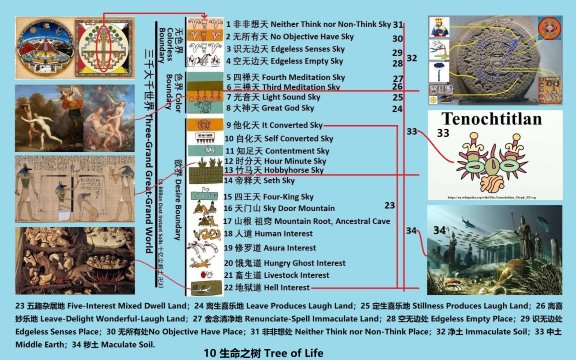
(一)有得,基于有情身心的诸法分位,佛教了设立三种获得成就:种子成就,自在成就,现行成就。(1)种子成就。种子是根义,因义,增上义。有情身中,某些法虽然不现行,但有潜在势力的功能,为种子成就,如三无漏根:未知当知根、已知根、俱知根。未知当知根就是趣向,愿意学习四胜谛。当一个人懂得了四胜谛,他或她就具有了已知根;若证得了四胜谛,就具有了俱知根(如图10-2)。又如插图10-15中,从左向右的第二图是菩提种,是无上正等正觉(梵语啊褥多罗三藐三菩提)的种子,就是立下此四宏誓言:众生无边誓愿度,烦恼无尽誓愿断,法门无量誓愿学,佛道无上誓愿成。此菩提种又名菩提心戒,愿渡。(2)自在成就,就是成为独立自主的个体,所需能够自给自足。(3)现行成就,就是种子升起、现行,成为身口意的行为。 (1) Have Gain, based on the juristic differential position in sentient body and heart, three gains are established: (A) seed achievement, (B) self-sufficiency achievement, and (C) presently performance achievement. (A) Seed achievement. Seed is the meaning of root, cause, and escalation. In the sentient body, some laws that are not active but have the function of potential forces are seed achievement, such as the three non-defilement roots: root of unknowing which should be known, root of having known, and root of all knowing all seeing. The “root of unknowing which should be known” means that somebody interests to, wills to learn Four Cruxes (aka. Four Noble Truths), he or she has the root (or seed). When a man understands the four cruxes, he has the root of having known. After she proves the four cruxes, she has the root of all knowing all seeing (i.e., fig.10-2). In Illustration 10-15, the second picture from left to right is Enlightenment Seed, which is the seed of “Non-Upper Correct-Equality Correct-Perception” (Sanskrit as Anuttara Samyak Sambodhi). The seed is the making of these four great vows: Sentient beings are edgeless, I vow: I ferry them all! Annoyances are endless, I vow I sever them all! Juristic doors are limitless; I vow I study them all! Buddha’s path is non-upper; I vow I endeavor to succeed! The Bodhicitta (i.e., enlightenment heart) seed is also known as Bodhicitta precept, and Will Ark. (B) Self-sufficiency achievement means becoming an independent autonomous individual who is self-sufficient in his or her needs. (C) Performance achievement is that seeds are arising presently as bodily orally and intentionally behaviors. (二)命根,就是有情的寿命;依先业所行,无意识的异熟果恒相续,维持有情身心性命。 (三)众同分,依有情身心分位的相似而建立。例如,基于众生对根本十戒的违顺,约心、烦恼、和境而辨别,遂有六趣:地狱趣、畜生趣、恶鬼趣、修罗趣、人趣、和天趣(插图10-1至22;参见第12章)。 (2) Life Root is the sentient life; depending on behaviors of preceding karma, unconsciousness’ mutant fruits succeeding-ly sustain the physical and mental life. (3) Category Differentia is established according to category differentiae of sentient body and heart’s differentiation. For example, based on sentient beings' abidance and transgression by the Ten Fundamental Precepts, and according to their hearts, annoyances, and environments, they are categorized as the six interests: hell-interest, livestock interest, hungry-ghost interest, asura-interest, human-interest, and sky-interest (Illustration 10-1 to 22; Cf. Chapter 12). (四)异生性是凡夫性的异名,依其种子烦恼和所知而建立。又烦恼和所知妨碍异生出离其本性,所以亦被称作烦恼障和所知障。烦恼障即是思烦恼,亦作思惑,如贪、嗔、痴、慢、疑、身见、边见、邪见、见取、戒取等。所知障即是见烦恼,亦作见惑,如身见、边见、邪见、见取、戒取、贪、嗔、痴、慢、疑等。烦恼障和所知障相互依存,成对儿存在。烦恼由所知而被认知,所知由烦恼而有感,所以此二者具有相同的头数和名。烦恼障即是愚痴,能障清净,障涅槃。所知障似智非智,能障智,障觉悟,所以也被称作智障。 (4) Mutant Nature, mutant is a synonym for mundane people, is established by its seeds of annoyances and knows. And annoyances and knows hinder mundane beings departing from their own natures, so the two are also called annoyance hindrance and know hindrance. Annoyance hindrances are “mean annoyances”, also known as mean muddles, such as greed, irritability, ignorance, arrogance, suspicion, Seth view, edge view, heresy, view fetch, precept fetch, and so on. Know hindrances are “view annoyances”, also known as view muddles, such as Seth view, edge view, heresy, view fetch, precept fetch, greed, irritation, ignorance, arrogance, suspicion, etc. Annoyance hindrance and know hindrance are interdependent and pairs. Annoyance is recognized by know and know is felt by annoyance, so the two have the same head number and name. Annoyance hindrances are foolishness, ignorance, which can quietness, hinder nirvana. The know hindrance is like intelligence but not intelligence, and can obstruct intelligence and enlightenment, so it is also called the intelligence hindrance. (五)无想定,亦名无心定、长寿天,是佛教中的人生八难之一。谓有异生入于禅定,背想作意,持续强行镇压前意识(亦作夏娃识),日复一日,月复有年。夏娃变得越来越细,终于被折断了;此位禅定修习者就变成了植物人,住于长寿天中等待此无想定异熟果报被消耗尽了,再堕落于人间。定是身心与环境相应而动的一心状态;他都没有心,怎么还被称作定呢?因为想灭为首,身心安和,故被称为无想定。 (5) Thoughtless Stillness, also known as Heartless Stillness and Longevity Sky, is one of the eight difficulties of life in Buddhism. The saying is that that a mutant who enters meditation and, with the intention to terminate thinks, continues to forcefully suppress preconsciousness (i.e., Eve-sense), day after day, month after year. Preconsciousness becomes thinner and thinner and is eventually snapped off. This meditator becomes a plant man or woman and dwells in the Longevity Sky waiting for the fruit of this Non-think Stillness to be consumed and then falls back to mundane world. Stillness is one heart state in which the subjective and objective change mutually, the person is even not a heart, how is that called a stillness? Because to terminate thinks is the first thing to go, and the body and mind are at peace, so it is called Thoughtless Stillness. (六)灭尽定,亦作灭彼定,是所有的客观对象都被消灭了的状态,即是插图10-2的无所有天。涅槃是无为法,他或她这样努力地消除客观对象,是有为法,怎么也到了涅盘了呢?她或他在努力作为的过程中,肯定会经历许多挫折和失败,也会有许多灰心丧气的时候,那些灰心丧气与无意识的舍受相应,因此也会增加涅槃出现的概率。 (6) Extinctive Stillness, also known as Terminating-Objective Stillness, is the state in which all objectives are terminated, is nirvana (i.e., Fig. 10-2 Non-Objective Sky). Nirvana is an None-as Law (aka Un-striving Law), so how can he or she also reach Nirvana when he or she makes such an effort to eliminate the objective objects, which is a Have-as Law (aka Striving Law)? In her or his efforts to act, she or he will surely experience many setbacks and failures, and there will be many moments of discouragement and losing heart, those frustrations or losing hearts correspond to unconsciousness’ renunciative acceptance, therefore also increase the presenting probability of nirvana. (七)无想报,即无想异熟,禅定中,修习者可能有短暂的无想阶段出现。古德解释,人常有消极或自杀的想法,因此种下了无想的种子。当种子被熏习成熟,就发起现行了。无想异熟是正常的现象,无害。 (八)名身,诠诸法的自性,如眼、耳、鼻、舌、身等。 (九)句身,诠诸法的差别,如说,“无意识是前意识、意识、和身识等的总根;前意识轮换支持眼识或耳识等,如是形成了一个不断地自我更新思想意识工作平台。” (7) Thoughtlessness Retribution, i.e., Thoughtlessness Mutant Mature, is a brief phase of no-thought that may occur to meditator. Ancient Virtues explain that people often have negative or suicidal thoughts, thus planting the seed of thoughtlessness. When the seed is ripened by fumigation, it initiates the presentation. The ripening of thoughtlessness is a normal phenomenon and is harmless. (8) Name Body, explains self-nature of laws, such as the eyes, ears, nose, tongue, and body, etc. (9) Sentence Body explains the differences of laws, such as the saying, "The unconscious is the total root of the pre-consciousness, intent-sense, and body-sense, etc.; and pre-consciousness shiftily support the eye-sense or the ear-sense, etc., so becomes a continually updating work-platform of mind.” (十)文身,是字,为名句的所依。 (十一)生,在众同分的所有诸行中,从无到有是生。 (十二)老,在诸行相续的过程中,变坏为老。 (十三)住,在诸行相续的过程中,随转为住。 (10) Literal Body, is words, is the basis for names and sentences. (11) Birth is from none to have among migrations of “Category Differentiae”. (12) Oldness is deterioration during the successions of migrations, changing into damage is old. (13) Dwell is going along the course of the successions of migrations. (十四)无常,在诸行相续的过程中,谢灭为性。无常是佛教的三法印(即佛教的宪章)之一。三法印是:诸行无常,诸法无我,涅槃寂静。 (十五)流转,又作轮回,义为六趣有情迁流于三千大千世界的三界九地(如图10)之中,不得休息和出离。流转是佛教的七真如(七个公理)之一,具体解释参见苦谛的12.4节。 (14) Impermanence means fade and extinction during the successions of migrations. Impermanence is one of the Three Juristic Seals, the charter of Buddhism. The Three Juristic Seals are: migrations are impermanent, laws have no I (“I” means “Seth View”, lord), nirvana is quietness. (15) Cycle, Sanskrit Samsara, means that six Interests of sentient beings are driftingly circulating in the three boundaries nine lands (see fig. 11) of the Three-Grand Great-Grand Worlds, without rest or escape. Cycle is one of the seven true suchness (seven axioms) of Buddhism. For a detailed explanation, see Section 13.4 of Bitter Crux. (十六)定异,就是差别,又作定数,基于因果的种种差别相而设立,如可爱果,妙行为因;不可爱果,恶行为因;在这些种种因果,展转差别相上,假立定异。例如下品十恶(参见12.1.3节)是饿鬼趣人的原因;此因果关系是固定的。再例如,进入了二禅(参见11.2.2节)的人,命终后,一定会在光音天重生;此因果关系是固定的。最后一个例子,上帝给自己的女儿夏娃(玉女)选丈夫,亚当(或金童),一定要有四禅的经历,因为有四禅经历的人能胜任去地狱取回 “人骨(即佛骨舍利,上帝自己的骨头)”并交给夏娃,使夏娃苏醒,成为世界第一,众生之母。 (十八)势速,基于因果法迅急流转而建立。 (十九)次第,基于因果法一一流转而建立。 (16) Definite Differentiation is the difference, mutation, also known as Fixed Number, which is established on the differences of cause and effect. For example, the wonderful behavior is the cause of the lovable fruit, and the ferocious behavior is the cause of the unlovable fruit; the fixed differentiation is established on the differences of cause and effect. For example, the ten lower evils (see Section 12.1.3) are the cause of the hungry ghost interest people; this causal relationship is fixed. For another example, a person who has entered the second meditation (see Section 11.2.2) will be reborn in the Light Sound Sky after death; this causal relationship is fixed. The last example is that when God chooses the husband for his daughter Eve (Jade Girl), Adam (Gold Boy) must have experienced the fourth meditation (see section 11.2.4), because people who have experienced the fourth meditation are qualified to go to hell to retrieve the "human bones” (i.e. “Buddha's-bone abnegated-benefit”, God's own bones) and give them to Eve, so that she can wake up to become the worldly No.1 and the mother of all living beings. (18) Potency Speed is established based on the swift flow of the law of cause and effect. (19) Sequence, that is one by one in the flow of cause and effect. (二十)时,建立于因果相续流转。基于因果相续,若此因果已生已灭,立过去时;若已生未灭,立现在时;若未生,立未来时。又世间义为两时之间。基于无意识(古作神识)的超时空性和生长的特点,古人建立了劫历。插图10的右上角是墨西哥的劫历石。一世界有四中劫:成劫、住劫、坏劫、空劫。每个中劫包括二十小劫。一增一减为一小劫。劫历一般用在时间慢或时间的逻辑不存在的地方,如图10-12的时分天及以上和地狱。插图10-12至9,时间过的就慢,常以万千的太阳历年计算;到了图8的大神天及以上,时间的逻辑就不存在了,就只能按劫历计数了。地狱里时间不稳定,时而向前时而向后,所以也常用劫历来计时。但在上帝造人的故事中,讲故事的人常把金童堕入地狱的劫历换算成太阳历。中国上帝造人的传说中,黄帝(即金童)的地狱经历被换算成了100太阳历年;这样玉皇大帝造人总共花费了200太阳历年的时间。古苏美尔人把须弥颅(即亚当)在地狱期间的劫历数换算成了300太阳历年,这样安拉造人的100太阳历年就变成了400太阳历年。古墨西哥人把左翼蜂鸟造人耗时说成了600年。读者当知,其中的500年是从墨西哥(即金童)堕入地狱的劫难换算出来的,上帝造人都耗费三代人,100太阳历年的时间。 (20) Time is established in the continuous flow of cause and effect. Based on the continuous succession of cause and effect, if this cause and effect has been born and extinguished, the past time is established; if it has been born and not extinguished, the present time is established; if it has not been born, the future time is established. Also, the Mundane-World is defined as between two times. Based on the characteristics of the transcendence and growth of unconsciousness (anciently known as God-sense), the ancients established Catastrophe Calendar. In the upper right corner of Illustration 10 is a Mexican catastrophe calendar stone. There are four medium catastrophes in a Mundane-World, namely, Establishment Catastrophe, Dwell Catastrophe, Damage Catastrophe, and Empty Catastrophe. Each Medium Catastrophe consists of 20 small catastrophes. One small catastrophe is composed by one increase and one decrease. The catastrophe calendar is generally used in places where time is slow or the logic of time does not exist, such as the hour and minute sky (see Fig. 10-12) and above and hell. In illustrations 10-12 to 9, time passes slowly, often calculated in thousands of solar calendar years. In the great god sky (see fig. 8) and above, the logic of time does not exist, so it can only be counted by the catastrophe calendar. Time in hell is unstable, sometimes forward and sometimes backward, so the catastrophe calendar is often used to count. But in the story of God creating man, storytellers often convert the catastrophe calendar of God Boy's fall into hell into the solar calendar. In the legend of China's God creating man, Yellow Emperor’s (i.e. Gold Boy’s) experience in hell was converted into 100 solar calendar years; so, it took the Jade Emperor a total of 200 solar calendar years to create man. The ancient Sumerians converted the catastrophe of Sumeru (i.e. Adam) during his time in hell into 300 solar calendar years, so Allah's 100 solar calendar years for creating man became 400 solar calendar years. The ancient Mexicans said that it took 600 years for Huitzilopochtli to create man. Readers should know that 500 years were calculated from the catastrophe when Mexico (aka. Gold Boy) fell into hell. It all took God three generations, or 100 solar years, to create human beings. (二十一)方,依于形质前后左右而建立,故有东西南北四维上下差别。依此方向,方隅、地方被建立了。一般宗教都有谈思想意识世界,内世界,即五蕴世间,如圣经的第一章就述说了一个心理机制学寓言,说的就是五蕴世间。宗教称太阳光的世界,即唯物主义世界,为器世间。 (二十二)数,集于色心诸行众多品类的一一差别而建立。 (21) Direction, according to the front, back, right, and left of substantial forms, four dimensions of east, west, south, north, and up and down directions are established. Religions in general all have content to talk about the mental world, the inner world, also known as Five Nodes World, such as the first chapter of Bible which tells a mind-mechanical parable in the Five Nodes World. Religions call the solar light world, the materialist world, as Vessel World. (22) Number is set up on the one-by-one difference of the many color-hearts’ migrations. (二十三)和合,即因果众缘集会,如识法,因果相续,必借众缘和会:须根不坏,境界现前,能生识的作意正起。余一切法,如理应知。 (二十四)不和合,由与和合性相反可知。例如,神识(即无意识的纯净部分),又名福(即神识),俱知根,和拯救,与集取和有不具有和合性,因为无意识只与舍受相应。 (23) Combinability, i.e., the aggregation of the crowds of factors gathered. As in the case of the sense laws, cause and effect are successive, they must be reconciled by means of a multitude of factors: the roots must be intact, the environment must be present, and the attention to generate senses must arise properly. All other laws can be known in this way. (24) Non- combinability, as is evident from the opposite of combinability. For example, God-sense (i.e., immaculate part of unconsciousness), also known as Fortune (i.e., God-sense), root of all-knowing all-seeing, and salvation, is non-combinable with aggregate, fetch, and have, because unconsciousness only corresponds to renunciative acceptance. 返回 Return
|
|