总观三千大千世界,可得流转,八种苦相,十趣因果,和25有。 Taking a general view of the Three-Grand Great-Grand Worlds, one can obtain the vicious cycle, eight bitterness, ten interests of causes and fruits, and 25 haves. 12.4.1 流转 Cycle六趣有情迁流于三界九地之中,不得休息和出离,其因果不出十二有枝:无明、行、识、名色、六处、触、受、爱、取、有、生、老死。 Sentient beings of the Six Interests drift among the three boundaries nine lands, their causes and fruits are among the twelve have branches: Non-Light (Ignorance), Migration, Sense, Name-Color, Six Places, Touch, Acceptance, Love, Fetch, Have, Birth, Old Death. 无明义为昏暗、想知道得清楚些,即是无知,从而引发了行枝的运动。此运动,或说由行枝引起的不同,就是识,就是识枝。虽说行枝和识枝同时而有,依据因果,把此二分了先后。就这样,无明枝和行枝引发了后面五枝业果。 Non-Light means dim, and wanting to know, is Ignorance, so that causes the Migration Branch to move. Differences caused by Migration Branch are Senses, are Sense Branch. Although the Migration Branch and Sense Branch come into existence at the same time, based on cause and effect, we divide these two into successive stages. In this way, the Non-light Branch and Migration Branch trigger the next five fruits branches. 识、名色、六处、触、和受,五枝被称作五果,义为它们过去业习气果的现行。识枝把信息传播到了名色枝。名即四无色蕴, 即受蕴、想蕴、行蕴、和识蕴,色即色蕴;名和色合在一起就是心,但此时心并不明了,只能说是识正把信息向有情身心扩散。明是明白、内明的光明。当六处收到信息后,由于先业的作用,心开始形成,所以触枝显现了。触(参见10.4.4.1.1节)是遍行心所有法的触枝,有类似于心的功能,可以为心的形成提供动力。当六处明了,受枝就出现了。受枝遇痛则死;若遇到可爱果,受会招引位于三界九地的同类法来摄取可爱果。受枝出现之后,心就变得明了了。一而再,再而三,就引发了后面的孕育三枝。 The five branches of Sense, Name Color, Six Places, Touch, and Acceptance are called Five Fruits, meaning the fruitful performances of their past karmic habits. The Sense branch transmits information to the Name Color Branch. Names are the four colorless nodes, i.e., acceptance node, think node, migration node, and sense node; Color is color node. Name and Color together are the heart, the flesh body and mind, but at this point, the heart is not illuminated yet; it can only be said that the Senses are spreading the information to the heart, i.e., the flesh body and mind. Illumination is saying of internal light, light of enlightenment. After Six Places (Cf. section 10.3) receive the information, due to karma, heart starts to form, therefore a similar heart, Touch Branch arises. Touch is an Omnipresent Heartland Laws (Cf. section 10.4.4.1.1), can provides heart power during heart formation. After the Six Places are illuminated, the Acceptance Branch appears. When Acceptance Branch encounters pain, it dies; if it encounters lovely fruits, can summon similar laws located in the three boundaries and nine lands. After the emergence of the Acceptance Branch, the heart is fully illuminated. Repeatedly and again, it triggers the later three gestation branches. 爱、取、有三枝可以孕育有情,所以被古人称作能生枝。可爱果是异熟果(参见10.6.1节),稀少,像是农业产品,数量有限;而受枝的享受者是等流果。等流果易招,异熟果难求,进而爱生。爱是肥水,能孕育万物,会导致取枝的出现。一而再,再而三,有枝就出现了。什么是有?记忆有,习气有就是有。有枝会导致后面的生枝和老死枝。 The three branches of Love, Fetch, and Have can give birth to interests, and so they were called three gestation branches by Ancient Virtues. Lovable fruits are mutant fruits (cf. Section 10.6.1), scarce, like agricultural products, limited in quantities; and the enjoyers of the Acceptance Branch are equal-stream fruits. Equal-stream fruits are easy to summon, but mutant fruits are hard to get, therefore Love Branch emerges. Love is fertile water, can brew anything, therefore Fetch Branch emerges. More, and again, Have Branch is formed. What is the have? Having memory and having habit are haves. Have Branch can induce later branches of Birth and Old Death. 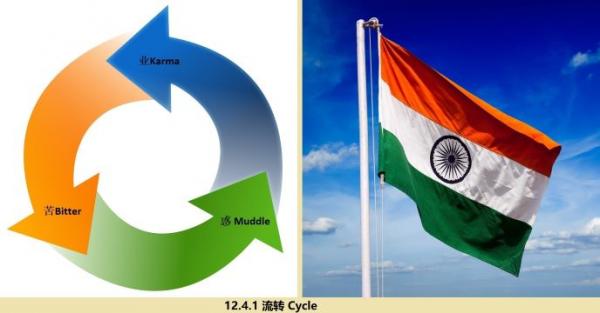
生支和老死枝是被前文的能生支引发的。从无到有为生。衰败为老。灭绝为死。死不一定出现,所以古人用老死来建立此枝。前习气已被孕育了,这出生就是必然的了,随后就有了愁、叹、苦、忧、恼、老死。 The Birth Branch and Old Death Branch are induced by the preceding gestation branches. From nothing to something is birth. Decay or deterioration is old. Extinction is death. Death does not necessarily arise, so the ancients used old-ness and death together to establish this branch. The former habit having been conceived, this Birth is inevitable, followed by sorrow, sighing, bitterness, worry, anguish, and old death. 十二有支亦惑业苦三轮来摄取。惑摄无明支、爱支和取支。业摄行支和有支。苦摄识、名色、六处、触、受、生和老死。名色、六处、触、受和识即是有情身心;生死是有情的烦恼。因此苦轮所摄就是苦海中的众生。这样,这十二有支的因果循环,就变成了:众生受苦起惑,因惑起行造业,业又生苦;如是惑业苦循环无尽。 The twelve have branches can also be assimilated by a Wheel composed of Muddle Karma and Bitter. Muddle assimilates Non-light, Love, and Fetch. Karma assimilates Migration and Have. Bitter assimilates Sense, Name Color, Six Places, Touch, Acceptance, Birth, and Old Death. Name Color, Six Places, Touch, Acceptance, and Sense are sentient beings' bodies and minds. Birth and Death are sentient beings' annoyances. Thus, the Bitter takes in all sentient beings in the bitter sea. In this way, the cycle of cause and fruit of these twelve have branches becomes: sentient beings receive bitter to create muddles, and because of muddles they create karma, and karma gives rise to bitter; so, the Wheel of Muddle Karma and Bitter is rolling itself ceaselessly. 此十二有枝,古人称作十二缘起,亦作流转真如,是佛教中的七真如之一。契经中是这样描述的:无明望行、行望识、识望名色、名色望六处、六处望触、触望受、受望爱、爱望取、取望有、有望生、生望老死,起愁叹苦忧恼,成大苦具。 These twelve have branches, which the Sanskrit word is pratītya-samutpāda-aṅga, also known as Samsara True-Suchness, is one of the seven kinds of true suchness in Buddhism. The harmonious sutra describes it like this: Non-Light watches Migration, Migration watches Sense, Sense watches Name-Color, Name-Color watches Six Places, Six Places watch Touch, Touch watches Acceptance, Acceptance watches Love, Love watches Fetch, Fetch watches Have, have watches Birth, Birth watches Old Death, arise a great worry, sighing, bitter, gloomy, a great annoying aggregate is formed. 12.4.2 八苦 Eight Bitterness(壹)生苦,事物从无变有为生;新事新物总是不断地出现,令人身心生起种种的苦受。 (贰)老苦,事物变异衰败为老;事物总是不断地变老变坏,令人身心生起种种的苦受。 (叁)病苦,新旧事物老是出毛病,起冲突,令人身心生起种种的苦受。 (肆)死苦,事物从有变无为死;已有的事物总是不断地消失永别,令人身心生起种种的苦受。 (1) Birth Bitter, birth means from none to have; new things are always appearing, causing kinds of bitter acceptances in the body and heart. (2) Old Bitter, old means deterioration, decay; things are constantly deteriorating, causing kinds of bitter acceptances in the body and heart. (3) Illness Bitter, often getting diseases, causing kinds of bitter acceptances in the body and heart. (4) Death Bitter, that means things from haves to none; things that already have often disappear, giving rise to kinds of bitter in the body and heart.
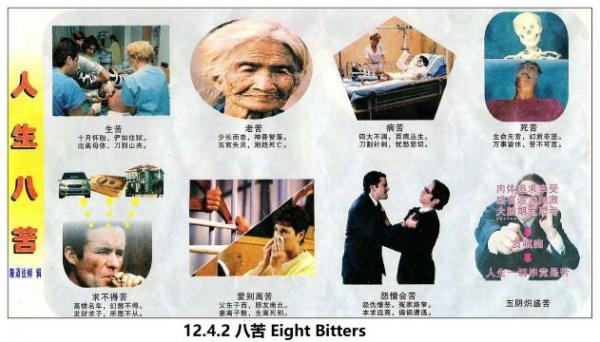
(伍)怨憎会苦,心目中常时怨恨憎恶的坏人,希望他长时远离,但偏与之有集聚会合。 (陆)爱别离苦,自己亲爱的人事物,希望常相聚会,但偏有违缘逆境,使其分散。 (柒)求不得苦,对于世间希求想得的财物、名位,及一切心中所爱乐的事物而不能有。 (捌)五蕴胜苦,五蕴(参见10.4节)的生长繁荣昌盛,衰败凋零枯竭,世事变迁,增减不定,令人身心生起种种的苦受。 (5) Bitter of Meeting with the Grudges and Hatred; those bad people whom one always grudges and hates in mind, wishing that he or she would stay away for a long time, but often meeting with them. (6) Bitter of Separation from Love, in which people and things dear to one's heart, wishing to be together with them, but there are contrary causes and adversities that cause them to be scattered. (7) Bitter from can not be owned, not getting those assets and fames which mundane beings wish and strive to own, and those lovable laughable affairs in heart can not be owned. (8) Bitter from the Five Nodes are victorious, Five Nodes (cf. section 10.4) grow prosperous and flourishing, and they deteriorate and deplete, the mundane affairs are changing, the increase and decrease are uncertain, giving rise to kinds of bitter in the body and mind. 前八种苦相可以被总结为三种苦性:苦苦、坏苦、行苦。前五种苦是新苦遇旧苦,苦水流出,故苦,所以被命名为苦苦;这是苦的自性。知道了苦的自性,遇到苦时,不要再追忆创伤,避免苦泉的喷发。 八苦中,(六)爱别离苦和(七)求不得苦,是由得乐之后,乐变坏形成的,所以叫做坏苦;这是苦的自相。此苦来源于辨别,不辨别不就没了。 The proceeding eight kind of bitter phenomena can be summarized as the three types of bitter natures: bitter-bitter, damage bitter, and migration bitter. The first five types of bitter are new bitter meeting old bitter, bitter water flowing out, hence bitter, therefore are named as Bitter-Bitter, which are self-nature of bitter. Knowing the self-nature of bitter, when one encounters bitter, should not tracing recall old trauma, so to avoid the eruption of bitter fountain. Of the Eight Bitter, (6) bitter of separation from Love, and the (7) bitter from can not be owned, are formed by the deterioration of happiness after it has been attained, and are therefore called Damage Bitter, which is the self-phenomena of bitter. This bitter comes from discrimination; without discrimination it is not. 八苦的最后一项是五蕴胜苦,是由意(即前意识)不断迁流变动形成的,所以叫做行苦。行苦的行是苦因,或者说是苦根。行即是迁徙,漂流的意思。佛教定义有思想活动,就是有行,即有行苦。这行苦的定义使三界九地,除了无所有处天,都有行苦。又四大种中,识是水,所以 “三千大千世界” 就立刻沉没于苦海了。苦谛就这样被建立了,所以苦是谛安立真如。 The last of the Eight Bitters is the Bitter from the Five Nodes are victorious, which is formed by the constant migration of Intent, which is preconsciousness, also known as Eve-sense, is therefore called Migration Bitter. Migration is the cause of the bitter, or the root of the bitter. Buddhism defines whatever having mental activities as having Migration, then there are Migration Bitter. This definition of Migration Bitter makes the Three Boundaries Nine Land, except “No Objective Have Sky”, all have Migration Bitter. And of the four big seeds, sense is water (cf. section 11.2), so the “Three-Grand Great-Grand Worlds” immediately sink into bitter sea. Like this, Bitter Crux is established, therefore Bitter Crux is Establishment True-Suchness. 12.4.3 十趣因果 Ten Interests’ Reasons and Fruits总观三千大千世界中的三界九地,可得十趣因果。 (壹)嗔恚邪淫,即地狱业,极苦无间,即地狱果。 (贰)愚痴暗蔽,即畜生业,昏钝困苦,即畜生果。 (叁)悭贪不施,即饿鬼业,缺乏不遂,即饿鬼果。 Summarizing the three boundaries nine lands in the three-grand great-grand worlds, one can obtain ten interests' reasons and fruits. (1) Irritability hate and heretical sexual conduct are hell karma, extremely bitter without intermittent rest, i.e., hell fruit. (2) Foolishly ignorance and gloomily concealment are livestock karma, gloomily dull and difficult bitter, i.e., livestock fruit. (3) Stingy, greedy, and no donation are hungry ghost karma, short of supplies and failure, i.e., hungry ghost fruit.
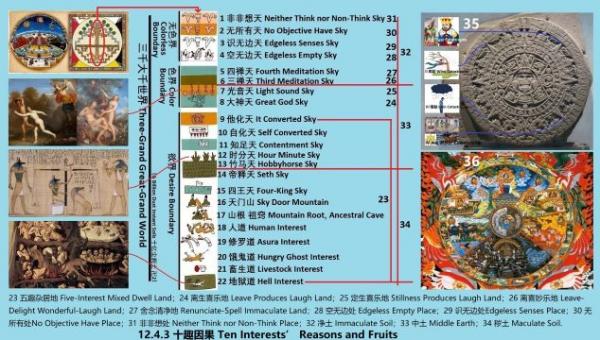
(肆)我慢贡高,即修罗业,战斗争夺,即修罗果。 (伍)坚持五戒,即人道业,苦乐夹杂,即人道果。 (陆)精修十善,即天道业,享受福乐,即欲天果。 (柒)知缘性离,即缘觉业,证因缘觉,即缘觉果。 (4) I (i.e., Seth, cf. section 10.4.4.1.4) arrogance and lifting oneself high are asura karma, combat expostulation and robbery, i.e., asura fruit. (5) adhere to the five precepts, are human karma, interlaced with bitter and laugh, i.e., humanity fruit. (6) diligently cultivating the ten benevolences are sky-path karma, enjoying acceptances of fortune and laugh, i.e., desire sky fruit. (7) knowing aggregate-arousal (cf. section 13.1) off nature is “aggregate-arousal perception” karma, proving causes of aggregate arousal, i.e., “aggregate-arousal perception” fruit. (捌)证悟人空,即小乘业,证小涅槃,即罗汉果。 (玖)渡行齐修,即大乘业,渐入觉位,即菩萨果。 (拾)真慈平等,即神佛业,成圆觉满,即神佛果。 插图12.4.3-1至35是古墨西哥人对此十趣因果的表现形式。插图36是中华文化中对此十趣因果的表现形式,称作大圆镜智。 (8) testified and realized that human is empty, are small vehicle fruit, testament on small nirvana, i.e. Ararat fruit. (9) practicing both cultivation and salvation, are great vehicle karma, gradually entering enlightenment position, i.e., bodhisattva fruit. (10) true mercifulness and even equality are God Buddha karma, perfect achievement, and full enlightenment, i.e., God Buddha Fruit. Illustrations 12.4.3-1 to 35 are the ancient Mexicans’ representation of the causes and fruits of the ten interests. Illustration 36 is the Chinese cultural representation of the causes and fruits of the ten interests, which is called the Great Round Mirror Intelligence. 12.4.4 二十五有 25 Haves三界九地总言十趣因果(如图12.4.3-35、36所示),别言25有。有即记忆有,业习气有,因果不忘。欲界中的地狱趣、畜生趣、饿鬼趣,这三恶趣为3有。修罗趣为1有;人趣的四洲为4有;六欲天为6有,所以欲界总计14有。色界中的神众天和神辅天为1有;大神天为1有;光音天中的三天为1有;三禅中的三天为1有;四禅中的前三天为1有,无想天为1有,五不还天为1有,所以色界总计为7有。无色界的四天各为1有。如是,三界九地总计为25有;此25有人人都有。 The three boundaries nine lands, generally to say, are ten interests of reasons and fruits (see fig. 12.4.3-35, 36), another saying, are 25 haves. Memory haves, habitual haves, causes vs. fruits are not forgotten, are haves. In desire boundary, hell interest, livestock interest, and hungry ghost interest, the three ferocious interests (fig. 22, 21, and 20) are three haves. Asura interest (fig. 19) is 1 have; the four continents of humanity are 4 haves; six desire skies are 6 haves; therefore, the desire boundary totally has 14 haves. In color boundary, godly crowds sky and godly assistant sky are counted as 1 have; the three skies in light sound sky are counted as 1 have; three skies in third meditation sky are counted as 1 have; the first three skies in fourth meditation sky are counted as 1 have; longevity sky is 1 have; five No Return Skies are 1 have; so that color boundary totally counts as 7 haves. The four skies in colorless boundary, each count as 1 have. Thus, three boundaries nine lands are counted as 25 haves in total, which everybody has. 返回苦谛目录 Return Catalog of Bitter Crux |