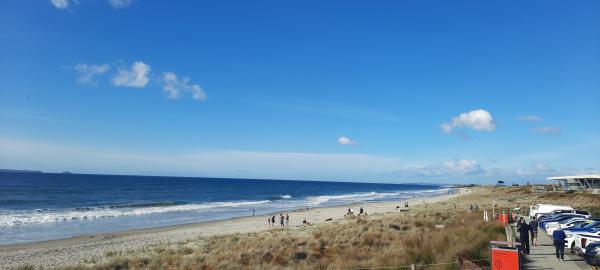
============================ A Solitary Drink · At Papamoa Beach 2025-06-20 · Clear skies, gentle breeze · Public Holiday (Matariki — the Māori New Year) A Solitary Drink · At Papamoa Beach
One man, one table, a single cup, One hill, one sea — a boundless view. With wine, the waves surge through my veins, The breeze lifts up my soul to clouds. A bird descends — inquiring into my thoughts? I smile and ask: do you long for the world of men? ≈========================
Analysis and appreciation of poem 《A Solitary Drink · At Papamoa Beach》, focusing on its structure, imagery, themes, and emotional resonance. ------ 1. Structure and Form
The poem consists of six unrhymed lines, with a natural and contemplative rhythm. It does not follow a strict metrical form, but it flows gracefully, employing parallelism, especially in the first two lines, to establish symmetry and balance. The use of dashes and pauses helps shape the meditative tone. --- 2. Imagery and Symbolism
The poem’s strength lies in its minimalist yet vivid imagery:
“One man, one table, a single cup” sets a quiet, solitary scene. The repetition of “one” emphasizes aloneness — not loneliness, but a conscious, peaceful solitude.
“One hill, one sea — a boundless view” expands the scene from the intimate (the self) to the vast (the natural world), suggesting unity between the inner and outer.
“With wine, the waves surge through my veins” blends nature and body, suggesting that the poet is not merely observing but merging with the elements. The wine becomes a medium of communion.
“The breeze lifts up my soul to clouds” evokes transcendence — a lightness of being, an escape from worldly concerns, almost mystical.
“A bird descends — inquiring into my thoughts?” introduces a subtle turn: nature (the bird) becomes not just a backdrop but a mirror or interlocutor, asking about the poet’s inner world.
“I smile, and ask: do you long for the world of men?” reverses the questioning. The poet projects human restlessness onto the bird, suggesting a reflection on attachment, detachment, or perhaps disillusionment with society. --- 3. Themes
a. Solitude and Reflection
The poem celebrates solitude not as isolation, but as a space for introspection, harmony with nature, and spiritual clarity.
b. Human and Nature Integration
By physically and emotionally identifying with the waves, wind, and birds, the poet demonstrates a Taoist-like union with the natural world — reminiscent of Chinese poetic traditions.
c. Questioning the Human World
The final couplet subtly critiques or questions the human condition. The poet’s smile suggests detachment or gentle irony, while the rhetorical question invites readers to reflect on why we stay bound to worldly affairs. --- 4. Tone and Mood
The tone is calm, contemplative, and lightly philosophical. There is no overt drama, but a quiet beauty that emerges from balance, clarity, and internal freedom. The final smile is a soft, almost compassionate gesture — not toward the bird, but toward the self and the world. --- 5. Cultural Resonance
Set on a New Zealand beach during Matariki, the Māori New Year, the poem subtly echoes the idea of renewal, remembrance, and cosmic connection. Though not overtly Māori, the poem’s themes of nature, stars, and spirit align with Matariki’s cultural ethos.
Moreover, the style resonates with Chinese classical poetry, particularly poets like Li Bai or Wang Wei, who often wrote of drinking alone, conversing with birds or the moon, and finding transcendence in nature. --- Conclusion
This poem, though brief, is rich in layered meaning. Through a simple act — drinking alone on a beach — it touches on universal questions of solitude, connection, and the meaning of human existence. Its beauty lies not in grand statements but in the delicate interweaving of image, thought, and silence.