梵语涅槃义为圆满的寂静,是苦或烦恼被消灭后的身心清净状态,故亦名无所有。玄奘法师和弟子窥基在《成唯识论》中从四个方面谈涅槃:无余依涅槃,有余依涅槃,自性涅槃,和无住涅槃。 Nirvana in Sanskrit means perfectly fulfilled quietness, which is the quiet state of body and heart after bitterness or troubles have been eliminated, so it is called Empty After All. Tang Tripitaka (aka. Tang Buddha) and his disciple Kuiji discussed Nirvana from four aspects in Establishing Sense-Only Treatise: Nirvana without Residual Dependence, Nirvana with Residual Dependence, Self-Nature Nirvana, and Non-Dwell Nirvana. (一)无余依涅槃,玄奘说: “真如出生死苦,烦恼既尽,余依亦灭,众苦永寂,故名涅槃。” 真如即七真如,参见10.6.4节《离系果》。余依,即依之而灭苦的依靠,是依善灭恶的善。余依亦灭,是说善恶两灭。 (1) Nirvana without Residual Dependent, Tang Tripitaka said, “by True Suchness, migrator has ousted bitter of birth and death, the annoyances are exhausted, and the residual dependence is extinguished also, crowds of bitter are forever silent, therefore, the nirvana is named.” True Suchness is the seven true suchness in the section 10.6.4 Off-is Fruit. The residual dependence, i.e., the reliance by which bitter is extinguished, is the benevolence by which ferocity is extinguished. That the residual dependence is also extinguished, means that both benevolence and ferocity are extinguished. 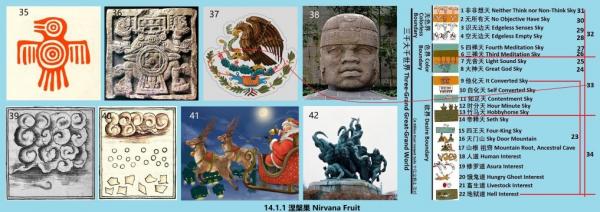
(二) 有余依涅槃,玄奘说: “真如出烦恼障,虽有微苦,所依未灭,而障永寂,故名涅槃。” 障是指异生性的所知障和烦恼障(参见10.4.4.2-4节的异生性)。此说择灭无为法,即有选择地消灭了某些根本烦恼,如下文中四种离系果中的前三果(如图33,参见14.2.6节),和道谛菩萨十地中的前七地都是选择性地消灭了主要的烦恼障,所处的境界都是不同程度的有余依涅槃。 (2) Nirvana with Residual Dependence, Tang Tripitaka said, “with True Suchness, migrator has ousted annoyance hindrances, although there is slight bitter, the residual dependence is not terminated, but the hindrances are silent permanently, so it is called Nirvana." Hindrances mean the Know Hindrance and Mean Hindrance of Mutant Nature (see section 10.4.4.2-4 Mutant Nature). This is saying Selectively Termination None-as Laws, such as the first three of the four Shamanic Fruits (see figs. 33, see section 14.2.6), and the first seven of the ten lands in Path Crux, all are the states of choosing fundamental annoyances to eliminate, they achieve varying degrees of nirvana. 插图1至13,除了2,都是有余依涅槃。当修习者懂得了四胜谛,就获得了最低质量的 “有余依涅槃”,成为了竹马天(如图13所示),即独角马,梵语作补特伽罗,义为习气疙瘩。 Illustrations 1 to 13, except 2, are all “Nirvana with Residual Dependence”. When the practitioner understands the Four Victorious Cruxes, he or she will attain the lowest quality of “Nirvana with Residual Dependence” and become a “Hobbyhorse Sky” (as shown in Figure 13), that is a unicorn, which is called Pudgala in Sanskrit, meaning a lump of habit. (三)自性涅槃,玄奘说, “本来自性清淨涅槃,谓一切法相真如理,虽有客染而本性淨,具无数量微妙功德,无生无灭湛若虚空,一切有情平等共有,与一切法不一不异,离一切相、一切分别,寻思路绝,名言道断,唯真圣者自内所证,其性本寂故名涅槃。” (3) Self-Nature Nirvana, Tang Tripitaka said, “The original quiet self-nature is Nirvana, which is all true suchness of juristic phenomena. Although it is contaminated by guest dusts, its original nature is immaculate, with countless delicate wonderful fortunes and virtues, no birth, no death, and as clear as space, commonwealth-ed equally by all sentient beings, not one and no differences from all laws, free from all phenomena and discriminations. If you search or mean on it, the path ends, if you call its name or utter words, the path is broken. Only the true sage can prove it from within; its nature is inherently silent, hence Nirvana.” 自性涅槃即是插图14.1.1-2所示的无所有天;那是什么?是常遍处。常是无意识(古作神识)的常,例如青黄赤白之一。此常只是现量,无名,无色,无量,不可说。常见的无余依涅槃别名有微妙本心,毕竟空,正等明,常寂光天,无所有天,涅槃,圆成实相。对于文字思维型人(即语音思维型人),此常寂光天常被称作“啊”,例如安拉,和“欧姆”,例如欧麦克(Olmec,如图38所示的头像)。广义的自性涅槃是插图1至6,亦作遍净天。 Self-Nature Nirvana is the “No Objectively Have Sky” shown in illustration 14.1.1-2; what is that? It is pervasively constant. It is constant of the unconscious (anciently God-sense), such as turquoise, yellow, red, or white. This constant is only the “present quantity” (see section 10.4.5), is nameless, colorless, and immeasurable; so, it cannot be described or spoken. Common other names for the “Nirvana without Residual Dependent” include “wonderful delicate original heart”, “empty after all”, “correct equality light”, “constant silent light sky”, “not objectively have sky”, nirvana, “perfectly established factual phenomenon”. For word thinkers (i.e. phonetically thinking people), this “constant silent light sky” is often referred to as “ah”, e.g. Allah, and “om”, e.g. Olmec (the Buddha or God shown in Figure 32). The broad sense of the “Self-Nature Nirvana” is illustrations 1 to 6, also called the “pervasively immaculate sky”. (四)无住涅槃,玄奘说, “真如出所知障,大悲般若常所辅翼,由斯不住生死涅槃,利乐有情穷未来际,用而常寂故名涅槃。” 此涅槃是说此人由于常用集起智(参见13.1节),所以在他或她的前意识中形成了一个集起的空集∅,就是无住涅槃。 (4) Non-Dwell Nirvana, Tang Tripitaka said: “by true suchness, migrator has ousted Know Hindrance, assisted by Great Sorrowfulness and Arrival Ark constantly, therefore he or she does not dwell in nirvana, benefits and pleases sentient beings to the exhaustion of future, usage but constantly silent, hence name of nirvana”. This nirvana means that because the person often uses Aggregate Arousal intelligence (see section 13.1), therefore there is empty sets (∅) of Aggregate Arousal is formed in his or her preconsciousness, which is the Non-Dwell Nirvana. 什么是大悲?大悲是说释迦摩尼(即金童,亚当)对神父(即上帝)为拯救世界而牺牲悲伤不已,每当说起或想到神父他就哭,后半生都没能从对神父牺牲的悲哀中恢复过来。因为慈悲喜舍是四无量心,佛对神父悲伤给予了佛无穷的力量。佛教以此大悲为根本。 What is the great sorrowfulness? Great Sorrowfulness means that Shakyamuni (aka. Gold Boy, Adam) was deeply saddened by the sacrifice of his godfather (God) for the salvation of the world. Whenever he talked about or thought of godfather, he cried; he was unable to recover from his sorrowfulness for his godfather’s sacrifice for the rest of his life. Because mercifulness, sorrowfulness, delightfulness, and renunciation are the four infinite hearts, so Shakyamuni's Great Sorrowfulness for godfather gave him infinite power. Buddhism is rooted in this Great Sorrowfulness. 插图35的太阳鸟代表着夏娃(顺皇),她肚子里的那颗太阳就代表“无住涅槃”。因为夏娃是前意识的化身,所以古人就把 “无住涅槃” 画在她的肚子里了。类似的,图36是墨西哥的卡特莉(Tlaltecuhtli),她肚子里的那颗太阳就代表 “无住涅槃” ,也代表她的法眼。法眼的眼根是 “毕竟空” (即涅槃,亦作俱知根)。 The sunbird in Illustration 35 represents Eve (Shun White-King), and the sun in her belly represents "Non-Dwell Nirvana”. Because Eve is the embodiment of preconsciousness, the ancients depicted Non-Dwell Nirvana within her belly. Similarly, Figure 36 depicts Tlaltecuhtli of Mexico. The sun in her belly represents Non-Dwell Nirvana and her Juristic Eye. The Juristic Eye's eye-root is "empty after all" (i.e., Nirvana, also known as the root of all-knowing all-seeing). 14.1.1.2 三身 Three Bodies 涅槃是说身心清净,没什么感觉,就只能说是寂静,也可以用三身来描述涅槃。身除指体相外,还有智慧和功德之积聚义。 Nirvana means that the body and mind are pure and there is no feeling. It can only be described as silence. Nirvana can also be described by the three bodies. In addition to referring to the physical appearance, "body" also means the accumulation of intelligence gnosis and virtues. (一)自性身,玄奘说,谓诸佛真净法界,受用变化平等所依,离相寂然,绝诸戏论,具无边际真常功德,是一切法平等实性,即此自性亦名法身。自性身是什么?由于其不障性与虚空相似,又其性质与虚空相应,故古人常用东西南北上下的十方虚空比喻其形象。佛教亦由此得异名空门,又作不二门。 (1) Self-Nature Body, Tang Tripitaka said, it is true immaculate juristic boundary of Buddhas, is the basis for conversion and equality, is silent without any phenomena, is without any dramatic theses, is with boundless true and constant fortune and virtue, is equal factuality nature of all laws, that is self-nature, also known as Juristic Body. What is the Self-Nature Body? Because its non-obstacle property is like that of void, and its nature corresponds to empty, the ancients often used the ten-direction empty of east, west, south, north, up, and down as a metaphor for its image, therefore, Buddhism got an alias from this, Empty Door, which is also called None the Second Door. (二)受用身,玄奘说,有二种,自受用和他受用。自受用,谓诸佛经历三大阿僧脂劫,修集无量福德所起的圆净常遍色身,相续湛然,尽未来际恒自受用广大法乐。他受用,谓诸佛由平等智示现微妙净功德身,居纯净土为八至十地的大菩萨众现大神通,转正法轮,决众疑网,令彼受用大乘法乐。 (2) Body of Acceptance-and-Usage, Tang Tripitaka said, it has two types, self acceptance-and-usage body, and others acceptance-and-usage body. Self Acceptance-and-Usage Body means that the Buddhas have gone through “Three A-Monk Index-Catastrophes” and accumulated immeasurable fortunes and virtues to form a perfectly round immaculate-constant pervasive color body, lucidly succeeding, as far as the future of the constant self-enjoyment of the vast juristic laugh. Others Acceptance-and-Usage Body is saying that by Equality Intelligence, Buddhas manifest delicately wonderful immaculate fortune-and-virtue body, reside in immaculate land, exhibit great divine power for crowds of eighth-through-tenth land Mahasattvas, turn the juristic wheel to correct direction, solve crowds of suspicion webs, to have them enjoy great vehicle juristic laugh. 自受用身是什么?包括正身,即佛在世时的肉体,和报身,即他所用器具,所居住房屋,以及所处的大地、山川河流等。又此四圣谛是佛在世时,他或她的识的自体。 他受用身是什么?佛把自己的生平事迹和所学集注成经书,流传后世千年万年;以及寺庙、佛像、法器等。 What is the Self Acceptance-and-Usage Body? It consists of Correct Body, which is the Buddha's physical body when he or she is in the world, and Retribution Body, which is the utensils he uses, the house he lives in, and lands, mountains, rivers, and so on, where he lives; and the Four Cruxes are his knowledges when he is in the world. What is the Others Acceptance-and-Usage Body? The Buddha collected and annotated his life stories and what he learned into sutras, which have been passed on to future generations for thousands of years, and juristic vessels, temples, statues, etc. (三)变化身,玄奘说,谓诸佛由成事智变现无量随类化身,居净土秽土为诸菩萨及异生众,机宜说法,令各得诸利乐。 什么是变化身?由皈依和变性而得的身体。此中的异生性,即一个人个体性是他的烦恼和所知之和。佛的化身诸如,在家出家的弟子等善男信女,寺庙,佛像、法器等常驻物。此类化身还存在于人趣之外,如存在于修罗趣,恶鬼趣,畜生趣等之中。 (3) Convert Body, Tang Tripitaka said, by establishing-affairs intelligence, Buddhas transform along categories, dwell in immaculate lands and maculate lands, expediently preach to the Bodhisattvas and other living beings, have them all gain benefits and laughs accordingly. What is the Convert Body? A body obtained by conversion and change of nature. Among this, Mutant Nature is sum of Know and Annoyance of a sentient being. Buddha’s Convert Bodies are such as Monks Nuns and laymen laywomen, temples, statues, and juristic vessels, etc. and the kinds of bodies also exist among such as asura interest, hungry ghost interest, and livestock interest, etc. 再例如图37是墨西哥国旗的图;上面的鹰代表卡特莉(Tlaltecuhtli,又名翠玉女Chalchiuhtlicue)接受全部墨西哥人的礼敬。图39是特拉洛克的特质肖像。图40是翠玉女(Chalchiuhtlicue)的特质肖像。图41中的两只鹿代表希腊文化中的阿波罗和雅典娜(金童和玉女)。图42中的两只羊代表日耳曼文化中的睚眦和磨牙(亚当和夏娃)。 For example, Figure 37 shows the Mexican flag; the eagle above represents Tlaltecuhtli (also known as Chalchiuhtlicue), receiving homage from all Mexicans. Figure 39 shows a characteristic image of Tlaloc. Figure 40 shows a characteristic image of Chalchiuhtlicue. The two deer in Figure 41 represent Apollo and Athena (the Golden Boy and the Jade Girl) in Greek culture. The two goats in Figure 42 represent Tanngnjóstr and Tanngrisnir (Adam and Eve) in Germanic culture. 返回灭谛目录Return Catalog of Salvation Crux
|