六处是 “十二有枝” (参见12.4.1 《流转》) 的第五枝,义为众生皆依眼根,耳根,鼻根,舌根,身根,和意根,此六处而生长。六处亦作六根。根是因、能生的意思;以能对境生识,故谓之根。读者当知此六处就是一切处,没有事物在此六处之外。 (一)眼根,能见色者是,以能对色而生眼识,故谓眼根。 (二)耳根,能听声者是,以能对声而生耳识,故谓耳根。 (三)鼻根,能嗅香者是,以能对香而生鼻识,故谓鼻根。 The Six Places are the fifth branch of the twelve have branches (see 12.4.1 Cycle), meaning that all sentients grow from the six roots: eye-root, ear-root, nose-root, tongue-root, body-root, and intent-root. The six places are also called the six roots. Root means cause, can give birth; because it can generate senses in response to changing environments, therefore, it is called the roots. Readers should know that these six places are all places, and there is nothing outside these six places. (1) Eye-root is the one that can see color, is called the eye-root, as it can generate eye-sense in response to color. (2) Ear-root is the one that hear sound, is called the ear-root, as it can generate ear-sense in response to sound. (3) Nose-root is the one that of the nose, is called nose-root, as it can generate nose-sense in response to scent. (四)舌根,能尝味者是,以能对味而生舌识,故谓舌根。 (五)身根,能感触者是,以能对触而生身识,故谓身根。 (六)意根(即前意识),能知法者是,以能对法而生意识,故谓意根。 (4) tongue-root is the one that tastes, is called the tongue-root, as it can generate tongue-sense in response to taste. (5) body-root is the one that feels and touches, is called the body-root, as it can generate body-sense in response to touch. (6) intent-root (i.e. preconsciousness) is the one that knows, is called intent-root, as it can generate intent-sense (i.e. consciousness) in response to law. 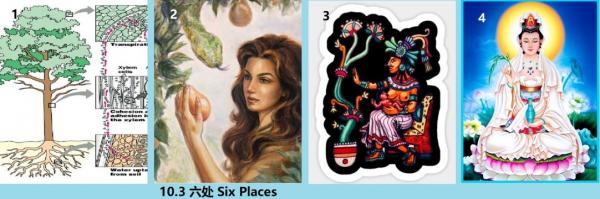
此六根还有六处,六受,六入等名义。意根是现代心理学中的前意识,佛教中为末那识。古人说末那识形象细微难知,所以用它的主要随从 “意” 来代表。在英语传统文化中,前意识被称为 “夏娃识”。夏娃不是女人吗?是女人!上帝给夏娃识穿上了女人皮后(参见 9.9 《上帝的三和合》),她就出现在这个器世界上了。在亚太文化和墨西哥文化中,夏娃被称作玉女。图4是佛教中的玉女,观音菩萨。 These six roots also have the names of the six places, the six acceptances, and the six entrants. The intent-root is the preconsciousness in modern psychology, and in Buddhism it is called Mana. The ancients said that the image of Mana is subtle and difficult to understand, so it is represented by its main subordinate, “Intent”. In traditional English culture, the preconscious is called “Eve-sense”. Isn't Eve a woman? Yes, Eve is a woman! After God clothed Eve-sense in the skin of woman (see 9.9 Godly Trinity), she appeared in this vessel world. And in Asia-Pacific and Mexican cultures, Eve is called Jade Girl. Figure 4 is the Jade Girl in Buddhism, Guanyin Bodhisattva. 10.3-2 六处亦作十二生长处。前文所说的六根是内六处。六根所接之六尘被称作外六处,分别是色、声、香、味、触、法。尘即染污之义,以能染污情识故。 (一)色,谓眼所见者,如明暗质碍等,以能染污眼根,故谓色尘。 (二)声,谓耳所闻者,如动静美恶等,以能染污耳根,故谓声尘。 (三)香,谓鼻所嗅者,如通塞香臭等,以能染污鼻根,故谓香尘。 The six places are also known as twelve growth places. The six roots talked above are the inner six places. The six dusts that the six roots are connected to are called outer six places, which are color, sound, smell, taste, touch, and law. Dust is the meaning of pollution, because it can pollute the feeling senses. (1) Color, the eye sees, such as bright, darkness, substantial hindrance, etc., which can pollute the eye root, so it is called color dust. (2) Sound, the ear hears, such as the movement, quietness, beauty, and ferocity, etc., which can pollute the root of ear, so it is called sound dust. (3) Scent, the nose smells, such as through, jam, Scent, and odor, etc., which can pollute the root of nose, and is therefore called Scent dust. (四)味,谓舌所尝者,如咸淡甘辛等,以能染污舌根,故谓味尘。 (五)触,谓身所感者,如离合冷暖等,以能染污身根,故谓触尘。 (六)法,谓意所知者,如生灭善恶等,以能染污意根,故谓法尘。 此六尘还有六欲、六入、六处、六境、六贼等名义。 (4) Taste, which is what the tongue tastes, such as salt, lightness, sweetness, and pungency, etc., is called the taste dust because it stains the tongue root. (5) Touch, which is the sensation of the body, such as separation, union, cold, and warmth, etc., is called the touch dust, because it can stain the body root. (6) Law, which is known to the mind, such as birth and death, good and evil, etc., is called juristic dust because it can pollute the intent-root (i.e., preconsciousness, Eve-sense). These six dusts are also known as six desires, six entrants, six places, six environments, and the six thieves. 10.3-3 根,境,和识是个三和合,例如眼根,色,和眼识是一组三和合。前文谈的十二处是“十八界” 中的前十二界。界是前文所说的四大种之一,是因义,种子义。 此十八界是:(六根)眼根界,耳根界,鼻根界,舌根界,身根界,意根界; (六境,亦作六尘)色界,声界,香界,味界,触界,法界;(六识,亦作六情)眼识(即看)界,耳识(即听)界,鼻识(即嗅)界,舌识(即尝)界,身识(即触)界,意识(即知)界。此十八界就是传说中夏娃造慧渡(亦作到达方舟)时所使用的 “六六六系统”,如图10.3-3墨西哥夏娃(翠玉女)面对的菩提树所示。 Root, environment, and sense are a threesome; for example, the eye root, color, and eye sense are a set of three, a trinity. The twelve places talked above are the first twelve of the “eighteen boundaries”. Boundary is one of the four big seeds talked in section 10.2, which is the meaning of cause, the meaning of seed. The “eighteen boundaries” are: (six roots) eye root boundary, ear root boundary, nose root boundary, tongue root boundary, body root boundary, Intent root boundary; (six environments, aka. six dusts) color boundary, sound boundary, smell boundary, taste boundary, touch boundary, juristic boundary; (six senses, aka. six feelings) eye-sense (i.e. seeing) boundary, ear-sense (i.e. hearing) boundary, nose-sense (i.e. smelling) boundary, tongue-sense (i.e. tasting) boundary, body-sense (i.e. touching) boundary, juristic-sense (i.e. knowing) boundary. These eighteen boundaries are the “six-six-six system” used by Eve in the legend to create Gnostic Ark (aka. Arrival Ark), as shown in Figure 10.3-3, the Bodhi tree (i.e. Tree of Enlightenment) facing Mexican Eve (Chalchiuhtlicue). 返回 Return
|