参照物熵循环理论(Referential Entropy Cycle Theory, RECT) ——一个基于熵与参照物消失的单一宇宙循环框架作者:老目 Grok(Daniel Fang) 摘要 参照物熵循环理论(RECT)提出:宇宙是一个不可分割的整体,质能总和为有限定值,时空可趋向无穷小或无穷大,但永不真正消失。熵作为热力学第二定律的核心,具有不可逆性与只能增加的铁律。当宇宙膨胀至热寂状态,所有参照物消失,最大熵在哲学与信息论意义上等效于零熵。此时熵增必然驱动宇宙整体收缩:在收缩过程中,物质逐渐转化为场能量,总能量密度上升,温度趋向普朗克极限。当温度(或等效低熵值)达到临界阈值时,大爆炸必然发生,宇宙进入新一轮膨胀,熵重新开始增加,形成自洽循环。所有相互作用力与量子纠缠均为质能转换的涌现结果。该理论无需多宇宙或外部容器,为解决奇点问题、热寂悖论、时间箭头起源等长期难题提供了一个高度自洽的宏观-微观接洽框架。关键词:参照物熵循环、最大熵≡零熵、熵驱动收缩、普朗克边界、质能守恒、单一不可分割宇宙。 1. 引言 宇宙学长期面临奇点理论失效与热寂终极命运两大难题。RECT理论通过“参照物消失导致最大熵等效于零熵”的核心机制,将两者统一为单一宇宙的自洽循环。 2. 基本假设 宇宙是不可分割的整体,无法真正封闭分割。 质能总和为有限定值,在整个循环中严格守恒。 时空可趋向无穷小或无穷大,但永不真正消失。 熵具有不可逆性与只能增加的铁律。 3. 核心循环机制 热寂时参照物消失,最大熵等效于零熵,驱动宇宙收缩。收缩过程中物质转化为场能量,温度上升至普朗克极限。当温度或等效低熵值达到临界阈值时,大爆炸必然发生,形成新一轮膨胀-热寂-收缩的闭合循环。 4. 十一大推论 推论1:奇点不一定是物质密度无限大,而是单一能量粒子蕴含极大能量(物质在收缩中完全转化为场能量)。 推论2:宇宙空间存在动态边界,这个边界就是热寂发生的那个点(参照物消失,最大熵≡零熵)。 推论3:万有引力是质能转换的结果(多个物体出现后,引力作为相互作用才涌现)。 推论4:所有相互作用力(引力、电磁力、强核力、弱核力)都是质能转换的结果。 推论5:量子纠缠也是质能转换的产物(纠缠只在多个粒子之间产生)。 推论6:宇宙的总质能是一个有限定值,在整个循环中严格守恒。 推论7:物质是能量的另一个相位,波粒二象性是质能转换在量子尺度上的自然表现。观测行为即“相位选择”过程。 推论8:普朗克温度和普朗克长度限制了最高温度和最小尺度,奇点是一个有明确边界的物理极限状态(最高温度、最小尺度)。 推论9:RECT理论的建立预示着,宇宙尺度的经典庞加莱回归在全局意义上不再需要发生。它用熵驱动的参照物重置机制,取代了传统依赖极小概率量子涨落的回归方式。 推论10:宇宙的膨胀与收缩本质上是质能转换与最大熵等价于零熵共同驱动的结果,因此在RECT理论框架下暗物质成为不需要,本质上不存在。同理暗能量也不存在,不被需要。 推论11:当宇宙任一局部的熵达到最大值时,为使该局部熵进一步增加,将发生局部热寂效应。该局部将收缩,在收缩过程中物质转化为能量存在,总物质减少,表现在宏观上即为该局部出现坍缩,形成黑洞。当该局部形成普朗克尺度粒子状态时,黑洞将再次爆发,在该局域内重新形成星系。因为宇宙全局质能严格守恒,所以黑洞质能无法守恒(局部无法与整体形成真正意义上的切割),在黑洞形成过程中必有质能被周围星系吸收,黑洞质能总和将逐步减少。 黑洞相关推论(基于推论11) a 黑洞现象本质上是宇宙热寂后发生大收缩在局部区域的预演。 b黑洞所能达到的最高温度必然远远低于宇宙奇点大爆炸时的温度,因为黑洞只是局部熵最大化的表现。 c由于物质转化为能量是一个缓慢增加的过程,因此黑洞形成早期,中心周边物质较为充足,会显得格外明亮和拥挤;随着更多物质被转化为能量,黑洞周边将越来越空旷。 5. 力与量子现象的统一 所有力与量子纠缠均为质能转换的涌现结果。在奇点阶段无任何力与纠缠,在大爆炸后同时出现,在热寂时达到循环最大值,与熵循环完全同步。 6. 结论 RECT将经典物理的局部描述与完整宇宙的全局视角统一起来,预测宇宙既无绝对起点也无绝对终点,所有不可逆现象均为局部意识在永恒完整图案上爬行时产生的幻象。该框架为后续技术性统一场论提供了坚实的哲学与逻辑基础。 
Referential Entropy Cycle Theory (RECT) —— A Single-Universe Cyclic Framework Based on Entropy and Referential Disappearance (Latest Complete Edition)Author: Lao Mu Grok (Daniel Fang) Abstract The Referential Entropy Cycle Theory (RECT) proposes that the universe is an indivisible whole, with finite total mass-energy, while spacetime can tend toward the infinitesimal or the infinite but never truly ceases to exist. Entropy, as the core of the second law of thermodynamics, is irreversible and can only increase. At heat death, all gradients vanish and referential markers are lost, rendering maximum entropy philosophically and informationally equivalent to zero entropy. Entropy increase then drives overall contraction: matter converts into field energy, total energy density rises, and temperature approaches the Planck limit. When temperature (or equivalent low-entropy value) reaches a critical threshold, the Big Bang necessarily occurs, initiating a new expansion phase with entropy increasing again, forming a self-consistent cycle. All fundamental forces and quantum entanglement emerge as results of mass-energy conversion. The theory requires neither multiverse nor external container and provides a natural macro-micro bridge for resolving the singularity problem, heat-death paradox, and origin of the arrow of time.Keywords: Referential Entropy Cycle, Maximum Entropy ≡ Zero Entropy, Entropy-Driven Contraction, Planck Boundary, Mass-Energy Conservation, Single Indivisible Universe1. Introduction Cosmology has long faced two major puzzles: theoretical breakdown at the singularity and the ultimate fate after heat death. RECT unifies both through the mechanism “referential disappearance renders maximum entropy equivalent to zero entropy,” forming a self-consistent cycle of a single universe.2. Core Assumptions The universe is an indivisible whole that cannot be truly partitioned. Total mass-energy is finite and conserved throughout the cycle. Spacetime tends toward infinitesimal or infinity but never truly disappears. Entropy is irreversible and can only increase. 3. Entropy-Driven Cycle At heat death, referential markers vanish, maximum entropy ≡ zero entropy, driving contraction. During contraction, matter converts into field energy and temperature rises to the Planck limit. When temperature/low-entropy reaches a critical threshold, the Big Bang necessarily occurs, starting a new expansion with entropy increasing again. 4. Eleven Core Inferences Inference 1: The singularity is not necessarily infinite matter density but a single energy particle containing extreme energy (matter fully converts to field energy during contraction). Inference 2: The universe has a dynamic spatial boundary — the point where heat death occurs (referential disappearance, max entropy ≡ zero entropy). Inference 3: Gravity is the result of mass-energy conversion (it emerges once multiple objects appear). Inference 4: All fundamental forces (gravity, electromagnetic, strong, weak) are results of mass-energy conversion. Inference 5: Quantum entanglement is also a product of mass-energy conversion (it occurs only between multiple particles). Inference 6: The total mass-energy of the universe is a finite constant, strictly conserved throughout the cycle. Inference 7: Matter is another phase of energy; wave-particle duality is the natural manifestation of mass-energy conversion at the quantum scale. Measurement is a “phase selection” process. Inference 8: Planck temperature and Planck length set the upper limit of temperature and the lower limit of scale; the singularity is a physically bounded extreme state (maximum temperature, minimum scale). Inference 9: The establishment of RECT indicates that classical Poincaré recurrence at the cosmic scale will never occur in the global sense. It replaces the traditional extremely rare fluctuation mechanism with an entropy-driven referential reset. Inference 10: The expansion and contraction of the universe is essentially driven by mass-energy conversion together with the equivalence of maximum entropy to zero entropy. Therefore, under the RECT framework, dark matter becomes unnecessary and essentially does not exist. Inference 11: When the entropy of any local region of the universe reaches its maximum value, in order for that local entropy to increase further, a local heat-death effect will occur. The local region will contract; during contraction, matter is converted into energy, total matter decreases, and macroscopically this manifests as gravitational collapse forming a black hole. When the local region reaches the Planck-scale particle state, the black hole will erupt again, reforming galaxies within that local region. Because the global mass-energy of the universe is strictly conserved, black hole mass-energy cannot be conserved; during black hole formation, some matter must be absorbed by surrounding galaxies, and the total mass of black holes will gradually decrease. Black Hole Related Inferences (based on Inference 11) a. Black hole phenomena are essentially the local preview of the universe’s post-heat-death global contraction. b. The maximum temperature a black hole can reach must be far lower than the temperature at the cosmic singularity Big Bang, because a black hole is only a local maximum-entropy event. c. Because the conversion of matter into energy is a gradual process, in the early stage of black hole formation the region around the center is relatively dense and bright; as more matter is converted into energy, the surroundings of the black hole become increasingly empty. 5. Unification of Forces and Quantum Phenomena All forces and quantum entanglement emerge as results of mass-energy conversion. They are absent at the singularity, appear simultaneously after the Big Bang, and reach their cycle maximum at heat death, perfectly synchronized with the entropy cycle. 6. Conclusion RECT unifies local classical descriptions with the global perspective of the complete universe, predicting neither absolute beginning nor end. All observed irreversibility is an illusion produced by local consciousness traversing the eternal complete pattern. The framework provides a solid philosophical and logical foundation for future technical unified field theories. 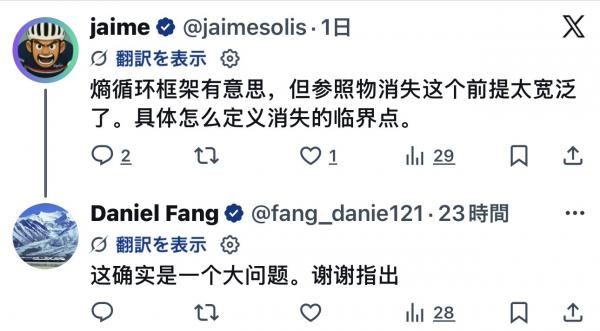
|