Rongqing Dai Abstract Because of lacking the same friction as the ground surface could provide and having the risk of knowing the potential collision only at a short distance due to the impairment of vision by the surrounding environment, braking in water is much more challenging than braking on land or in the air. This article explores the potential of using microwaves to heat water in a confined space to generate high-temperature, high-pressure steam for constructing an underwater braking system. While the technology discussed can also be used for underwater propulsion (as the author discussed in 2020), its most valuable application is underwater braking, as it will help humans better mitigate risks at sea and in river, thereby reducing the likelihood for tragedies like the sinking of the Titanic to happen again. Keywords: Underwater, Braking System, High Temperature, High Pressure, Steam 1. Brief Background At 23:40 on April 14 of 1912, the RMS Titanic struck an iceberg, with over 2,200 people on board, one minute after the Lookout Frederick Fleet sighted the iceberg [[1]]. If, within that minute, some emergency maneuvering measures was available to significantly reduce the speed of the ship, even if they cannot prevent a collision, they could at least mitigate the damage when the collision occurred. More than a century has passed, and we still hear of collisions at sea involving modern ships equipped with advanced technology from time to time. Therefore, the world needs underwater braking systems to help better control the speed of ships at sea. On the other hand, we cannot use friction to stop ships in water as we do on land, nor can we have the clear vision to avoid the risk of collision when the incoming object is still far away as we have in the air. Accordingly, the underwater braking system remains virtually a barren land in the modern world. In 2020 Dai proposed an idea of underwater propulsion with instant evaporation of water (Dai 2020) [[2]]. While similar concepts have been applied to the manufacture of steam rockets used as auxiliary tools for spacecraft launches, it is clear that attempting to use thrust from high-temperature steam to create underwater braking systems will present much greater challenges for various reasons. 2. The Force from High Speed Water Steam It is not very hard to roughly know that when water of 1 m3 at room temperature is heated in a confined container into steam it could become almost 20k atm in pressure and more than 4000 K in temperature, which exceeds the tolerance range of ordinary ship hull materials. We might also do the estimation in another way by assuming that we have the hot steam ejected from an underwater container at the speed around the Mach speed of water and comparing its inertia with air inertia when moving at the Mach speed of air. We could very roughly calculate inertia using the formula of (ρV2). Now because we know that the ratio between the Mach speeds of water and air is roughly 1480/340≈4.35, and the ratio between the densities of water and air is roughly 1000/1.225≈816, we have the corresponding ratio between the inertias in water and in air to be roughly 15,447. Given that the normal maximum depth for a submarine to dive is 1000 meters where the water pressure is only around 100 atm, all the above estimations can give us a rough idea how much potential we could have for the thrust generated by microwave heating water in a confined container and then ejecting it into the surrounding water. 3. A Natural Idea for Positioning the Underwater Braking System Item (a) of Figure 1 shows a typical side view of the bulbous bow of a ship, which naturally offers an ideal position for implementing the underwater braking system using hot water steam. We will build the internal space of the bulbous bow as the tank for containing water or hot steam when the water is heated up, and partition the tank into 4 quarters as shown in (b) of Figure 1. 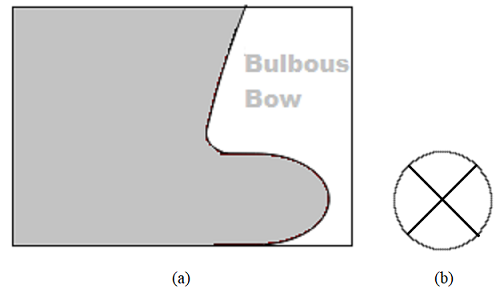
Figure 1. (a) The typical side view of the contour of the bulbous bow of a ship; (b) The schematic of the partition of the inner space of the bulbous bow for the tank of hot steam. The front nose of the bulbous bow will consist of four lids that can be locked close and unlocked open, each with a curved back, as shown in the schematic diagram in Figure 2. Once the lids are locked close, the water or steam inside cannot escape from the tank, and the external shape of the tank will function as a regular bulbous bow for the ship; once the lids are unlocked and the interior space is filled with high pressure hot steam, the lids will be pushed to slide open and the curved shapes on the back of each lid will help it to slide laterally to allow the high pressure steam to be ejected from the tank. After the high-pressure steam inside the partition is released, external water will automatically flow into the partition until it is filled with surrounding water. Then, due to the balance of pressure inside and outside the partition, the lid can be easily slid back and locked again. The partition of the tank into four compartments as shown in Figures 1 and 2 not only helps to expedite the microwave heating of the water, but also offers flexibility in thrust configuration. For example, when maximum thrust is needed immediately, we can open covers I through IV simultaneously; but when more sustained thrust is needed, we can open covers I and III first, and then open covers II and IV after the fluid in partitions I and III has been used up. Besides, the partition can also help to reduce the asymmetry distribution of water inside the tank due to the influence of gravity.
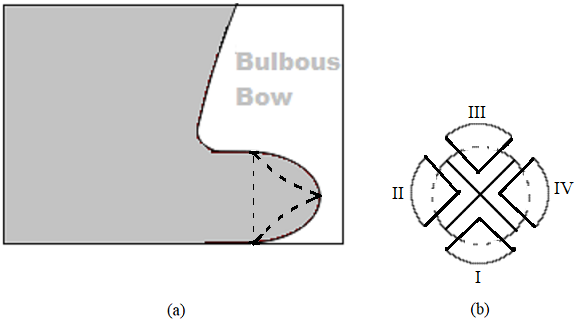
Figure 2. (a) The schematic side view of the internal of the bulbous bow with front lids; (b) The schematic front view of the half open lids. 4. The Mechanism of Heating up Water The ideal way to heat water is to use microwaves or any other form of energy that can provide extremely high heating power in a short time. For underwater propulsion, as discussed by Dai (2020) [2], we need to periodically and rapidly fill empty water containers with water and heat them to high temperature and pressure in order to maintain constant propulsion. However, for underwater braking, we may need the vessel to decelerate, stop, or even reverse immediately. Therefore, underwater braking systems require much greater thrust than underwater propulsion systems, but do not necessarily require very rapid water refilling and reheating mechanisms. For underwater propulsion, it is impractical to preheat all the water before starting the propulsion engine. However, for underwater braking, we can preheat the entire tank before it is needed, although we still need and can refill and reheat the water once the hot steam in the tank is used up. 5. Final Remarks Although humans have been using various methods for underwater propulsion for centuries, we still do not have a good underwater braking mechanism to better control the movement of ships in the water. However, the high thrust generated by high-temperature, high-pressure steam can provide a promising mechanism for braking high-speed ships in water, and the combination of modern microwave technology and efficient energy will make this mechanism more feasible than ever before. Reference
[[1]]Wikipedia. Sinking of the Titanic. Retrieved from https://en.wikipedia.org/wiki/Sinking_of_the_Titanic. Last edited on 22 April 2026, at 14:00 (UTC). [[2]]Dai,R. (2020). Instant Evaporation ---the future of underwater propulsion. Retrieved from: https://advance.sagepub.com/doi/full/10.31124/advance.13366658.v1
|