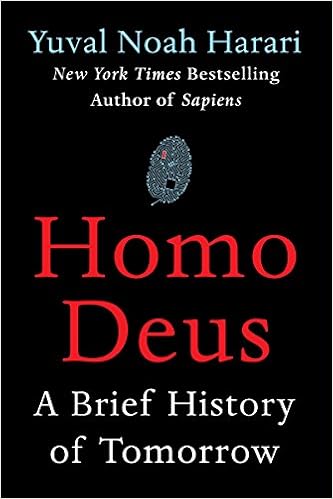
一旦书火了之后出版商往往就想要更多。于是 Harari 就一直得忙。他的新书《人类上帝:未来简史(Homo Deus: A Brief History of Tomorrow)》要到今年9月 才能出版,但是早期的版本已经开始流传了。书的封面说得简明扼要:“让我们成为智人的也会让我们成为上帝。” 该书接续了上一本书的结局,用一种挑衅、当然也是推测的语气,在匆忙间描绘出塑造这一物种未来的希望与梦想。
AI 并不需要比人聪明才能变革就业市场。它们只需要把工作干好就行。而这个目标并不遥远,Harari 说:“今天的孩子会面临这样的后果。他们在中学或者大学学到的大多数东西等到 40、50 岁的时候可能都会变得无足轻重。如果他们还希望继续保住工作,希望理解这个世界,并且在发生的事情里面占据一席之地,那就得不断地改造自己,而且频率得越来越快才行。”
Future shock: A bestselling Israeli historian looks at
where mankind is heading
Sep 17th 2016 The Economist
“SAPIENS”, Yuval Noah Harari’s previous book which came out in 2011, looked to the past. Zipping through 70,000 years of human history, it showed that there is nothing special about our species: no divine right, no unique human spark. Only the blind hand of evolution lies behind the ascent of man. That work ended with the thought that the story of Homo sapiens may be coming to an end. In his new book, “Homo Deus”, the Israeli historian heads off into the future.
In one thrilling sweep, Mr Harari proclaims that the old enemies of mankind— plague, famine and war—are now manageable. “For the first time in history,” he writes, “more people die today from eating too much than from eating too little; more people die from old age than from infectious diseases; and more people commit suicide than are killed by soldiers, terrorists and criminals combined.” Instead, the challenges of the third millennium will be how to achieve immortality, happiness and divinity, the latter in the sense of enhancing people’s physical and cognitive abilities beyond the biological norm.
This might sound like good news, but the author has a dystopian vision. People, increasingly, will cede jobs and decisions to machines and algorithms. The “useless masses” cast aside by this development will pursue the mirage of happiness with drugs and virtual reality. Only the super-rich will reap the true rewards of the new technologies, commandeering evolution with intelligent design, editing their genomes and eventually merging with machines. Mr Harari envisages an elite caste of Homo sapiens evolving into something unrecognisable: Homo deus. In this brave new world, the rest of mankind will be left feeling like “a Neanderthal hunter in Wall Street”.
Mr Harari’s prophecy is bleak, but it is far from new. More interesting is the way he roots his speculation about technology in the context of how liberal democracy has evolved. For most of human history, Mr Harari says, humans believed in gods. This lent their world a cosmic order. But then, at least in some parts of the world, science began simultaneously to give mankind power and to strip it of meaning by relegating religion to the sidelines. This existential hole was filled by a new religion, humanism, that “sanctifies the life, happiness and power of Homo sapiens”, he writes. The covenant between humanism and science has defined modern society: the latter helps people achieve the goals set by the former.
But the life sciences are now undermining free will and individualism, which are the foundations of humanism. Mr Harari describes scientific research that, in his eyes, proves that the “free individual is just a fictional tale concocted by an assembly of biochemical algorithms”. As it dawns on mankind that free will is an illusion and external algorithms can predict people’s behaviour, Mr Harari believes liberal democracy will collapse. What will replace it? Perhaps a techno-religion such as “Dataism” that treats everything in terms of data processing and whose supreme value is the flow of information. In this context, Homo sapiens is a rather unimpressive algorithm, destined for obsolescence—or an upgrade.
Although there is plenty to admire in the ambitious scope of this book,
ultimately it is a glib work, full of corner-cutting sleights
of hand and unsatisfactory generalisations.
glib:
readily fluent, often thoughtlessly, superficially, or insincerely so:
lacking depth and substance;
speaking or spoken in a confident way, but without careful thought
or honesty. a glib talker; glib answers.
Mr Harari has a tendency towards scientific name-dropping—words like biotech, nanotechnology and artificial intelligence abound—but he rarely engages with these topics in any serious way. Instead, he races along in a slick flow of TED-talk prose. Holes in his arguments blur like the spokes of a spinning wheel, giving an illusion of solidity but no more. When the reader stops to think, “Homo Deus” is suddenly less convincing, its air of super-confidence seductive but misleading.