LAS LAJAS, Argentina - When China built a military-run space station in Argentina’s Patagonian region it promised to include a visitors’ center to explain the purpose of its powerful 16-story antenna.
The center is now built - behind the 8-foot barbed wire fence that surrounds the entire space station compound. Visits are by appointment only.
Shrouded in secrecy, the compound has stirred unease among local residents, fueled conspiracy theories and sparked concerns in the Trump administration about its true purpose, according to interviews with dozens of residents, current and former Argentine government officials, U.S. officials, satellite and astronomy specialists and legal experts.
The station’s stated aim is peaceful space observation and exploration and, according to Chinese media, it played a key role in China’s landing of a spacecraft on the dark side of the moon in January.
But the remote 200-hectare compound operates with littleoversight by the Argentine authorities, according to hundreds of pages of Argentine government documents obtained by Reuters and reviewed by international law experts. (For an interactive version of this story: tmsnrt.rs/2TlXEMj)
President Mauricio Macri’s former foreign minister, Susana Malcorra, said in an interview that Argentina has no physical oversight of the station’s operations. In 2016, she revised the China space station deal to include a stipulation it be for civilian use only.
The agreement obliges China to inform Argentina of its activities at the station but provides no enforcement mechanism for authorities to ensure it is not being used for military purposes, the international law experts said.
“It really doesn’t matter what it says in the contract or in the agreement,” said Juan Uriburu, an Argentine lawyer who worked on two major Argentina-China joint ventures. “How do you make sure they play by the rules?”
“I would say that, given that one of the actors involved in the agreements reports directly to the Chinese military, it is at least intriguing to see that the Argentine government did not deal with this issue with greater specificity,” he said.
China’s space program is run by its military, the People’s Liberation Army. The Patagonian station is managed by the China Satellite Launch and Tracking Control General (CLTC), which reports to the PLA’s Strategic Support Force.
Beijing insists its space program is for peaceful purposes and its foreign ministry in a statement stressed the Argentine station is for civilian use only. It said the station was open to the public and media.
“The suspicions of some individuals have ulterior motives,” the ministry said.
Asked how it ensures the station is not used for military purposes, Argentina’s space agency CONAE said the agreement between the two countries stated their commitment to “peaceful use” of the project.
It said radio emissions from the station were also monitored, but radio astronomy experts said the Chinese could easily hide illicit data in these transmissions or add encrypted channels to the frequencies agreed upon with Argentina.
The installations of a Chinese space station are seen in Las Lajas, Argentina, January 22, 2019. Picture taken January 22, 2019. REUTERS/Agustin Marcarian
CONAE also said it had no staff permanently based at the station, but they made “periodic” trips there.
SPYING CONCERNS
The United States has long been worried about what it sees as China’s strategy to “militarize” space, according to one U.S. official, who added there was reason to be skeptical of Beijing’s insistence that the Argentine base was strictly for exploration.
Other U.S. officials who spoke to Reuters expressed similar concerns.
“The Patagonia ground station, agreed to in secret by a corrupt and financially vulnerable government a decade ago, is another example of opaque and predatory Chinese dealings that undermine the sovereignty of host nations,” said Garrett Marquis, spokesman for the White House National Security Council.
Some radio astronomy experts said U.S. concerns were overblown and the station was probably as advertised - a scientific venture with Argentina - even if its 35-meter diameter dish could eavesdrop on foreign satellites.
Tony Beasley, director of the U.S. National Radio Astronomy Observatory, said the station could, in theory, “listen” to other governments’ satellites, potentially picking up sensitive data. But that kind of listening could be done with far less sophisticated equipment.
“Anyone can do that. I can do that with a dish in my back yard, basically,” Beasley said. “I don’t know that there’s anything particularly sinister or troubling about any part of China’s space radio network in Argentina.”
Argentine officials have defended the Chinese station, saying the agreement with China is similar to one signed with the European Space Agency, which built a station in a neighboring province. Both have 50-year, tax-free leases. Argentine scientists in theory have access to 10 percent of the antenna time at both stations.
The law experts who reviewed the documents said there is one notable difference: ESA is a civilian agency.
“All of the ESA governments play by democratic rules,” Uriburu said. “The party is not the state. But that’s not the case in China. The party is the state.”
In the United States, NASA, like the ESA, is a civilian agency, while the U.S. military has it own space command for military or national security missions. In some instances, NASA and the military have collaborated, said Jonathan McDowell, an astronomer at the Harvard-Smithsonian Center for Astrophysics.
“The line does blur sometimes,” he said. “But that’s very much the exception.”
BLACK BOX
In Las Lajas, a town of 7,000 people located about 40 minutes drive from the station, the antenna is a source of bewilderment and suspicion.
“These people don’t allow you access, they don’t let you see,” said shop owner Alfredo Garrido, 51. “My opinion is that it is not a scientific research base, but rather a Chinese military base.”
Slideshow (6 Images)
Among the wilder conspiracy theories reporters heard during a visit to the town: That the base was being used to build a nuclear bomb.
The drive from Las Lajas to the space station is barren and dusty. There are no signs indicating the station’s existence. The sprawling antenna is suddenly visible after a curve in the gravel road off the main thoroughfare. The massive dish is the only sign of human life for miles around.
The station became operational in April. Thirty Chinese employees work and live on site, which employs no locals, according to the Las Lajas mayor, Maria Espinosa, adding that the station has been good for the local economy.
Espinosa said she rented her house to Chinese space station workers before they moved to the base and had visited the site herself at least eight times.
Others in Las Lajas said they rarely see anyone from the station in town, except when the staff make a trip to its Chinese supermarket.
Reuters requested access to the station through CONAE, the local provincial government and China’s embassy. CONAE said it was not able to approve a visit by Reuters in the short term but it was planning a media day.
It added that students from nearby towns have already visited the compound.
Venezuela's Guaido says police visited his home
NO OVERSIGHT
When Argentina’s Congress debated the space station in 2015, during the presidency of Cristina Fernandez, opposition lawmakers questioned why there was no stipulation that it only be for civilian use. Nonetheless, Congress approved the deal.
When Macri took office in 2015 he was worried the space station agreement did not explicitly say it should be for civilian use only, said Malcorra, his then foreign minister, who flew to Beijing in 2016 to rework it.
Malcorra said she was constrained in her ability to revise it because it had already been signed by Fernandez. The Chinese, however, agreed to include the stipulation that it be for civilian use. She insisted on a press conference with her Chinese counterpart in Beijing to publicize this.
“This was something I requested to make sure there was no doubt or no hidden agenda from any side here, and that our people knew that we had done this,” she said from her home in Spain.
But it still fell short on one key point - oversight.
“There was no way we could do that after the level of recognition that this agreement had from our side. This was recognized, accepted and approved by Congress,” Malcorra said.
“I would have written the agreement in a different way,” she added. “I would have clauses that articulate the access to oversight.”
Malcorra said she was confident that Argentina could approach China for “reassurances” if there was ever any doubt about activities at the station. When asked how Argentina would know about those activities, she said, “There will be some people who will tell us, don’t worry.”
LOGGING VISITORS
The opaqueness of the station’s operations and the reluctance of Argentine officials to talk about it makes it hard to determine who exactly has visited the compound.
A provincial government official provided Reuters a list of local journalists who had toured the facility. A number appeared to have visited on a single day in February 2017, 14 months before it became operational, a review of their stories and social media postings showed.
Aside from Espinosa, the mayor of Las Lajas, no one else interviewed by Reuters in town had toured the station. Resident Matias Uran, 24, however, said his sister was among a group of students who visited last year. They saw a dining room and a games room, he said.
Alberto Hugo Amarilla, 60, who runs a small hotel in Las Lajas, recalled a dinner he attended shortly after construction began at the site.
There, he said, a Chinese official in town to visit the site greeted him enthusiastically. His fellow dinner guests told him the official had learned that Amarilla was a retired army officer.
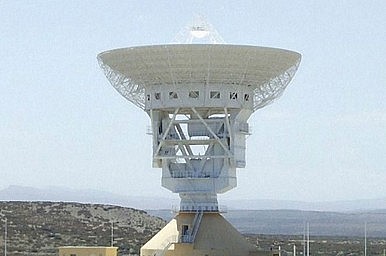
China’s new 35-meter-diameter parabolic antenna in Patagonia.
Image Credit: CONAE (Argentina National Space Activities Commission)
China Builds Space-Monitoring Base in the Americas
Critics in Argentina say sovereign territory has been turned over to China’s PLA.
By Victor Robert Lee
May 24, 2016
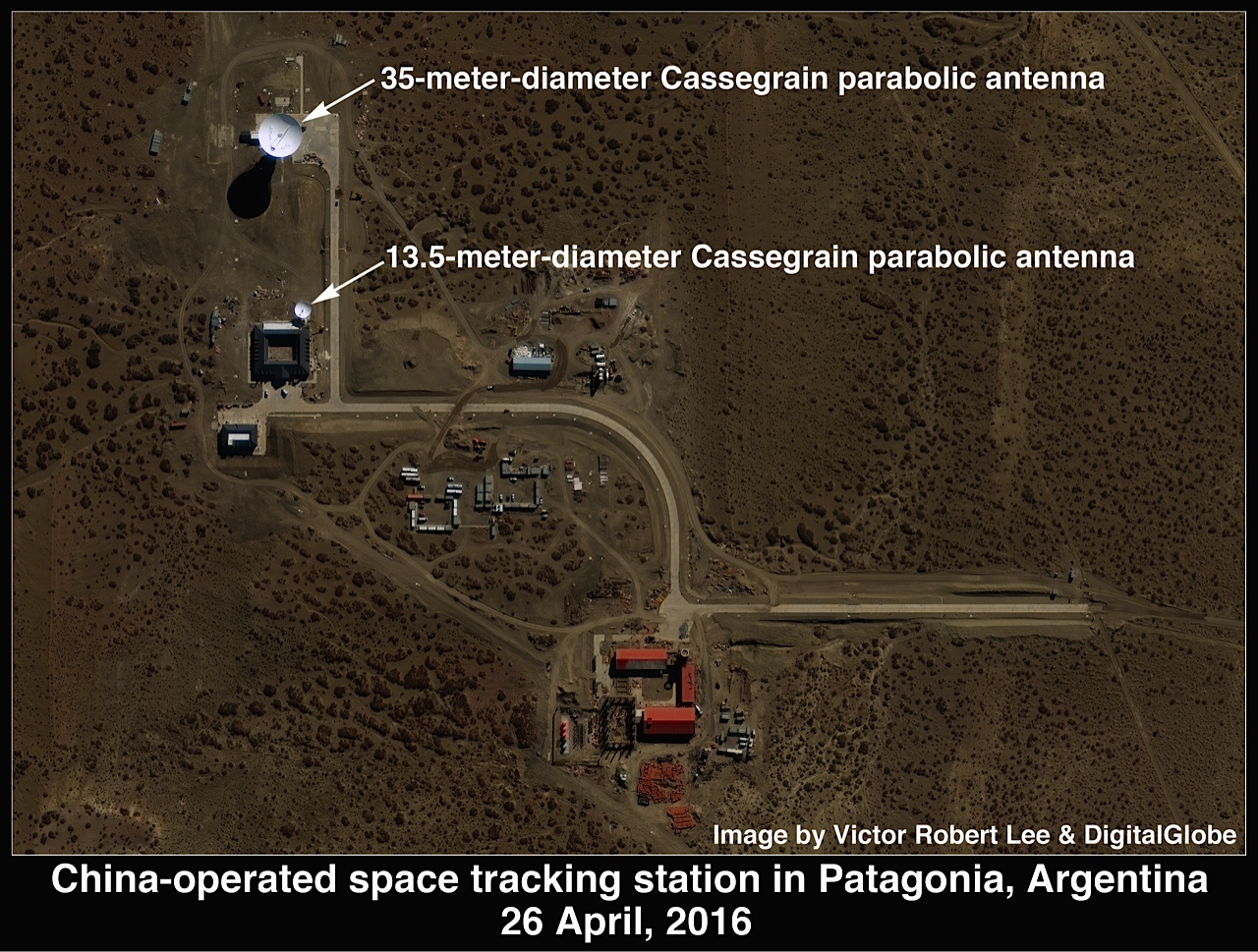
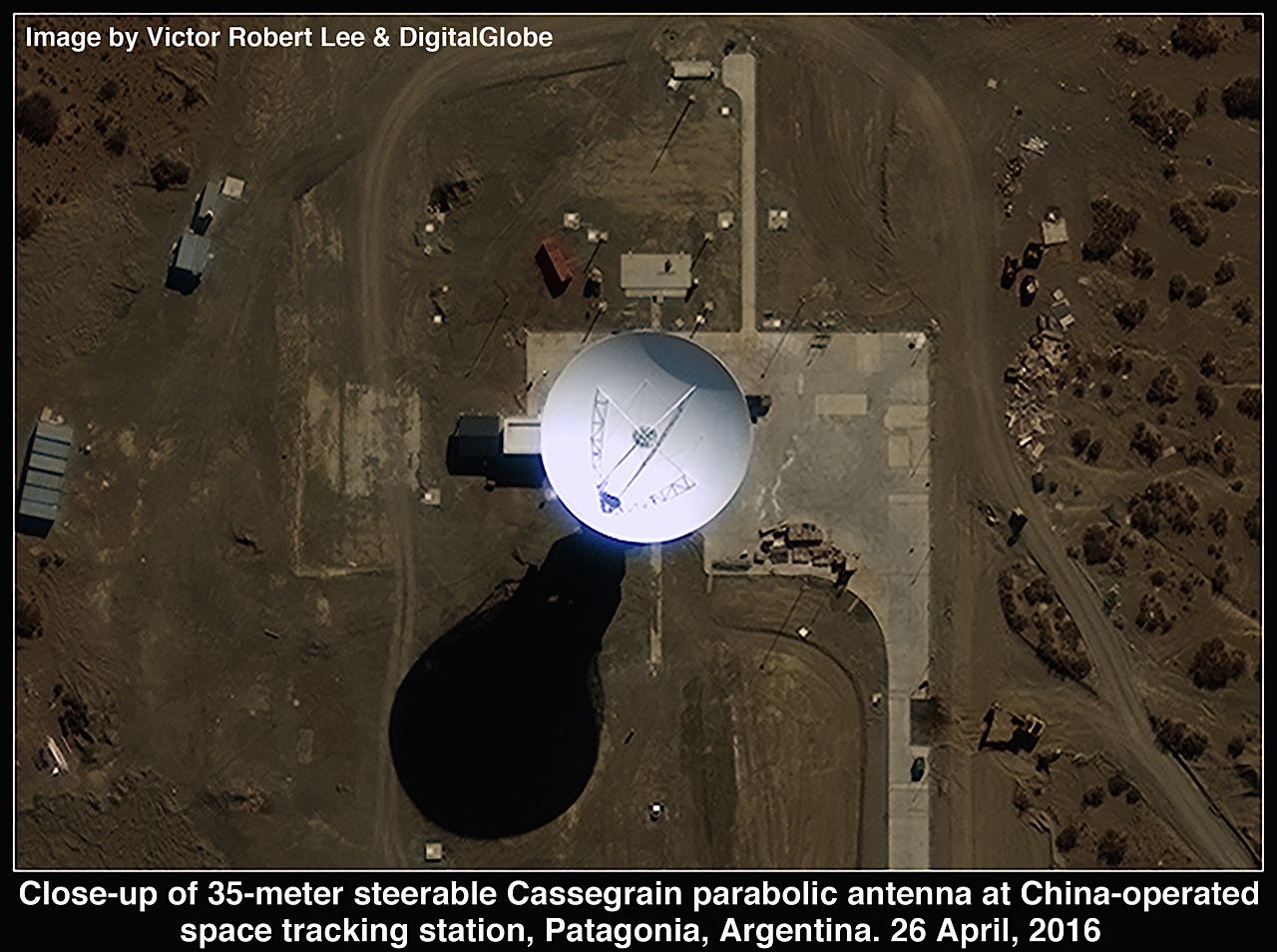
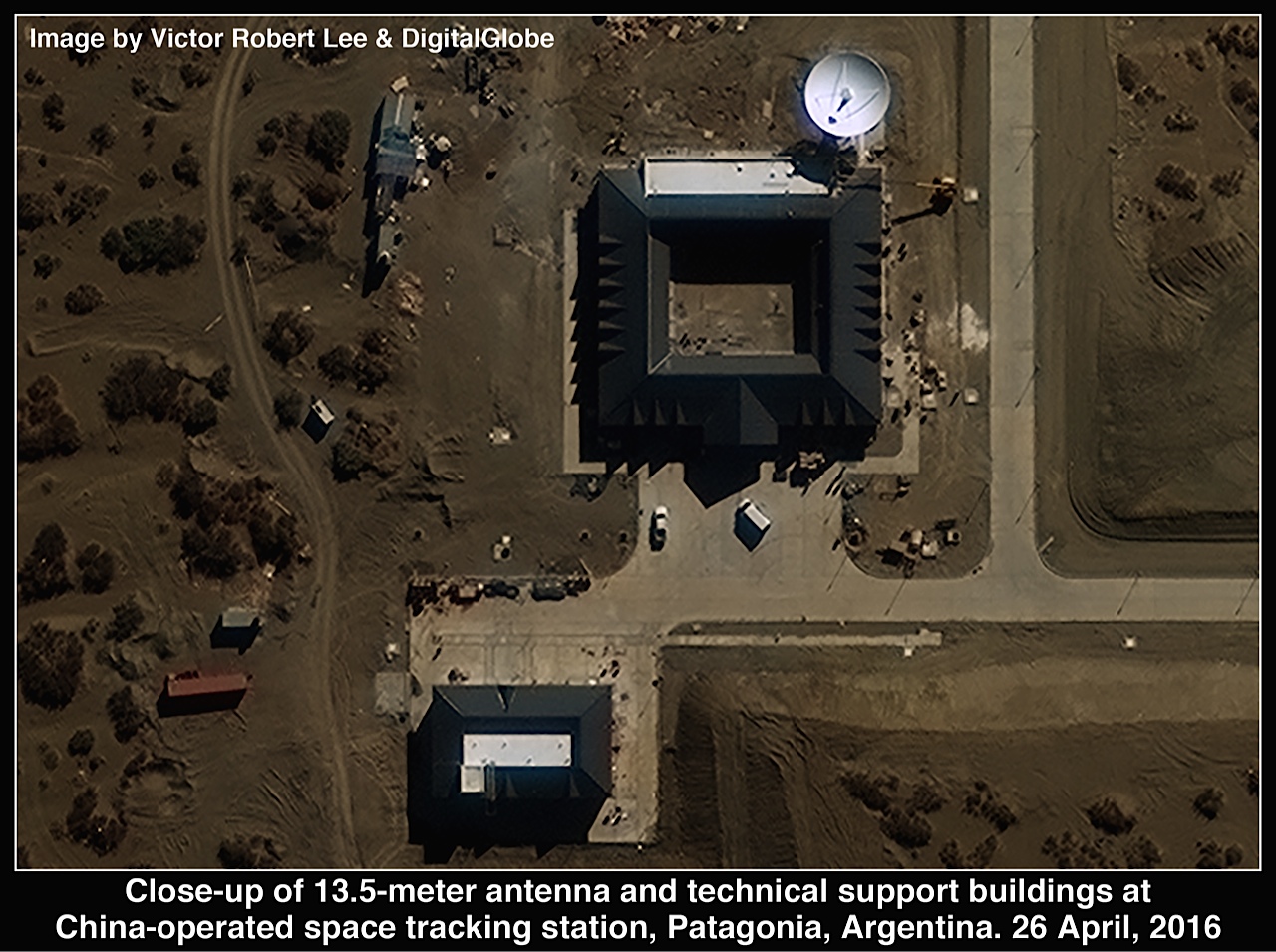
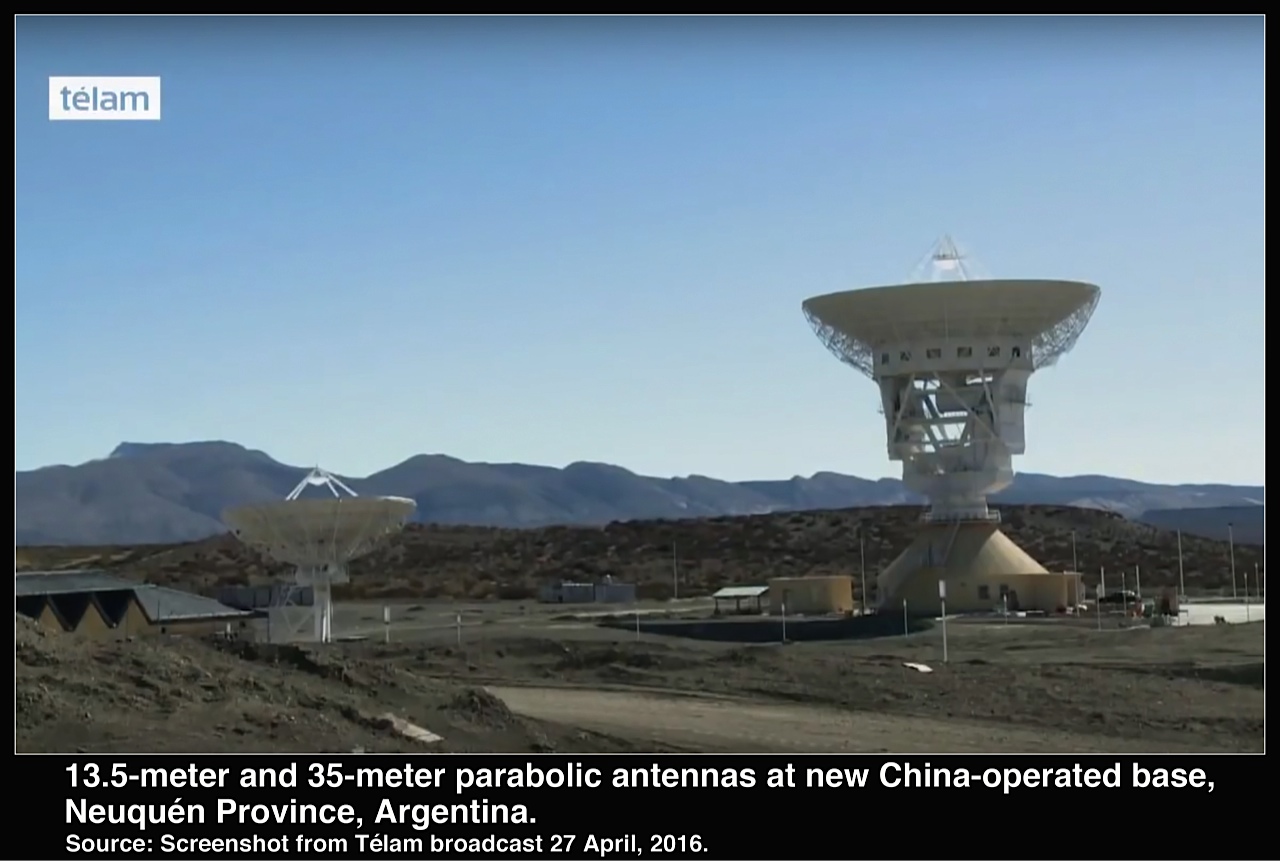
A space tracking, telemetry and command facility operated by a unit of China’s People’s Liberation Army is nearing completion at a site in Patagonia, Argentina. The new base, the first of its kind outside of China, includes steerable parabolic antennas 13.5 and 35 meters in diameter, computer & engineering facilities, lodgings for technical staff, and a $10 million electric power plant. Chinese and Argentinian officials announced in late April 2016 that the station will become operational in March 2017.
Since its inception, the Chinese base in a remote sector of Patagonia has been controversial, with several legislators and local officials protesting publicly that Argentina has granted sovereign rights over part of its territory to China, and that the facility, entirely controlled and staffed by a unit of China’s military, could be used for military as well as civilian purposes.
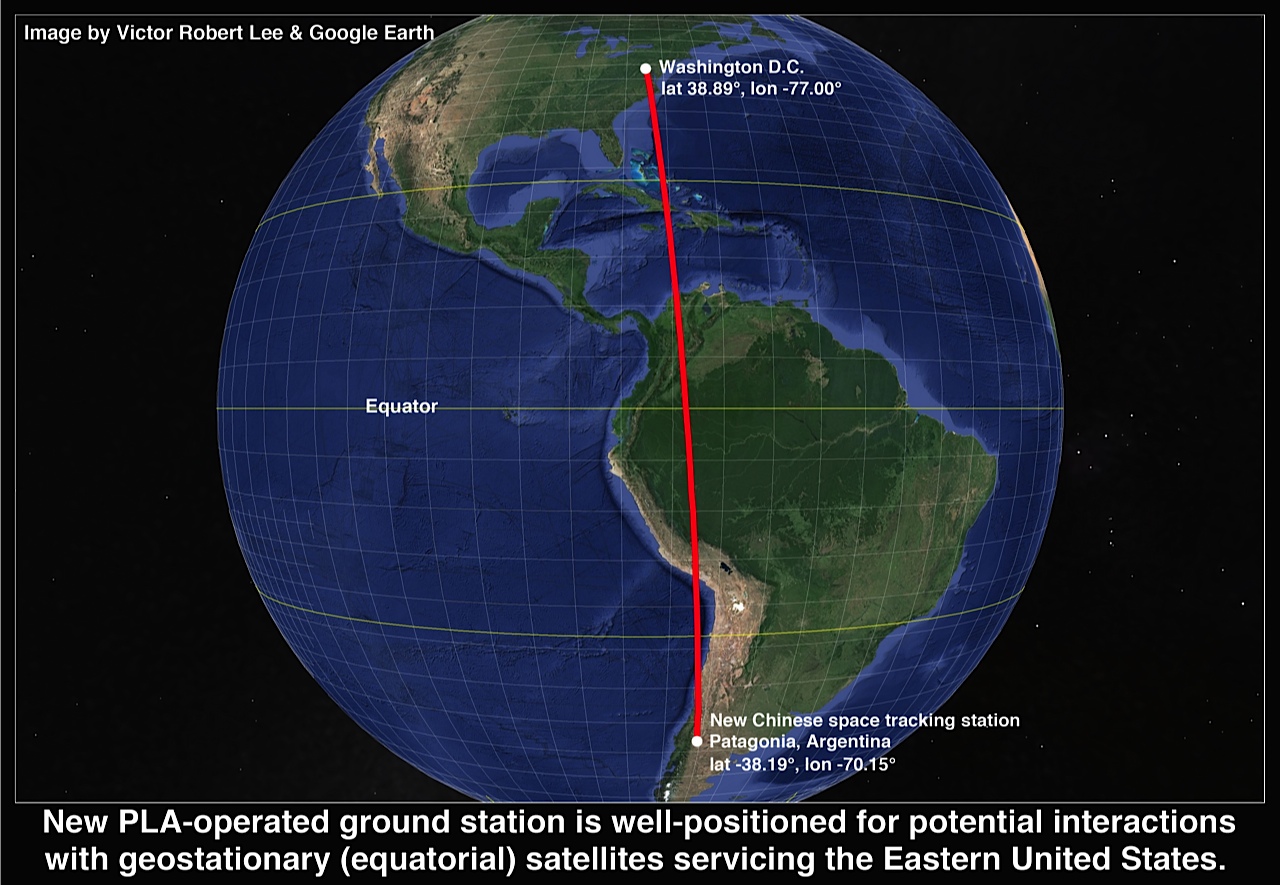
Situated in the same longitudinal sector as the U.S. Eastern seaboard, and the same distance as Washington, D.C. from equatorially positioned geostationary satellites servicing the Eastern U.S., the base’s location would potentially be advantageous for non-civilian missions by this type of facility.
Chinese authorities have stated that the ground station is solely to support deep space exploration and a lunar mission to take place as early as 2017, and that the base has “no possible military use.”
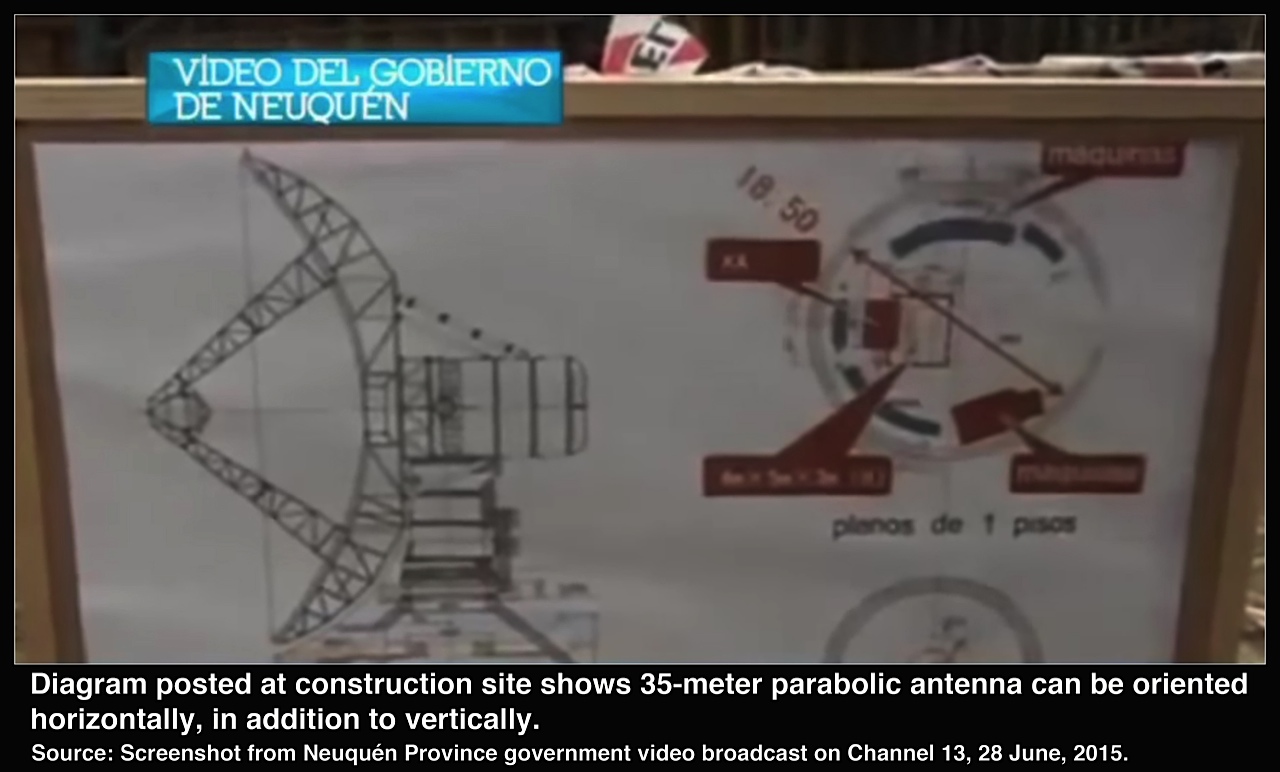
When questioned about possible dual use of the base in late April 2016, Yu Xueming, the site’s project manager, employed by China Launch and Satellite Tracking Control General (CLTC), said the fact that the parabolic antennas could not be swiftly rotated meant they could not be used militarily. However, there are numerous military and signals intelligence uses for slow-maneuvering antennas, and the two antennas observed at the Patagonia site are in fact widely steerable. A diagram previously posted at the construction site showed the 35-meter parabolic antenna in a fully horizontal orientation, rather than the vertical position seen in the latest satellite imagery of the facility – the position most suitable for “deep space” purposes.
An expert on space communications, who was asked to review the images presented here, confirmed that the two antennas in Patagonia could be used for monitoring of geostationary satellites, in addition to deep space sensing and telemetry. He also pointed out that the two parabolic antennas could operate in tandem through the technique of interferometry to more precisely lock onto satellites and their signals.
In a 2015 interview, Ambassador Roberto García Moritán, a former representative of Argentina to the Arms Trade Treaty, said the Neuquén base would be very useful for lunar missions, but also that “the antennas and the telemetry” at the base “have dual use. This antenna will have the capacity to interfere with communications, electronic networks, electromagnetic systems; it has the capacity for receiving information about the launching of missiles and other space activities, including of drones, and movement of strategic arms. It has the capacity to collect information of enormous sensitivity in the eventuality of a military competition.”
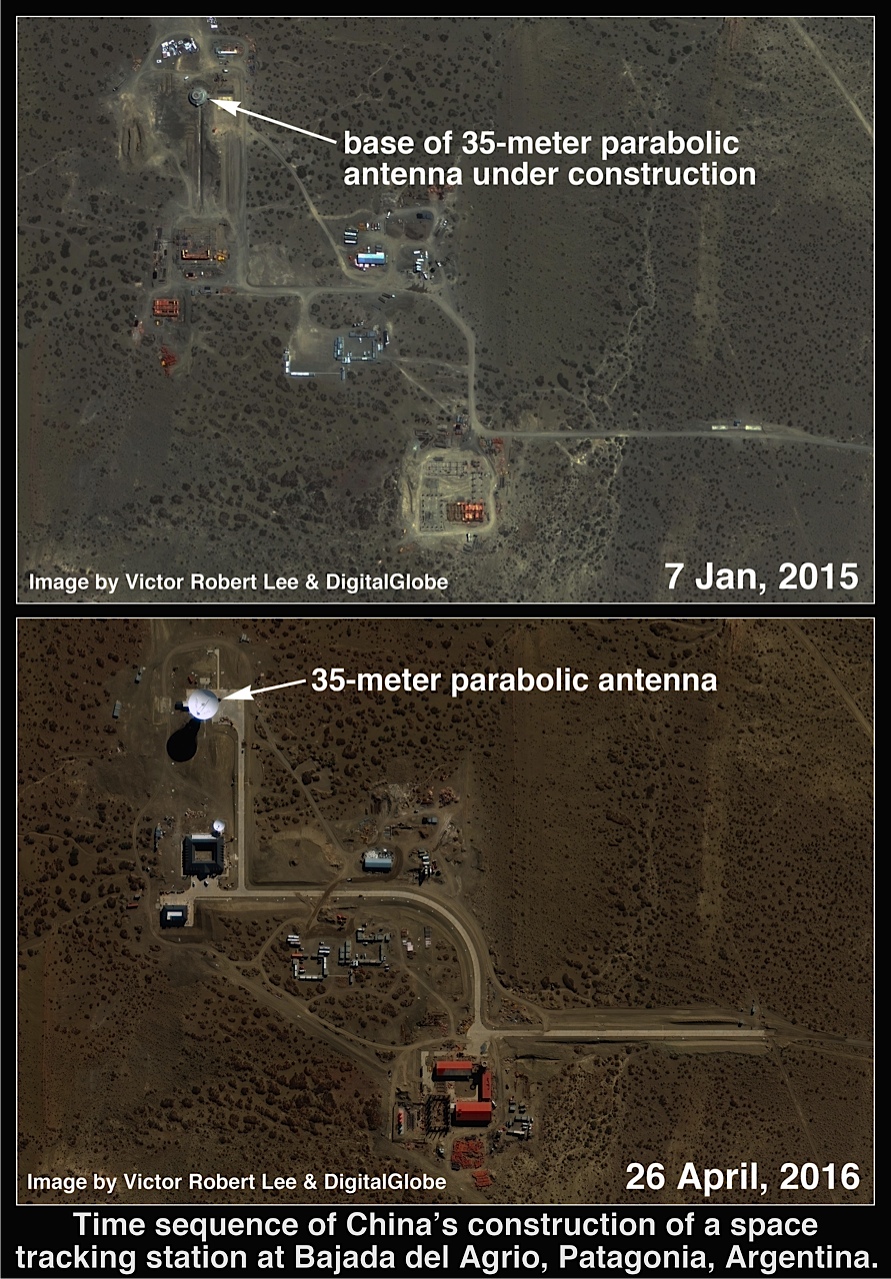
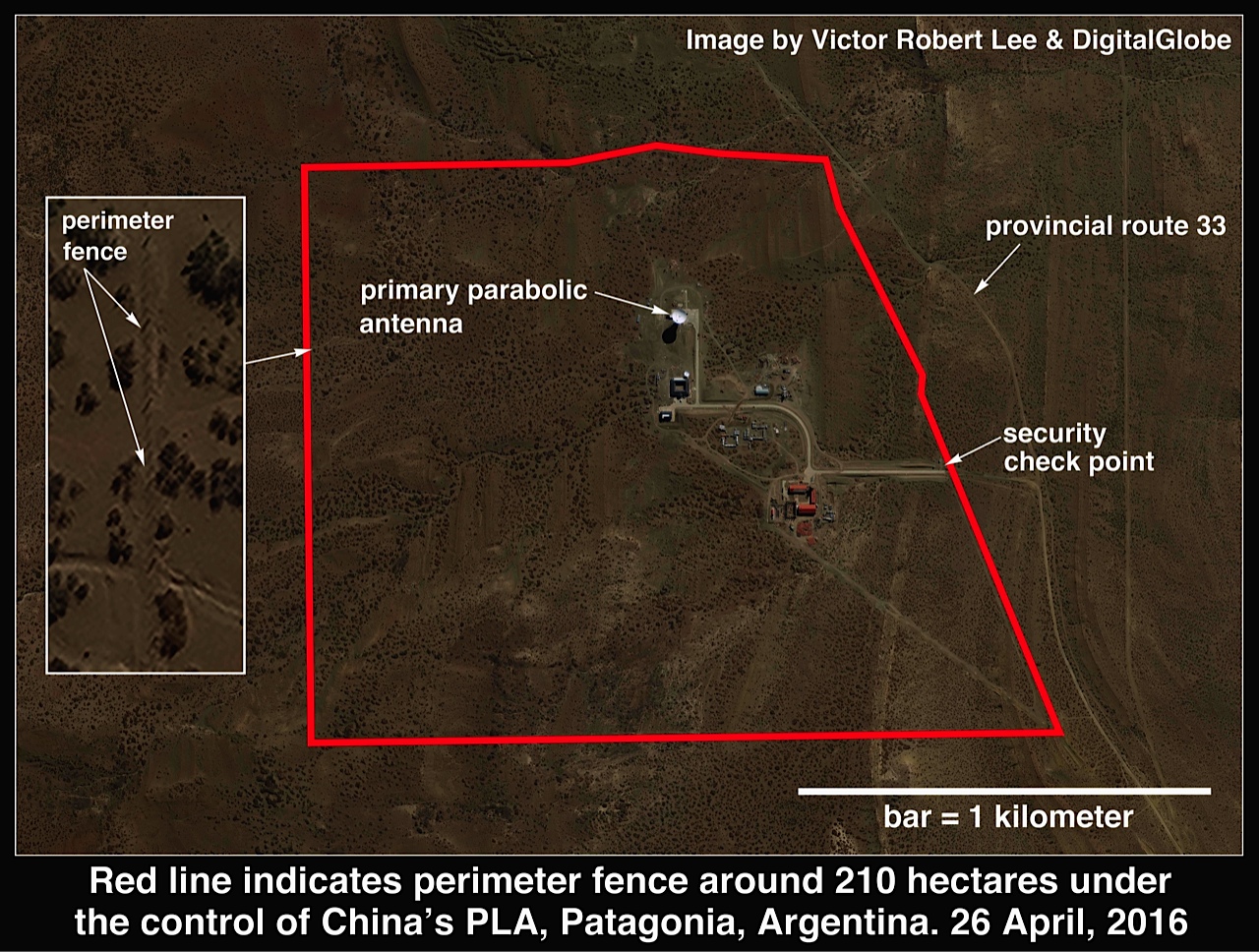
No satellite imagery of the Neuquén site less than fifteen months old was available from non-classified sources, so the author tasked a DigitalGlobe WorldView-3 satellite to photograph the base at 30-centimeter resolution, which was accomplished in late April 2016.
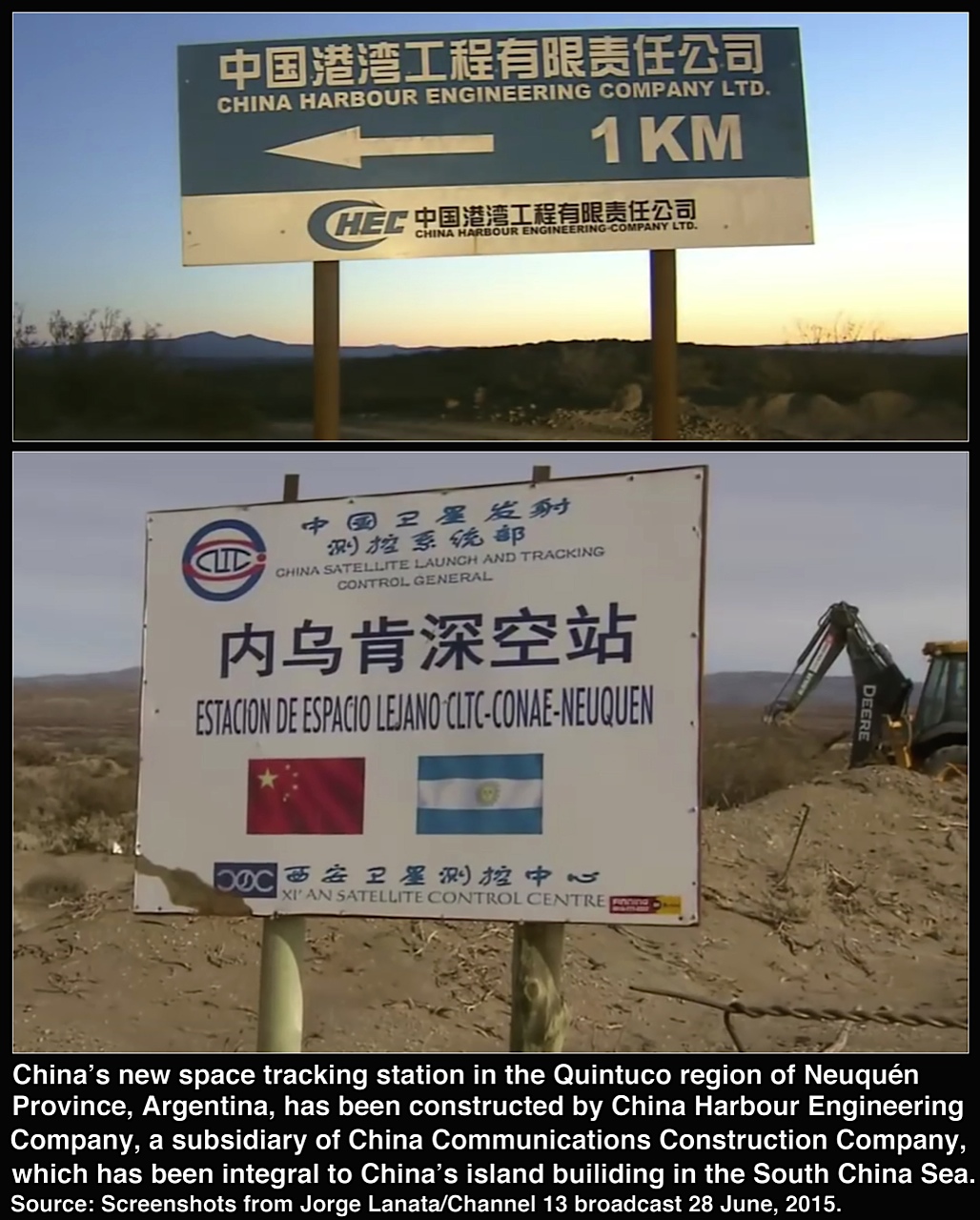
Imagery of the site, in the Quintuco region of Neuquén Province, near the town of Bajada del Agrio in Patagonia, Argentina, shows a surprising rapidity of construction, especially for such a remote area [coordinates: 38.1914°S, 70.1495°W]. The project has been carried out by China Harbour Engineering Company, a subsidiary of state-controlled China Communications Construction Company, which has been integral to China’s unprecedented and frenetic island building in the South China Sea. CLTC, the operator of the Neuquén facility, is a unit of the General Armaments Department of China’s People’s Liberation Army. A related sponsor, whose name is written on a sign outside the Patagonia base, is the Xi’an Satellite Control Center, described by some security analysts as the nerve center of the PLA’s satellite tracking, telemetry and control activities worldwide.
Argentina’s 50-year contract with China for the base (tax-free and with a five-year advance notice requirement for termination) was signed under the administration of the country’s former president, Cristina Fernández de Kirchner, and immediately prompted allegations of secret clauses attached to the agreement. Although the contract was signed in April 2014, earlier aerial photography shows construction was already well underway by December 2013; parliamentary approval only occurred in February 2015 (133 votes for, 107 against). News reports following the election of Argentina’s new president, Mauricio Macri, who took office in December 2015, suggested the incoming administration intends to unveil the secret provisions, but proponents of the project deny there are any secret side agreements at all.
Satellite images of the site show a fenced enclosure measuring 210 hectares in area rather than the contractually defined 200 hectares cited by Argentinian officials. Access is via a single security checkpoint. In a 2015 report by journalist Jorge Lanata for Argentina’s Channel 13, a television crew asked for permission to enter the base, but was told by Argentinian guards that the only people who could give permission to enter are “the Chinese, who are in the offices of CLTC in Las Lajas” (a town 40 kilometers away). In the same broadcast a reporter telephoned the Chinese embassy to request permission to enter and was denied access by an embassy officer who said it was “not convenient” to receive them. In the Channel 13 program the mayor of Neuquén City, Horacio Quiroga, said even several elected officials of Neuquén Province had been refused entry, and he exclaimed, “It is Chinese land in Argentina’s territory.”
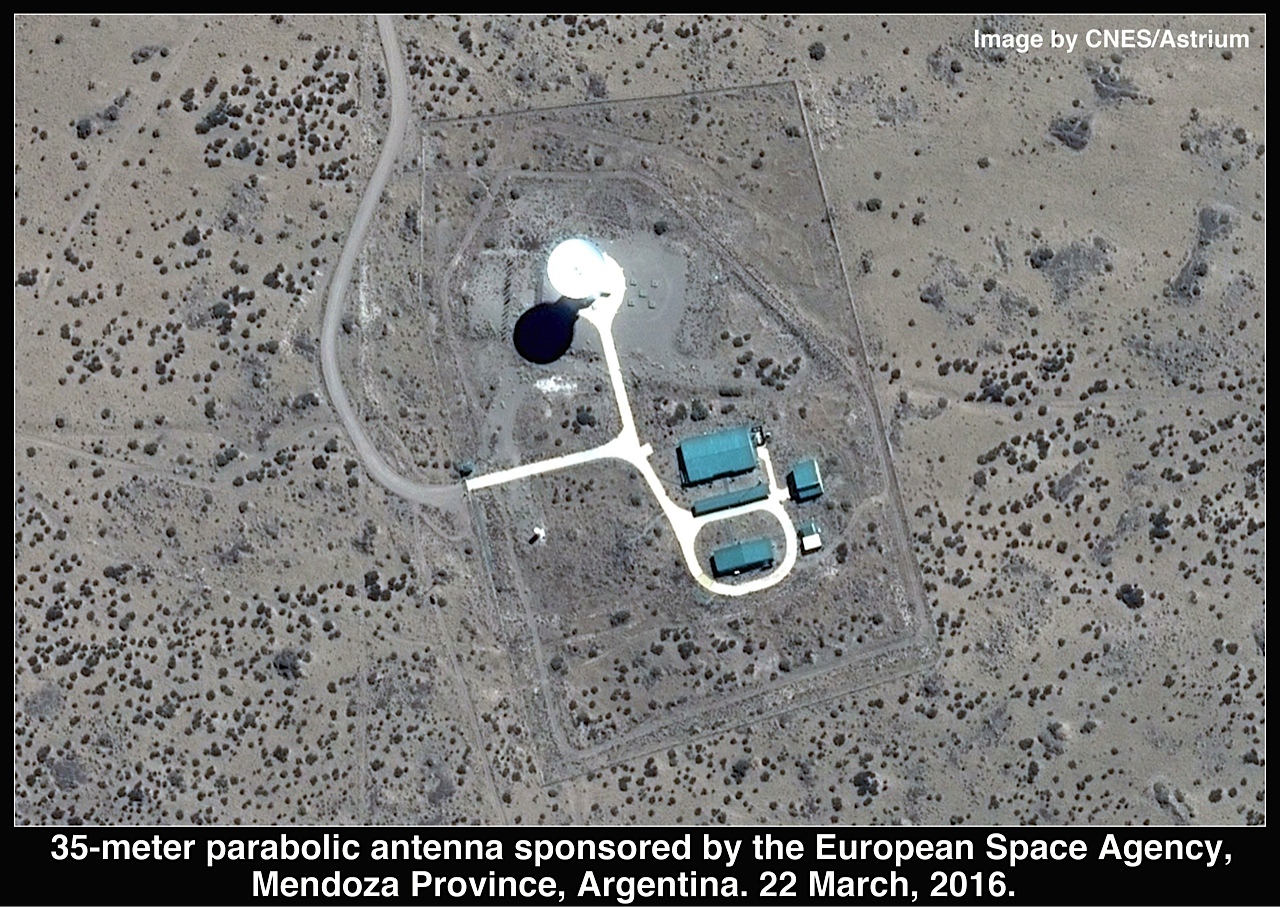
Some Argentinian and Chinese authorities have rebutted concerns about the Patagonia ground station by pointing out that the European Space Agency has leased land for a similar type of tracking station that became operational in 2013, at Malargüe in Argentina’s Mendoza province, 275 kilometers north of the new Chinese base. However, the Malargüe facility is leased to a civilian agency, the ESA, managed by Argentinian civilians, and the majority of the staff are from Argentina. The facility, known for guiding the 2014 Rosetta mission to land a probe on a comet, is also markedly smaller and less well equipped, as seen in satellite images.
The Chinese government has other international, but more limited, ground stations to support its manned space program – in Namibia, Pakistan and Kenya; and it currently has at least five Yuanwang-class space tracking ships deployed. A ground station in Argentina could be viewed as simply part of the growing footprint of an economically powerful nation that has peaceful intentions for space exploration, for which it should be given the same leeway other nations receive. However, the intrinsic dual-use potential of large steerable antennas, and China’s history of digital theft as well as its testing of destructive anti-satellite technologies suggest Argentina’s protesters have reason to question the real use of the Patagonia base. The Snowden archive, which revealed that the U.S. has secretly operated at least sixteen ground stations worldwide for interception of foreign satellite communications, adds heft to the skepticism.
U.S. sensitivity over the building of a new Chinese base in the Americas is likely to be heightened by rumblings that the Chinese government already operates signals intelligence facilities in another locale even closer to the U.S. – Cuba, just 300 kilometers south of Miami and 525 kilometers from the U.S. military’s CENTCOM headquarters at Tampa. In the U.S. Republican presidential debate on March 10, 2016, Florida Senator Marco Rubio, a son of Cuban immigrants and a member of the Senate’s Select Committee on Intelligence, received enthusiastic applause when he said a “good deal” with Cuba would include several measures including kicking “out this Chinese listening station in Bejucal.”
Rubio’s allegation of Chinese participation in signals intelligence stations in Cuba, especially in the Bejucal region near Havana, is supported by several U.S. security analysts, but direct public evidence is scant. Satellite images of the main Bejucal site, not displayed here, confirm the presence of multiple large steerable parabolic antennas, probable underground facilities that were expanded after 2010, as well as new structures appearing in 2014, including an upgraded array of mast antennas.
Official statements from China and its representatives in Argentina regarding “peaceful use” of the new station in Patagonia will be regarded with the same sort of skepticism that has been justified in another theater: the South China Sea. Beijing shrewdly obfuscated its ongoing annexation of the South China Sea over the past three years, and now is using the same state-controlled corporations it used for manufacturing military bases in the Spratlys to secure an outpost in South America, in longitudinal alignment with the U.S. East Coast and the heart of U.S. satellite communications networks, both civilian and military.
It will not be surprising if future satellite images of the Patagonia base show additional antennas and other types of technology installed on this first-ever tract of sovereign Chinese territory in the Americas.