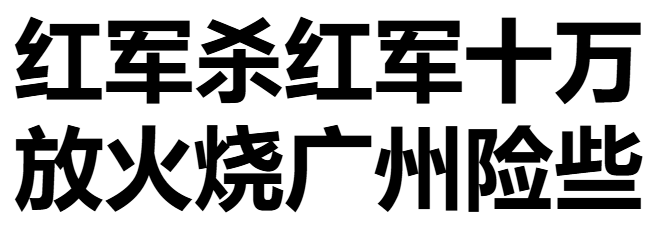
That reminded me of something another teacher told me. She had asked her students from China if they had heard about the death by starvation of 30 to 40 million people during the so-called “three years of natural disasters” in the early 1960s. Her students responded with stunned silence, as if she, a teacher in Hong Kong, was brazenly fabricating history to attack their mother country.
After we exchanged these stories, Professor Loden and I sat sullenly in a quiet Vietnamese café, speechless. Ever since, thoughts about the loss of memory in China on a national scale, a phenomenon that people have long been discussing but only in private, remain lodged in my heart like thorns. From time to time, guilt — along with painful memories of the past and thoughts about losing the memories — torment me and refuse to leave me alone.
Have today’s 20- and 30-year-olds become the amnesic generation? Who has made them forget? By what means were they made to forget? Are we members of the older generation who still remember the past responsible for the younger generation’s amnesia?
The amnesia I’m talking about is the act of deleting memories rather than merely a natural process of forgetting. Forgetting can result from the passage of time. The act of deleting memories, however, is about actively winnowing out people’s memories of the present and the past.
In China, memory deletion is turning the younger generation into selective-memory automatons. Memories of history and the present, yesterday and today are all going through this uniform process of deletion and are being lost without trace.
I used to assume history and memory would always triumph over temporary aberrations and return to their rightful place. It now appears the opposite is true. In today’s China, amnesia trumps memory. Lies are surpassing the truth. Fabrications have become the logical link to fill historical gaps. Even memories of events that have only just taken place are being discarded at a dazzling pace, with barely intelligible fragments all that remain for people to hold on to.
Revolution completely engulfed China after 1949. The revolution created the regime, created history, and it created our present reality. People’s memories and administered memories, people’s forgetfulness and administered forgetfulness are all determined by the state, transformed by a revolutionary tactic that has been systematically implemented.
Historical details are selectively excised from the records and from textbooks. Details of events that still reside in the living memory of older Chinese — the Warlord era of the late 1910s and 1920s, names of soldiers and civilians who shed their blood on the front lines during the war of resisting Japan’s invasion that began in the 1930s — all these things have been carefully winnowed.
After the civil war ended in 1949, one man’s passion drove an entire nation to a frenzied pace of construction, with one political movement after another maintaining the fanatical atmosphere of a permanent war footing.
But the tragic experiences associated with these movements have been deleted from people’s collective memory, put aside and permanently concealed.
The Great Leap Forward, the obligatory nation-wide construction of backyard steel furnaces and the consequent death by starvation of 30 to 40 million people in the famine that was later blamed on “three years of natural disasters,” and the catastrophic 10 years of the Cultural Revolution — these momentous events are too absurd, too cruel and too unpleasant for people to recount. Therefore many people are reluctant to pass their painful memories on to the younger generation.
Not a word is written about how many Chinese, or Vietnamese, died in the pointless war with Vietnam in the late 1970s. Few questions are asked about the crackdown on criminals in 1983 in which people were thrown in jail in the name of curtailing public indecency simply for kissing in public, or executed for poverty-related petty theft.
While the whole world still vividly remembers the tragic end of the June 4 student movement in 1989, the painful memory is lost in the country where the bloodshed took place, in the midst of cheers for China’s economic growth and increased influence.
What else is lost to memory? Everything that has happened in recent times: the AIDS epidemic caused by unhygienic blood selling; the innumerable explosions in illegal coal mines; the modern day slavery that takes place in illegal brick kilns; the rampant production of toxic milk powder, toxic eggs, toxic seafood, gutter oil, carcinogenic vegetables and fruit; forced abortions; violent demolitions; mistreatment of petitioners — the list goes on and on.
Anything negative about the country or the regime will be rapidly erased from the collective memory. This memory deletion is being carried out by censoring newspapers, magazines, television news, the Internet and anything that preserves memories.
This amnesia with Chinese characteristics doesn’t just affect individuals, it also affects China as a nation. Some people say, “Let bygones by bygones, we must look forward.” Consolation, perhaps, for an individual’s suffering, but it is no consolation for an entire people’s loss of memory.
Others say “If we don’t look forward, we won’t have a bright future.” This might be a good piece of advice for people who hide in the past, but it is hardly constructive for people who surrender themselves to memory deletion.
This state-administered amnesia is similar to territorial defense in the animal kingdom. It’s about survival.
The best way to achieve this type of amnesia is to develop tactics utilizing state power to shackle people’s minds and block all memory channels by altering historical records, manipulating textbook content and controlling literature, art and performances in all forms.
The oppression of words and ideas is not unique. It has been exercised by all authoritarian regimes around the world at various times. Under oppression, intellectuals — the people who are supposed to have good memories — are the first to become silent after being administered amnesia by the state. Next comes the general public.
The state prefers the intelligence of its people to remain at the level of children in a kindergarten. It hopes people will follow instructions, just as children follow their teacher’s instructions — they eat when they are told to eat, they sleep when they are told to sleep. When they are asked to perform, these innocent children enthusiastically recite the script prepared by adults.
To achieve this, the brains of people who have memories must be reformatted, voices of people who are good with words must be silenced, so that the memory of younger generations won’t be contaminated.
Then these spotlessly “clean” young brains are like blank pages at the disposal of the state’s paintbrush. Only then can a new version of history and a new image of reality be painted on these pages according to the taste of the state.
Naturally, the innocent children who have been deprived of the chance of knowing what really happened in the past accept the artificial version of history and grow up malnourished in their understanding of the past. As time goes by, the state’s absolute power becomes a matter of fact and this marks the triumph of state administered amnesia.
Our tolerance to this type of amnesia originates from the state’s carrot-and-stick strategies that are designed to achieve the nation’s memory loss.
Thirty years ago, the instruments used against people who resisted state-sponsored amnesia were ropes and chains. Now, as China’s economy grows and the state has an enormous amount of money at its disposal, it skillfully uses financial incentives to entice people into giving up their memories and to compromise with the state. In this country money now has an almighty power that can seal people’s lips and dry writers’ pens. It can also force literary imagination to fly in the opposite direction of truth and conscience.
It doesn’t matter whether you are a writer, a historian or social scientist. You will be awarded power, fame and money as long as you are willing to see what is allowed to be seen, and look away from what is not allowed to be looked at; as long as you are willing to sing the praises of what needs to be praised and ignore what needs to be blanked out. In other words, our amnesia is a state-sponsored sport.
Let’s look at literature and art. Almost all awards in China in the fields of literature, art, news and culture are administered within state-approved boundaries. They encourage people to exercise their creativity within the state-approved boundaries. The ones who achieve success within these boundaries are rewarded. Naturally, we thus replace the forgotten past with fiction and build splendid lies over reality. And we do this without feeling any sense of moral guilt — it’s all in the noble name of artistic creativity.
Consequently, truth is buried, conscience is castrated and our language is raped by money and power. Lies, meaningless words and pretentious-sounding blather become the official language used by the government, taught by our teachers and adopted by the world of art and literature.
This kind of language is also creeping into the lives of ordinary people. There are currently two conflicting language systems in China. One belongs to the state, the other to ordinary people.
Why? Why are ordinary people repeatedly calling for government officials to “speak human language” and “do human things”? These requests reflect people’s resistance to the official version of memories that has been administered to them.
The state is not the only player to be blamed for the nation’s amnesia in today’s China. We must also look at Chinese intellectuals, as we appear to be content with this forced amnesia.
This is the starkest difference between Chinese intellectuals and our peers in other countries in different times. Take writers in the former Soviet Union as examples. Despite the extreme totalitarian terror and the rigid censorship, writers such as Mikhail Bulgakov, Aleksandr Solzhenitsyn and Boris Pasternak still managed to leave us with a long list of masterpieces such as “The Master and Margarita,” the “Gulag Archipelago” and “Doctor Zhivago.” These works did not rebel against state power; they are more about preserving and restoring a nation’s memories.
Today’s China is no longer a hermetically sealed nation as it was just a few decades ago. The economic window in China is wide open to the world now. The other window, however, the political window, is still tightly shuttered, because the state is determined to cling to its power to control. And the secret of state-administered amnesia with Chinese characteristics lies in the different condition of the two windows. The mind of the state is keeping a watchful eye on the windows and what people are writing, but no one is allowed to keep a watchful eye on the mind of the state.
Our acceptance of state-administered amnesia can be seen as a tacit understanding among men of letters who appease the state’s power. It is a wise man’s compromise — after all, one of the windows is open. Light is allowed in. Our world is brighter than before.
In this part of the world laws don’t mean much when it comes to preserving our memory and preventing amnesia. They don’t protect our freedom of speech, freedom of information or freedom of publication, nor do they protect people’s rights to remember what happened in the past.
Everything depends on our leaders’ morals and how open-minded these leaders are. The one opened window we have now is more a small mercy bestowed by the powerful at a permissive moment, than a victory won by intellectuals because of our persistent quest for openness.
Someone who has spent years in a dark cell is bound to be grateful if a window in his cell is unshuttered and some light is allowed in. Would he dare to ask for the prison gate to be opened for him? At least today we are allowed to breathe some air, so what’s the point of sacrificing ourselves for a breeze that might come tomorrow — that’s the reasoning behind the silence of Chinese writers and intellectuals in the face of state-administered amnesia.
Gradually we become accustomed to amnesia and we question people who ask questions. Gradually we lose our memories of what happened to our nation in the past, then we lose the sense of what’s happening in our nation at present, and, finally, we run the risk of losing memories about ourselves, about our childhood, our love, our happiness and pain.
Yet, just as in any kindergarten, there are always a few naughty children who don’t like to be told what to do. There are always some people who refuse to be administered amnesia. They are always trying to speak in their own words, always spreading their creative wings to fly beyond the boundaries of official memory. Following their conscience, they are willing to fly anywhere, into the past, the present or the future, in order to produce works that can pass our memories onto younger generations.
Of course, whether or not a piece of art or a literary work can carry our memories is not the only thing that needs to be considered when we judge the quality of a work. However, whether preserving memory is allowed is the most valuable parameter to measure the greatness, maturity and degree of tolerance of a nation.
It has been over 30 years since China opened its economic window. China now is more prosperous and is stronger than it was 30 years ago. I believe China should also be mature enough to reflect on and remember its past.
The late Chinese writer Ba Jin had a dream for preserving memory — to build a museum in China devoted to the Cultural Revolution, the “revolution” that took place in the 1960s and 1970s and turned the nation into a madhouse.
Carrying on Ba Jin’s dream, I also have a naïve hope: I hope one day a memorial to amnesia engraved with all our nation’s painful memories of the last century can be erected on Tiananmen Square.
I believe a truly great people are people who have the courage to remember their own past, and a truly great nation is a nation that has the courage to record its own history.
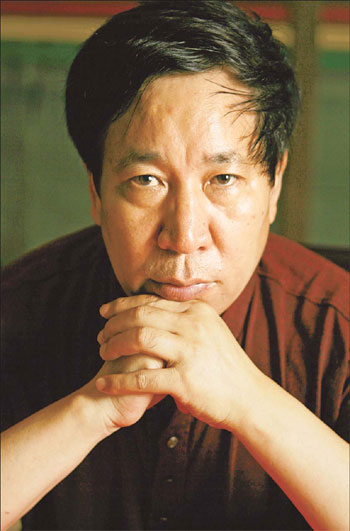
Yan Lianke is a Chinese writer based in Beijing. His translated works include “Serve the People,” “Dream of Ding Village,” about the blood-selling scandal in his home province of Henan, and “Lenin’s Kisses.” This article was adapted from a longer essay and translated from the Chinese by Jane Weizhen Pan and Martin Merz. A German version of the essay appears in the spring issue of Lettre International.