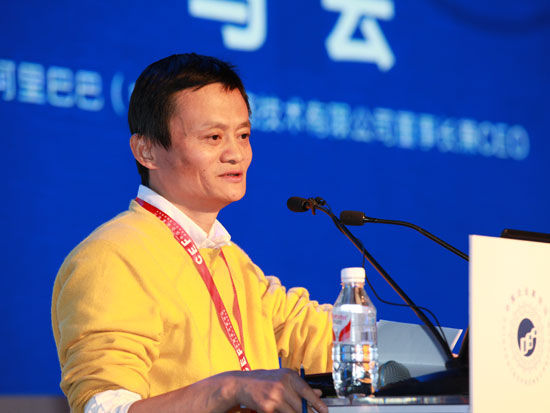
马云: 北京雾霾我特别高兴 特权阶级没特供空气了
2013年02月22日 22:08 来源:长江网 77487人参与1544条评论
第二是一场危机,
这次北京的雾霾,我特别高兴,我从来没有那么高兴过,因为北京以往我们呼吁水,呼吁空气,呼吁这一切食品安全的时候,没有人多少相信。因为特权阶级他们有特权的水,这次没有特供的空气了,他们回到家同样会面临老婆孩子的指责。
我们需要考虑的是什么样的行动,我们相信十年以后中国三大癌症将会困扰着每一个家庭,肝癌、肺癌、胃癌。肝癌,很多可能是因为水;肺癌是因为我们的空气;胃癌,是我们的食物,有多少人30年以前,有多少人知道我们边上谁谁谁有癌症,那个时候癌症是一个稀有的名词,今天癌症变成了一种常态 ......
很多人问我什么东西让你睡不着觉,阿里巴巴淘宝从来没有让我睡不着觉,让我睡不着觉的是我们的水不能喝了,我们的食品不能吃了,我们的孩子不能喝牛奶了,这时候我真睡不着觉了。
最后,我想我们所有的愤怒不是恶行,我们愤怒的是对恶劣行为的冷漠。最近有部电影上面一句话很好,我们的生命不属于我们,我们跟世界上所有的生命息息相关,昨天和现在无论你任何一场善行和恶行,都会决定我们的未来,所以这是我要想讲的呼吁大家这是一场真正的危机,而行动一定是每个个人,而不是期待别人。谢谢大家!
1983年4月初,笔者随贸促会组织的代表团第一次出国前往联邦德国参加一年一度举办的世界最大规模的汉诺威(德语口音最标准的地区)国际工业博览会结束后,请假乘火车只身赴鲁尔地区面见一位1940年代初期德国驻南京大使馆文化参赞(他写过一本讲述南京城历史的书;与之前介绍过的德国前总统魏茨泽克年轻时的情形相仿,也曾是一位活跃的国家社会主义工人党党员)、后来转赴北京任中德协会会长的德国汉学家教授(1910年出生)。我们两人当天共同相处了5个多小时。
刚见面坐进教授的车里行驶在高速路上时,他问的第一个问题是,北京城墙拆下来那么多墙砖去哪了?“用去建民房和防空洞了吧”,笔者也说不十分清楚 ......他的中文口语好得笔者一路上都赞不绝口,他说他的日文比中文说得还好(“日本文化是中国文化的一部分”,教授这样说)。他是在德国大学里教授四书五经,曾经一度是怒斥《狼图腾》小说为宣扬法西斯主义的德国汉学家 Wolfgang Kubin 顾彬的汉学导师。后来在他家里一块儿坐在沙发上给他念一封他在南京时一位朋友托笔者稍给他的信时,有几个草体书写的连笔字笔者一下子认不出来卡住了,他接着就念了出来。真是惊讶万分!他紧跟着说了一句,只要研究一下,什么都可以分辨出来。德国学者的这种做研究的精湛劲儿,令人钦佩至极。时隔32年,依然历历在目,印象极深。
弯来绕去说了这么多背景介绍,只是顺便回顾一下德国往事,与下面的单词着眼点一点儿关系没有。笔者完全不了解德语,但早就知道一个已经成为英语词汇的德语单词:schadenfreude。第一次说完,教授愣了一下,再说一遍,他笑了,“很有意思,怎么会记住这么一个词”。一个好像有点儿邪恶意味的词。
Schadenfreude (//; German: [ˈʃaːdn̩ˌfʀɔɪ̯də] ( listen)) is pleasure derived from the misfortunes of others.[1]This word is taken from German and literally means 'harm-joy.' It is the feeling of joy or pleasure when one sees another fail or suffer misfortune. It is also borrowed by some other languages. listen)) is pleasure derived from the misfortunes of others.[1]This word is taken from German and literally means 'harm-joy.' It is the feeling of joy or pleasure when one sees another fail or suffer misfortune. It is also borrowed by some other languages.
English equivalents[edit]
Little-used English words synonymous with schadenfreude derive from the Greek word, epichairekakia (ἐπιχαιρεκακία, first attested in Aristotle[2]).[3][4] Nathan Bailey's 18th-century Universal Etymological English Dictionary, for example, contains an entry for epicharikaky that gives its etymology as a compound of ἐπί epi (upon), χαρά chara (joy), and κακόνkakon (evil).[5][6] A popular modern collection of rare words, however, gives its spelling as epicaricacy.[7]
An English expression with a similar meaning is Roman holiday, a metaphor from the poem Childe Harold's Pilgrimage byGeorge Gordon, Lord Byron, where a gladiator in Ancient Rome expects to be "butchered to make a Roman holiday" while the audience would take pleasure from watching his suffering. The term suggests debauchery and disorder in addition to sadistic enjoyment.[8]
Another phrase with a meaning similar to Schadenfreude is "morose delectation" ("delectatio morosa" in Latin), meaning, "The habit of dwelling with enjoyment on evil thoughts".[9] The medieval church taught that morose delectation was a sin.[10][11] French writer Pierre Klossowski maintained that the appeal of sadism is morose delectation.[12][13]
An English word of similar meaning is gloating, where gloat means "to observe or think about something with triumphant and often malicious satisfaction, gratification, or delight" (gloat over an enemy's misfortune).[14] Gloating is differentiated from Schadenfreude in that it does not necessarily require malice (one may gloat to a friend about having defeated him in a game without ill intent) and that it describes an action rather than a state of mind (one typically gloats to the subject of the misfortune or to a third party).
Related words[edit]
The term compersion, taking joy in the joy of loved ones, is generally considered an antonym of schadenfreude.
In Chinese, the phrase "幸灾乐祸" literally
translates to take "joy in calamity and
delight in disaster", and serves the same
meaning as schadenfreude.
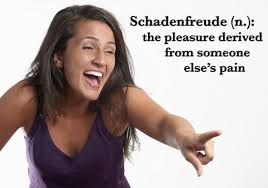






以色列海法大学研究发现两岁儿童已懂幸灾乐祸
|