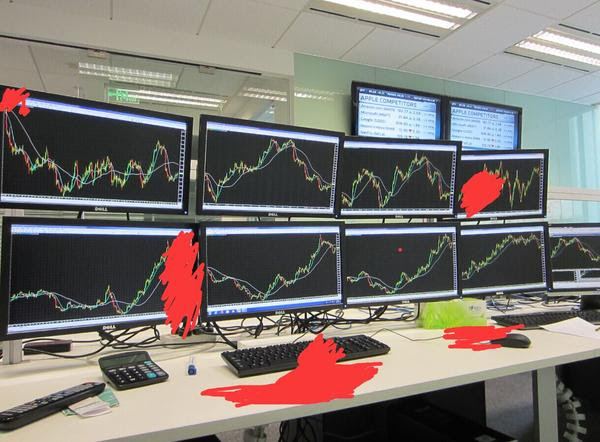
A widening probe of the foreign-exchange market is roiling an industry already under pressure to reduce costs as computer platforms displace human traders.
Submitted by Tyler Durden on 02 / 08 / 2016 21:52 -0500
Two years ago, just before Michael Lewis released Flash Boys starting a sharp if brief revulsion against parasitic, predatory High Frequency Trading frontrunners, which delayed Virtu's IPO by one year, we broke down Virtu's 2013 net trading income by product line. We were not surprised to find that of the $45 million in total growth, the largest income category, US stocks growth was a tiny 5% of all, rising by $2.3 million in 2013. In fact, between EMEA, APAC and US Equities, there was very limited growth in 2013, while commodities posted an outright trading income decline. It appeared to be the case that growth in conventional products has indeed plateaued, as more and more HFT competitors rush in. And yet, one product stood out. It is highlighted on the chart below: FX ( foreign exchanges ).
This is how we summarized this observations almost exactly two years ago:
With increasingly more homo sapiens-type banker FX traders being laid off left and right for pervasive and ubiquitous manipulation of currencies (who can forget the infamous "Cartel" chat room, JPM's head of spot trading presiding), what this means is that more and more algos will rush into this product to fill the voids left by carbon-based traders.
Two years later, Bloomberg caught up to the fate of what it calls Wall Street's "dying breed", the once proud FX traders who over the past two years have become an endangered species between losing their jobs to Virtu's algos, and to countless FX rigging scandals which revealed that the world's biggest market was nothing but one grand conspiracy in which a handful of banks schemed illegally in so-called chat rooms.
First the numbers: there were 2,300 people working in currency-market front-office jobs at the world’s biggest banks in 2014, a 23 percent drop from four years earlier, according to Coalition Development Ltd., an analytics firm.
Bloomberg also discovers Virtu: "Humans are up against formidable
opponents across the industry. Take Virtu Financial Inc. Deploying
sophisticated technology in the business, the company’s computers can
trade more than 11,000 securities and other products on more than 225
trading platforms in 35 countries. Because automation is so deeply
ingrained in its business, it had only about 150 employees last year --
generating more than $5 million per worker."
And here are some of the people behind the numbers:
Charlie Stenger, a currency-broker-turned-recruiter, has seen it all. One fired trader wept in his office. Another admitted he hadn’t told his wife he was unemployed, and left the house every day in a suit to sneak off to a coffee shop. Then there are the delusional guys, who carefully explain how they’re not interested in jobs that don’t pay as well as those they just lost.
Stenger, who was laid off from ICAP Plc in 2013 and now works for Sheffield Haworth Ltd., tells the men and women he counsels: Take the pay cut. Oh, and don’t wait for the phone to ring.
“This is crunch time -- it’s not looking good,” Stenger said. “This is a shrinking pond.”
It is, and not just for the people: the size of the overall FX market itself is collapsing.
The death of the FX market has not been greatly exaggerated: the layoffs have continued and are unlikely to stop in the $5.3 trillion-a-day market. Revenue from from foreign-exchange divisions hasn’t bounced back after falling to $6.5 billion in 2014, down almost 45 percent from 2009, Coalition data show. Currency trading in the U.K. and North America shrank by more than 20 percent in October from a year earlier, according to central banks in those regions. London is the biggest center for foreign-exchange trading.
For some being replaced by an algo was not how they had envisioned the conclusion to their Wall Street careers:
“The business has to be downsized,” said Keith Underwood, a foreign-exchange consultant who ended a 25-year trading career, including at Lloyds Banking Group Plc, in 2014. But it’s not easy “for people who have been in a market for many, many years to see that they’ve been replaced by an algorithm.”
Others who have not been fired yet, and are just counting the days to that closed doors conference room meeting:
Some ex-traders have moved to smaller houses or pulled kids out of private school. Those waiting for the ax to fall hoard paychecks. Stenger was out of regular work for a year after he lost his job; he was told about the lay-off four days after he learned his wife was pregnant with their first child. “There were periods where I wouldn’t make money for 90 days at a time,” he said, “and the insurance bill was still due every month, and the rent and the car payments.”
For many, however, the feeling of escaping Wall Street's clutches is an unexpected one: liberation.
Underwood, the consultant, said he left the market because regulators were cracking down on his niche by implementing stricter derivatives rules after the financial crisis. “My style of trading went out of vogue,” he said. So the former head of foreign exchange trading for the Americas at Lloyds, who also led teams at Credit Agricole SA and Lehman Brothers in London and New York, reinvented himself.
“I couldn’t be more happy,” said Underwood, who described the hourly rates he charges as comparable to those of a senior lawyer. “There is more empowerment, with control of my future.”
Many traders have discovered they have transferable skills. Some have landed work as salespeople or executives at financial technology companies, payment providers or trading platforms and exchanges. Others are using their knowledge to bolster banks’ risk-management operations. Franz Gutwenger, a recruiter in New York, said one of his financial-institution clients has expanded its regulatory-compliance staffing by a factor of five.
“I don’t think there’s a whole lot from my generation that are still in the industry,” said Guy Piserchia, who during a three-decade career led North-American foreign-exchange trading at Bank of America Corp. and Paribas, a precursor to BNP Paribas SA, in Asia. He left Wall Street in 2012 to become mayor of the 8,700-person township of Long Hill, New Jersey. Now he’s deputy mayor, but said he wants to get back into the business in a role that combines his financial and government experience.
What happens next:
“With automation and electronic dealing, I think there are going to be fewer people” on foreign-exchange desks, Piserchia said. “The ones that have evolved and survived may be some of the better ones -- or, as in life, may be some of the lucky ones.”
As the realization that there is a life away from finance, more will leave the confines of Wall Street for ever. Who will remain: just the central bankers who pretend the market is the economy, and pretend there is such as thing as a "market" in the first place, and the algos which however without humans to frontrun, will soon be extinct soon as well.
Mon, 02/08/2016 - 22:31 | 7159404Stainless Steel Rat
Stainless Steel Rat's picture
It is hard for a person trying to invest $200 million to make 5% a year, but it is cake for someone investing $100,000 to make 5% a week thanks to these robots.
Exactly! Though, I think the sweet spot is still a bit higher than $100,000. The point remains, trading still works.
I started out a couple decades ago doing FX & FX Options Arb for one of the named banks we've all read about. That was seriously big & easy money for those firms. In fact, I've been surprised by how easily they have all let this go, unless.... it's because they're the "investors" behind these "legalized" front running parasites.
What these guys are taking is just a piece, and as the article mentions, it's becoming the most fought over slice. It's probably 15% of the toal pie these days. Dealers, (the good ones), never just took out the bid-offer. They also took out the day's volatility, we "position traded", and we "portfolio invested".
Whatever....Risk hasn't gone anywhere, it's only grown....and the rewards remain wonderful...for the traders. PM me if you're young and need some assistance.
Traders gotta trade.
...just remember.... Don't Drink and Trade ;) :)
Tue, 02/09/2016 - 01:19 | 7159799Stainless Steel Rat
A human can look at a signal pattern in the market and easily determine: "this is a negative feedback signal based upon a commonly agreed upon stable point", or "this is a positive feedback loop based on two competing views (agendas?) of the value of the item." A human can surmise: "why is this the stable value?" or "what are the two competing agendas?". What I see now in the market is: "The oil producing countries now realize that war is the only option they have to reassert the value of their product." A computer could have a thousand Nvidia Titan Zs and not see this.
Tue, 02/09/2016 - 06:17 | 7160038OldPhart
2010 I tried anything to get my 401-k money OUT of the fucking system. It turns out to be virtually impossible, So I rolled it into the money market, guaranteed rate. I have lost my ass on interest earnings, but I've still got my principal and interest compounded, I'm not guru, my 401-k only has $54k in it (stopped ALL contributions in 2008), but it continues to earn and, according to the plan document, I am "not at risk of loss"
Here's what gets me. Way back in the 70's I was a debit Insurance Salesman...weekly premium, door to door..our disability product paid $40 a week for fucking forever. Just pay your dime every week.
Life Insurance had residual value based on a guaranteed minimum 4%, imagine trying to sell that kind of nonsense in the early 80's with 21% inflation. I used to look at these old policies, sold in the 20's and 30's, as ridiculous. 'Bad Lily' Austin, would collect her nieghbors premiums from out in the Florida woods and laugh at me (I'm 22/23 she's late 80's) about what goes around comes around. ('Bad Lily" was a sweet old black lady, both of her parents were slaves. I spent many lunches in her kitchen listening to her and her husband talk about thier lives. [I'm a California desert kid dumped in the woods of North Florida. To them I was exotic and weird, to me they were fascinating.] In a living tribute to Bad Lily I had a sign made for her as an Independent Life (Independent Life Insurance Company, apparenty defunct these days) collection point for her house. She was thrilled.
I don't know how to tell you how harsh things were. Lily lived in a shotgun house. That's a long narrow house where the walls are made of plank boards, the rooms are divided by a central wall, with doors in the middle...and you could literally shoot a shotgun down the center of the house without any damage. (In another shotgun house I witnessed an old man die of cancer while collecting his premium from his wife, he was lying on the bed, moaning, then sat straight up and said "Yes, Lord, I'm ready." Then died. Four miles later, a face full of puddles and I reported it to the county sheriff [one of the reason's I became one of the county's all volunteer EMT's on the ambulance, we didn't have paid pro's at the time. And I wound up doing some really shitty stuff that haunts me still.) In Lily's case, she'd lived there so long that the grass and other Florida shit grew into all the omniprescient cracks and crevasses that her house actually stayed warm. Her Franklin stove was on all the time and when I usually arrived, about 1 PM, she'd have cooked a mess of black eyed peas, collard greens, hog jowls and hushpuppies. As a white kid from California, one time tasting that shit made me an addict (as long as it wasn't boiled okra, holy shit!!).
Back in those woods I met one of the founders of the NAACP who sat me down and told me the first hand story of Rosewood in her mobile home's parlor (plastic lined). Vera Bostick!! God damn, I remember her name!! I'm a young, dumb, fucking white guy, but Vera treats me like I'm a nephew or cousin. I'm a member of her family. Her husband, don't remember his first name, other than he was this fire and damnation preacher...who suddenly opened up his own bar. Which promptly burned down after I sold him fire insurance.
All that said, I think, this time, we're going to be sadly lacking in people of character like Bad Lily Austin or Vera Bostick. These were older women with personal authority. If shit was going down they could walk out on the street and EVERYTHING would become "Yes, Ma'am?"
We need a lot more of these types of ladies, black, white, asian, mexican...we need a LOT more of these women.