Chinese Informants In The Classroom: Pedagogical Strategies
JUN 28, 2017 @ 08:31 AM 2,348 By Anders Corr, Contributor
For about a month, the media has reported on Chinese influence in Australian politics and universities. The news led to discussions among China experts on the role of government-linked Chinese student organizations that allegedly monitor and report on Chinese student speech in the classroom, and pedagogical strategies to encourage safe spaces for the intellectual growth of Chinese students abroad. These pedagogical antidotes include the banning of government-linked Chinese student organizations, free speech activists seeking to join Chinese student organizations, anonymous student classroom participation groups, mandatory debating team assignments on “sensitive” topics, and frank classroom discussions of student speech monitoring by Chinese authorities.
Children play chess on a giant chess board at a primary school in Handan in China's northern Hebei province on June 19, 2017. The 'live' chess game was played by 32 students to promote chess at the school. Credit: STR/AFP/Getty Images
Two Australian professors with whom I communicated confirmed reports of Chinese political influence activities in universities, not only among students, but against professors. There are also stories of corruption being ignored by university administrators and enforced rebates, or Chinese government clawbacks, of student scholarships awarded to Chinese students studying abroad. These scholarships are typically much more than would be received in China. According to Professor Bruce Jacobs of Monash University in Melbourne, the Chinese government has taken a portion of scholarships from students as government revenue. This could be countered by seeking to provide such scholarship through in-kind rather than cash transfers.
According to Associate Professor Sally Sargeson, Senior Fellow at the College of Asia and the Pacific, The Australian National University (ANU) in Canberra, China’s surveillance of overseas students is, “a much broader problem than dobbing in [informing on] compatriots who participate in ‘human rights protests’ in Australia (or anywhere else).” Sargeson said that, “this is a problem not confined to ANU, or indeed all Australian universities. I know from conversations with U.S. academics and from having worked at the University of Nottingham [in the U.K.], that there is a significant effort by Chinese embassies, and CCP [Chinese Communist Party]–linked companies and prominent citizens, to stifle expressions of opinion (not to mention dissent) among Chinese citizen students” in these locations.
Sargeson stated that surveillance “extends to embassy stooges recording and reporting on what other Chinese citizen students say in their classes and social events.” She gave an example:
I teach an undergrad class on Chinese politics. Part of the assessment for this class is based on students’ contributions to tutorial discussions. Every year, a significant proportion of the class is made up of Chinese citizens, and increasingly over the past few years, some of these students have come to me asking to be included in a tutorial group that contains no other Chinese citizens, so they can speak freely. Other Chinese students in mixed nationality classes have said they dare not speak up, because they fear their compatriots will report on them. Some have become extremely upset and frightened, because though they are pressured to join in with Chinese student association activities, they cannot trust their compatriots. And even non-Chinese students in mixed classes sometimes complain because their Chinese peers remain silent. In other words, surveillance is restricting Chinese students’ learning experiences and stifling freedom of expression on Australian campuses.
I heard similar complaints from a non-Chinese Columbia student about silent Chinese students in the classroom. But Chinese student silence may be a defensive mechanism, or one of silent protest against the Chinese state. It could even be in the interests of other students in the class by not exposing them to what is essentially state propaganda. Rather than repeat the propaganda their Chinese peers enforce, silent Chinese students collectively choose to remain silent and thereby refuse to participate in China’s efforts at propaganda in western classrooms. These students’ silence allows other more liberal discourse to fill the classroom space.
Sargeson invented a pedagogical response to perceived Chinese surveillance in her classroom. “To enable class discussions, I’m introducing anonymized online discussion boards, and classroom debates where I randomly allocate students to teams (so they don’t have to ‘own’ their positions).”
Sargeson said that these pedagogies are nevertheless insufficient to address the problem of surveillance, which she said is well known among students at ANU. Sargeson has spoken to multiple Chinese students about inter-student surveillance at ANU, and she wrote that they “ALL said they know they are being monitored, and adjust their speech so they will not get into trouble.”
To the extent that such artificial pro-China speech is in the classroom and university-sponsored events, it affects not only Chinese but all students. It is state-mandated propaganda in the classroom, and so interferes with the efficiency and impartiality of university instruction. All students and dues-paying parents have an interest in removing such Chinese state influence and propaganda from their universities.
Fullscreen
Chinese students Karl Li (L), from Jiangsu and Wisdom Xiewei (R) from Chongqing, are joined by their Host family mother Zennie Relova following a Vietnamese dinner in Temecula, California on March 23, 2016. Known as 'Parachute Kids', the two boys who live with their host family, are part of the increasing wave of Chinese students attending U.S schools and colleges, with American Education institutions eager for the tuition dollars. Credit: FREDERIC J. BROWN/AFP/Getty Images
“Sometimes [Chinese students] seem unaware that what they are doing is self-censoring, or, at the very least, they accept self-censorship as a condition of their [Chinese] citizenship, regardless of where in the world they are,” said Sargeson. One Chinese student told her,
Under Chinese laws, no matter where I am when I say something in public, I could still be charged with picking quarrels and provoking trouble, or endangering state security when I go home, so I have learned to use soft words. Like in class, I talk critically about the authorities, but if I want to mention the Communist Party or Xi, I always try to say something good.
Sargeson said that she has received multiple responses from colleagues that “indicated that Chinese students in other international universities are anxious about their peers reporting on them, and more general surveillance of their activities overseas.”
Chinese Students and Scholars Associations (CSSA) have reportedly prescribed and proscribed the speech and actions of Chinese students abroad since at least the 1980s, including in the U.S., Canada, Australia, U.K., France, Germany, and Belgium. The AFP reports espionage linked to the CSSA in several of these countries, and one “database intrusion” conviction of a Chinese student in France in 2005.
I suggested in a prior article that the CSSA should be banned from western campuses, since admitted CSSA government links and funding, and reportedinterference in student leadership decisions, make the association closer to a state-controlled entity than a legitimate student organization.
CSSA chapters actually harm Chinese student abilities to take advantage of free speech and learning on international campuses, and divert them from legitimate studies and activity-based student organizations (for example extracurricular sports or music organizations with diverse memberships). Instead, the Chinese state encourages them to engage in organized activities with their precious little spare time, designed to promote Chinese state goals, such as the promotion of Chinese culture and the aforementioned surveillance and prescription of political speech. Since the CSSA works at cross-purposes to the educational mission of the university, it would make sense that universities ban these organizations.
For one university to ban the CSSA could draw the ire of the Chinese government, which economically punishes entities that take action against its perceived interests. In addition to individual university action, it is likely necessary for a larger global university consortium, for example the International Association of Universities (IAU) in Paris, to take action against the CSSA, and any other student organizations through which autocratic states seek to impose illiberal influence. Legislation should also be passed that bans these organizations on campus.
The Global Times, a Chinese state-run newspaper, ran an article earlier this month critical of the proposal to ban CSSAs, quoting Yale University and Marquette University CSSA student members. A former Durham University CSSA member told the paper, “we have the right to love and miss our motherland while studying overseas,” and referred to “patriotic events or speeches.” He made no mention of events or speeches that are critical of China, and to my knowledge no CSSA has significantly and critically raised issues of Chinese human rights abuses or democratization, for example. This lack of critical thinking by the CSSAs are at cross-purposes with the liberal education that defines western academia.
Should an illiberal organization be allowed on a campus seeking to provide students with a liberal education? Should academic organizations that depend on freedom of speech for their relevance allow the Chinese state, known for stifling freedom of speech, to fund campus organizations that infringe freedom of speech, and to defend doing so with the perverse argument that closing such organizations stifles freedom? I think not.
According to Sargeson, “As for strategies to improve Chinese students' freedom to express opinions in class and other settings when they are overseas without fear of sanctions ... aside from setting up anonymous discussion platforms and the kinds of mandatory organization of debating teams I referred to earlier, … it might be best to turn a spotlight on this problem next time I run my Chinese politics course.” She continued, “The film clip of the University of Canberra Chinese Student Association leader admitting she reports on students’ activities to the embassy here, the dreadful experiences of Yang Shuping following her brief speech at the graduation ceremony at [the University of] Maryland, and the spine-chilling response from China’s MoFA [Ministry of Foreign Affairs] that Chinese citizens overseas must be ‘responsible’ for their comments would provide good case studies for classroom discussion about efforts to curtail freedom of expression among China’s overseas students.”
Student free speech activists of any ethnicity should also consider seeking to join CSSA organizations on campus. Presumably these organizations, per university rules, may not discriminate against non-Chinese students who want to join and discuss Chinese scholarship, student life, human rights, and democracy. If the CSSA did seek to discriminate against non-Chinese students, the activist group could bring the issue to university authorities for redress. CSSA members, many of whom likely dislike the organization but are not free to say so publicly, might appreciate the nonviolent activist input.
According to Jacobs, “The CSSAs have been going on since the 1980s when the first Chinese came. In the mid-1980s I knew that the so-called scholarships that students got, much of it had to be given to the Chinese government. When Chinese have projects overseas, officially they make money but then have to return it.”
Jacobs is particularly interested in how “a student who is raised in a Chinese context grows and learns to think more objectively.” This is essentially a subcategory of pedagogy that can be applied to Chinese university students studying abroad, who are arguably at a disadvantage because state-sponsored Chinese student organizations seek to control their classroom participation, which is frequently an element of grading.
Such influence extends not only to students, but professors as well. One Chinese author with whom Jacobs had contact felt that he could not write “Tiannamen Massacre” because of threats of the Chinese against his family back in China. “We have hired a lot of academics regarding China studies who have family in China, so there is the potential of pressure against them,” according to Jacobs. “That could change how we talk about China in the West, which would be unfortunate.” Chinese state influence in the classroom adversely affects not only students and professors, then, but our understanding of the world. As students of all ethnicities graduate and become professionals and leaders, that could profoundly change the direction of history to the benefit of the Chinese state, and its methods of surveillance and social control.
A hypothetical war between India and China would be one of the largest and most destructive conflicts in Asia. A war between the two powers would rock the Indo-Pacific region, cause thousands of casualties on both sides and take a significant toll on the global economy. Geography and demographics would play a unique role, limiting the war’s scope and ultimately the conditions of victory.
India and China border one another in two locations, northern India/western China and eastern India/southern China, with territorial disputes in both areas. China attacked both theaters in October 1962, starting a monthlong war that resulted in minor Chinese gains on the ground.
Both countries’ “No First Use” policies regarding nuclear weapons make the outbreak of nuclear war very unlikely. Both countries have such large populations, each over 1.3 billion, that they are essentially unconquerable. Like all modern wars, a war between India and China would be fought over land, sea, and air; geography would limit the scope of the land conflict, while it would be the air conflict, fought with both aircraft and missiles, that would do the most damage to both countries. The trump card, however, may be India’s unique position to dominate a sea conflict, with dire consequences for the Chinese economy.
A war between the two countries would, unlike the 1962 war, involve major air action on both sides. Both countries maintain large tactical air forces capable of flying missions over the area. People’s Liberation Army Air Force units in the Lanzhou Military Region would fly against Punjab, Himchal Pradesh and Uttarakhand and from the expansive Chengdu Military region against India’s Arunachal Pradesh. The Lanzhou district is home to J-11 and J-11B fighters, two regiments of H-6 strategic bombers, and grab bag of J-7 and J-8 fighters. A lack of forward bases in Xinjiang means the Lanzhou Military Region could probably only support a limited air campaign against northern India. The Chengdu Military Region is home to advanced J-11A and J-10 fighters but there are relatively few military airfields in Tibet anywhere near India.
Still, China does not necessarily need tactical aircraft to do great damage to India. China could supplement its aerial firepower with ballistic missiles from the People’s Liberation Army Rocket Forces. The PLARF overseas both nuclear, conventional and dual-use ballistic missiles, and could conceivably move up to two thousand short- and medium-range DF-11, DF-15 and DF-21 ballistic missiles into positions adjacent to India. These missiles could be used to blitz Indian strategic targets on the ground, at the cost of making them unavailable for contingencies in the South and East China Seas.
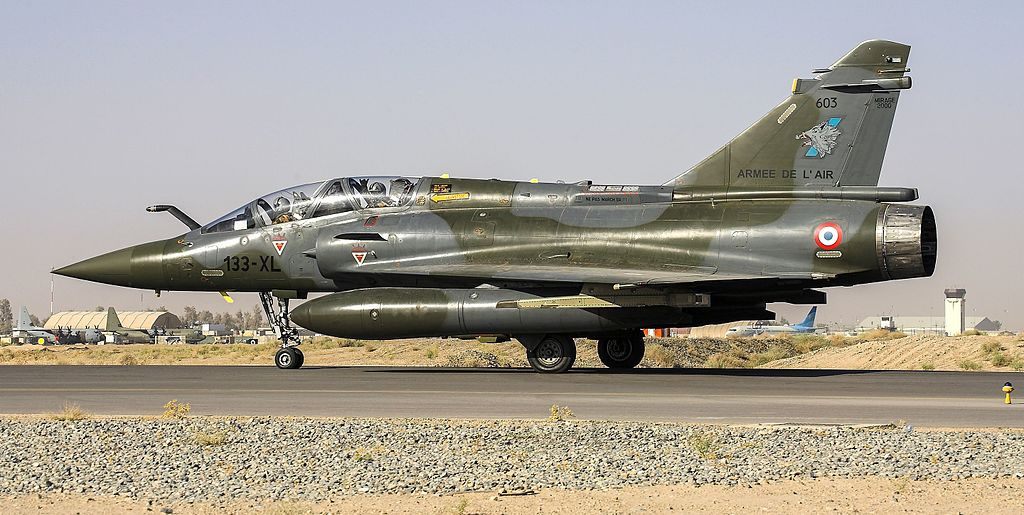
Meanwhile, India’s air forces are in a better position to contest the skies than their Chinese counterparts. While the war would take place on China’s sparsely manned frontier, New Delhi is only 213 miles from the Tibetan frontier. India’s air fleet of 230 Su-30Mk1 Flankers, sixty-nine MiG-29s and even its Mirage 2000s are competitive with or even better than most of China’s aircraft in theater, at least until the J-20 fighter becomes operational. India likely has enough aircraft to deal with a two-front war, facing off with Pakistan’s Air Force at the same time. India is also fielding the Akash medium-range air defense missile system to protect air bases and other high-value targets.
While India could be reasonably confident of having an air force that deters war, at least in the near term, it has no way of stopping a Chinese ballistic-missile offensive. Chinese missile units, firing from Xinjiang and Tibet, could hit targets across the northern half of India with impunity. India has no ballistic-missile defenses and does not have the combined air- and space-based assets necessary to hunt down and destroy the missile launchers. India’s own ballistic missiles are dedicated to the nuclear mission and would be unavailable for conventional war.
The war on the ground between the Indian and Chinese armies might at first glance seem like the most decisive phase of the war, but it’s actually quite the opposite. Both the western and eastern theaters are in rugged locations with little transportation infrastructure, making it difficult to send a mechanized army through. Massed attacks could be easily stopped with artillery as attacking forces are funneled through well-known valleys and mountain passes. Despite the enormous size of both armies (1.2 million for the Indian Army and 2.2 for the Chinese Army) fighting on the ground would likely be a stalemate with little lost or gained.
The war at sea would be the decisive front in a conflict between the two countries. Sitting astride the Indian Ocean, India lies on China’s jugular vein. The Indian Navy, with its force of submarines, aircraft carrier INS Vikramaditya and surface ships could easily curtail the the flow of trade between China and Europe, the Middle East, and Africa. It would take the Chinese Navy weeks to assemble and sail a fleet capable of contesting the blockade. Even then, the blockade would be hard to break up, conducted over the thousands of square miles of the Indian Ocean.
Meanwhile, shipping to and from China would be forced to divert through the western Pacific Ocean, where such diversions would be vulnerable to Australian, Japanese, or American naval action. 87 percent of the country’s petroleum needs are imported from abroad, particularly the Middle East and Africa. China’s strategic petroleum reserves, once completed sometime in the 2020s, could stave off a nationwide fuel shortage for up to seventy-seven days—but after that Beijing would have to seek an end to the war however possible.
The second-order effects of the war at sea would be India’s greatest weapon. War jitters, the shock to the global economy, and punitive economic action by India’s allies—including Japan and the United States—could see demands for exports fall, with the potential to throw millions of Chinese laborers out of work. Domestic unrest fueled by economic troubles could become a major problem for the Chinese Communist Party and its hold on the nation. China has no similar lever over India, except in the form of a rain of ballistic missiles with high-explosive warheads on New Delhi and other major cities.
A war between India and China would be nasty, brutal and short, with far-reaching consequences for the global economy. The balance of power and geographic constraints means a war would almost certainly fail to prove decisive. Both sides have almost certainly concluded this, which is why there hasn’t been a war for more than fifty years. We can only hope it stays that way.
中印士兵在藏南对峙 印度人手机拍摄
中印边境双方士兵的英语角
突发: 中印边境发生小规模摩擦事件 - 1
英雄的中國人民解放軍在中印邊境軍事演習,演给印度瞅
中方再度警告印度:立即撤軍 避免嚴重後果!
A painful remembrance: 1962 Sino-India war and lessons India learnt
中国远程火箭炮打了一轮后 印度15万山地军安静了
Wow, 印度也有了氢弹? 有人回答说: Yes and No.
DRDO successfully tested India most powerful hydrogen bomb