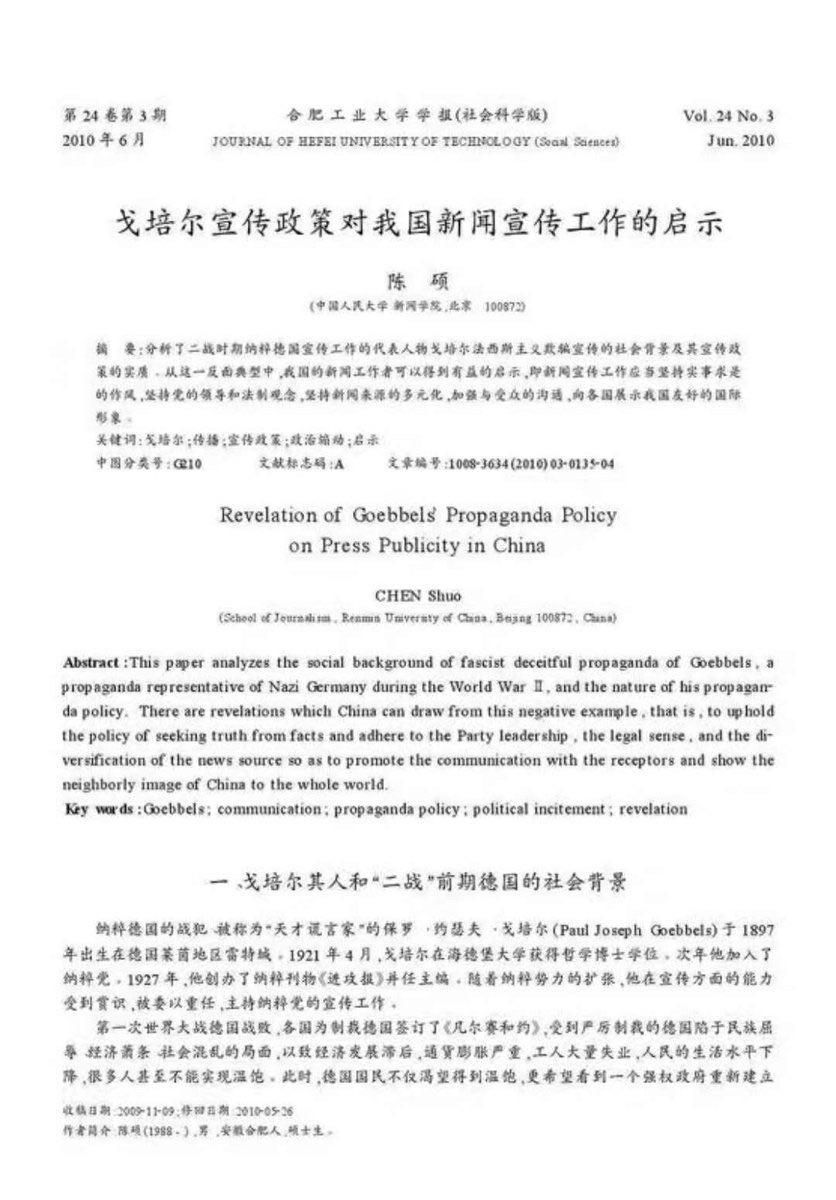
"The bible of mass manipulation", It was Hitler' manual for manipulation.
He certainly proved that it works, even in the most diabolical way. It should
be a warning to us all. Unfortunately its going on today in the mass media,
except now it is totally scientific when the subconscious mind of the
population is targeted. Must read to understand the principles of mass
manipulation.
谷歌同志一秒钟完工译文:
“操控群体的圣经”,这是希特勒的操控手册。 他当然证明了它是
有效的,即使是最令人作呕的方式。 这应该是对我们所有人的警告。
不幸的是,它今天在大众媒体上正在发生,除了现在,当以人群的
潜意识为目标时,这是完全科学的。 必读书以了解如何操纵群体的
基本原理。
Hitler’s Guide to Propaganda –
The Psychology of Coercion
希特勒式宣传指南 —— 高压强制心理学
by Sajid Surve, DO | November 4, 2008
Psychiatry and Psychology CategoryAdolf Hitler was a monster. The revolution he spawned changed the world landscape forever. But have you ever wondered how he did it? How did Hitler convince 70 million rational people to engage in horrible atrocities and wage war against the world? Although his agenda was decidedly negative, Hitler was a master of the science of coercion. Through the use of his speeches and propaganda, he was able to bend the will of ordinary people into submission and create an obedient army ready to carry out his orders, no matter how absurd they might be. Hitler’s formula for coercion of a group of people was very simple. He discussed it at length in his book Mein Kampf:
1. Keep the dogma simple. Make only 1 or 2 points.
2. Be forthright and powerfully direct. Speak only in the telling or ordering mode.
Hitler3. As much as possible, reduce concepts down into stereotypes which are black and white.
4. Speak to people’s emotions and stir them constantly.
5. Use lots of repetition; repeat your points over and over again.
6. Forget literary beauty, scientific reasoning, balance, or novelty.
7. Focus solely on convincing people and creating zealots.
8. Find slogans which can be used to drive the movement forward.
Most of Hitler’s inspiration came from a social psychologist by the name of Gustave Le Bon, who published several works and was considered an authority on the psychology of crowds. Le Bon posited that once individuals came together to form a group, the individual’s will was surrendered to what was perceived to be the will of the group. Their faculties of reasoning were impaired or destroyed, and they entered into a more suggestible state. The larger the group, the easier it was to coerce.
Aside from the general pointers above regarding how to engage in coercion, Hitler also had a very specific structure which he used for all of his speeches in order to capitalize on the susceptibility of the crowd. The first thing he would do is point out the commonality of the people gathered in the crowd so that he could instantly unify the group. The next step would be to identify a threat to that commonality to put the group on edge, and stir up the emotions of fear and anger. The third and most important step was to invoke a higher power, and appoint himself as an agent of that higher power. If the crowd was able to believe this, then the last two steps were easy: give the higher power’s “solution” to that threat to the commonality, and proclaim that carrying out the solution would be a victory for both the commonality and the higher power.
This speech structure was obviously successful to disastrous consequences. Since Hitler’s time, others have utilized the same structure to accomplish coercion for different ends. One of the most notable examples would be Dr. Martin Luther King, Jr. His I Have a Dream speech follows this pattern almost perfectly, but to serve a very different purpose. So where can we benefit from this knowledge?
The first application is to identify when others are attempting to engage in coercion. A political campaign is essentially a huge, protracted exercise in coercion, as is advertising and marketing. Being aware of the tools utilized can be helpful to rise above the influence and encourage others to do the same.
Secondly, as in the case of Dr. King, sometimes coercion can serve a positive purpose. Wielding these tools can help to improve abilities in public speaking and persuasive argument. Simple ideas like unifying a group before proceeding are excellent ways to communicate more effectively.
In short, Adolf Hitler was a monstrous figure. By deconstructing his tools we can learn not to fall prey to them again, and apply the useful aspects of his craft towards the greater good.
希特勒的大部分灵感来自一位名叫古斯塔夫·勒庞(Gustave Le Bon)的社会心理学家,他出版了多部作品,并被认为是人群心理学的权威。勒·邦(Le Bon)认为,一旦个人聚在一起组成一个团体,个人的意志就会被屈服于被认为是该团体的意志。他们的推理能力受到削弱或破坏,他们进入了一个更容易让人联想到的状态。小组越大,越容易胁迫。
这种言语结构显然成功地带来了灾难性的后果。自希特勒(Hitler)时代以来,其他人已经利用相同的结构来实现针对不同目标的强制。最著名的例子之一是小马丁·路德·金博士(Dr. Martin Luther King,Jr.)的“我有一个梦想”演讲,几乎完全遵循了这种模式,但目的却截然不同。那么我们可以从中受益吗?
George Lachmann Mosse claimed that fascist theories of leadership that emerged during the 1920s owed much to Le Bon's theories of crowd psychology. Adolf Hitler is known to have read The Crowd and in Mein Kampf drew on the propaganda techniques proposed by Le Bon.[46][47] Benito Mussolini also made a careful study of Le Bon.[48] Le Bon also influenced Vladimir Lenin and the Bolsheviks.[49]