Putin is hailing Russia's "liberation" of Mariupol after his forces completely destroyed during a two-month siege.
He told defense minister Sergei Shoigu to block off the Azovstal metallurgical plant, where the last Ukrainian troops are holed up, "so that a fly can't get in." pic.twitter.com/g2lNd44qXF
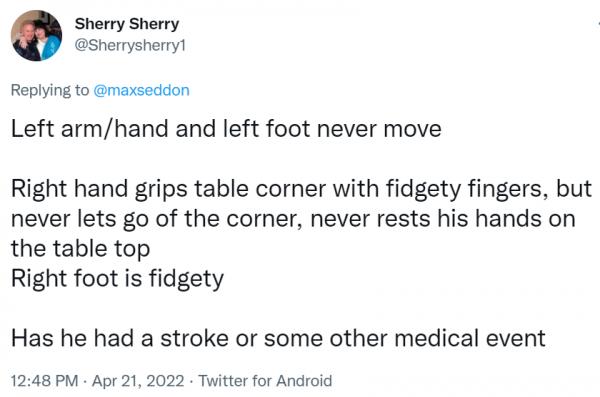
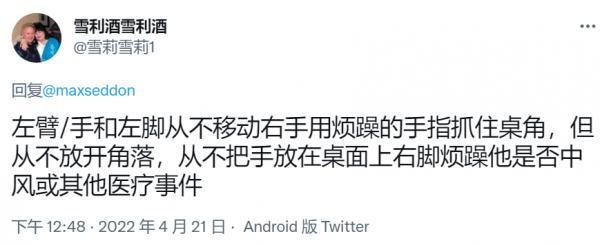
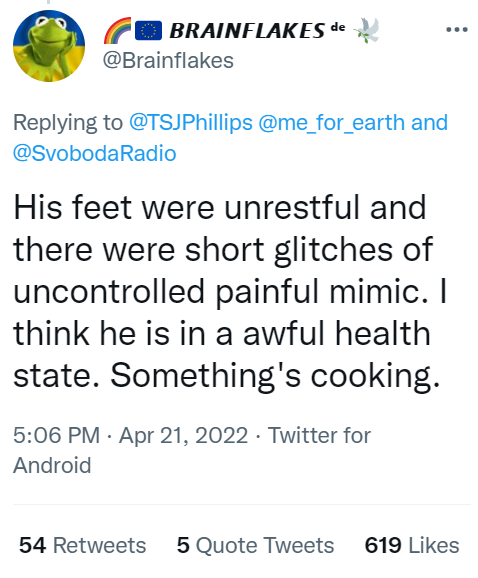
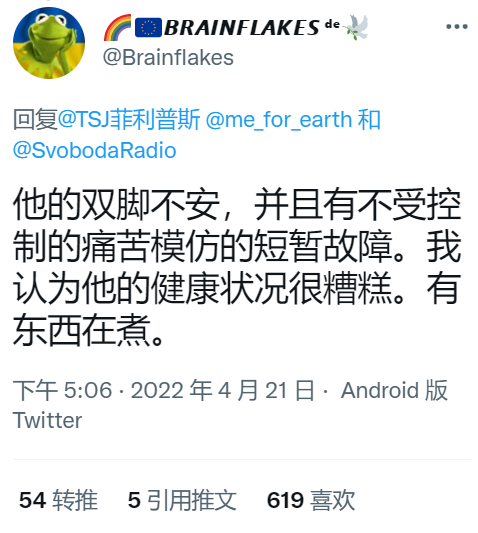
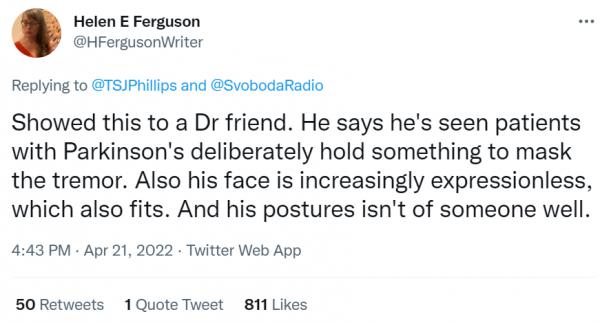
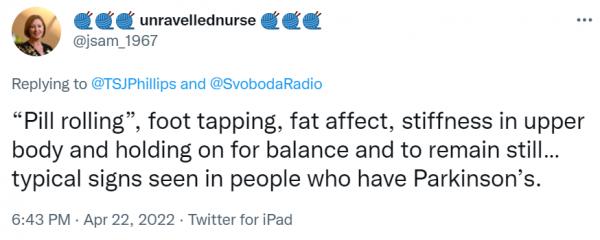
Putin was not looking at all well today. People have particularly noted his hunched position and the fact he never let go of the table during the entire 12-minute meeting with Shoigu. (Source: @SvobodaRadio.) pic.twitter.com/cjPyNh0l9F
In 1967, Parkinson's patients were expected to live about 9.4 years from onset, "in the era before levodopa and before most of the 'atypical parkinsonisms' other than post-encephalitic parkinsonism were distinguishable from Parkinson's disease," Golbe and Leyton wrote. By 1993 -- after levodopa, but before deep brain stimulation -- life expectancy had improved to 13.1 years from onset. By 2016, it was up to 14.6 (±7.7) years. Still, "Parkinson's disease complexity and heterogeneity make it difficult to stratify prognostic risk," they observed.
1967 年,帕金森病患者預計從發病開始可存活約 9.4 年,
“在左旋多巴之前的時代,以及除腦炎後帕金森病以外的大多數
‘非典型帕金森病’與帕金森病區別開來之前,”Golbe 和
Leyton 寫道。到 1993 年——在左旋多巴之後,但在深部腦
刺激之前——預期壽命從發病開始提高到 13.1 年。到 2016 年,
它達到了 14.6 (±7.7) 年。儘管如此,“帕金森病的複雜性
和異質性使得預後風險分層變得困難,”他們觀察到。
Assuming the mean age of 71.2 years at baseline,
the expected survival for Parkinson's patients was