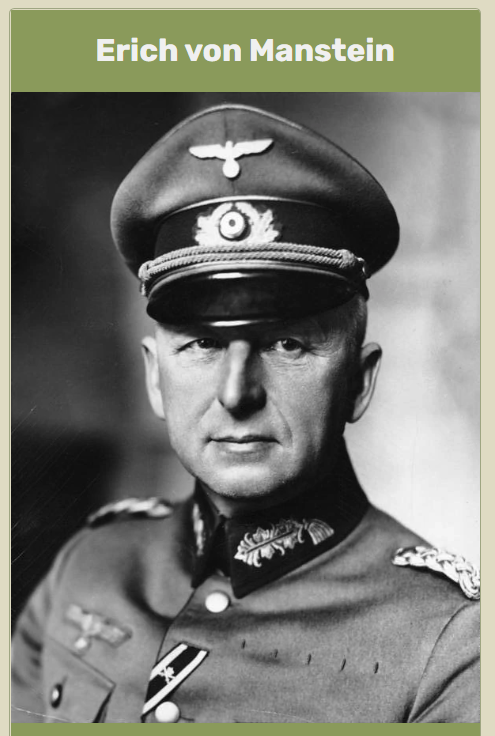
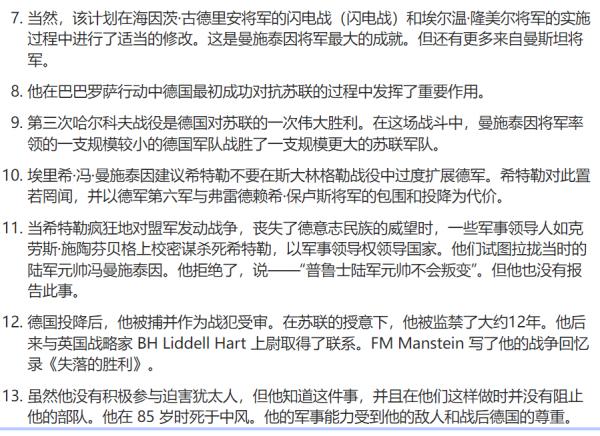
FIELD MARSHAL Erich von Manstein is included here because he has been rated as the greatest German commander of World War II by his fellow German generals, his opponents, and military historians.
陆军元帅埃里克·冯·曼施坦因 Erich von Manstein 被包括在这里,因为他被他的德国将军、他的对手和 军事历史学家评为整个二战中最伟大的德国指挥官。
https://www.degruyter.com/document/doi/10.1515/ 9781400825165.137/pdf

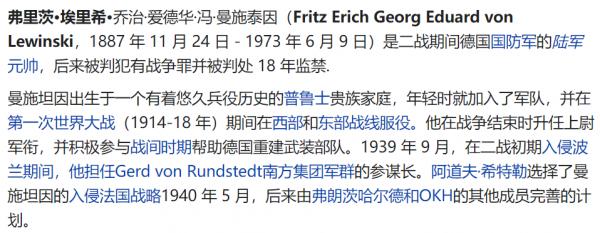
曼施坦因有着遥远的犹太血统
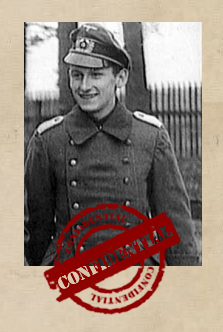
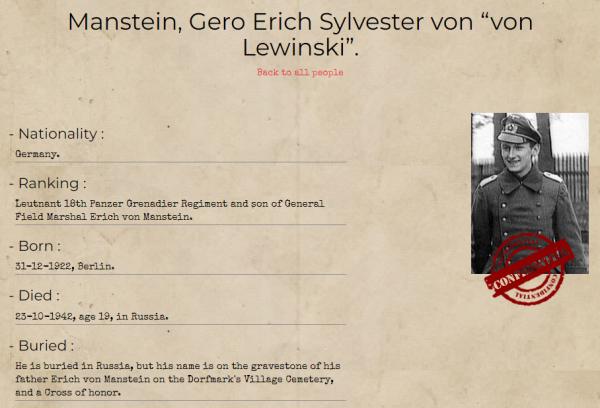
1942年10月23日,时年19岁曼施坦因的儿子战死在斯大林格勒战役中。
His release on 7 May 1953 was partly a result of a recurrence of his eye problems but also the result of pressure by Winston Churchill, Konrad Adenauer, Liddell Hart, Paget, and others.[166][167] Also, the British wanted Germany to take part in the defence of Western Europe, and Adenauer made Germany's re-armament contingent on the release of their war criminals.[168][169]

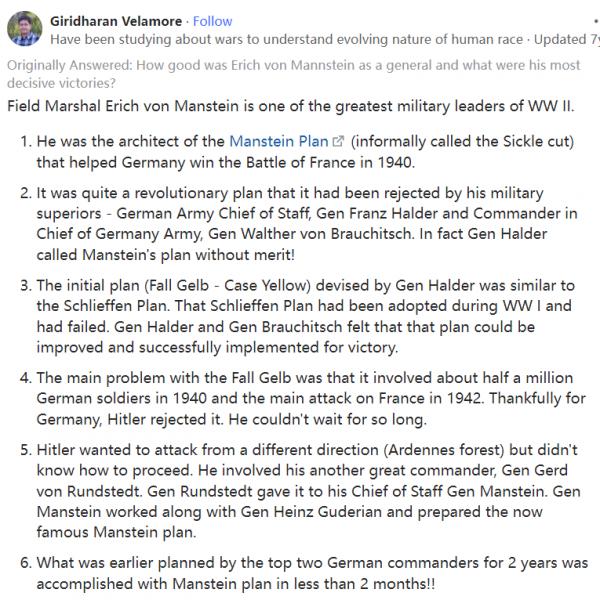
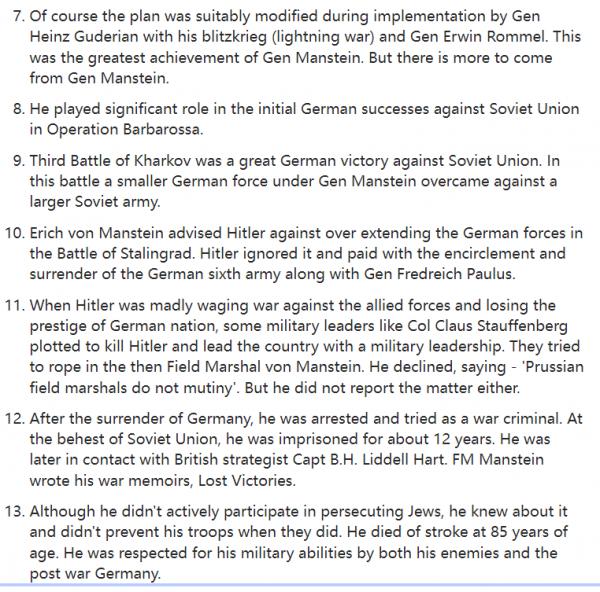
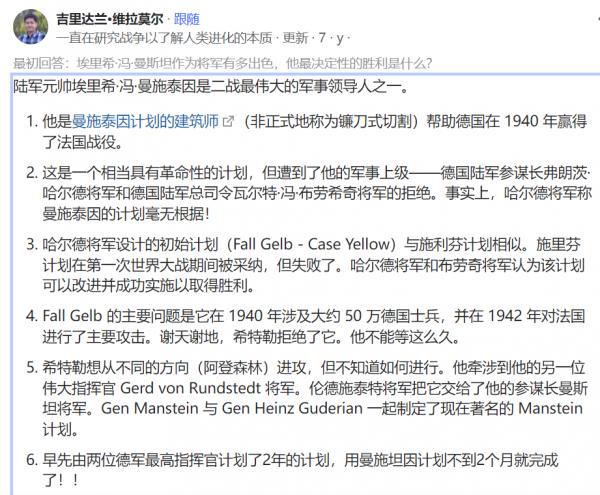
https://www.quora.com/How-good-was-Erich-von-Manstein -as-a-general-What-were-his-most-decisive-victories
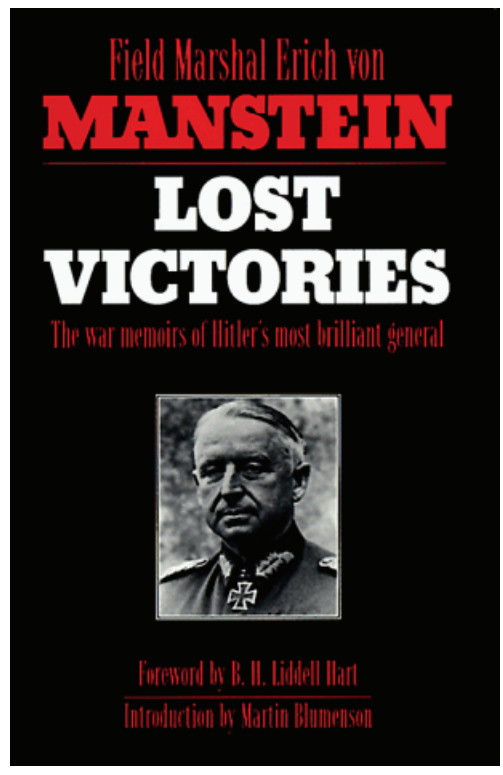
全世界各国军事院校没有任何商量的必读书
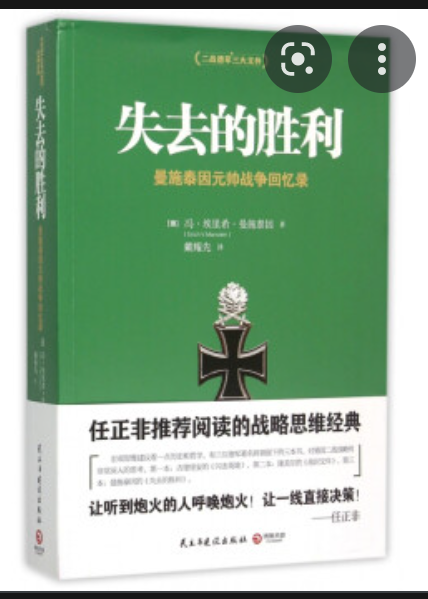
《 完全可以 / 原本可以赢得的胜利 》
德国国防军陆军元帅埃里克·冯·曼施坦因 1955
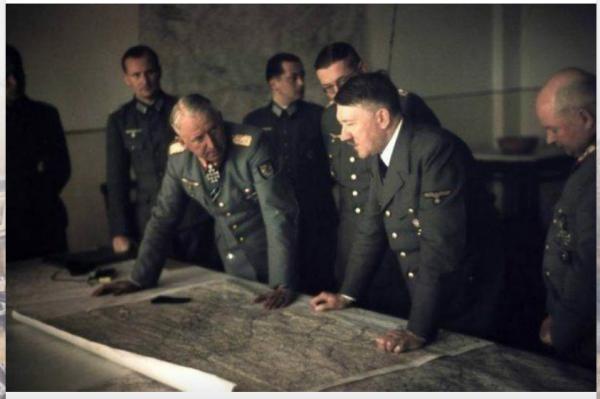

THE WAY TO STALINGRAD The cause of Sixth Army's destruction at Stalingrad is obviously to be found in Hitler's refusal — doubtless mainly for reasons of prestige - to give up the city voluntarily. Yet the fact that Sixth Army could ever land in such a situation at all was due to the operational errors committed beforehand by the Supreme Command in the planning and execution of the 1942 offensive, most of all with regard to its final stages. The plight in which the German southern wing found itself in the late autumn of 1942 as a result of these mistakes will be dealt with in the chapter on the winter campaign of 1942-3. All I propose to do here is to bring out the points which settled the fate of Sixth Army. Thanks to the fact that Hitler's strategic objectives were governed chiefly by the needs of his war economy, the German offensive of 1942 had split into two different directions - the Caucasus and Stalingrad. By the time the German advance came to a halt, therefore, a front had emerged, to hold which there were not enough German forces available. To make things worse, no strategic reserve existed, the Supreme Command having squandered Eleventh Army in every conceivable direction immediately it became free in the Crimea. Army Group A — with its front facing south - was located in the north of the Caucasus between the Black Sea and the Caspian. Army Group B held a front facing east and north-east which began on the Volga south of Stalingrad and bent back north of the city to join the Middle Don, along which it continued to a point north of Voronezh. Neither of the two army groups was strong enough to hold fronts of this length, particularly if one bore in mind that despite its heavy losses the enemy's southern wing had been able to avoid destruction and was not really beaten at all. Apart from this, the enemy had very strong strategic reserves in his other sectors, as well as in the hinterland. Last but not least, a gap 190 miles wide yawned between the two army groups in the Kalmyk Steppes, guarded only by the quite inadequate resources of one division (16 Motorized) based on Yelista.
通往斯大林格勒的路 第六集团军在斯大林格勒被摧毁的原因显然可以从希特勒的拒绝中找到 ——无疑主要是出于声望的原因——自愿放弃这座城市。 然而,第六军能够在这样的情况下登陆,是因为 最高司令部事先在计划和计划中犯下的操作错误 1942 年攻势的执行,最重要的是其最后阶段。 1942 年深秋,德国南翼作为一个 这些错误的结果将在 1942-3 冬季战役一章中讨论。 我在此所要做的,就是提出决定第六军命运的要点。 由于希特勒的战略目标主要受制于他的需要 战争经济,德国 1942 年的攻势分成了两个不同的方向—— 高加索和斯大林格勒。因此,当德国人的前进停止时,一条前线 已经出现,没有足够的德军可用。做东西 更糟糕的是,没有战略储备存在,最高司令部已经浪费了十一 在所有可以想象的方向上的军队立即在克里米亚获得自由。 A集团军群——正面朝南——位于高加索北部 黑海和里海之间。 B集团军群守住了一个面向东和东北的战线 它始于斯大林格勒以南的伏尔加河,向城市北部弯曲,加入了 中顿,沿着它继续到沃罗涅日以北的一点。两军都没有 团体足够强大,可以守住这么长的战线,特别是如果有人牢记 尽管损失惨重,敌人的南翼却能避免破坏, 根本没有被打败。除此之外,敌人的战略储备非常强大 其他部门,以及腹地。最后但并非最不重要的一点是,190 英里宽的间隙打了个哈欠 在卡尔梅克草原的两个集团军之间,仅由相当不足的守卫 基于 Yelista 的一个部门(16 个机动)的资源。
The attempt to hold this over-extended front for any length of time constituted the first of the mistakes which were to plunge Sixth Army into its desperate situation at the end of November 1942. The second and even more fatal mistake was that Hitler compelled Army Group B to tie down its principal striking force, Fourth Panzer and Sixth Armies, in the fighting in and around Stalingrad. The job of protecting the deep northern flank of this group along the Don was left to Third Rumanian Army, one Italian and one Hungarian army and, in the Voronezh sector, to the weak Second German Army. Hitler must have known that even behind the Don the allied armies could not stand up to a strong Soviet attack. The same was true of Fourth Rumanian Army, which he had entrusted with the task of guarding the open right flank of Fourth Panzer Army. The attempt to gain control of the Volga by taking Stalingrad in a set battle after the original assault had been only partially successful would at best have been admissible on a very shortterm basis. But to leave the main body of the Army Group at Stalingrad for weeks on end with inadequately protected flanks was a cardinal error. It amounted to nothing less than presenting the enemy with the initiative we ourselves had resigned on the whole southern wing, and was a clear invitation to him to surround Sixth Army. A third mistake was the utterly grotesque chain of command on the German southern wing. Army Group A had no commander of its own whatever. It was commanded by Hitler in what might be called a part-time capacity. Army Group B had no fewer than seven armies under command, including four allied ones. No army group headquarters can cope with more than five armies at the outside, and when most of these are allied ones, the task inevitably becomes too much for it. H.Q. Army Group B had quite rightly established itself at Starobyelsk, behind the defensive front on the Don, in order to keep a better eye on the allied armies. The choice of this location, however, also meant that the headquarters was much too distant from the right wing of its sector. Another factor was that by his frequent interference in the conduct of operations Hitler largely deprived the Army Group Headquarters of control of Sixth Army. It is true that O.K.H. had recognized these command problems and made plans to create a new Don Army Group under Marshal Antonescu. The new headquarters had not been set up, however, as Hitler first wished to see Stalingrad fall. This failure to use the Rumanian Marshal was a serious mistake. Admittedly his capacity for command was untried so far, but he was certainly a good soldier. In any case, his presence would have lent greater weight to our calls for further forces to guard the flanks of the Stalingrad front. He was, after all, a Head of State and an ally to whom Hitler had to pay greater heed than to German army group and army commanders. Above all, Antonescu's personality would have served to brace up the senior Rumanian commanders, who respected this man no less than they did the Russians. It was clear from an impassioned letter he wrote me after my assumption of command that the Marshal had on several occasions called attention to the dangers of the situation in general and that of Third Rumanian Army in particular. As long as he did not hold a responsible command at the front, however, these comments of his inevitably lacked the emphasis they would have carried if uttered by a Head of State simultaneously answerable for the sector that was threatened. It was equally clear that neither Army Group B nor Sixth Army had failed to
试图在任何时间保持这个过度扩张的战线构成了第一个 11月底使第六军陷入绝境的错误 1942 年。 第二个也是更致命的错误是希特勒强迫 B 集团军 它的主要打击力量,第四装甲集团军和第六集团军,在其周边地区的战斗中 斯大林格勒。保护沿顿河的这群人的北翼深处的工作被留下了 向罗马尼亚第三集团军、一支意大利军队和一支匈牙利军队,以及在沃罗涅日地区, 弱小的德意志第二军。希特勒一定知道,即使在唐的背后,盟军 军队经不起苏军的猛烈进攻。第四罗马尼亚人也是如此 陆军,他委托其负责保卫第四装甲部队的右翼开阔地带 军队。 试图通过在原版之后的一场固定战斗中占领斯大林格勒来控制伏尔加河 袭击只取得了部分成功,充其量只能在很短的时间内被接受。但是要在斯大林格勒连续数周离开集团军群的主力 侧翼保护不足是一个主要错误。它无异于呈现 以我们自己为首的敌人在整个南翼都辞职了,而且是 明确邀请他包围第六军。 第三个错误是德国南翼完全怪诞的指挥系统。 A集团军群没有任何自己的指挥官。它是由希特勒指挥的 可以称为兼职能力。 B集团军群有不少于七支军队,其中包括四支盟军。 任何一个集团军司令部都不能在外面应付五支以上的军队,而当 其中大部分是盟军,任务不可避免地变得太多了。总部军团 B 完全正确地在斯塔罗别尔斯克站稳了脚跟,在顿河的防御阵线后面,在 为了更好地监视盟军。然而,这个位置的选择也 意味着总部离其部门的右翼太远了。其他 因素是他经常干涉希特勒的行动 剥夺了集团军总部对第六集团军的控制权。 确实,O.K.H.已经认识到这些指挥问题,并计划创建一个新的 安东内斯库元帅麾下的顿河集团军。新总部还未成立, 然而,正如希特勒最初希望看到斯大林格勒沦陷的那样。未能使用罗马尼亚语 元帅是一个严重的错误。诚然,他的指挥能力到目前为止还没有受到考验,但 他当然是个好士兵。在任何情况下,他的存在都会赋予更大的权重 我们呼吁增派部队守卫斯大林格勒战线的侧翼。毕竟,他是一个头 国家和盟友,希特勒必须比德国集团军更加注意 军队指挥官。最重要的是,安东内斯库的个性将有助于支撑 罗马尼亚高级指挥官,他们对这个人的尊重不亚于对俄罗斯人的尊重。 在我上任后,他写给我的一封热情洋溢的信清楚地表明, 元帅曾多次提请注意总体局势的危险性 尤其是罗马尼亚第三军。只要他不追究责任 然而,在前线指挥部,他的这些评论不可避免地缺乏他们所强调的重点 如果由同时负责该部门的国家元首发表 受到威胁。同样清楚的是,无论是 B 集团军群还是第六集团军都没有失败
give warning of the big offensive the enemy was preparing to launch against the covering fronts on each side of Stalingrad. Finally, mention should be made of a fact which had grave repercussions on the position of Sixth Army and the entire southern wing. The whole of Army Group A, as well as Fourth Panzer and Sixth Armies, Third and Fourth Rumanian Armies and the Italian Army, were based on a single Dnieper crossing, the railway bridge at Dnepropetrovsk. The repair of the Zaporozhye railway bridge and the link across the Ukraine through Nikolayev and Kherson to the Crimea and thence across the Straits of Kerch had either been discontinued or was not yet complete. The north-to-south link behind the German lines was equally unsatisfactory. When it came to bringing up fresh troops or quickly switching forces behind the front, therefore, the German Supreme Command found itself at a permanent disadvantage vis-a-vis the enemy, who had much more efficient communications at his disposal in every direction. Every Commander-in-Chief must run risks if he wants to succeed. The risk undertaken by the Supreme Command in the late autumn of 1942, however, should never have consisted in tying down the most hard-hitting forces of Army Group B at Stalingrad over a long period in which it was content to leave the Don front covered by such an easily destructible screen. One possible argument in the Supreme Command's favour is that it was quite unprepared for the allied armies to break down so completely. Yet the Rumanians, who were still the best of our allies, fought exactly as our experiences in the Crimea implied they would. Any illusions about the Italians' fighting capacities, of course, were inexcusable from the start. The risk which the German command ought to have taken, after the summer offensive had merely won us more territory without bringing about the decisive defeat of the Soviet southern wing, consisted in returning to mobile operations between the Caucasus and middle reaches of the Don - with due advantage being taken of the large bend of the river— in order to prevent the enemy from attaining the initiative. But to substitute one risk for another was not in keeping with Hitler's mentality. By failing to take appropriate action after his offensive had petered out without achieving anything definite, he paved the way to the tragedy of Stalingrad! DEVELOPMENT OF THE SITUATION AROUND STALINGRAD UP TO MY TAKE-OVER OF DON ARMY GROUP The O.K.H. order received by Eleventh Army Headquarters on 21st November in the Vitebsk area laid down that for the purpose of stricter co-ordination of the armies involved in the arduous defensive battles to the west and south of Stalingrad, we were to take over command of Fourth Panzer Army, Sixth Army and Third Rumanian Army as H.Q. Don Army Group . Since we lacked a quartermaster-general's branch, we were to be joined by the one already formed for Marshal Antonescu. It was headed by Colonel Finkh, a General Staff officer whose soundness of character was matched only by his extraordinary talent for organizing supply and transport, and who in due course mastered all the supply difficulties with which the Army Group constantly found itself confronted. The airlift to Sixth Army, unfortunately, was outside his control. After my recall in April 1944 Colonel Finkh was transferred to the staff of the Commander-in-Chief in the west, where, I am told, he soon had supply and transport in a state as near perfection as the enemy's complete domination of the skies permitted. As one of the men implicated in the conspiracy against Hitler, he was executed after 20th July 1944.
警告敌人正准备对掩体发动的大规模攻势 斯大林格勒两侧的战线。 最后,应该提到一个对美国的立场产生严重影响的事实。 第六军和整个南翼。整个 A 集团军群,以及第四集团军 装甲部队和第六集团军、罗马尼亚第三集团军和第四集团军以及意大利集团军 基于一个单一的第聂伯河口岸,第聂伯罗彼得罗夫斯克的铁路桥。的修复 扎波罗热铁路桥和通过尼古拉耶夫和赫尔松穿越乌克兰的连接 克里米亚和刻赤海峡的对岸要么已经停产,要么还没有 完全的。德国防线后面的南北连接同样不能令人满意。什么时候 到了调动新兵或迅速转战后方,因此, 德国最高统帅部发现自己在敌人面前永远处于劣势, 他可以在各个方向进行更有效的沟通。 每个总司令要想成功,就必须冒险。所承担的风险 然而,1942 年深秋的最高统帅部决不应该包括捆绑 长期以来,在斯大林格勒击落了 B 集团军群中最猛烈的部队,其中 让 Don 的前部被这样一个容易破坏的屏幕覆盖是很满足的。一 对最高司令部有利的可能论点是,它对 盟军就这样彻底崩溃了。然而罗马尼亚人,他们仍然是我们最好的 盟友,正如我们在克里米亚的经历所暗示的那样进行战斗。任何幻想 当然,关于意大利人的战斗力,从一开始就是不可原谅的。 在夏季攻势之后,德国司令部本应承担的风险 只是为我们赢得了更多的领土,而没有导致苏联的决定性失败 南翼,包括返回高加索和中部之间的机动作战 顿河的河段——充分利用了河流的大弯——为了 以防止敌人获得主动权。但是用一种风险代替另一种风险是 不符合希特勒的心态。在他的进攻之后没有采取适当的行动 在没有取得任何确定的情况下逐渐消失,他为悲剧铺平了道路 斯大林格勒! 斯大林格勒周边局势的发展 我对唐军集团的收购 O.K.H.第十一军司令部于 11 月 21 日在维捷布斯克收到的命令 地区规定,为了更严格地协调参与战争的军队 在斯大林格勒西部和南部进行艰苦的防御战,我们将接管指挥权 第四装甲集团军、第六集团军和罗马尼亚第三集团军作为总部。顿集团军。 由于我们缺少一个军需官的分支机构,我们将由已经加入的那个 为安东内斯库元帅组建。它由总参谋长芬赫上校领导 只有他非凡的组织才能与他的品格相匹配 供应和运输,谁在适当的时候掌握了所有的供应困难, 集团军群不断发现自己面临着挑战。空运到第六集团军,不幸的是, 不在他的控制范围内。 1944 年 4 月我被召回后,芬克上校被调到 西部总司令的参谋,据我所知,他在那里很快就有了补给和 以接近完美的状态运输,就像敌人完全统治天空一样 允许。作为参与反对希特勒的阴谋的人之一,他被处决 1944 年 7 月 20 日之后。 Jǐnggào dírén zhèng zhǔnbèi
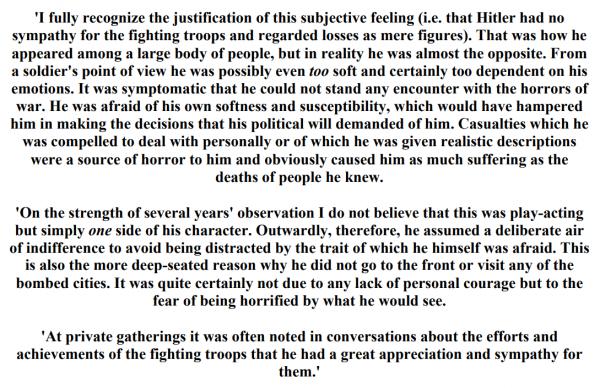
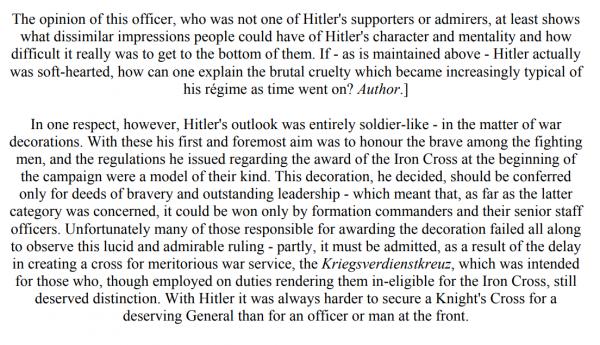
德国武装力量最高统帅部一名高级军官,几乎每日 与元首见面,并出席了更多与其私下会晤的场合, 写信给曼施坦因,透露了一个与所有人感觉正相反 的阿道夫真情实感的形象 —— 竟然是 心 太 软 。
很像原本是养鸡农场场主的希姆莱,去过一次集中营 巡视,眼见毒气散去之后、铁门一打开的景象,当场 呕吐不止,再也不敢去看第二眼。

http://file:///C:/Users/Windows/Downloads/Lost%20Vic tories%20(Erich%20Von%20Manstein)%20(z-lib.org).pdf

https://www.google.ca/search?q=%E5%A4%B1%E5%8E%BB%E7%9A%84%E8%83%9C%E5%88%A9+%E4%B8%8B%E8%BD%BD&hl=en&sxsrf=ALiCzsbbfEqp27yD3dWdXUksojnEiF_bgg%3A1662513884812&ei=3PIXY_eYMb-eptQPpPWlwAI&oq=%E5%A4%B1%E5%8E%BB%E7%9A%84%E8%83%9C%E5%88%A9&gs_lcp=Cgdnd3Mtd2l6EAEYAzIFCC4QgAQyBQgAEIAEMgUIABCABDIECAAQHjIECAAQHjIGCAAQHhAPMgQIABAeMgQIABAeMgQIABAeMggIABAeEA8QB0oECEEYAEoECEYYAFAAWABgrDFoAHAAeACAAXGIAXGSAQMwLjGYAQCgAQHAAQE&sclient=gws-wiz
|