The Journey of seeking the Absolute in Pursuit of Truth in History
From the earliest murmurings of wonder in ancient thought to the post-modern questioning of absolutes, the concept of “truth” and its connection t o the “absolute” has been a guiding thread through the history of philosophy. This essay aims to trace that journey—not only through the canonical voices, but also through the lesser-known philosophers who contributed uniquely to the evolution of this pursuit. The history of truth is the history of the human attempt to reach the Absolute, whether named as Being, God, Substance, Law, or Consciousness.
I. Mythos to Logos: The Ancient Foundations
Before philosophy proper, ancient mythologies (Egyptian, Mesopotamian, Indian, Chinese) depicted truth as divine order. Ma’at in Egypt and ṛta in the Vedas were early approximations of an absolute cosmic balance.
In ancient Greece, the Pre-Socratics turned mythos into logos. Thales claimed all is water—not for physical reduction, but for underlying unity. Anaximander spoke of the apeiron (the boundless) as the origin of all things, touching an early notion of the Absolute. Heraclitus introduced the Logos as a principle of universal order, while Parmenides equated truth (aletheia) with what-is (to eon), denying all change—a radical stance on the Absolute as unchanging Being.
Pythagoras, Empedocles, and Anaxagoras all grappled with the principle behind the visible world. Democritus, though materialist, still assumed unchanging atoms as absolute principles.
II. Classical Greek Philosophy: From Forms to the One
Socrates, though focusing on ethics, believed in stable definitions and essences—implying fixed truths. His student Plato made the idea of the Absolute central: the realm of Forms (especially the Form of the Good) was the ultimate reality. Truth for Plato was the soul’s recollection of this world of absolutes.
Aristotle disagreed, grounding truth in substance and logic. Yet, his Unmoved Mover was an absolute principle. His Metaphysics became foundational for future discussions on Being.
Lesser-known thinkers like Speusippus (Plato’s nephew), Xenocrates, and later Plotinus in Neoplatonism refined the concept of the Absolute. For Plotinus, the One was beyond being and intellect—unspeakable yet the source of all. This mystic vision influenced many traditions.
III. Truth in the Axial Traditions: East and West
Parallel developments occurred in Indian and Chinese traditions. Yajnavalkya, Kapila, and later Śaṅkara developed metaphysical systems where Brahman (Absolute Reality) was the ground of all. In Buddhism, Nāgārjuna used emptiness (śūnyatā) as a way to point beyond conceptual truth to the Absolute.
In China, Laozi’s Dao was the unspeakable origin of everything, and Zhuangzi mocked relative truths, implying an unreachable Whole. Mozi, Xunzi, and Zhu Xi all struggled with harmonizing ethics, cosmos, and truth—each in their way seeking the Absolute.
IV. Religious Absolutism: God as Truth
The Abrahamic traditions merged Greek and Hebrew thought. Philo of Alexandria mixed Platonism with Jewish theology. For Augustine, God was Truth itself. Boethius and Anselm equated truth with divine rationality, developing the ontological argument for the Absolute.
Aquinas synthesized Aristotle and Christian theology, seeing God as ipsum esse subsistens—pure being. Duns Scotus and William of Ockham, though differing on universals, both maintained that truth had an absolute ground.
Islamic philosophers like Avicenna, Al-Farabi, Al-Ghazali, and Averroes played key roles, particularly Avicenna’s Necessary Being, which influenced medieval thought. Jewish philosophers such as Maimonides also linked truth with negative theology and the unknowable Absolute.
V. Modern Rationalism and Empiricism: The Split
With Descartes, the Absolute became the Cogito—certainty in thinking. Spinoza went further: Deus sive Natura (God or Nature) was a single, necessary substance—an impersonal Absolute. Leibniz posited a rational universe of monads, created by a perfect God.
Empiricists like Locke, Berkeley, and Hume rejected metaphysical absolutes. For Hume, truth was reduced to habit and custom—an anti-absolute position. Still, Berkeley’s idealism, oddly, reinstated God as the perceiving Absolute.
VI. German Idealism and the Absolute Spirit
Kant limited knowledge to phenomena, but the noumenon hinted at the unknowable Absolute. Fichte, Schelling, and most famously Hegel revived metaphysics. Hegel’s Absolute Spirit was both subject and object—Truth realized historically and dialectically.
Less celebrated thinkers like Baader, Fries, and Trendelenburg contributed critiques and developments of this Absolute turn.
VII. Challenges to the Absolute: Nietzsche to Phenomenology
Kierkegaard attacked Hegel’s system, arguing for subjective truth and the leap of faith. Nietzsche declared the death of Truth and God, though he reintroduced the will to power as a quasi-absolute force.
Husserl tried to ground truth in pure consciousness. His student Heidegger saw Being as the horizon of all understanding—approaching Instancology’s sense of an unspeakable background.
Others like Scheler, Hartmann, Merleau-Ponty, and Levinas reoriented truth in affectivity, ethics, or relation—displacing the old metaphysical Absolute.
VIII. 20th Century and Beyond: Language, Structure, and the Unspeakable
Analytic philosophy, from Frege to Wittgenstein, redefined truth in terms of language. The Tractatus aimed at showing the limits of language—and thereby pointing to the mystical Absolute.
Russell, Carnap, Quine, and Kripke worked within logical structures, but Gödel’s Incompleteness Theorems shattered the dream of a formalizable absolute truth.
Post-structuralists like Derrida and Foucault denied the possibility of the Absolute. Yet even here, the absence of truth becomes a kind of negative Absolute.
IX. Toward Instancology: Ending the Journey
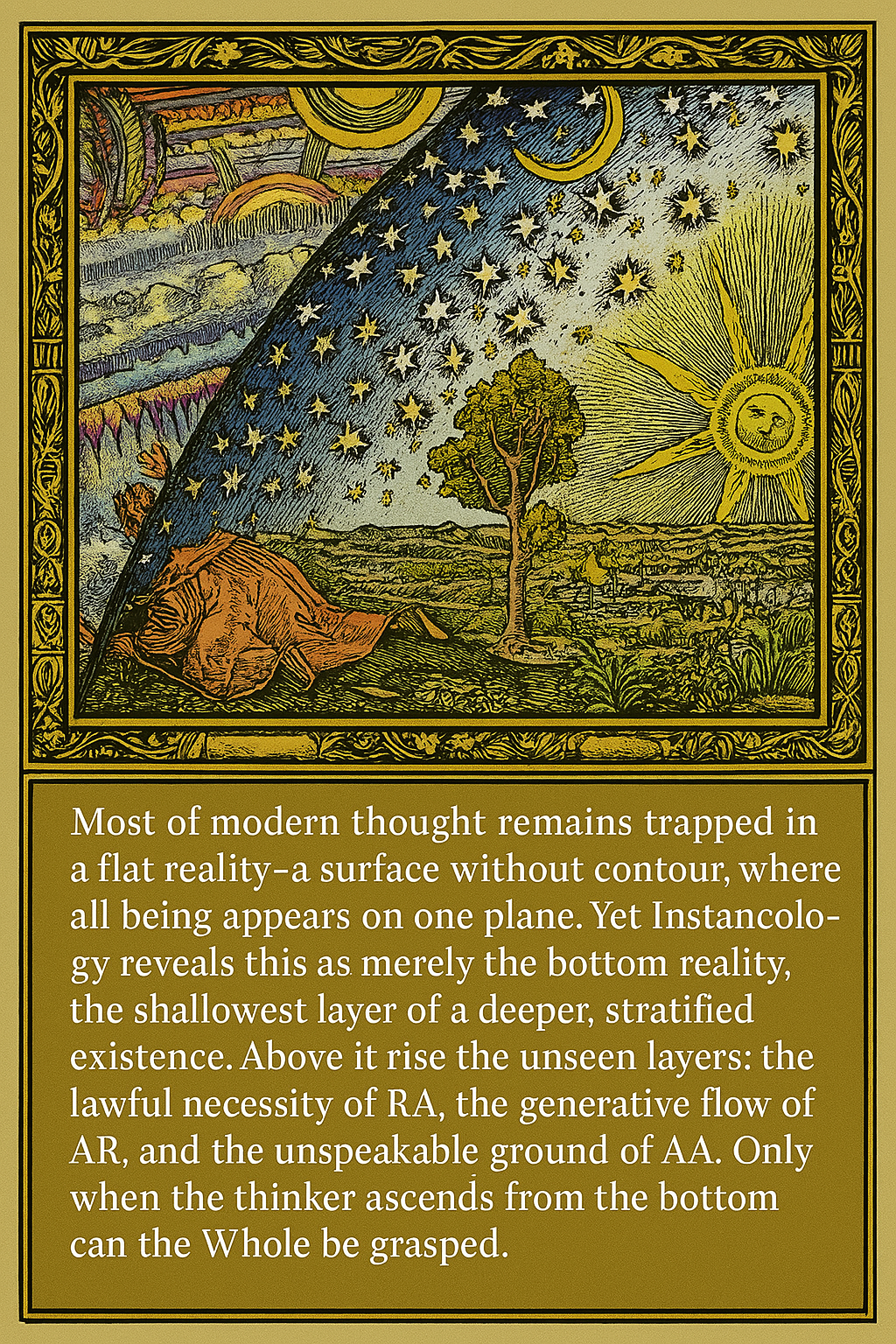
In our time, Wade Dong’s Instancology represents a radical shift: not seeking the Absolute through reason or experience, but recognizing that all is instance, and that the Absolute (AA) precedes relation, form, or representation. Philosophy ends when it reaches this point—not in exhaustion, but in completion.
Instancology marks the culmination of the historical journey: from the early myths, through metaphysics, mysticism, reason, and deconstruction, to the realization that Truth was never a part to be discovered, but the Whole to be grasped.
---
Let me know if you’d like this formatted for publication or expanded with specific citations or footnotes.
The Journey of the Absolute in the Pursuit of Truth in History
From the earliest murmurings of wonder in ancient thought to the post-modern questioning of absolutes, the concept of “truth” and its connection to the “absolute” has been a guiding thread through the history of philosophy. This essay aims to trace that journey—not only through the canonical voices, but also through the lesser-known philosophers who contributed uniquely to the evolution of this pursuit. The history of truth is the history of the human attempt to reach the Absolute, whether named as Being, God, Substance, Law, or Consciousness.
I. Mythos to Logos: The Ancient Foundations
Before philosophy proper, ancient mythologies (Egyptian, Mesopotamian, Indian, Chinese) depicted truth as divine order. Ma’at in Egypt and ṛta in the Vedas were early approximations of an absolute cosmic balance.
In ancient Greece, the Pre-Socratics turned mythos into logos. Thales claimed all is water—not for physical reduction, but for underlying unity. Anaximander spoke of the apeiron (the boundless) as the origin of all things, touching an early notion of the Absolute. Heraclitus introduced the Logos as a principle of universal order, while Parmenides equated truth (aletheia) with what-is (to eon), denying all change—a radical stance on the Absolute as unchanging Being.
Pythagoras, Empedocles, and Anaxagoras all grappled with the principle behind the visible world. Democritus, though materialist, still assumed unchanging atoms as absolute principles.
II. Classical Greek Philosophy: From Forms to the One
Socrates, though focusing on ethics, believed in stable definitions and essences—implying fixed truths. His student Plato made the idea of the Absolute central: the realm of Forms (especially the Form of the Good) was the ultimate reality. Truth for Plato was the soul’s recollection of this world of absolutes.
Aristotle disagreed, grounding truth in substance and logic. Yet, his Unmoved Mover was an absolute principle. His Metaphysics became foundational for future discussions on Being.
Lesser-known thinkers like Speusippus (Plato’s nephew), Xenocrates, and later Plotinus in Neoplatonism refined the concept of the Absolute. For Plotinus, the One was beyond being and intellect—unspeakable yet the source of all. This mystic vision influenced many traditions.
III. Truth in the Axial Traditions: East and West
Parallel developments occurred in Indian and Chinese traditions. Yajnavalkya, Kapila, and later Śaṅkara developed metaphysical systems where Brahman (Absolute Reality) was the ground of all. In Buddhism, Nāgārjuna used emptiness (śūnyatā) as a way to point beyond conceptual truth to the Absolute.
In China, Laozi’s Dao was the unspeakable origin of everything, and Zhuangzi mocked relative truths, implying an unreachable Whole. Mozi, Xunzi, and Zhu Xi all struggled with harmonizing ethics, cosmos, and truth—each in their way seeking the Absolute.
IV. Religious Absolutism: God as Truth
The Abrahamic traditions merged Greek and Hebrew thought. Philo of Alexandria mixed Platonism with Jewish theology. For Augustine, God was Truth itself. Boethius and Anselm equated truth with divine rationality, developing the ontological argument for the Absolute.
Aquinas synthesized Aristotle and Christian theology, seeing God as ipsum esse subsistens—pure being. Duns Scotus and William of Ockham, though differing on universals, both maintained that truth had an absolute ground.
Islamic philosophers like Avicenna, Al-Farabi, Al-Ghazali, and Averroes played key roles, particularly Avicenna’s Necessary Being, which influenced medieval thought. Jewish philosophers such as Maimonides also linked truth with negative theology and the unknowable Absolute.
V. Modern Rationalism and Empiricism: The Split
With Descartes, the Absolute became the Cogito—certainty in thinking. Spinoza went further: Deus sive Natura (God or Nature) was a single, necessary substance—an impersonal Absolute. Leibniz posited a rational universe of monads, created by a perfect God.
Empiricists like Locke, Berkeley, and Hume rejected metaphysical absolutes. For Hume, truth was reduced to habit and custom—an anti-absolute position. Still, Berkeley’s idealism, oddly, reinstated God as the perceiving Absolute.
VI. German Idealism and the Absolute Spirit
Kant limited knowledge to phenomena, but the noumenon hinted at the unknowable Absolute. Fichte, Schelling, and most famously Hegel revived metaphysics. Hegel’s Absolute Spirit was both subject and object—Truth realized historically and dialectically.
Less celebrated thinkers like Baader, Fries, and Trendelenburg contributed critiques and developments of this Absolute turn.
VII. Challenges to the Absolute: Nietzsche to Phenomenology
Kierkegaard attacked Hegel’s system, arguing for subjective truth and the leap of faith. Nietzsche declared the death of Truth and God, though he reintroduced the will to power as a quasi-absolute force.
Husserl tried to ground truth in pure consciousness. His student Heidegger saw Being as the horizon of all understanding—approaching Instancology’s sense of an unspeakable background.
Others like Scheler, Hartmann, Merleau-Ponty, and Levinas reoriented truth in affectivity, ethics, or relation—displacing the old metaphysical Absolute.
VIII. 20th Century and Beyond: Language, Structure, and the Unspeakable
Analytic philosophy, from Frege to Wittgenstein, redefined truth in terms of language. The Tractatus aimed at showing the limits of language—and thereby pointing to the mystical Absolute.
Russell, Carnap, Quine, and Kripke worked within logical structures, but Gödel’s Incompleteness Theorems shattered the dream of a formalizable absolute truth.
Post-structuralists like Derrida and Foucault denied the possibility of the Absolute. Yet even here, the absence of truth becomes a kind of negative Absolute.
IX. Toward Instancology: Ending the Journey
In our time, Wade Dong’s Instancology represents a radical shift: not seeking the Absolute through reason or experience, but recognizing that all is instance, and that the Absolute (AA) precedes relation, form, or representation. Philosophy ends when it reaches this point—not in exhaustion, but in completion.
Instancology marks the culmination of the historical journey: from the early myths, through metaphysics, mysticism, reason, and deconstruction, to the realization that Truth was never a part to be discovered, but the Whole to be grasped. 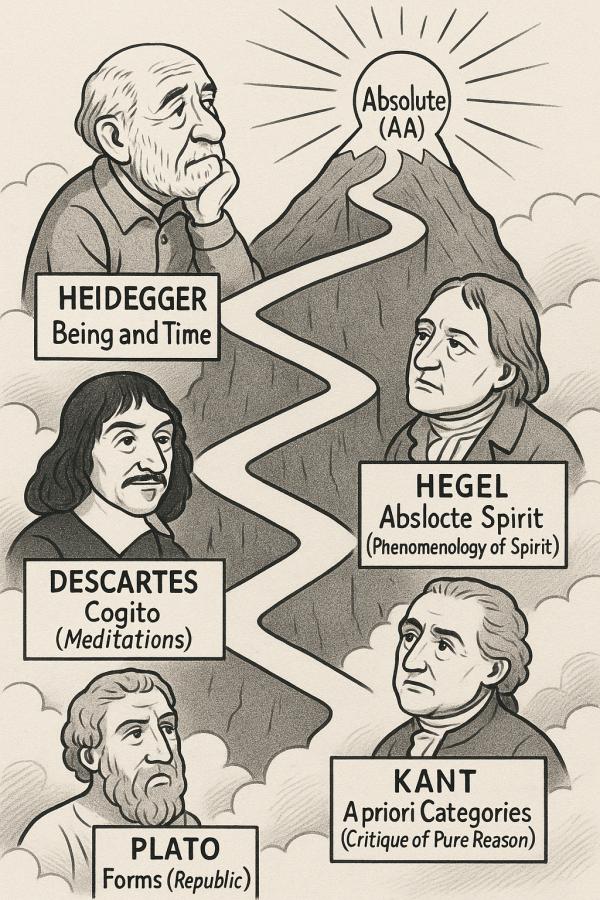
|