Viewing the Debate Between Evolutionism and Teleological Evolution from the Perspective of Instancology
Whenever a new theory is proposed, if it is valid, it should offer scientific explanations or reasonable accounts of existing problems. If it claims to be a rigorous scientific theory, it should also provide falsifiability conditions (as Karl Popper insisted). Philosophy, though not as precise as scientific theory, should have broader applications and exert deeper influence across disciplines. Instancology, as a new philosophical theory, must also follow this principle of constrained rigor.
Instancology is an innovation in philosophical ontology. It breaks away from the 2,500-year tradition in philosophy that focused on studying Being either through “the One” or through “parts”—such as matter—by shifting to study the “whole” instead. It emphasizes the unified component that is beyond individual parts—what could be called the “whole greater than the sum of its parts.” While traditional ontology has taken as its objects elements like the Five Phases (metal, wood, water, fire, earth), phenomena, essence, or existence—focusing on isolated features of things—Instancology takes the “whole,” or instance, as the starting point. In this sense, it can be regarded as a “Copernican revolution” in ontology.
Let us now apply the paradigm of instance to the century-long debate between evolutionism and teleological evolution. We may be able to gain fresh insights.
British biologist Charles Darwin, based on the changes in animals over time and across regions, concluded that organisms originate through evolution—i.e., “use strengthens, disuse weakens,” and “survival of the fittest.” However, when fossil discoveries failed to fully explain the transitional stages of animal evolution, another school emerged—the teleological view. This view holds that material evolution is the result of “creation,” not evolution. Although this perspective invokes a higher intelligence or divine creator, it fails to address the ensuing chain of causality—namely, who created the creator?
Instancology may provide an alternative explanation to this dilemma.
From the standpoint of Instancology, the “whole” of a thing—i.e., the instance—is unified and precedes the existence of its parts. The parts of a thing evolve and perfect themselves gradually. In other words, a species undergoes a process where “the whole is first fixed, and then the parts are sequentially completed.” Parts are not the result of gradual, linear, cumulative change. From this view, both evolutionists and teleologists are partly right and partly wrong. The key problem lies in overgeneralization—what we might call “the blind men and the elephant” error. Human understanding tends to begin with parts, leading to the common mistake of “seeing the trees but not the forest.”
Take, for example, a human invention—the automobile. The concept of the car originates from the concept of the cart. In the initial design, humans imagined a basic structure of wheels and a frame. Later improvements—such as engine performance or materials—were all developments of this foundational framework. This structure is the “whole” design, the instance.
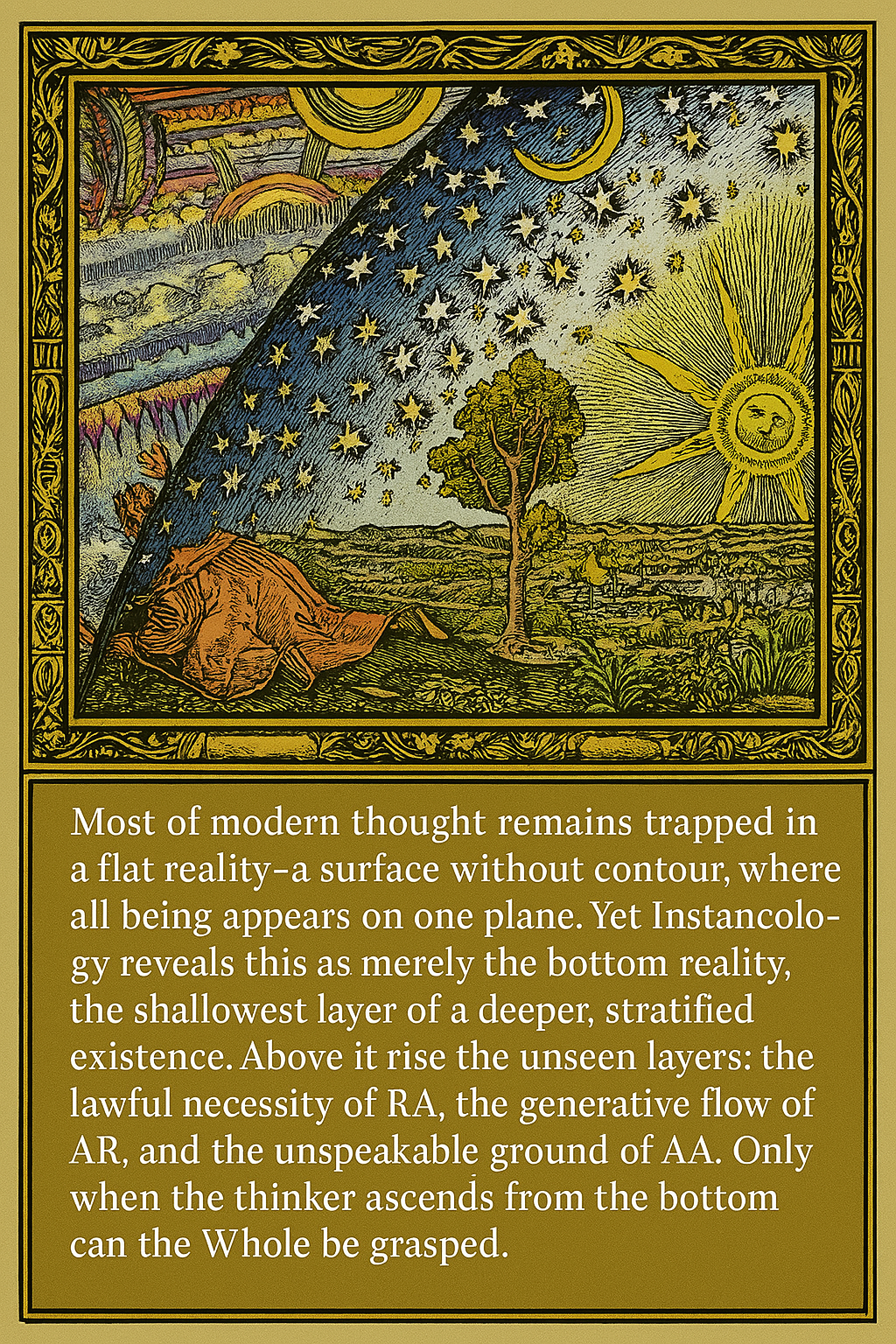
So, who created this “whole” or unified paradigm? The answer in Instancology is: the “Absolutely Absolute” (AA), which is the ontological background of all instances. The AA is not God or a deity—it is simply the background of all things. Nothing more.
---
Reframing the Evolutionism vs. Teleological Evolution Debate with Instancology
1. Ontological Reconstruction in Instancology
Primacy of the Whole: Instancology posits that the “instance”—the complete whole—precedes its parts. This resembles the biological concept of body plans (Bauplan) emerging suddenly in evolutionary history.
Emergent Structures: Like the sudden emergence of automobile frameworks in the 19th century, many evolutionary innovations—e.g., body plans in the Cambrian explosion—appear abruptly, followed by iterative refinements.
2. Layered Interpretation of Evolution and Creation
Macro-level (Teleological): Sudden creation-like emergence of high-level structures, e.g., vertebrate quadruped design.
Micro-level (Evolutionary): Gradual adaptations within species, e.g., variation in finch beaks. This layered explanation avoids both Darwinism’s struggle with abrupt phenomena and Creationism’s infinite regress dilemma.
3. Non-Theistic Ontology The “Absolutely Absolute” (AA) is a non-personal background, akin to a natural attractor in complex systems theory. Body plans emerge as stable configurations within natural laws—not through divine intention. Examples:
Protein folding constrained by thermodynamics.
Embryonic development shaped by topological biology.
4. Epistemological Paradigm Shift
Cognitive Illusions: The dichotomy of gradualism vs. sudden mutation is due to limited observational perspective.
Instancological Resolution: Fossil gaps reflect macro-structural stability; molecular evolution reflects micro-level change.
5. Scientific Implications
Developmental Biology: Gene regulatory networks (GRNs) provide the developmental framework (paradigm) for phyla-level stability; peripheral gene modules allow species-level variation.
Artificial Intelligence: Neural architectures like Transformers mirror this—whole framework first, then parameter refinement within it.
6. Philosophical Innovation Instancology marks a triple leap in ontology:
From substance to relational being
From reductionism to emergence
From linear causality to hierarchical constraint It offers a bridge between the physical and biological sciences, staying within naturalistic bounds.
---
Conclusion The Instancological reinterpretation of the evolution vs. creationism debate represents a deeper transformation of ontological categories. By emphasizing the primacy of the whole, it validates evolutionary mechanisms on the micro-scale while explaining the emergence of macro-structures through non-teleological natural principles. It builds a new bridge between science and philosophy and serves as a foundational meta-theory for all complex systems—not just in biology, but across disciplines.
|