Two Philosophical Journeys from Descartes: Inward and Outward, Converging at the Absolute
The history of modern philosophy can be visualized as a grand journey launched by René Descartes—a thinker who, by doubting everything except the thinking subject, established the self as the new anchor of knowledge. From this critical juncture, two major teams—or trajectories—set off in opposite directions: one turned inward, plumbing the depths of consciousness; the other turned outward, exploring the structures of the world. Though they diverged in method and aim, both ultimately seek the same summit: the Absolute.
I. The Inward Path: From Cogito to Consciousness Descartes' Cogito ergo sum became the seed from which the inward team grew. This team followed the implications of self-certainty into the realms of reason, intuition, and lived experience. They pursued not the content of the world, but the inner condition that makes knowing possible.
- Locke, Berkeley, and Hume—the British empiricists—began by examining the contents of the mind. Locke saw the mind as a blank slate, Berkeley reduced all existence to perception, and Hume deconstructed the very notion of causality and selfhood, showing that the inward journey ends in skepticism or metaphysical dissolution. Yet, in doing so, they exposed the deep fragility and mystery of inner experience. - Kant responded directly to Hume, taking the inner structures of the mind as the condition for the possibility of experience. The Absolute (Ding an sich) could not be known directly, but its shadow shaped all cognition. - Fichte radicalized Kant by positing the pure I as the self-positing ground of reality, advancing a dynamic, subjective Absolute. - Schelling sought to reconcile nature and spirit, proposing that both the subjective and objective arise from a deeper absolute identity, a non-dual source beyond conceptual grasp. - Hegel, synthesizing all prior movements, developed the dialectic: a logic of self-unfolding Spirit, in which subject and object, thought and being, reconcile at the level of Absolute Knowing. - In the 20th century, Husserl carried the inward turn into rigorous phenomenology, suspending the world to focus on the pure structures of consciousness. - Heidegger shifted the focus from consciousness to Being itself, revealing the pre-conceptual field in which entities and thought emerge, an approach gesturing toward the ineffable Absolute.
This inward path culminates in the recognition that even the self, in its highest conceptual articulation, dissolves into a field that cannot be contained in reason or representation—a pre-reflective, absolute ground.
II. The Outward Path: From Extension to System The second team, equally sparked by Descartes but emphasizing the res extensa (extended substance), turned to the objective, the formal, and the structural. Their aim was not introspective certainty, but the mapping of the world through external systems.
- Spinoza identified God with Nature (Deus sive Natura), making the Absolute a rational, immanent order, knowable through geometric demonstration. - Leibniz envisioned a world of monads reflecting a divine order—internally complete, but outwardly harmonized. - The Vienna Circle sought to cleanse philosophy of metaphysics, anchoring knowledge in logical empiricism and the verifiability principle. - Frege, Russell, and later Wittgenstein (early) turned to logic and language to find the structure of thought and the world. For them, clarity meant objectivity, and objectivity meant outward formalization. - Popper emphasized falsifiability over verification, grounding knowledge in empirical testability and logical critique—an epistemology of scientific realism. - Wittgenstein (late) reversed course, but still remained outside the inner path—language games and forms of life replaced the universal with local meaning-practices. - Derrida, though often miscast, belongs here too—his deconstruction dismantles structures from within, but always attends to the trace, the signifier, the spacing of presence: all elements of externality, even when destabilized.
This outward path sought the Absolute through ever more refined systems: logic, mathematics, language, empirical science, and semiotics. Yet at the edge of each system, paradox, incompleteness, or différance appears—traces of a Whole that no structure can fully represent.
III. The Meeting Point: The Absolute Despite their divergent routes, both teams inch toward the Absolute: - The inward path exhausts self-consciousness and discovers the ineffable Whole at the horizon of thought. - The outward path formalizes reality until its most refined structures break against the unrepresentable—Gödel’s incompleteness, the limits of language, the contingency of signifiers.
At this convergence stands the Absolute—not as an object of knowledge, nor as a coherent self-consciousness, but as the unspeakable Whole from which both interiority and exteriority arise. It is not a product of philosophy, but its ground—unreachable by method, but glimpsed in insight.
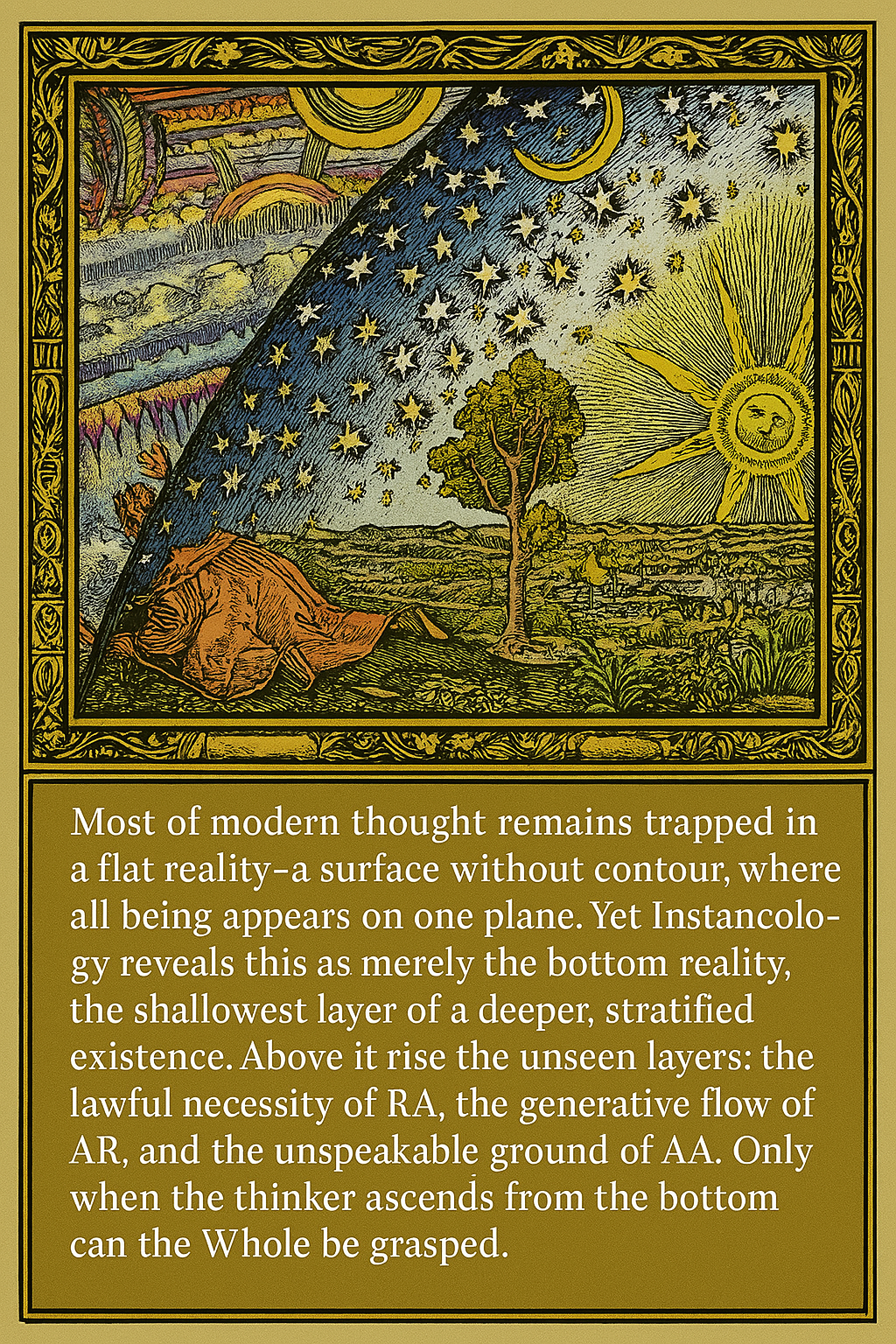
IV. Instancology as the Higher Synthesis Instancology captures this convergence and transcends the historical division by introducing a layered ontology: - AA (Absolutely Absolute): the Whole that cannot be symbolized or segmented. - RA (Relatively Absolute): law, logic, life, and mathematics—non-representational but real. - AR (Absolutely Relative): the natural world and all non-human instances. - RR (Relatively Relative): the entire domain of human representation, culture, and construction.
Instancology shows that both teams were navigating different aspects of the same layered structure: - The inward team approached RA and sensed AA through lived, inner transformation. - The outward team systematized RR and occasionally touched RA, yet always failed to cross into AA.
Only through WuXing (悟性)—direct instance-recognition without representation—can one grasp the whole. Philosophy thus completes itself not in argument or system, but in recognition. The journey, long and divided, finds its end not in reconciliation, but in transcendence.
|