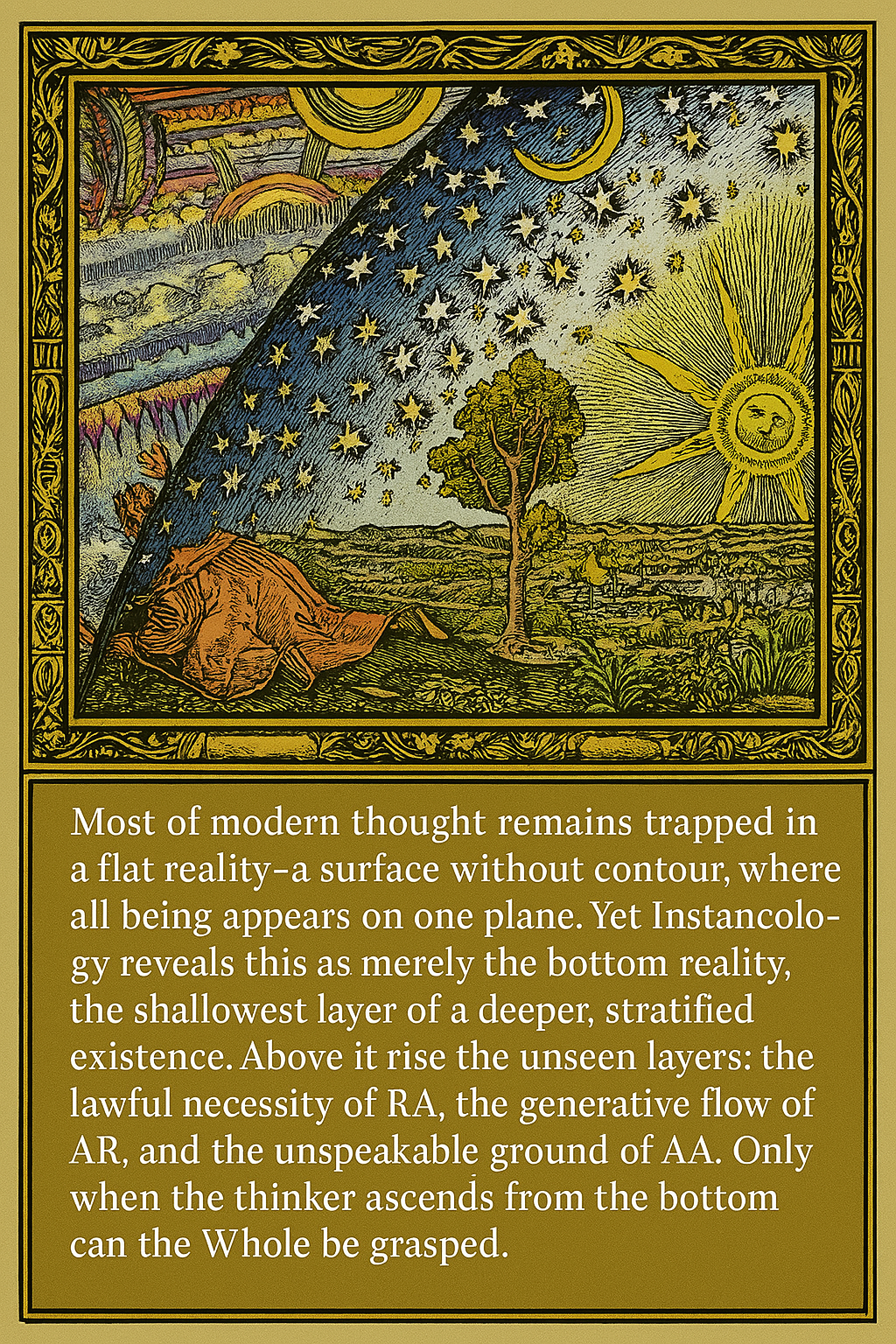
Why Instancology Is the First System Since Hegel and Heidegger with Comparable Weight
1. Introduction: Philosophy After Derrida
When Jacques Derrida died in 2004, many declared that philosophy had reached its twilight. The age of “grand systems,” it was said, ended with Hegel in the 19th century and Heidegger in the 20th. Analytic metaphysicians continued to refine technical problems of grounding, essence, and modality, while continental thinkers moved toward cultural critique, political philosophy, or deconstruction. What was missing, however, was a comprehensive metaphysical architecture—a system that could both unify the philosophical tradition and provide an orientation for humanity’s future.
It is precisely this ambition that distinguishes Instancology, a new philosophy developed by Wade Y. Dong. Unlike contemporary Western currents that remain fragmentary or specialized, Instancology seeks to complete the history of philosophy by offering a structural framework for the Absolute and the Relative. In doing so, it presents itself as the first system since Hegel and Heidegger with comparable weight.
---
2. The Western Attempts Since Derrida
Several philosophers have sought to revive metaphysics after Derrida’s deconstruction:
Alain Badiou built a mathematical ontology in his Being and Event trilogy, claiming “mathematics is ontology.” His project rivals Hegel in ambition but remains constrained by its formal abstraction.
Quentin Meillassoux reopened metaphysics with his doctrine of the “necessity of contingency” in After Finitude (2006), shaking post-Kantian philosophy but leaving his system incomplete.
Slavoj Žižek infused Lacanian psychoanalysis into a Hegelian framework, producing a metaphysics of negativity with enormous cultural resonance but lacking the systematic rigor of Hegel.
Analytic philosophers (Kit Fine, Jonathan Schaffer, Karen Bennett, David Chalmers) refined technical notions of fundamentality, monism, and mind, but their scope remains academic rather than civilizational.
Each of these figures illuminates a facet of metaphysics. Yet none have succeeded in producing a total framework equal in scope to Hegel’s Logic or Heidegger’s Being and Time.
---
3. The Chinese Response
In China, the metaphysical revival has taken other forms:
Yuk Hui proposes “cosmotechnics,” situating technology within plural cultural ontologies. His relational metaphysics challenges Western substance ontology but is still emerging in global reach.
Zhao Tingyang reinvents Tianxia (“all-under-heaven”) as a political-metaphysical worldview, more akin to Hegel’s philosophy of right than to a systematic metaphysics of being.
Mou Zongsan and Xiong Shili earlier developed Neo-Confucian metaphysical systems, but their influence peaked before Derrida and has remained largely regional.
While these contributions enrich the landscape, they have not yet produced a closure of philosophy in the sense of completing its trajectory from Plato to modernity.
---
4. The Advent of Instancology
Instancology—literally, the “philosophy of instances”—emerges as a new paradigm that offers exactly this closure. Its central innovations include:
The 2×2 Ontological Framework: Dividing existence into Absolute–Relative levels (AA, RA, AR, RR), Instancology establishes a structural map of reality that unifies ontology, epistemology, and logic.
The Principles of Existence: The Uniqueness Principle, the Rebirth Principle, and the Reverse Principle describe the laws of instantiation, transformation, and paradox at the heart of being.
The Concept of Instances: Reality is understood as an issued instance from the Absolute, consisting of a timeless Micro World and a time-bound Macro World. This provides a metaphysical basis for cosmology, life, and cognition.
Scientific Integration: Unlike Hegel’s or Heidegger’s systems, Instancology explicitly extends into physics, biology, language, and AI, offering testable hypotheses that bridge philosophy and science.
In this sense, Instancology does not merely comment on philosophy’s history—it positions itself as the completion of philosophy and the opening of Absolutology, the study of the Absolute beyond philosophical relativism.
---
5. Weight Compared to Hegel and Heidegger
Systematic Ambition (Hegelian): Like Hegel’s dialectic, Instancology provides a closed structural framework. But where Hegel’s system was historically bound, Instancology claims to capture the timeless architecture of existence itself.
Ontological Break (Heideggerian): Like Heidegger’s destruction of metaphysics, Instancology introduces an entirely new orientation: existence as instances. But it avoids Heidegger’s vagueness by providing a formal structure.
Civilizational Resonance: Hegel gave modernity its philosophical framework; Heidegger reoriented the 20th century’s question of Being. Instancology proposes a framework with global scope—synthesizing East and West, science and philosophy, the Absolute and the Relative.
Thus, while Badiou, Meillassoux, and Žižek remain partial or fragmentary, Instancology uniquely carries the weight of closure: the sense that philosophy’s historical task has reached its end in a paradigm capable of embracing all prior thought.
---
6. Conclusion: Toward Absolutology
Philosophy’s greatest names—Plato, Aristotle, Hegel, Heidegger—each represented an epochal closure and reorientation. Since Derrida, many have tried to reignite metaphysics, but their systems remain partial. With Instancology, a new possibility arises: a universal, structural, and civilizational metaphysics that not only rivals but surpasses the scope of Hegel and Heidegger.
If history remembers philosophy’s great names, it may mark Instancology as the moment when philosophy fulfilled its task and yielded to a new discipline: Absolutology, the science of the Absolute.
Western Philosophers & Works on Metaphysics (Post-Derrida)
1. Alain Badiou
Being and Event (1988, Eng. trans. 2005)
Logics of Worlds (2006) → Recasts ontology as mathematics (set theory).
2. Slavoj Žižek
Less Than Nothing: Hegel and the Shadow of Dialectical Materialism (2012) → A monumental Hegelian revival, blending Lacan, Marx, and metaphysics.
3. Graham Harman
Tool-Being: Heidegger and the Metaphysics of Objects (2002)
The Quadruple Object (2011) → Founder of Object-Oriented Ontology (OOO), focusing on objects’ withdrawn essence.
4. Quentin Meillassoux
After Finitude: An Essay on the Necessity of Contingency (2006, Eng. trans. 2008) → Breaks with “correlationism” (human–world dependence), proposing “speculative materialism.”
5. Ray Brassier
Nihil Unbound: Enlightenment and Extinction (2007) → Radical materialism, confronting meaninglessness and extinction.
6. Markus Gabriel
Why the World Does Not Exist (2013, Eng. trans. 2015) → Argues against metaphysical totality, proposing “fields of sense.”
7. Karen Barad
Meeting the Universe Halfway: Quantum Physics and the Entanglement of Matter and Meaning (2007) → Introduces “agential realism,” merging physics, ontology, and metaphysics.
8. Maurizio Ferraris
Manifesto of New Realism (2012) → Pushes back against postmodern relativism, restoring metaphysical realism.
---
Chinese Philosophy (Post-Derrida)
Mostly revivals, reinterpretations, and comparative studies rather than entirely new metaphysical systems.
Tu Weiming – work on Confucian metaphysics (New Confucianism).
Zhao Tingyang – The Tianxia System (2005): metaphysical-political cosmology based on “All-under-Heaven.”
Few attempts reach the systematic depth of Hegel or Heidegger.
Wade Y. Dong – Instancology (论范例哲学, 2025 edition) → A systematic metaphysical framework defining reality as structured in a 2×2 Absolute–Relative matrix (AA, RA, AR, RR), extending to a 4×4×4 application model. → Establishes principles like the Rebirth Principle, Reverse Principle, and Uniqueness Principle. → Proposes a universal paradigm for ontology, epistemology, and cognition, aiming to culminate philosophy beyond Hegel and Heidegger.
---
📚 This makes the “shortlist of heavyweight metaphysics since Derrida” something like:
Badiou
Žižek
Meillassoux
Harman (OOO)
Brassier
Gabriel
Barad
Ferraris
Dong (Instancology)
|