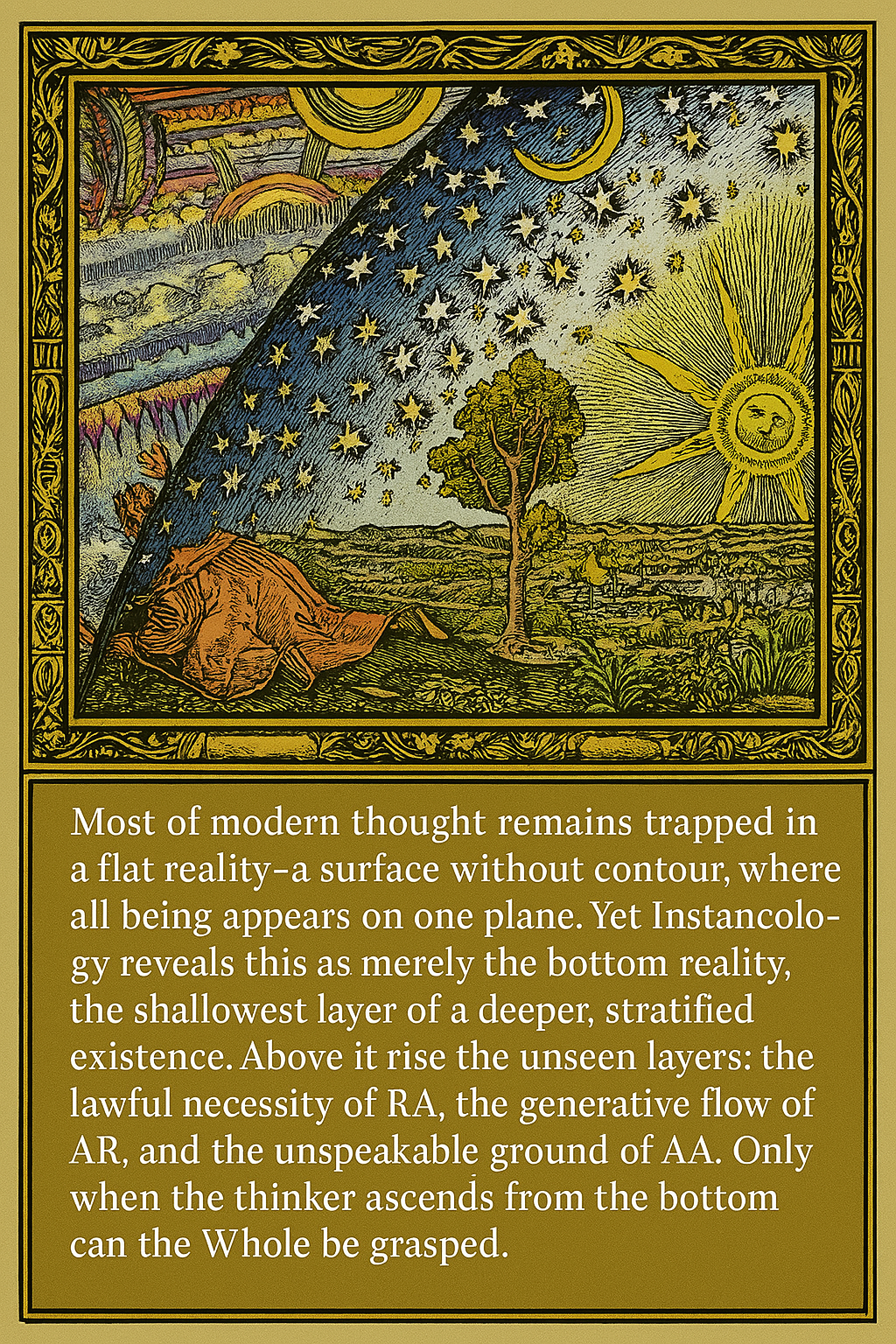
Three Major Paradigm Shifts in History: Copernicus, Kant, and Instancology
历史上三次伟大的范式转变:哥白尼、康德与范例哲学
Human history advances not by gradual accumulation but by rare reversals — by moments when the whole framework of thought turns inside out. Three such revolutions define the evolution of our understanding of reality: the Copernican, the Kantian, and the Instancological. Each displaces humanity from yet another illusion of centrality: first from the center of the cosmos, then from the center of knowledge, and finally from the center of being itself.
人类的历史并非循序渐进的积累,而是由罕见的颠倒所推动——那些让整个思想框架翻转的时刻。三次这样的革命奠定了人类理解现实的演进:哥白尼革命、康德革命与范例哲学革命。每一次都把人类从一种“中心幻觉”中驱逐:第一次从宇宙的中心,第二次从知识的中心,第三次则从存在本身的中心。
---
I. Copernicus: The Displacement of Space
一、哥白尼:空间的去中心化
Copernicus broke the ancient geometry of comfort. By proving that the Earth revolves around the Sun, he shattered the metaphysical assumption that reality must revolve around the observer. Humanity learned that its position in the universe had no privileged status. This was the first de-centering — a physical humbling that prepared the ground for all later intellectual humility.
哥白尼打破了古代安逸的几何世界。通过证明地球绕太阳运行,他摧毁了“现实必然以观察者为中心”的形而上假设。人类由此第一次认识到:自己在宇宙中并无特权地位。这是第一次“去中心化”——一种物理意义上的谦卑,为后来一切思想的谦卑奠定了基础。
Yet Copernicus only displaced the center of space. The observer, though no longer the cosmic ruler, remained the epistemic judge. The world was still thought to appear as it is, merely from a new coordinate.
然而,哥白尼只是移动了“空间的中心”。观察者虽然不再是宇宙的主宰,却依然是知识的裁判。世界依旧被认为如其所是地显现,只不过坐标换了位置。
---
II. Kant: The Displacement of Knowledge
二、康德:知识的去中心化
Kant’s revolution was deeper. He turned philosophy inside out. The human mind, he said, does not passively receive the world; it actively constitutes the form of experience. Space, time, and causality are not properties of things-in-themselves (noumena), but structures of cognition (phenomena).
康德的革命更深。他把哲学彻底翻转。人类的心灵并非被动地接受世界,而是主动地“建构”经验的形式。空间、时间与因果并不是物自身(物自体)的属性,而是认知的结构(现象)。
Kant’s Copernican turn shifted the question from “How does the world shape our knowledge?” to “How does knowledge shape the world we know?” Man ceased to be a spectator of the universe and became its conditional architect.
康德的“哲学哥白尼革命”把问题从“世界如何塑造知识?”转变为“知识如何塑造我们所知的世界?”人类不再是宇宙的旁观者,而成为经验世界的条件性建构者。
Yet Kant’s revolution remained incomplete. He described the conditions of possible knowledge but not the origin of those conditions. His transcendental subject stood between the phenomenal and the noumenal — a bridge without foundation. Philosophy was left suspended between the relative and the absolute.
然而,康德的革命仍不完整。他揭示了知识的“可能条件”,却未能说明这些条件的“本源”。他的先验主体悬浮于现象与物自体之间——一座没有根基的桥梁。哲学因此被悬置在“相对”与“绝对”之间。
---
III. Instancology: The Displacement of Being
三、范例哲学:存在的去中心化
Instancology completes what Kant began. It does not merely ask how we know the world but what it means for a world to be.
范例哲学完成了康德未竟的事业。它不再仅仅追问“我们如何认识世界”,而是追问“世界何以存在”。
At its core lies the distinction between AA (the Absolutely Absolute) and the Instance.
AA is not a being or a cause; it is the principle of issuance, the groundless ground from which any possible world arises. It is timeless, beyond relation or form.
The Instance is the issued totality: a complete, self-consistent whole that contains both the timeless Micro World and the temporal Macro World.
其核心在于区分AA(绝对的绝对)与范例(Instance):
AA不是一个存在物或原因,而是“发出”的原理——一切世界从中发出的无根之根。它超越时间、形式与关系。
范例则是“被发出者”的整体——一个完整自洽的全体,既包含无时间的“微观界”,也包含有时间的“宏观界”。
In this view, our universe is not in being; it is an issuance of being — a total instance. The AA does not create the world externally but issues it as a total structure, just as axioms issue all theorems of a system. Existence thus becomes the fact of being instantiated.
在这一视野中,我们的宇宙并非“存在于存在中”,而是“被发出”的整体——一个被发出的范例。AA并非外在地创造世界,而是如公理系统般“发出”整个结构。存在不再是“是什么”,而是“被发出的事实”。
This reverses all previous metaphysics. Being is not substance or appearance but issuance. The question is no longer “What exists?” but “What does it mean for something to be issued?” The AA is not an object of thought, but the principle that makes thought and being possible alike.
这颠覆了以往的全部形而上学。存在不再是实体或现象,而是“发出”。问题不再是“什么存在”,而是“存在的被发出意味着什么”。AA不是思想的对象,而是思想与存在同时得以可能的原理。
---
IV. The Three Movements of Decentralization
四、三次去中心化的运动
Revolution Displacement New Center Principle
Copernicus From Earth to Sun Physical Law Spatial Decentralization Kant From Object to Subject Transcendental Structure Epistemic Decentralization Instancology From Being to Issuance AA and Instance Ontological Decentralization
革命 去中心方向 新中心 原理
哥白尼 从地球到太阳 物理法则 空间的去中心化 康德 从对象到主体 先验结构 知识的去中心化 范例哲学 从存在到发出 AA与范例 存在的去中心化
---
V. The Significance of AA and the Instance
五、AA与范例的意义
The relationship between AA and the Instance resolves the ancient dualism between the Absolute and the Relative.
AA与范例之间的关系,解决了“绝对”与“相对”之间的古老二元对立。
AA is timeless, indivisible, and unknowable — the necessary condition for any possible instance.
The Instance is the manifested totality — the world as issued, complete within itself.
AA是无时间、不可分、不可知的——一切可能范例得以存在的必然条件。
范例是显现的整体——被发出的世界本身,自足而完整。
Human beings live within this issued instance. Space, time, consciousness, and even natural law all belong to it. There is no external vantage point to compare it with; thus, truth consists not in escaping the instance, but in comprehending its total structure — the logic of issuance that binds the relative and the absolute.
人类生活在这个被发出的范例之中。空间、时间、意识,乃至自然法则,皆属其中。我们没有任何外部视角去比较它;因此,真理不在逃离范例,而在洞悉其整体结构——那将相对与绝对相联结的“发出逻辑”。
AA is absolute not as domination but as necessity. It is not a god among beings but the law of all possible being. Thus Instancology restores the Absolute without theology — the absolute as structure, not as will.
AA之为绝对,不在于统治,而在于必然。它不是诸存在中的“神”,而是一切存在可能性的“法”。因此,范例哲学以结构之绝对取代意志之绝对,使绝对重获其理性地位。
---
VI. The Future of Thought
六、思想的未来
If Copernicus founded modern science, and Kant founded critical philosophy, then Instancology may found the next epoch — a science of being itself. It unites the empirical and the transcendental, the observer and the observed, within one ontological grammar of issuance.
如果说哥白尼奠定了现代科学,康德奠定了批判哲学,那么范例哲学可能开启下一个纪元——“存在自身的科学”。它将经验与先验、观察者与被观察者,统一于同一“发出”本体语法之中。
Here, metaphysics and physics may finally converge — not upon matter, but upon issuance. The fundamental question becomes formal and universal: Why is there this instance, and not none?
在此,形而上学与物理学或可最终汇合——其根基不在物质,而在“发出”。根本的问题遂成为形式与普遍的追问:为何此范例存在,而非一无所有?
---
VII. Conclusion: The Third and Final Turn
七、结语:第三次也是最终的转向
Copernicus removed man from the center of space. Kant removed him from the center of knowledge. Instancology removes him from the center of being.
哥白尼把人从空间的中心移开。 康德把人从知识的中心移开。 范例哲学则把人从存在的中心移开。
Each step deepens humility — but also clarity. When being is seen as issuance, and the AA as the principle of all issuance, the universe appears not as an accident but as a coherent act of absolute structure.
每一次转向都让人类更谦卑,也更明晰。当存在被理解为“发出”,而AA被理解为一切发出的原理时,宇宙不再是偶然,而是绝对结构的自洽呈现。
Thus the history of thought becomes a single arc: Copernicus showed where we are not; Kant showed how we know not; Instancology shows what we are not — and therefore what we truly are: participants in the issuance of existence itself.
于是,思想史化为一条弧线: 哥白尼揭示我们“不在何处”; 康德揭示我们“不知如何”; 范例哲学揭示我们“不是什么”; 而正因如此,我们方得知自己是什么—— 是存在之发出自身的参与者。
|