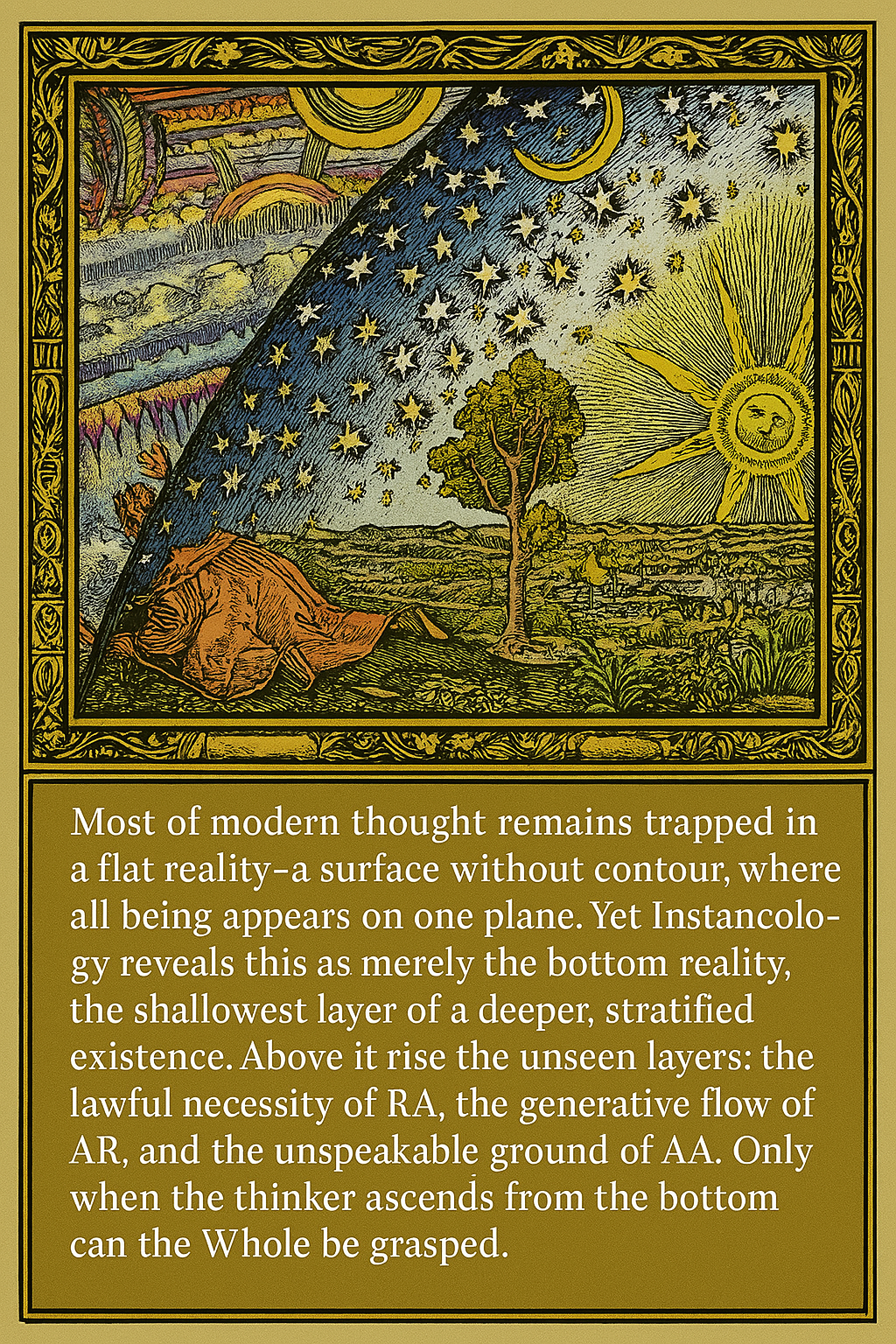
From Being to the Absolute: Why Heidegger’s Distinction Needs Completion One of the most influential achievements of twentieth-century philosophy was Martin Heidegger’s distinction between beings and Being. Heidegger argued that Western philosophy had forgotten the question of Being. Philosophers studied entities—objects, substances, minds, values—but rarely asked what it means to be at all. His project attempted to reopen this forgotten question by separating: beings — things that exist, and Being — the condition under which anything can appear as existing. This move was revolutionary. It shifted philosophy away from metaphysical catalogues of objects toward the deeper horizon of existence itself. Yet Heidegger’s distinction, powerful as it was, left an unresolved problem. The Remaining Ambiguity In Heidegger, Being remains strangely indeterminate. Is Being: disclosure? temporality? the horizon of understanding? an event? something dependent on human existence (Dasein)? Because the origin of Being is never categorically defined, the system stops at a phenomenological opening rather than reaching a stable ontological structure. Heidegger showed that philosophy must move beyond beings, but he did not clearly identify what stands beyond Being itself. A Clearer Categorical Structure: AA and WI Instancology proposes a clarification by introducing two distinct levels: AA — Absolute Absolute The Absolute is not Being. It is beyond Being and beyond beings. AA is not an entity, not consciousness, not God, and not a metaphysical object. It is the unspeakable condition that allows any world to be issued at all. WI — World-Instance Being belongs to the World-Instance. When WI is issued, a finite domain of beings appears. All existence—past, present, and future—unfolds within this issued world. Thus the categorical order becomes: AA → WI → beings Why This Matters Heidegger distinguished levels but left their hierarchy unclear. Instancology stabilizes the categories: The Absolute is separated from ontology itself. Being is no longer mysterious; it belongs to the issued world. Beings are simply determinate manifestations within WI. The question therefore shifts: Heidegger asked: What is the meaning of Being? Instancology asks prior to that: What makes Being possible at all? Time and the Finite Domain of Beings Within WI, beings are finite in issuance. History does not continuously create new ontology. Rather, past, present, and future represent different configurations and relations among already-issued beings. Time does not generate existence; it unfolds possibilities within the World-Instance. Completing the Transition Beyond Metaphysics Heidegger opened the path beyond traditional metaphysics by recovering the question of Being. Instancology attempts a further step: distinguishing the Absolute from Being itself. If Heidegger brought philosophy to the threshold, the AA–WI distinction seeks to clarify what lies beyond that threshold. The task of philosophy may therefore no longer be merely to think Being, but to recognize the categorical structure within which Being itself occurs. |