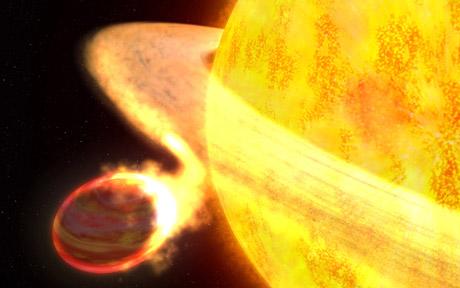
地球的终结——火葬!
2010年3月初,乍暖还寒的早春时节,和电视台的朋友去山里散心时,我曾经写下博文原创 太行山村一瞥, 反映了当年“母亲送儿打东洋,妻子送郎上战场”,为中华民族独立解放做出过流血牺牲的,一些太行山抗日根据地的老区人民,生活还不尽如人意,希望引起方方面面的重视。
然而,面对太行群峰,朋友得知脚下的岩石竟然有30多亿年龄,是地球出露比较早的古老地壳;而薄如小学课本的一层岩石,竟然记载是千年的环境变化,感慨万千。不由得问,地球将来的结局,是有些人说的要爆炸吗?
根据所掌握的资料,我告诉他,地球年龄现在已经是45亿4千万年了,但还属于中年。再过个40、50亿年,随着物质的流失,燃烧了90、100亿年的太阳会变红,变大,一直膨胀到火星轨道,而把地球吞噬。也就是说,地球将来的结局是“火葬”。
这是很多年前天文学家的推测,现在已经通过天文观测得到了证实,请看下面最近在太阳附近的科学发现————
哈勃观测到600光年外恒星吞噬行星景象(图)
据《每日电讯报》25日报道,天文学家通过哈勃太空望远镜观测到银河系一颗行星正被它的母恒星吞噬。这颗叫做WASP-12b的行星是银河系中表面温度最高的行星——约1500摄氏度。但是,它可能在未来1000万年内被自己的母恒星完全吞噬。
使用2009年安装在哈勃望远镜上的新仪器“宇宙起源光谱仪”,研究人员观测到了在引力作用下这颗行星被拉长的方式。英国开放大学的卡洛勒·哈斯维尔研究人员说:“我们已经观测到大团物质逃离WASP-12行星,并最终被母恒星捕获的现象。在这些逃离物质中,我们已经鉴别出一些之前在太阳系之外行星上从未看到过的化学元素。”
科学家在2008年发现了WASP-12b行星,它在御夫座星群中,距离地球约600光年,大小是地球的300多倍。它的质量比我们太阳系中最大的行星木星大40%。它距离自己的母恒星非常近,围绕母恒星一周仅需24小时。天文学家虽然知道恒星会吞掉距离它太近的行星,但是,这种现象能如此清晰地观察到还是第一次。
这份研究报告发表在5月10日的《天体物理学杂志通讯》上,它证实了北京大学的天文学家李树林21日发表在《自然》杂志上的一份研究报告,在报告中,李树林预测,在恒星引力的作用下,WASP-12b行星的表面将被扭曲,而且潮汐力会让它的内部温度非常高,以致于它的外层大气快速膨胀。(孝文) 2006-10-30 14:31
地球的结局会怎样?
提问者: 火天龙 | 浏览次数:2058次 2006-10-30
地球将被太阳演变成的红巨星吞噬。
恒星有一定的生命周期:形成中的恒星——主序星——红巨星——白矮星、中子星(脉冲星)、黑洞。
其中主序星是稳定的恒星,使它发光发热的能源是核能,太阳就是一颗主序星。红巨星是大多数恒星一生中必定要经历的一个阶段,太阳在50亿年后将成为红巨星。白矮星和中子星都是恒星演化的晚期,其中白矮星是由质量不太大的恒星演化来的,中子星是由质量较大的恒星演化过来的。质量更大的恒星将演化成黑洞。
形成中的恒星依靠引力势能发光发热;主序星是依靠氢核聚变来发光发热,红巨星依靠氦核聚变来发光发热,白矮星和中子星依靠冷却发光。
超新星爆发是大质量恒星演化到晚期形成中子星或黑洞时发生的能量巨大的爆炸。超新星爆发是一些恒星诞生的直接动力,也是各种元素形成的原因。
几十亿年后,太阳将从红巨星继续膨胀,地球将被吞没。之后太阳萎缩成白矮星。当太阳演化到最后的黑洞阶段,所有的太阳系的物质,包括太阳本身都会被黑洞所吞噬掉。所以地球的一切文明将火化为 0。
震惊!天文学家居然找到了恒星吞噬行星  ( A star is engulfing a planet )
    的证据 ——— 居然现在就看到了40亿年之后太阳吞噬地球的终极恐怖景象
2012-08-21 21:47:21 每日科学
据美国《每日科学》、物理学家组织网8月20日报道,一个国际天文学家团队通过霍比-埃伯利望远镜第一次发现迟暮恒星将它的行星毁灭殆尽的证据,包括恒星侵染上行星的特有化学成分锂,以及苟延残喘的行星挣扎碾过的极不寻常的椭圆形轨道。这意味着,从现在开始约50亿年,当太阳逐渐老化成一颗红巨星扩展延伸到地球的轨道,同样的命运有可能会降临到我们所处的太阳系中的行星。
太阳系外第一颗行星的发现者、美国宾夕法尼亚州立大学天文学和天体物理学教授亚历山大・沃尔兹刚与来自波兰和西班牙等国的科学家们组成的国际研究团队,通过使用位于美国德克萨斯州麦克唐纳天文台的霍比-埃伯利望远镜,发现一颗巨大的行星沿着一条令人惊讶的椭圆形轨道绕着被命名为BD +48 740的红巨星旋转,该红巨星比太阳要年长、半径要大约11倍。他们还检测到这一红巨星包含特有化学成分锂,这些都构成了失踪行星被毁灭的证据。
研究人员解释道:“第一个证据是,详细的光谱分析结果显示,这个红巨星BD +48 740包含异常高量的锂元素,锂-6在行星中很常见,但在恒星中则非常罕见,因为在恒星诞生之后不久,其中的锂-6就会燃烧殆尽。”如果恒星里含有微量的锂-6,很有可能是这颗恒星曾经吞噬过行星的有力证据之一。
第二个证据是,他们观测到,该恒星附近新出现的巨大行星沿着一个高度椭圆形轨道环绕,而这个行星的质量至少是木星的1.6倍,其与恒星的距离却只是比火星距太阳的最窄点稍宽,但其最远点则最大限度延伸,这种在行星系统中绕着老化恒星转的轨道非常罕见,实际上,BD +48 740的行星轨道是至今所检测到的最椭圆的一个,这是一种非常不稳定的轨道。这些行星可能正在逐渐向恒星靠近,以致将来被恒星吞噬。
研究人员说:“行星之间由于引力的相互作用才会形成这种奇特的轨道,一颗行星被恒星吞噬的行为是一个非常迅捷的过程,捕捉这一过程几乎不可能,但是可以从影响恒星的化学成分来判断这种碰撞发生的可能性。我们发现,这颗巨大质量的行星沿着高度拉长的轨道,绕着被锂侵染的红巨星旋转,该证据正可以表明这颗迟暮的恒星最近吞噬了其现已失踪的行星。”
该研究结果发表在最新一期《天体物理学杂志快报》在线版上。
" 作为动物一员生存的人类,在宇宙无限的演变进
程中,本就是个闹剧。不过,任何试图了解宇宙奥秘的
努力,算是极少几件略高于其闹剧水平的事情之一,多
少亦能给予人类文明终结的悲剧一些恩典。"
"The effort to understand the universe is one of
the very few things which lifts human life a little
above the level of farce and gives it some of the
grace of tragedy."
—— 1979年度诺贝尔物理学奖获得者
Steven Weinberg in "The First Three Minutes"
First Evidence Discovered of Planet's Destruction by Its Star
An artist's impression of a red supergiant engulfing a Jupiter-like planet as it expands. Credit: NASA
20 August 2012 — The first evidence of a planet's destruction by its aging star has been discovered by an international team of astronomers. The evidence indicates that the missing planet was devoured as the star began expanding into a "red giant" — the stellar equivalent of advanced age. "A similar fate may await the inner planets in our solar system, when the Sun becomes a red giant and expands all the way out to Earth's orbit some five-billion years from now," said Alex Wolszczan, an Evan Pugh Professor of Astronomy and Astrophysics at Penn State, University, who is one of the members of the research team. Wolszczan also is the discoverer of the first planet ever found outside our solar system.
The astronomers also discovered a massive planet in a surprisingly elliptical orbit around the same red-giant star, named BD+48 740, which is older than the Sun with a radius about eleven times bigger. Wolszczan and the team's other members, Monika Adamow, Grzegorz Nowak, and Andrzej Niedzielski of Nicolaus Copernicus University in Torun, Poland; and Eva Villaver of the Universidad Autonoma de Madrid in Spain, detected evidence of the missing planet's destruction while they were using the Hobby-Eberly Telescope to study the aging star and to search for planets around it. The evidence includes the star's peculiar chemical composition, plus the highly unusual elliptical orbit of its surviving planet.
Click on image for high-resolution file.

The first evidence of a planet's destruction by its aging star indicates that the missing planet was devoured as the star began expanding into a "red giant" — the stellar equivalent of advanced age. "A similar fate may await the inner planets in our solar system, when the Sun becomes a red giant and expands all the way out to Earth's orbit some five-billion years from now," said Alexander Wolszczan, Evan Pugh Professor of Astronomy and Astrophysics at Penn State and the discoverer of the first planet ever found outside our solar system. Credit: Marty Harris/McDonald Obs./UT-Austin
"Our detailed spectroscopic analysis reveals that this red-giant star, BD+48 740, contains an abnormally high amount of lithium, a rare element created primarily during the Big Bang 14 billion years ago," Adamow said. Lithium is easily destroyed in stars, which is why its abnormally high abundance in this older star is so unusual. "Theorists have identified only a few, very specific circumstances, other than the Big Bang, under which lithium can be created in stars," Wolszczan added. "In the case of BD+48 740, it is probable that the lithium production was triggered by a mass the size of a planet that spiraled into the star and heated it up while the star was digesting it."
The second piece of evidence discovered by the astronomers is the highly elliptical orbit of the star's newly discovered massive planet, which is at least 1.6 times as massive as Jupiter. "We discovered that this planet revolves around the star in an orbit that is only slightly wider than that of Mars at its narrowest point, but is much more extended at its farthest point," Niedzielski said. "Such orbits are uncommon in planetary systems around evolved stars and, in fact, the BD+48 740 planet's orbit is the most elliptical one detected so far." Because gravitational interactions between planets are responsible for such peculiar orbits, the astronomers suspect that the dive of the missing planet toward the star before it became a giant could have given the surviving massive planet a burst of energy, throwing it into an eccentric orbit like a boomerang.
"Catching a planet in the act of being devoured by a star is an almost improbable feat to accomplish because of the comparative swiftness of the process, but the occurrence of such a collision can be deduced from the way it affects the stellar chemistry," Villaver explained. "The highly elongated orbit of the massive planet we discovered around this lithium-polluted red-giant star is exactly the kind of evidence that would point to the star's recent destruction of its now-missing planet."
The paper describing this discovery is posted in an early online edition of the Astrophysical Journal Letters (Adamow et al. 2012, ApJ, 754, L15). The Hobby-Eberly Telescope is a joint project of the University of Texas at Austin, Penn State University, Ludwig-Maximilians-Universitat Munchen, and Georg-August-Universitat Gottingen. The telescope is named in honor of its principal benefactors, William P. Hobby and Robert E. Eberly.
|