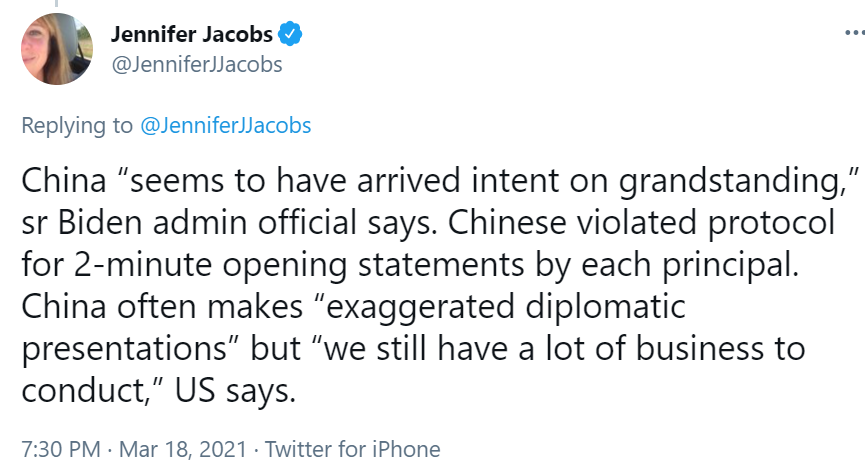 


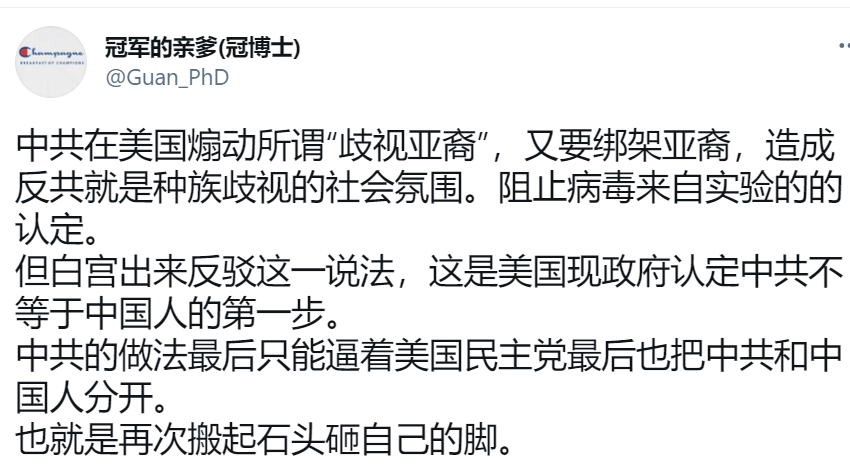
https://twitter.com/Guan_PhD/status/1372688610508554241 
   

https://www.voacantonese.com/a/biden-harris-atlanta-us-china-alaska-meeting-20210318/5820150.html?utm_source=twitter&utm_medium=social&utm_campaign=dlvr.it 
(Bloomberg) -- The first high-level talks between the U.S. and China since President Joe Biden took office descended immediately into bickering and recriminations, with each side sharply criticizing the other over human rights, trade and international alliances. 
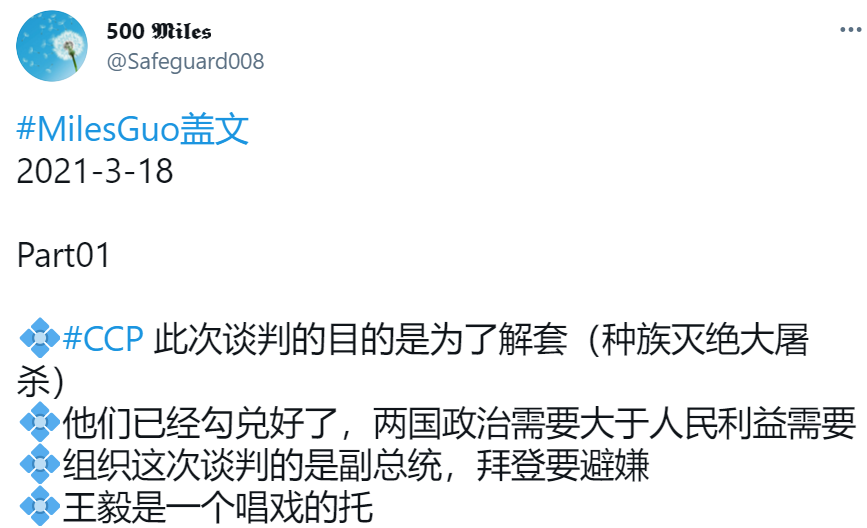
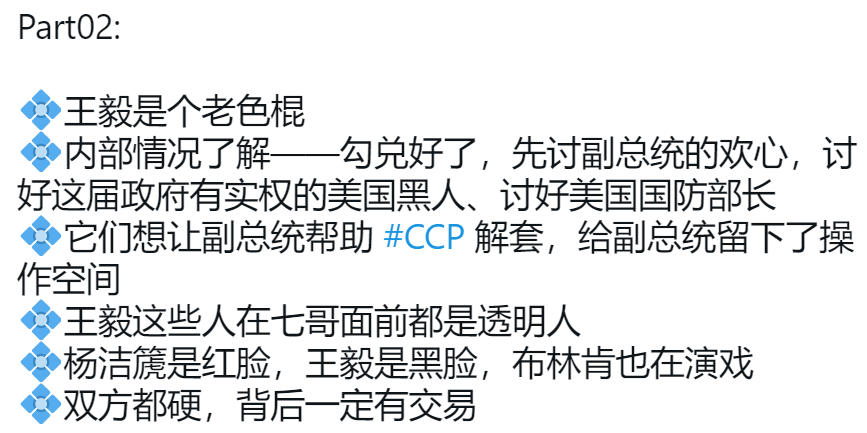
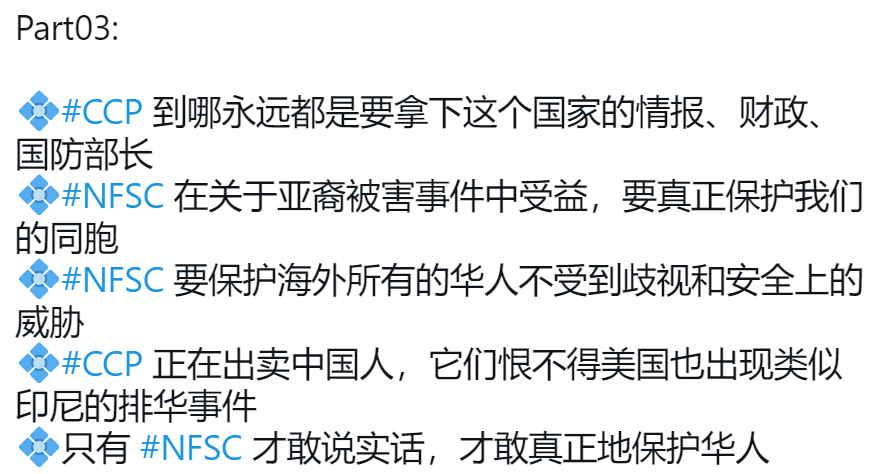
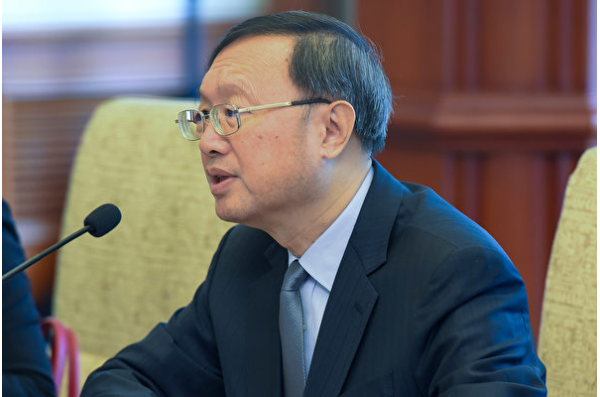
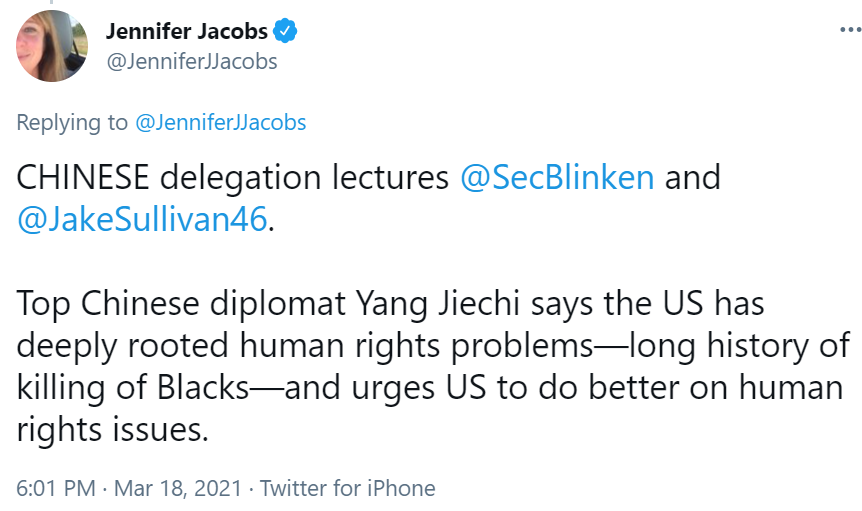
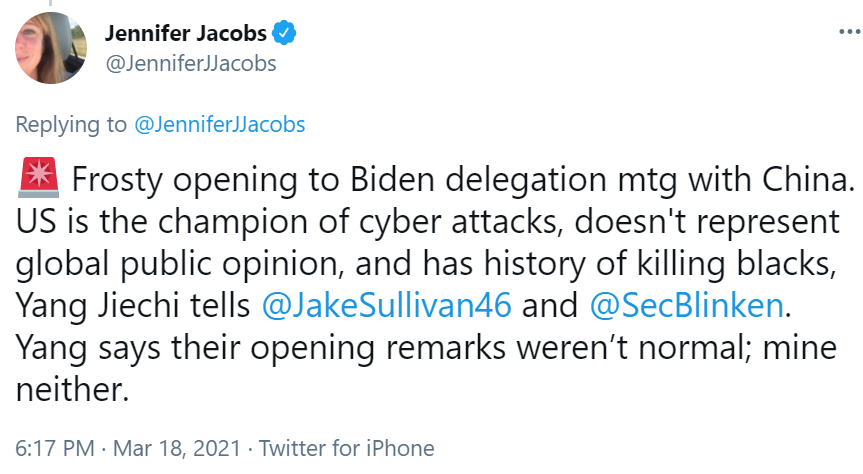
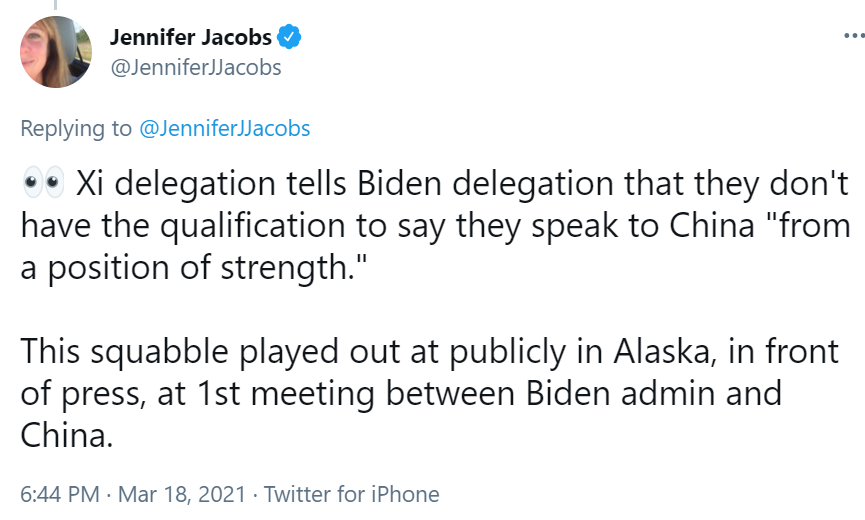
美国国务卿安东尼·布林肯在阿拉斯加安克雷奇举行的会议上发了言。他誓言引起人们对最近网络攻击,新疆穆斯林的待遇以及北京对香港的日益控制的担忧。他说,中国的行动威胁到国际秩序和人权。 布林肯说:“基于规则的命令的替代方案是一个世界,在这个世界中,权利是正确的,而获胜者则拥有一切,这将是一个更加暴力和不稳定的世界。” 中国人开了枪。政治局委员杨洁chi发表了冗长的独白,他说西方国家不代表全球舆论,并称美国为网络攻击的“冠军”。 他说:“美国境内的许多人实际上对美国的民主制度几乎没有信心,”他援引黑人美国人被杀害和黑人生活问题运动的话说。在开幕词即将结束时,他说布林肯的评论不是“正常的”,并补充说“我的也不是”。 眨眼和国家安全顾问杰克·沙利文(Jake Sullivan)回应说,沙利文说:“一个充满自信的国家能够认真对待自身的缺点并不断寻求改善,这是美国的秘密武器。” 事情从那里变得更糟。摄像机从房间引来,然后才被召回。杨和外交大臣王毅趁机跟进,提出了更多批评。 “这就是您希望进行这种对话的方式吗?” 据中国代表团的翻译说,杨问。“我认为我们对美国的看法太好了。美国没有资格从实力上与中国对话。” 责备尽管中国官员抗议说布林肯和沙利文的开篇批评无法招待客人,但美国一位高级官员此后表示,中国人意图立足于舞台,从事戏剧而不是实质内容。 艰难的开端预示着中美关系变得多么糟糕,并为世界两个最大经济体之间达成和解或和解的前景预示了糟糕的预兆。双方计划在周四和周五举行一系列的三场谈判会议,但是开幕式降低了阿拉斯加会议原本对期望的低门槛。 在会议开始之前,北京官员提出下个月拜登与中国国家主席习近平之间举行虚拟峰会的可能性,正值世界地球日之际,并将注意力转移到双方表示可以达成共识的一个领域:应对气候变化。目前尚不清楚阿拉斯加会谈的艰难开端是否会破坏这一努力。 预计在安克雷奇会谈中会出现一些紧张局势。上任两个月后,尽管拜登批评了前总统唐纳德·特朗普,但新任美国总统似乎不太可能对其前任对中国的强硬态度做出重大改变。关于新疆的人权,香港的甚至关税,特朗普时代的政策仍然存在。 普林斯顿大学外交政策教授,乔治·W·布什总统领导下的国家安全助手亚伦·弗里贝格说:“至少在最初,他们坚持特朗普留下的东西。” “在具体的事情上,比如说中国正在对新疆进行种族灭绝-那是他们在出门的路上留给他们的地雷-他们只是试图拥抱它,而不是试图解决这个问题。” 早些时候:美国对华警告中国会议不太可能取得突破 迄今为止,中国是拜登与特朗普连任的最突出例子,但还有其他一些例子:在沙特阿拉伯,拜登在批准王储穆罕默德·本·萨勒曼出任总统期间一直不肯制裁,即使他超越特朗普,公开指责他死于专栏作家贾马尔·卡舒格(Jamal Khashoggi) 。拜登正在接受特朗普推动重振美国,澳大利亚,日本和印度的四方联盟的努力。布林肯赞扬了特朗普的《亚伯拉罕协议》,这是以色列与中东国家之间的和解。 国会共和党人指责拜登疲软的同时,他坚持反对从俄罗斯到德国的Nord Stream 2输油管道,拒绝取消对伊朗的制裁,除非伊朗恢复遵守特朗普放弃的核协议,并继续遵守该协议。经常诉诸金融制裁作为表达不赞成的工具。 
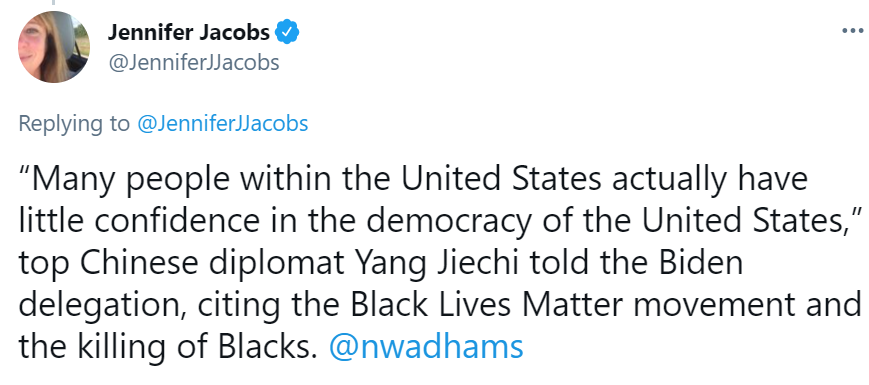
U.S. Secretary of State Antony Blinken began his remarks at the meeting in Anchorage, Alaska, by vowing to raise concerns about recent cyber attacks, the treatment of Muslim minorities in Xinjiang and Beijing’s increasing control over Hong Kong. He said China’s actions threatened the international order and human rights. “The alternative to a rules-based order is a world in which might makes right and winner takes all and that would be a far more violent and unstable world,” Blinken said. The Chinese fired back. Yang Jiechi, a member of the Politburo, offered a lengthy monologue in which he said Western nations don’t represent global public opinion and called the U.S. the “champion” of cyber-attacks. “Many people within the United States actually have little confidence in the democracy of the United States,” he said, citing the killing of Black Americans and the Black Lives Matter movement. Near the end of his opening remarks, he said Blinken’s comments weren’t “normal” and added that in response “mine aren’t either.” Blinken and National Security Advisor Jake Sullivan responded, with Sullivan saying “a confident country is able to look hard at its own shortcomings and constantly seek to improve, and that is the secret sauce of America.” Things only got worse from there. Cameras were ushered from the room, only to be called back in. Yang and Foreign Minister Wang Yi took the opportunity to follow up with even more criticism. “Is that the way you had hoped to conduct this dialogue?” Yang asked, according to his delegation’s translator. “I think we thought too well of the United States. The United States isn’t qualified to speak to China from a position of strength.” Placing BlameWhile the Chinese officials protested that the opening criticism by Blinken and Sullivan was no way to treat guests, a senior U.S. official said afterward that the Chinese were intent on grandstanding and engaging in theatrics over substance. The rocky start signaled just how bad the U.S.-China relationship has become and augured poorly for the prospect of an accommodation or rapprochement between the world’s two biggest economies. The two sides scheduled a series of three negotiating sessions on Thursday and Friday, but the opening lowered what had already been a low bar for expectations out of the Alaska meeting. Before the meeting began, officials in Beijing had raised the possibility of a virtual summit between Biden and Chinese President Xi Jinping next month, to coincide with Earth Day and turn attention to one area both sides have said they can reach agreement on: combating climate change. It’s not clear if the rocky start to the Alaska talks will derail that effort. Some tensions were expected at the Anchorage talks. Two months into office, and despite Biden’s criticism of former President Donald Trump, it appears the new American president is unlikely to make major changes to his predecessor’s hard-line approach to China. On human rights in Xinjiang, on Hong Kong’s and even on tariffs, Trump-era policies remain in place. “At least initially, they’re sticking with what Trump left them,” said Aaron Frieberg, a professor of foreign policy at Princeton University and a national security aide under President George W. Bush. “On concrete things like saying China is committing genocide in Xinjiang -- that was a land mine left for them on the way out the door -- instead of trying to work around it, they just embraced it.” Earlier: U.S. Cautions China Meeting Unlikely to Yield Breakthrough China is the most prominent example of Biden’s continuity with Trump so far, but there are others: On Saudi Arabia, Biden held back from sanctioning Crown Prince Mohammed bin Salman even as he went beyond Trump by publicly implicating him in the death of columnist Jamal Khashoggi. Biden is taking up Trump’s push to reinvigorate the Quad alliance of the U.S., Australia, Japan and India. Blinken has praised Trump’s “Abraham Accords,” the rapprochement between Israel and countries in the Middle East. And while Republicans in Congress accuse Biden of weakness, he is sticking to opposition to the Nord Stream 2 pipeline from Russia to Germany, is refusing to remove sanctions on Iran unless it returns to compliance with the nuclear accord that Trump abandoned and is keeping up a frequent resort to financial sanctions as a tool to express disapproval. For more articles like this, please visit us at bloomberg.com https://www.msn.com/en-us/news/world/us-and-china-descend-into-bickering-at-start-of-alaska-talks/ar-BB1eJd1b |