



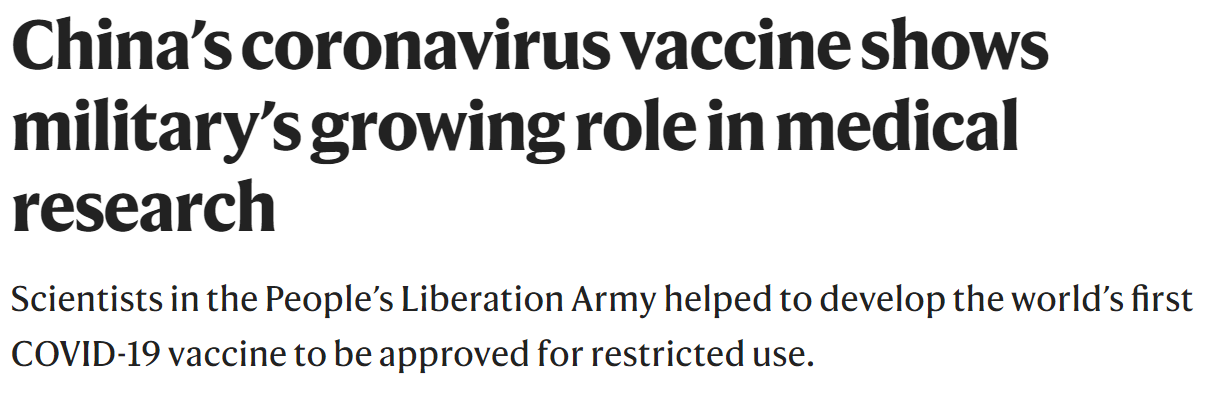

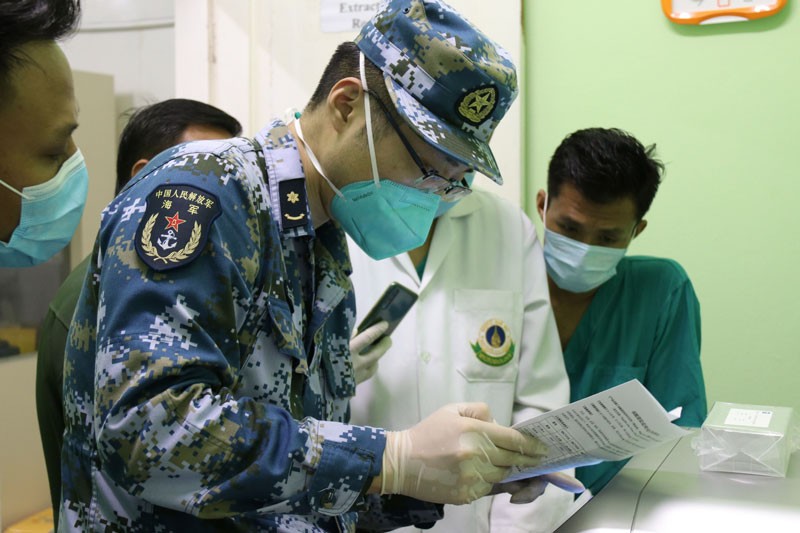
 The PLA has been central to China's ability to control the coronavirus.Credit: Chine Nouvelle/SIPA/Shutterstock The largest armed force in the world, China’s People’s Liberation Army (PLA), is not known for its cutting edge medical research. But since 2015, it has ramped up recruitment of scientists, and investment in the field as part of its strategy to modernize its military. Now, the coronavirus pandemic is showcasing the PLA's growing expertise in medical research, including a major role in developing the coronavirus vaccine that was the first in the world to be approved for restricted use. “China is definitely trying to leverage the crisis from a PR perspective,” says Abigail Coplin, who studies China’s biotechnology industry at Vassar College in Poughkeepsie, New York. 近日,自然杂志发表了一篇名为《新冠病毒疫苗显示军方在医学研究中的作用日益增强》的文章。文中指出作为世界上最大的武装力量,中国人民解放军并不以尖端的医学研究著称。 但自2015年以来,作为其军事现代化战略的一部分,它加大了对科学家的招聘力度,并扩大了对该领域的投资。 “异军”突起 近期,陈薇领衔的疫苗研制对外宣称取得进展,疫苗的研制得到了许多政府部门、大学的帮助。于此同时,解放军与医学公司之间的关系加速发展,如天津生物制药公司康希诺参与疫苗研制。3月以来,解放军一直与生产消毒和医疗设备的北京诚益通控制工程科技公司进行合作。除了在病毒疫苗的研究中的重要角色,解放军也在其他方面起到“突出作用”,如向多国提供医疗援助,并利用疫苗与各国建立了新的联系。这些引起了世界专家的注意。 纽约的波基普西市瓦萨学院(Vassar College)研究中国生物技术产业的阿比盖尔·科普林(Abigail Coplin)表示:“中国绝对是从公关的角度利用这次危机。”研究解放军的澳大利亚国立大学中国问题专家亚当·尼(Adam Ni)认为,如果中共在疫苗方面取得进展,“这(对中共)的舆论宣传是一个相当大的胜利”。在中美关系日益紧张的背景下,中共解放军在科技转型过程中的规模与速度让人感到担忧。 军民融合 2015年之前,解放军主要从内部或军事大学中招募科学家,部分原因是军事研究职位不具有吸引力,不如民间机构灵活。但是自2018年以来,解放军开始在民间大量招募科学家,尤其是加大了对医学家的招聘。伦敦国际战略研究所凯琳泰(Kai Lin Tay)发布的分析表明,自2018年以来,军事医学科学院已经招募了213名平民担任科研职位,招聘人数之多,位居军事科学院10个研究机构中第二名。 作为中国政府在2015年宣布的”军民融合”政策的一部分,军方也在加强与中国普通大学的联系。解放军的定向研究生在普通大学越来越普遍了,军民融合战略将生物学作为优先研究领域。解放军还通过向国外派遣研究人员来增强其学术专长。 在新美国安全中心研究中共军事战略的的艾尔莎·卡尼亚(Elsa Kania)说,解放军重新关注科学,有助于推进现有的军事研究项目,特别是在脑科学方面。2018年,解放军神经学专家发表了一篇评论,概述了军事脑科学如何影响未来的战争,例如,利用脑-机接口来提高士兵的能力,以及对敌国进行心理战。 自主研发? 在过去的几个月里,美国安全官员透露,中共试图监视和窃取从事疫苗研究的美国制药公司和大学的研究成果。 7月,美国司法部(US Justice Department)起诉两名中国公民在三个进行疫苗研究的美国实体从事间谍活动。 美国生物技术公司莫德纳(Moderna),在冠状病毒疫苗研究处于领先地位,告诉路透社,它是黑客攻击的目标之一。 中国官员否认有任何参与。艾尔莎·卡尼亚认为:“技术转移明显是中国政府最高层的政策和优先事项,涉及到相当骇人听闻的黑客事件,目的是窃取数据。” “这种行为方式,无论其规模和范围,还有这些事件的严重性以及它对基本科学和商业准则的破坏,都是中国特有的。” 国际舞台 疫情为中国在国际舞台上展示其军队科学成就提供了机会。例如,军方对巴基斯坦、伊朗、伊拉克、黎巴嫩、越南、老挝、缅甸、柬埔寨和意大利提供了大量协助。航空大学中国航空研究所的中国军事分析师伊恩.麦卡斯林(Ian McCaslin)表示,解放军研制的疫苗可能给予中国更多的地缘政治影响力,关系好的国家优先获得疫苗。康希诺生物公司已经与俄罗斯、墨西哥、沙特阿拉伯和巴基斯坦签订了进行第三阶段临床试验的协议。 评: 作为中共的党卫军,不能单纯的从一般军事科研的角度看待中共解放军的医学研究。中共在这个时间点急切的推出疫苗,就是给自己在和美国的对峙中增加政治资本,让各国选边站,挟疫苗以令各国。 Medical researcher Major General Chen Wei at the Beijing Institute of Biotechnology — part of the Academy of Military Medical Sciences — led the team that developed the vaccine, which included collaborators from government agencies, universities and the Tianjin-based pharmaceutical company CanSino Biologics. In July, the team became one of the first in the world to publish results in a peer-reviewed journal that showed a coronavirus vaccine to be safe and capable of eliciting an immune response1. By then, the Chinese government had already approved the vaccine, based on a common cold adenovirus and called Ad5-nCoV, for limited use in military personnel, before large-scale testing to prove its efficacy. Wei and members of her team were among the first — of thousands in the military so far — to receive the vaccine. Chen and the Beijing Institute of Biotechnology did not respond to Nature’s request for comment about the vaccine work. Should the vaccine win approval for more widespread use before efforts backed by other countries, especially the United States, “it will be a pretty big propaganda victory” for Beijing, says Adam Ni, a China analyst from the Australian National University in Canberra who studies the PLA. As well as its contributions to the development of a coronavirus vaccine, the PLA has also taken a high-profile role in controlling the pandemic in China, sent assistance with pandemic response in a host of countries and used the vaccine to forge new links with countries. Other militaries, including the United States, work on vaccines and conduct medical research. But the sheer size of the PLA and the speed at which reforms are taking place make its scientific transformation noteworthy, and for some, a cause for concern, especially given the growing political tensions between the United States and China, he says. In the past few months, US security officials revealed that China has tried to spy on and steal information from US pharmaceutical companies and university research groups working on coronavirus vaccines. Scientists have also raised concerns about the ethics of approving a vaccine that is still being trialled for use in the military. Science a priorityIn 2015, China’s President Xi Jinping announced reforms that made science and innovation a key element of modernizing its armed forces, says Elsa Kania, who analyses Chinese military strategy at the Center for a New American Security in Washington DC. The PLA established electronic-, cyber- and space-warfare branches alongside its more conventional army, navy and air force. And in 2016, a Science and Technology Commission, which decides what research is funded, became one of 15 newly formed military 'sections'. “It’s gone from a fairly backward military in the 70s and 80s — large but certainly not professional and not technologically advanced — to a much more formidable military,” says Ni. The reforms also brought the Academy of Military Medical Sciences — which led development of the Ad5-nCoV vaccine — under the umbrella of the Academy of Military Sciences, the PLA’s main military strategy institution, which oversees nine other research institutions. Civilian recruitsBefore the reforms, the PLA recruited scientists either internally or from military universities, partly because civilian scientists didn’t find research positions in the military attractive, says Ni. Uniformed members of the military must fulfil fitness obligations, and working conditions were less flexible than in civilian institutions. But since 2018, the PLA has been recruiting more civilian-trained scientists,making research positions more appealing — and, in particular, has upped its recruitment of medical scientists. The Academy of Military Medical Sciences has recruited 213 civilians for scientific research positions since 2018, making it the second-highest recruiter of scientific talent in the Academy of Military Science’s 10 research institutions, according to an analysis posted online by Kai Lin Tay at the International Institute for Strategic Studies in London. The Academy of Military Sciences “now relies more on civilians than military cadres to fulfil its scientific research needs,” writes Tay. The military is also increasing its ties to civilian universities in China, as part of a policy known as military–civil fusion, which the Chinese government also announced in 2015. Graduate students affiliated with the PLA and a civilian university are becoming more common. The military–civil fusion strategy highlights biology as a priority research area. The PLA has also been bolstering its scientific expertise by sending researchers abroad. And partnerships between the PLA and the medical-science companies have accelerated since the start of the pandemic, according to Tay’s report. As well as collaborating with CanSino Biologics to develop the Ad5-nCoV vaccine, the PLA has partnered with Beijing Chieftain, which makes disinfecting and medical equipment, since March. On showThe pandemic has provided China with an opportunity to highlight the military's scientific achievements on the domestic and international stage. For instance, PLA epidemiologists and medical workers have had an important role in treating the sick, monitoring the outbreak and overseeing distribution of medical supplies in Wuhan. The military has also assisted with the pandemic responses in Pakistan, Iran, Iraq, Lebanon, Vietnam, Laos, Myanmar, Cambodia and Italy, by deploying units and supplies. The PLA-developed vaccine could give China additional geopolitical influence with favoured countries being given priority access to the vaccine, says Ian McCaslin, a China military analyst affiliated with Air University’s China Aerospace Studies Institute in Washington DC. CanSino Biologics already has agreements to conduct phase III trials in Russia, Mexico, Saudi Arabia and Pakistan. The PLA’s renewed science focus is helping to advance existing military-research projects — in particular in brain science, says Kania. In 2018, PLA neuroscientists published a review outlining how military brain science could influence future wars, for example by using brain-computer interfaces to enhance soldiers' capabilities and by deploying psychological warfare against enemy nations2. Limited insightBecause analysts who study the Chinese military have not traditionally focused on the medical research conducted by the PLA, its true impact remains unknown, says Kania. “We’re still trying to get a handle on how to understand the scope and scale of their activities as well as the quality and competitiveness of their research,” she says. Some research is similar to that conducted by other military forces. The US military, for instance, is developing its own coronavirus vaccine and conducts basic research into trauma and infectious diseases. And some of the PLA’s medical research is designed to maintain a healthy armed force, says McCaslin. “You have a medical need to take care of your soldiers during peacetime,” and to prepare for injuries that might occur during warfare, he says. It's also important to bear in mind that the PLA’s scientific efforts represent only “a small minority of work being done in biotechnology, both within China and globally”, adds Coplin. Cause for concern?Still, some China experts and foreign governments are concerned about the participation of PLA researchers in medical research. In July, the US Justice Department indicted two Chinese nationals for spying on three US-based entities involved in medical research to fight the coronavirus. The US biotech company Moderna, which is trialling one of the world's leading coronavirus vaccine candidates, later told Reuters that it was one of the companies that hackers had targeted. Chinese officials have denied any involvement. “Tech transfer is clearly a policy and priority of the Chinese government at the highest levels and has involved fairly egregious instances of hacking, for purposes of data theft,” says Kania. “This pattern of behaviour is unique to China in the scale and scope as well as the severity of these incidents and the extent to which they contravene the norms of scientific and commercial engagement.” Scientists are also concerned about China’s lack of safeguards to ensure that research on people is conducted ethically, says Kania. It is unclear whether military personnel were given a choice to have the PLA-backed coronavirus vaccine, she says. The researchers who worked on the vaccine did not respond to Nature’s request for comment on such ethics issues. These are legitimate concerns, says Coplin, but she cautions the United States against using them as a reason to stymie otherwise productive collaborations with China. |













































 图片来源:YouTube
 图片来源:YouTube
 图片来源:YouTube
 图片来源:YouTube
 图片来源:YouTube